In recent years, the Chinese Heritage Virtual Museum has strived to produce a series of catalogues, such as Mountains Ablaze-Exodus and Restoration, Preliminary Catalogue of Inkworks, Books, and Artefacts by Personages of the Republic of China 1949-1987; A Collection of Memorial Books, Part One and Part Two; Catalogue of Historic Documents, Writings, Certificates and Letters in the Wang Ch’ung-hui (王寵惠) Collection; An Account of the T’ang En-p’u (唐恩溥) Collection: His Father’s Schoolworks, His Own Writings, Letters and Various Personal Items; and now the latest offering of Voyage of Sinology from East to West: Catalogue of Letters, Books and Artefacts of Western and Chinese Personages Across Three Centuries.
It is true the nature of a catalogue is devoid of literary flair, reading it can be dry and bland, but to acquire an overall view, to gain some perspectives of contexts and narratives, are certainly most befitting. In addition, time is limited while knowledge is unlimited. Even if the Almighty grants life by thirty more years, for the task of assiduously writing an article on one character and one event each month, there will only be a meagre three hundred and sixty articles by the end, far too inadequate to chronicle the great variety of cultural artefacts available at the Chinese Heritage Virtual Museum, or to elucidate the epic tales of the myriad human characters and events. Only by reading a catalogue can the subject’s broad outline be instantly revealed. By presenting Voyage of Sinology from East to West: Catalogue of Letters, Books and Artefacts of Western and Chinese Personages Across Three Centuries, together we can roam in the reflective realm where Chinese and Western cultures meet, and meditate on the Voyage of Sinology.
Curatorial and Editorial Department
Since the dawn of Creation, humans and animals have been traveling and migrating. For millennia, mountains and rivers form natural distances and barriers; distinct beliefs, customs, scripts and languages are moulded. Intangible cultures gradually evolve, articulating the tangible forms of cities and states. Although all living beings share a common origin, they have long nurtured animosities and hostilities towards each other, their conflicts fuel the cycles of prosperity and decline that intertwine forever till the end of time. The earliest contact between the West and China is lost in the depths of antiquity. It is known since ancient times, merchants travelled back and forth, exploring land and sea routes. There were countless others who fled unrests and resettled in distant lands. The earliest written account of travel to China is by the Venetian Marco Polo (1254–1324). Around the 11th year of the Chih-yüan reign (1274 AD) of the Yuan dynasty, he first arrived in China and was granted an audience with Kublai Khan. His writings, which blend the observations of an explorer and the literary liberties of a storyteller, introduced China to the Western world. Whether his accounts were entirely factual or partly embellished have been discussed and debated. Nonetheless, the exploration of the strange and extraordinary continues to captivate human imagination.
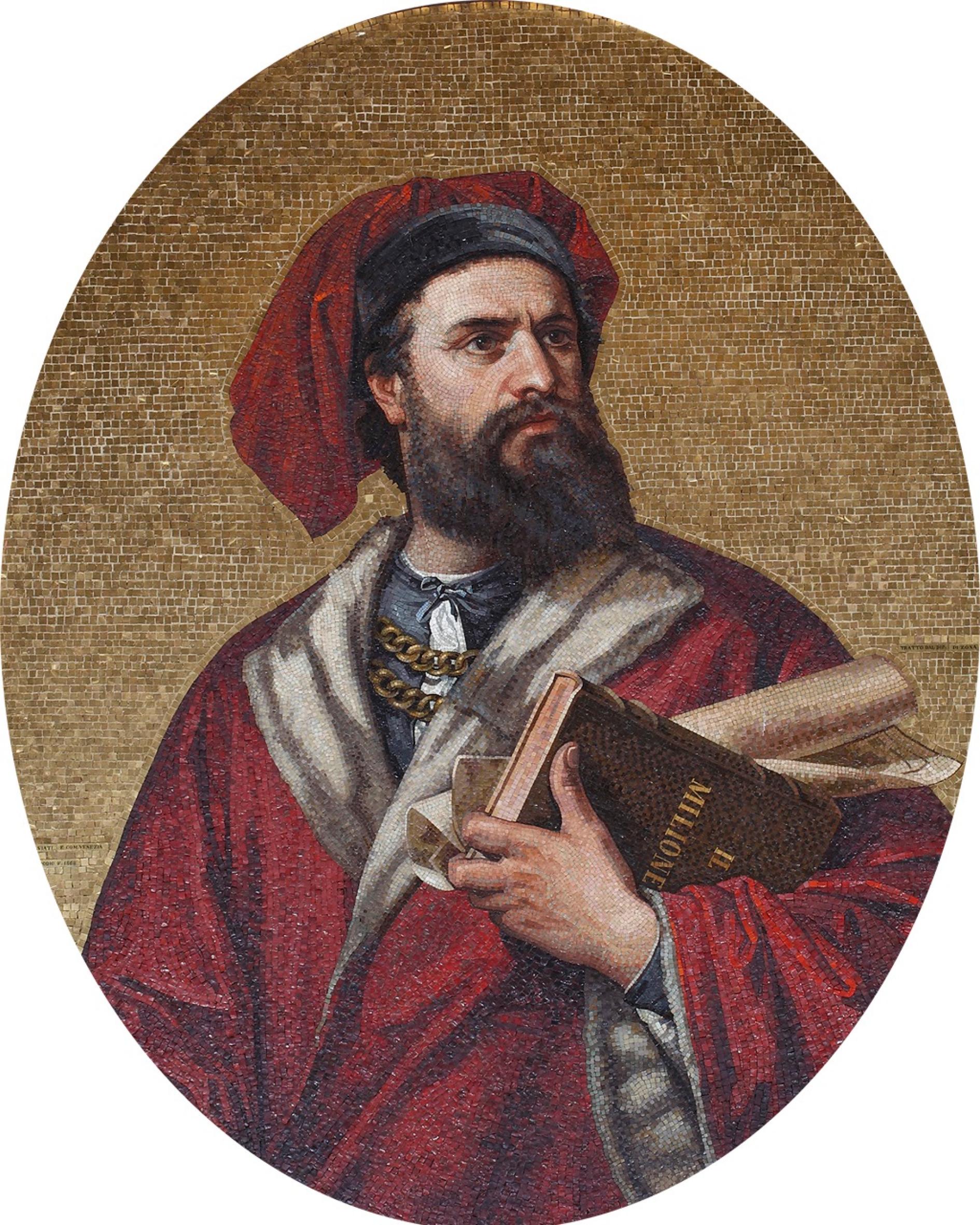
Portrait of Marco Polo
After five to six Chinese sexagenary cycles, in the late Ming and early Ch’ing periods, European Catholic missionary volunteers arrived in China in succession. Driven by missionary zeal, they gave little thought to the perils of voyage. Before ever reaching their destination, many perished in storms, towering waves, reefs, diseases, or piracy. Even those who survived the voyage still faced grave perils upon arrival in China, where they might be killed by bandits, local authorities, or imperial decrees. To describe their ordeal as “near-death experience” is not an exaggeration. When they were tired of travelling and wished to go home, the return voyages were equally dangerous and daunting. At that time, departure from Europe to the East often meant an almost final farewell to family and friends. Gazing at the far horizon where the sea joined the sky, life and death were accorded to divine will.
With the vast distance separating East and West, postal service faced huge impediment. According to Philip Robinson, the collector of Jesuit documents, in the late Ming period a letter could take as long as seven years to reach Europe. In one known instance, a letter sent from Macau to Rome took as long as seventeen years to arrive. Among the missionaries who voyaged eastward, the most accomplished distinguished themselves with their mastery of Western astronomy, geography and sciences, complemented by their personal qualities of exceptional courage and discernment. Thus they managed to secure the favour of the imperial court and were permitted to reside in the capital, wielding science as their safeguard and preaching as their purpose. A handful of such figures were recorded in history.
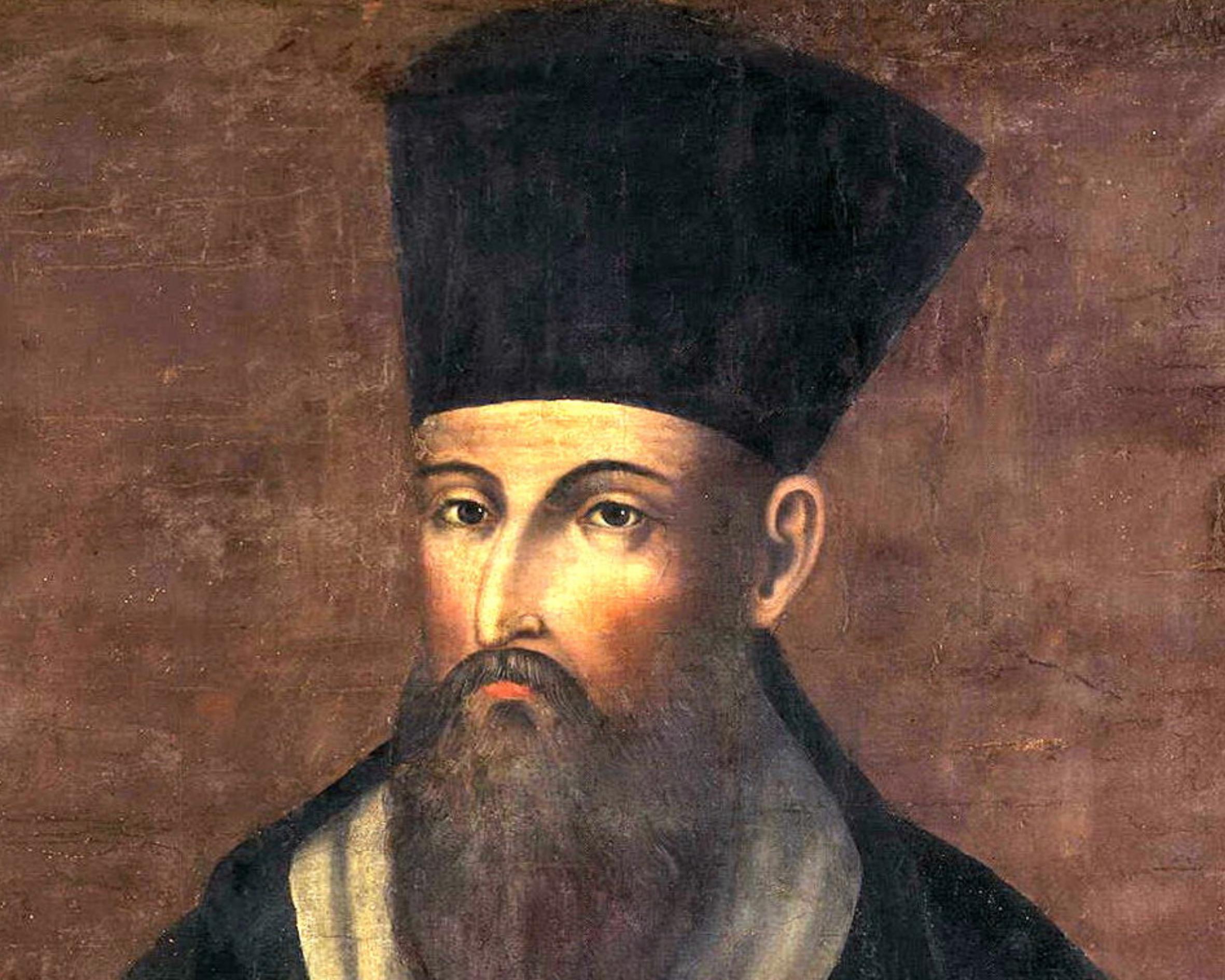
Portrait of Matteo Ricci
In 1577, the Italian Jesuit priest Matteo Ricci (1552–1610) set sail from Lisbon. Five years later, on 7 August 1582, he arrived in Macau and remained in China for twenty-eight years. Ricci produced the Complete Map of the Great World (大瀛全圖), compiled a Chinese–Portuguese dictionary, and established the Hsüan-wu-men Catholic Church (宣武門天主堂) in Peking - the first church in China. He also converted Hsu Kuang-ch’i (徐光啓) into the Christian faith.
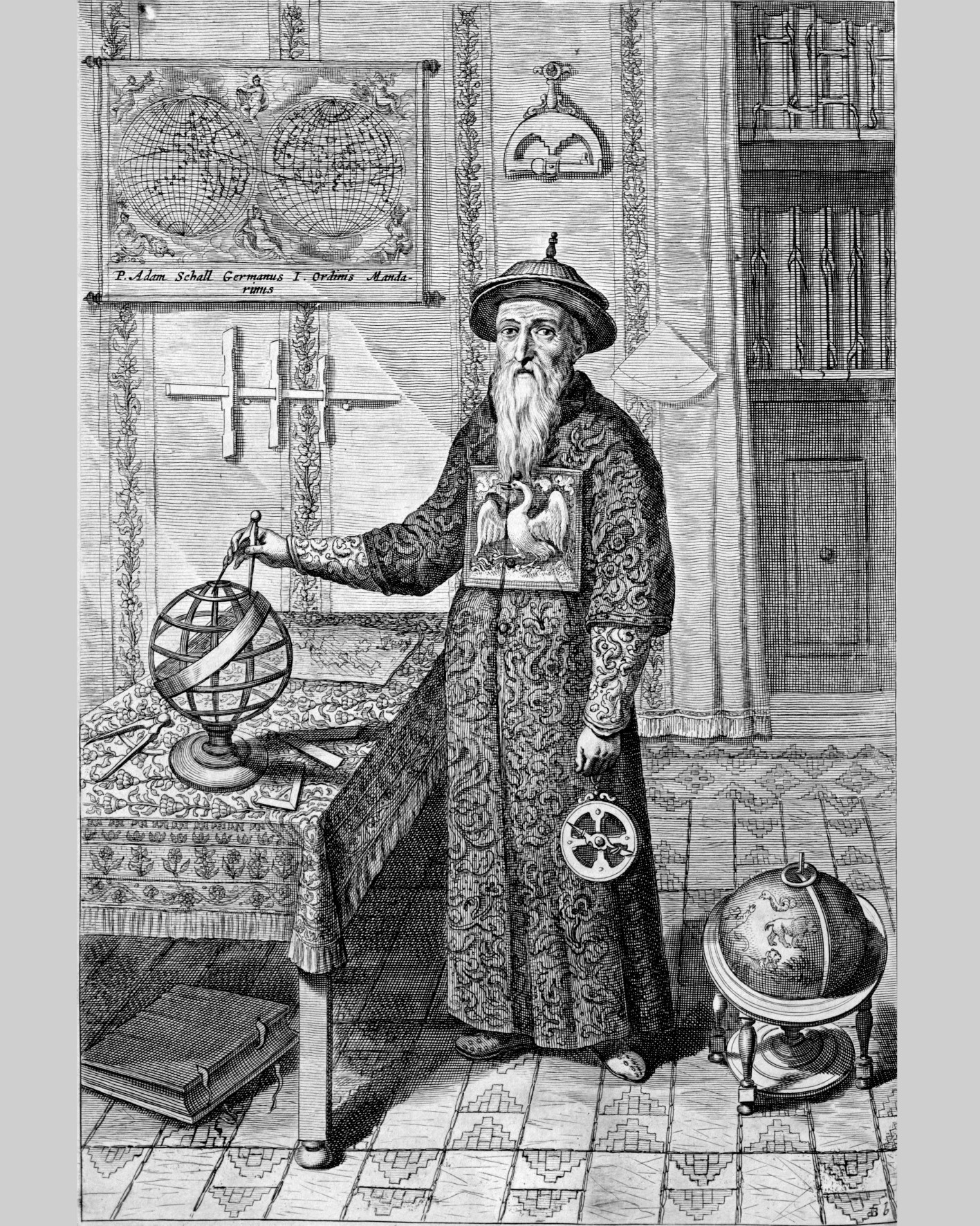
Portrait of Johan Adam Schall von Bell
In 1618, the German Jesuit priest Johann Adam Schall von Bell (1591–1666) set sail from Portugal. After more than a year, he arrived in Macau on 15 July 1619. He remained in China for forty-seven years. Schall von Bell assisted the revision of the Ch’ung-chen Calendar (崇禎曆) of late Ming dynasty, and after the Ch’ing conquest, he continued to work on calendrical revisions during the Shun-chih reign. He was granted the honorific title “Teacher Who Understands Mysteries” (通玄教師). It is said that, with imperial approval to spread Christianity, he coordinated the efforts of Jesuit missionaries across many regions and gained a following of as many as 500,000 converts.
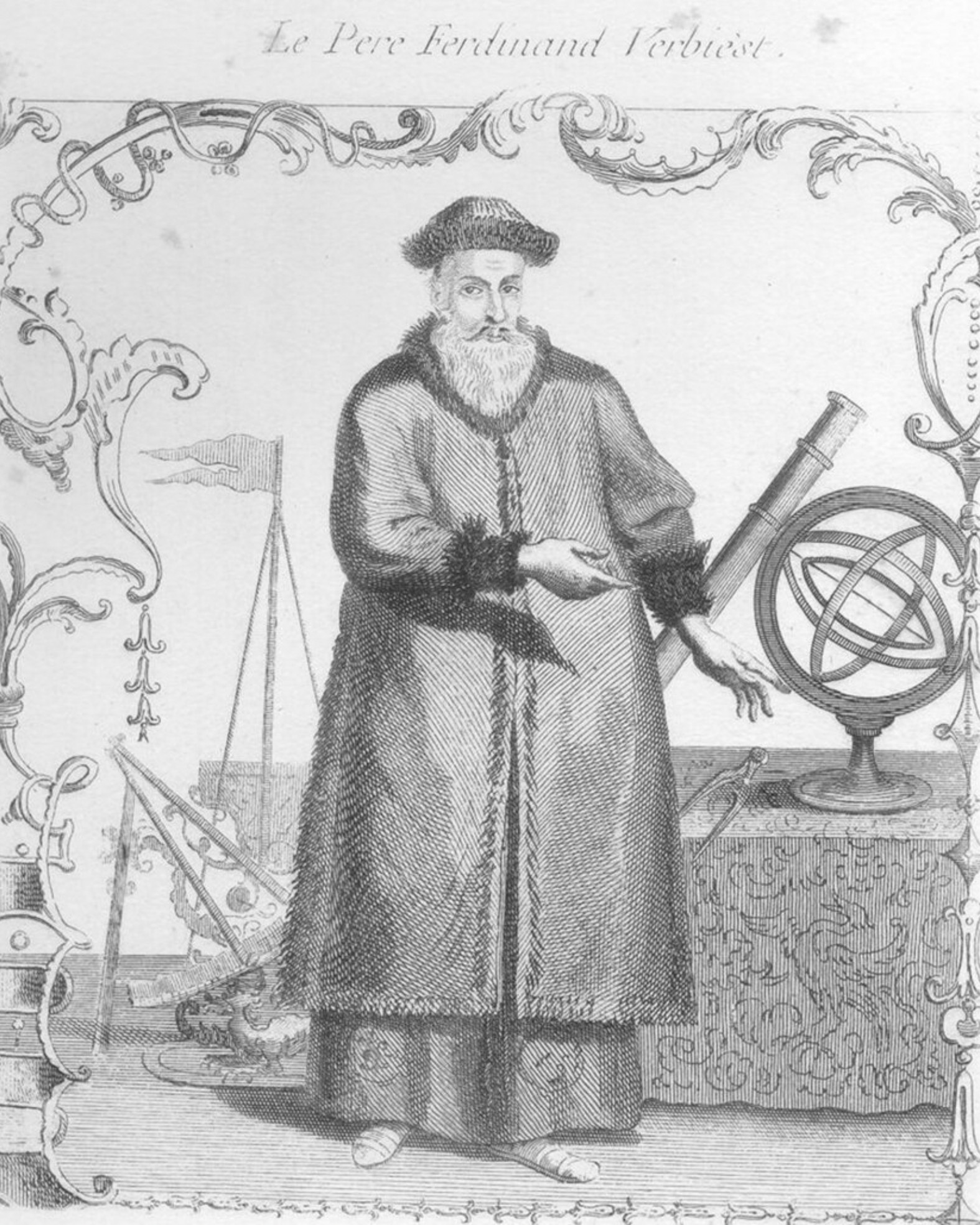
Portrait of Ferdinand Verbiest
On 4 April 1657, the Belgian Jesuit priest Ferdinand Verbiest (1623–1688) set sail from Lisbon. After more than a year, he arrived in Macau on 17 July 1658, and remained in China for thirty years. During the K’ang-hsi reign, Verbiest revised the Chinese calendar, supervised the construction of astronomical instruments at the Imperial Observatory in the Forbidden City, and was appointed vice minister of the Ministry of Works.
Missionaries who travelled east to China would typically land in Macau first. From 1557 onwards, the Portuguese paid an annual tribute to the Ming court and were permitted to occupy Macau as a Western trading port. Missionaries would stay there temporarily, diligently studying Chinese language and customs, before journeying into the inland provinces.
The eastward dissemination of Western religion and science, the westward transmission of Chinese philosophy and arts, could have developed into a continuous cycle of mutual exchange. Yet over the course of more than three centuries, the scale and extent of the “eastward” and the “westward” flows were markedly unbalanced. It is all too frequent for Chinese to hear the phrase Western Knowledge to the East (西學東漸), whereas Chinese Knowledge to the West (東學西漸) is hardly ever mentioned. This is because the latter is inconspicuous and marginal. The westward transmission of Chinese Knowledge began with the letters and writings of missionaries. Two hundred years after Marco Polo, the West started to gain a preliminary understanding of China.
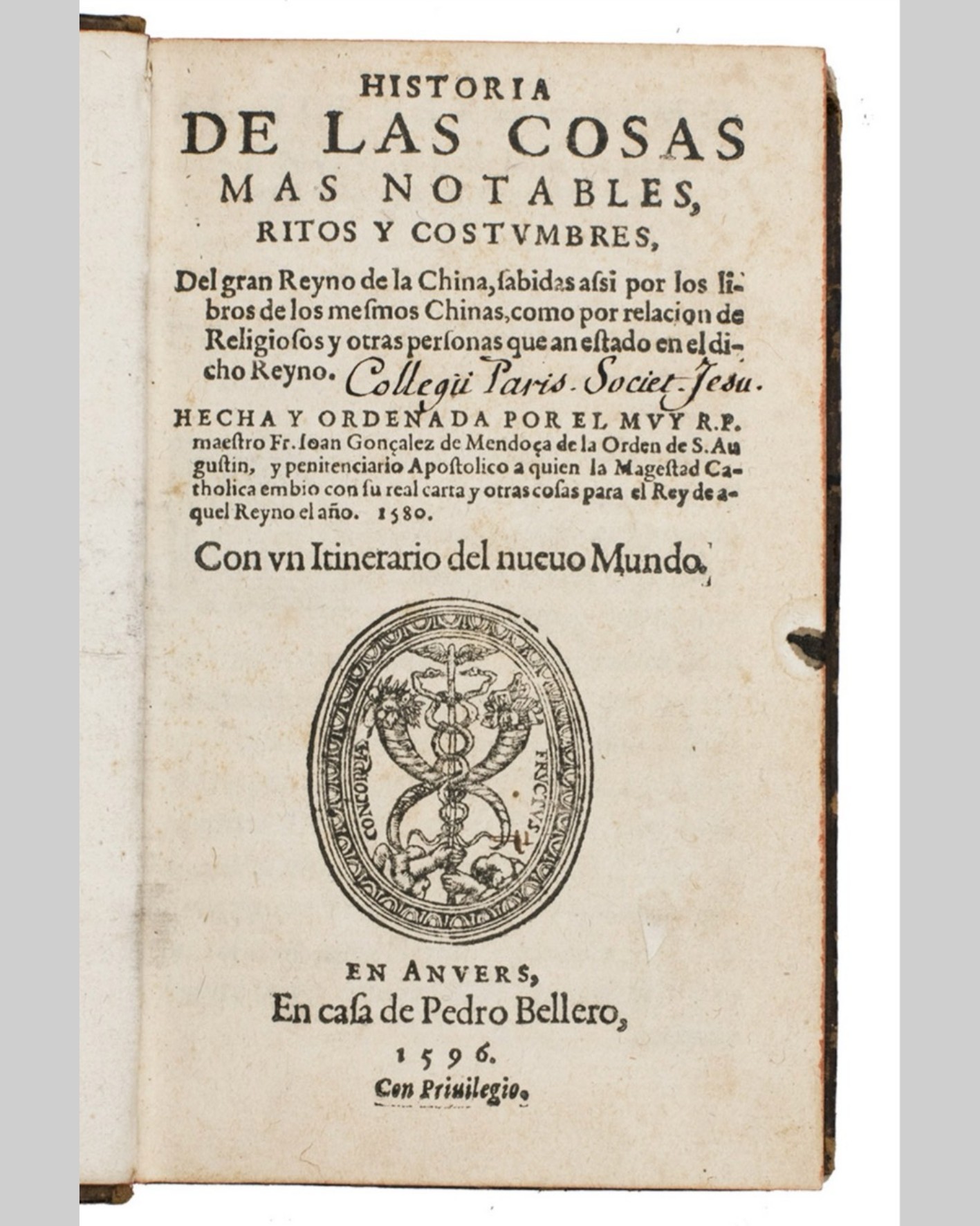
Title page of Historia de las cosas mas notables, ritos y costumbres del gran reyno de la China
In 1585, the Spanish Augustinian friar Juan González de Mendoza (1540–1618) published History of the Most Notable Things, Rites and Customs of the Great Kingdom of China (Historia de las cosas más notables, ritos y costumbres del gran reyno de la China).
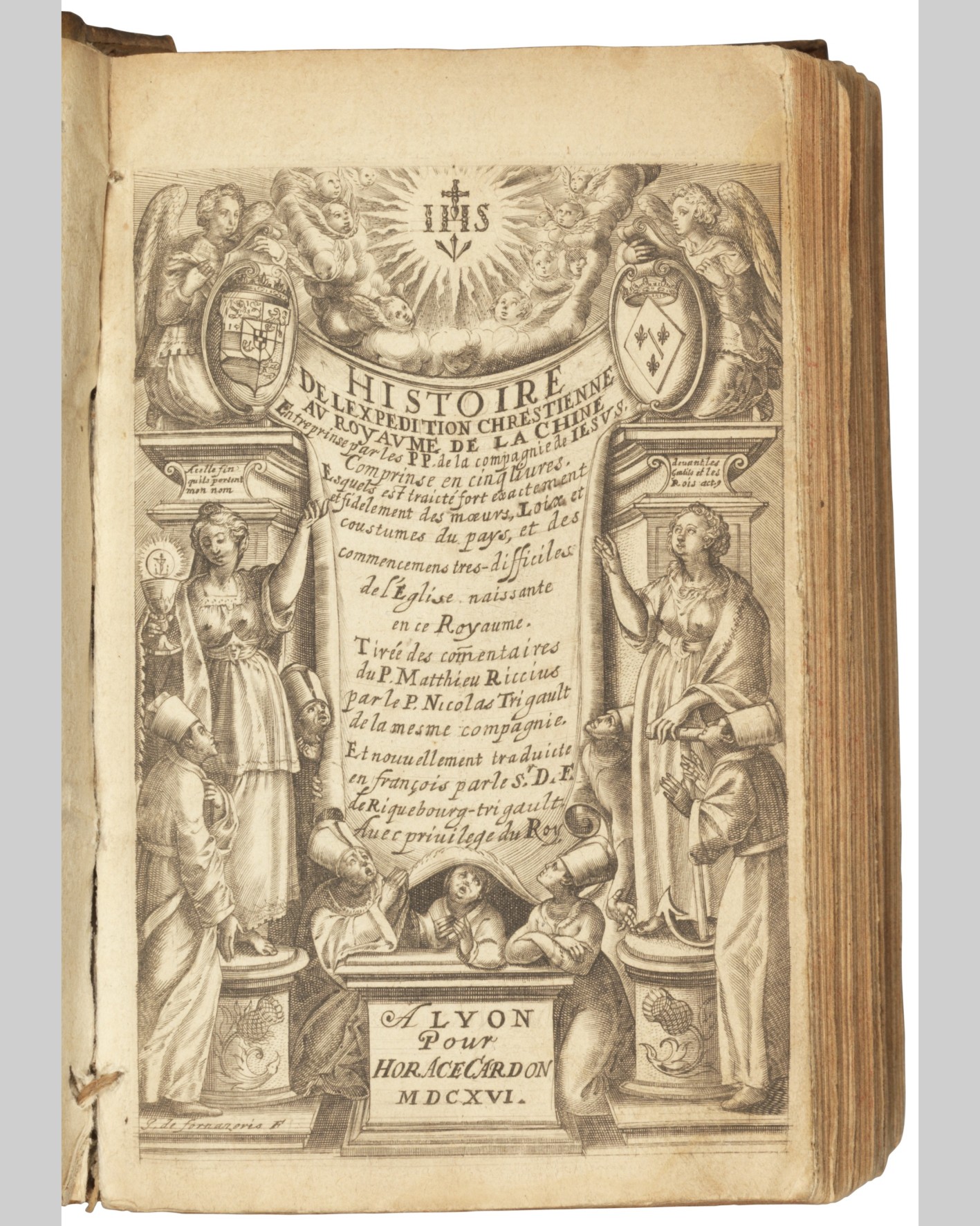
Title page of French translation of De Christiana expeditione apud Sinas
In 1615, the French Jesuit missionary Nicolas Trigault (1577–1628) published The Christian Expedition to China According to Matteo Ricci (De Christiana expeditione apud Sinas).
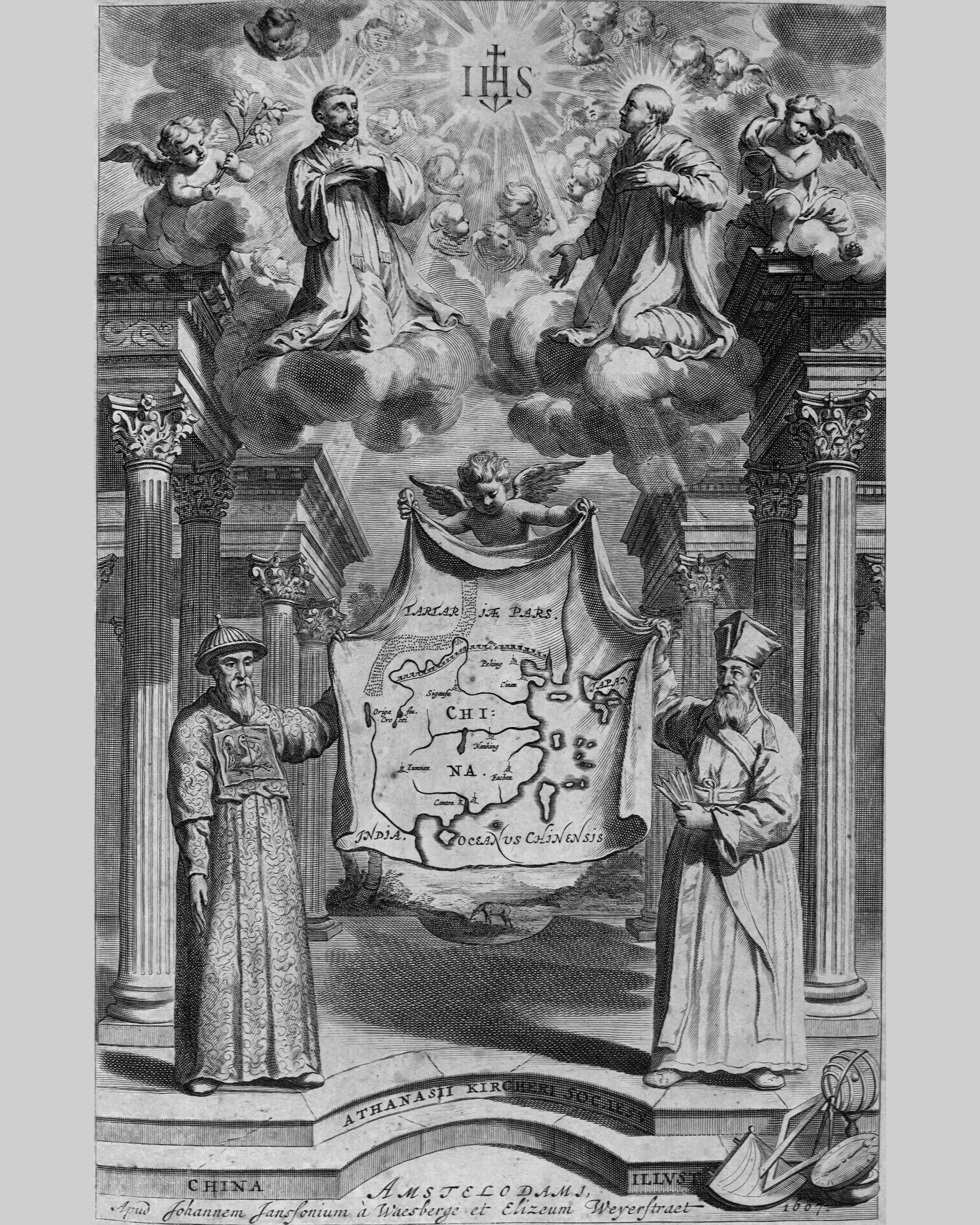
Inside page of China Illustrata
In 1667, the German Jesuit scholar Athanasius Kircher (1602–1680) published China Illustrata.
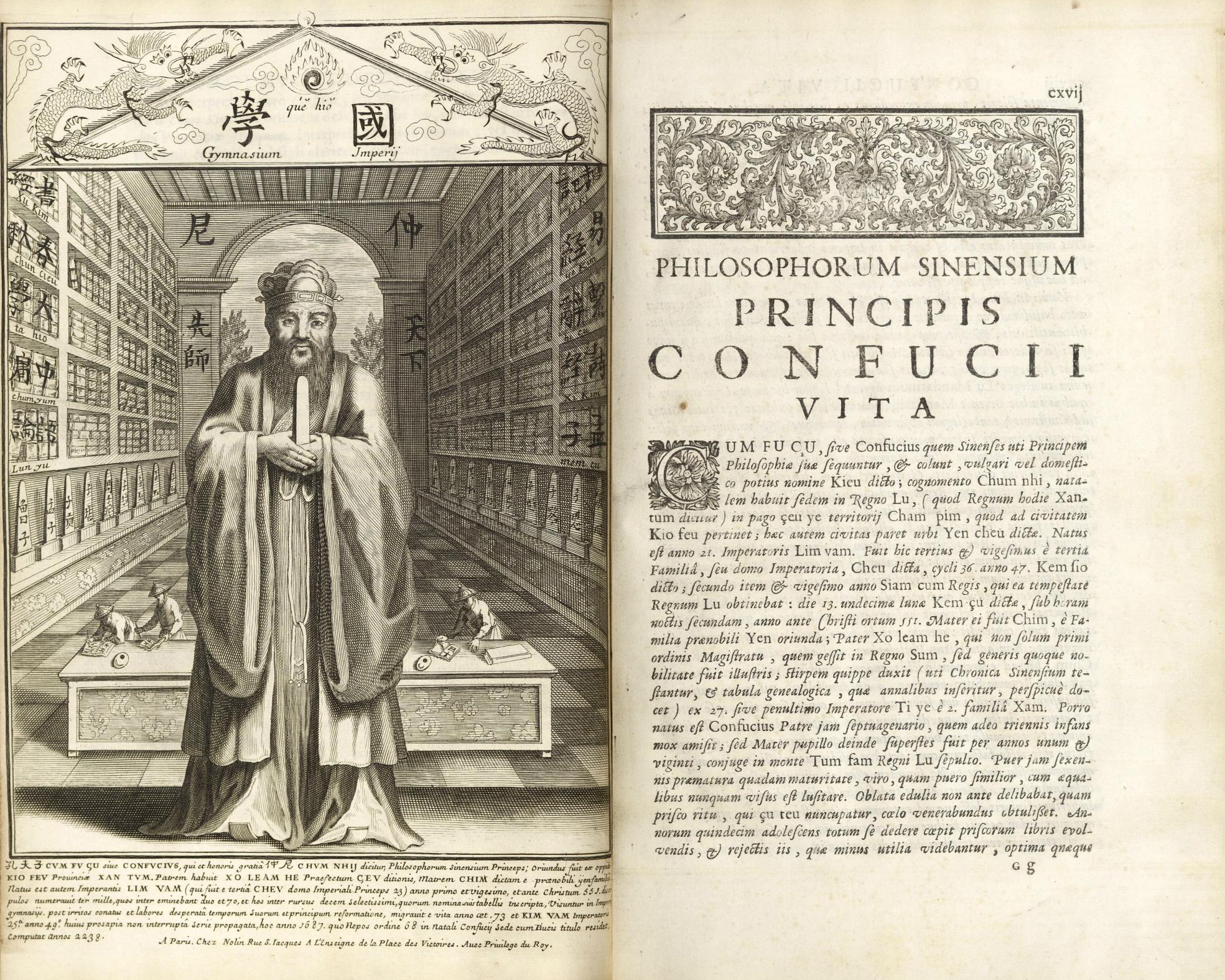
Inside page of Confucius Sinarum Philosophus
In 1687, the Belgian Jesuit missionary Philippe Couplet (1623–1693), together with collaborators, translated and published Confucius, Philosopher of the Chinese (Confucius Sinarum Philosophus), a pioneering exposition of Confucianism for the West.
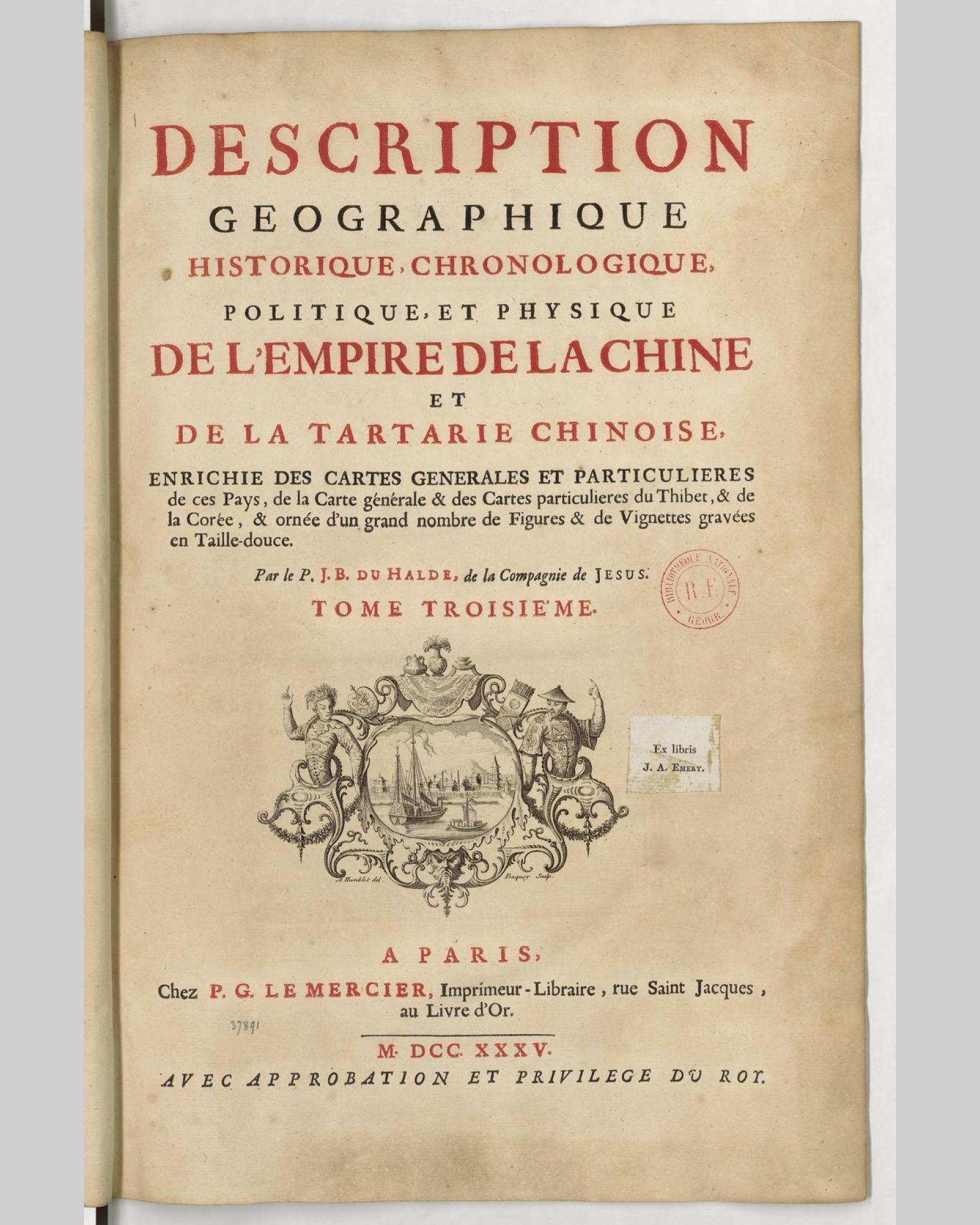
Title page of Description Geographique, Historique, Chronologique, Politique, et Physique de L’Empire de La Chine et de La Tartarie Chinoises
In 1735, the French Jesuit priest Jean-Baptiste Du Halde (1674–1743) published Description of the Empire of China and Chinese Tartary, including its Geography, History, Chronology, Politics and Physical Description (Description Géographique, Historique, Chronologique, Politique, et Physique de l’Empire de la Chine et de la Tartarie Chinoise).
The above works were all authored by men from the Catholic Church.
Confucian practices of ancestral worship and the veneration of Confucius led to a major dispute between the Ch’ing imperial court and the Vatican, known in history as the Chinese Rites Controversy. In 1704, Pope Clement XI issued a papal decree strictly prohibiting Chinese Christians from performing ancestral rites or rites to honour Confucius. The following year, a papal envoy was sent to China to enforce the ban. It angered Emperor K’ang-hsi and the envoy was expelled to Macau. In 1721, Emperor K’ang-hsi issued an edict condemning the Vatican’s stance. In 1724, Emperor Yung-cheng issued an edict prohibiting the propagation of Catholicism in China. By the nineteenth century, missionaries entered China under the protection of gunboats and artillery, with imperialistic military powers safeguarding their missionary activity.
Looking around our world, China has been radically Westernized to extremity. The West has scarcely soaked up any Chinese philosophy or arts, while Chinese have enthusiastically discarded and dismantled Classical Culture and Studies. In mainland China, Marxist political doctrine and simplified Chinese characters are hailed to this day. On both sides of the Taiwan Strait, regarding philosophy, religion, architecture, dress, etiquette, literature, music, drama and painting, none have been able to desist Westernization.
The obscurity of Chinese Knowledge to the West and the disintegration of Classical Culture within China herself, induce our reflection on those individuals from both East and West who, over the past three centuries, carried Chinese Knowledge across the seas to land in Europe and America. With lofty aspirations and perseverances, they forged remarkable trajectories by themselves, and continue to inspire those today who stand precariously by the edge of abyss. While Chinese Classical Culture has not been able to flourish in its place of origin, the seeds transported by these westward voyages, may bear fruits in new homelands. By referring to the Collection of the Studio of Prunus Ode, this catalogue has been compiled bearing the title: Voyage of Sinology from East to West: Catalogue of Letters, Books and Artefacts of Western and Chinese Personages Across Three Centuries. It can be a supplement to fill the absent parts of other historical compilations.
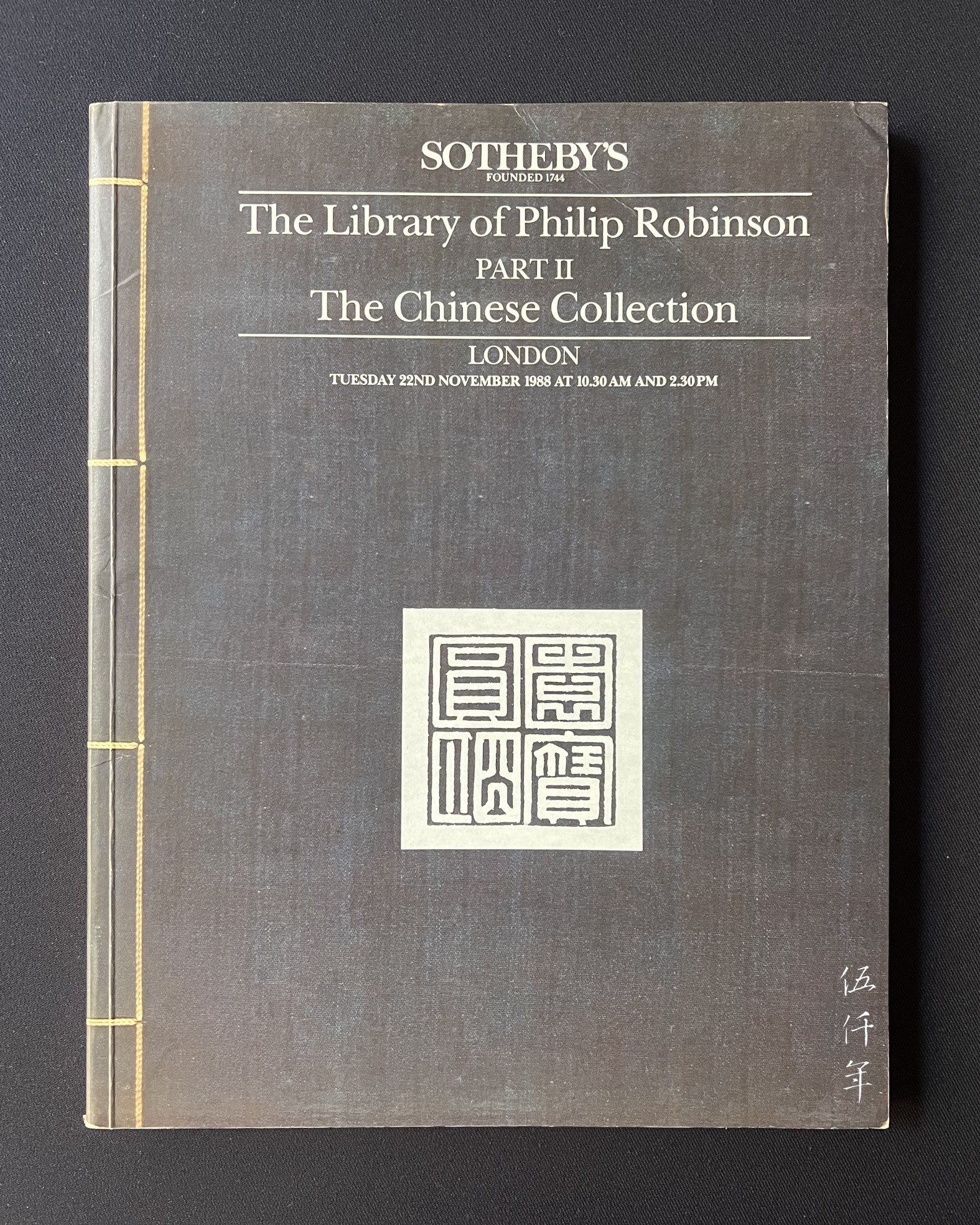
Catalogue of The Library of Philip Robinson Part II, The Chinese Collection
Reading the catalogue of the Philip Robinson Collection, his assemblage of missionary artefacts from late Ming to early Ch’ing had already established a sweeping panorama of that entire historical period, later collections will be hard-pressed to follow. For this reason, the present catalogue does not attempt to cover the same historical period at all. Moreover, the limitations of my own feeble learning, lacking proficiency in Latin, German, and French, made it impossible to read any of the original materials produced during that era. To collect without understanding will only deprive such material of their substance and pleasure. Although the first few items in this catalogue are dated to the eighteenth century, most of the listed items belong to the nineteenth or twentieth centuries. By then English has evolved to become the dominant language of the Western world.
The word Sinology incorporated in the title: Voyage of Sinology from East to West: Catalogue of Letters, Books and Artefacts of Western and Chinese Personages Across Three Centuries is used in the broadest possible sense. Sinology is not just confined to philosophy, literature and art, it also encompasses politics, diplomacy, military affairs, economics, religions, social sciences, science, and many other fields. Only by bringing these diverse sectors together, exploring the vast complexity of their totality, can one be equipped to understand a nation. The Catalogue lists one hundred and ninety-seven personages, including statesmen, diplomats, military leaders, economists, entrepreneurs, bishops, priests, missionaries, Buddhist lay practitioner, academics, translators, writers, novelists, playwrights, musicians, artists, collectors, film and theatre figures, scientists, physicians, explorers, archaeologists, botanists, journalists, witnesses to historical events, and others.
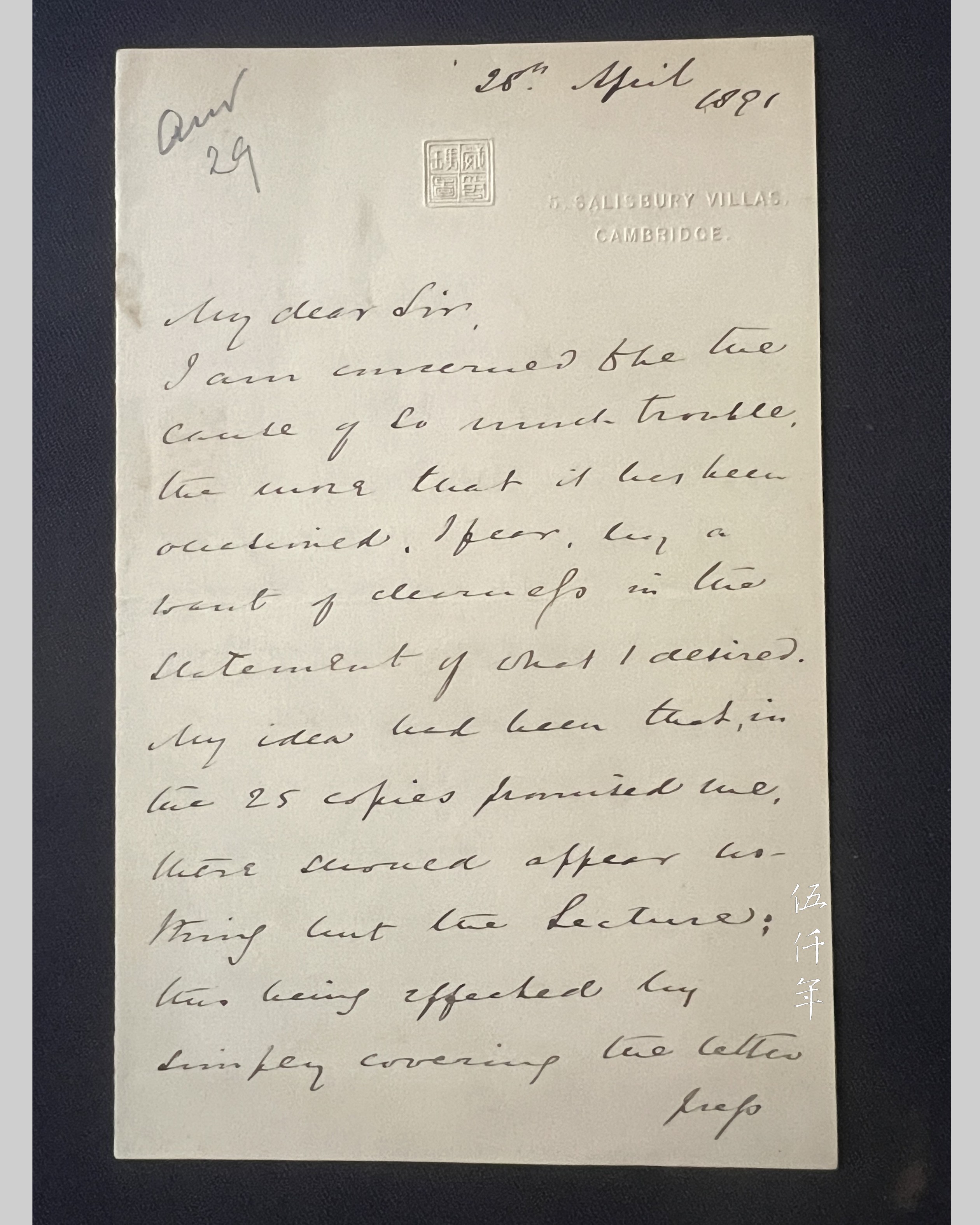
Letter by Thomas Wade, written on 28 April 1891 in Cambridge
As for items in Voyage of Sinology from East to West: Catalogue of Letters, Books and Artefacts of Western and Chinese Personages Across Three Centuries, the category of Artefacts incorporated in the title refer to portraits, photographs, illustrations, and other miscellaneous categories. Letters, as well as paper notes, scribbles of handwriting, traces of ink, provide ample means to touch the minds and hearts of later generations. It is indeed possible to befriend those from bygone ages, and to communicate with them spiritually. Examples of rare letters are those by Thomas Francis Wade (1818–1895), Herbert Giles (1845–1935), Henri Cordier (1849–1925), and Robert Hans van Gulik (1910–1967), among others.
There are two reasons why letters by such Western personages are scarcely encountered. For those who lived in China, their letters were mostly destroyed or discarded, for few could recognize them. Chinese today have long been indifferent to national history, it is unlikely they know about these foreigners. In late Ch’ing and early Republican periods, few Chinese could understand foreign language, not to mention acknowledging letters by foreigners and treasuring them. For those who lived in the West, their letters were mostly destroyed or discarded too. Sinology has never been a prominent field in Western academia, aficionados are few. For those who returned home from the East at old age, they left for too long and were little known in their own countries. Their letters naturally fell into neglect. It is thus understandable why it is sometimes difficult to find even a single letter.
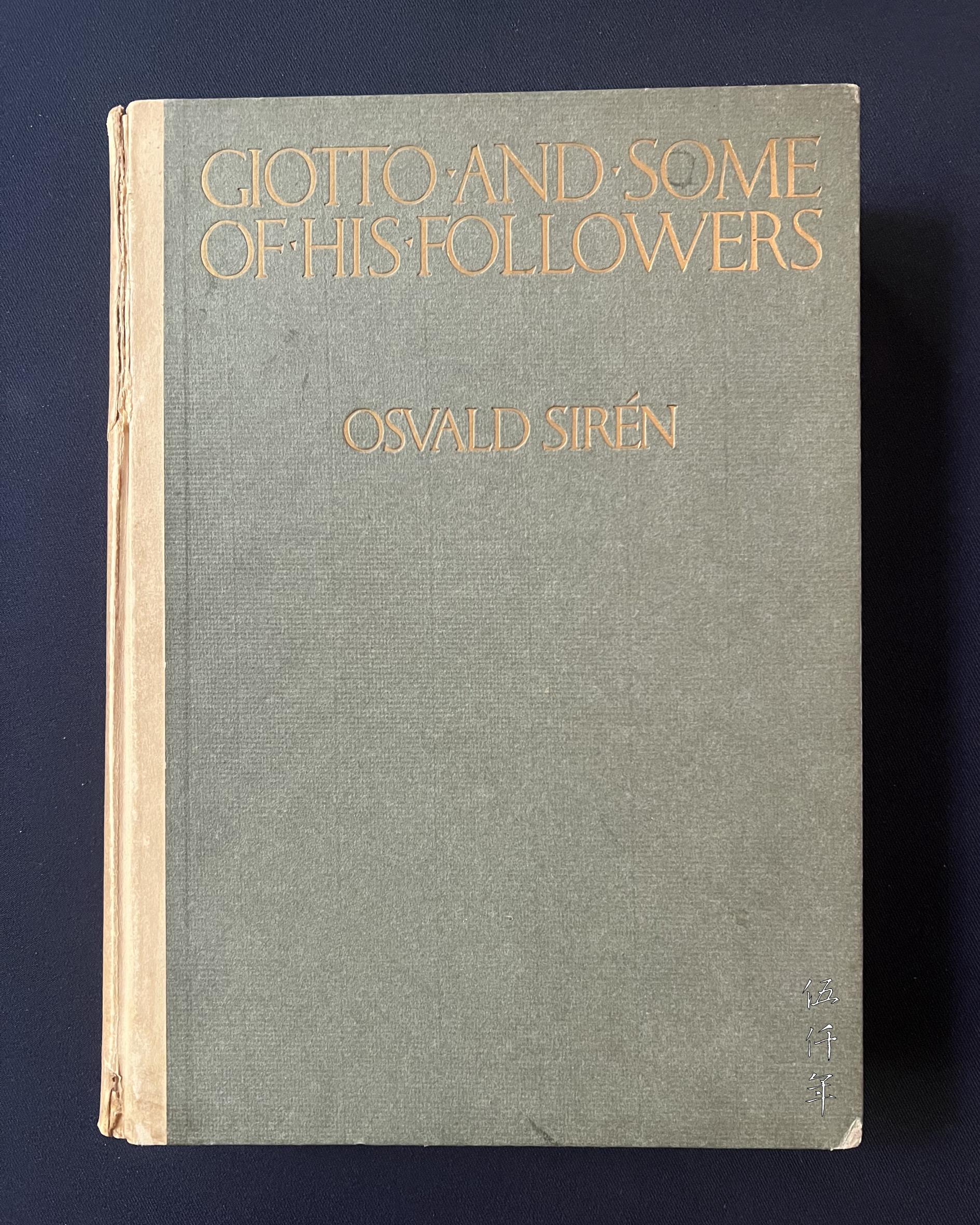
Front cover of Giotto and Some of His Followers. By Osvald Siren
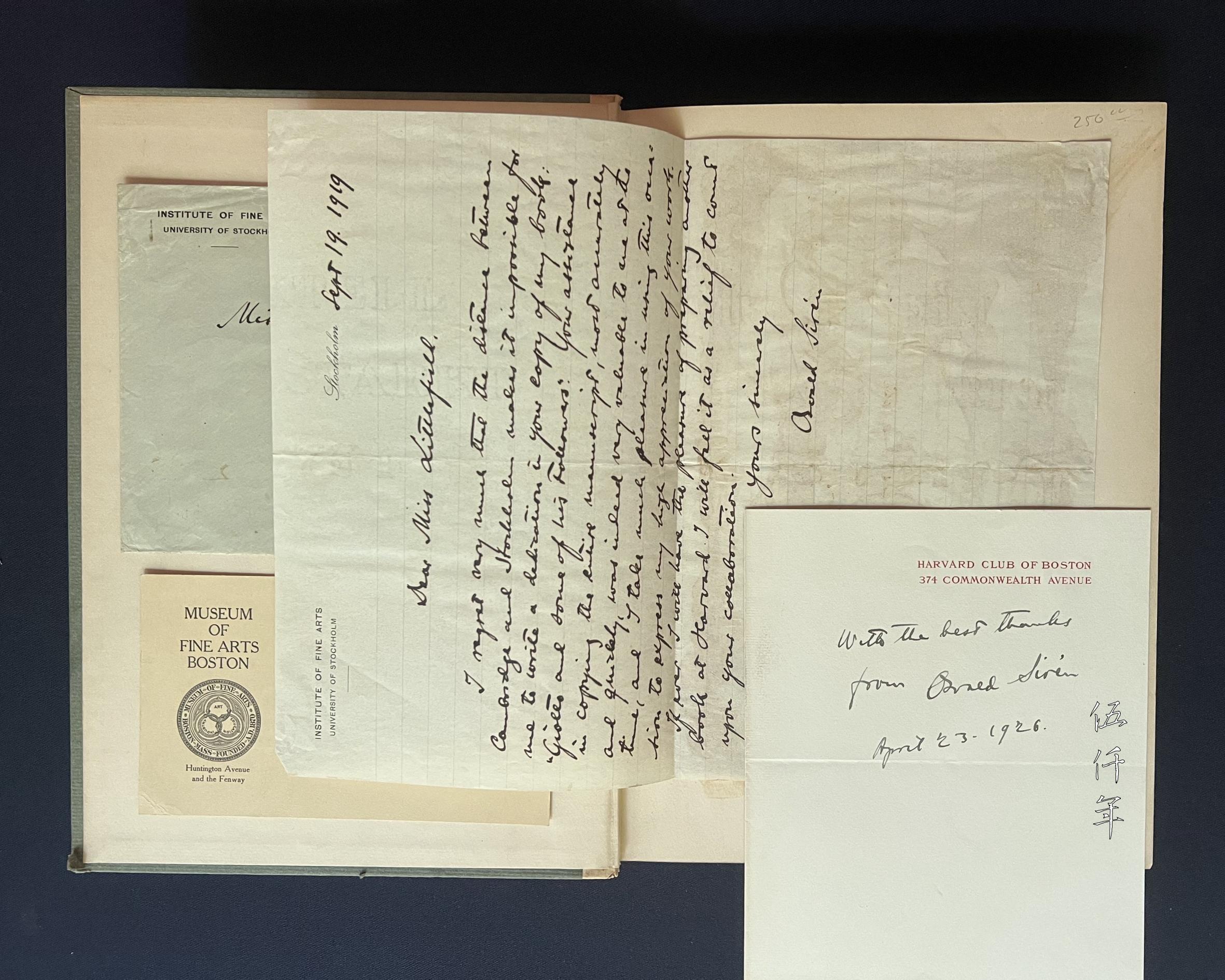
Letter and note by Osvald Siren to Littlefield, written on 19 September 1919 in Stockholm
Most of the books listed in the Catalogue were signed or inscribed by the authors. Some rare examples are: Three Years’ Wandering in the Northern Provinces of China, A Visit to the Tea, Silk, and Cotton Countries, with an Account of the Agriculture and Horticulture of the Chinese, New Plants, etc., inscribed by Robert Fortune (1812–1880) ; The Nestorian Monument of Hsi-an Fu in Shen-hsi, signed by James Legge (1815–1897); Annals & Memoirs of the Court of Peking, inscribed by Edmund Backhouse (1873–1944); Giotto and Some of His Followers,inscribed by Osvald Sirén (1879–1966). Books signed by authors come in two categories: those with just the signature, or those inscribed with a few lines. I have always favoured long inscriptions with many words, for words are no less the bearers of the author’s spirit. However, many Western collectors prefer book with only the signature of the author, unless it is dedicated to someone important. Chinese and Western bibliophiles seem to have different habits and priorities in book collecting.
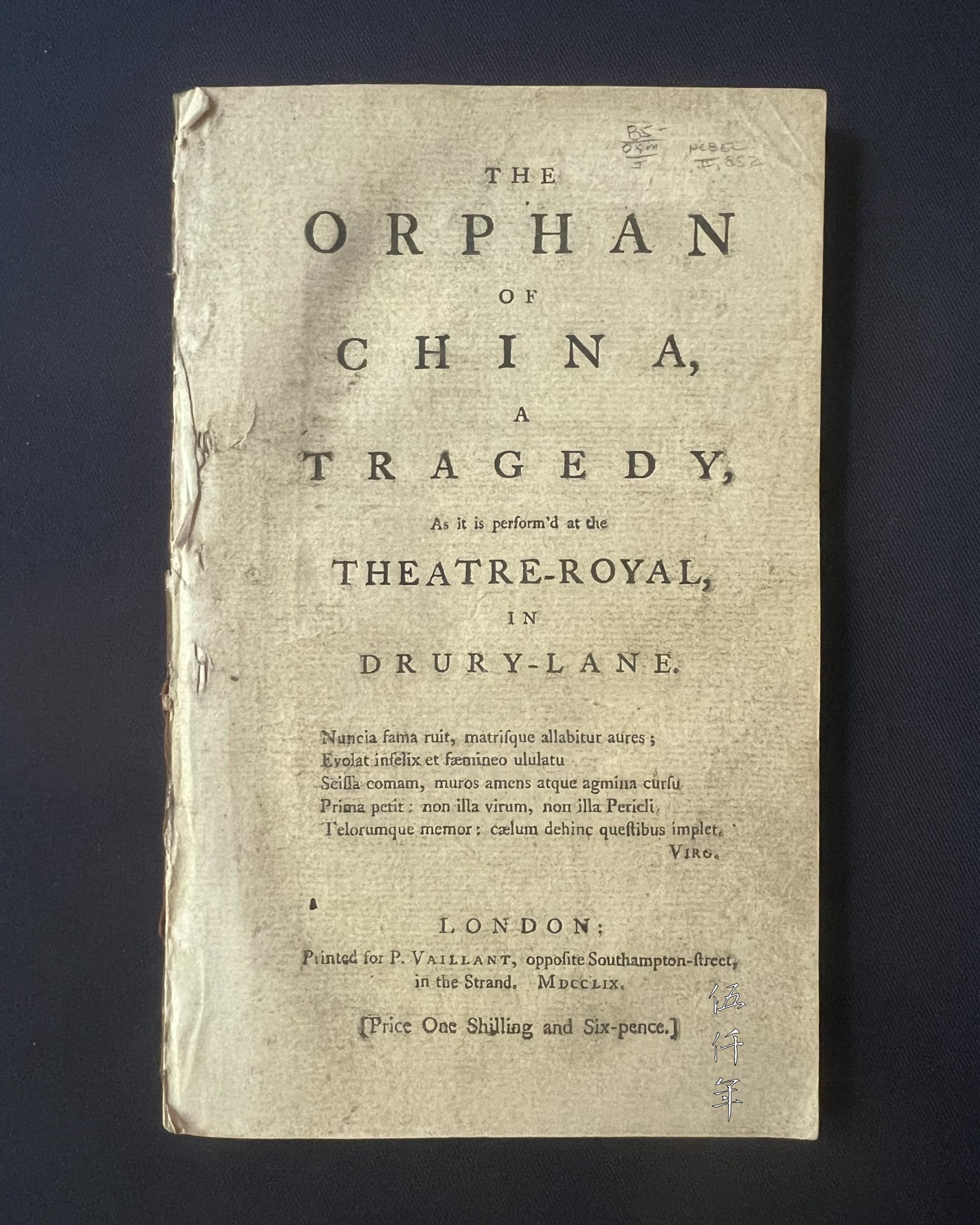
Theatre programme of The Orphan of China: a Tragedy, performed at the Theatre-Royal in 1759. Play adapted by Arthur Murphy
In the early eighteenth century, Europe was home to many philosophers who held the moral, political, and cultural ideas of Confucianism in high esteem. Among them were the German philosopher Gottfried Wilhelm Leibniz (1646–1716), the German thinker Christian Wolff (1679–1754), and the French writer Voltaire (1694–1778). During this period, the Chinoiserie movement in architecture and art emerged in Europe. In August 1755, Voltaire adapted The Orphan of Chao (趙氏孤兒), a Yüan dynasty play by Chi Chün-hsiang (紀君祥), for the Paris stage. It was retitled L’Orphelin de la Chine (The Orphan of China) This became the first Western drama based on Chinese historical material. In 1759, the British playwright Arthur Murphy (1727–1801) translated it into English for the London stage. The Catalogue includes the two programmes of the Paris premiere of Voltaire’s L’Orphelin de la Chine and the London premiere of Arthur Murphy’s The Orphan of China. We can imagine returning to attend theatre in the two capitals of Paris and London when Confucianism was all the rage. By mid-nineteenth century, with the outbreak of the Opium Wars, Europe was made aware of China’s economic weaknesses and military backwardness. Earlier admiration gave way to contempt, and the idealized vision of Confucian morality, politics, and culture was shattered.
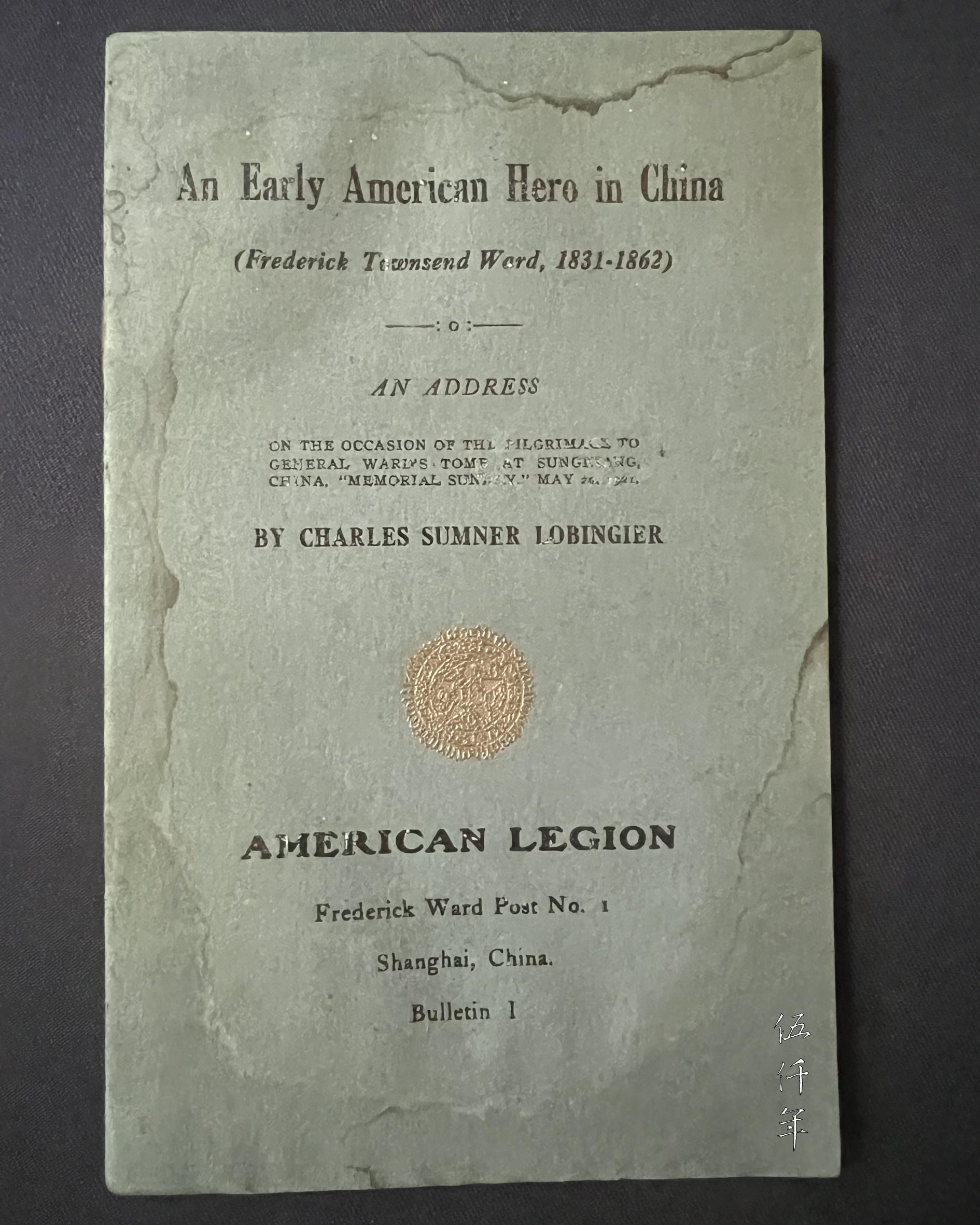
Front cover of An Early American Hero in China (Frederick Townsend Ward 1931-1862). An Address on the Occasion of the Pilgrimage to General Ward’s Tomb at Sungkiang, China, “Memorial Sunday”, May 29, 1921. By Charles Sumner Lobringier
The West also learn about China through books on politics, diplomacy, and military affairs. Some are chronicled in the Catalogue. From 1851 to 1864, the Taiping Rebellion shook the foundations of the Ch’ing dynasty, and it was extensively reported in Europe and the United States. The American General Frederick Townsend Ward (1831–1862) and the British General Charles George Gordon (1833–1885) successively led the Ever-Victorious Army, and their biographies are plenty.
In 1900, the Eight-Nation Alliance occupied Peking. The American missionary William Alexander Parsons Martin (1827–1916) and the British diplomat Robert Hart (1835–1911) both wrote about their experiences.
After the founding of the Republic of China, Homer Lea (1876-1912), military advisor to Dr. Sun Yat-sen, and Carl Glick (1890–1971) both wrote about the participation of Americans in the Republican revolution.
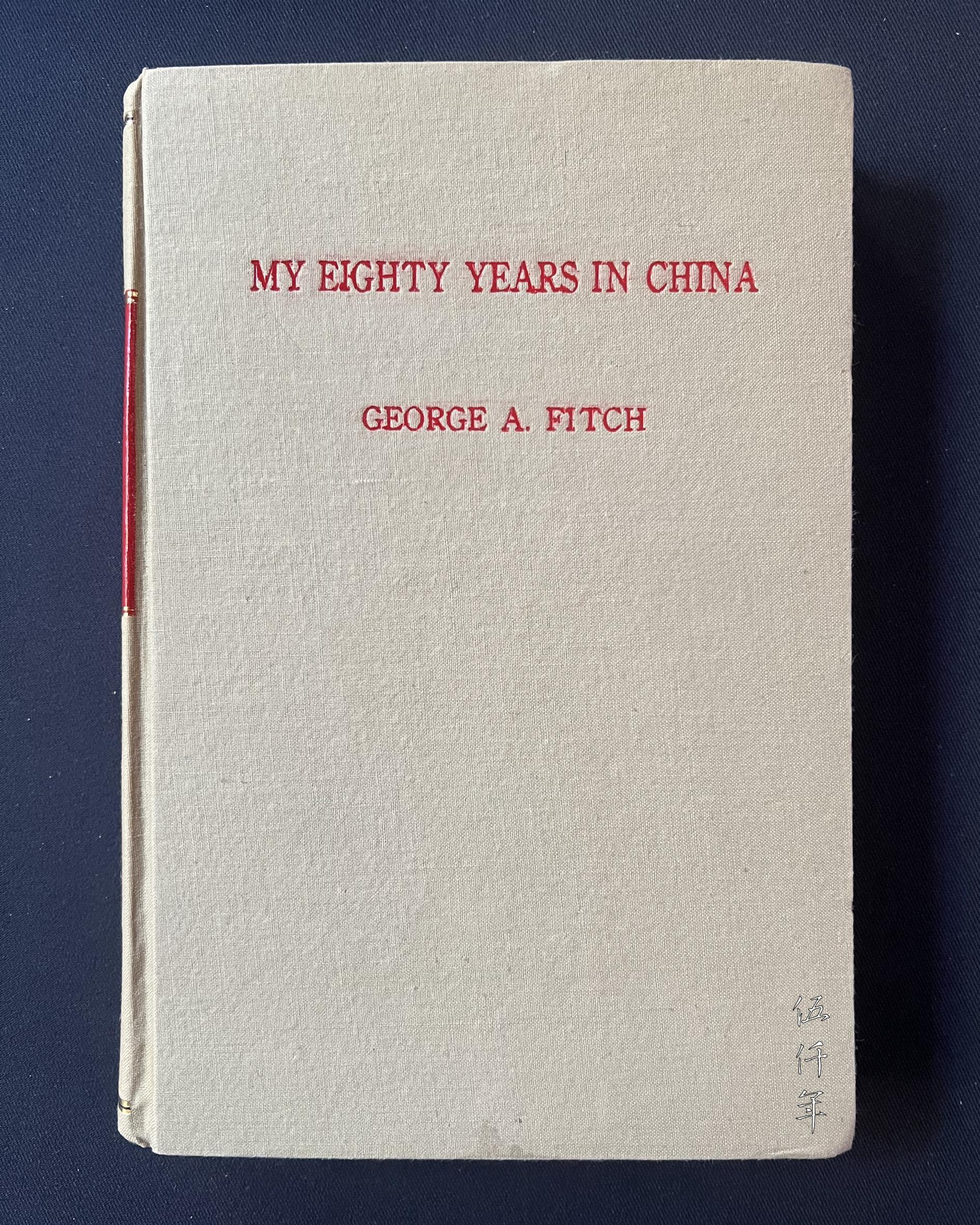
Front cover of My Eighty Years in China. By George Fitch
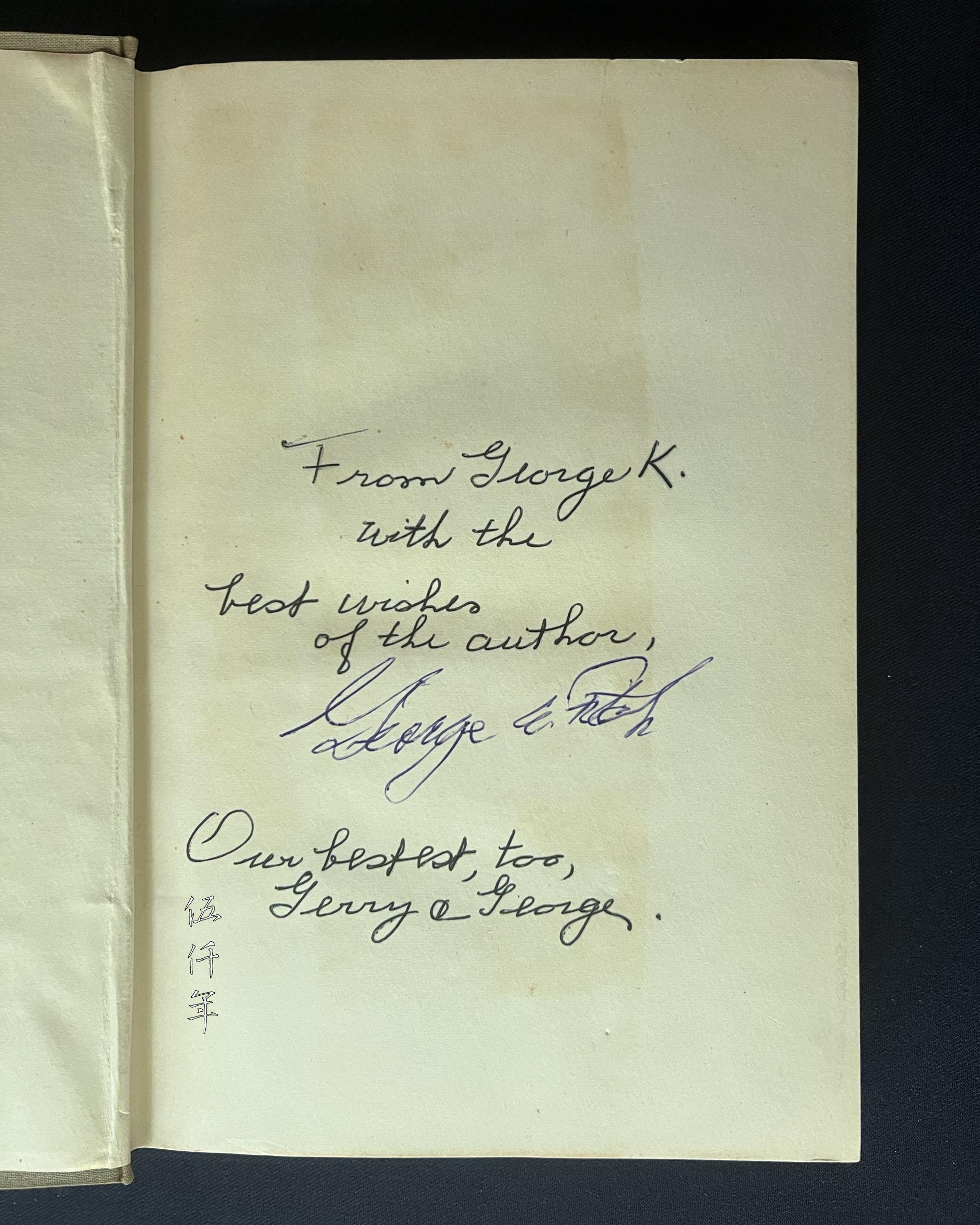
Inside page of My Eighty Years in China. By George Fitch
On 13 December of the 26th year of the Republic 1937, the capital of Nanking fell, and the Japanese army massacred the city, known as The Rape of Nanking. A small number of Caucasians established the Nanking Safety Zone, sheltering approximately 250,000 refugees. In the following year, a few American magazines published articles about The Rape of Nanking, verified by smuggled-out film and witness diary. The Catalogue listed books written or inscribed by four members of the Nanking Safety Zone Committee: George Ashmore Fitch (1883–1979), Hubert Lafayette Sone (1892-1970), Miner Searle Bates (1897–1978), and Lewis Strong Casey Smythe (1901–1978).
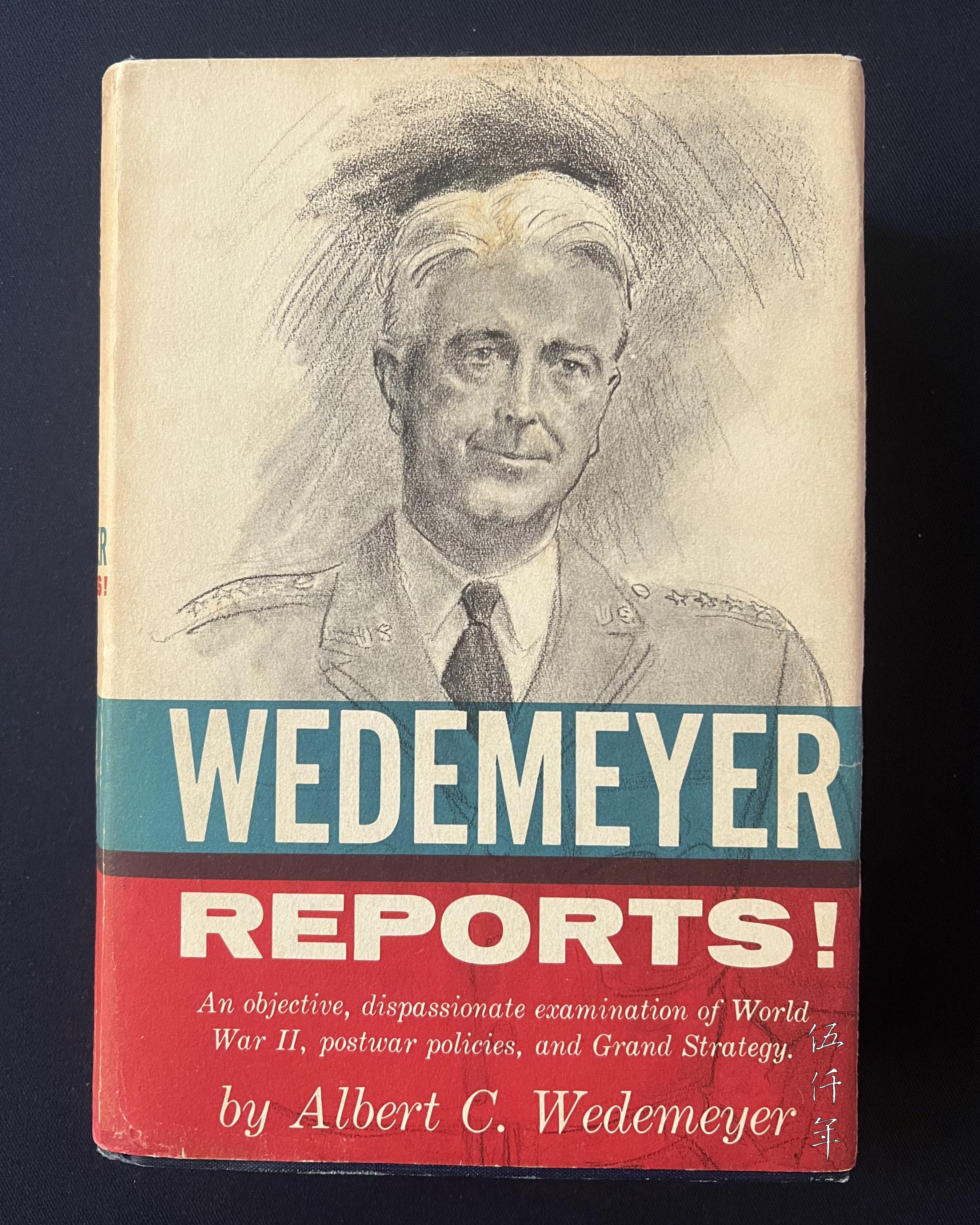
Front cover of Wedemeyer Reports! By Albert Coady Wedemeyer
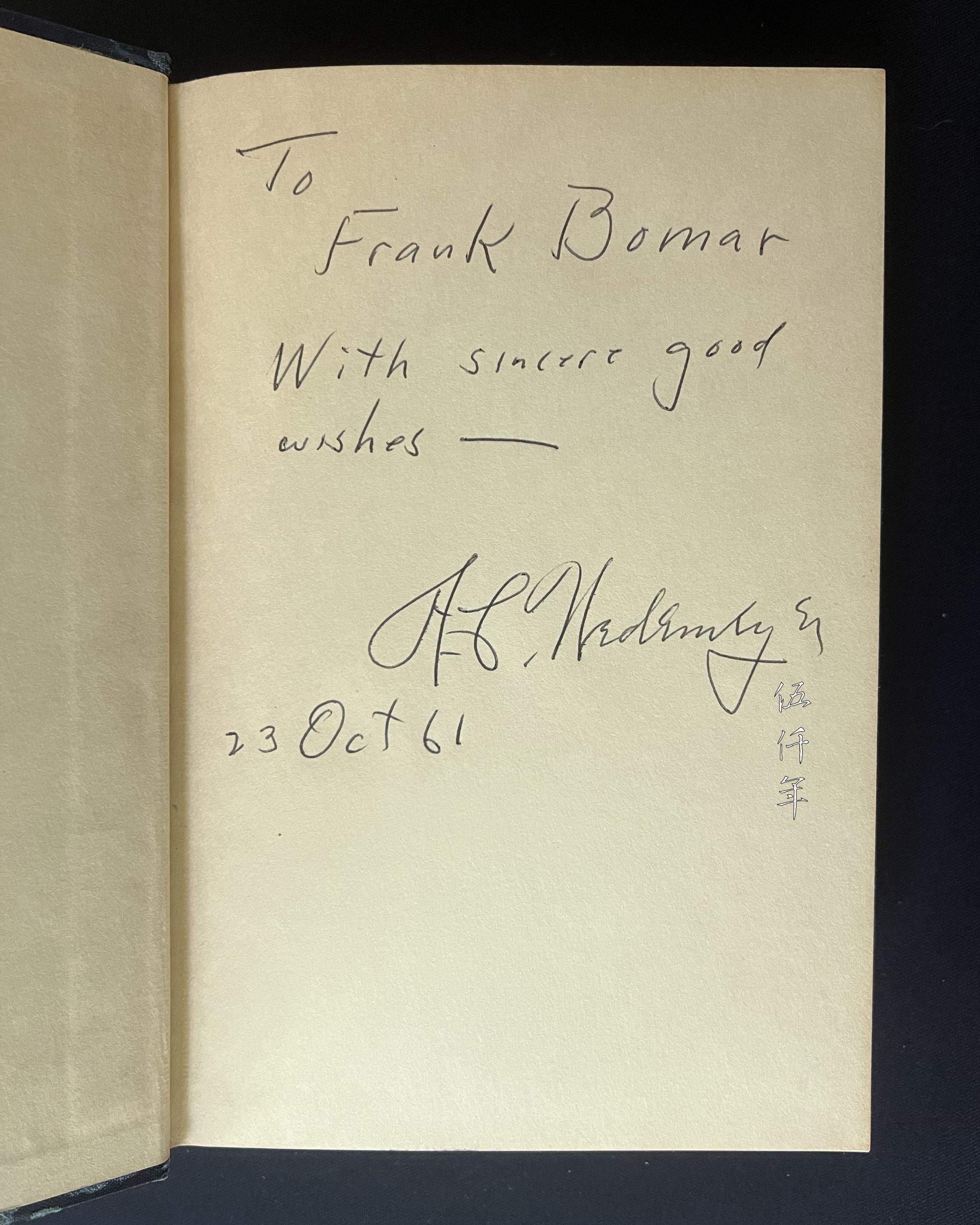
Inside page of Wedemeyer Reports! By Albert Coady Wedemeyer
In the 38th year of the Republic of China 1949, when mainland China fell to the communists, the Central Government relocated to Taiwan. American military officers and scholars wrote retrospective accounts of the years the Republican Government was in mainland China and the reasons behind the 1949 debacle. They include Albert Coady Wedemeyer (1897–1989), Milton Edward Miles (1900–1961), and Anthony Kubek (1920–2003).
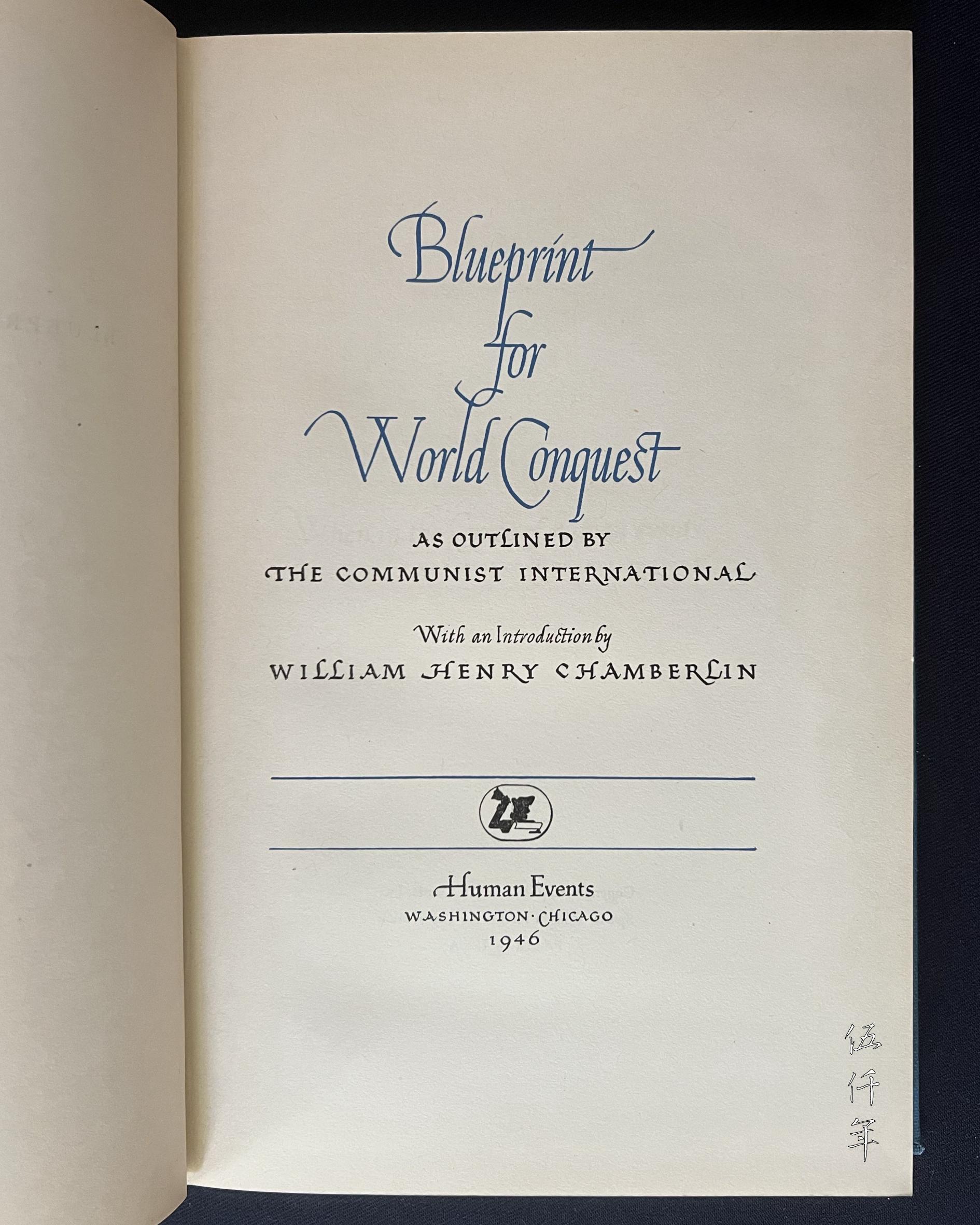
Title page of Blueprint For World Conquest, As Outlined By The Communist International
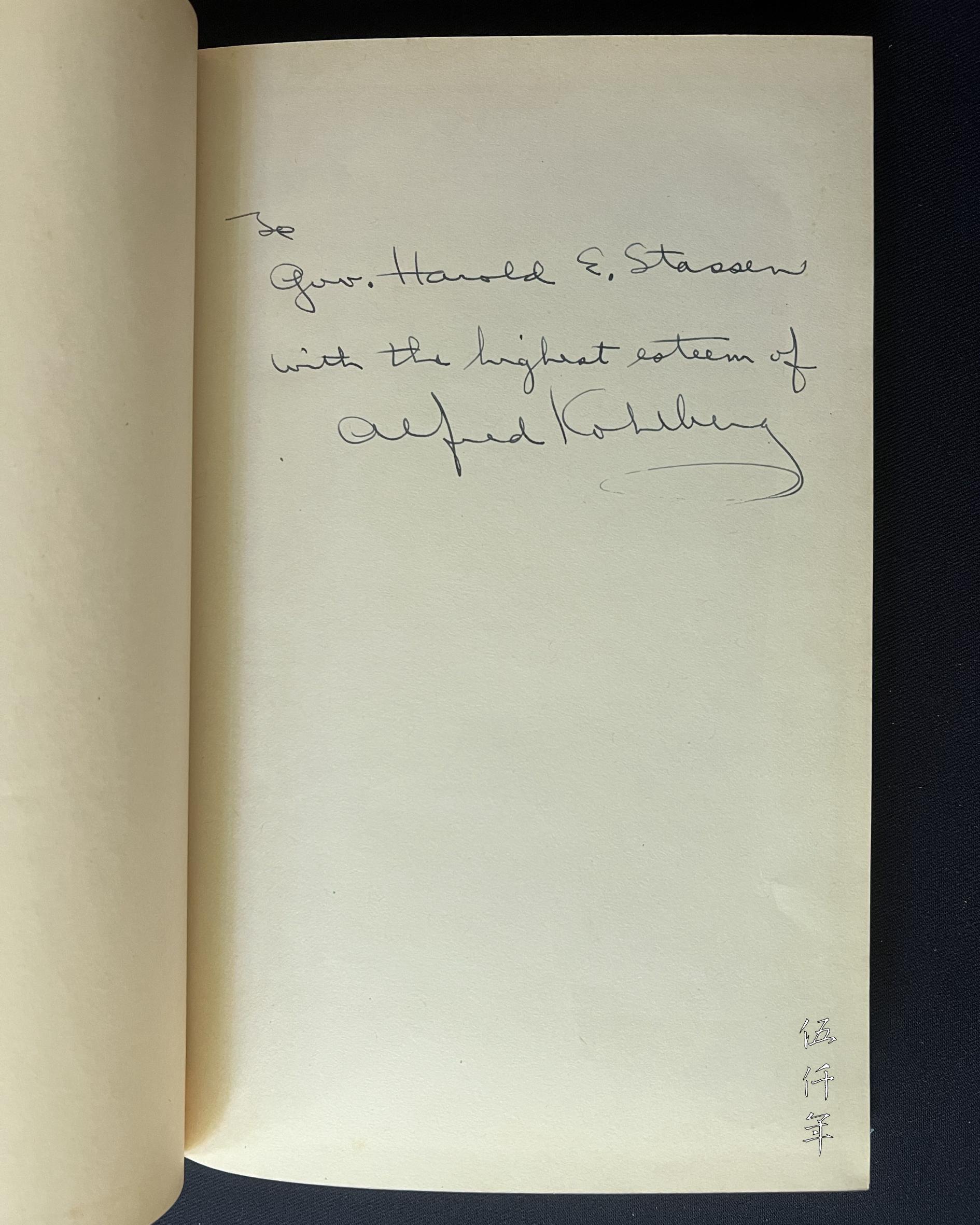
Inside page of Blueprint For World Conquest, As Outlined By The Communist International. Inscribed by Alfred Kohlberg
Later on, prominent American political and business leaders formed an informal group to promote and support the Republic of China, sometimes referred to as the China Lobby. Members include Alfred Kohlberg (1887-1960), Henry Robinson Luce (1898–1967), Congressman Walter Henry Judd (1898-1994), Senator William Fife Knowland (1908–1974), Senator Barry Morris Goldwater (1909-1998), Marvin Liebman (1923–1997), and others. The Catalogue lists a selection of their letters and books.
There were Chinese authors who wrote in foreign languages and achieved considerable popularity in Europe and America. In late Ch’ing, notable figures include Yung Wing (容閎 1828–1912), Wu T'ing-fang (伍廷芳 1842–1922), Ch'en Chi-t'ung (陳季同 1851–1907), and K'u Hung-ming (辜鴻銘 1857–1928).
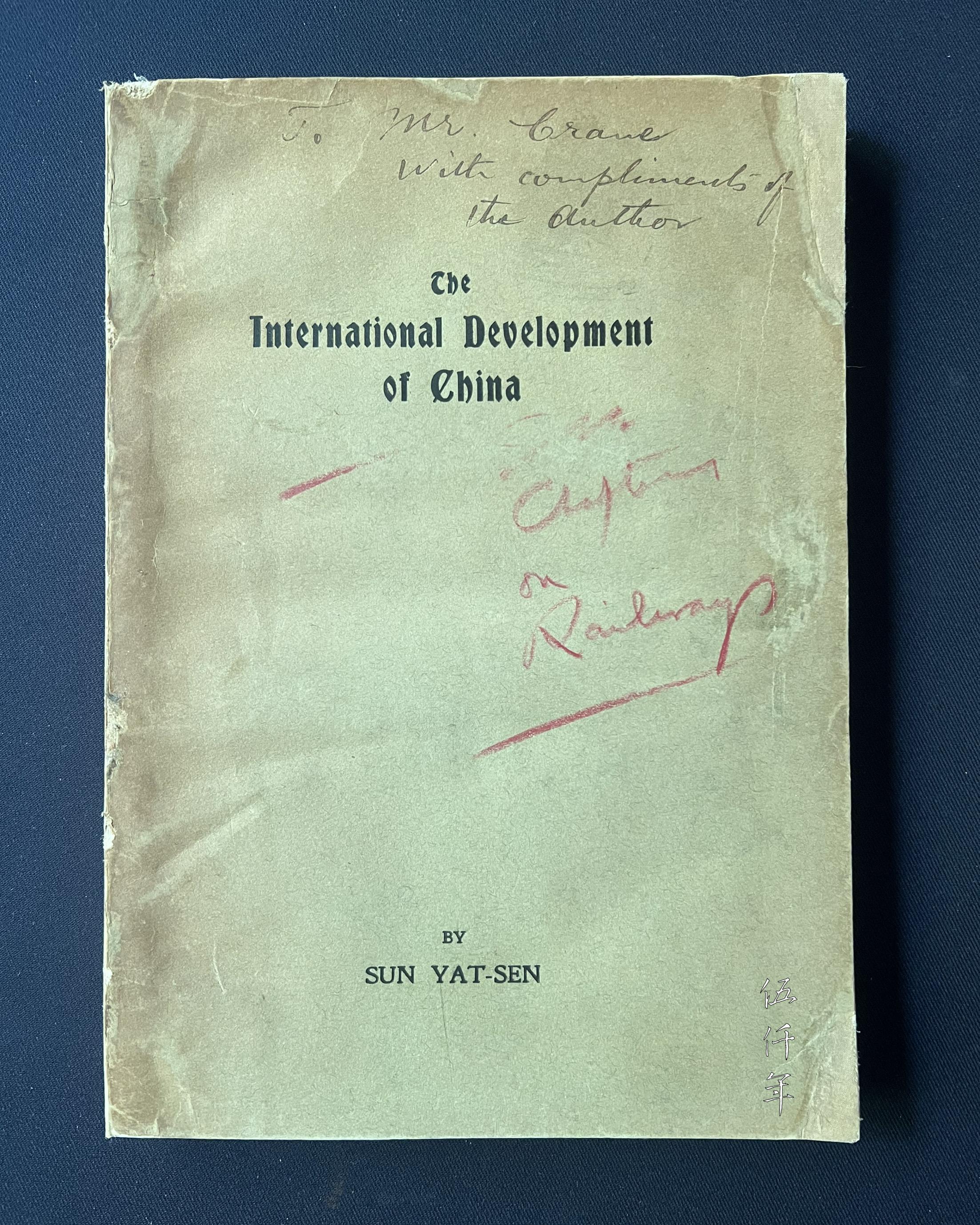
Front cover of The International Development of China. By Dr. Sun Yat-sen
In the early Republican period, the most influential English book by Chinese that impacted a whole epoch is The International Development of China (實業計劃) by Dr. Sun Yat-sen (孫中山 1866–1925), the founding father of the Republic of China. It was published in 1920.
During the Republican period in mainland China, prominent foreign-language writers include Chiang Monlin (蔣夢麟1886-1964),Tung Hsien-kuang (董顯光1887–1971), Madame Chiang Soong Mei-ling (蔣宋美齡 1898–2003), Hu Shih (胡適1891–1962), and Lin Yutang (林語堂1895–1976), among others.
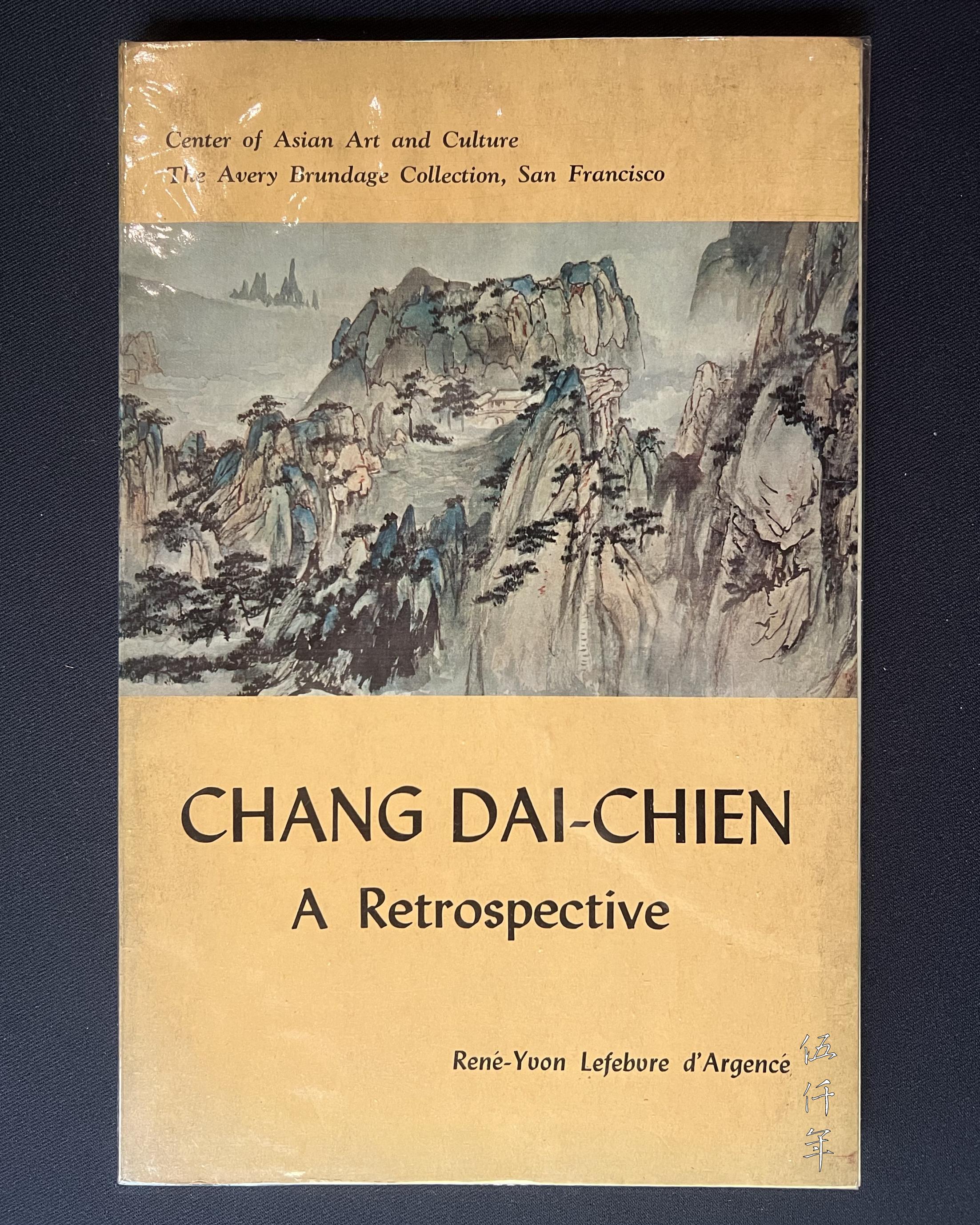
Front cover of Chang Dai-chien: A Retrospective, Centre of Asian Art and Culture, The Avery Brundage Collection, San Francisco, 11 November to 17 December 1972
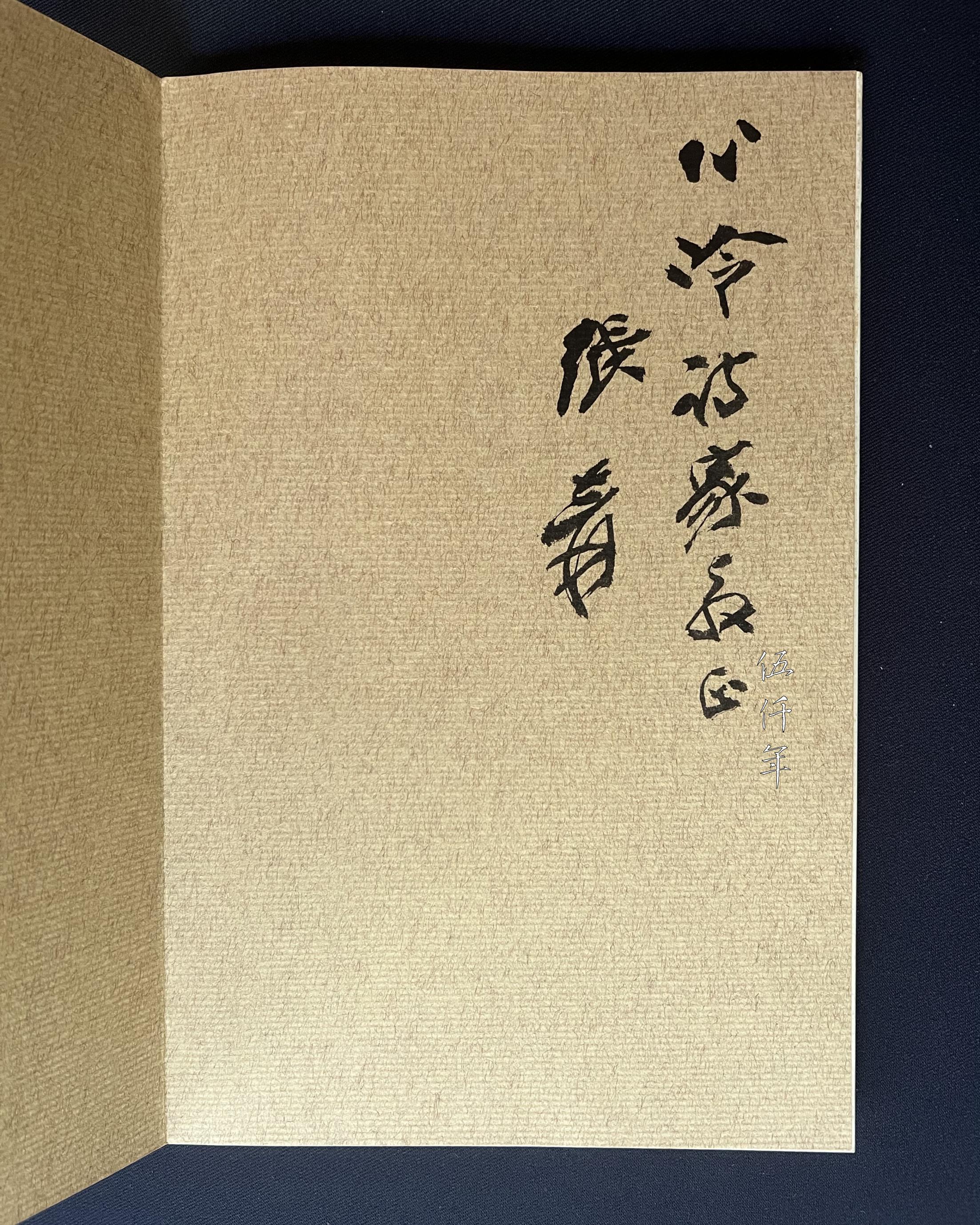
Inside page of Chang Dai-chien: A Retrospective, Centre of Asian Art and Culture, The Avery Brundage Collection, San Francisco, 11 November to 17 December 1972. Inscribed by Mr. Chang Dai-chien to Mr. Soong Hsün-leng
After the relocation of the Central Government of the Republic of China to Taiwan in 1949, many political figures, scholars, writers, and artists in Taiwan and Hong Kong wrote books in foreign languages or commissioned translations to promote Free China and to continue the transmission of Chinese Knowledge. Among them were Li Chi (李濟 1896–1979), Hsieh Shou-kang (謝壽康 1897–1973), Ch'en Ch'eng (陳誠 1898–1965), Ch'eng T'ien-fang (程天放1899–1967), Chang Dai-chien (張大千1899–1983), Chang Chi-yün (張其昀1901–1985), Hang Li-wu (杭立武1903–1991), Lo Hsiang-lin (羅香林 1906–1978), Li Kuo-ting (李國鼎 1910–2001), Chiang Wei-kuo (蔣緯國 1916–1997), and Lin Hai-yin (林海音1918–2001). The books recorded in the Catalogue only represent a tiny fraction of the total foreign-language output by Chinese authors at that time.
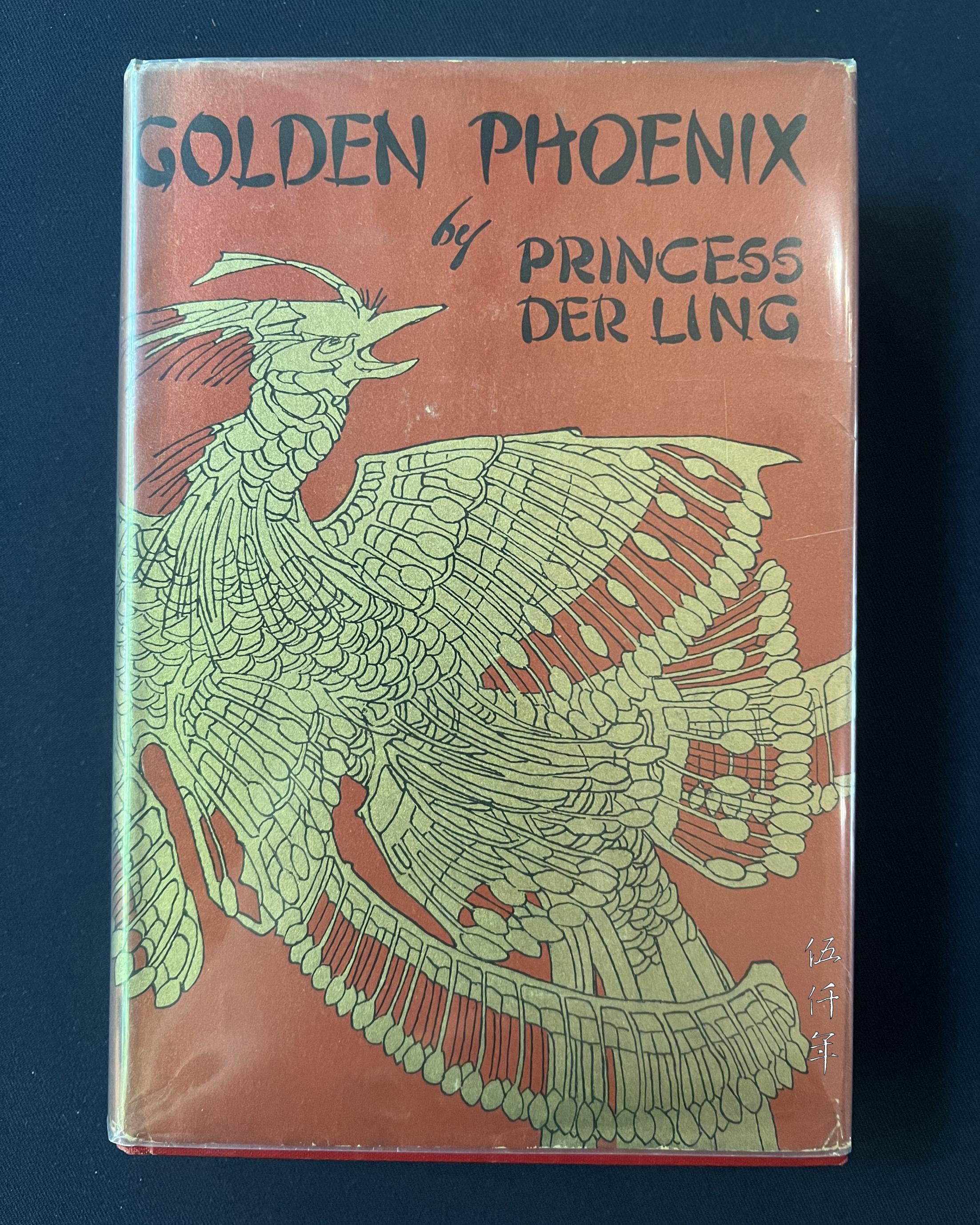
Front cover of Golden Phoenix. By Der Ling
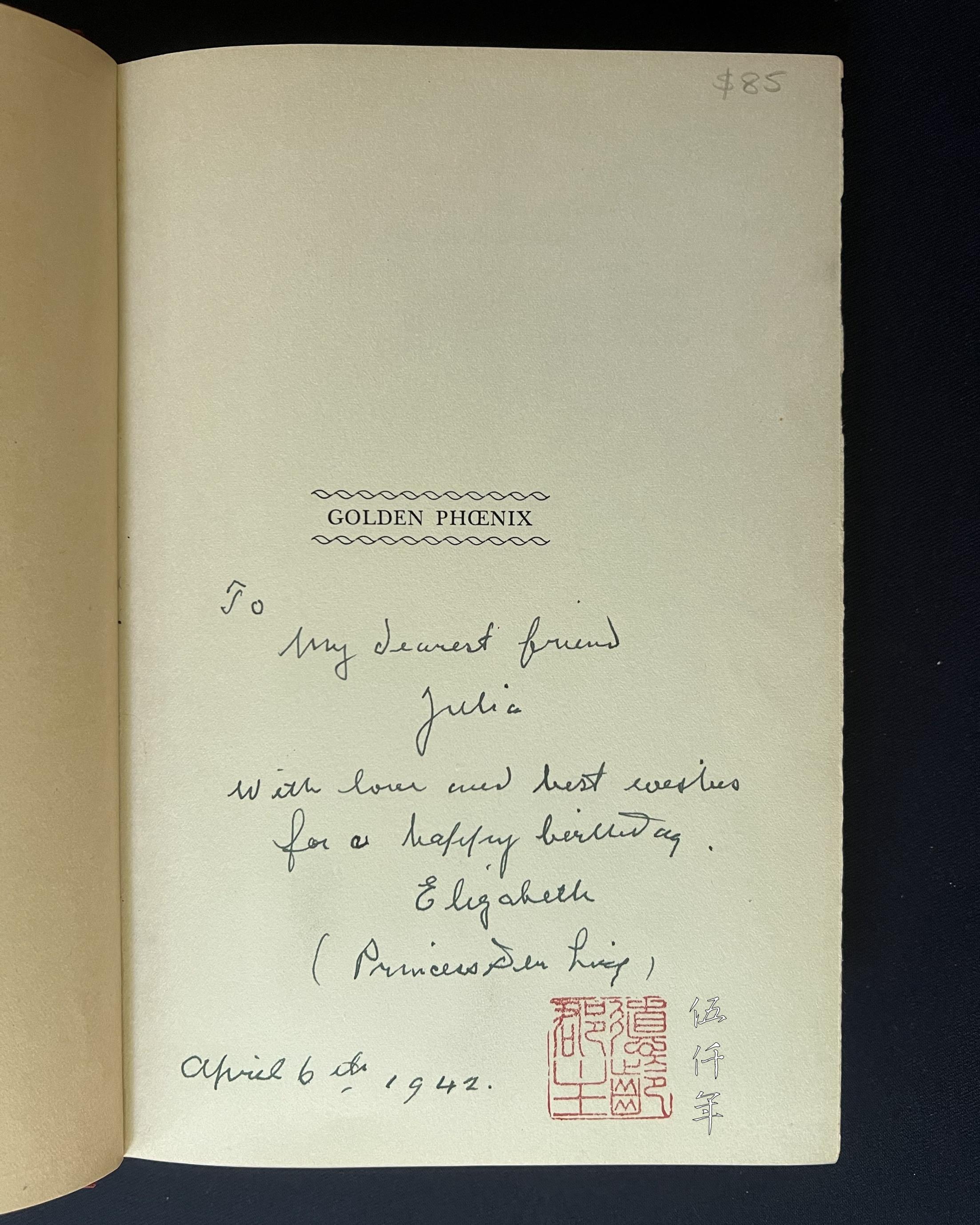
Title page of Golden Phoenix. By Der Ling
Chinese writers who lived overseas include Princess Der Ling (裕德齡公主1885–1944), Yang Buwei (楊步偉1889–1981), Huang Hui-lan (黃蕙蘭 1889–1992), Cheng Yü-hsiu (鄭毓秀1891–1959), Chang Peng-ch’un (張彭春 1892–1957), Chao Yuen Ren (趙元任1892–1982), Chiang Yee (蔣彝 1903–1977), and the playwright Hsiung Shih-yi (熊式一1902–1991), among others. Regrettably, lesser known writers can be easily overlooked. For example, Lo Kung-yuan (羅公遠), a youth member of an anti-Japanese assassination squad during the War of Resistance, wrote a book titled Nowhere Is My Home (余家何在) once he immigrated to the United States. The work provides detailed account of his comrades and their missions, supplementing the historical materials of the War of Resistance Against Japanese Aggression.
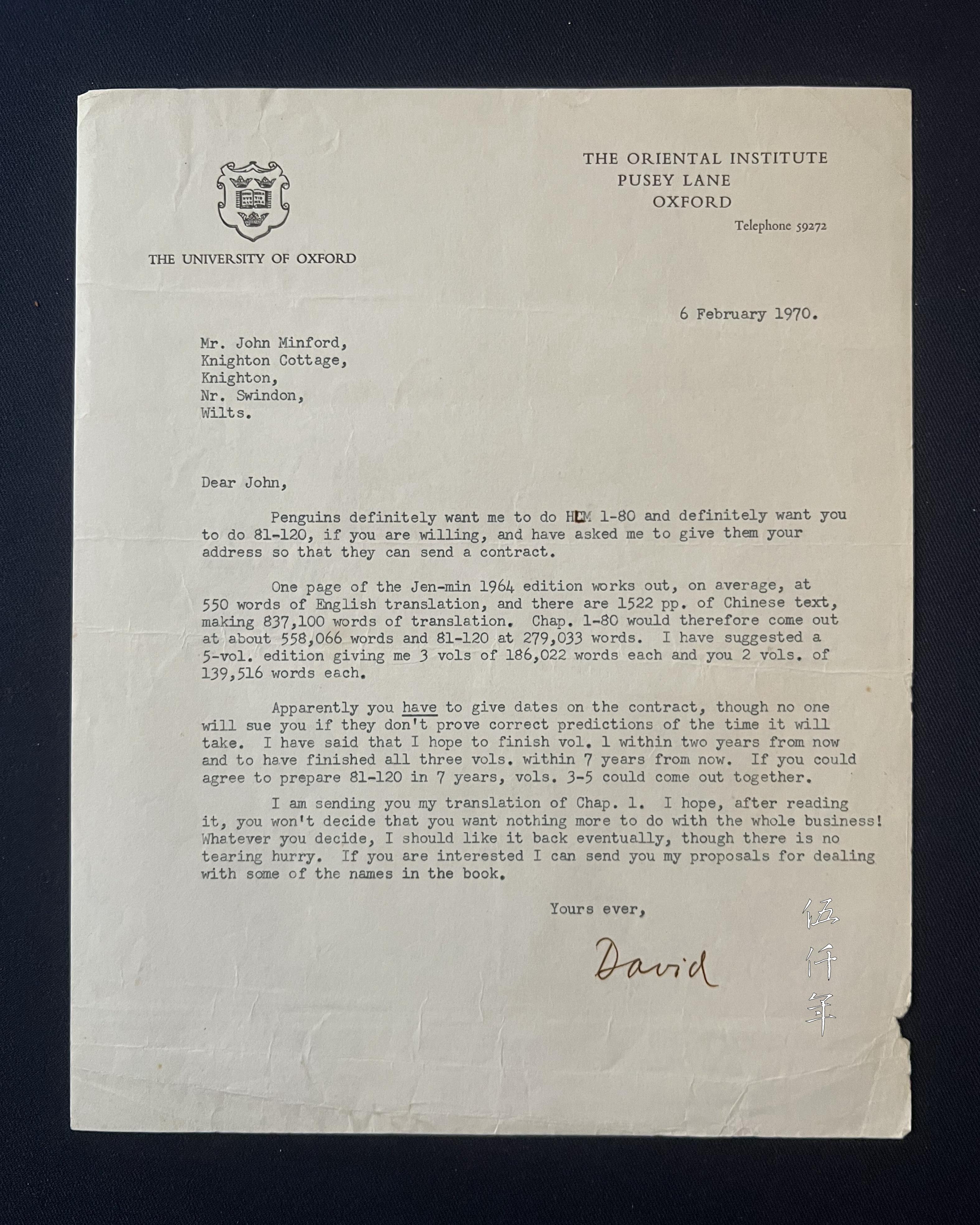
Letter by Prof. David Hawkes to Prof. John Minford, written on 6 February 1970 in Oxford
The last section of the Catalogue lists the names of Prof. David Hawkes (1923–2009), Prof. John Minford, and Prof. Pierre Ryckmans (1935–2014). Prof. Hawkes and Prof. Minford jointly translated into English The Story of the Stone (紅樓夢) by Ts’ao Hsüeh-ch’in (曹雪琴) of the Ch’ing dynasty. The three-volume English edition, issued in 1973, 1977, and 1980, stands as a lasting milestone for Chinese and English literature. Prof. Minford generously gifted over seventy letters by Prof. Hawkes along with over seventy of his response letters, many of which concern the translation of The Story of the Stone. If not for their close familial bond of in-law, such a partnership would be challenging, and the correspondences from both would not have been put together, an exceptional feat in letter collecting. In the past, the translators’ deliberations on interpretations and meanings, the painstaking searches for the right vocabularies, the laborious polishing and refining of rhetorics and phrasings, are tortuous endeavours not lightly revealed in writing. Yet this set of private correspondences document these processes in great detail, truly a treasure trove for Redology, and an invaluable chronicle of the art of translation.
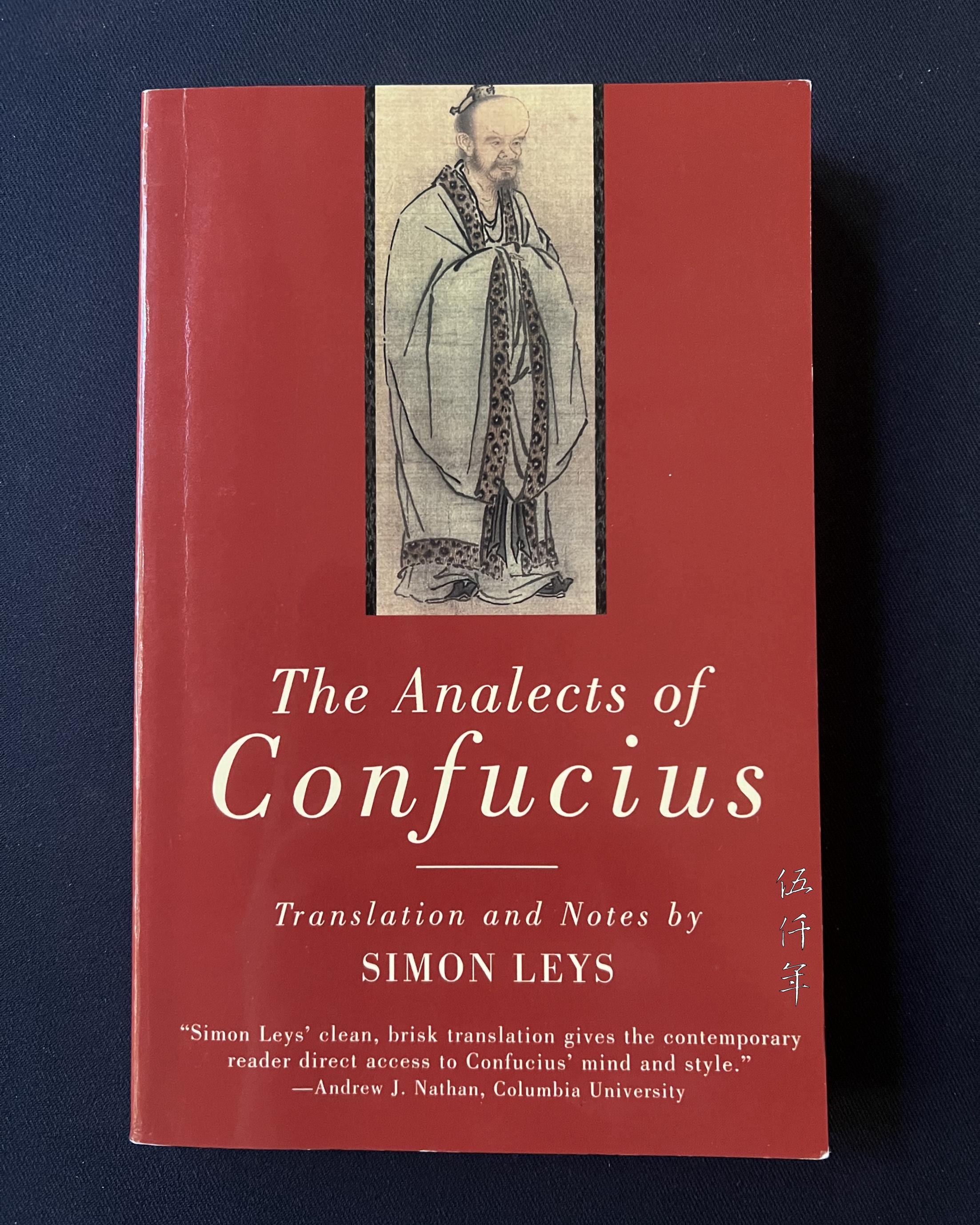
Front cover of The Analects of Confucius. Translated by Simon Leys (Pierre Ryckmans)
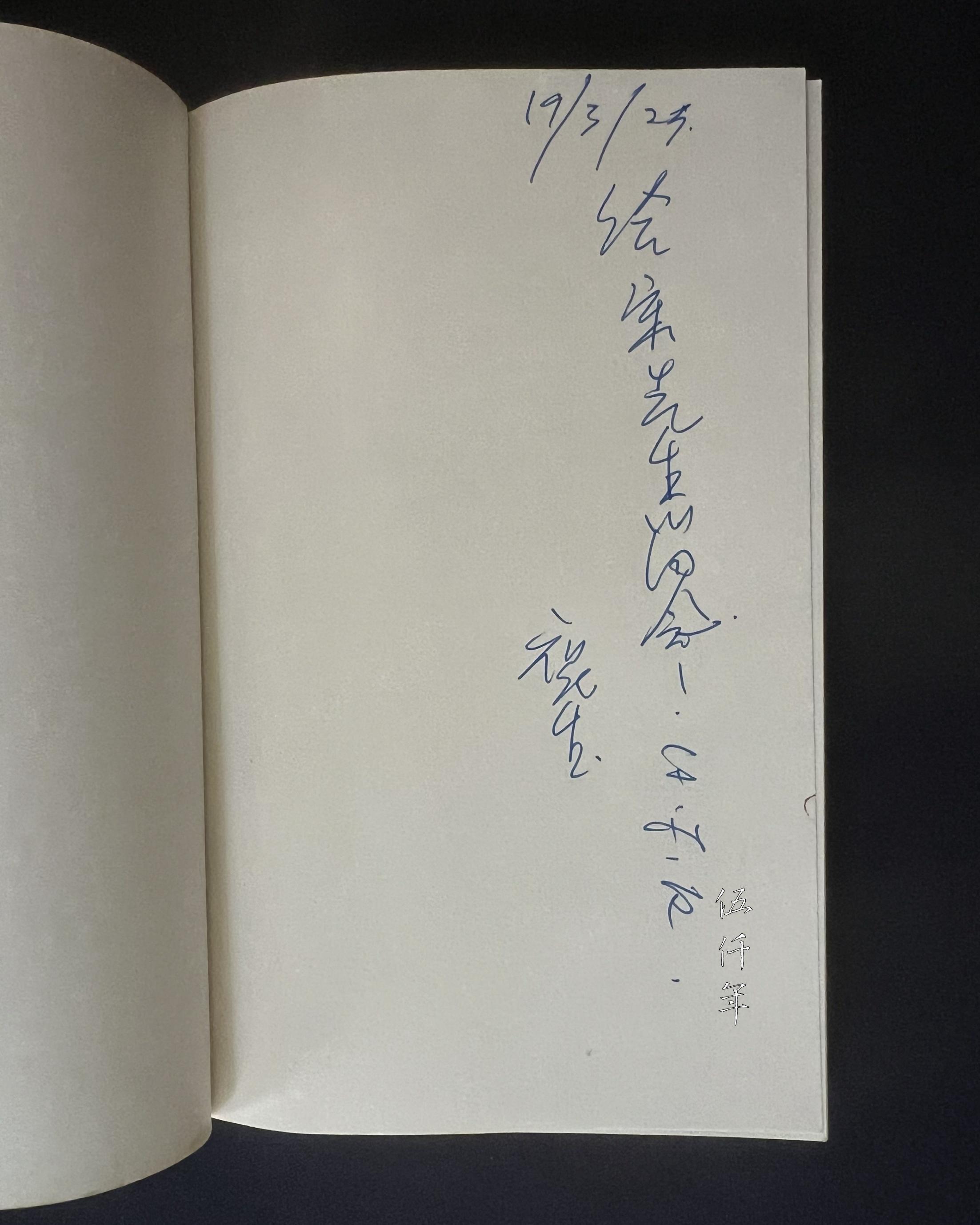
Inside page of The Analects of Confucius. Inscribed by Mrs. Hanfang Ryckmans to Soong Shu Kong
The Chinese Heritage Virtual Museum initially received some letters and postcards by Prof. Ryckmans through the generosity of his student Prof. Geremie Barmé. A few years later, Madame Chang Hanfang (張涵芳), wife of Prof. Ryckmans, made an exceptional gift of approximately seventy-five items that belonged to her late husband, including handwritten manuscripts, published works, correspondences from friends and colleagues, and other related documents. Prof. Ryckmans was the first Western scholar to reveal the violent and destructive nature of the Cultural Revolution. His English translation of The Analects of Confucius gained international acclaim, while his French writings were honoured with literary awards and adaptations for film. He may justly be regarded as a scholar steeped in both Chinese and Western traditions. Examining the world of Chinese Knowledge to the West over several decades, some overseas scholars have drawn on both political and cultural perspectives to better interpret China. Prof. Ryckmans and Prof. Yu Ying-shih (余英士) are exemplary figures in this school of thought.
Voyage of Sinology from East to West: Catalogue of Letters, Books and Artefacts of Western and Chinese Personages Across Three Centuries can be fairly criticized for being flawed and shallow, inadequate to outline the personages and scholarships of the past three centuries. Regrettably my frail labour can only proceed so far, and it has nearly reached its limits. Even if more years are allocated to improve the Catalogue, it will likely be rewarded with the slightest of progress. Hence I humbly present the Catalogue with all its shortcomings to fellow enthusiasts, merely confident that it is fitting for Chinese Knowledge to thrive in the world beyond the oceans.
目錄
Catalogue
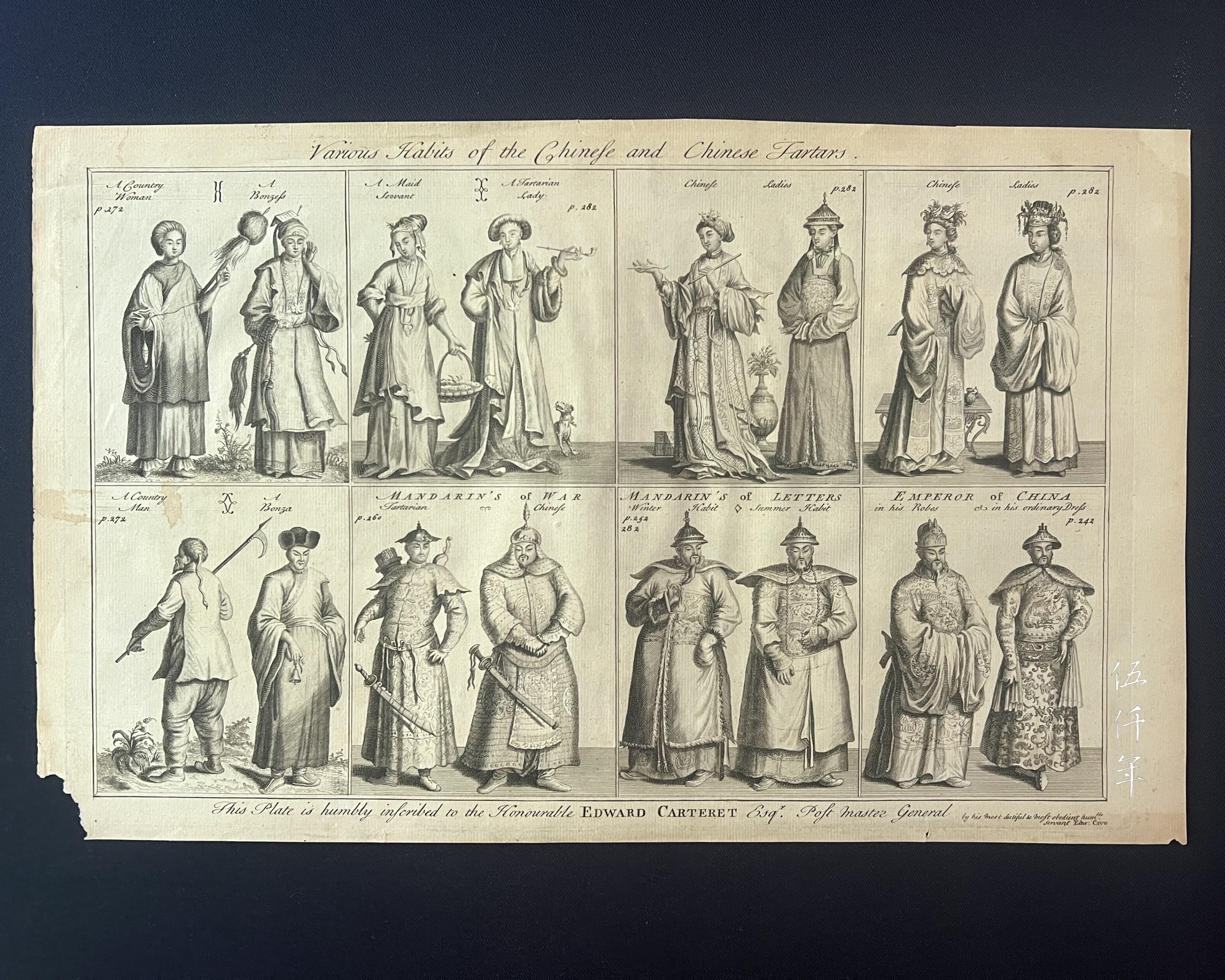
An illustration titled Various Habits of the Chinese and Chinese Tartars 1738. Dedicated by the publisher Edward Cave
(1) Jean-Baptiste Du Halde 1674 – 1743 (杜赫德)
(1-1) A dedicated illustration from The General History of China: Containing a Geographical, Chronological, Political and Physical Description of the Empire of China, Chinese – Tartary, Corea, and Thibet. Including an Exact and Particular Account of Their Customs, Manners, Ceremonies, Religion, Arts and Sciences. Title of illustration: Various Habits of the Chinese and Chinese Tartars, 1738. Dedicated by the publisher Edward Cave (1691-1754).
(2) Johann Friedrich Böttger 1682 – 1719 (貝特格)
(2-1) Portrait of Johann Friedrich Bottger, circa 1720.
(2-2) Dessin du Cabinet de Porcelaine á Charlottenbourg du coté de l'entrée, printed in 1717.
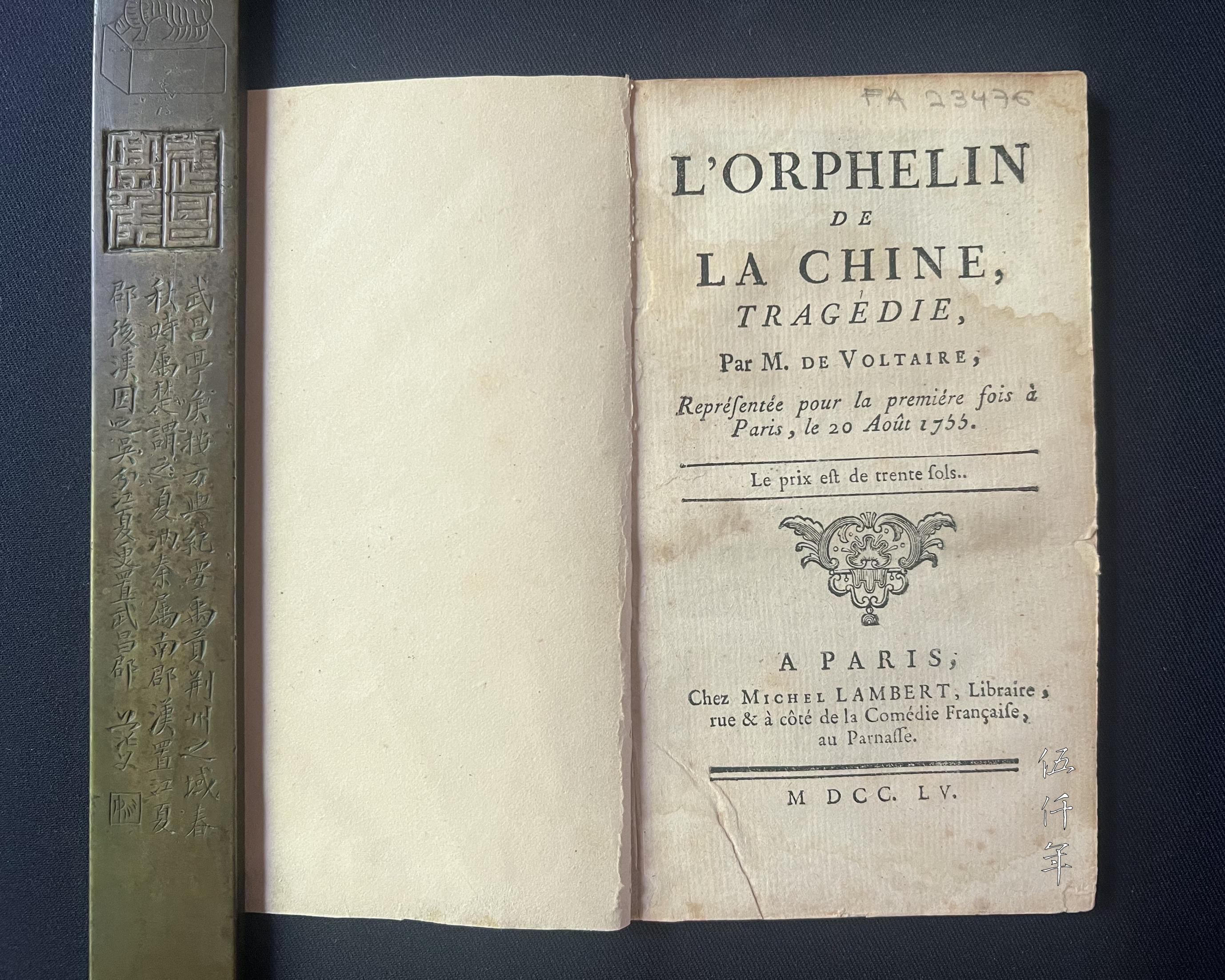
Theatre programme of L'Orphelin de la Chine, Tragedie, Paris, Le 20 Aout 1755. Play by Voltaire
(3) François-Marie Arouet, nom de plume Voltaire, 1694 – 1778 (伏爾泰)
(3-1) Theatre programme titled: L'Orphelin de la Chine, Tragédie , Paris, Le 20 Aout 1755.
(4) Joseph de Guignes 1721 – 1800 (德金)
(4-1) Letter in French by Joseph de Guignes on the meaning of a Chinese seal, with seal impression on wax, a hand written seal layout, a piece of paper with the character miao (緲),and a piece of paper with some drawn brackets.
(5) Sir William Chambers 1723 – 1796 (威廉‧錢伯斯爵士)
(5-1) Portrait of Sir William Chambers by D. P. Pariset (1740-active 1783), after Pierre-Etienne Falconet (1741-1791) stipple engraving, 1769.
(5-2) Print of the Chinese Pagoda in Kew Gardens designed by William Chambers, circa 1832.
(5-3) Photograph of the Chinese Pagoda in Kew Gardens designed by William Chambers, circa 1875.
(6) Arthur Murphy, nom de plume Charles Ranger, 1727 – 1805 (亞瑟‧墨菲)
(6-1) Theatre programme titled: The Orphan of China: a Tragedy, as it is Performed at the Theatre-Royal, in Drury-Lane 1759.
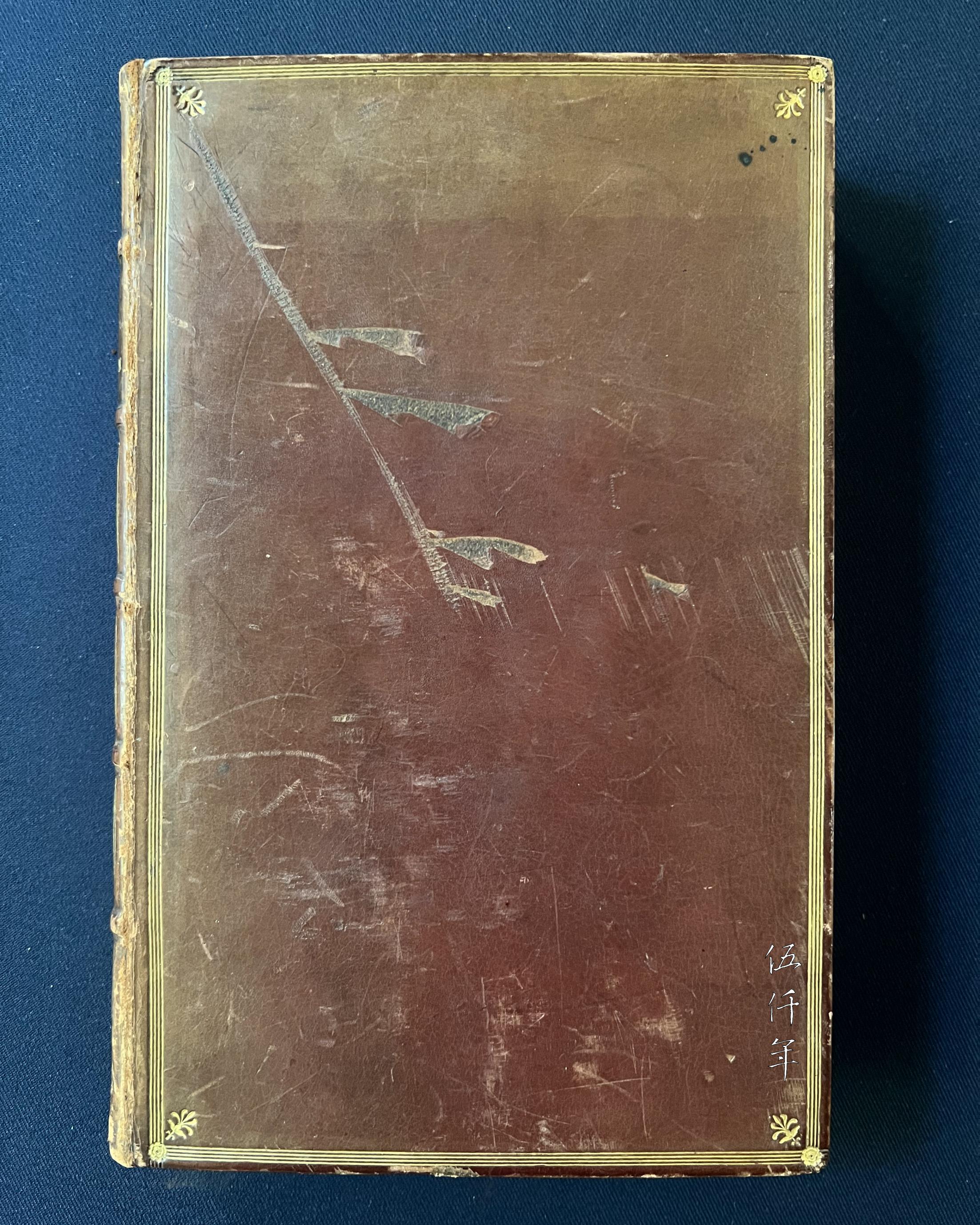
Front cover of Memoir of the Life and Family of the Late Sir George Leonard Staunton, Bart. By George Leonard Staunton
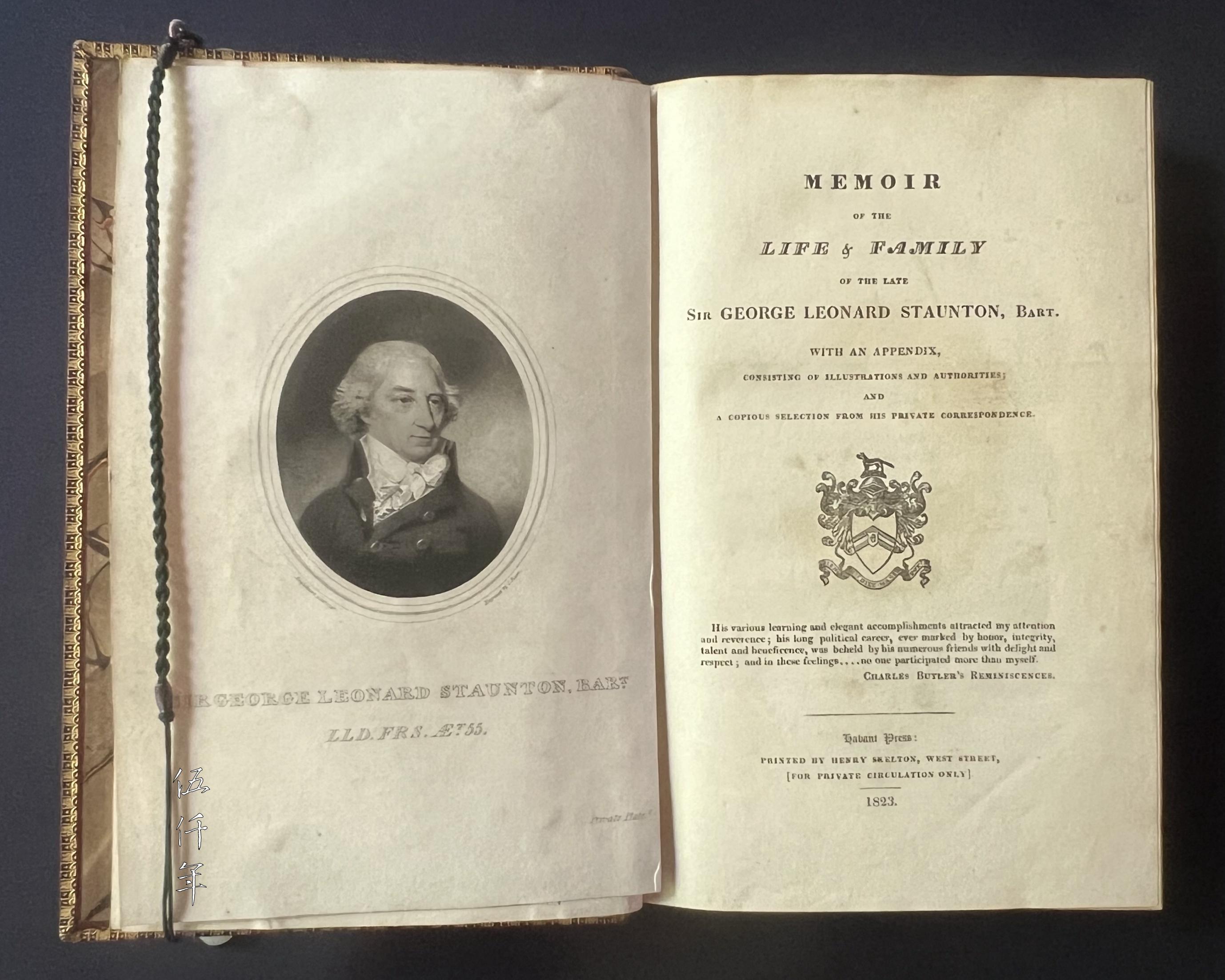
Title page of Memoir of the Life and Family of the Late Sir George Leonard Staunton, Bart. By George Leonard Staunton
(7) Sir George Leonard Staunton, 1st Baronet, 1737 –1801 (喬治‧倫納德‧斯當東男爵)
(7-1) Memoir of the Life and Family of the Late Sir George Leonard Staunton, Bart. With an Appendix, Consisting of Illustrations and Authorities; and a Copious Selection from His Private Correspondence. London: Henry Skelton, 1823. First copy, made from the proof sheets. Inscribed by the son George Thomas Staunton.
(8) Chrestien-Louis-Joseph de Guignes 1759 – 1845 (小德金)
(8-1) Letter in French by Christine-Louis-Joseph de Guignes to J. J. A. Caussin de Perceval (1759-1835), orientalist and keeper of the manuscript section of the French Royal Library since 1787, written in Paris, dated 31 December 1790.
(9) David Weiss 1775 – 1848 (大衛‧魏斯)
(9-1) A Tea Garden by David Weiss, printed in 1880.
(10) Sir George Thomas Staunton, 2nd Baronet, 1781 – 1859 (喬治‧湯瑪斯‧斯當東男爵)
(10-1) Letter by George Thomas Staunton, written in London, dated 30 November 1829.
(10-2) Letter by George Thomas Staunton, written in London, dated 5 March 1849.
(11) Nathan Dunn 1782 – 1844 (內森‧鄧恩)
(11-1) Ten Thousand Chinese Things – A Descriptive Catalogue of the Chinese Collection in Philadelphia with Miscellaneous Remarks upon the Manners, Customs, Trade, and Government of the Celestial Empire. Philadelphia: Printed for the Proprietor, 1839.
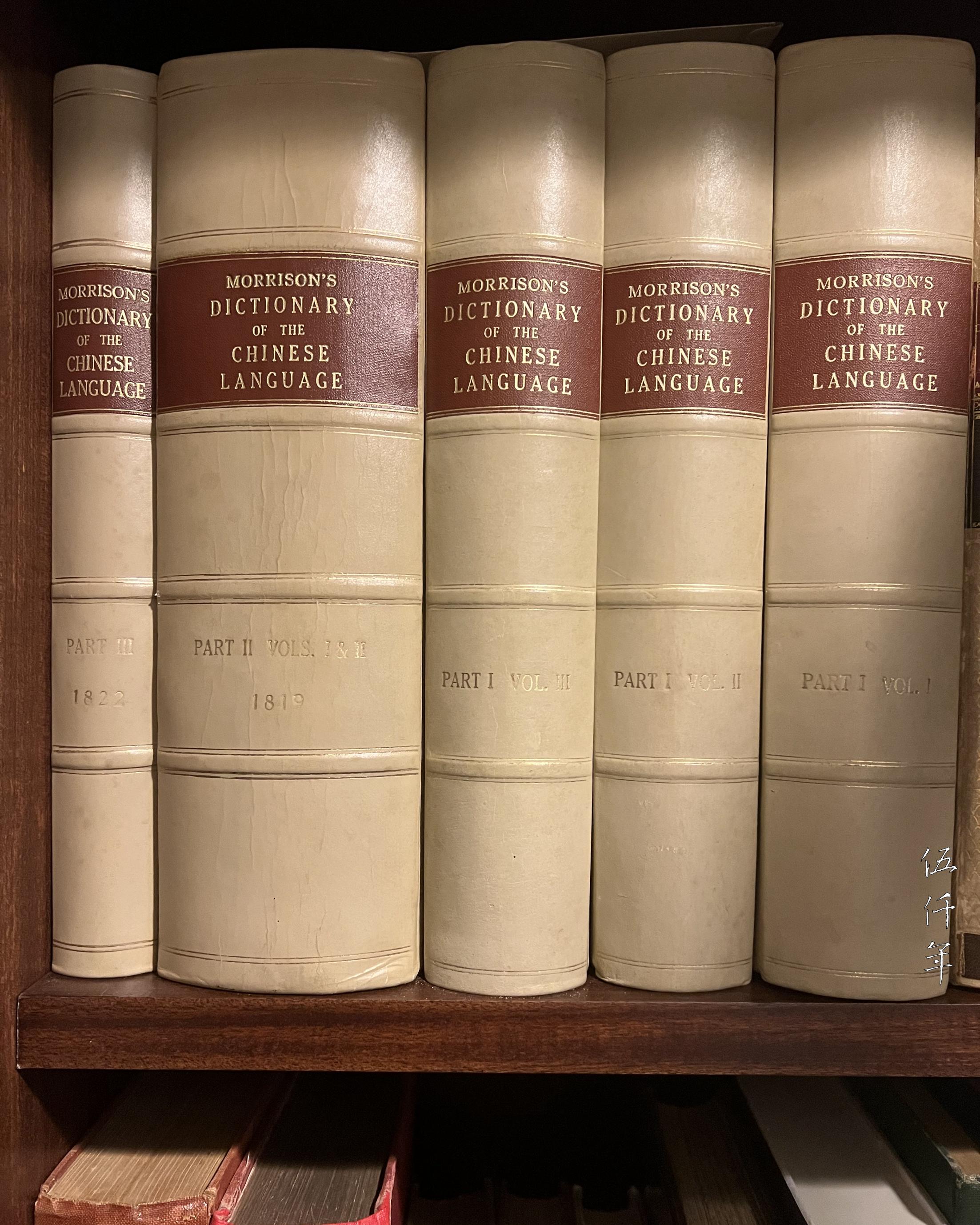
A set of Dictionary of the Chinese Language in Three Parts. Compiled by Robert Morrison
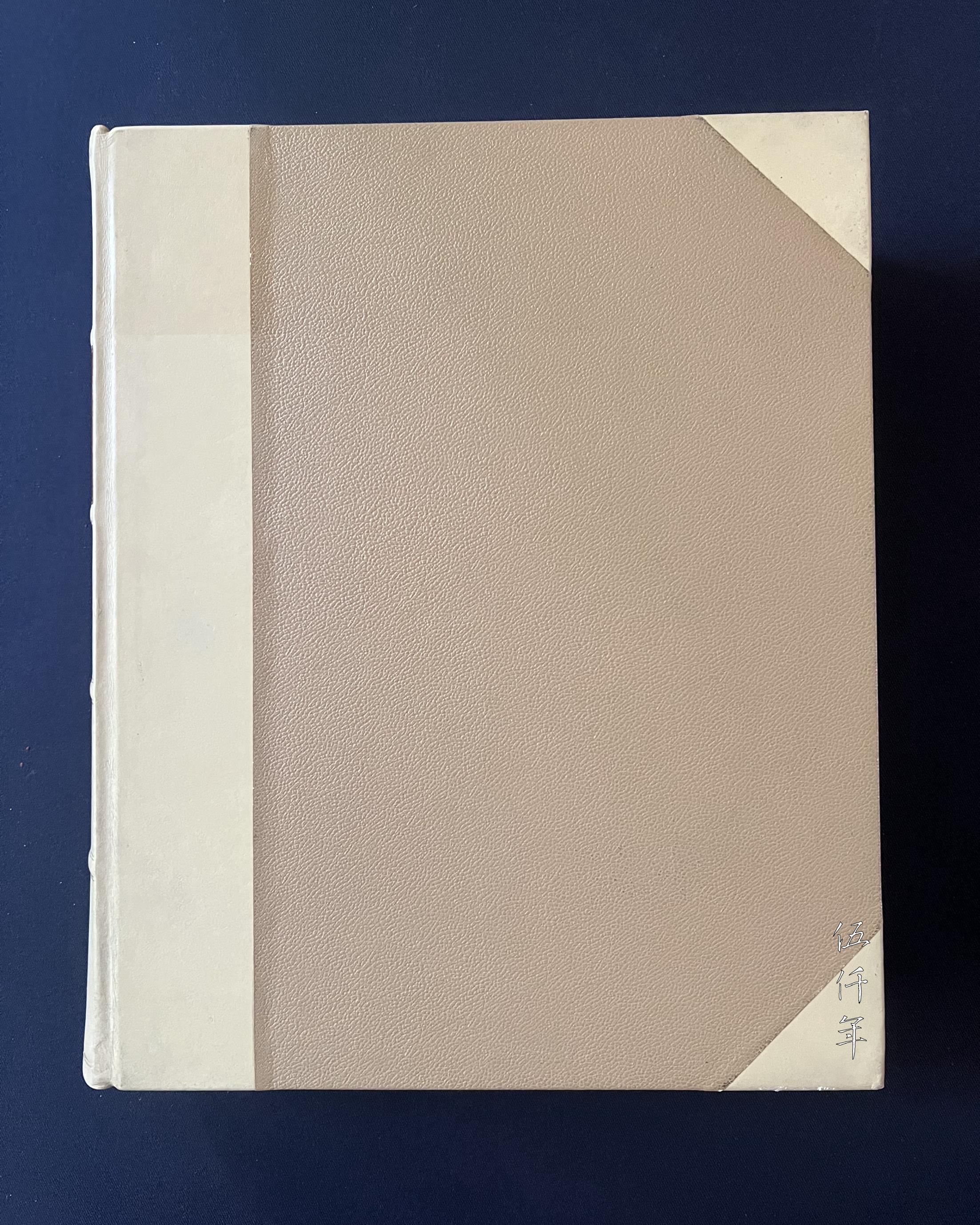
Front cover of first volume of Dictionary of the Chinese Language in Three Parts. Compiled by Robert Morrison
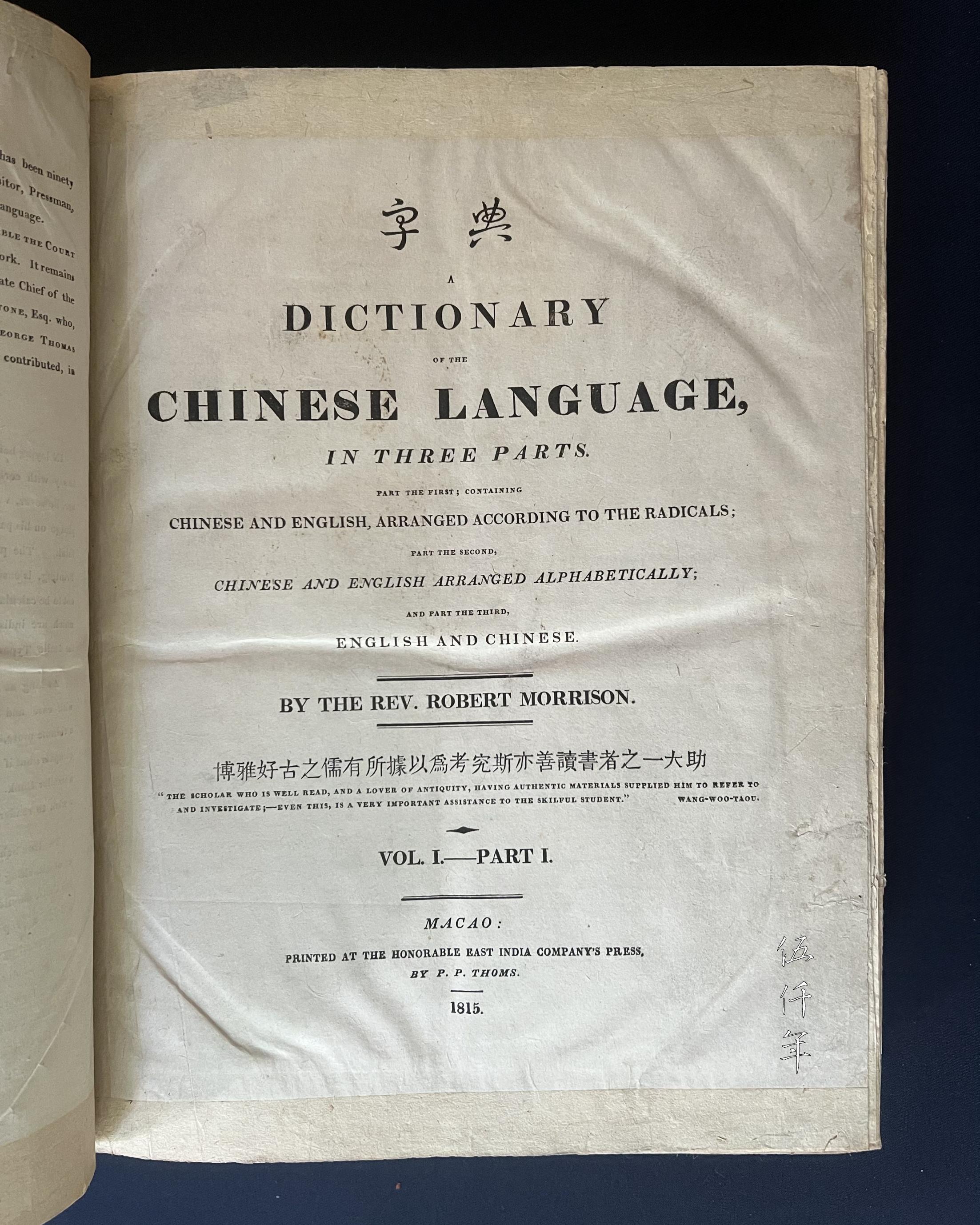
Title page of Dictionary of the Chinese Language in Three Parts. Compiled by Robert Morrison
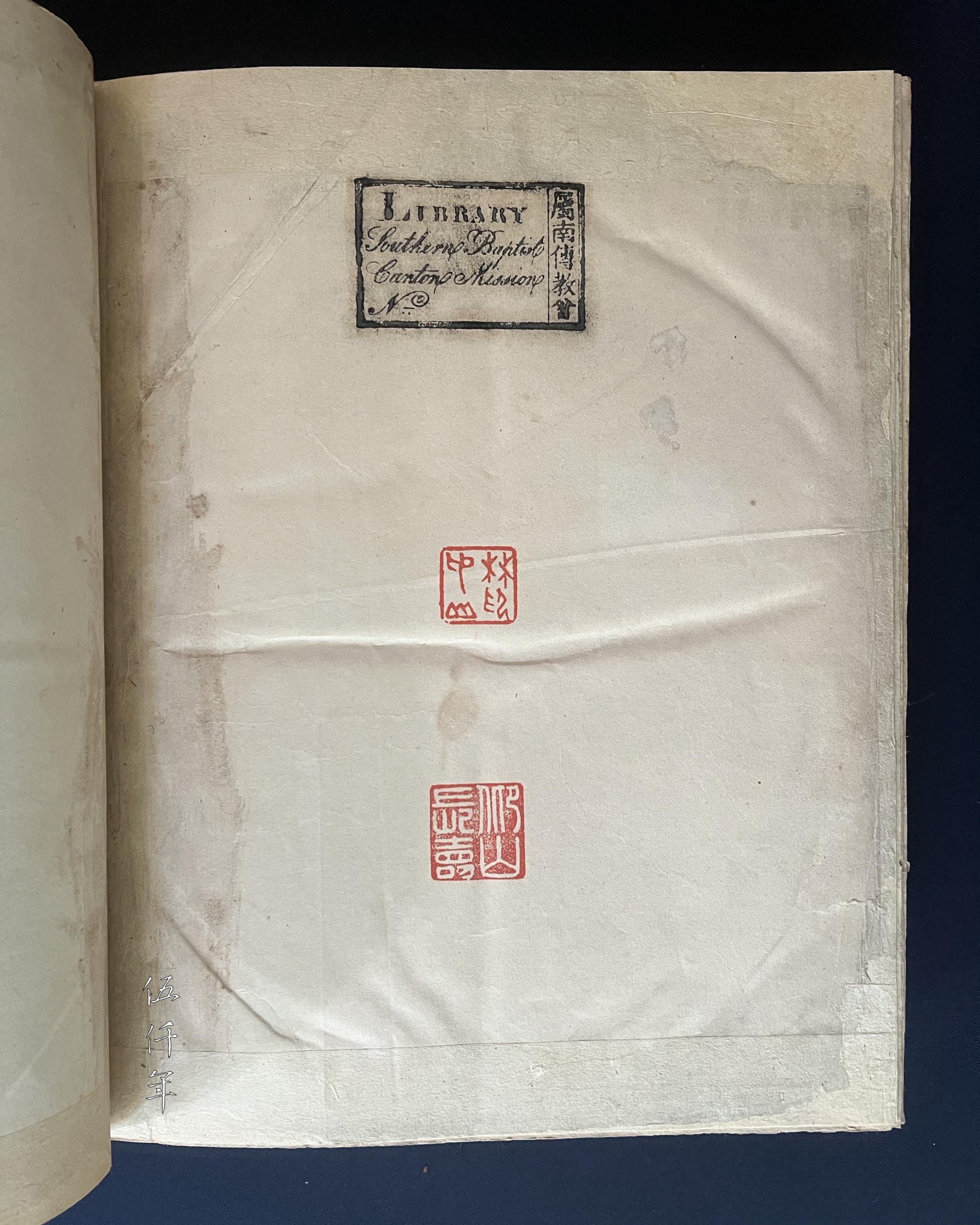
Inside page of Dictionary of the Chinese Language in Three Parts. Compiled by Robert Morrison
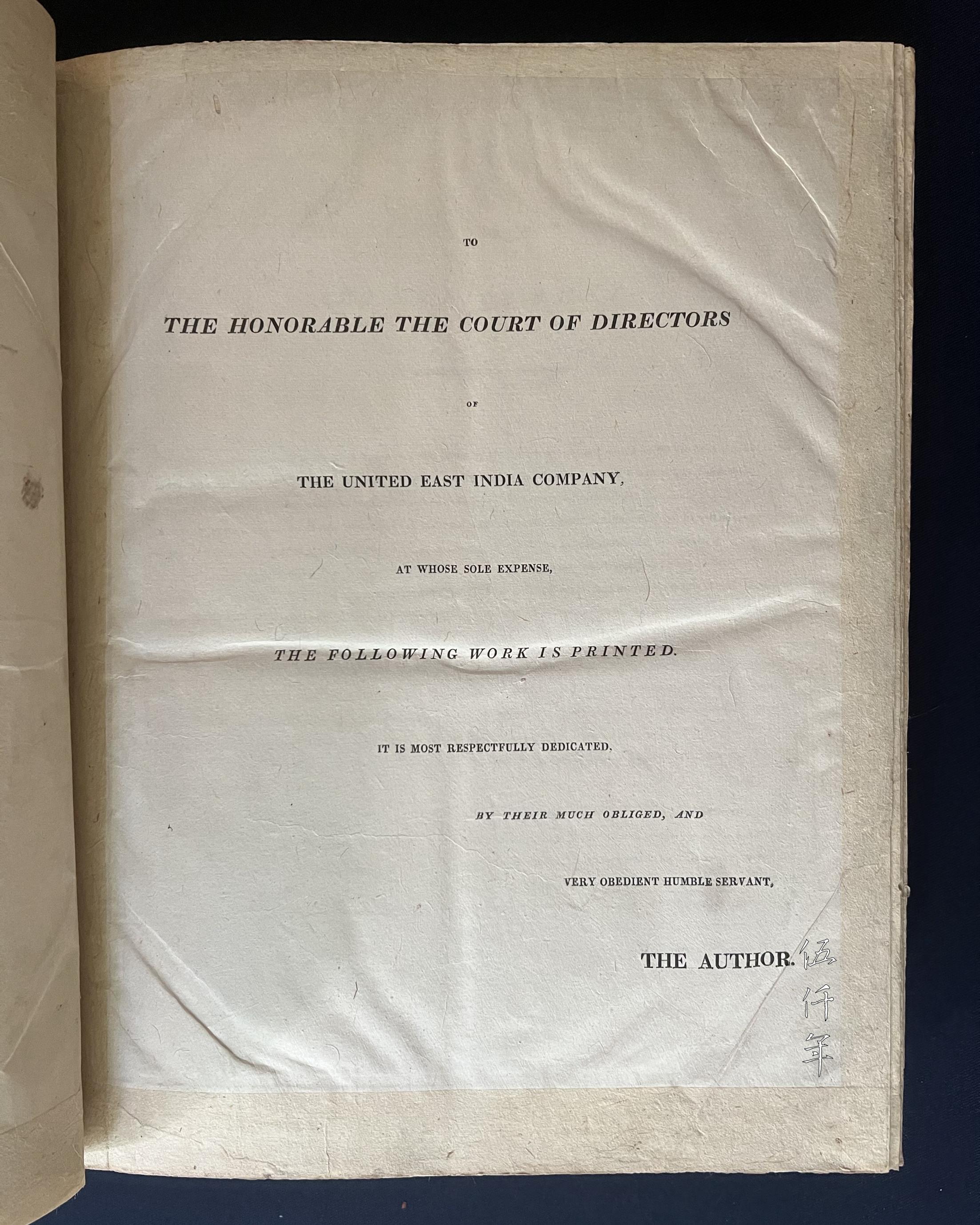
Inside page of Dictionary of the Chinese Language in Three Parts. Compiled by Robert Morrison
(12) Robert Morrison 1782 – 1834 (馬禮遜)
(12-1) Picture of Robert Morrison and helpers, circa 1840.
(12-2) Dictionary of the Chinese Language in Three Parts. Macao: The Honorable East India Company's Press, 1815. First edition.
(13) Jean-Pierre Abel-Rémusat 1788 – 1832 (雷暮沙)
(13-1) Letter in French by Jean-Pierre Abel-Remusat, written in Paris, dated 1 October 1828.
(13-2) Letter in French by Jean-Pierre Abel-Remusat.
(14) Walter Henry Medhurst 1796 – 1857 (麥都思)
(14-1) Print of Walter H. Medhurst, Choo Tih Lang and a Malay Boy, 1838.
(14-2) Letter by Walter H. Medhurst, written in London, dated 12 May 1847. Gifted by Attorney Roy Ian Delbyck.
(14-3) Notebook inscribed in English and Chinese by Walter H. Medhurst and Choo Tih Lang.
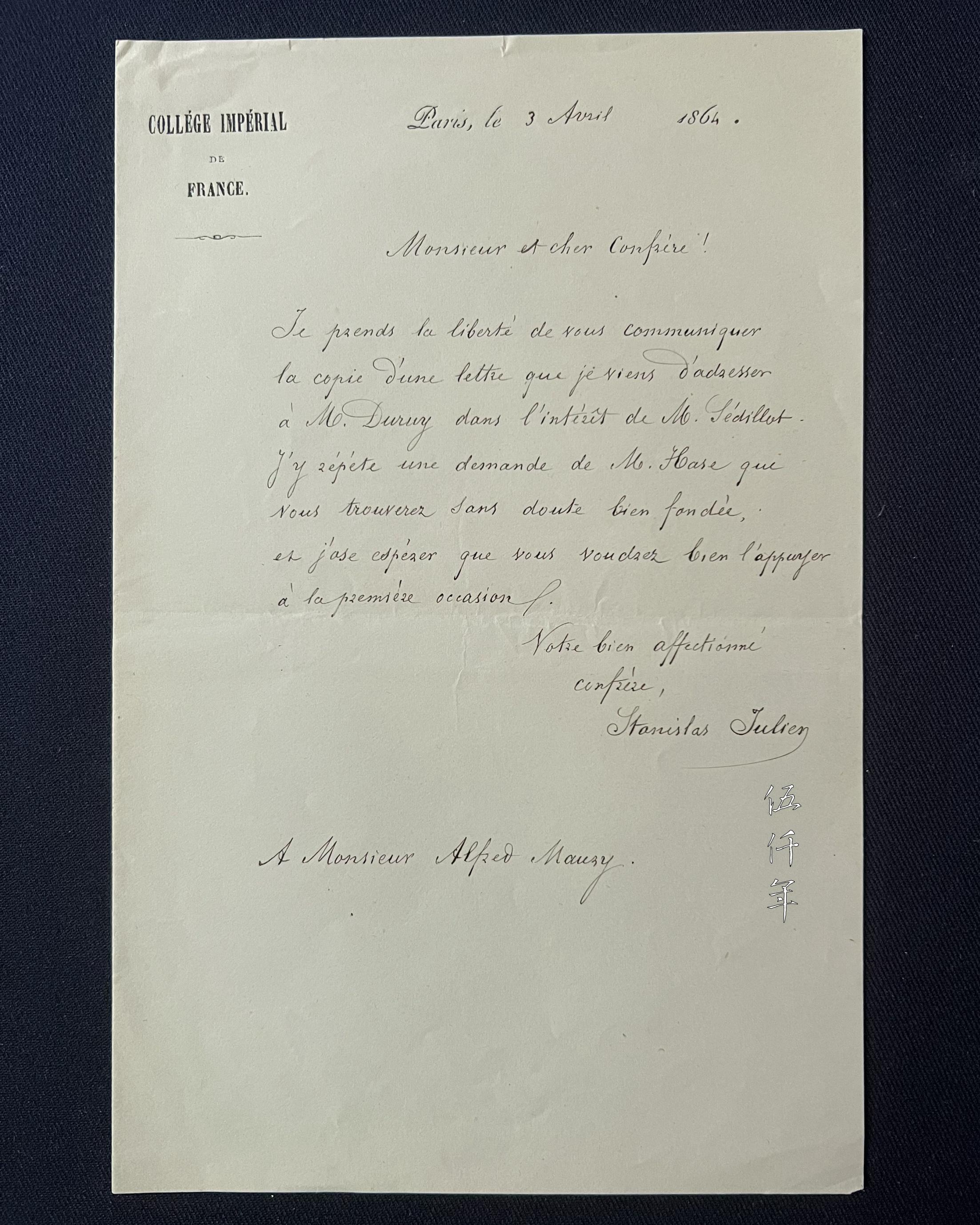
Letter by Stanislas Aignan Julien to Louis Ferdinand Alfred Maury, written on 3 April 1864 in Paris
(15) Stanislas Aignan Julien 1797 – 1873 (儒蓮)
(15-1) Nine letters in French by Stanislas A. Julien to Louis Ferdinand Alfred Maury (1817-1892), librarian of the Bibliotheque de l'institut de France, later of the Tuileries, and from 1862 onwards professor at the College de France. The nine letters are dated from 14 October 1851 to 21 June 1864.
(15-2) Letter in French by Stanislas A. Julien, dated 13 August 1868.
(16) Wilhelm Schott 1802 – 1889 (威廉‧碩特)
(16-1) Nachrichten von Mongolen und Tataren. Berlin: Konigliche Akademie der Wissenschaften in Commission bei Ferd. Fummler's Verlags-Buchhandlung, 1845. Signed by the author.
(17) Samuel Kidd 1799 – 1843 (修德,又譯塞繆爾‧基德)
(17-1) China. London: Taylor & Walton, 1841. First edition. Inscribed by the author to Mr. & Mrs. Tough, dated 28 December 1847.
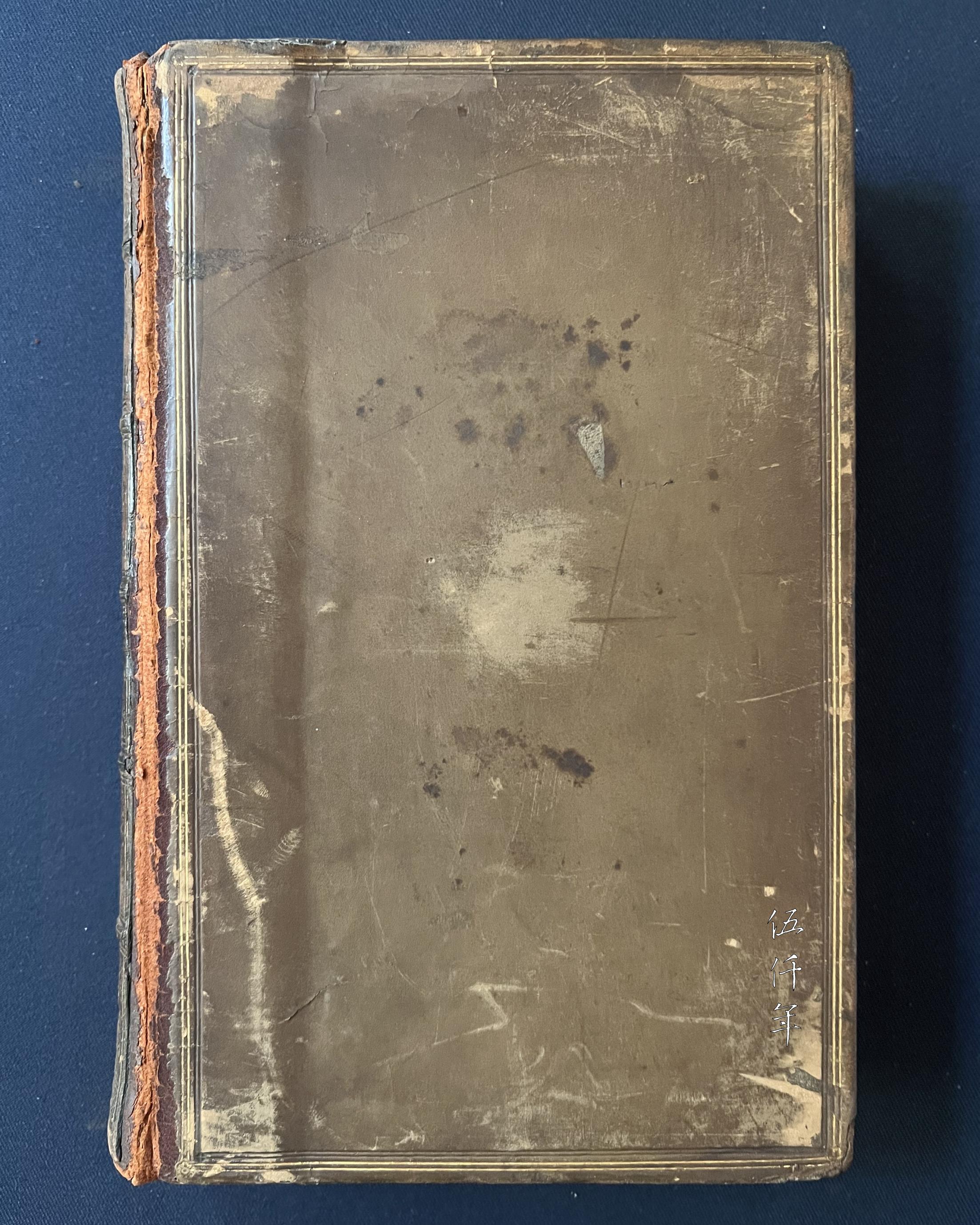
Front cover of Three Years’ Wanderings in the Northern Provinces of China, Including a Visit to the Tea, Silk, and Cotton Countries; With an Account of the Agriculture and Horticulture of the Chinese, New Plants, Etc. By Robert Fortune
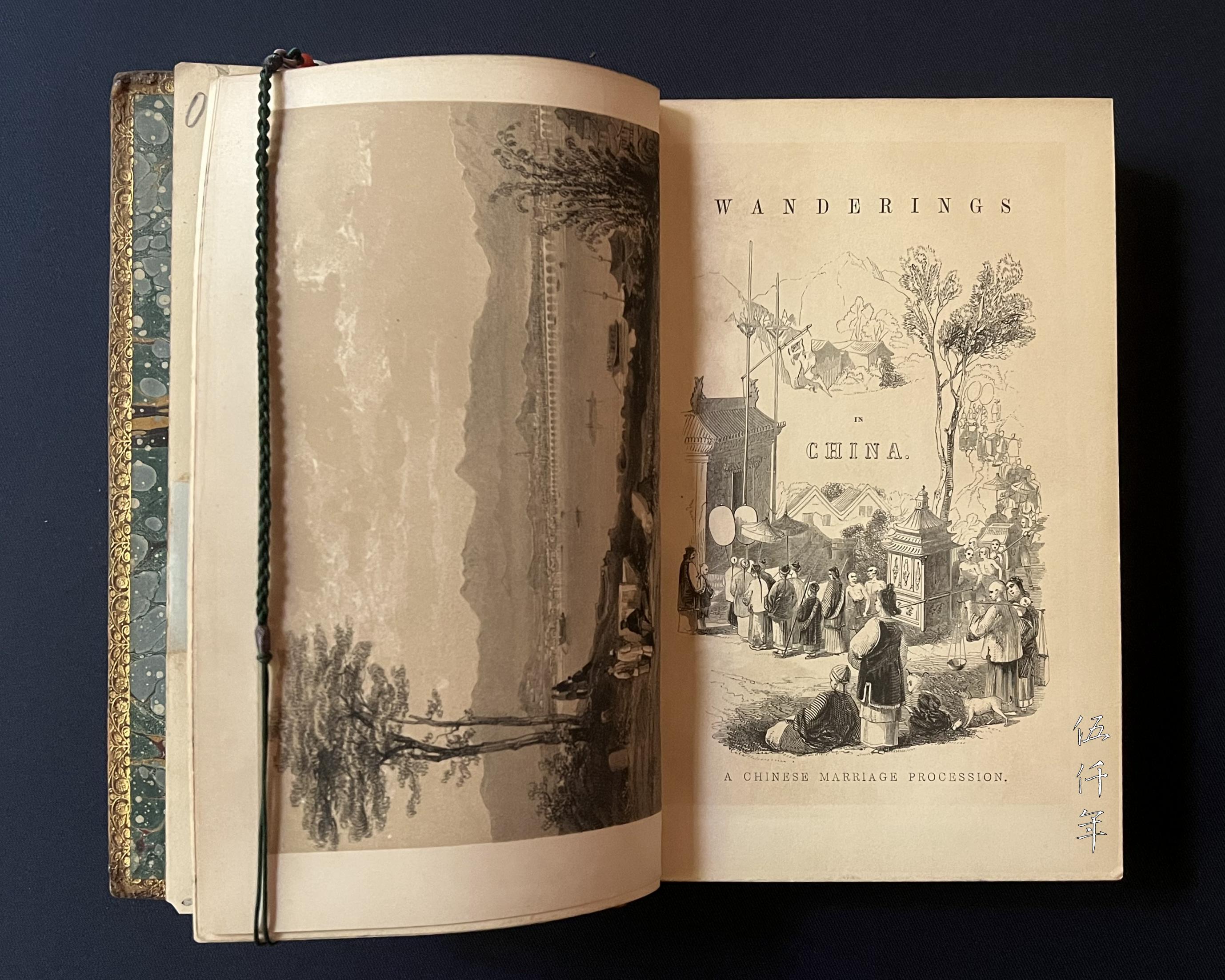
Title page of Three Years' Wanderings in the Northern Provinces of China, Including a Visit to the Tea, Silk, and Cotton Countries; With an Account of the Agriculture and Horticulture of the Chinese, New Plants, Etc. By Robert Fortune
(18) Robert Fortune 1812-1880 (羅伯特‧福鈞,又譯羅伯特‧福瓊)
(18-1) Three Years' Wanderings in the Northern Provinces of China, Including a Visit to the Tea, Silk, and Cotton Countries; With an Account of the Agriculture and Horticulture of the Chinese, New Plants, Etc. London: Murray, 1847. First edition. Inscribed by the author.
(19) Samuel Wells Williams 1812 – 1884 (衛三畏)
(19-1) Original photograph of Samuel Wells Williams, an extract from The Far East Journal, December 1876, Vol. 1.
(20) Father Évariste Régis Huc 1813 – 1860 (古伯察神父)
(20-1) Document in French from Pope Gregory XVI to grant Evariste R. Huc the right to erect devotional works related to the Stations of the Cross, dated 7 February 1839.
(20-2) French Imperial Decree to award the Legion of Honour (Knight) to Evariste R. Huc while Napoleon III also appointed him advisor on China, dated 1853.
(20-3) French passport of Evariste R. Huc for traveling to England in 1854 and to Saxony in 1856.
(20-4) Official documents from the Ministry of the Interior in France, to acknowledge that Evariste R. Huc had deposited a two volume duplicate book titled Recollections of the Journey Through Tartary, Tibet and China in 1844,1845 and 1846. Duplicate book was delivered on 16 July 1856.
(20-5) A copy of the Birth Certificate of daughter Felix Stephanie Regis Huc, dated 1809.
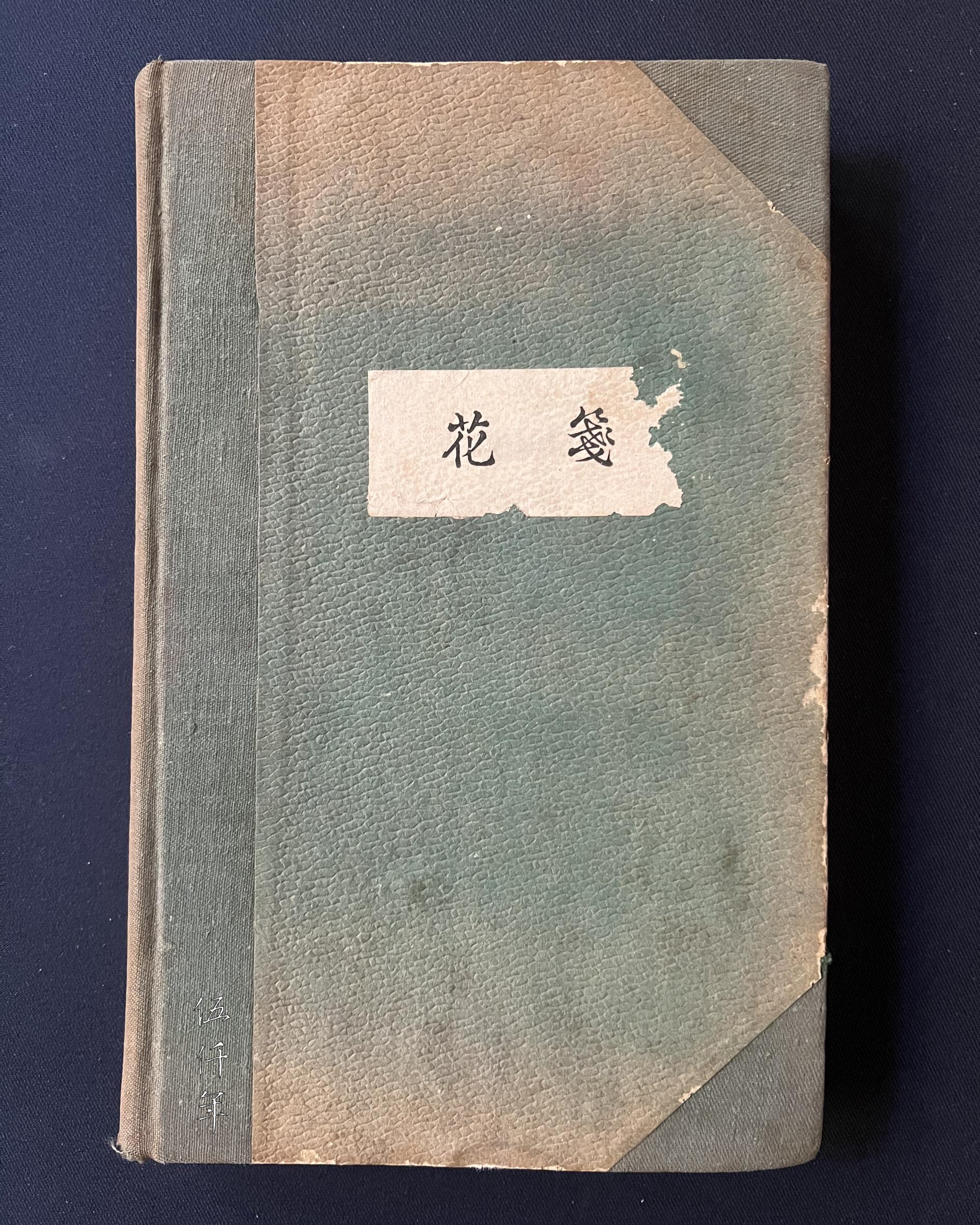
Front cover of Hwa-Tseen, The Flower's Leaf. Translated by Peter Perring Thoms
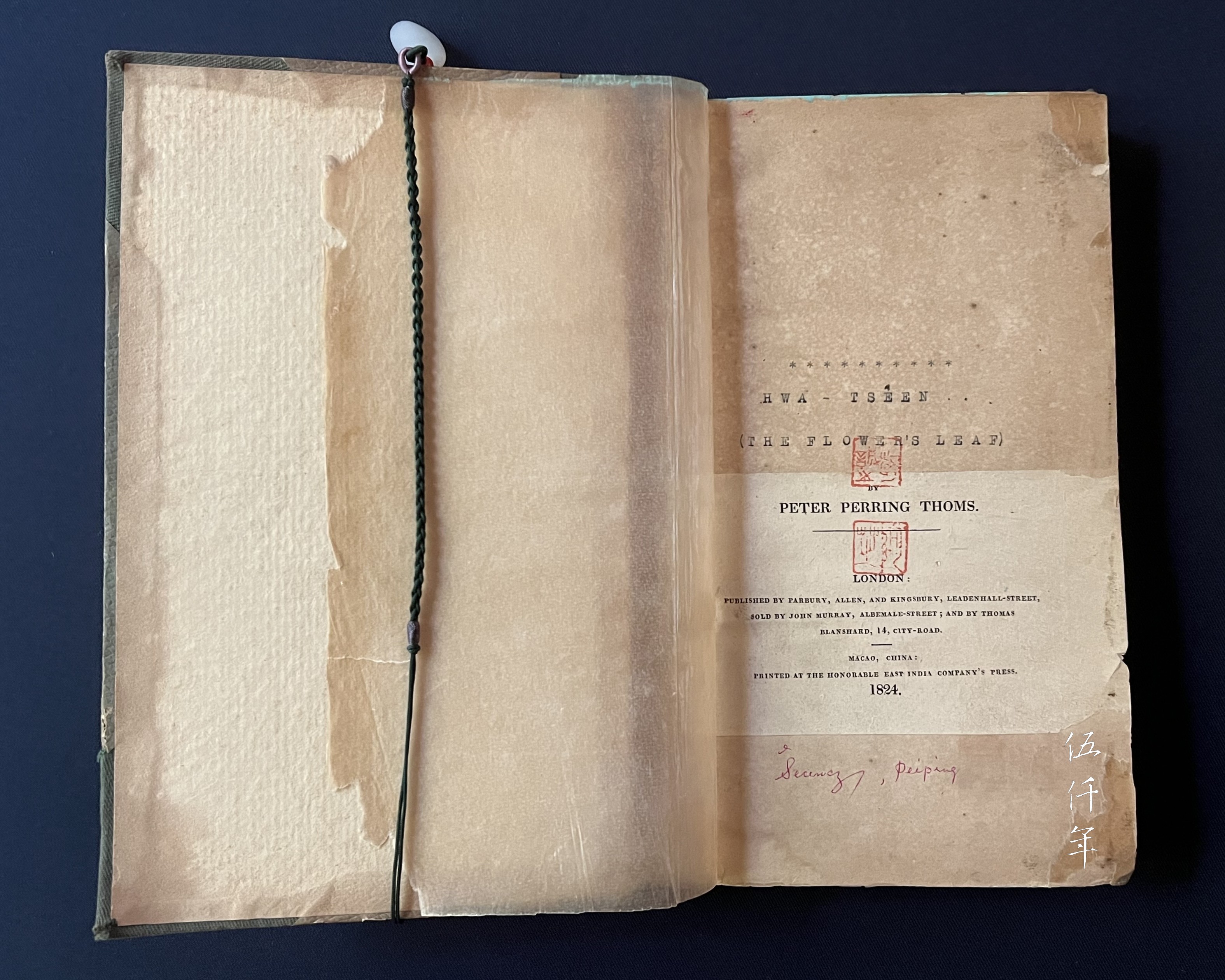
Title page of Hwa-Tseen, The Flower's Leaf. Translated by Peter Perring Thoms
(21) Peter Perring Thoms 1814 – 1851 (彼得‧湯姆斯)
(21-1) Hwa -Tseen, The Flower's Leaf. Macao: Printed at the Honorable East India Company's Press, 1824. First edition. Full page inscription in Chinese by previous collector, dated winter 1939.
(22) Alexander Wylie 1815 – 1887 (偉烈亞力)
(22-1) The Chinese Classical Work Commonly Called the Four Books; Translated and Illustrated with Notes, by the Late Rev. David Collie (1791-1828), Principal of the Anglo Chinese College, Malacca. Malacca: The Mission Press, 1828. First edition. Inscribed by Alexander Wylie.
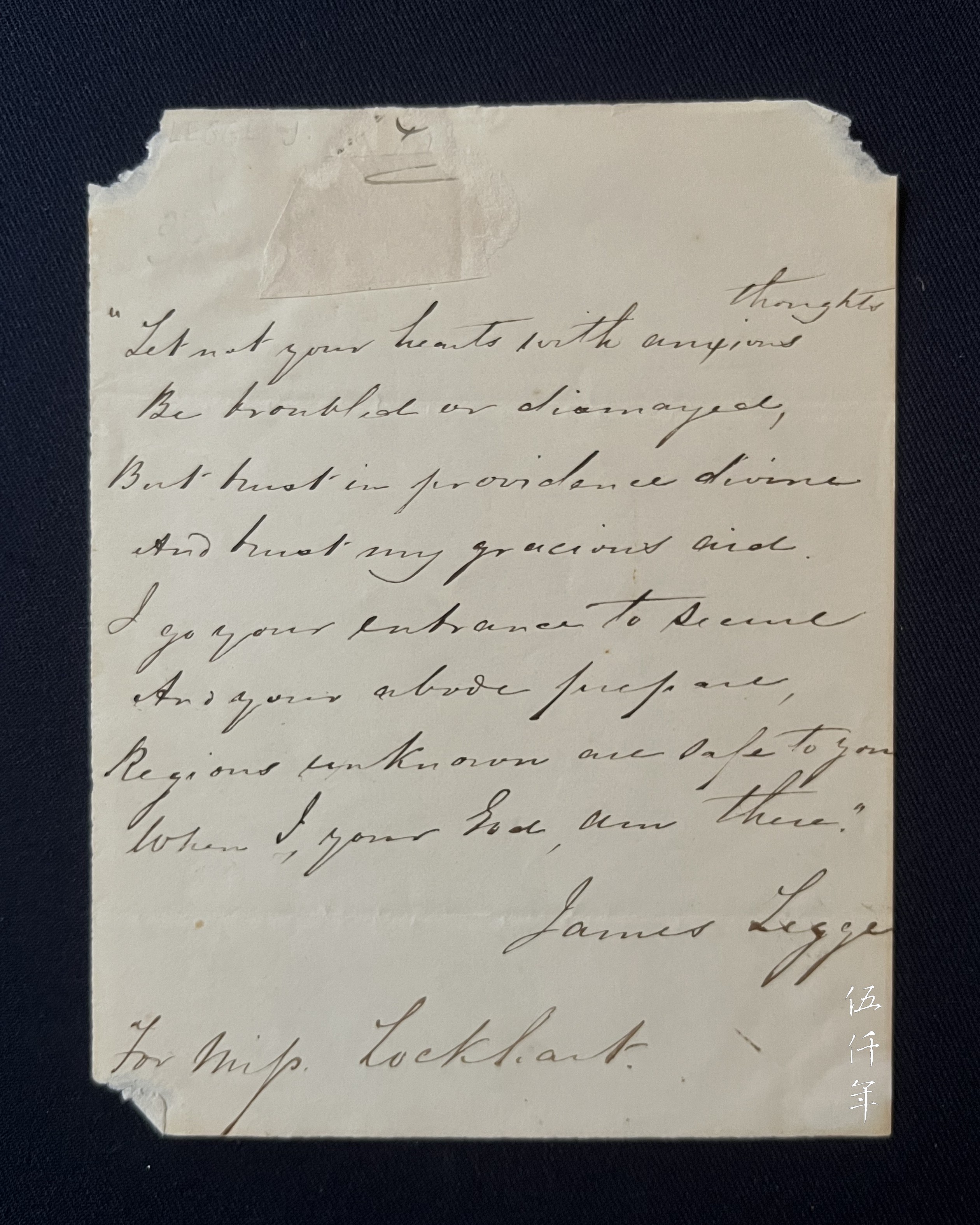
An untitled poem by James Legge
(23) James Legge 1815 – 1897 (理雅各)
(23-1) Letter by James Legge to Marquis d'Hervey de Saint-Denys (1822-1892), written in Scotland, dated 17 April 1874.
(23-2) Letter by James Legge to William Sheowring, secretary of South Place Ethical Society, written in Oxford, dated 26 June 1888.
(23-3) Letter by James Legge to William Sheowring, secretary of South Place Ethical Society, written in Oxford, dated 30 March 1889.
(23-4) An untitled poem by James Legge.
(23-5) The Sacred Books of the East Translated by Various Oriental Scholars and Edited by E. Max Muller, Vol 3. The Sacred Books of China, the Texts of Confucianism, Translated by James Legge, Part 1. Oxford at the Clarendon Press, 1879. First edition. Inscribed by James Legge to Reverend Charles Pritchard (1808-1893), professor of astronomy at The University of Oxford.
(23-6) The Nestorian Monument of Hsi-An-Fu. London: Trubner & Co., 1888. First edition. Signed by the author.
(23-7) Inaugural Lecture on the Constituting of a Chinese Chair in the University of Oxford Delivered in the Sheldonian Theater, October 27, 1876.
(23-8) Religious Systems of the World. National, Christian, and Philosophic. A Collection of addresses delivered at South Place Institute in 1888-1889. Includes the text of Legge's lecture titled: Confucius the Sage and the Religion of China. Edited by William Sheowring. London: Swan Sonnenschein and Co., 1890.
(23-9) Translation of The Four Books by James Legge, in a clamshell leather case made by James Tapley.
(24) Ambassador Kuo Sung-tao 1818-1891 (郭嵩燾公使)
(24-1) Photograph of Kuo Sung-tao by Lock & Whitfield, published by Sampson Low, Martin, Searle and Rivington. Woodbury type, published 1880.
(24-2) Portrait of Kuo Sung-tao by Sir Leslie Ward, chromolithograph, Vanity Fair, 16 June 1877.
(24-3) Letter in Chinese by Kuo Sung-tao to Viceroy Li Han-chang (1821-1899), elder brother of Viceroy Li Hung-chang (1823-1901).
(25) Sir Thomas Wade 1818 – 1895 (威妥瑪爵士)
(25-1) Letter by Thomas Wade, written in Cambridge, dated 28 April 1891.
(25-2) Letter by Thomas Wade, written in Cambridge, dated 29 March 1892.
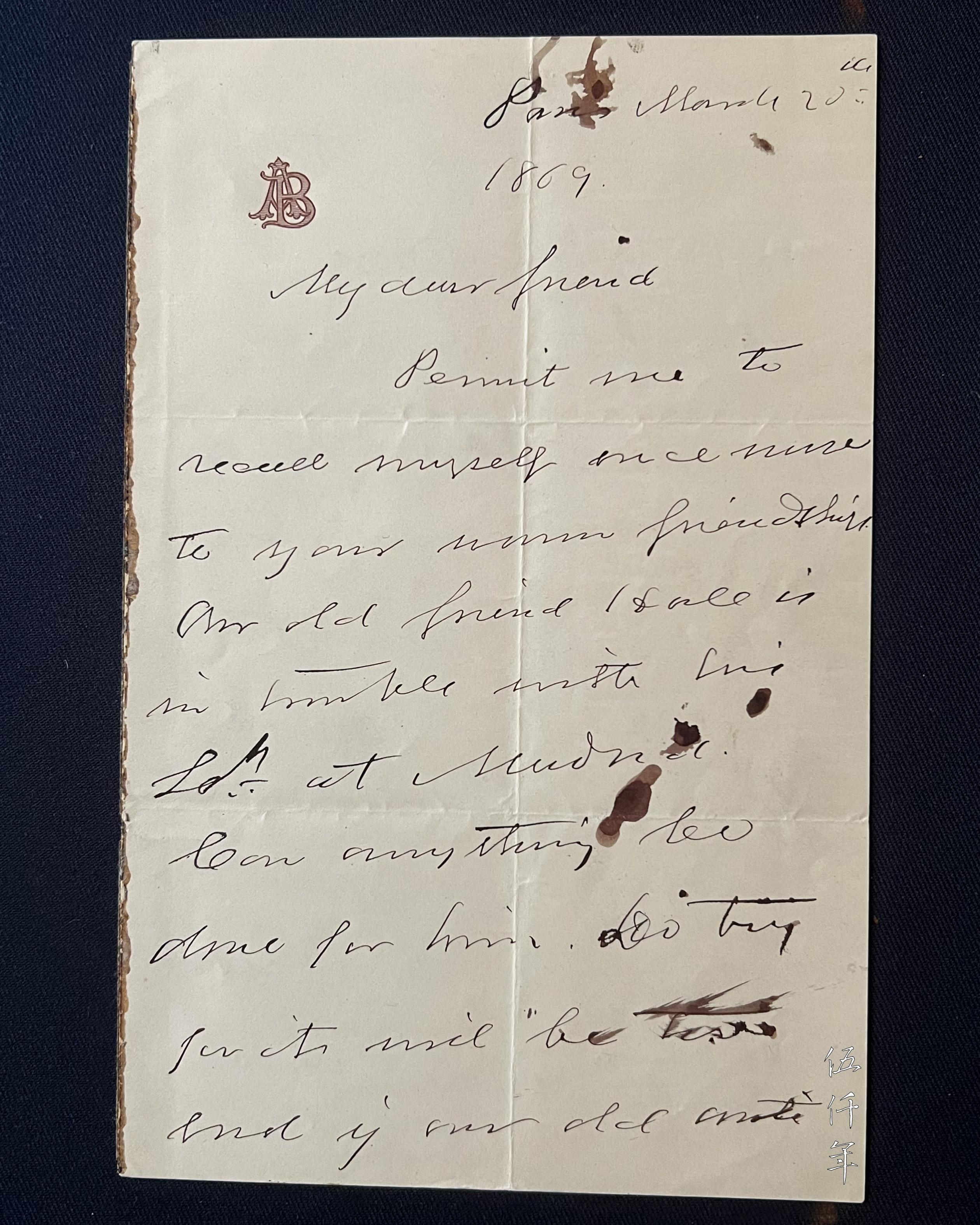
First page of letter by Anson Burlingame, written on 20 March 1869 in Paris
(26) Ambassador Anson Burlingame 1820-1870 (蒲安臣公使)
(26-1) Picture of Anson Burlingame with members of the Chinese Mission, circa 1868
(26-2) Letter by Anson Burlingame to Judge Thomas Russell (1825-1887) of Massachusetts, minister resident to Venezuela, written in Peking, dated 12 August 1867.
(26-3) Letter by Anson Burlingame, written in Paris as envoy of China, dated 20 March 1869.
(26-4) Memorial of Abraham Lincoln, Late President of the United States. Boston: Printed by Order of the City Council, 1865. First edition. Signed by Anson Burlingame.
(26-5) Defense of Massachusetts, Speech of Hon. Anson Burlingame, of Massachusetts, in the House of Representatives. June 21, 1856. Signed by Henry Wilson (1812-1875), vice-president of the United States.
(26-6) Tribute of the Chamber of Commerce of the State of New York to the Memory of Anson Burlingame, Late Ambassador from China, March 3rd, 1870.
(26-7) Anson Burlingame and the First Chinese Mission to Foreign Powers, by Frederick Wells Williams. New York: Charles Scribner's Sons, 1912. First edition. Inscribed by Edward Livermore Burlingame, son of Anson Burlingame, to cousin Emma in New York, dated April 1913.
(27) Viceroy Li Hung-chang 1823-1901 (李少荃 (鴻章) 總督)
(27-1) Picture of Li Hung Chang, General Shan and the Late Prince Ch’un, titled Three Great Men of China; and picture of Chinese Prime Minister Li Hung Chang, Viceroy of Chih-Li, Going in His State Barge from Tientsin to Pao-Ting-Fu, Scientific American, 29 September 1894.
(27-2) Picture of the arrival Li Hung-chang in Paris and picture of the President of France receiving Li Hung-chang and the diplomatic corps from China, L’illustration, 18 July 1896.
(27-3) Portrait of Li Hung-chang, Le Petit Journal Supplement Illustre, titled: Les Hotes de la France, Le vice-roi Li Hung-Chang, ambassadeur extraordinaire de Chine, 26 July 1896.
(27-4) Autographed card for Miss F. M. Neumann from Li Hung-chang, envelope attached.
(27-5) Letter in Chinese by Li Hung-chang to his elder brother Viceroy Li Han-chang (1821-1899).
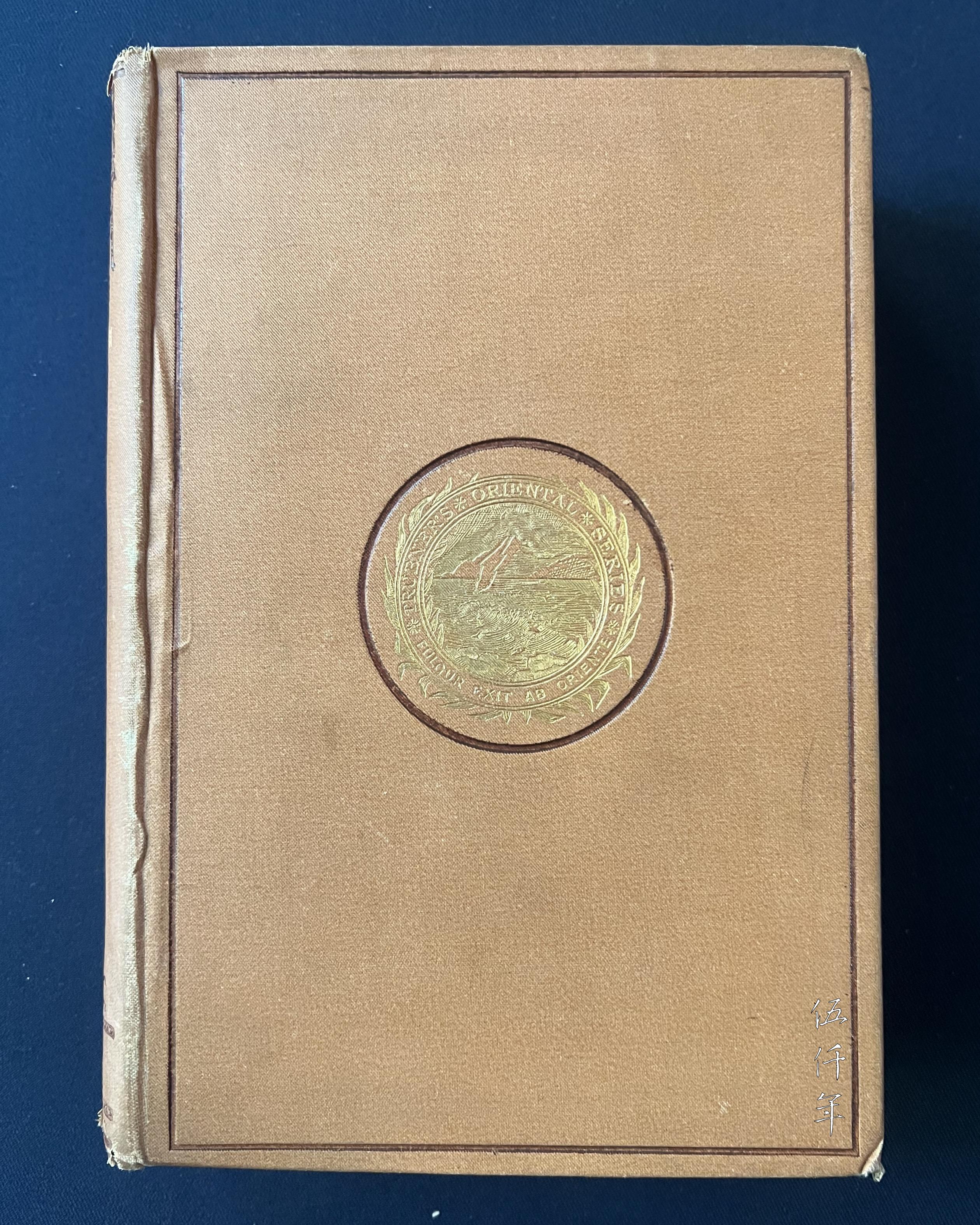
Front cover of Chinese Buddhism. By Joseph Edkins
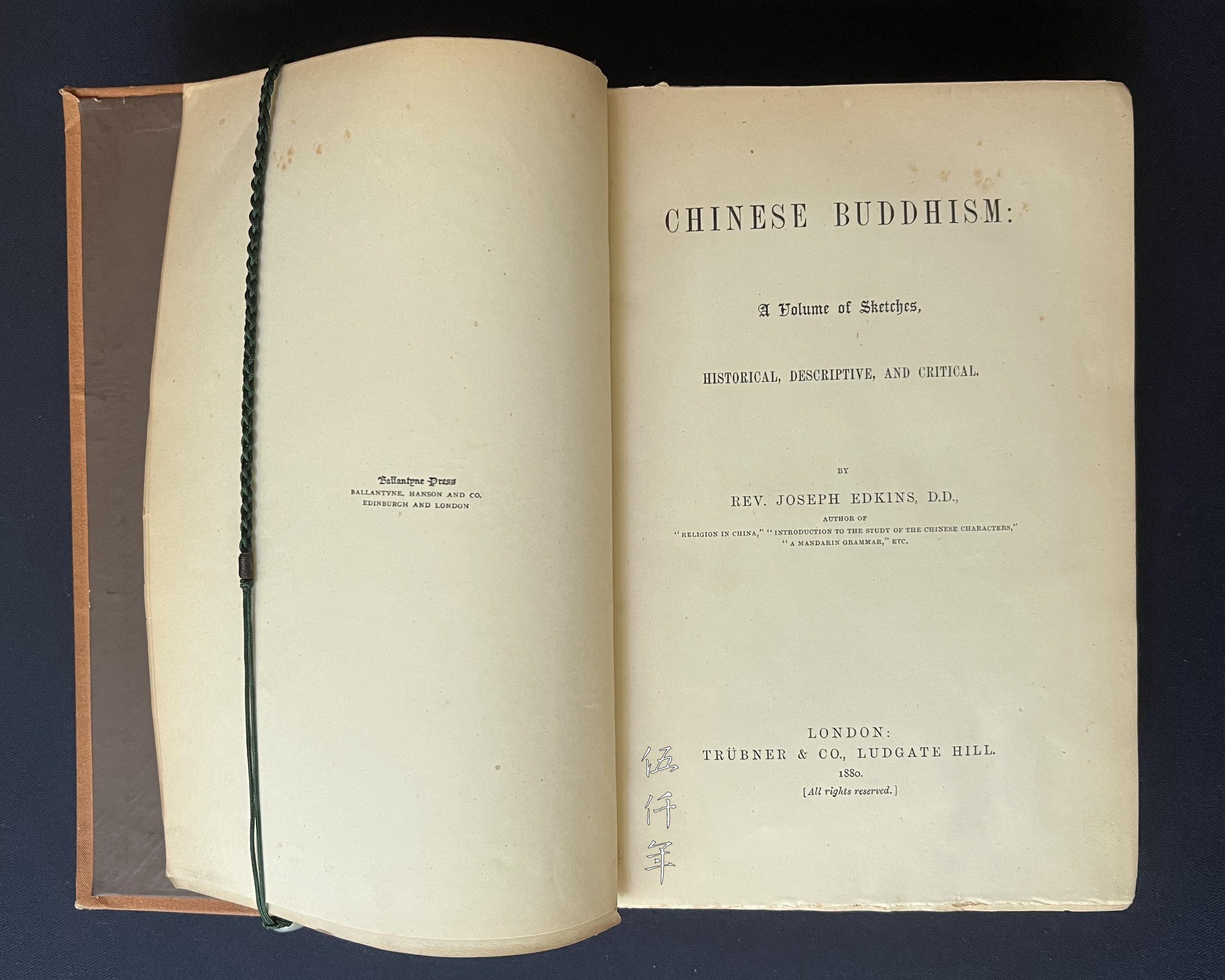
Title page of Chinese Buddhism. By Joseph Edkins
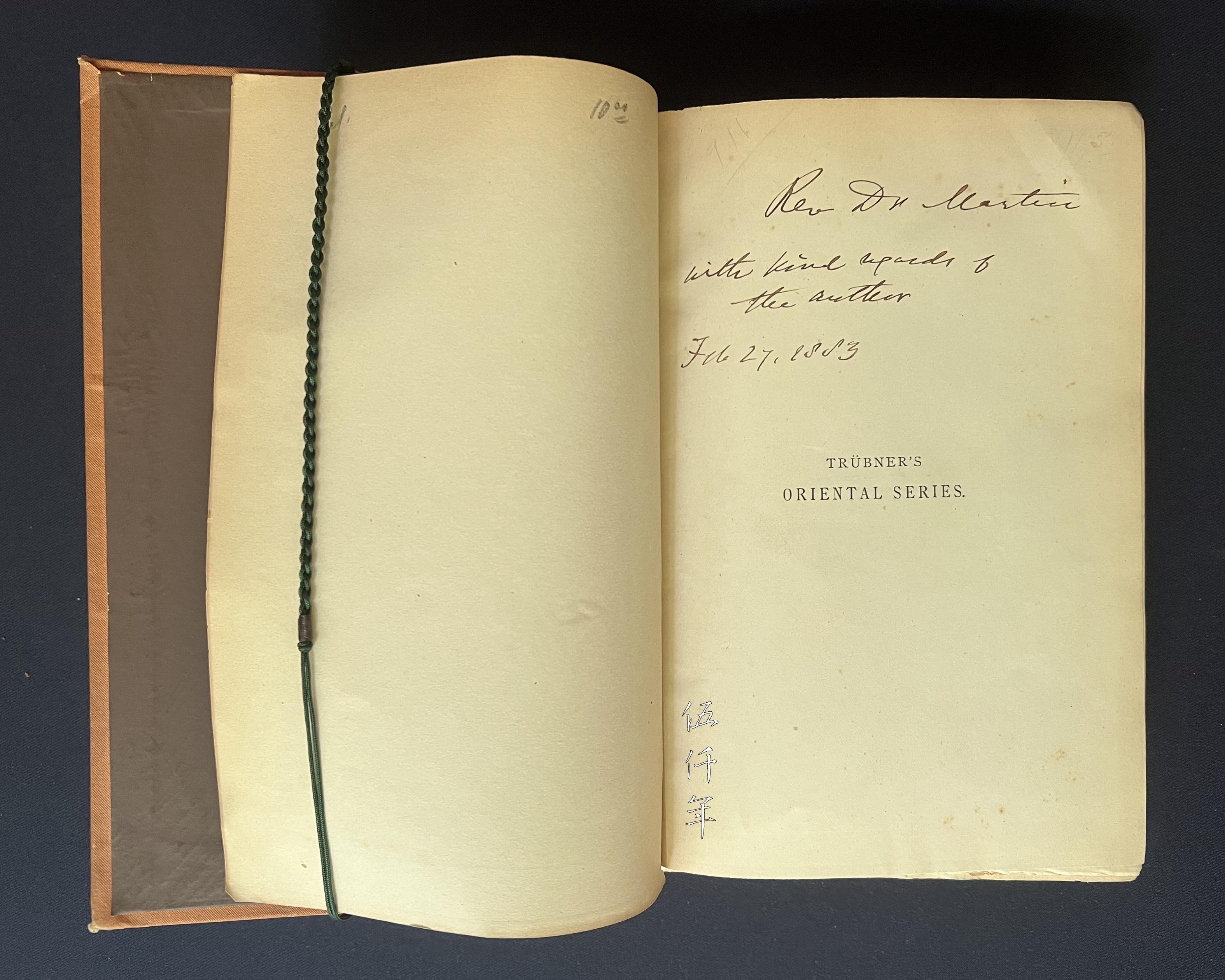
Inside page of Chinese Buddhism. By Joseph Edkins
(28) Joseph Edkins 1823 – 1905 (艾約瑟)
(28-1) Introduction to the Study of the Chinese Characters. London: Trubner & Co., 1876. First edition. Inscribed by the author.
(28-2) Chinese Buddhism. London: Trubner & Co., 1880. First edition. Inscribed by the author to W. A. P. Martin, inaugural president of the Imperial University of Peking, dated 27 February 1883.
(28-3) En Einer Reihe von Briefen, by Jane R. Edkins (1838-1861), wife of Joseph Edkins, published in 1871. First edition.
(29) Senator Thomas Stanley Mathew 1824-1889 (托馬斯‧斯坦利‧馬修斯參議員)
(29-1) Chinese Immigration, Speech of Hon. Stanley Matthew's of Ohio in the Senate of the United States, February 13, 1879.
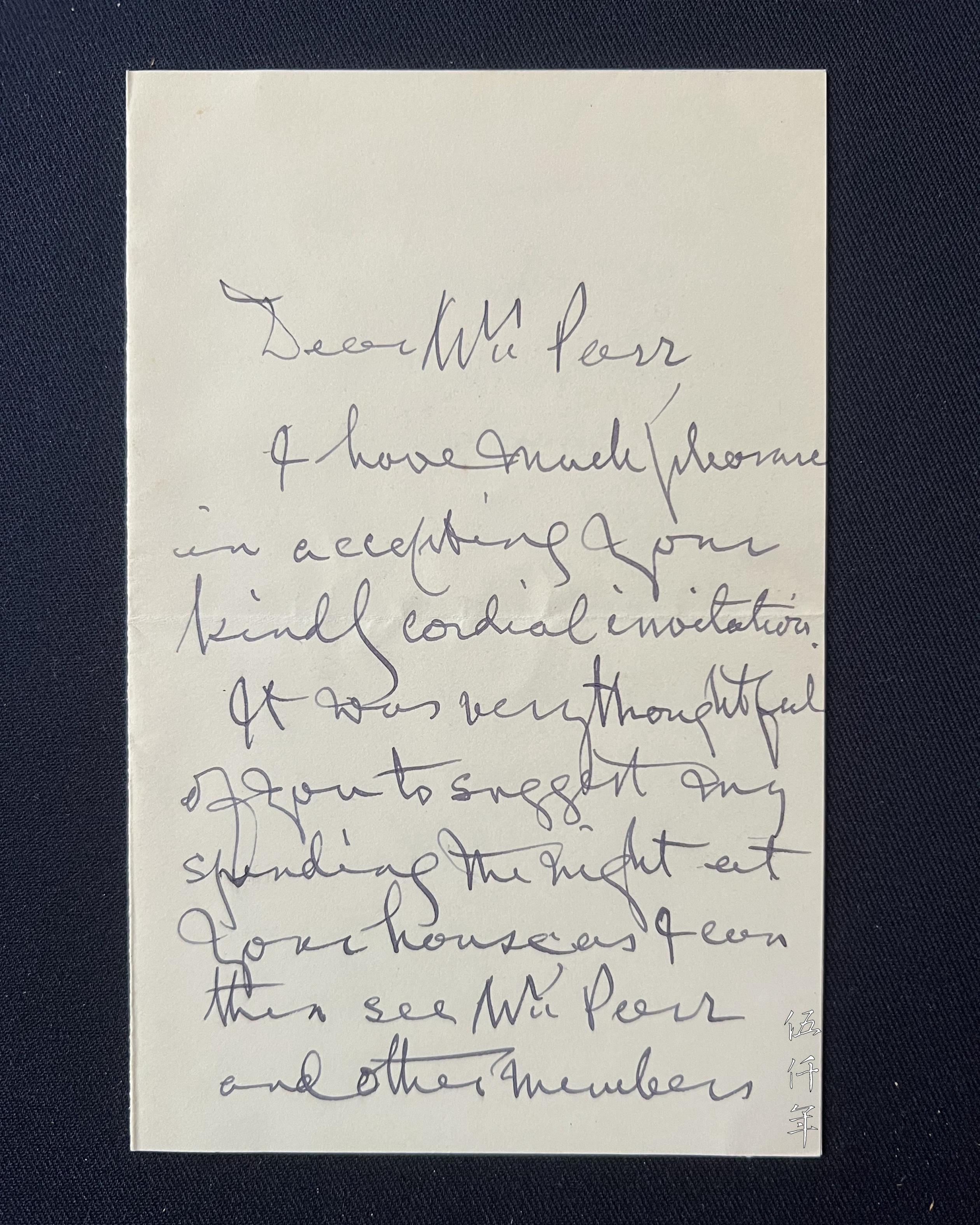
First page of letter by W. A. P. Martin to Parr
(30) William Alexander Parsons Martin 1827 – 1916 (丁韙良)
(30-1) Letter by W. A. P. Martin to Parr.
(30-2) The Analytical Reader. Shanghai: Presbyterian Mission Press, 1897. First edition. Inscribed by the author to Rev. H. Mathews, dated 7 May 1908.
(30-3) The Siege in Peking. New York: F. H. Revell Company, 1900. First edition. Inscribed by the author to Mrs. F. C. Oviatt.
(30-4) A Cycle of Cathay. Fleming H. Revell Company, 1897. Second edition. Two page inscription by W. L. R. to Agnes, dated 21 November 1902.
(30-5) The Lore of Cathay or The Intellect of China. Fleming H. Revell Company, 1901. First edition. Affixed bookplate of Joseph M. Gleason (1869-1942).
(30-6) The Awakening of China. New York: Doubleday, Page & Company; 1907. First edition.
(31) Wang Tao 1828-1897 (王韜)
(31-1) Letter in Chinese by Wang Tao to Tzu-mei.
(32) Sir Joseph Whitwell Pease, 1st Baronet, 1828-1903 (約瑟夫‧惠特威爾‧皮斯男爵)
(32-1) Circular requesting support from Members of Parliament for the resolution initiated by Sir Joseph Pease (1828-1903) towards the suppression of opium trade with China. Signed by MP Justin McCarthy (1830-1912) at bottom. Attached are nineteen letters addressed to Storrs-Turner and Mabbs as Organizing Secretaries to the Society for the Suppression of the Opium Trade, written in response to requests to attend meetings and events. The letters were written by:
- Granville Augustus William Waldegrave, Lord Radstock (1833-1913), missionary;
- Henry Bouverie William Brand, Viscount Hampden (1814-1892), Liberal Member of Parliament and Speaker of the House of Commons;
- John Campbell Hamilton-Gordon, Earl of Aberdeen (1847-1934), Lord Lieutenant of Ireland and Governor-General of Canada;
- Samuel Smith (1836-1906), Liberal Member of Parliament;
- Sir Edward Fry (1827-1918), Lord Justice of Appeal and zoologist;
- John Morley, Viscount Morley (1838-1923), Liberal statesman, Secretary of State for India and Chief Secretary for Ireland;
- Alexander Martin Sullivan (1830-1884), Irish nationalist politician and barrister;
- Robert William Dale (1829-1895), English Congregational church leader;
- Griffith John (1831-1912), Welsh Christian missionary and translator in China;
- Russell Gurney (1804-1878), Conservative Member of Parliament and English lawyer;
- Samuel Gurney (1816-1882), Independent Member of Parliament and banker;
- Samuel Morley (1809-1886), abolitionist and philanthropist;
- Rev. Alexander Duff (1806-1878), Scottish missionary in India;
- William Sproston Caine (1842-1903), Liberal Member of Parliament and temperance advocate;
- Frederic Harrison (1831-1923), British jurist and historian;
- Sir Edward Clarke (1841-1931), Conservative Member of Parliament and barrister;
- Sir Wilfred Lawson (1829-1906), Liberal Member of Parliament and temperance advocate;
- Sir Robert Nicholas Fowler (1828-1891), Conservative Member of Parliament and Lord Mayor of London;
- Pratap Chunder Mozoomdar (1840-1905), leader of Hindu reform movement.
(33) Yung Wing 1828-1912 (容閎)
(33-1) My Life in China and America. New York: Henry Holt and Company, 1909. First edition.
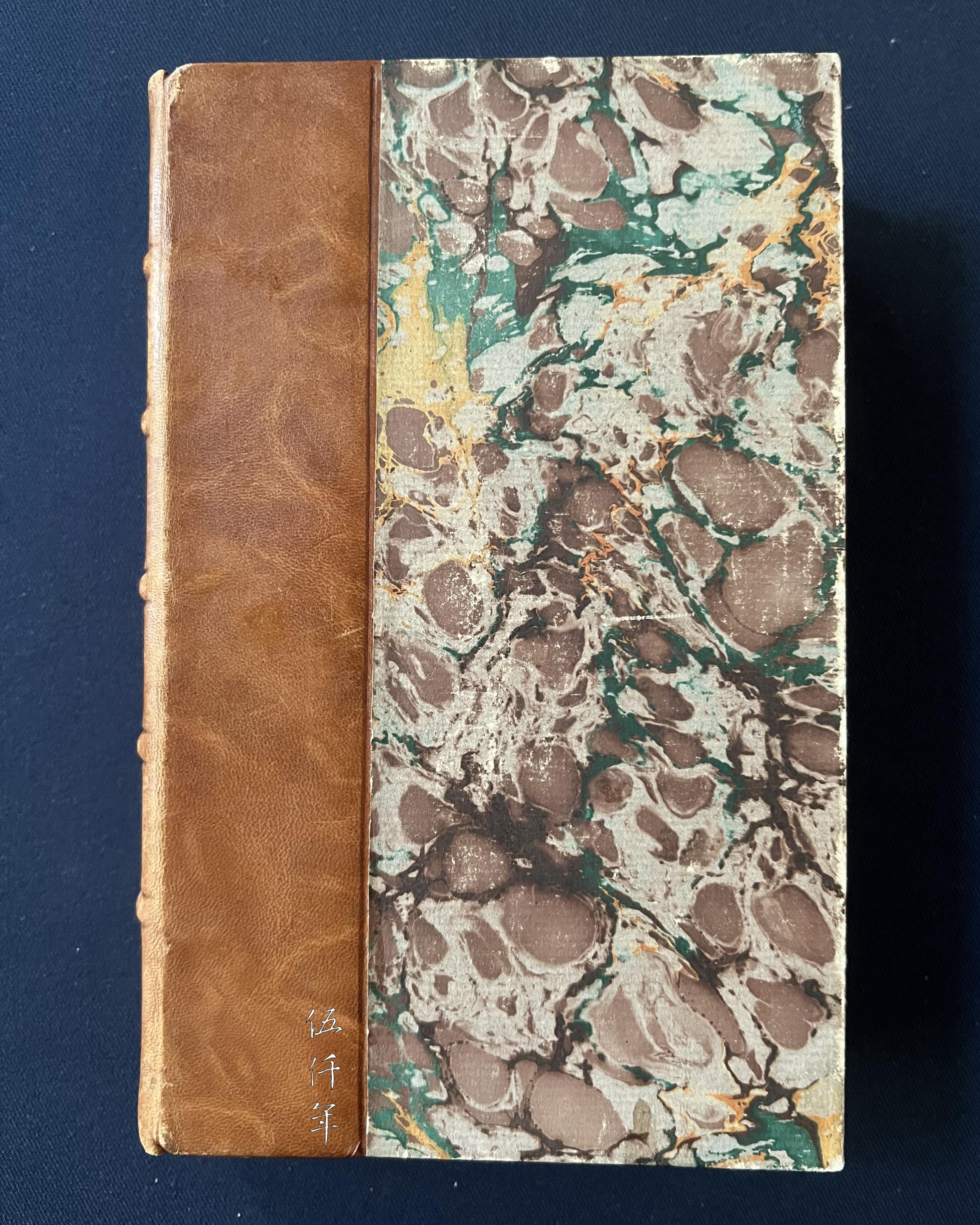
Front cover of Sur La Terre et Par La Terre. By G. Eugene Simon
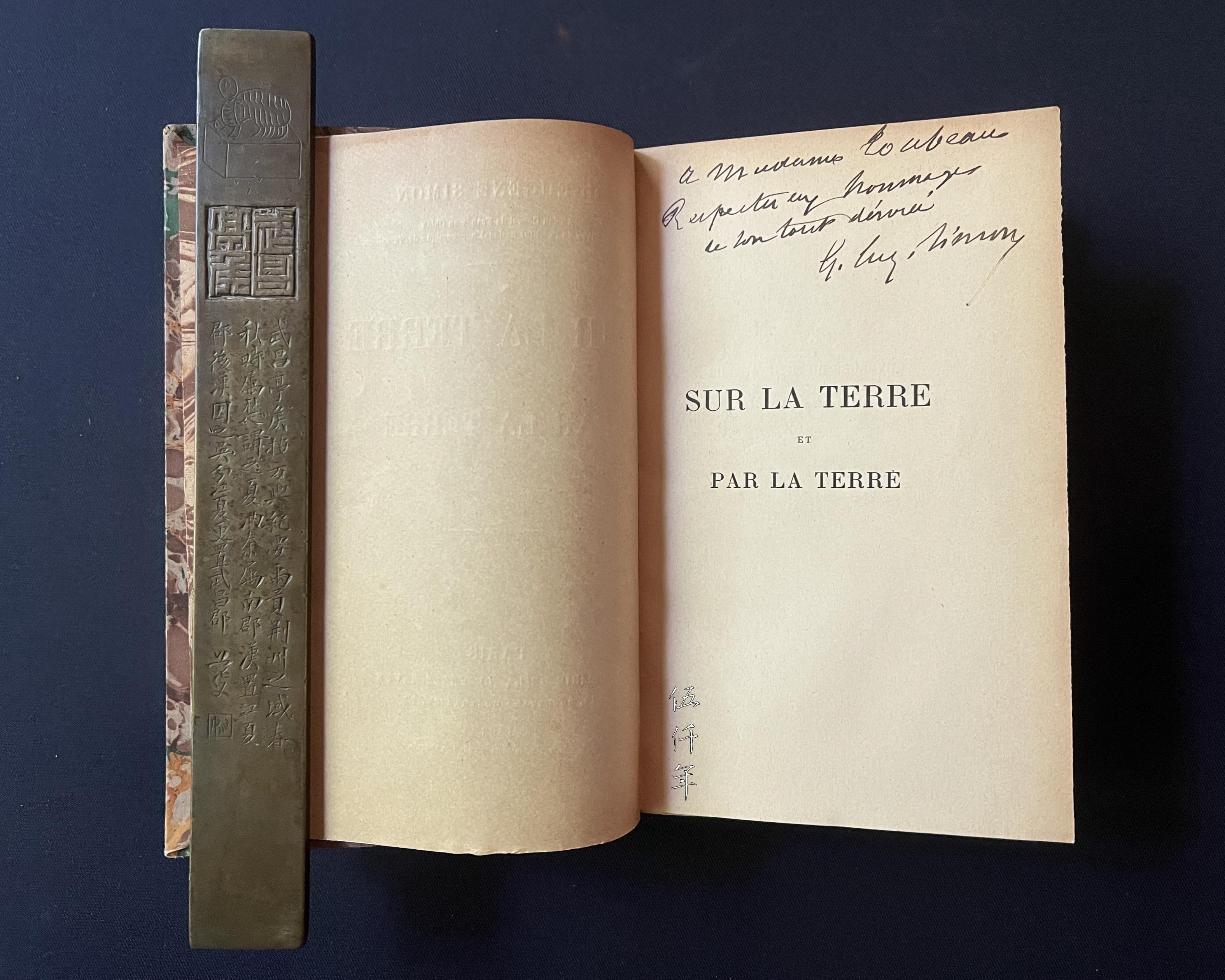
Title page of Sur La Terre et Par La Terre. By G. Eugene Simon
(34) G. Eugene Simon 1829 – 1896 (尤金‧西蒙)
(34-1) La Cite Chinoise. Paris: Nouvelle Revue, 1886. Third edition. Inscribed by the author to Madame De la Croix, dated 16 September 1889.
(34-2) Sur La Terre et Par La Terre. Paris: Librairie de la Nouvelle Revue, 1893. First edition. Inscribed by the author to Madame Loubeau.
(35) General Frederick Townsend Ward 1831-1862 (華爾將軍)
(35-1) An Early American Hero in China (Frederick Townsend Ward 1831-1862). An Address on the Occasion of the Pilgrimage to General Ward's Tomb at Sungkiang, China, “Memorial Sunday”, May 29, 1921, by Charles Sumner Lobringier. American Legion. Frederick Townsend Ward Post No. 1, Shanghai, China, Bulletin 1.
C.S. Lobringier (1866-1956) served as Judge of the United States Court for China in Shanghai from 1914 to 1924.
(36) Griffith John 1831-1912 (楊格非)
(36-1) Letter by Griffith John to Stevenson, affixed to the inside page of Griffith John-The Story of Fifty Years in China, by R. Wardlaw Thompson.
(36-2) Griffith John-The Story of Fifty Years in China, by R. Wardlaw Thompson. New York: A.C. Armstrong and Son, 1906. First edition. One page inscription by Griffith John to Stevenson.
(37) Rev. James Hudson Taylor 1832-1905 (戴德生牧師)
(37-1) Letter by J. Hudson Taylor, written on a journey from Wu-chou to T'ai-chou, dated 24 July 1880.
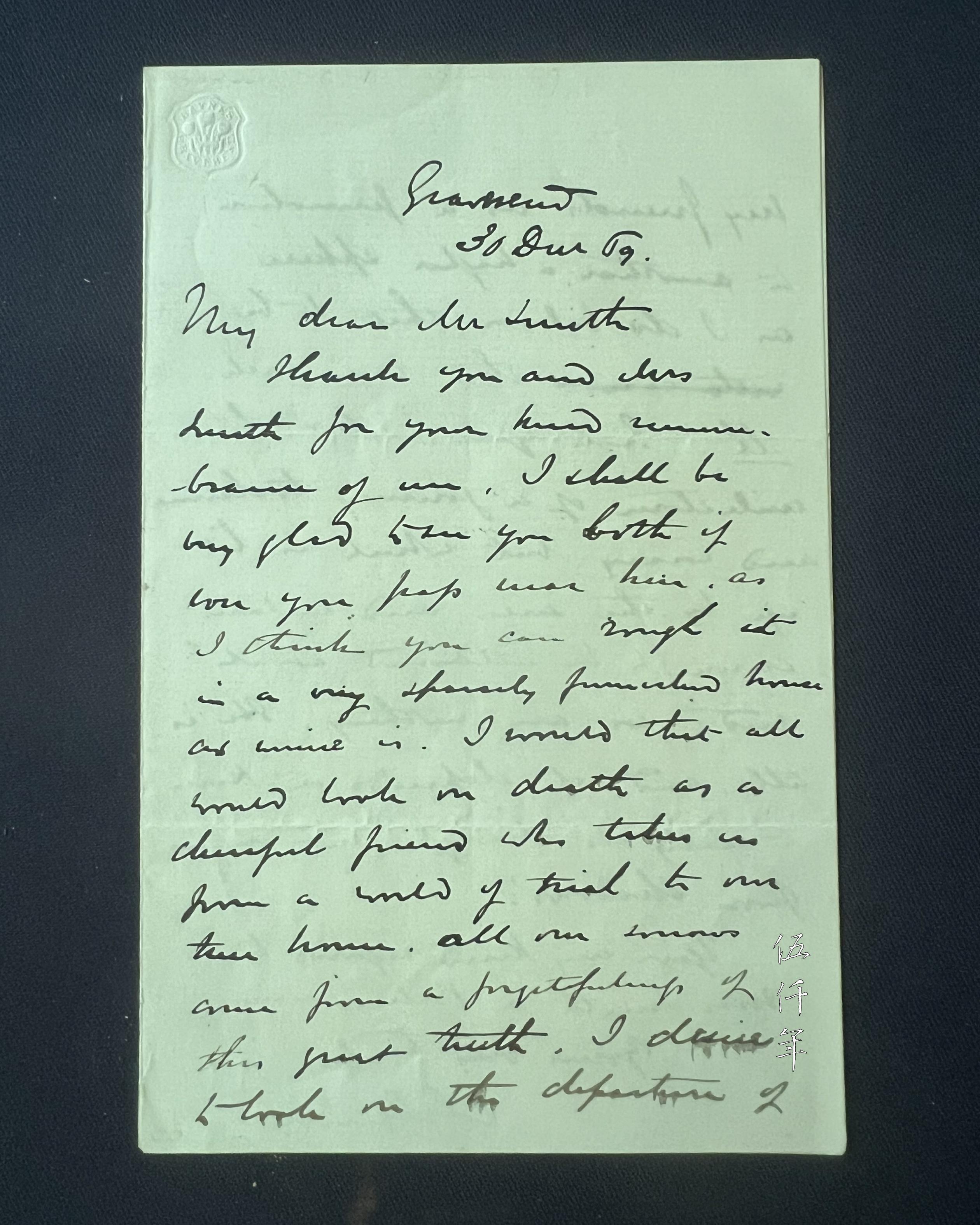
Letter by Charles George Gordon to Smith, written on 30 December 1869 in Gravesend
(38) Major-General Charles George Gordon 1833-1885 (戈登將軍)
(38-1) Letter by Charles George Gordon to Smith, written in Gravesend in England, dated 30 December 1869.
(38-2) Letter by Charles George Gordon to Captain Murray, written at sea, dated 17 July 1880.
(38-3) Letter by Charles George Gordon to Lieutenant Charles Nugent (1850-1879) who led the 7th Company of Sappers and Miners. Nugent died at the Battle of Kabul when setting up mines to blow up enemy fort.
(39) Prosper Marie Giquel 1835-1886 (日意格)
(39-1) Coloured portrait of Prosper M. Giquel, circa 1886.
(39-2) Obituary of Prosper M. Giquel, Le Voleur, 18 March 1886.
(39-3) The Tientsin Massacre, Being Documents in the Shanghai Evening Courier, from June 16th to Sept. 10th, 1870, with an Introductory Narrative, Shanghai. Affixed with the bookplate of Prosper M. Giquel.
(40) Sir Robert Hart 1835-1911 (赫德爵士)
(40-1) Portrait of Sir Robert Hart, Vanity Fair, 27 December 1894.
(40-2) Letter by Sir Robert Hart to Major General Charles George Gordon (1833-1885), written in Peking, dated 19 August, 1865.
(41) Titular Bishop Pierre-Marie-Alphonse Favier-Duperron 1837 – 1905 (領銜主教樊國梁)
(41-1) Certificate in Latin to award the Cross of the Knight by Pope Leo XIII (1810-1903), signed by Cardinal Luigi Macchi (1832-1907), dated 9 January 1900.
(41-2) Document in French by Alphonse Favier to Fernand Jules Francois Joseph Berteaux, regarding the award of the Cross of the Knight, whereby his name of Fernand was erroneously written as Jacques.
(42) Constance Frederica Gordon-Cumming 1837 – 1924 (康斯坦斯‧弗雷德里卡‧戈登‧卡明)
(42-1) Original photograph of C. F. Gordon-Cumming.
(42-2) Letter by Constance F. Gordon-Cumming, written in Edinburgh, dated 6 February, after 1874.
(42-3) The Inventor of the Numeral-Type for China: by the Use of Which Illiterate Chinese Both Blind and Sighted Can Very Quickly be Taught to Read and Write Fluently. London: Downey & Co., 1898. First edition. Inscribed by the author to John Rae, at the Medical Missionary Exhibition from 25 to 30 July 1898.
(42-4) The Inventor of the Numeral-Type for China: by the Use of Which Illiterate Chinese Both Blind and Sighted Can Very Quickly be Taught to Read and Write Fluently. London: Downey & Co., 1899. Three booklets inserted: The Destruction of the Schools for the Blind by the Chinese in June 1900, Reprinted from The Sphere; Statement by the Committee; The Fifteenth Annual Report of the Mission to the Chinese Blind, Year 1901. Glasgow: A. Bryson & Co., 1902. Second edition. Inscribed by the author to Mary Dow, dated 1 August 1903.
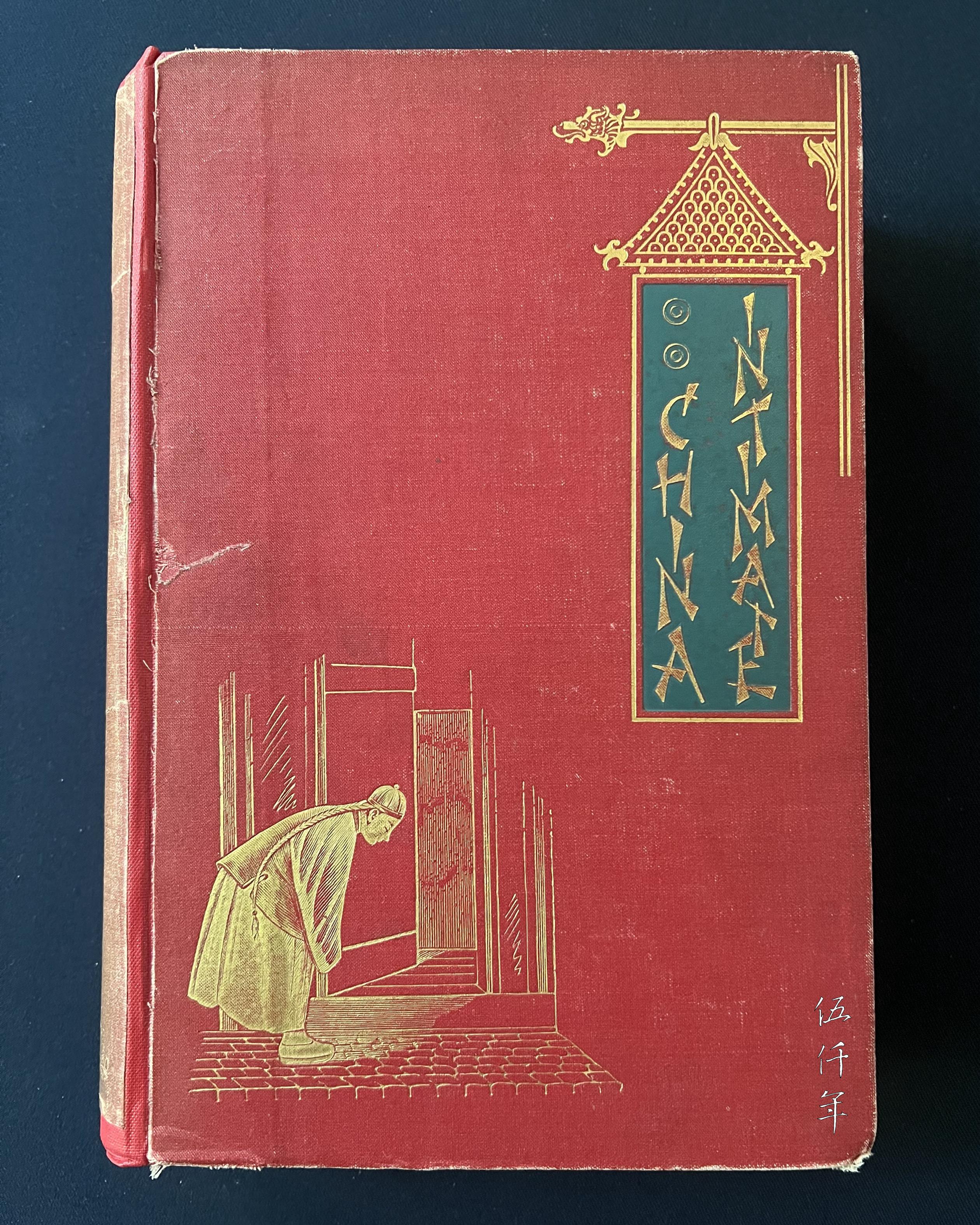
Front cover of Intimate China, the Chinese as I Have Seen Them. By Mrs. Archibald J. Little
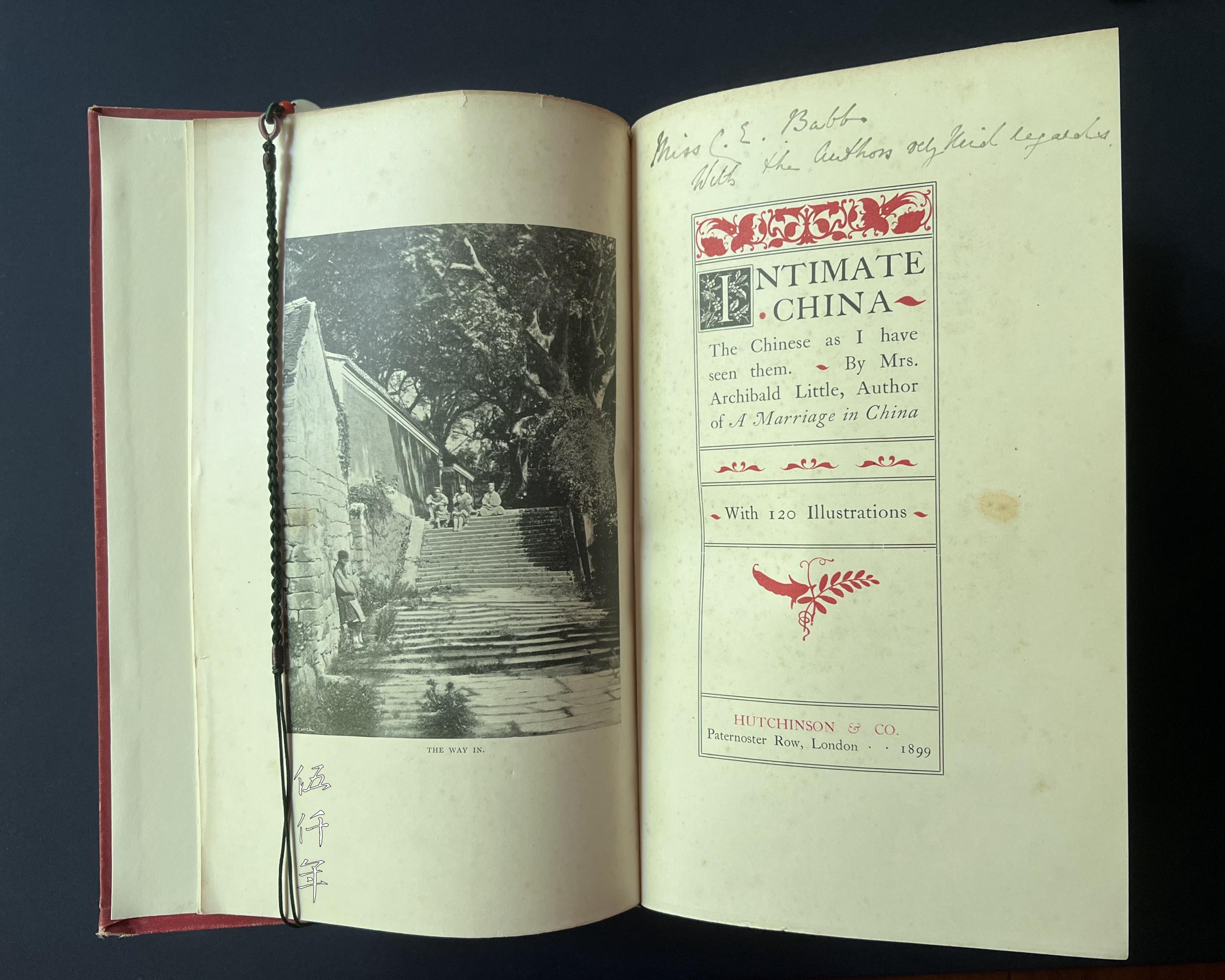
Title page of Intimate China, the Chinese as I Have Seen Them. By Mrs. Archibald J. Little
(43) Archibald J. Little 1838 – 1908 (立德)
(43-1) Through the Yang-Tse Gorges or Trade and Travel in Western China. London: Sampson Low, Marston & Co., Ltd., 1898. First edition. Inscribed by the author to Dorothy Tennant Stanley (1855-1926), painter and wife of explorer Sir Henry Morton Stanley, dated 27 November 1898.
(43-2) Across Yunnan. London: Sampson Low, Marston & Co., Ltd., 1910. First edition. Inscribed by Alicia Little to the author and husband.
(43-3) Intimate China, the Chinese as I Have Seen Them. London: Hutchinson & Co., 1899. First edition. Inscribed by the author to Charlotte Elizabeth Babb (1830-1906), painter and advocate of women's suffrage.
(44) Sir Robert Kennaway Douglas 1838 – 1913 (羅伯特‧道格思爵士)
(44-1) Letter by Robert K. Douglas to Sir Walter Elliot (1803-1887), orientalist and civil servant at East India Company.
(44-2) Li Hungchang(李鴻章). London: Bliss, Sands and Foster, 1895. First edition. Inscribed by the author, dated 11 March 1903.
(45) Marquis Tseng Chi-tse 1839-1890 (曾劼剛(紀澤)公使)
(45-1) Portrait of Tseng Chi-tse, titled: M. le Marquis de Tseng, Ambassadeur de Chine en France, Le Journal illustre, 29 July 1883.
(45-2) Portrait of Tseng Chi-tse, titled: Le Marquis de Tseng, Don Quichotte, 2 November 1883.
(45-3) A Chinese five-character poem composed and written by Tseng Chi-tse, signed in Chinese and English.
(45-4) A Chinese seven-character poem composed and written by Tseng Chi-tse, signed in Chinese and English.
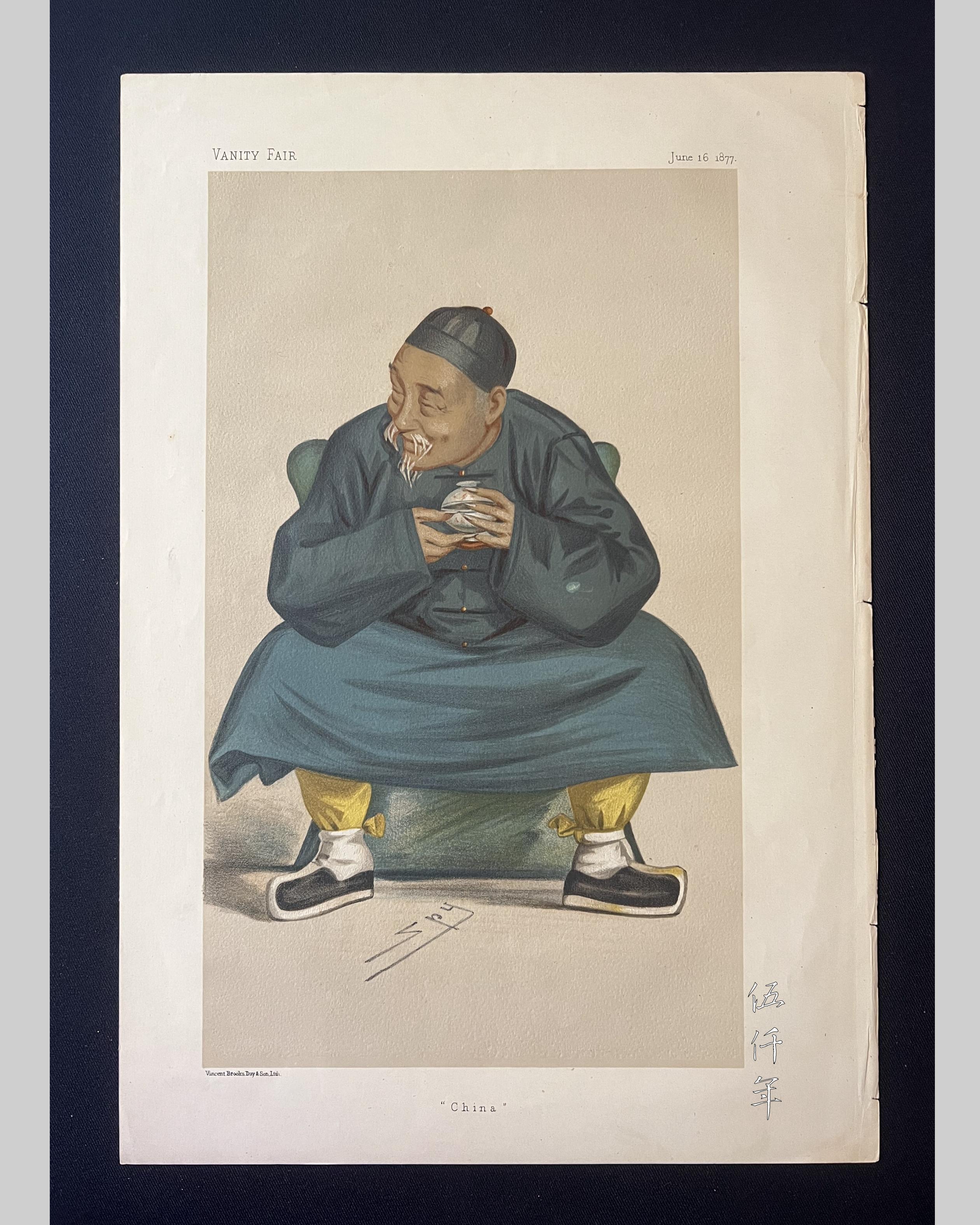
Portrait of Wu Ting-fang, Harper’s Weekly, 17 November 1900
(46) Minister Wu Ting-fang 1842-1922 (伍廷芳總長)
(46-1) Picture of Wu Ting-fang, titled: One of the Season's Most Popular After-Dinner Speakers - Chinese Minister Wu Ting-Fang Addressing A Gathering of New York Merchants, Harper's Weekly, 9 June 1900.
(46-2) Portrait of Wu Ting-fang, drawn by William Nicholson, Harper's Weekly, 17 November 1900.
(46-3) Typed letter by Wu Ting-fang to Issac P. Noyes, author and supporter of Chinese Exclusion Act, dated 11 November 1902.
(47) Sarah Pike Conger 1843-1932 (薩拉‧派克‧康格)
(47-1) Letters from China-with Particular Reference to the Empress Dowager and the Women of China. Chicago: A. C. McClurg & Co., 1910. Third edition. Letter by Sarah P. Conger to Mrs. Fanner affixed, dated 8 April 1912.
(48) Timothy Richard 1845-1919 (李提摩太)
(48-1) A Mission to Heaven, A Great Chinese Epic and Allegory by Ch'iu Ch'ang Ch'un, a Taoist Gamaliel Who Became a Nestorian Prophet and Advisor to the Chinese Court. Shanghai: The Christian Literature Society's Depot, 1913. First edition. Inscribed by the author to Laura Marsden White (1867-1937), missionary to China, dated November 1913.
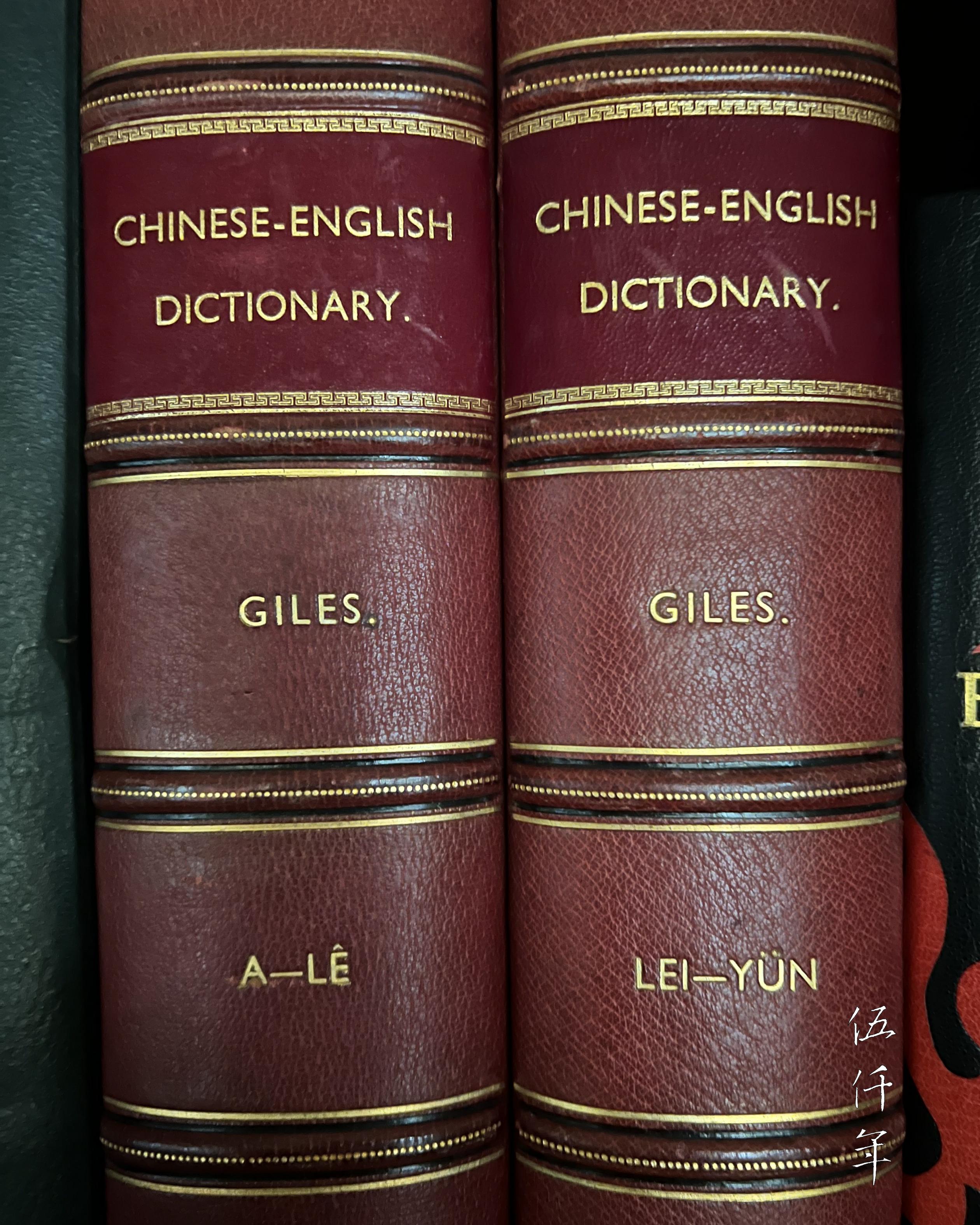
A set of A Chinese-English Dictionary. Compiled by Herbert Allen Giles
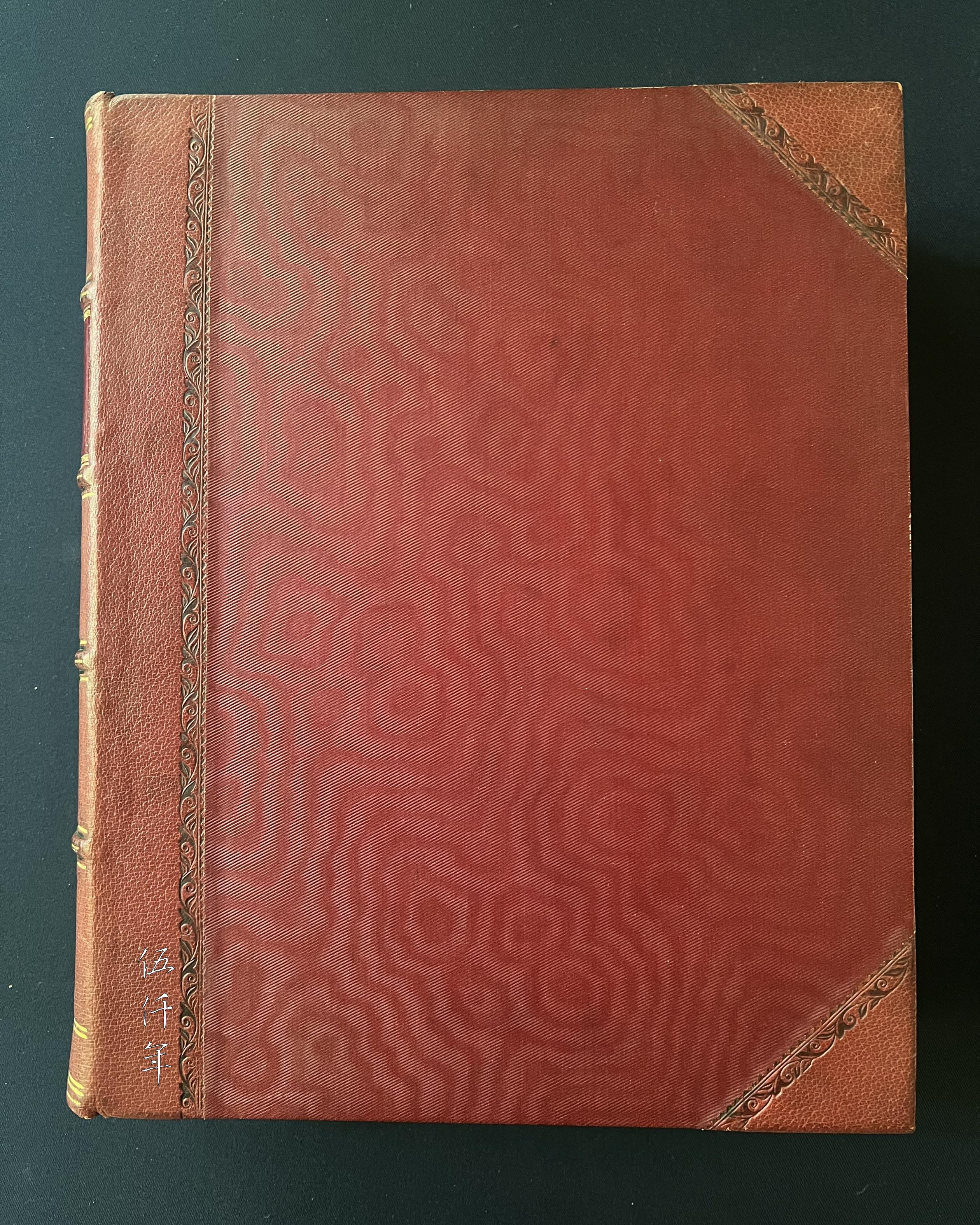
Front cover of first volume of A Chinese-English Dictionary. Compiled by Herbert Allen Giles
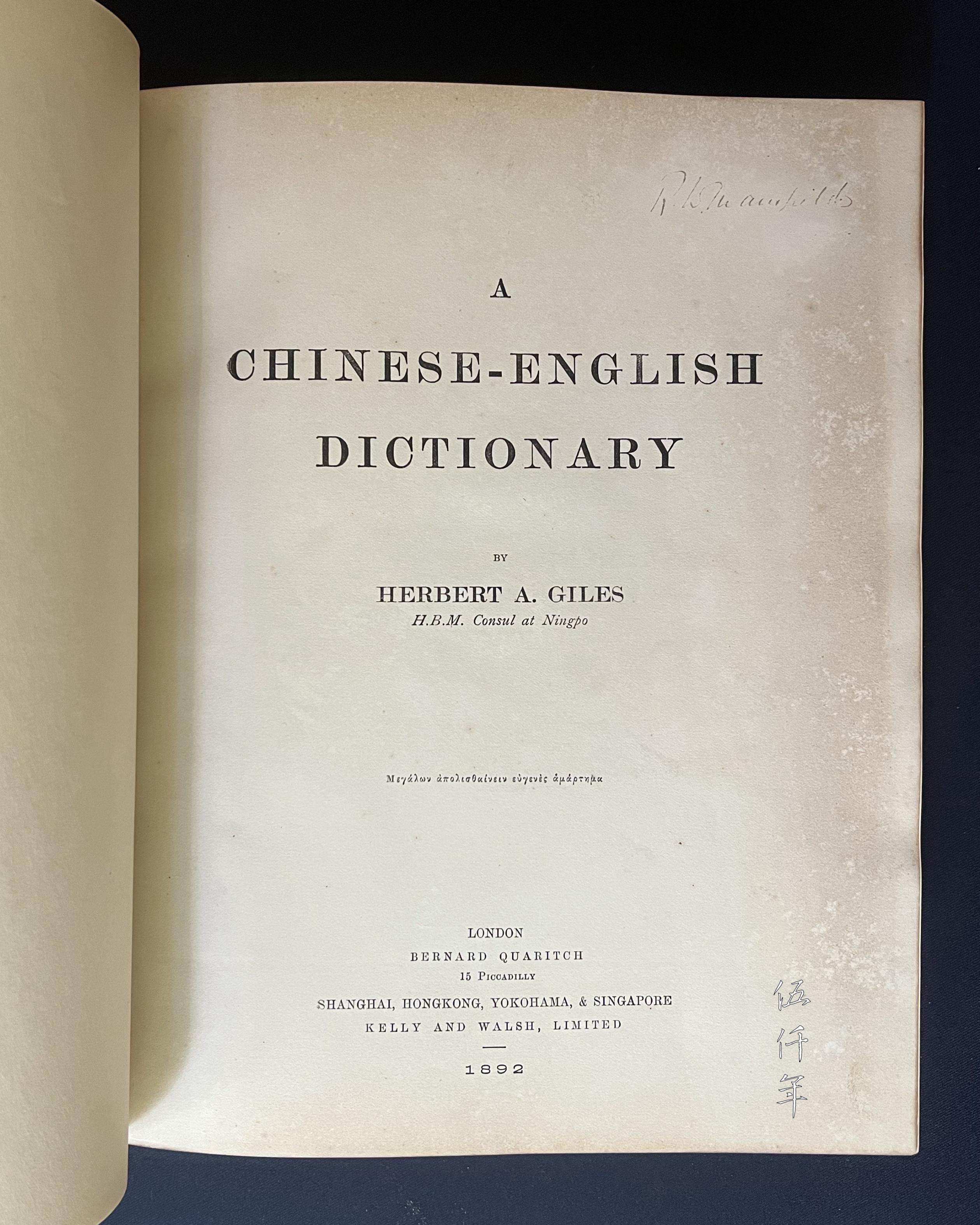
Title page of A Chinese-English Dictionary. Compiled by Herbert Allen Giles
(49) Herbert Allen Giles 1845 – 1935 (翟理斯)
(49-1) Letter by Herbert A. Giles to Henry Osborne Taylor (1856-1941), American historian and legal scholar, affixed to Deliverance- The Freeing of the Spirit in the Ancient World by H. O. Taylor. The letter was written in Cambridge, dated 18 March 1915.
(49-2) An Index of Chinese Artist Represented in the Sub-Department of Oriental Prints and Drawings in the British Museum, by Arthur D. Waley. London: British Museum, 1922. First edition. Signed with commentaries on numerous pages by Herbert A. Giles.
(49-3) A Chinese-English Dictionary. London: Bernard Quaritch, 1892. First edition.
(49-4)Chinese Poetry in English Verse. London: Bernard Quaritch, 1898. First edition. Inscribed by the translator.
(50) Henri Cordier 1849 – 1925 (高第)
(50-1) Letter in French by Henri Cordier affixed to Notes sur Eusebe de Salle by Henri Cordier, Paris, 1917. The Letter was written in Paris and dated 16 February 1921.
(50-2) Bibliotheca Sinica- Dictionnaire Bibliographique des Ouvrages Relatifs a l'Empire Chinois. Paris: Libraire de la Societe Asiatique de Paris de l'Ecole des Langue's Orientales Vivantes Etc., 1878. First edition. Inscribed by Henri Cordier to his father.
(50-3) Bibliotheca Sinica- Dictionnaire Bibliographique des Ouvrages Relatifs a l'Empire Chinois, Supplement 1 to 3. Paris: Libraire de la Societe Asiatique de Paris de l'Ecole des Langue's Orientales Vivantes Etc., 1893.
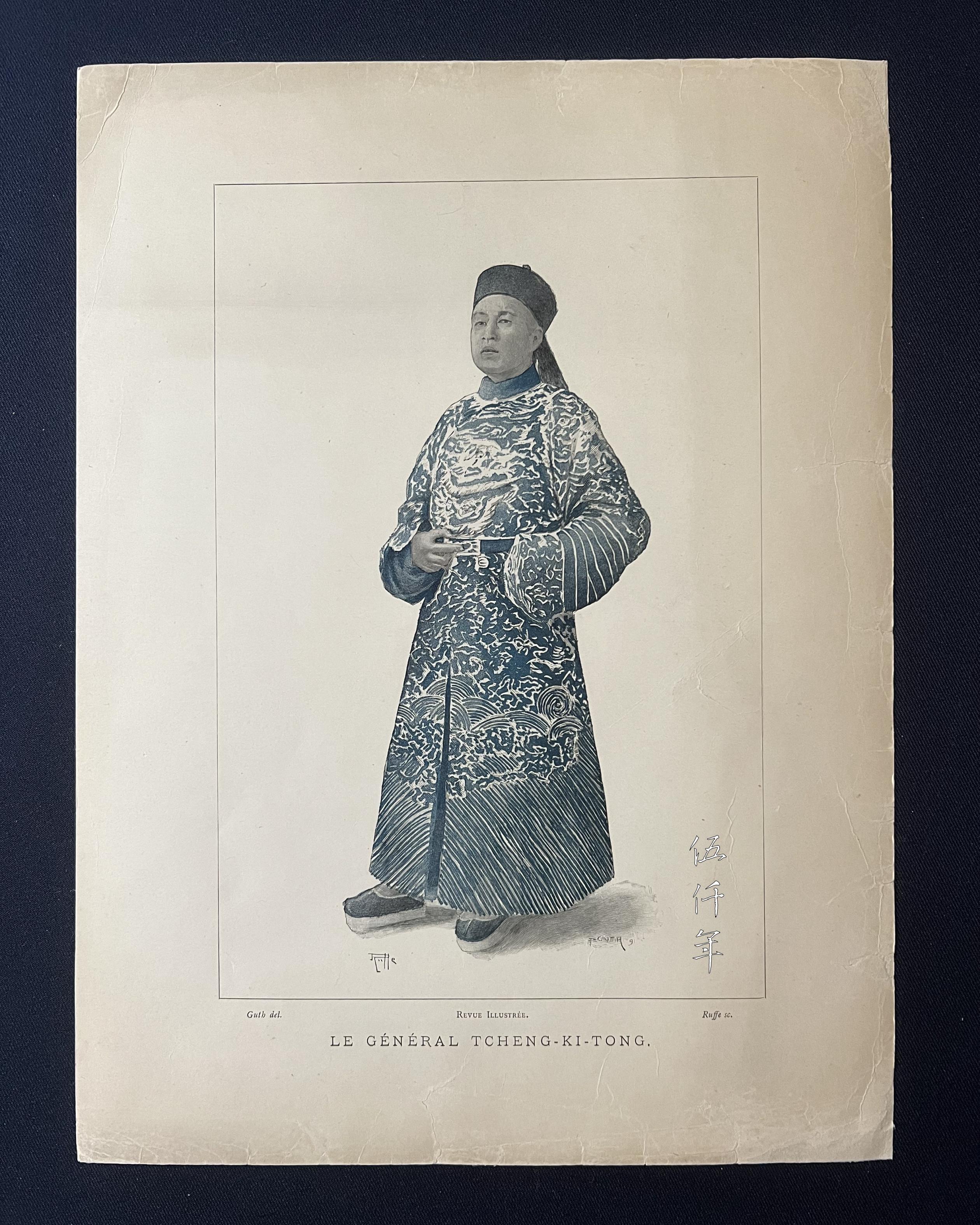
Portrait of Tcheng Ki-tong
(51) Minister Tcheng Ki-tong 1851-1907 (陳季同外務大臣)
(51-1) Portrait of Tcheng Ki-tong, Revue Illustre.
(51-2) Letter in French by Tcheng Ki-tong, written in Paris, dated 9 July 1888.
(51-3) Souvenirs Chinois, by Leon Caubert. Paris: Librairie des Bibliophiles, 1891. First edition. Inscribed by the author to Tcheng Ki-tong.
(52) Dr. James Cantlie 1851-1926 (康德黎醫師)
(52-1) Photograph of Dr. James Cantlie, signed by himself and wife Mabel.
(52-2) Beri-Beri, Researches Concerning Its Nature and Cause and the Means of Its Arrest, Made by Order of the Netherlands Government by C. A. Pekelharing and C. Winkler, Translated by James Cantlie. Edinburgh and London: Young J. Pentland, 1893. First edition. Inscribed by the translator to Dr. Hamilton Wright (1867-1917), American physician and pathologist who served as the United States Opium Commissioner.
(53) Louis Livingston Seaman 1851-1932 (路易‧利文斯頓‧席曼)
(53-1) The Recognition of the Chinese Republic, Address of Major Louis Livingston Seaman, M.D., A.B., L.L.B., F.R.G.S., President of the China Society of America, etc., Delivered at the Conference on Recent Developments in China, Held at Clark University, Worcester. November 13th, 1912. Inscribed by the speaker to Mrs. Upham.
(54) Jan Jakob Maria de Groot 1854 – 1921 (高延)
(54-1) Letter by J. J. M. de Groot to Dr. Bust, written in Leyden, dated 31 January 1893.
(54-2) Religion in China: Universism, a Key to the Study of Taoism and Confucianism. London: G. P. Putman's Sons, 1912. First edition. Inscribed by the author to Professor Paul Pelliot (1878-1945), French Sinologist and explorer, dated 20 February 1913.
(55) Ambassador William Woodville Rockhill 1854 – 1914 (柔克義公使)
(55-1) Formal letter in Chinese from the United States Legation represented by William W. Rockhill to Prince I-k'uang (奕劻 1838-1917), with envelope and Chinese name card. Letter dated 24th day in the third month of the 32nd year of the Kuang-hsü reign, corresponding to 17 April 1906.
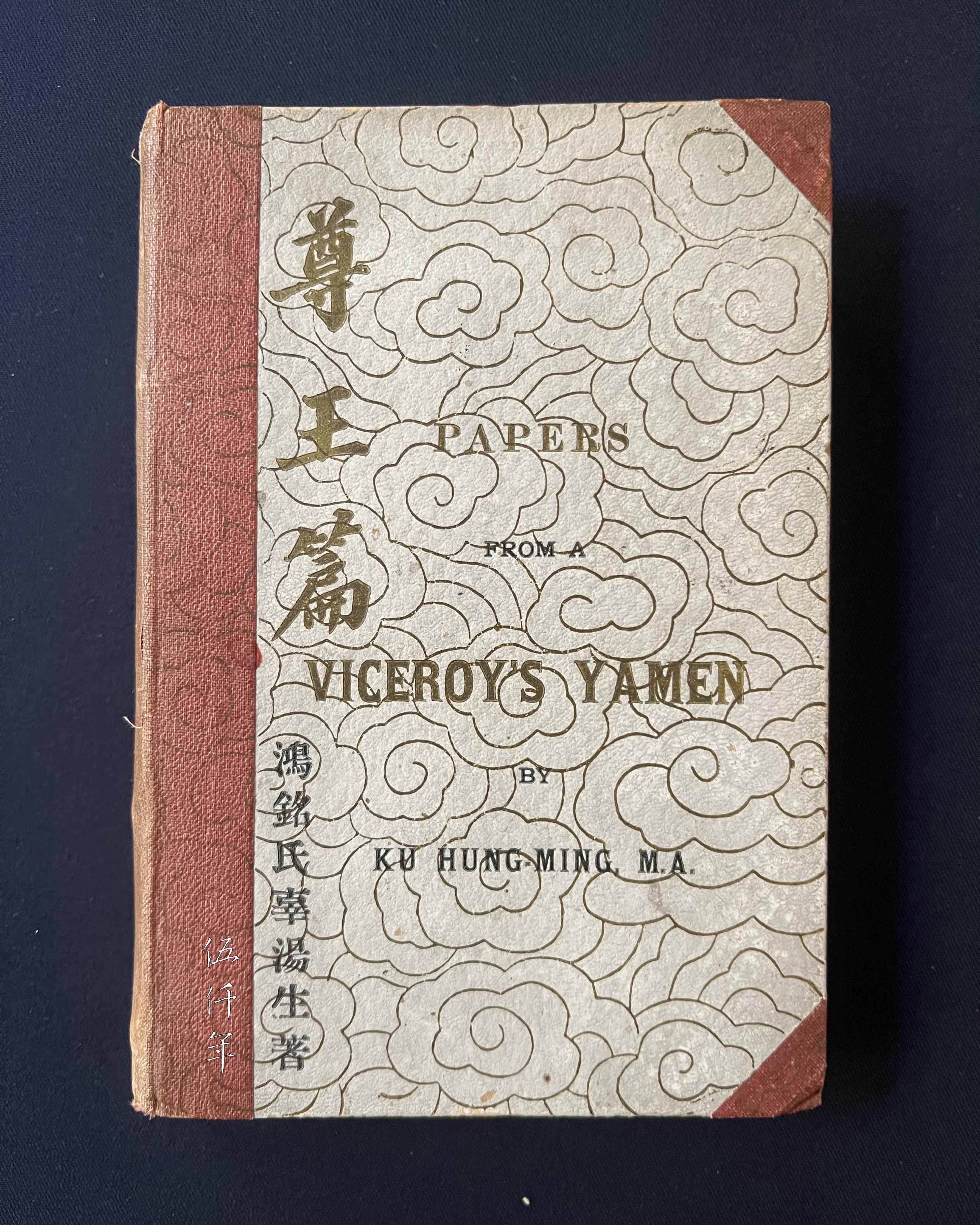
Front cover of Papers from a Viceroy's Yamen. Chinese Plea for the Case of Good Government and True Civilization in China. By Ku Hung Ming
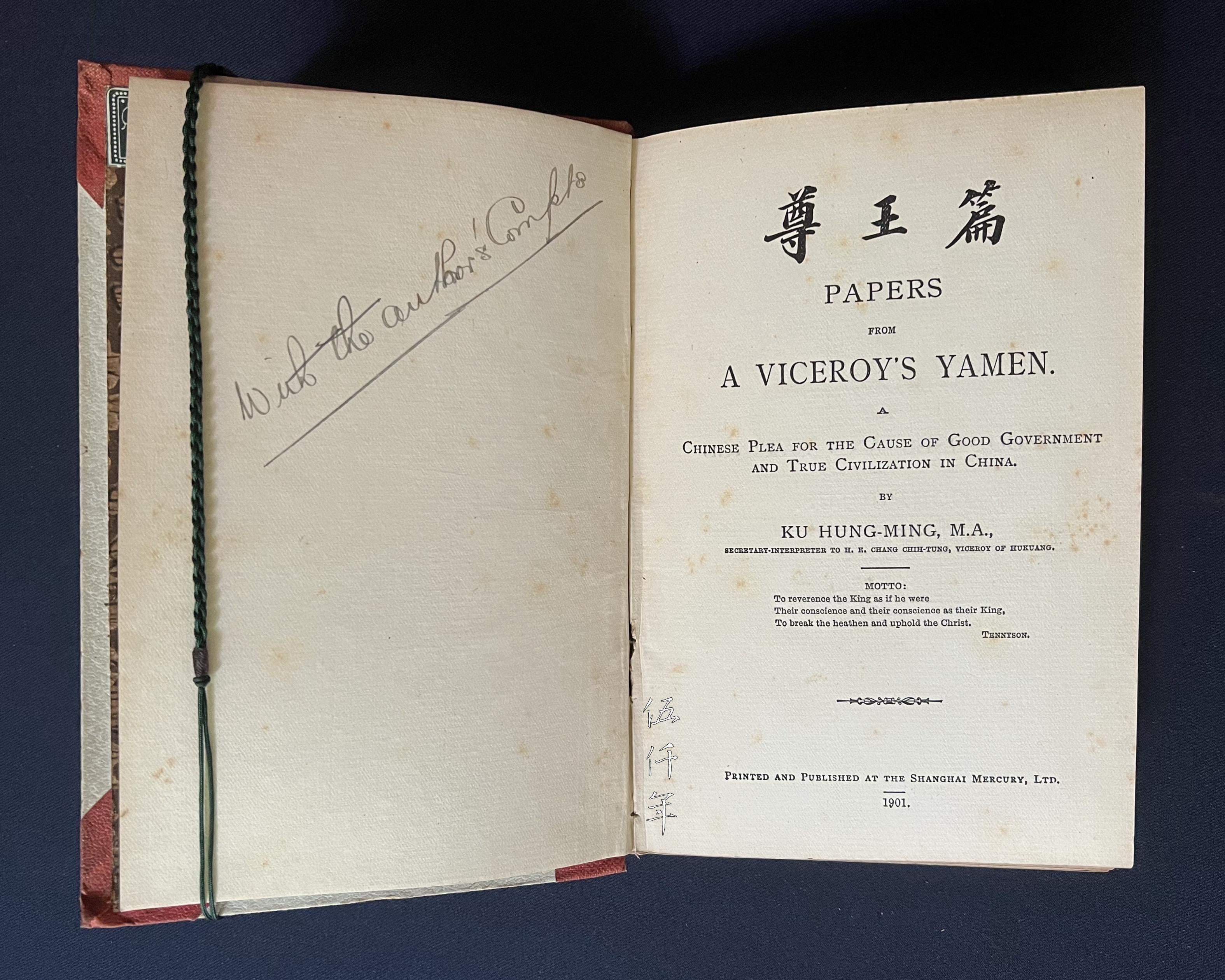
Title page of Papers from a Viceroy's Yamen. Chinese Plea for the Case of Good Government and True Civilization in China. By Ku Hung Ming
(56) Ku Hung Ming 1857 – 1928 (辜鴻銘)
(56-1) Papers from a Viceroy's Yamen. Chinese Plea for the Cause of Good Government and True Civilization in China. Shanghai: Shanghai Mercury, Ltd., 1901. First edition. Inscribed by the author.
(56-2) Papers from a Viceroy's Yamen. Chinese Plea for the Cause of Good Government and True Civilization in China. Peking: North China Standard, 1923. Inscribed by the author to Mrs. Richards.
(56-3) Papers from a Viceroy's Yamen. Chinese Plea for the Cause of Good Government and True Civilization in China. Shanghai: Shanghai Mercury, Ltd., 1901. First edition. Inscribed by Kaw Hung Take, elder brother of Ku Hung Ming, to Chihchen Lo Feng Luh, Chinese minister to Britain, dated 9 July 1902.
(56-4) Story of a Chinese Oxford Movement. Shanghai: Shanghai Mercury, Ltd., 1912. Second edition.
(56-5) The Spirit of the Chinese People, with an Essay on Civilisation and Anarchy. Peking: The Commercial Press, Work Ltd., 1922. Second edition. Inscribed by Hsiung Hsün-ch'i to Ravindranath Tagore (1861-1941), Indian poet and the first Asian recipient of a Nobel Prize, dated 2 May in the 13th year of the Republic of China, 1924.
(57) Giacomo Puccini 1858 – 1924 (吉爾卡摩‧普契尼)
(57-1) Two original artworks for the programme cover of a performance of Turandot by Puccini, music by Robert Stolz (1880-1975), words by Alfred Grunfeld (1852-1924). Cover design by Hans Weyrauch, nom de plume Pontus Barabane. The first piece with the executioner lying on the ground, the second piece with the executioner holding his sword and Turandot standing behind him.
(58) Lewis Charles Arlington 1859 – 1932 (阿靈敦)
(58-1) Symbolism of Chinese Sign-Boards. Reprinted from the China Journal, Vol. XI, No. 5, November, 1929, p 222-232. Inscribed by the author to Mrs. Dulcie Hope Danby (1889-1991), writer on Chinese history and archaeology who lived in Peking with husband Charles.
(58-2) Some Remarks on the Worship Offered Confucius in the Confucian Temple. Peiping: The Peiping Chronicle, January 1935. Inscribed by the author in Peking to Mrs. Dulcie Hope Danby, dated 27 January 1935.
(58-3) In Search of Old Peking, by L. C. Arlington and William Lewisohn. Peking: Henri Vetch, The French Bookstore, MCMXXXV (1935). First edition.
(59) Isaac Taylor Headland 1859 – 1942 (何德蘭)
(59-1) The Most Fascinating Mother Goose Book of the Century, Chinese Mother Goose Rhymes, Over 160 Pages, Nearly 150 Rhymes, Over 150 Pictures. New York, Chicago, Toronto: Fleming H. Revell Company, 1900. First edition. Inserted letter written by the author in New York to Dr. Noble, dated 10 January 1910.
(59-2) Chinese Heroes, Being a Record of Persecutions Endured by Native Christians in the Boxer Uprising. New York: Eaton & Mains, Cincinnati: Jennings & Pye, 1902. First edition. Inscribed by the author stating that this book was displayed at the Peking University Exhibit in St. Louis.
(59-3) Chinese Art Collection of Issac Taylor Headland, Ph.D., Under the Auspices of The Art Society of Pittsburgh, April 15 to 30, 1908. Catalogue of an Exhibition of Chinese Paintings from the Collection of Issac Taylor Headland.
(60) Gustav Mahler 1860 – 1911 (古斯塔夫‧馬勒)
(60-1) Die chinesische Flote, by Hans Bethge (1876-1946). Leipzig: Im Inselverlag, 1907. First edition.
(60-2) Gedachtnis-Feier fur Gustav Mahler (18. Mai 1911), Munchen, 19. und 20. November 1911.
(61) Viceroy Tuan Fang 1861-1911 (端方 總督)
(61-1) Report of the Visit of the Imperial Chinese Special Mission to Christiania, 27 to 29 April 1906.
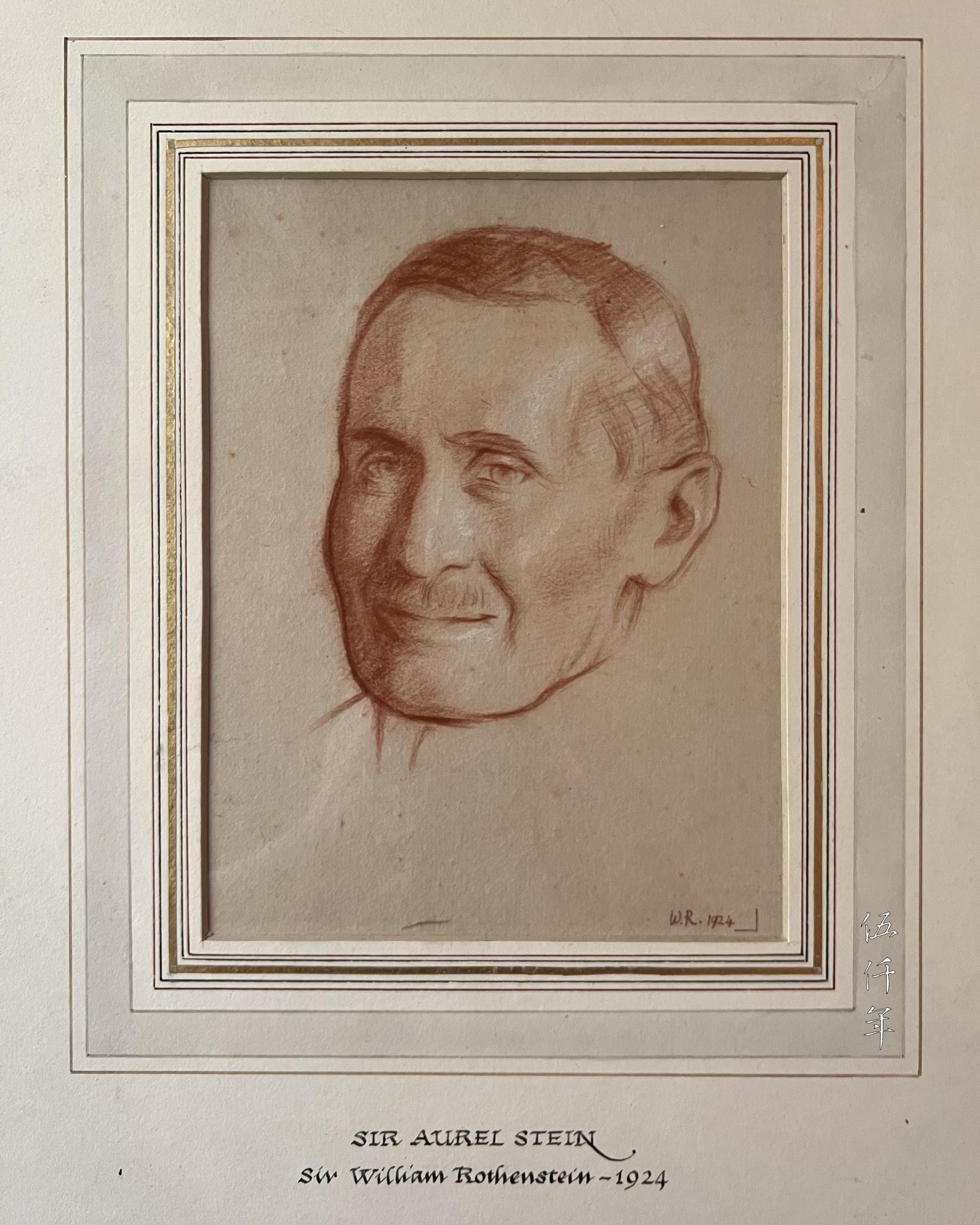
Portrait of Aurel Stein by William Rothenstein, 1924
(62) Sir Aurel Stein 1862 – 1943 (斯坦因爵士)
(62-1) Portrait of Aurel Stein by Sir William Rothenstein (1872-1945), English painter and writer on art, signed: W. R. 1924.
(62-2) Letter by Aurel Stein to Dr. Augustus Frederic Rudolf Hoernle (1841-1918), German Indologist and philologist who collaborated with A. Stein, written in Lahore, dated 1 April 1898.
(63) Goldsworthy Lowes Dickinson 1862 – 1932 (高茲渥斯‧狄金遜)
(63-1) Letter by Goldsworthy L. Dickinson to Prof. Harold Joseph Laski (1893-1950), English political theorist and economist, written at King’s College in University of Cambridge.
(63-2) Goldsworthy Lowes Dickinson, by E. M. Forster (1879-1970). London: Edward Arnold & Co., 1934. First edition. Inserted a typed letter with envelope by G. L. Dickinson to Mrs. Fairchild, written in London, dated 23 April 1923.
(63-3) Letters from a Chinese Official, Being an Eastern View of Western Civilization. New York: McClure, Philips & Co., 1903. First edition. Inscribed by the author to W. W. Gibbins, dated May 1904.
(63-4) Goldsworthy Lowes Dickinson, 6 August 1862, 3 August 1932, Fellow of the College, 1887-1932. King's College Cambridge, Printed at the University Press, January 1933, For distribution to Members of the College.
(64) George Ernest Morrison 1862 – 1920 (莫理循)
(64-1) Letter by G. E. Morrison to Lady Dorothy Fanny Nevill (1826-1913), English writer and horticulturist, written in Peking, dated 31 December 1907.
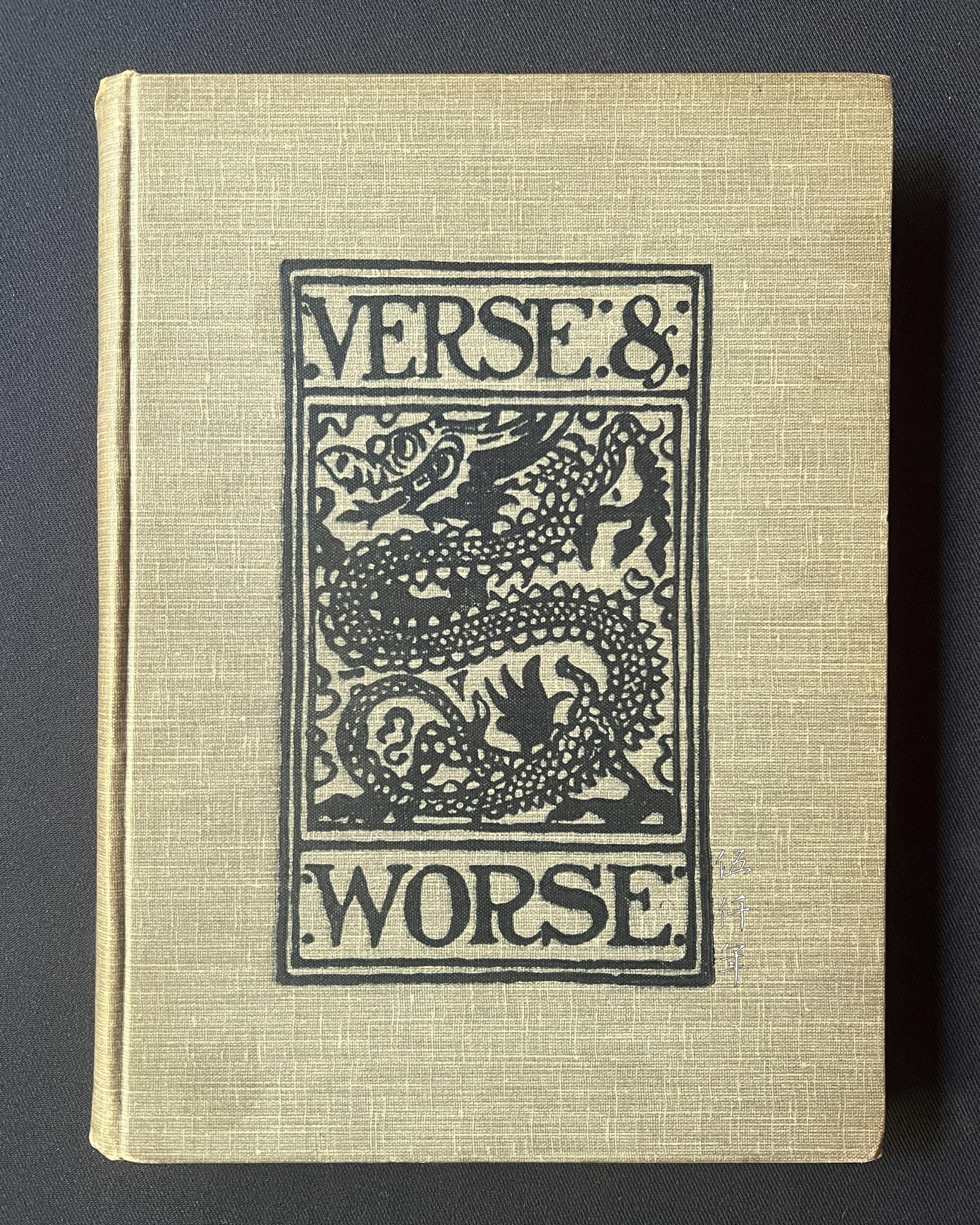
Front cover of Verse and Worse, Selections from the Writings of Tung Chia. By John Percy Bland
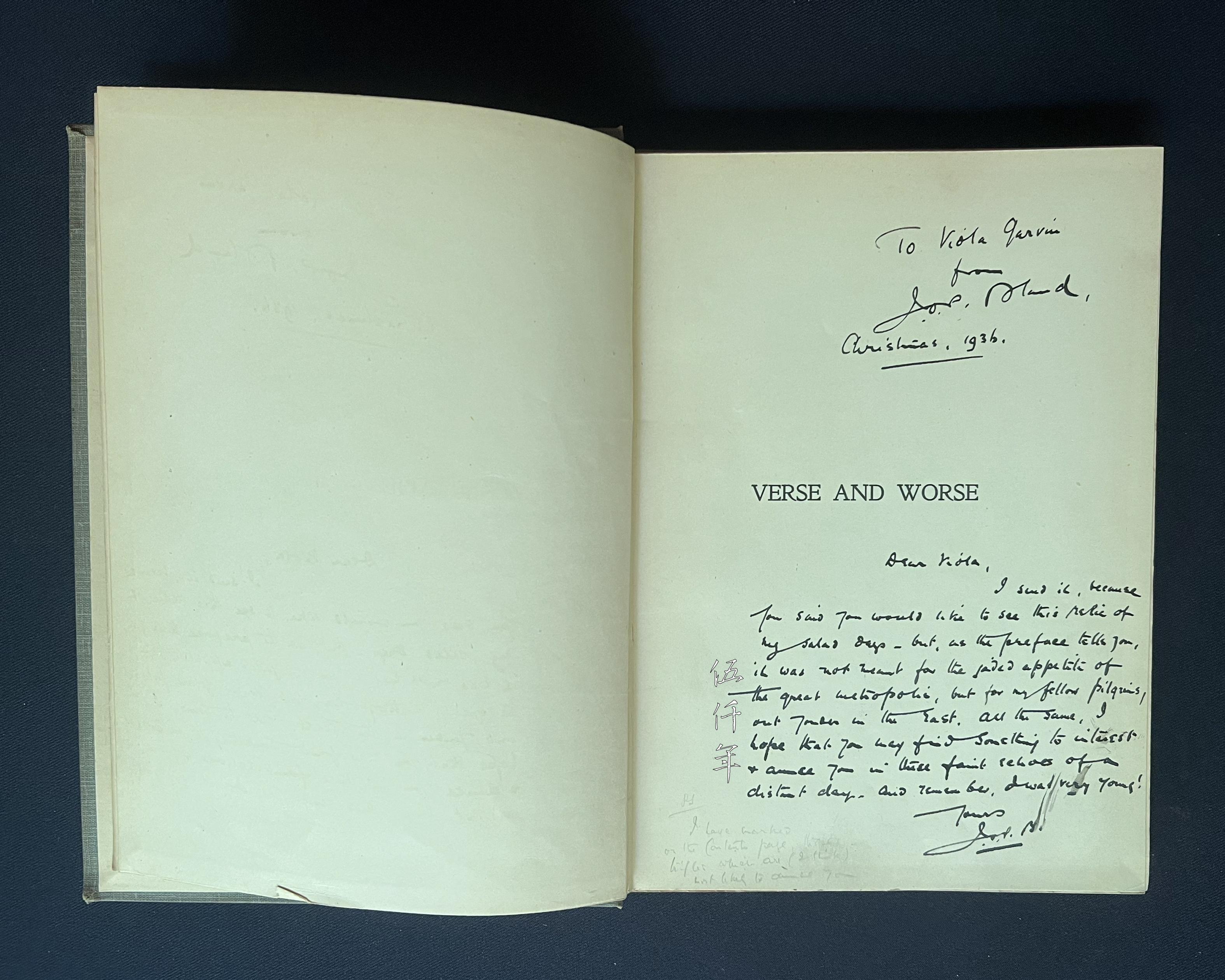
Inside page of Verse and Worse, Selections from the Writings of Tung Chia. By John Percy Bland
(65) John Otway Percy Bland 1863 – 1945 (濮蘭德)
(65-1) Houseboat Days in China. London: Edward Arnold, 1909. First edition. Full page inscription by the author to R. V. Leveson, dated 14 March 1914.
(65-2) Verse and Worse, Selections from the Writings of Tung Chia (J. O. P. Bland), With Illustrations by W. D. Straight. Published in Shanghai, 1902. First edition. Half page inscription by the author to Viola Garvin (1898-1969), English poet and literary editor, dated Christmas 1936.
(66) Ambassador Liang Cheng 1864-1917 (梁誠大使)
(66-1) Typed letter by Liang Cheng to Charles D. Norton (1871-1923), American banker who served as assistant secretary of the Treasury and secretary to President William Taft, written in Washington, dated 17 January 1906.
(67) Herbert Henry Gowen 1864 –1960 (高恩)
(67-1) An Outline History of China. Boston: Sherman, French & Co., 1917. Second edition. Inscribed by the author in English and Chinese to William David Vincent, dated April 1922. Attached is a photograph of the author with the Bishop of Idaho. Inserted is a typed letter by H.G.C. Hillock to W. D. Vincent, dated 6 September 1929. Also inserted is a woodblock print of God P'an-ku.
(68) Katharine Carl 1865 – 1938 (凱瑟琳‧卡爾)
(68-1) With the Empress Dowager. New York: The Century Co., 1905. First edition. Half page inscription by previous collector.
(68-2) Shanghai, Chinese Roof Garden, Chinese Village, World's Fair, Pike Mandarin Style Chop Suey. Inscribed by the previous owner with the date of 2 September 1904 after visiting the St. Louis World’s Fair.
(69) Sven Anders Hedin 1865 – 1952 (斯文‧安德斯‧赫定)
(69-1) Letter by S. A. Hedin to Young, written in Stockholm, dated 15 November 1909.
(69-2) Sketch map by Sven A. Hedin illustrating part of his route to Lhasa of Tibet in 1901, on his second Asian expedition (1899-1902). The map shows the location of Camp 44, the journey to Namru where he was stopped by Kamba Bombo, governor of the province, and continuing onward to Naktsang where he was stopped by Hlaje-Tsering. The expedition was then redirected westwards by way of Kashmir to Ladakh. Sketch map was reproduced under the title The Dash for Lhasa in My Life as an Explorer, Chapter XLII Back to High Tibet. Signed by Hedin and dated 1925.
(70) Provisional President Sun Yat-sen 1866-1925 (孫中山臨時總統)
(70-1) The International Development of China. Shanghai: Printed by the Commercial Press, Ltd., 1920. First edition. Inscribed by the author to Crane, possibly Charles R. Crane (1858-1939), United States ambassador to China from 22 March 1920 to 2 July 1922. Bookplate of Stanley K. Hornbeck attached, who was chief of the State Department Division of Far Eastern Affairs between 1928 to 1937, and ambassador to the Netherlands between 1944 to 1947.
(70-2) The Three Principles of the People. Taipei: China Publishing Company, 1982. Translated by Frank Wilson Price. Inscribed by President Ma Ying-jeou to Dr. James Stephen Cotton, dated 6 December 1984.
(70-3) The Three Principles of the People. Taipei: China Publishing Company, 1982. Translated by Frank Wilson Price. Inscribed by Premier Sun Yun Suan, dated 3 June 1985.
(71 ) George Cochrane Hazelton 1868-1941 (黑澤爾頓)
(71-1) The Yellow Jacket, a Chinese Play Done in a Chinese Manner, In Three Acts. Indianapolis: The Bobbs-Merrill Company, Publishers, 1913. First edition. Signed by G. C. Hazelton, Harry Benrimo (1874-1942) and Coburn Theatre directors Mr. and Mrs. Coburn.
(71-2) Theatre programme titled: The Yellow Jacket at Coburn Theatre, from 26 November 1928.
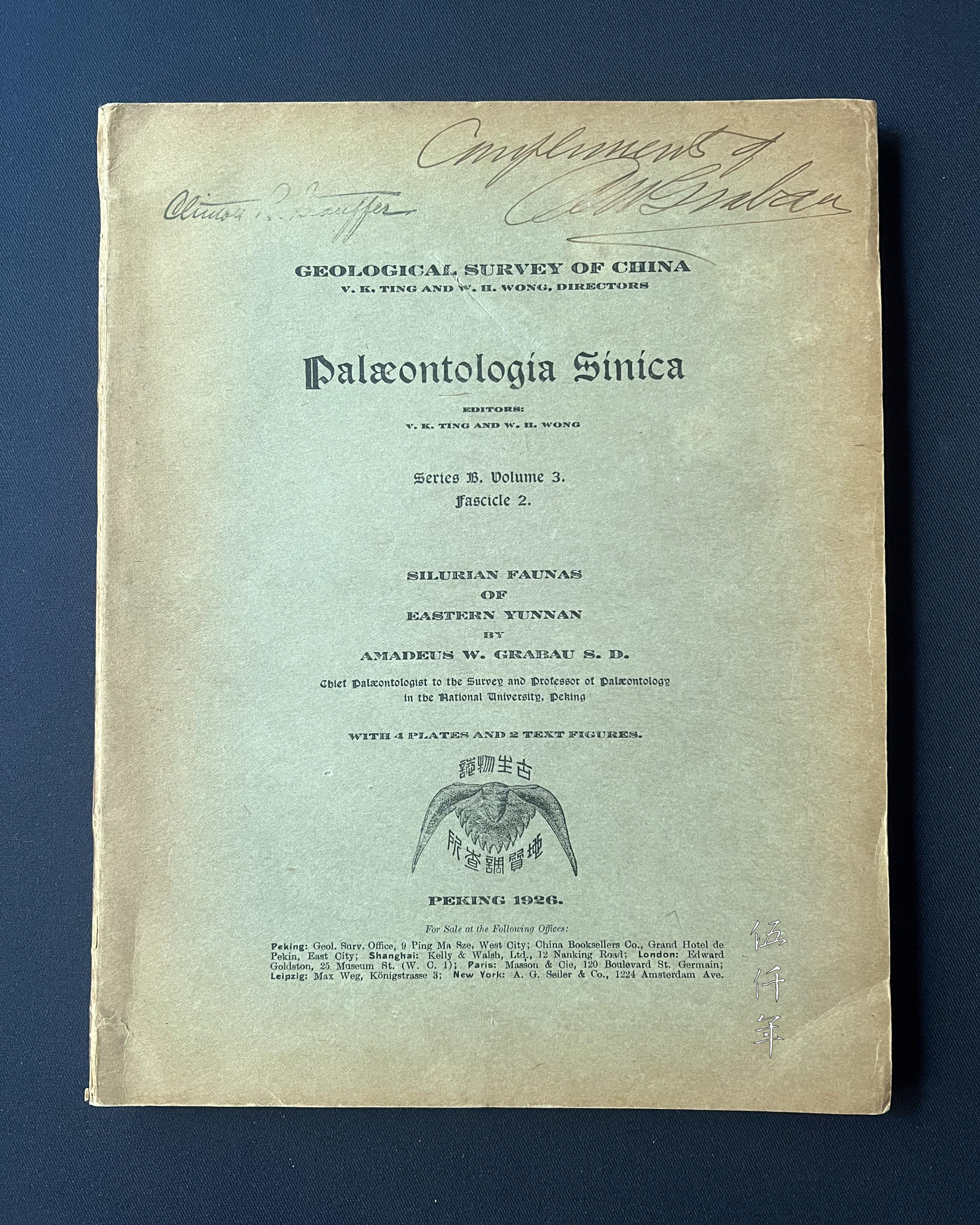
Front cover of Geological Survey of China. Inscribed by Amadeus Grabau
(72) Amadeus Grabau 1870 – 1946 (葛利普)
(72-1) Geological Survey of China, V. K. Ting and W. H. Wong, Directors, Palaeontologia Sinica, Series B, Volume 3, Fascicle 2, Silurian Faunas of Eastern Yunnan. Peking 1926. Inscribed by A. Grabau.
(73) Minister Lou Tseng-tsiang 1871-1949 (陸子欣 (徵祥) 總長)
(73-1) Letter in French by Lou Tseng-tsiang to Leori, written in Pei-tsai-ho, Peking, dated 2 September 1916.
(73-3) L'invasion et l'occupation de la Mandchourie, jugees a la lumiere de la Doctrine Catholique par des ecrits du Cardinal Mercier, publies par Dom P. C. Lou Tseng-Tsiang. Paris: Les Editions du Foyer, November 1933. Inscribed by the author to de Rotrou, dated 2 September 1937. Inserted typed introduction by T. T.. Lou and newspaper clipping.
(74) Carlo de Fornaro 1872 – 1949 (卡羅‧德‧佛里諾)
(74-1) The Chinese Decameron. New York: The Lotus Society, 1929. Copy No. 16 out of 25 that was hand illuminated, specially bound and signed by the translator.
(75) Grace Thompson Seton 1872-1959 (葛蕾絲‧西頓)
(75-1) Chinese Lanterns. New York: Dodd, Mead and Company, 1924. Second printing. Inscribed by the author to Lola Sleeth Miller (1860-1951), American painter and sculptor, dated 4 November 1940.
(76) George Forrest 1873 – 1932 (喬治‧福雷斯特)
(76-1) Some Plants, Shrubs and Trees Found by Mr. Forrest in 1924, by John Charles Williams (1861-1939), horticulturist and sponsor of George Forrest's seven expeditions to China between 1912 and 1932. Private Publication, June 1925. Inscribed by the author to Frederick Robert Stephen Balfour (1873-1945), horticulturist, dated 2 August 1925. Inserted letter by the author to F. R. S. Balfour, dated 2 August 1925.
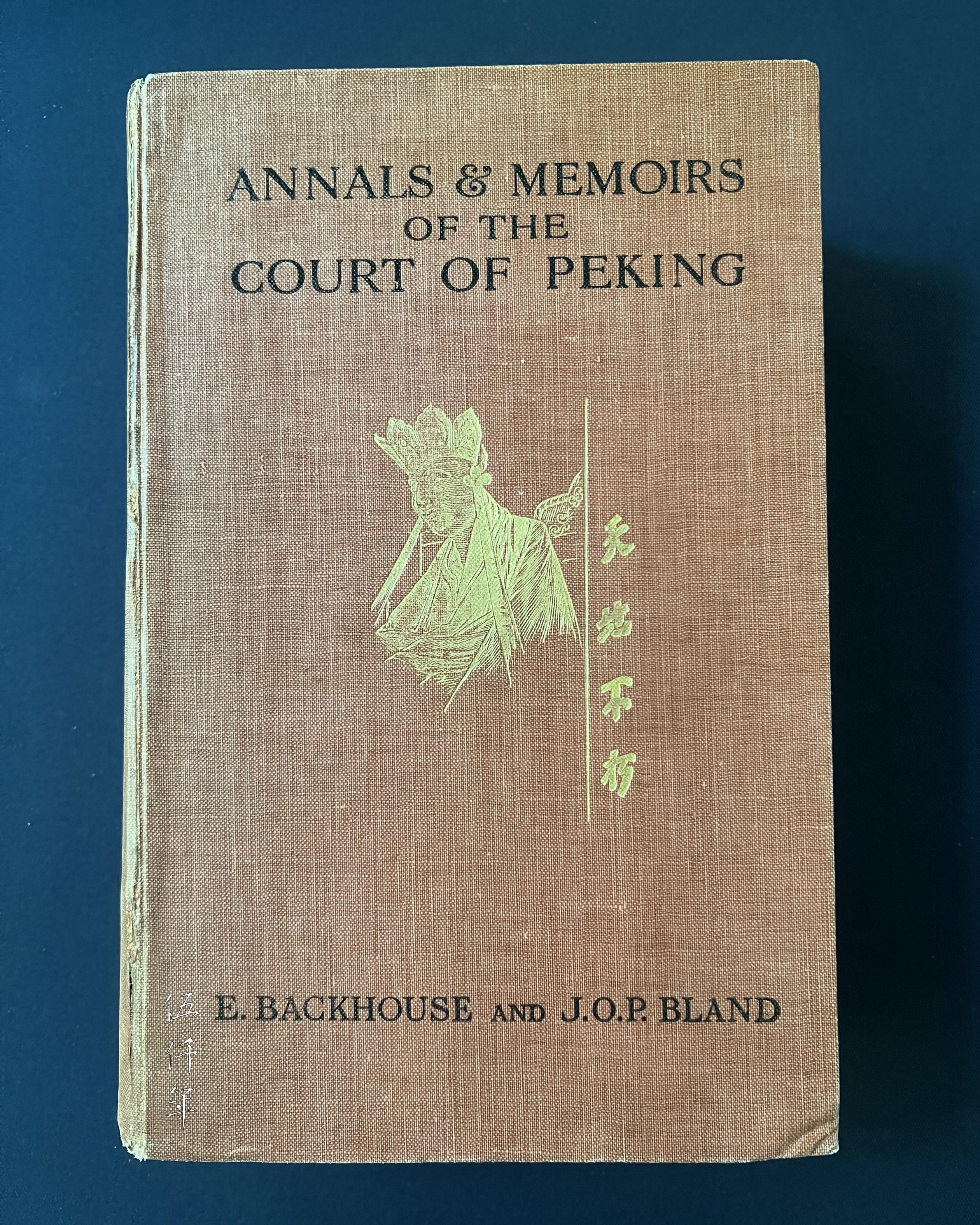
Front cover of Annals & Memoirs of the Court of Peking. By Edmund Backhouse and J. O. P. Bland
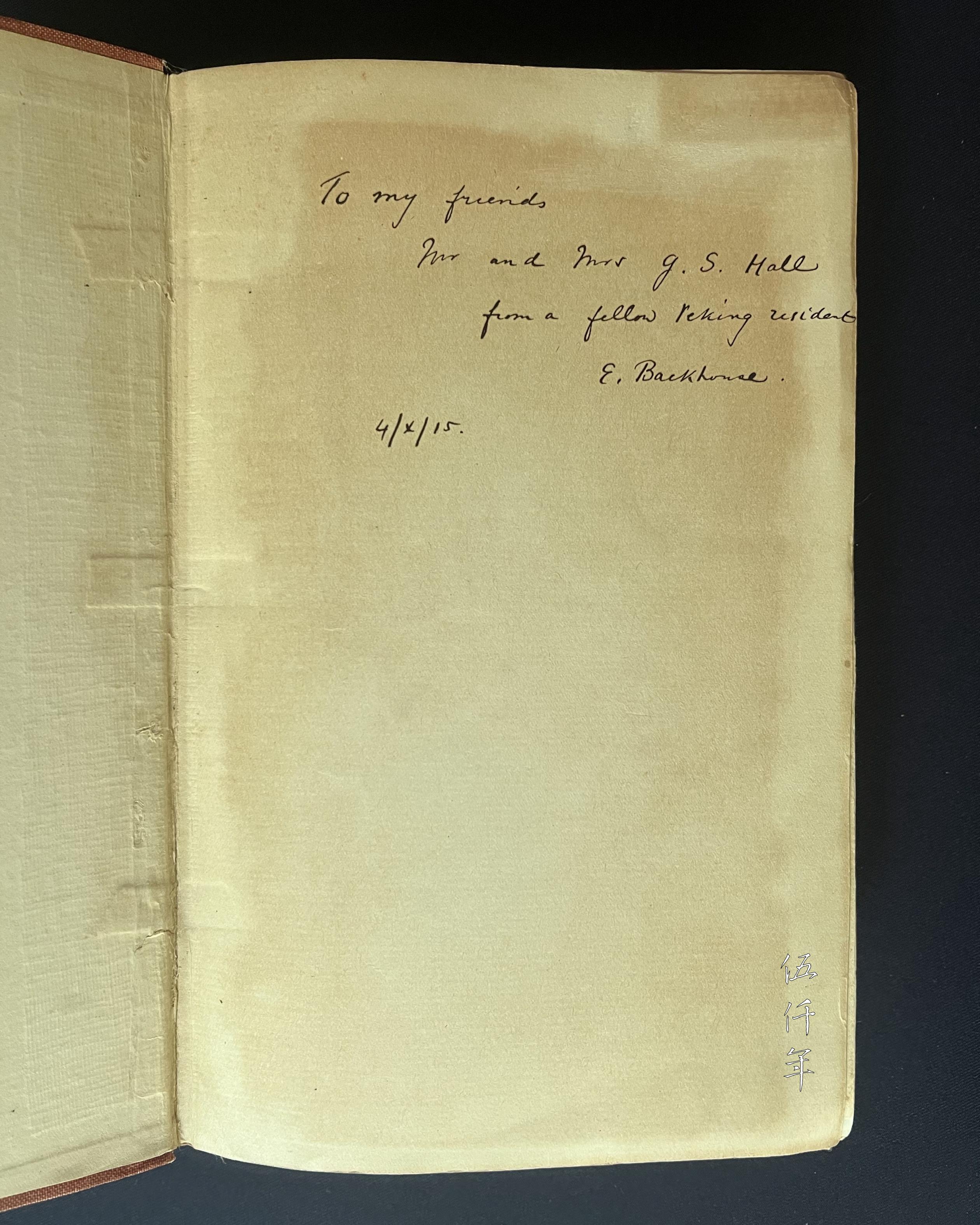
Inside page of Annals & Memoirs of the Court of Peking. By Edmund Backhouse and J. O. P. Bland. Inscribed by Edmund Backhouse
(77) Sir Edmund Backhouse 1873-1944 (巴克斯)
(77-1) Annals & Memoirs of the Court of Peking, by E. Backhouse and J.O. P. Bland. London: William Heinemann, March 1914, Second impression. Inscribed by Edmund Backhouse to Mr. And Mrs. G. S. Hall, dated 4 October 1915.
(78) Ellen Newbold La Motte 1873-1961 (艾倫‧拉莫特)
(78-1) The Opium Monopoly. New York: The Macmillan Company, 1920. First edition. Inscribed by the author to Jeanne, circa 1923.
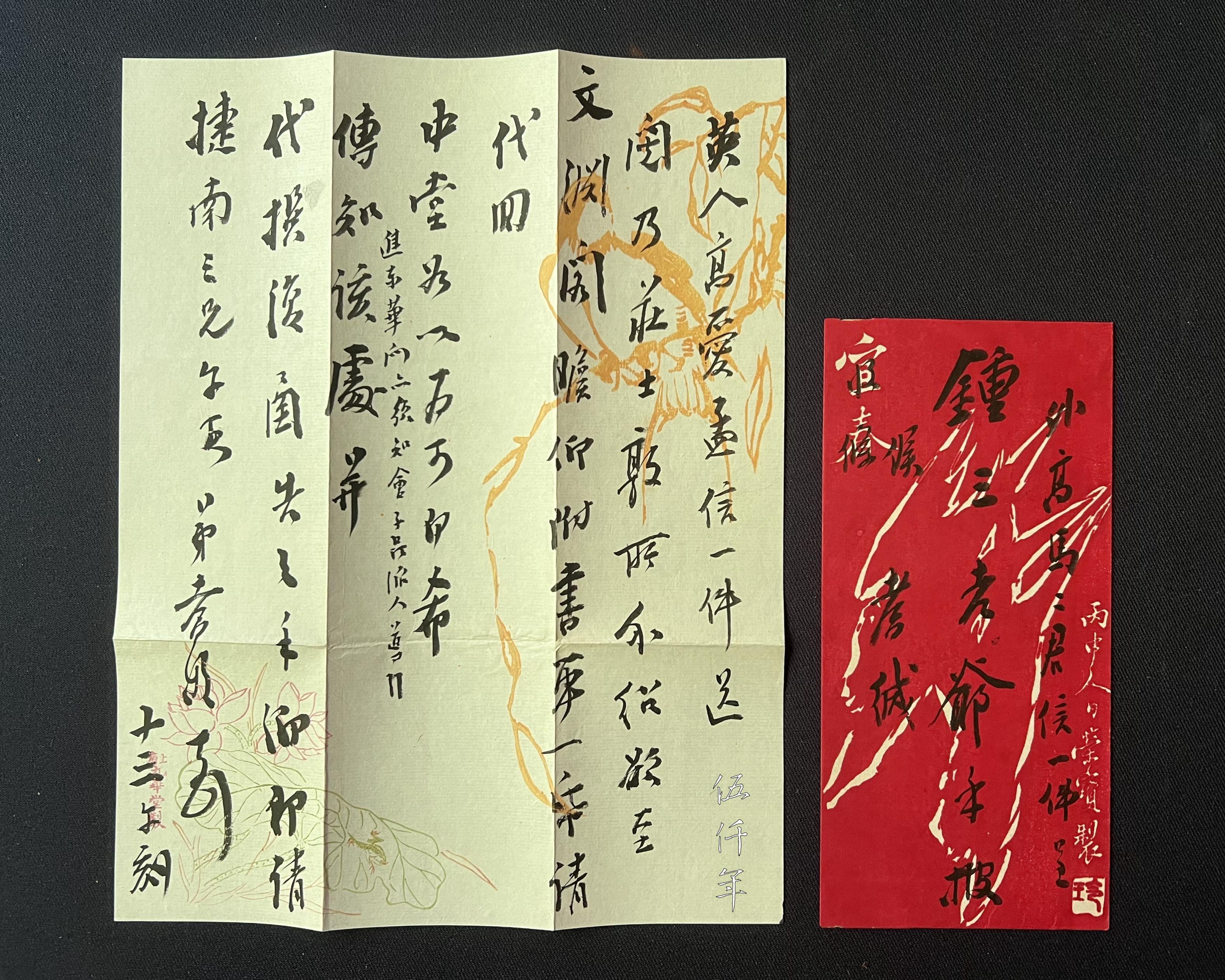
Letter in Chinese by Ch'i-i to Chung Chieh-nan, regarding a visitor to the Imperial Library who was introduced by Reginald F. Johnston
(79) Sir Reginald Fleming Johnston 1874 – 1938 (莊士敦爵士)
(79-1) Letter by R. Johnston to Mrs. Howell, whose husband Edward Butts Howell (1879-1952) was a sinologist who worked for the Chinese Maritime Customs Service. Letter was written in Tientsin, dated 1 February 1926.
(79-2) Letter by R. Johnston to Mabel Ward Rudd (1877-1958), American poet, written in Scotland, dated 4 January 1938.
(79-3) Letter in Chinese by Ch'i-i to Chung Chieh-nan, regarding a visitor to the Imperial Library who was introduced by R. Johnston.
(79-4) Lion and Dragon in Northern China. London: John Murray, 1910. First edition.
(79-5) A Chinese Appeal to Christendom Concerning Christian Missions, by Lin Shao-yang, pseudonym of R. Johnston. London: Watts & Co., 1911. First edition.
(79-6) Twilight in the Forbidden City. London: Victor Gollancz Ltd., 1934. First edition.
(80) Johan Gunnar Andersson 1874 – 1960 (安特生)
(80-1) Geologie und Genesis der lapplandischen Eisenerzlagerstatten voh Stuttgart: E. Schweizerbart'sche Verlagshandlung (E. Nagele), 1907.
(Geology and Genesis of the Lapland Iron Ore Deposits, by Dr. O. Stutzer. Stuttgart: 1907). Signed by Gunnar Andersson.
(80-2) Spetsbergens och Beeren Eilands Karlvaxtflora Grundade Pa Iakttagelser Under 1898 Ars Svenska Polarexpedition, af Gunnar Andersson och Henrik Hesselman. Stockholm: Kungl. Boktryckereit. P. A. Norstedt & Soner, 1900.
(Contributions to the Knowledge of the Vascular Plant of Spitsbergen and Berenice Islands. Founded on the Observations Made During Swedish Polar Expedition of 1898. Stockholm: 1900. By Gunnar Anderson and Henrik Hesselman 1874-1943). Inscribed to Prof. Gerard De Geer (1858-1943), Swedish geologist.
(81) Florence Ayscough 1875 – 1942 (佛洛倫絲‧艾思柯)
(81-1) Christmas greeting card with photograph of Florence Ayscough and husband Harley Farnsworth MacNair, signed by both in 1936.
(81-2) Typed letter with envelope by F. Ayscough to Rodolphe Louis Megroz (1891-1968), English poet and critic, written on a ship in the Indian Ocean, dated 28 March 1934. Apart from the inserted letter, there are also a sheet of pine leaf diagram signed by Ayscough in English and Chinese with seal impression, a fish design envelope, and a small card with envelope addressed to Shih-i Hsiung (熊式一 1902-1991).
(81-3)Tu Fu(杜甫), the Autobiography of a Chinese Poet, A.D. 712-770, Including a Historical Year Record, a Biographical Index, and a Topographical Note, as well as Maps, Plans, and Illustrations, Arranged from his poems and translated by Florence Ayscough. London: Jonathan Cape, 1929. First edition.
(82) Lionel Giles 1875 – 1958 (翟林奈)
(82-1) Taoist Teachings, from the Book of Lieh Tzu. London: John Murray, 1947. Second edition. Inscribed by the author to Hesketh Pearson (1887-1964), English actor and biographer, for Christmas.
(82-2) A Topographical Fragment from Tunhuang, Reprinted from the Bulletin of the School of Oriental Studies, London Institution, Vol. VII, Part 3, 1934. Inscribed by the author.
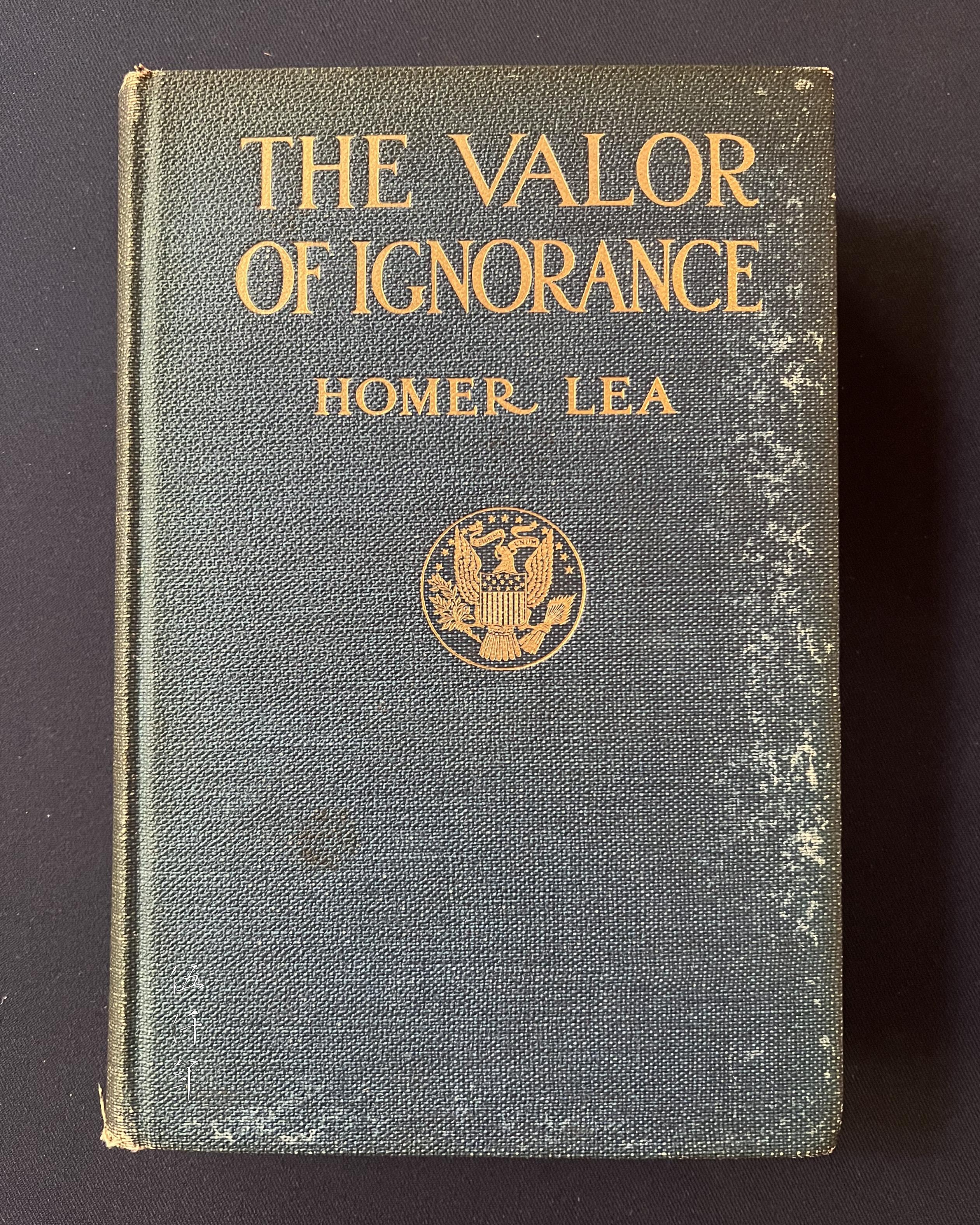
Front cover of The Valor of Ignorance. By Homer Lea
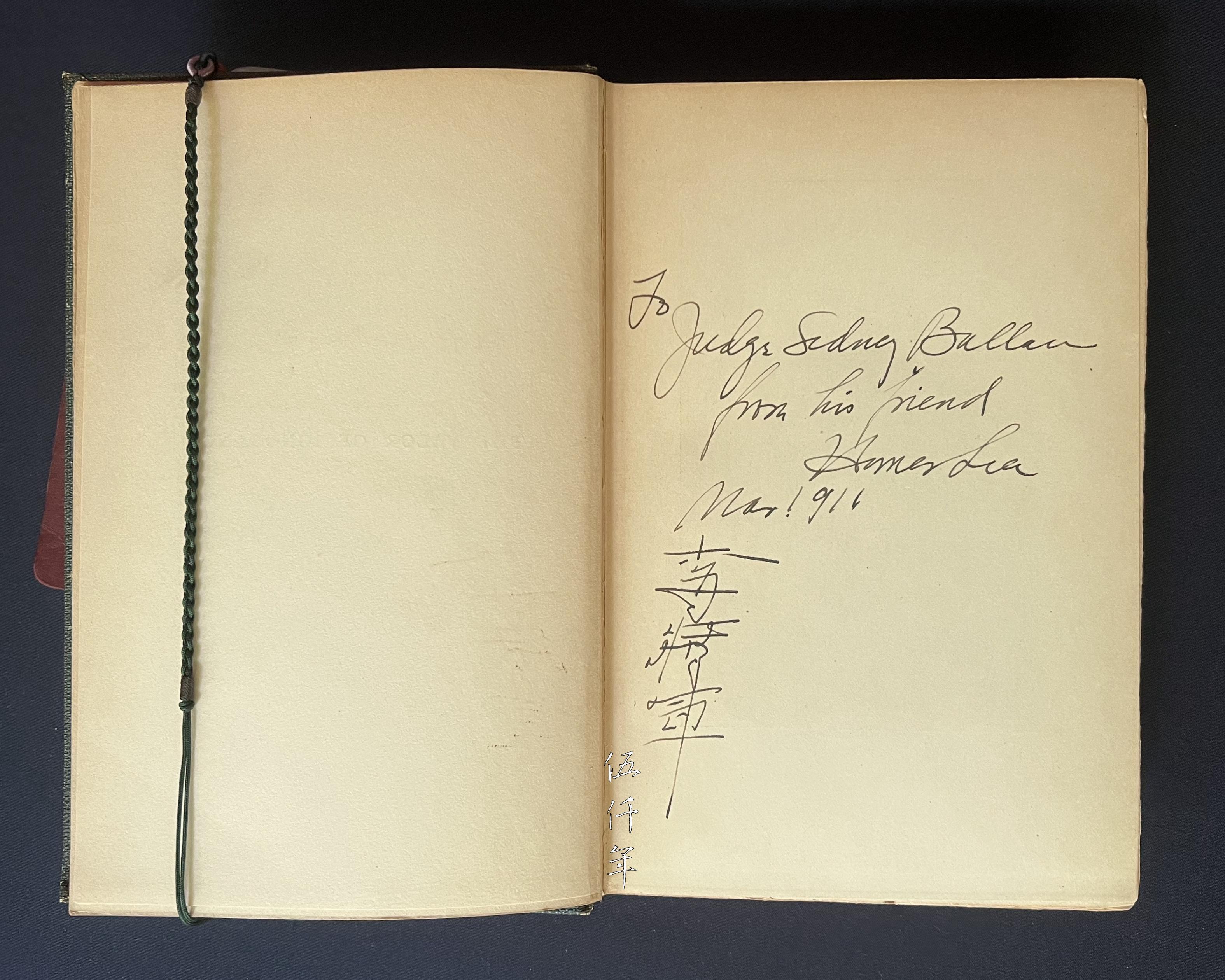
Inside page of The Valor of Ignorance. By Homer Lea
(83) Homer Lea 1876-1912 (荷馬李)
(83-1) The Vermillion Pencil, A Romance of China. New York, The McClure Company, 1908. First edition. Inserted typed letter by lawyer stating some background information relating to Homer Lea, dated 4 September 1908.
(83-2) The Vermillion Pencil, A Romance of China. New York: The McClure Company, 1908. First edition. Inscribed by the author to Chas.
(83-3) The Valor of Ignorance. New York: Harper & Brothers Publishers, 1909. First edition. Inscribed by the author in English and Chinese, dated March 1911.
(84) Ernest Henry Wilson 1876 – 1930 (威爾蓀)
(84-1) Letter by E. H. Wilson to W. J. Tutcher (1867-1920), superintendent of the Public Gardens in Hong Kong, written in I-chang on his first expedition to China, dated 20 July 1901.
(84-2) Envelope by E. H. Wilson to W. J. Tutcher (1867-1920), superintendent of the Public Gardens in Hong Kong, on his second expedition to China, sent from Szechwan, through Shanghai to Scotland.
(85) Henry L. Stimson 1867-1950 (亨利‧史汀生)
(85-1) Typed letter by H. L. Stimson to Rovner consenting to be Honorary Chairman of The American Committee for Non-Participation in Japanese Aggression, written in New York, dated 22 January 1940.
(85-2) Typed letter by Harry B. Price, executive secretary of The American Committee for Non-Participation in Japanese Aggression, dated 22 January 1940.
(85-3) Typed card by Harry B. Price, executive secretary of The American Committee for Non-Participation in Japanese Aggression, dated 16 June 1939.
(85-4) America Supports Japanese Aggression, publicity brochure.
(85-5) What One Person Can Do, publicity leaflet.
(85-6) Legislation to Prohibit War Exports to Japan, publicity brochure by H. L. Stimson.
(86) Thomas E. La Fargue 1872-1954 (拉法格)
(86-1) China's First Hundred. Washington: State College of Washington, 1942. First edition. Inscribed by the author to Dr. William R. Davis, dated 9 November 1942.
(87) Dr. Edward Hicks Hume 1876-1957 (胡美醫師)
(87-1) The Chinese Way in Medicine. Baltimore: The John Hopkins Press, 1940. First edition. Inscribed by the author to Kate.
(87-2) Doctors East Doctors West, An American Physician's Life in China. New York: W. W. Norton & Company Inc., 1946. First edition. Inscribed by the author to George and Nora Lane, dated 14 September 1946.
(88) Ambassador Sao-ke Alfred Sze 1877-1958 (施肇基大使)
(88-1) Geneva Opium Conferences, Statements of the Chinese Delegation. Baltimore: The John Hopkins Press, 1926. First edition. Name card of Sao-ke Alfred Sze affixed to inside page.
(88-2) Address delivered at the Reception held on the occasion of the opening of the Society's new Quarters on March 30, 1920, by His Excellency Sao-ke Alfred Sze (Minister of the Republic of China at the Court of St. James). From the Journal of the Royal Asiatic Society, July, 1920.
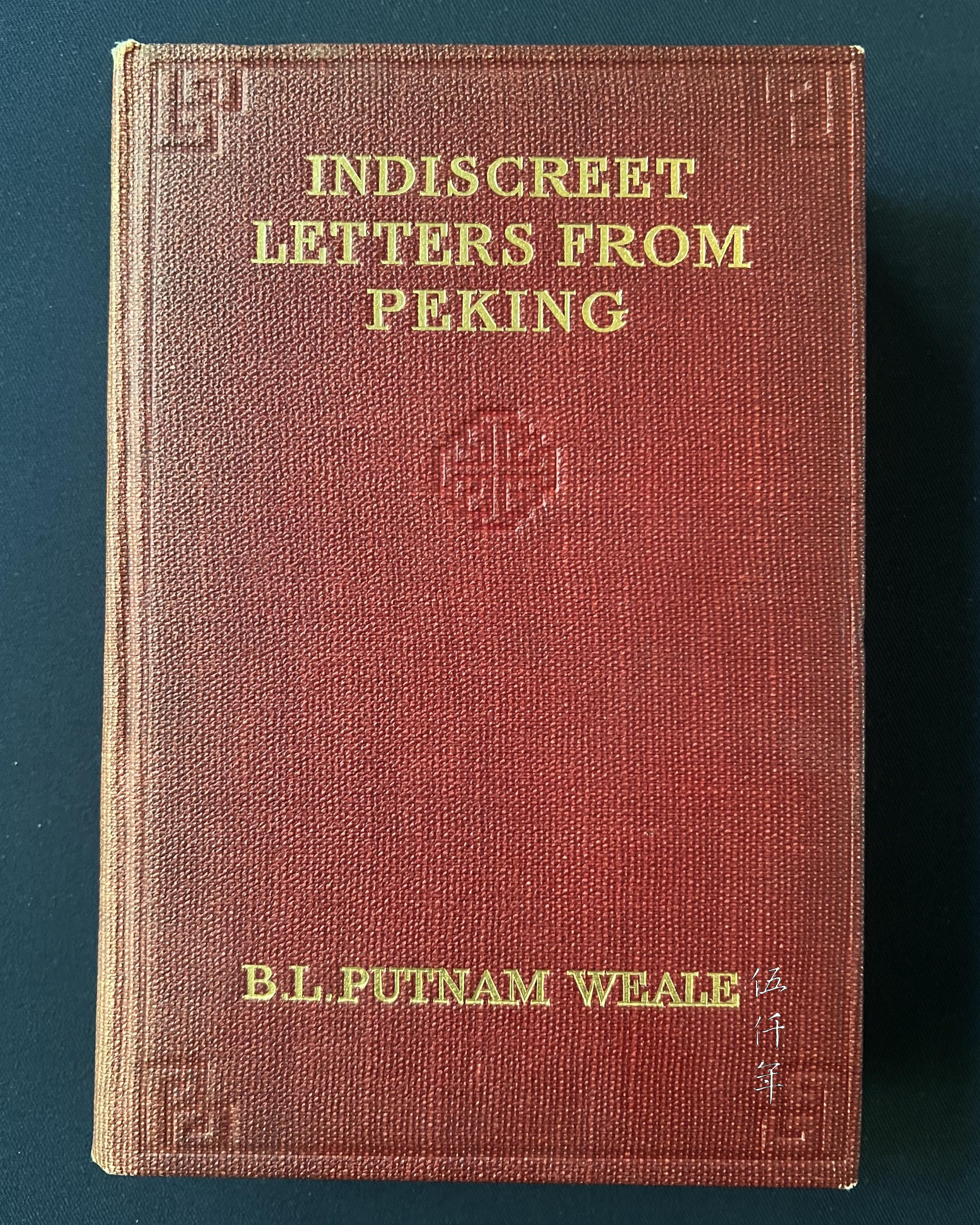
Front cover of Indiscreet Letters from Peking, being the Notes of an Eye-Witness, Which Set Forth in Some Detail, from Day to Day, the Real Story of the Siege and Sack of a Distressed Capital in 1900- the Year of the Great Tribulation. By Bertram Lenox Simpson
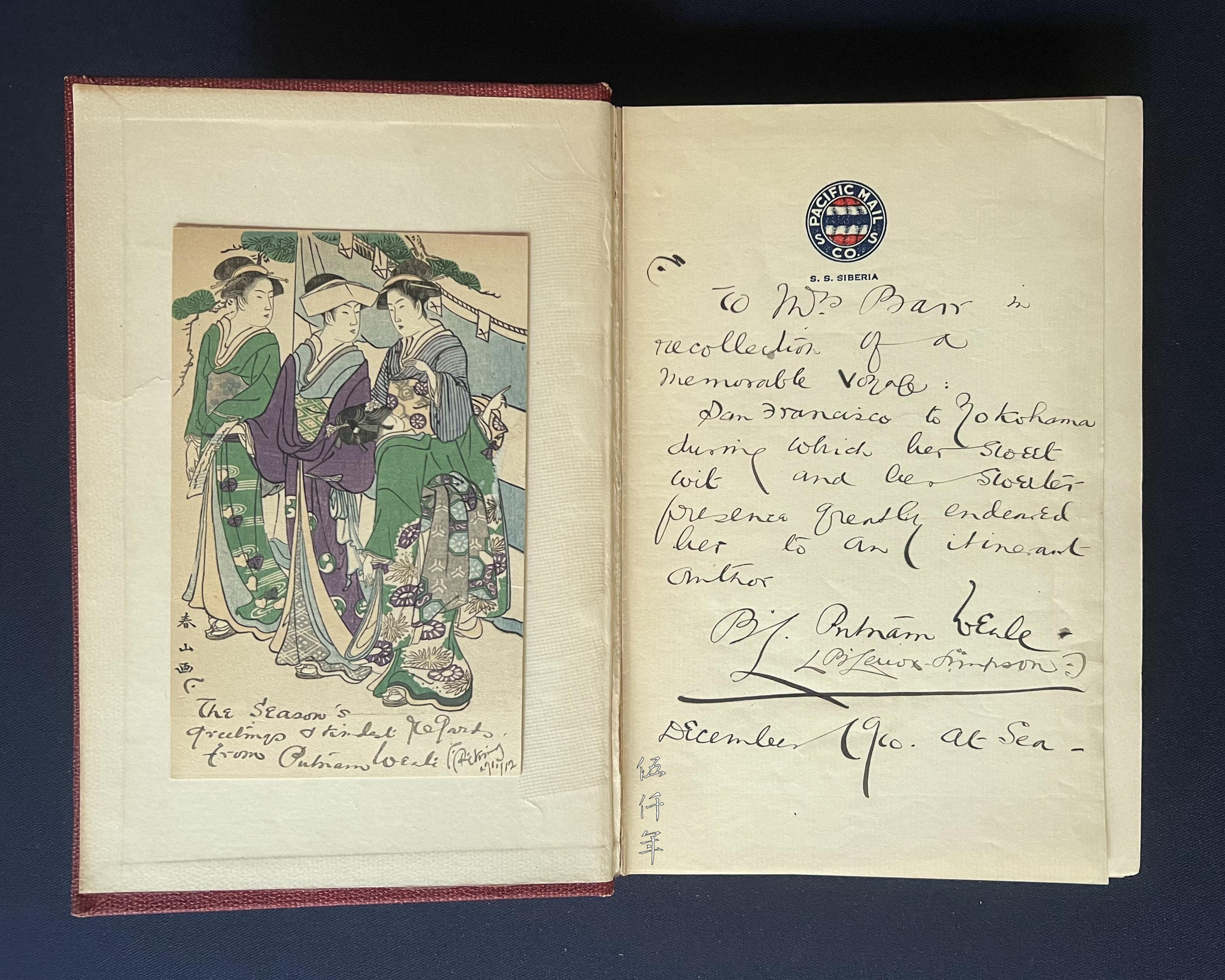
Letter by Bertram Lenox Simpson to Mrs. Barr, written on 23 May 1911 at sea
(89) Bertram Lenox Simpson, nom de plume Putnam Weale 1877 – 1930 (辛博森)
(89-1) Indiscreet Letters from Peking, being the Notes of an Eye-Witness, Which Set Forth in Some Detail, from Day to Day, the Real Story of the Siege and Sack of a Distressed Capital in 1900 – the Year of Great Tribulation. New York: Dodd, Mead and Company, 1911. First edition. Attached is a letter by P. Weale to Mrs. Barr, dated December 1910. Second inserted letter by P. Weale to Mrs. Barr, dated 23 May 1911. A small Season’s Greeting card inserted signed by P. Weale, dated 1910.
(90) Mildred Cable 1878 – 1952 (蓋群英)
(90-1) Through Jade Gate and Central Asia, An Account of Journeys in Kansu, Turkestan and the Gobi Desert, by Mildred Cable and Francesca French. London: Constable & Co. Ltd., 1932. Second edition. Inscribed by the the authors. Affixed letter by Mildred Cable to Livinstone, dated 19 April 1934.
(91) Walter Perceval Yetts 1878 – 1957 (顏慈)
(91-1) “West” and “East” and the Chou Dynasty. London: The China Society, 1958.
(91-2) Typed manuscript of “West” and “East” and the Chou Dynasty, signed by W. Perceval Yetts, dated 28 April 1957. There are two additional sheets, a diagram titled “West” and “East” at End of Chou Dynasty, and a hand drawn map of Ch'ang-an and its adjacent area.
(91-3) Report on the Literary Affairs of Professor W. Perceval Yetts, C.B.E., D. Lit., M.R.C.S., by Sidney Howard Hansford (1899-1973), professor of Chinese Art and Archaeology in the University of London, dated 8 July 1957.
(92) Osvald Siren 1879 – 1966 (喜仁龍)
(92-1) Giotto and Some of His Followers. Cambridge: Harvard University Press, London: Humphrey Milford, Oxford University Press, 1917. First Edition. Affixed letter by O. Siren to Littlefield, dated 19 September 1919. Also affixed envelope with note by O. Siren to Littlefield, and a card from the Museum of Fine Arts Boston to notify the postponement of O. Siren's lectures. In addition, an inserted thank you note from O. Siren.
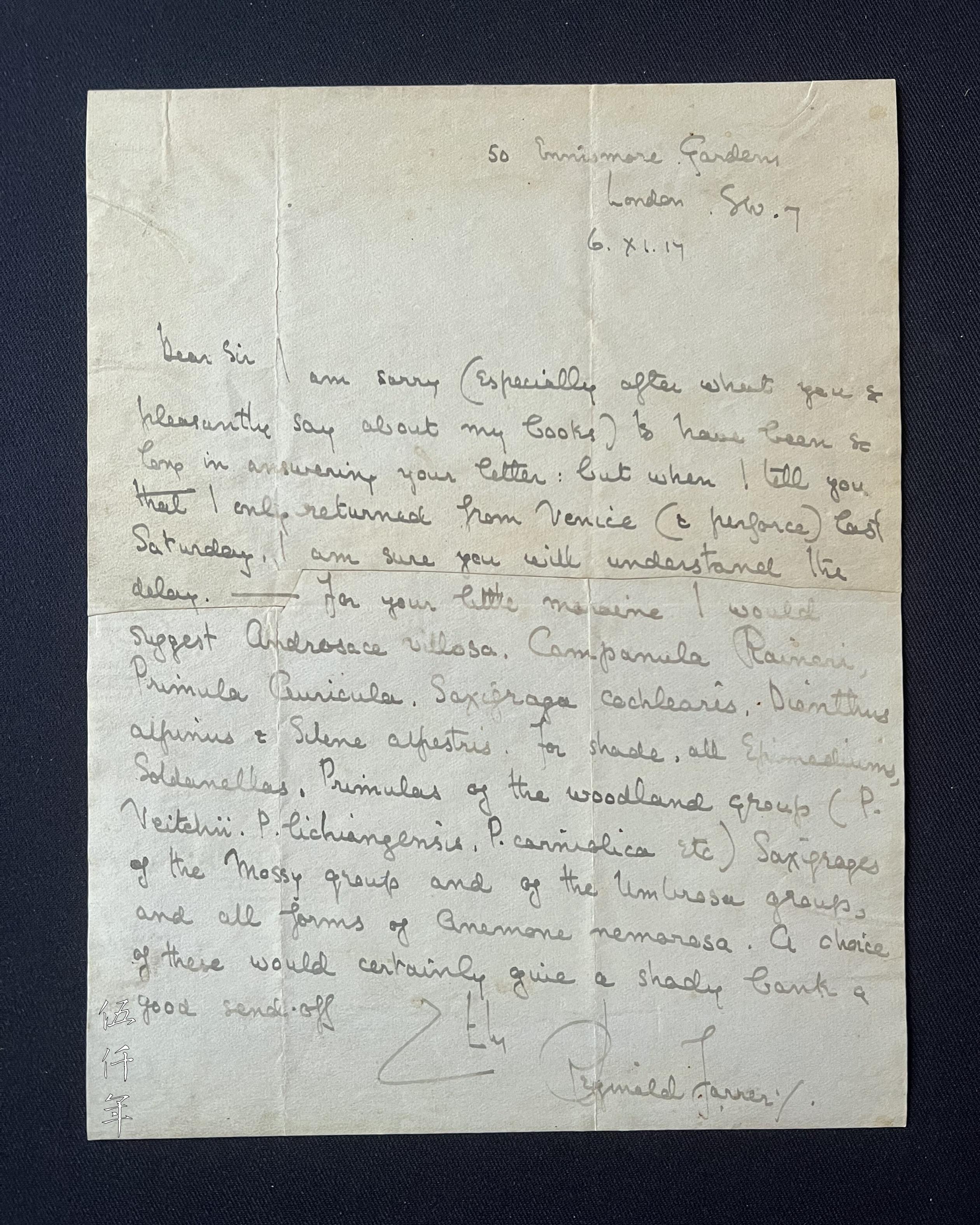
Letter by Reginald Farrer, written on 6 November 1917 in London
(93) Reginald Farrer 1880 – 1920 (雷吉納德‧法勒)
(93-1) Letter by R. Farrer to Grinling, written in London, dated 19 May 1915.
(93-2) Letter by R. Farrer, written in London, dated 6 November 1917.
(93-3) Letter by R. Farrer to Alice Christiana Gertrude Meynell (1847-1922), British poet and suffragist, written in London, dated 12 February 1906.
(94) William Bacon Pettus 1880 – 1959 (裴德士)
(94-1) The Fine Art of Reviling: a Translation Out of the Chinese. Los Angeles: The Auk Press, 1936.
(95) Juliet Bredon 1881-1937 (裴麗珠)
(95-1) Chinese Shadows. Peking: Pei Kuan Press, 1922. First edition. Inscribed by the author in Peking to Kate, 1921.
(96) King Gustav VI Adolf of Sweden 1882 – 1973 (瑞典國王古斯塔夫六世)
(96-1) Christmas card signed by Gustav VI Adolf (1882-1973) and wife Lady Louise (1889-1965), adjacent to photograph of Drottningholm Palace, circa 1935.
(97) Lü Pi-ch'eng, or Pi Cheng Lee, or Alice Pi Cheng Lee, or Upasika Chihmann 1883-1943 (呂碧城)
(97-1) The Two Buddhist Books in Mahayana, translated and published by Upasika Chihmann (Miss P. C. Lee of China), Bodhisattva in Precepts. 1935.
(98) H. G. W. Woodhead 1883 – 1959 (伍德海)
(98-1) A Journalist in China. London: Hurst & Blackett, Ltd., 1934. First edition. Inscribed by the author to Guinness, dated 6 November 1934.
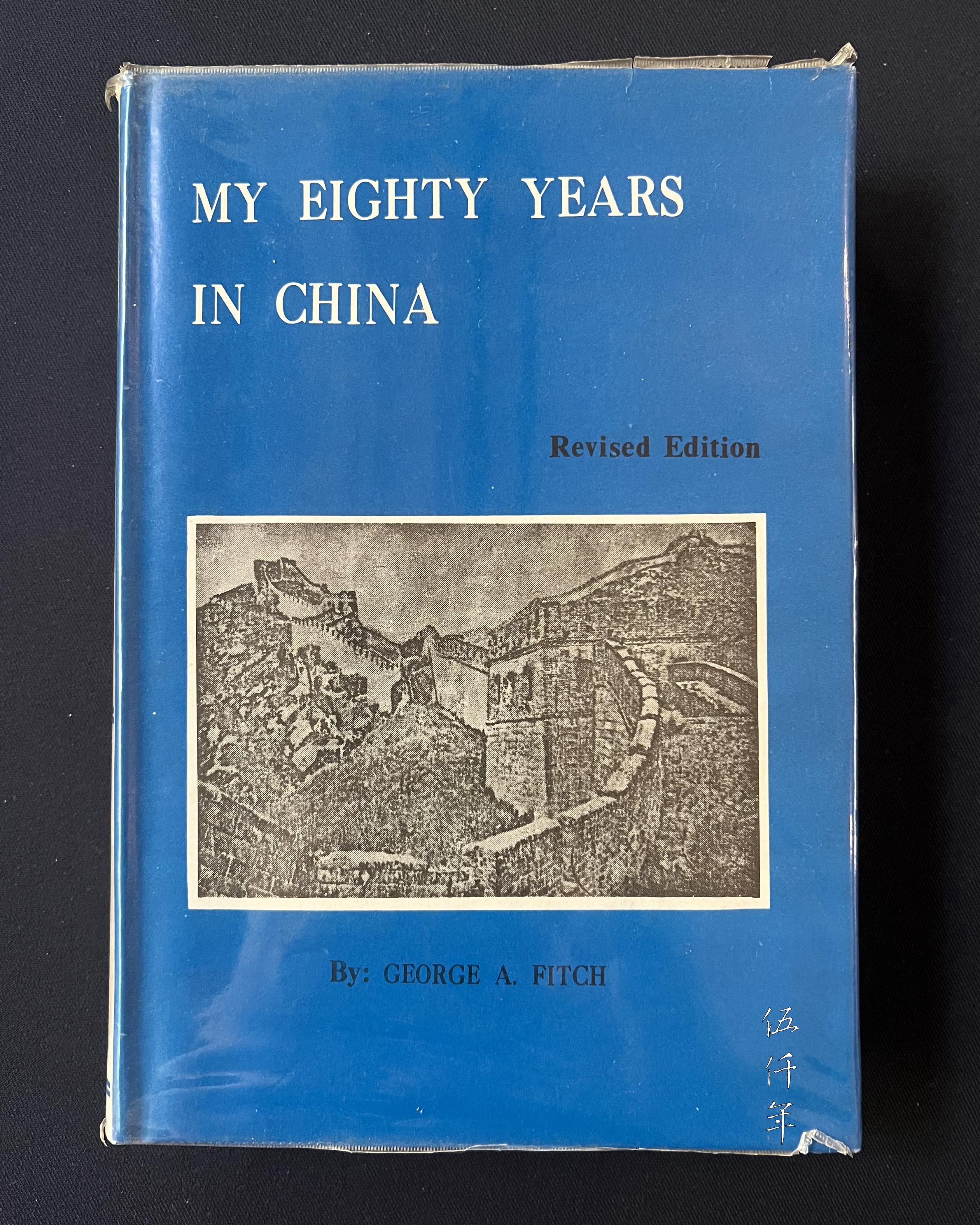
Front cover of My Eighty Years in China. By George Ashmore Fitch
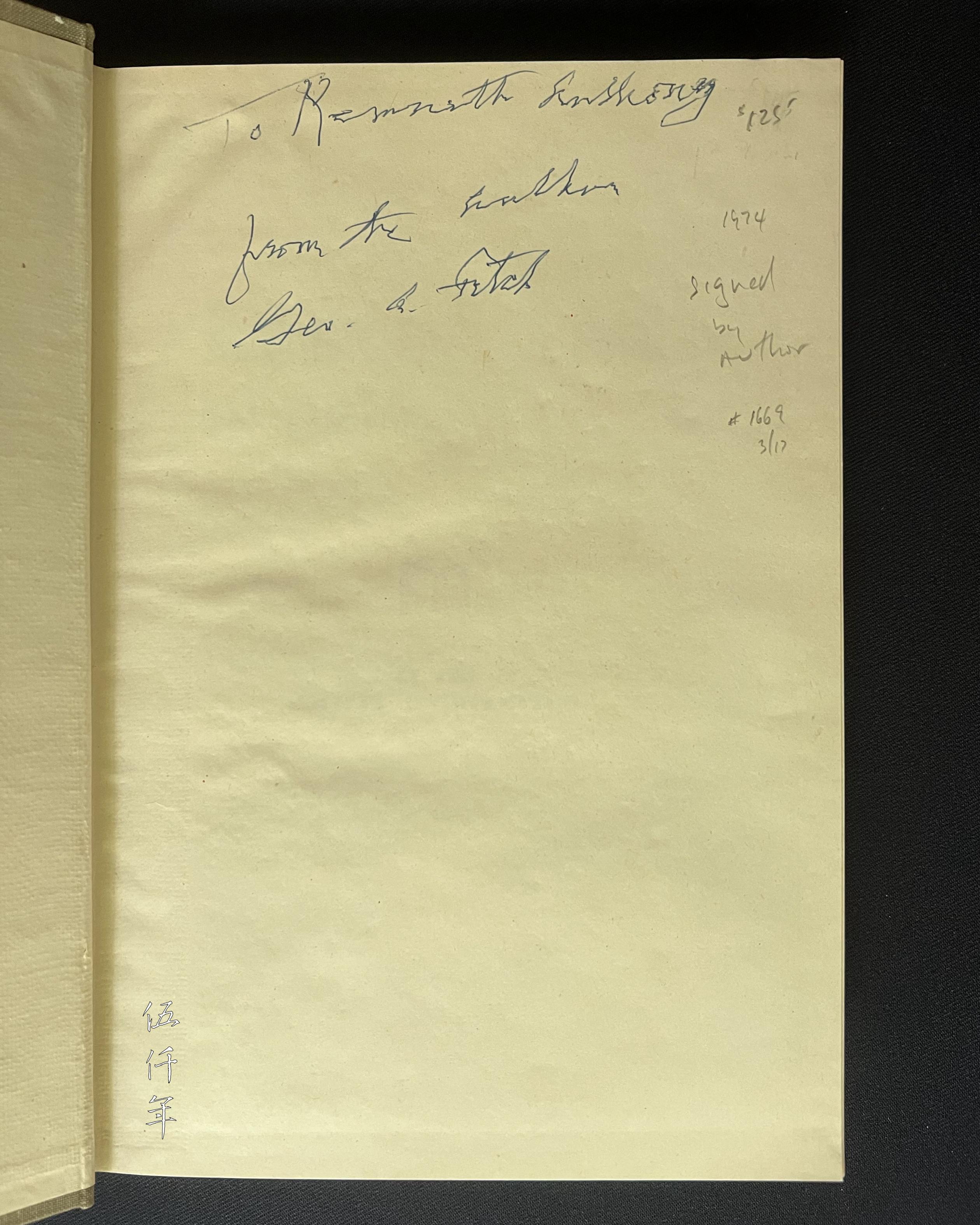
Inside page of My Eighty Years in China. By George Ashmore Fitch
(99) George Ashmore Fitch 1883-1979 (費吳生)
(99-1) My Eighty Years in China. Republic of China: Mei Ya Publications, Inc., 1967. First edition. Inscribed by the author.
(99-2) My Eighty Years in China. Republic of China: Mei Ya Publications, Inc., 1974. Inscribed by the author.
(99-3) Formosa Beachhead, by Geraldine Fitch (1892-1976), wife of G. A. Fitch, Chicago: Henry Regnery Company, 1953. First edition. Inscribed by the author.
(99-4) Formosa Beachhead, Chinese edition, translated by T’ang Hsiang, published in 1966.
(99-5) Blunder Out of China, a Commentary on the White-Jacoby Book, circa 1946.
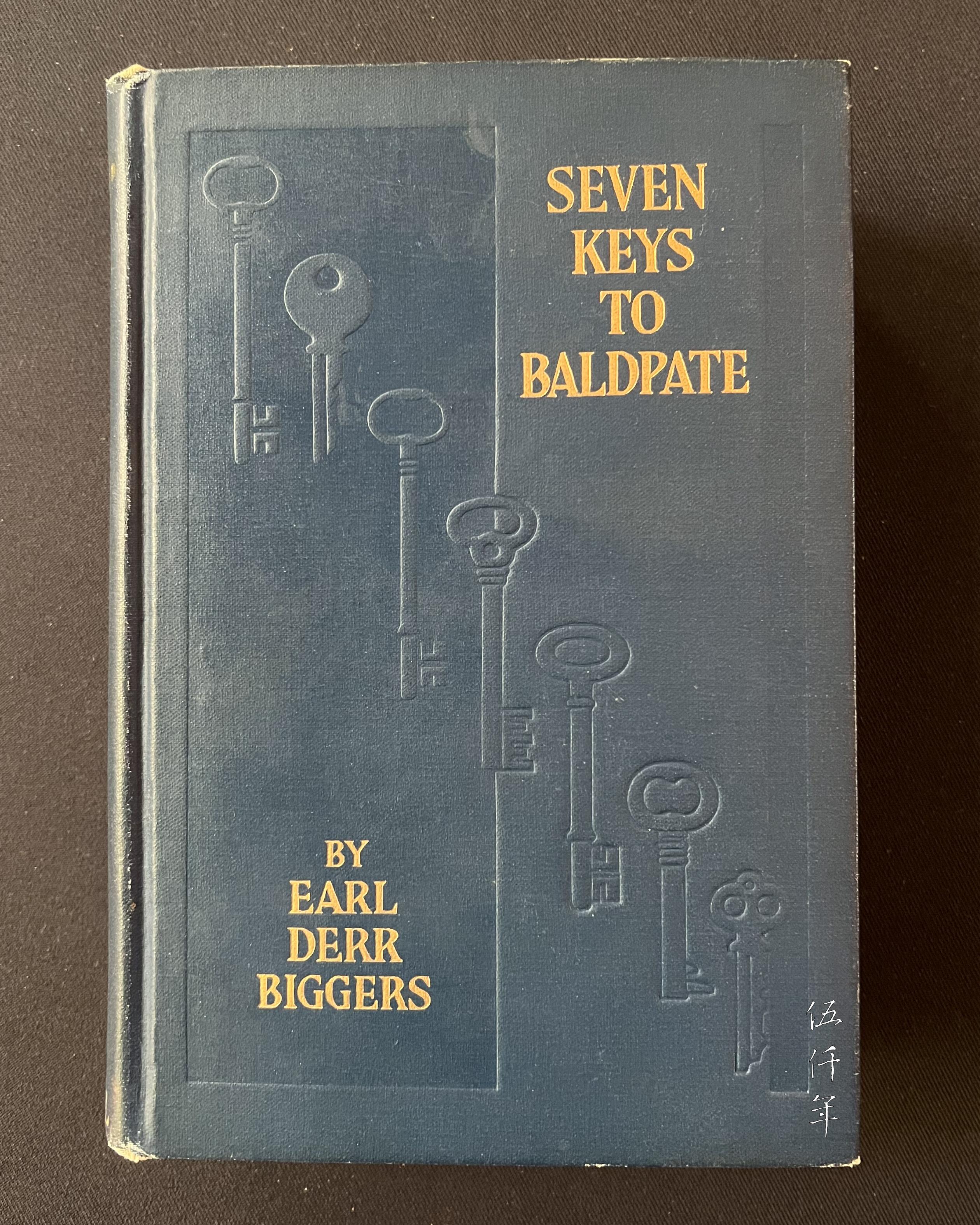
Front cover of Seven Keys to Baldpate. By Earl Derr Biggers
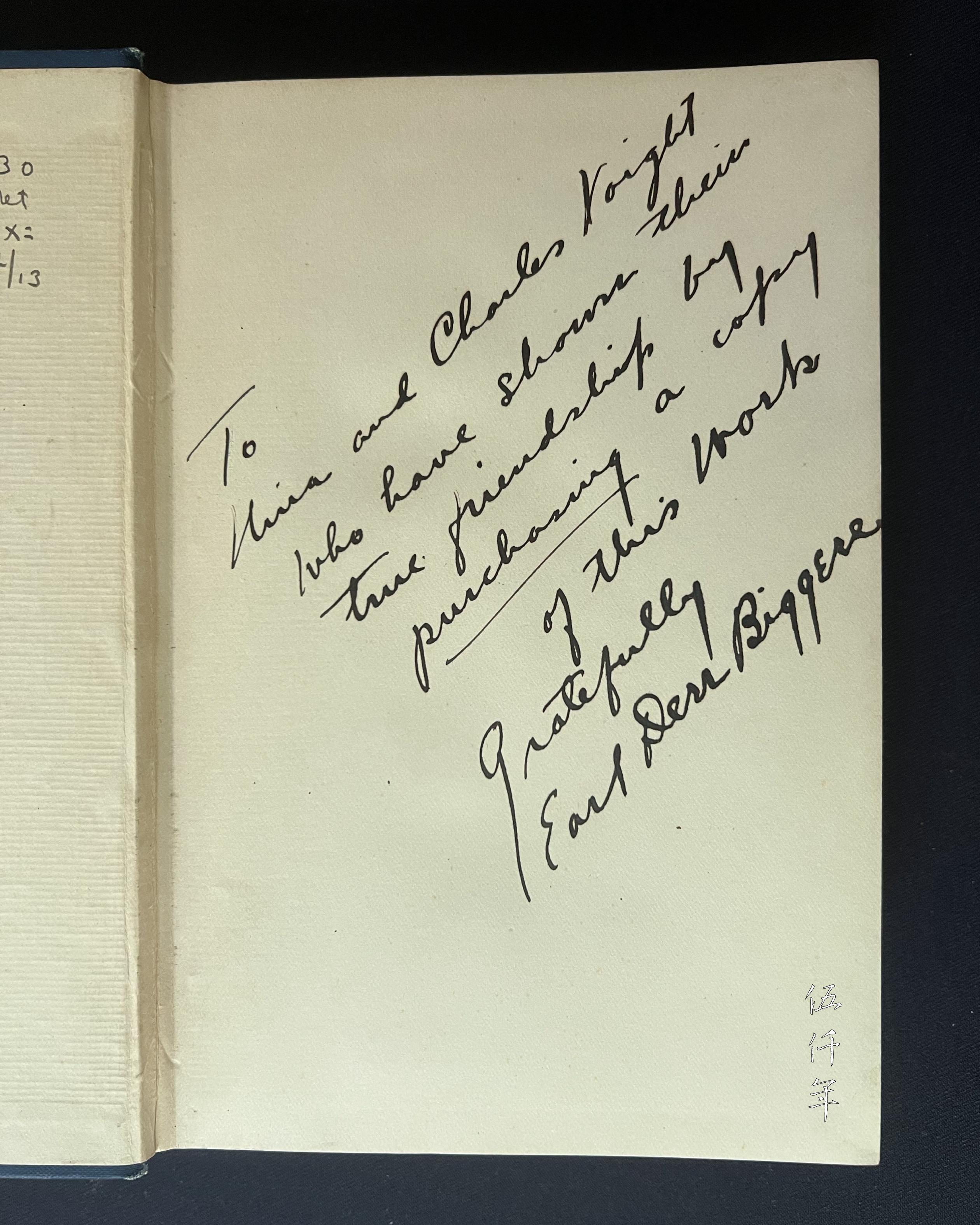
Inside page of Seven Keys to Baldpate. By Earl Derr Biggers
(100) Earl Derr Biggers 1884 – 1933 (艾爾‧德爾‧華格斯)
(100-1) Charlie Chan on Broadway with Warner Orland, 20th Century Fox, 1937.
(100-2) Seven Keys to Baldpate. Indianapolis: The Bobbs-Merrill Company Publishers, 1913. First edition. Inscribed by the author to Nina and Charles Anthony Voight (1887-1947), American cartoonist.
(101) Minister Chiang Tso-ping 1884-1942 (蔣作賓公使)
(101-1) Inscriptions in Chinese, English and French by Tsiang Tso-ping, Wu Chao-chu, Tcheng Loh, Wang K'ing-ky and Woo Kai-seng on World Peace, inscriptions by the first four were published in Pax Mundi.
(101-2) Pax Mundi, Livre d'or de la paix. Geneve: Paxunis, 1932. Copy number 182 out of 260 copies.
(102) Carl Crow 1884 – 1945 (卡爾克勞)
(102-1) The Chinese are Like That. New York, London: Harper & Brothers Publishers, 1939. First edition. Inserted typed letter by Carl Crow.
(103) Roy Chapman Andrews 1884 – 1960 (安得思)
(103-1) Letter by R. C. Andrews to Bob.
(104) Tehyi Hsieh 1884 – 1972 (謝德怡)
(104-1) Our Little Manchurian Cousin. Boston: L. C. Page & Company, 1935. Third impression. Inscribed by the author to Louise Peltier, also inserted a typed letter by T. Hsieh to Louise Pelletier, dated 6 January 1942. In addition there are two newspaper clippings inserted, both with pictures of T. Hsieh.
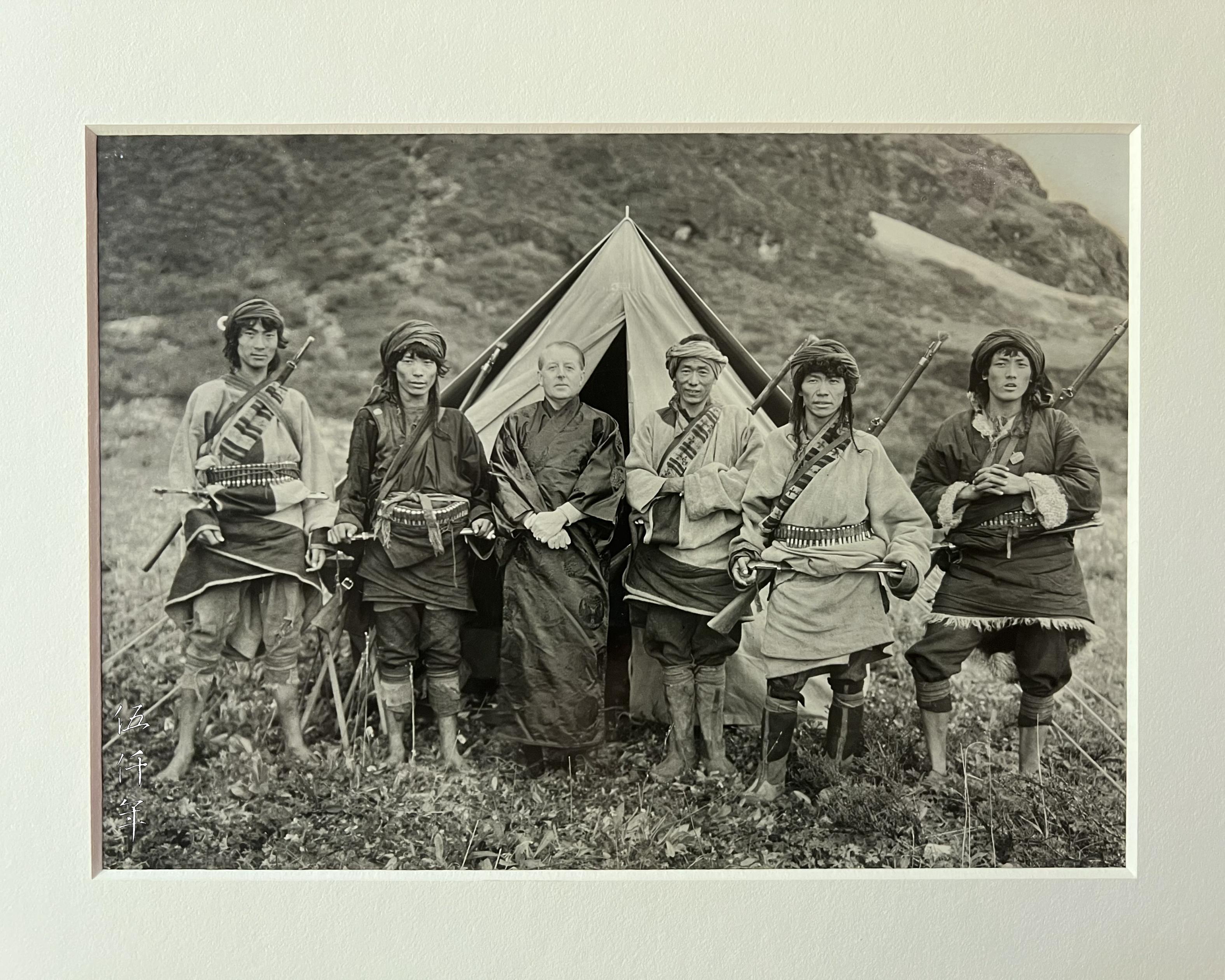
Photograph of Joseph Rock with some of his outlaw escort of Konkaling highwaymen, 20 June 1928
(105) Joseph Rock 1884 – 1962 (羅克)
(105-1) Photograph of J. Rock, leader of the National Geographic Expedition, at Mt. Konka in front of his tent with some of his outlaw escort of Konkaling highwaymen. Located at Camp N’han she, southern slopes of Mt. Jambeyang, elevation 15,100 meter, Szechwan province. Published National Geographic Magazine, July 1931, page 31. Illustrated: Great Adventures (National Geographic Society, 1963), page 357.
(105-2) The Land of the Tebbus. Reprinted from The Geographical Journal, vol. LXXXI no. 2, February 1933. Inscribed by the author.
(106) Arthur Hummel 1884 – 1975 (恒慕義)
(106-1) Forever China, by Robert Payne (1911-1983). New York: Dodd, Mead and Company, 1945. Second printing. Inscribed by A. Hummel's wife Ruth as a gift to husband, dated 6 March 1946.
(106-2) Mencius, A new translation arranged and annotated for the general reader, by W. A. C. H. Dobson (1913-1982). University of Toronto Press, 1963. First edition. Inserted a two-page book review by A. Hummel.
(106-3) A Short History of Chinese Civilization, by Richard Wilhelm (1873-1930). New York: The Viking Press, 1929. First edition. Envelope affixed on inside page, with three book reviews. Inserted a typed letter by A. Hummel to Henry Winters Luce (1868-1941), dated 22 January 1937.
(106-4) Written on Bamboo and Silk, The Beginnings of Chinese Books and Inscriptions, by Tuen-Hsuin Tsien (錢存訓1910-2015), sinologist and professor of Chinese literature, Chicago: The University of Chicago Press, 1962. First edition. Inscribed by Mr. and Mrs. A. Hummel to son Arthur Jr., dated 1 June 1963.
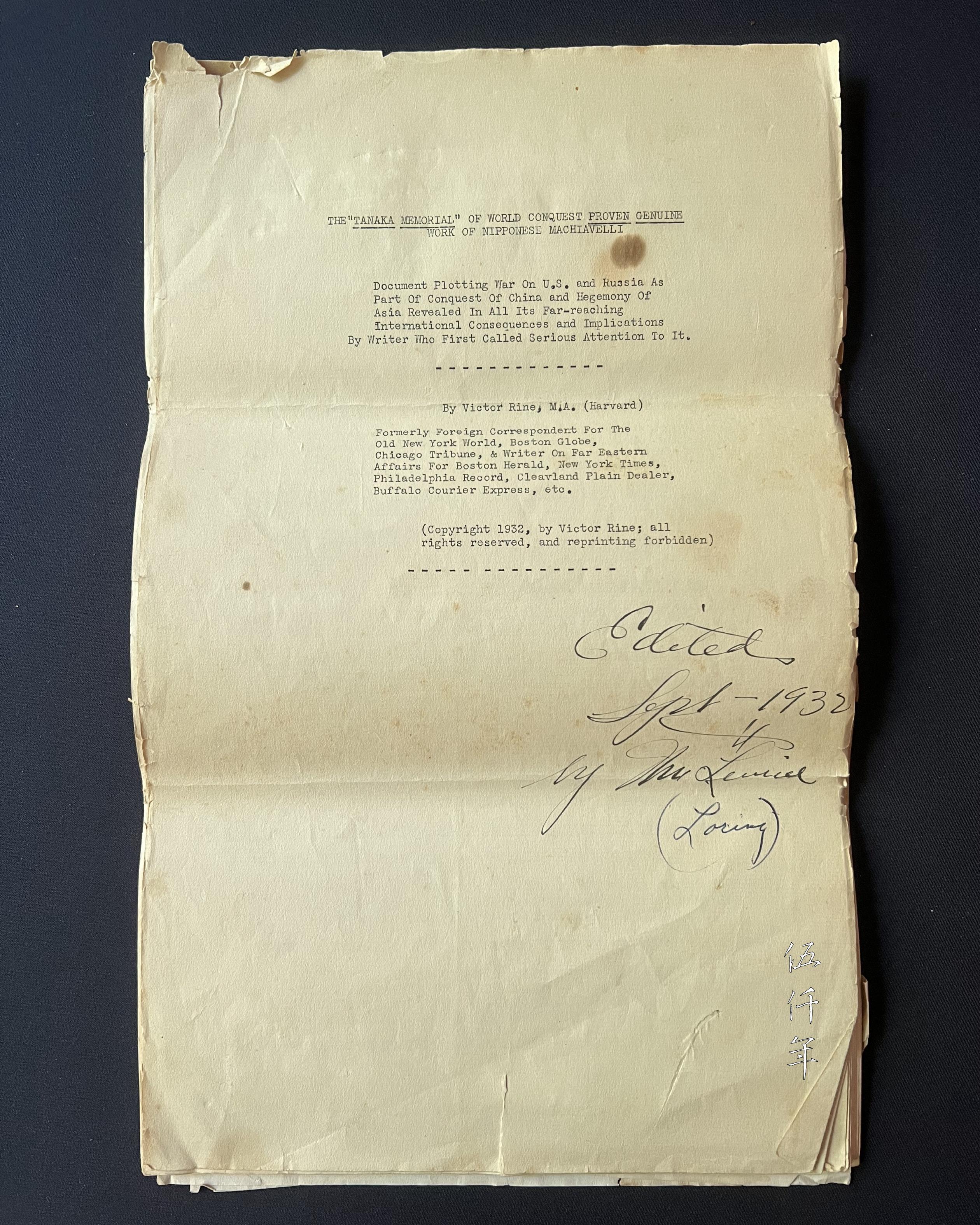
Typed manuscript of The Tanaka Memorial of World Conquest Proven Genuine Work of Nipponese Machiavelli. By Victor Rine
(107) Victor Rine b. 1884 (維克多‧林)
(107-1) Machiavelli of Nippon, Japan's Plan of World Conquest, Willed by Emperor Meiji, Developed by Premier Tanaka, “Tanaka Memorial” Proven Genuine by Victor Rine, M. A. New York: The Wandering Eye, 1932. Inscribed by the author to Edythe V. Lutzker (1904-1991), historian and author, dated 2 November 1932.
(107-2) Typed manuscript of The Tanaka Memorial Of World Conquest Proven Genuine Work Of Nipponese Machiavelli, by Victor Rine. Inscribed by the author: “Edited Sept-1932 by Wm Leuriel (Loring).”
(108) Princess Der Ling 1885 – 1944 (裕德齡公主)
(108-1) Golden Phoenix. New York: Dodd, Mead & Company, 1932. First edition. Inscribed by the author to Julia, dated 6 April 1942.
(108-2) Kowtow. New York: Dodd, Mead & Company, 1929. First edition. Signed by the author. Affixed a Chinese style bookplate from the library of Nellie M. Carman.
(108-3) Old Buddha. New York: Dodd, Mead & Company, 1929. First edition. Inscribed by the author to Elizabeth Hardison, dated 29 September 1930. Inserted are nine pieces of newspaper clippings, mainly about Der Ling, a small piece of Chinese pattern, and an auction catalogue cover related to the sale of Der Ling properties.
(109) Arthur de Carl Sowerby 1885 – 1954 (蘇柯仁)
(109-1) Nature in Chinese Art. New York: The John Day Company, 1940. First edition. Inserted an Editorial Copy note from the publisher, dated 11 April 1940. Inscribed by the author to Nina, dated 11 April 1940.
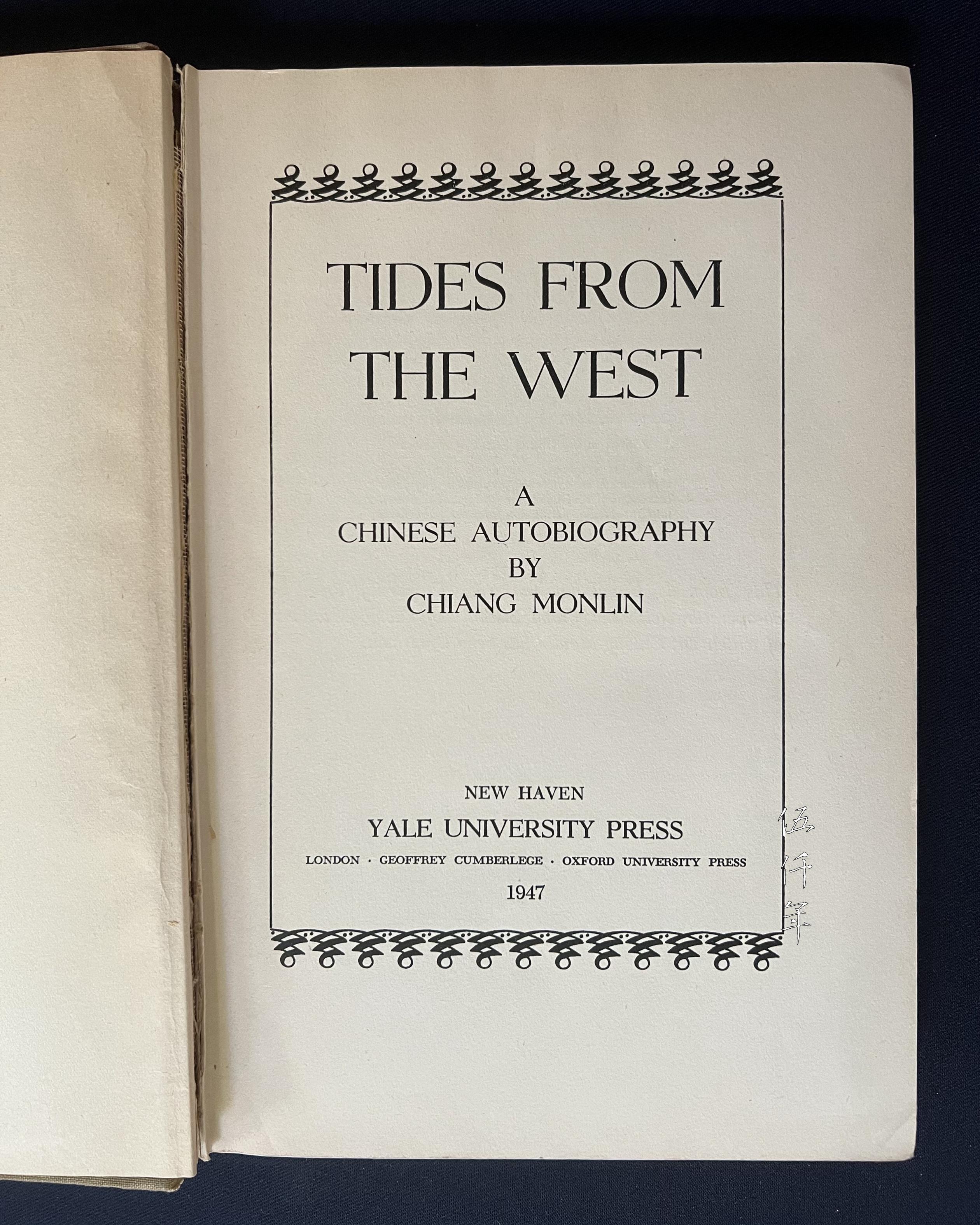
Title page of Tides from the West, A Chinese Autobiography. By Chiang Monlin
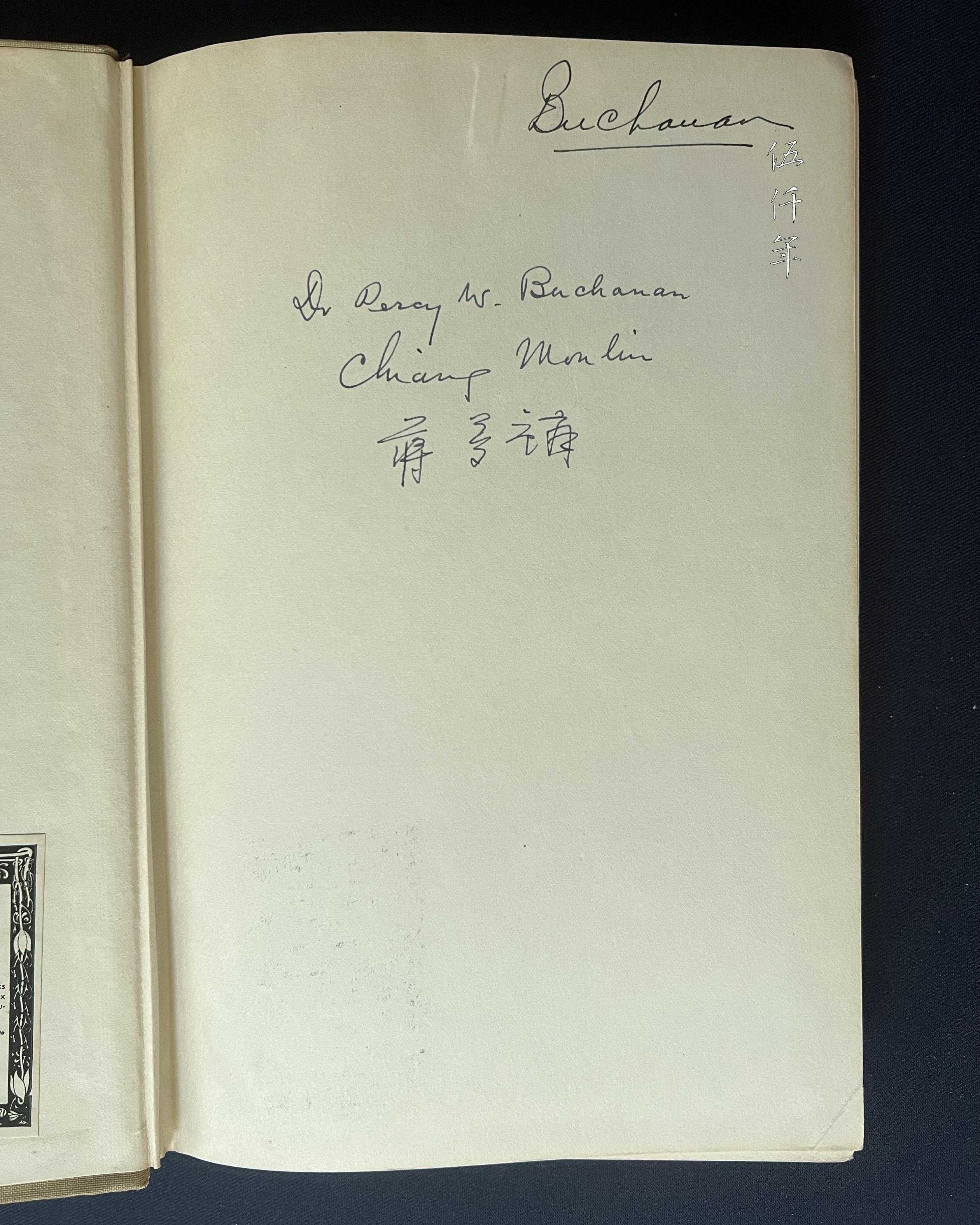
Inside page of Tides from the West, A Chinese Autobiography. By Chiang Monlin
(110) Minister Chiang Monlin 1886 – 1964 (蔣夢麟部長)
(110-1) Tides From the West, A Chinese Autobiography. New Haven: Yale University Press, 1947. First edition. Inscribed by the author to Dr. Percy W. Buchanan (?-1977), American Asian scholar, also signed by Buchanan.
(111) Alfred Kohlberg 1887-1960 (柯柏)
(111-1) Photograph of A. Kohlberg, 1950.
(111-2) The China Lobby Man-The Story of Alfred Kohlberg, by Joseph Keeley. Arlington House, 1969. First edition. Signed by the author.
(111-3) Brain Washing in the U.S.A., Address Before Sunday Evening Club, First Congregational Church, Los Angeles, California, Sunday Evening, September 20, 1953.
(111-4) Blueprint For World Conquest, As Outlined By The Communist International. Washington, Chicago: 1946. Inscribed by A. Kohlberg to Governor Harold Edward Stassen (1907-2001).
(112) Henry H Hart 1886 – 1968 (亨利‧哈特)
(112-1) Venetian Adventurer, Being an Account of the Life and Times and of the Book of Messer Marco Polo. Stanford University Press, 1943. Second edition. Inscribed by the author to Helen Seymour in English and Chinese. Inserted typed letter by Hart to Seymour, dated 23 January 1946.
(113) Ambassador Nelson Trusler Johnson 1887-1954 (詹森大使)
(113-1) Letter by N. T. Johnson, written in Peking, dated 31 July 1932.
(114) Ambassador Hollington K. Tong 1887-1971 (董顯光大使)
(114-1) Dateline: China, The Beginning of China’s Press Relations with The World. New York: Rockport Press, Inc., 1950. First edition. Inscribed by the author in Tokyo to General Shang, dated 19 September 1953.
(114-2) Chiang Kai-Shek. Taipei: China Publishing Company, 1953. First edition. Inscribed by the author in Tokyo to Eric Wates, dated 17 September 1953.
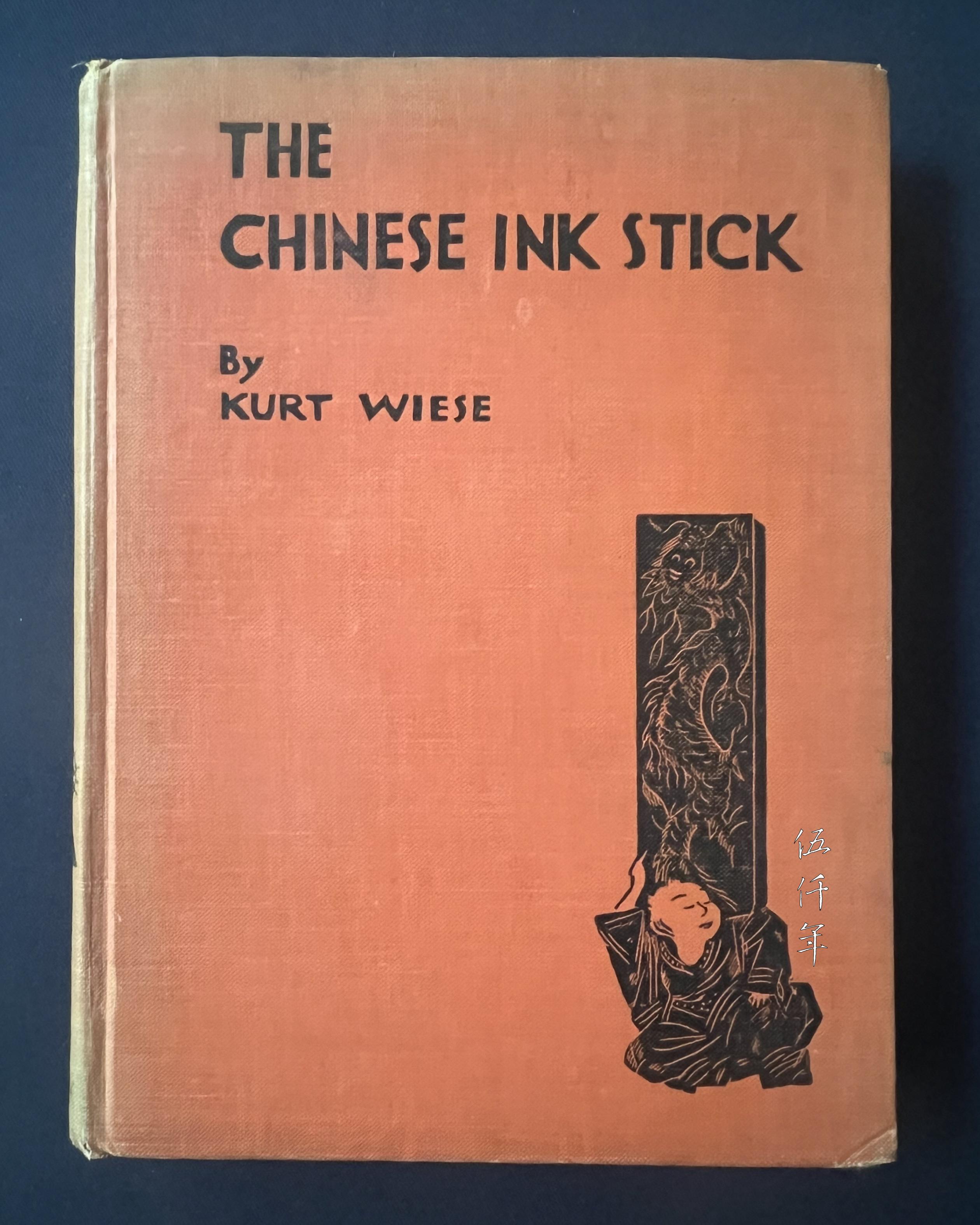
Front cover of The Chinese Ink Stick. By Kurt Wiese
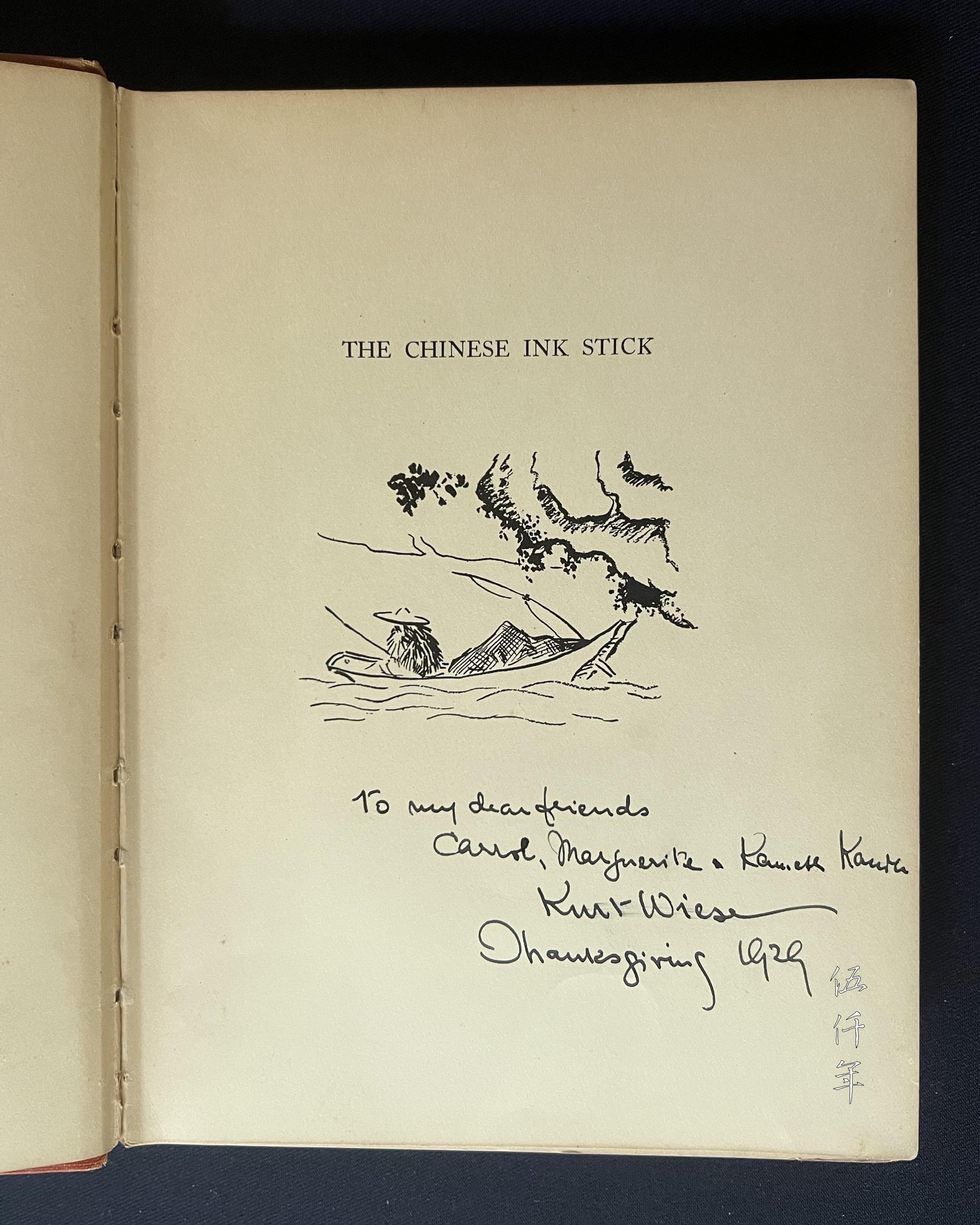
Title page of The Chinese Ink Stick. By Kurt Wiese
(115) Kurt Wiese 1887 – 1974 (寇特‧威斯)
(115-1) The Chinese Ink Stick. New York: Doubleday, Doran and Company, Inc., 1929. First edition. Inscribed by the author to Carol, Marguerite, Kamell, Kauth, written in Shanghai, dated 1929.
(116) Chiang Kai-shek 1887-1975(蔣介石總統)
(116-1) Soviet Russia in China, A Summing-Up at Seventy. New York: Farrar, Straus and Cudahy, 1957. Translated from Chinese by Ambassador James Shen. Inscribed in Chinese and English by General Wang Shu-ming to Col. Willand L. Haskin, dated 18 January 1958. Inscribed by the recipient.
(116-2) Three months after the death of President Chiang Kai-shek, Chang Ku-nien, standing committee member of the Executive Committee of the Chinese Cultural Renaissance Movement, produced this painting titled The Eternal President Chiang Kai-shek as tribute.
(116-3) In early April 1976, on the First Death Anniversary of President Chiang Kai-shek, Friends of China from Belgium travelled to Taipei to pay respects at The Mausoleum of President Chiang Kai-shek. Golden button pins with the image of President Chiang made by the Belgian sculptor Rene Cliquet were presented to the visitors. This button pin was a gift from the veteran diplomat Mr. Fu Wei-hsin to Soong Shu Kong.
(117) J. J. L. Duyvendak 1888 – 1954 (戴文達)
(117-1) The Diary of His Excellency Ching-Shan, Being a Chinese Account of the Boxer Troubles. Leiden: Apud E. J. Brill, Lugduni Batavorum, 1924. First Edition. Inscribed by the author to Herbert A. Giles (1845-1935).
(117-2) Postcard by J. J. L. Duyvendak to Herbert A. Giles (1845-1935), written in Leiden, dated 21 September 1925.
(117-3) China's Discovery of Africa, Lectures given by J. J. L. Duyvendak at the University of London on January 22 and 23, 1947. London: Arthur Probsthain, 1949. First edition.
(118) Ambassador Vi Kyuin Wellington Koo 1888-1985 (顧維鈞大使)
(118-1) The League of London-A Book of Interviews with Allied Sovereigns and Statesmen, by H. R. Madol. London, New York, Melbourne: Hutchinson & Co. (Publishers) Ltd. In 1943, Hans Roger Madol (1903-1956) invited thirty eight representatives or heads of states whom he interviewed to inscribe his own copy. Ambassador Vi Kyuin Wellington Koo of the Republic of China inscribed in Chinese and English on 22 September 1943.
(118-2) No Feast Lasts Forever, by Madame Oei Hui-lan (1889-1992), wife of Wellington Koo with Isabella Taves. New York: Quadrangle, The New York Times Book Co., 1975. First edition. Inscribed by the author in New York to Prince David Mdivani (1904-1984), dated 1975.
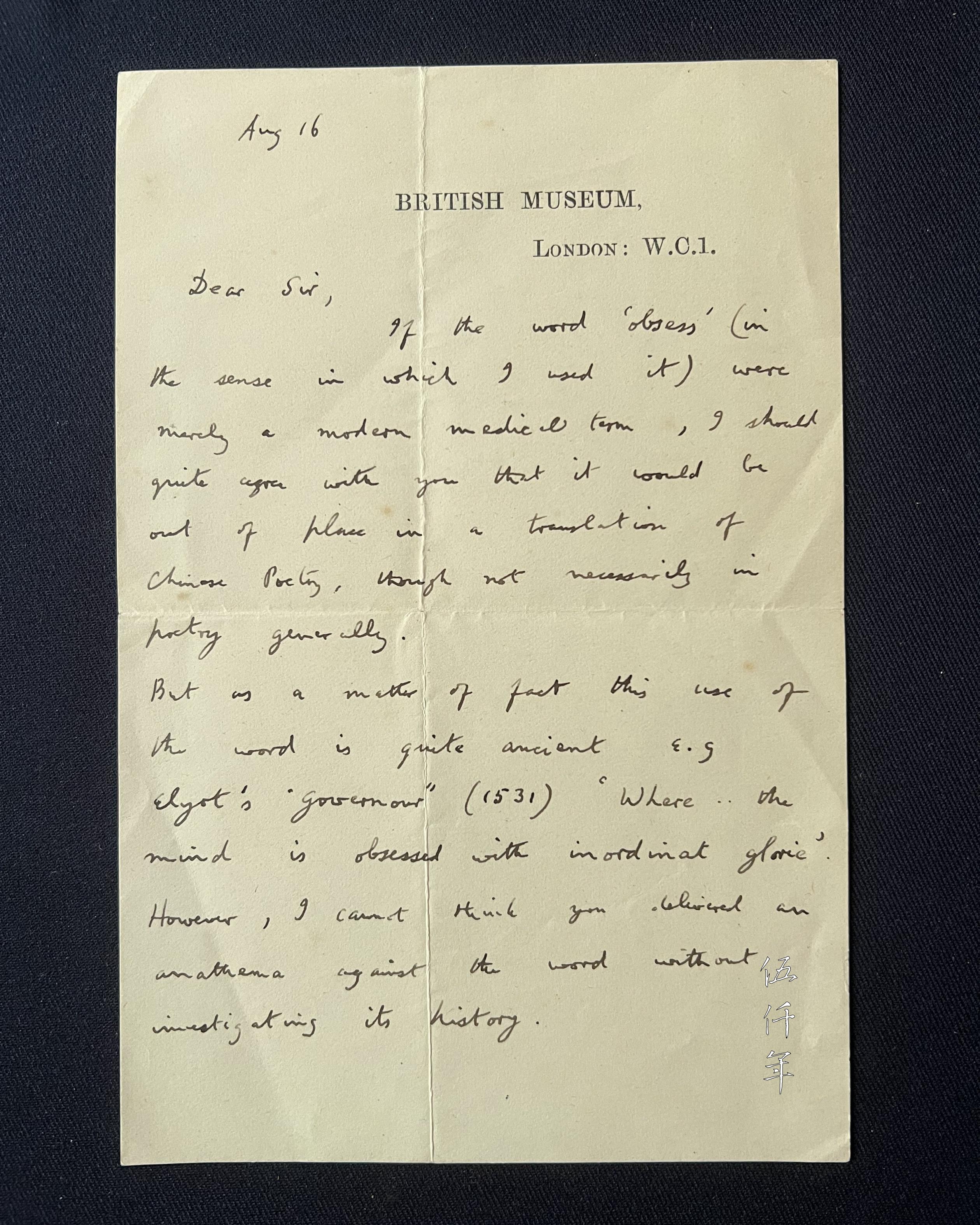
Letter by Arthur Waley, written circa 1918 in London
(119) Arthur Waley 1889 – 1966 (亞瑟‧偉利)
(119-1) Portrait of Arthur Waley by Roger Fry (1866-1934), circa 1918. This portrait was removed from a Fry sketchbook belonging to The Bloomsbury Workshop, a London gallery, around 1990. The Bloomsbury Workshop acquired it from the grandchildren of Roger Fry.
(119-2) Letter by A. Waley to a book critic, likely written in 1918 or 1919 with the publication of A Hundred and Seventy Chinese Poems or More Translations from the Chinese.
(119-3) Yuan Mei, Eighteenth Century Chinese Poet. London: George Allen and Unwin Ltd., 1956. First edition. Inscribed by the author to Sebastian (Walter John Herbert Sprott 1897-1971), British psychologist and writer, dated January 1957. Letter by A. Waley to Sebastian inserted, dated 20 October, circa 1956.
(120) Klas Bernhard Johannes Karlgren 1889 – 1978 (高本漢)
(120-1) Harvard-Yenching Institute Sinological Index Series, No. 34, Combined Indices to Forty-Seven Collections of Sung Dynasty Biographies. Second edition issued by the Japan Council for East Asian Studies, c/o The Toyo Bunko, 1959. Inscribed by Bernhard Karlgren in Stockholm, dated 1960.
(121) Yang Buwei 1889 – 1981 (楊步偉)
(121-1) How to Cook and Eat in Chinese. New York: The John Day Company, 1963. Third edition. Inscribed by the author to Chen.
(121-2) How to Cook and Eat in Chinese. London: Faber and Faber, 1968. First printing for paperback format. Inscribed by the author to Jeannie Griffin.
(122) Carl Glick 1890-1971 (卡爾‧格里克)
(122-1) Double Ten: Captain O'Banion's Story of the Chinese Revolution. London, New York: Whittlesey House, 1945. Inscriptions by Ansel E. O'Banion and Mildred K. Wilkes.
(123) Madame Wei Tao-Ming 1891 – 1959 (魏道明夫人-鄭毓秀)
(123-1) My Revolutionary Years. New York: Charles Scribner's Sons, 1943. First edition. Inscribed in English and Chinese by the author in Washington to Hon. Florence Allen (1884-1966), American federal judge, signed Cheng U-sei, dated 15 December 1943.
(123-2) My Revolutionary Years. New York: Charles Scribner's Sons, 1943. First edition. Inscribed in English and Chinese by the author in Washington to Clare E. Van Devander, signed Cheng U-sei, dated 20 September 1945.
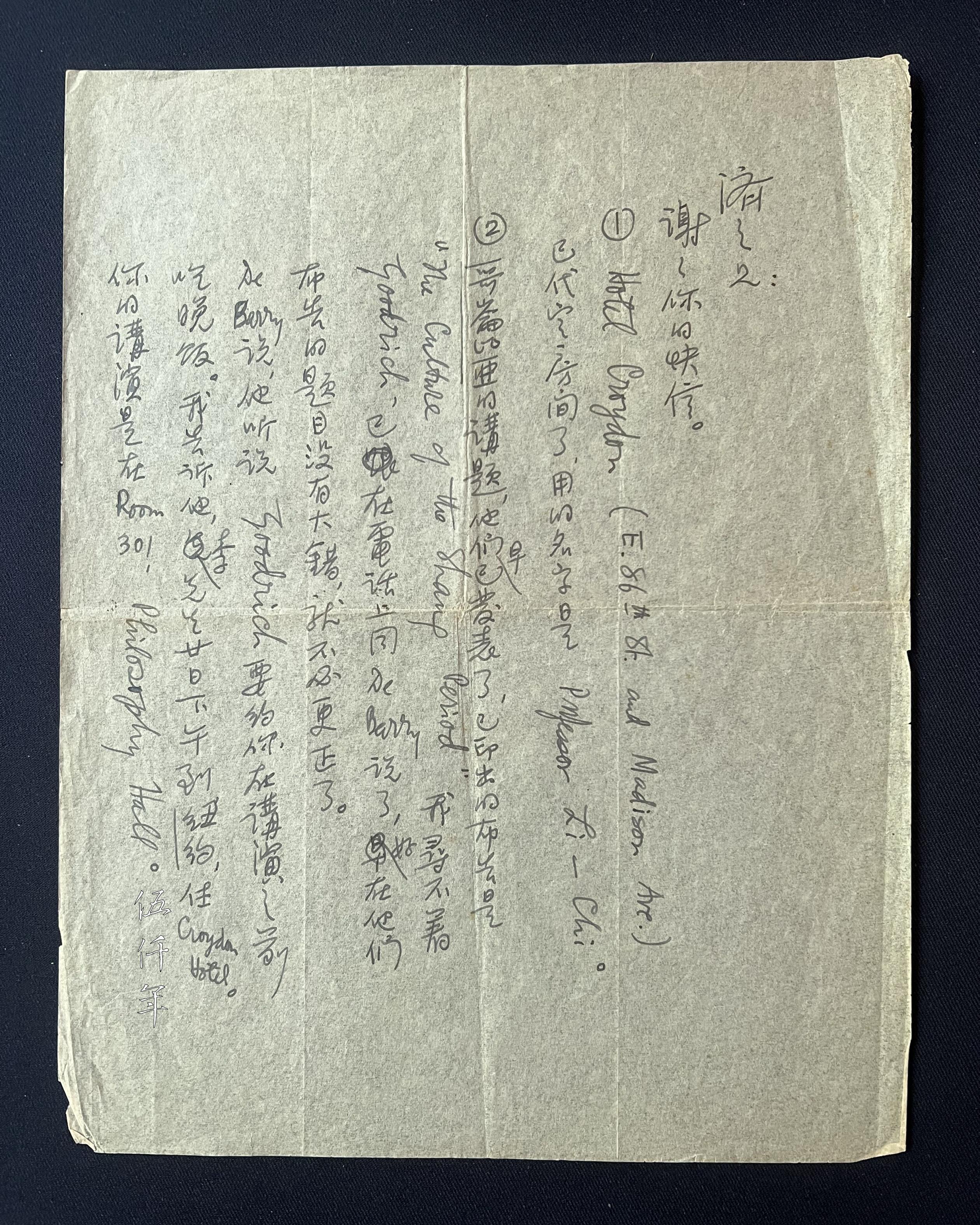
Letter in Chinese by Hu Shih to Li Chi, written on 17 November 1954
(124) Ambassador Hu Shih 1891-1962 (胡適大使)
(124-1) Letter in Chinese by Hu Shih to Prof. Li Chi (1896-1979), dated 17 November 1954.
(124-2) China Too is Fighting to Defend a Way of Life, An Address by His Excellency, Dr. Hu Shih, Ambassador of the Republic of China to the United States of America, Delivered at Washington, D. C., March 23, 1942. San Francisco: The Grabhorn Press, July 1942.
(124-3) Maker of Modern China-The Story of Sun Yat-sen, by Hu Shih, compiled in Into the Eighth Year-Messages and Articles commemorating seven years of China's continuous resistance to aggression, with a foreword by H. E. Dr. V. K. Wellington Koo, prepared by the London Office of the Chinese Ministry of Information. Signed by Hu Shih.
(125) Minister Wang Shih-chieh 1891 – 1981 (王雪艇 (世杰) 部長)
(125-1) Certificate of Appointment for Wang Shih-chieh to be Minister of Education, issued on 21 April 1933.
(125-2) The Illustrated London News, 30 November 1935, page 985 to 996. Article title: The Great Chinese Art Exhibition-A Comprehensive Collection of the Arts of China.
(126) Representative Peng-Chun Chang 1892-1957 (張彭春代表)
(126-1) China: Whence and Whither? By Peng-Chun Chang, assisted by Helen Gay Pratt. Honolulu: Institute of Pacific Relations, 1934. First edition.
(126-2) China At The Crossroads, The Chinese Situation in Perspective. London: Evan's Brothers Ltd. 1936. First edition.
(127) Elizabeth Forman Lewis 1892-1958 (伊麗沙白‧路易斯)
(127-1) Young Fu of the Upper Yangtze. The John C. Winston Company, 1932. First edition. Inscribed by the author to Bobby Conrad.
(128) Hubert Lafayette Sone 1892-1970 (宋煦伯)
(128-1) From the library of H. L. Sone and signed by Sone: Prolegomena to the History of Israel, by Julius Wellhausen. Edinburgh: Adam & Charles Black, 1885. First edition.
Front cover of The Barclays Restaurant Menu
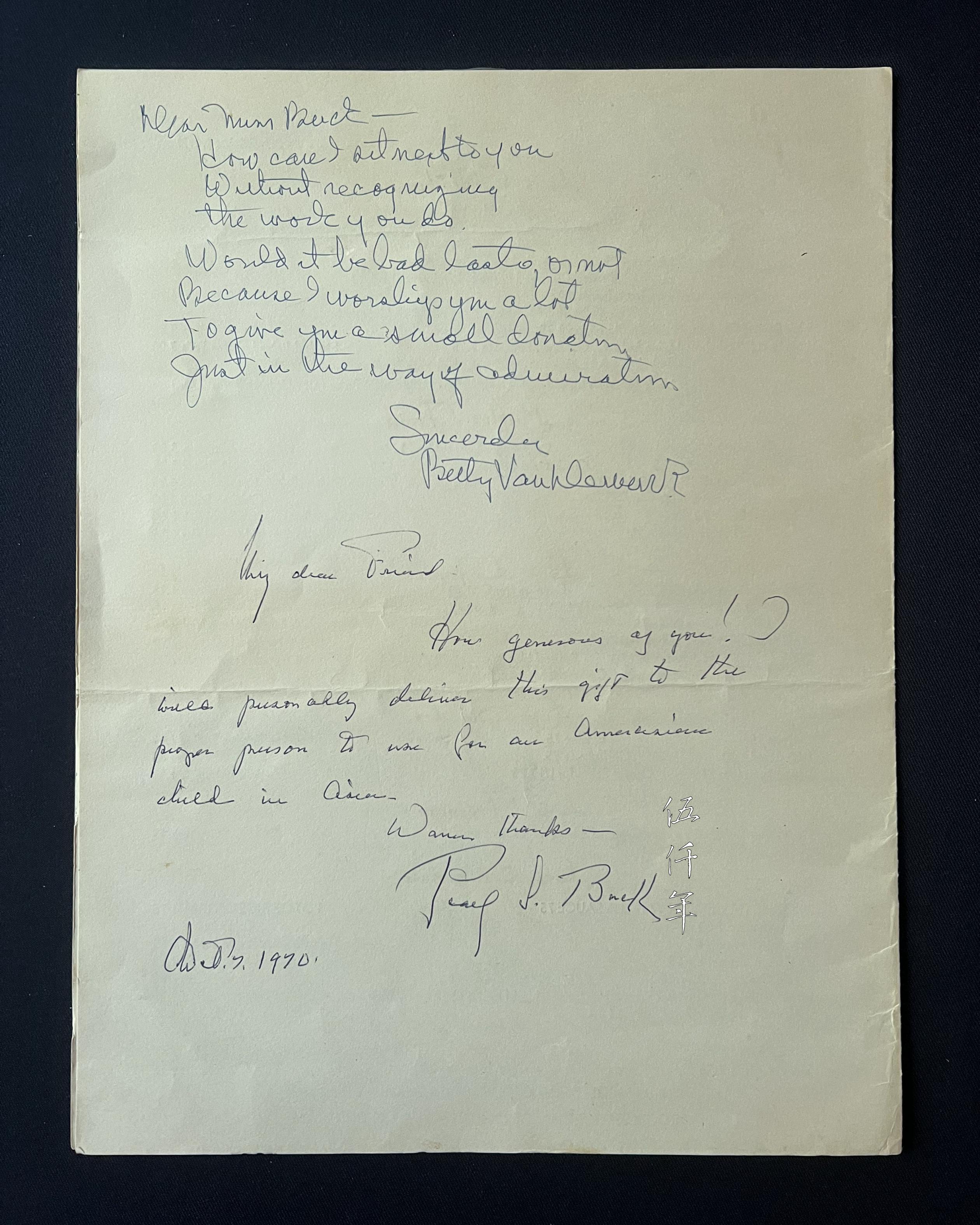
Back of The Barclays Restaurant Menu. Inscribed by Pearl S. Buck
(129) Pearl Sydenstricker Buck 1892 – 1973 (賽珍珠)
(129-1) A Small Child Cried Last Night, Did You Hear Her? Her Father is an American Soldier, her Mother Asian. To her this brings fearful problems ….desertion …. hunger….cold….sickness without care….discrimination….no chance for education or gainful employment….these and more are her problems. The Pearl S. Buck Foundation, Inc. Inscribed by Pearl S. Buck to Chuck Zuik.
(129-2) Pearl S. Buck inscribed the back of the menu of The Barclays Restaurant for an admirer, dated 7 October 1970.
(129-3) Book review of Lin Yu Tang’s Moment in Peking, by Pearl S. Buck, consisting of two typed pages with corrections, signed by Pearl S. Buck.
(130) Alex Taub 1892-1974 (亞歷克斯‧陶布)
(130-1) Mission to China, typed manuscript, dated 1944. Inscribed by the author.
(131) Yuen Ren Chao 1892 – 1982 (趙元任)
(131-1) Letter by Yuen Ren Chao to Liu Shao-t'ang (1921-2000), publisher of Biographical Literature Magazine, written at the University of California, dated 12 October 1972.
(131-2) Language and Symbolic Systems. Cambridge: The University Press, 1968. First edition. Inscribed by the author in California to Chen Hsiung and Luke, dated 20 May 1968.
(132) Y. C. James Yen 1893-1990 (晏陽初)
(132-1) Tell the People: Talks with James Yen About the Mass Education Movement, by Pearl S. Buck. New York: The John Day Company, 1945. First edition. Inscribed in English and Chinese by James Yen to Mr. and Mrs. Chester Bowles, dated February 1951.
(132-2) Tell the People: Talks with James Yen About the Mass Education Movement. by Pearl S. Buck. New York: International Mass Education Movement, Inc., 1959. Inscribed in English and Chinese by the author to Mrs. Gilbert Harrison, dated 1959.
(132-3) Typed manuscript with corrections of Tell The People: Talks with James Yen About the Mass Education Movement. by Pearl S. Buck.
(133) Arthur Szyk 1894-1851 (亞瑟‧錫克)
(133-1) A lithograph of the Republic of China from the United Nation Series by Szyk, circa 1948.
(134) Luther Carrington Goodrich 1894 – 1986 (富路德)
(134-1) Condolence letter by L. G. Goodrich to Catherine Bowen, wife of Trevor Bowen (1886-1961), written in New York, dated 19 December. As T. Bowen died in 1961, this letter should written in 1961.
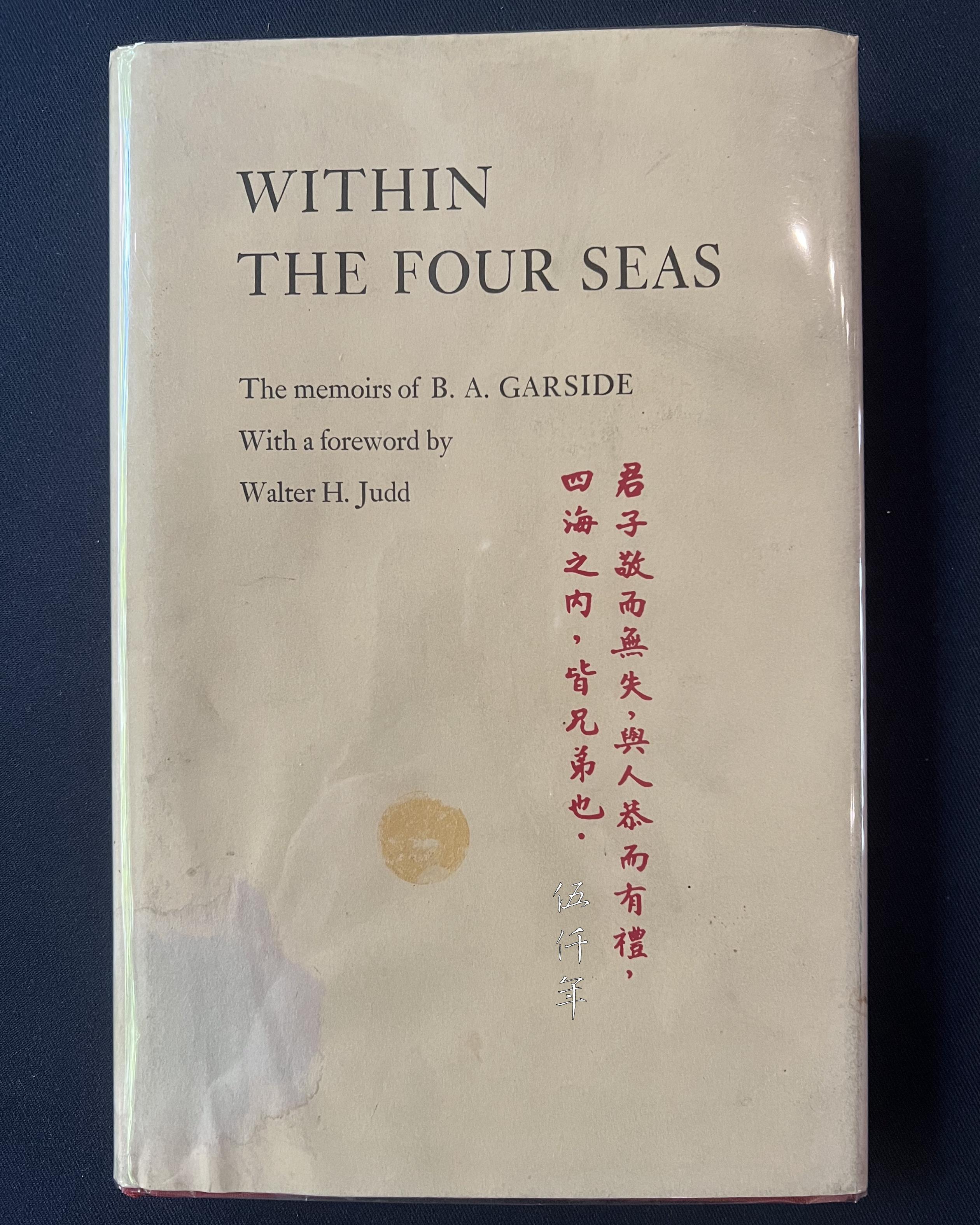
Front cover of Within the Four Seas-The Memoirs of B. A. Garside
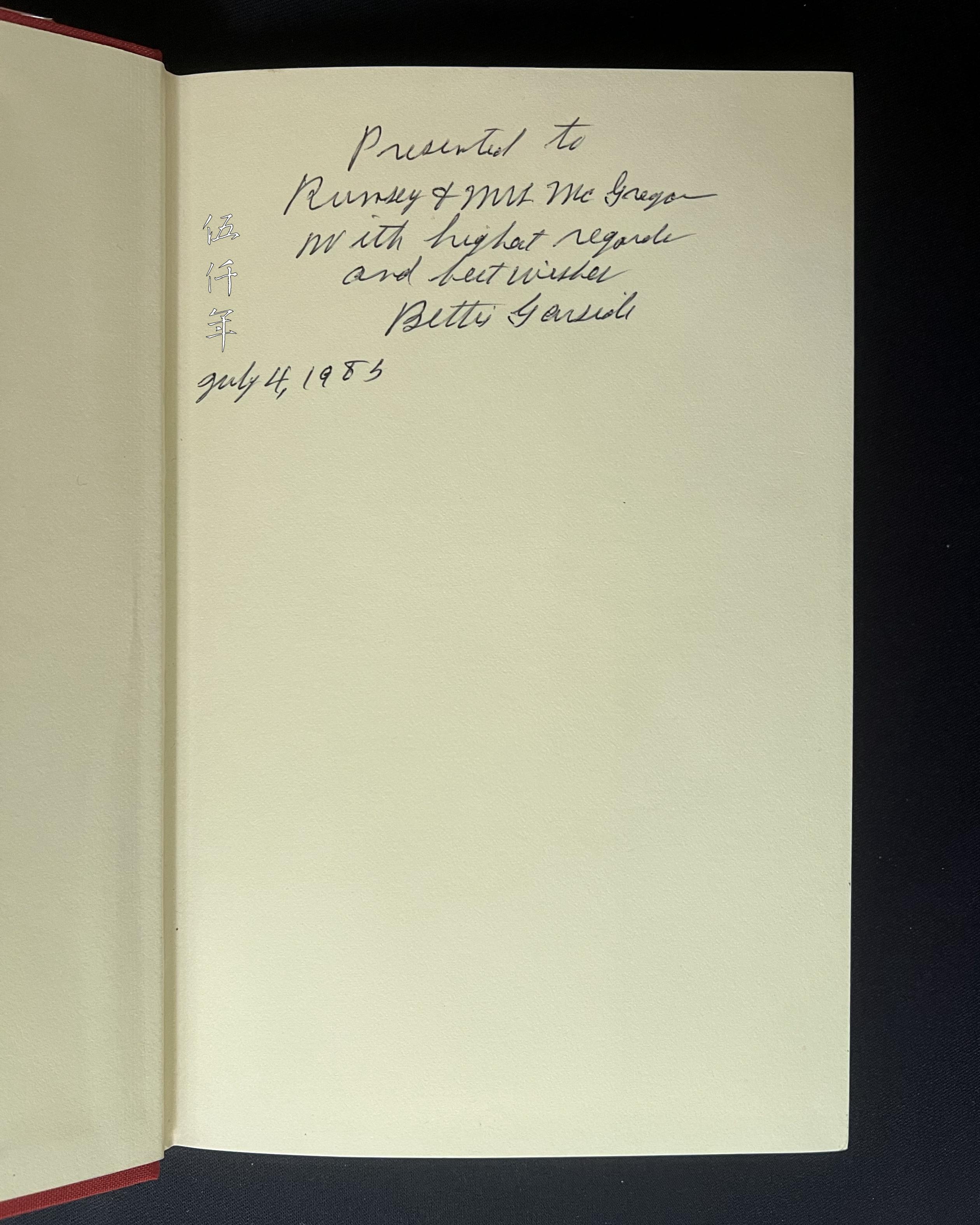
Inside page of Within the Four Seas-The Memoirs of B. A. Garside
(135) Bettis Alston Garside 1894-1989 (葛思德)
(135-1) Within the Four Seas-The memoirs of B. A. Garside. New York: Frederic C. Beil, 1985. First edition. Inscribed by the author to Rumsey and Mrs. McGregor, dated 4 July 1985.
(135-2) Within the Four Seas-The memoirs of B. A. Garside. New York: Frederic C. Beil, 1985. Presented to the University of Akron, Bierce Library, signed by B. A. Garside.
(136) Frank W. Price 1895-1974 (畢范宇)
(136-1) Photograph of Frank W. Price and a card inscribed on both sides by Price.
(136-2) As the Lightning Flashes. Virginia: John Knox Press, Richmond, 1948. First edition. Inscribed by the author to Don Shriver, likely Rev. Dr. Donald W. Shriver (1927-2021), president emeritus of Union Theological Seminary, dated 15 July 1953.
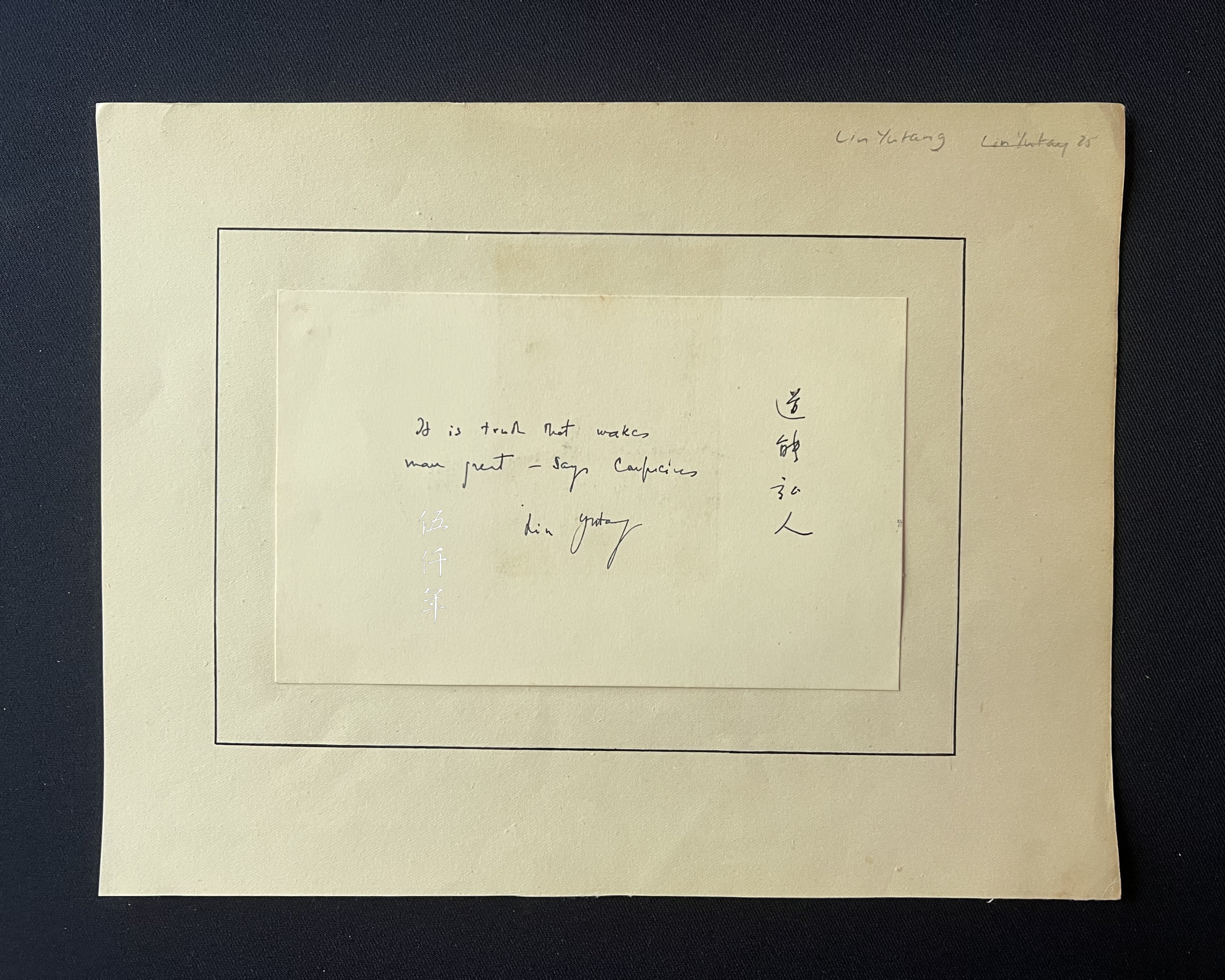
A card inscribed with the proverb of Confucius in English and Chinese. By Lin Yu Tang
(137) Lin Yu Tang 1895 – 1976 (林語堂)
(137-1) A card inscribed with the proverb of Confucius in English and Chinese by Lin Yu Tang.
(137-2) The Wisdom of China and India. New York: Random House, 1942. First edition. Signed by the author.
(137-3) On the Wisdom of America. New York: The John Day Company, 1950. First edition. Inscribed by the author in Cannes to Carl Van Doren (1885 - 1950), American critic and biographer, dated June 1950.
(138) Marion Herbert Duncan 1896-1977 (馬里昂‧鄧肯)
(138-1) The Yangtze And The Yak, Adventurous Trails In and Out of Tibet. Alexandria, Virginia, 1952. First edition. Inscribed by the author to Ambassador John Leighton Stuart (1876 - 1962), dated 4 January 1955.
(139) Li Chi 1896-1979 (李濟)
(139-1) Studies of the Decorative Art of the Yin-Shang Period: Part 1, On the Decorative Patterns of the Ku-Vase Discovered from Hsiao-T'un And Hou-Chia-Ch'uan. Reprinted from the Bulletin of the Institute of History and Philology, Academia Sinica, Vol. XXXIV, 1963. Inscribed by the author.
(139-2) Position of the Black Pottery Culture in the History of Ancient China, Reprinted from the Bulletin of the Department of Archaeology and Anthropology, Nos. 21 & 22, November, 1963, National Taiwan University, Taipei, Taiwan, China. Inscribed by the author.
(140) General Albert Coady Wedemeyer 1896-1989 (魏德邁上將)
(140-1) Wedemeyer Reports! New York: Henry Holt & Company, 1958. Fourth printing. Inscribed by the author to Frank Bomar, possibly petty officer Frank Bomar (1940-1970), dated 23 October 1961.
(140-2) Wedemeyer Reports! New York: Henry Holt & Company, 1958. First edition. Inserted a typed letter by Geraldine Fitch, dated 13 February 1959. Numerous newspaper clippings on A. Wedemeyer and G. Fitch were affixed to the inside pages.
(141) Chang-hsü Hsü 1897-1931 (徐志摩 (章垿))
(140-1) The Foundations of Aesthetics, by I. A. Richards, C. K. Ogden and James Wood. New York: Lear Publishers, 1925. First edition. Chang-hsü Hsü, also known as Hsü Chih-mo wrote the two characters of Chung-yung (中庸 Doctrine of the Mean) in traditional brushwork, accompanied by two pages of explanation and interpretation, page 13 and 14. He travelled to England and other European countries in 1925, the year of publication.
(142) Mayor Huang Chao-chin 1897-1972 (黃朝琴市長)
(142-1) The Case of the S. S. Kwang Yuan, edited by Chao-chin Huang. San Francisco: The S. S. Kwang Yuan Publication Committee, circa 1939. Inscribed in Calcutta by the editor to Miriam Faverman, dated 20 January 1940. Inserted a typed letter by Ambassador Patrick Pichi Sun, a reply letter by Miriam Faverman and a portion of the wrapping paper with Faverman's address.
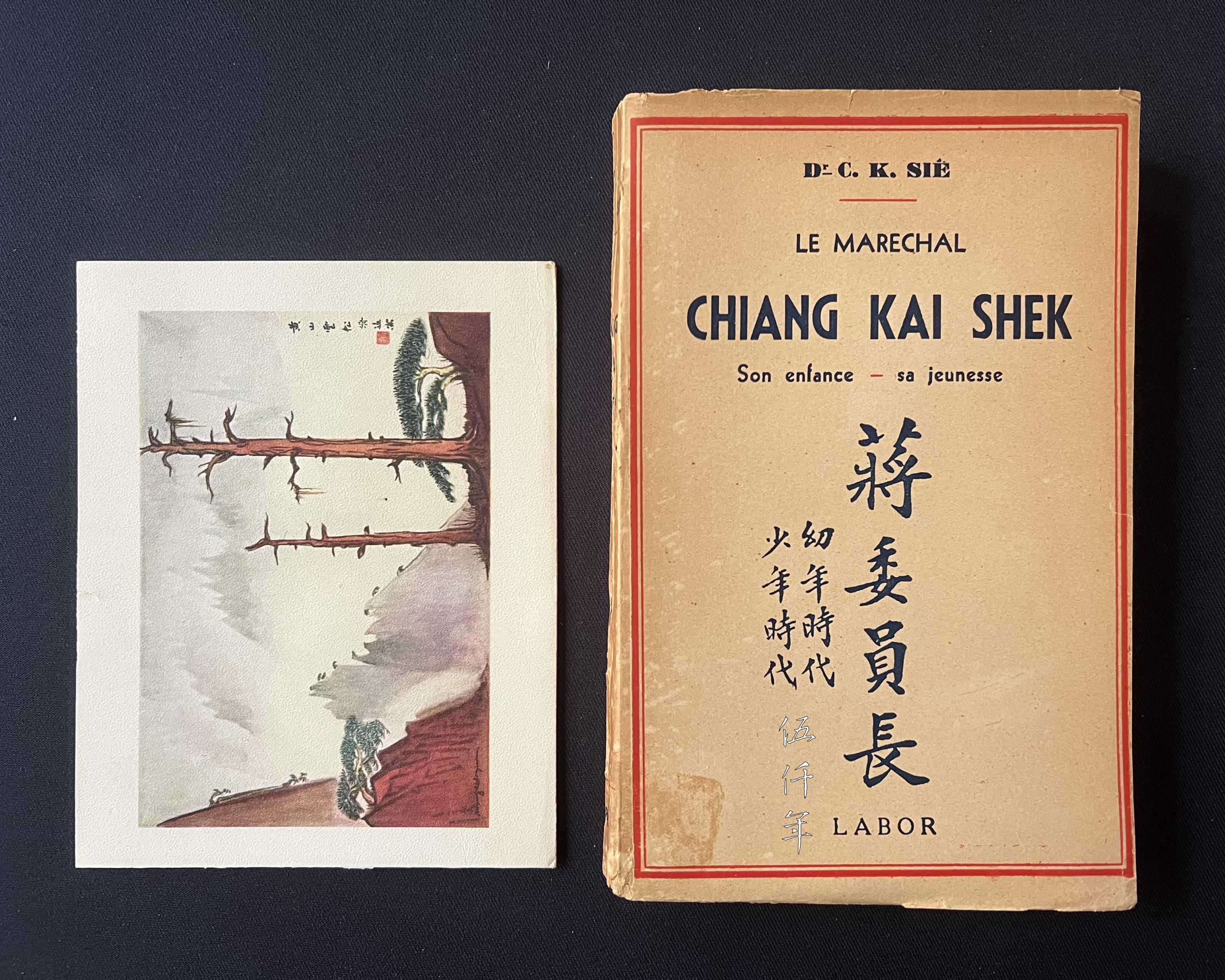
Front cover of Le Marcechal Chiang Kai Shek with Christmas greeting card. By Cheou-kang Sie
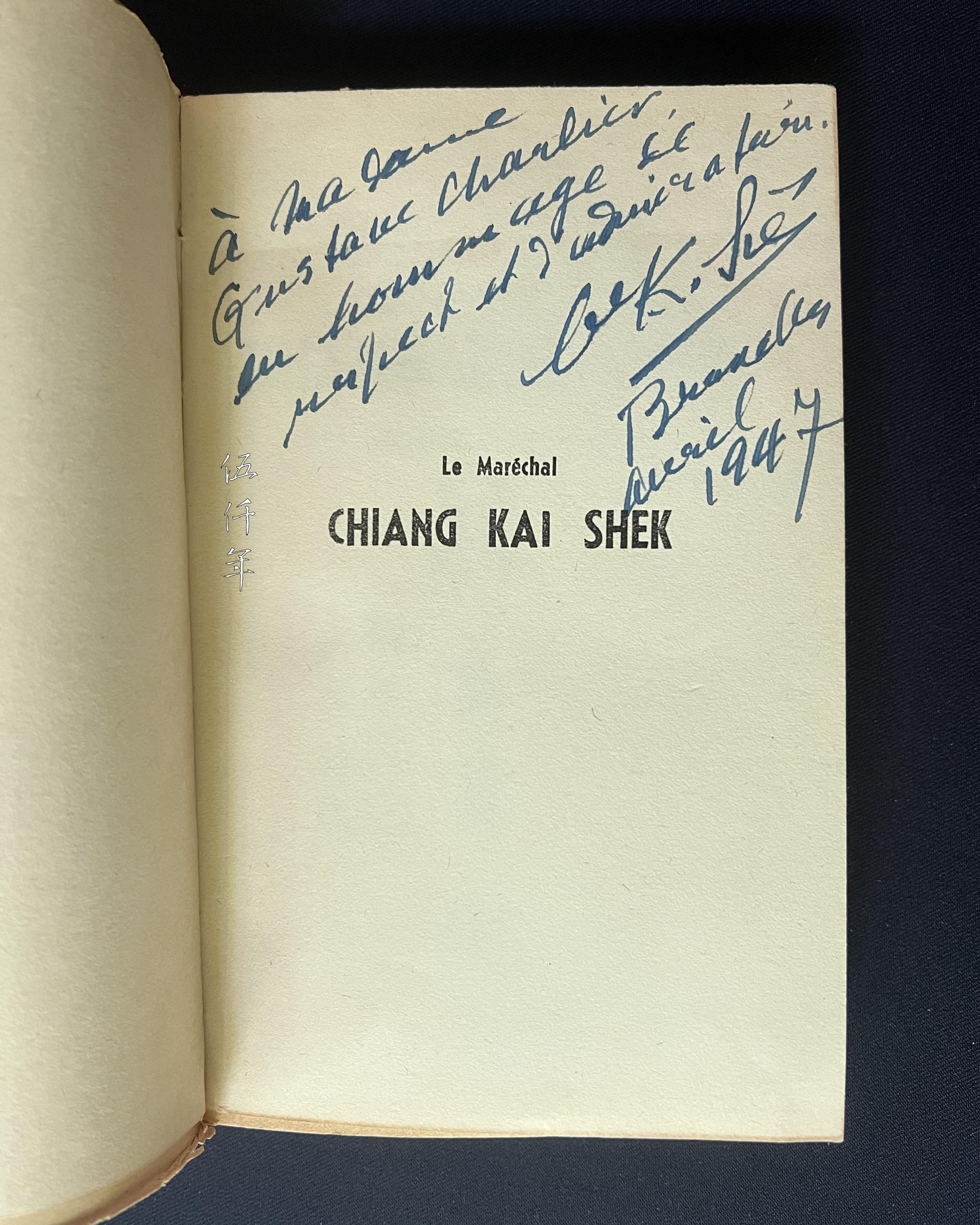
Inside page of Le Marcechal Chiang Kai Shek. By Cheou-kang Sie
(143) Ambassador Hsieh Shou-k'ang, also known as Dr. Cheou-kang Sie 1897-1973 (謝壽康大使)
(143-1) Est-Ouest, Reflets Croises. First edition. Inscribed by the author to G. Detaille, dated February 1941.
(143-2) Le Marechal Chiang Kai Shek, Son enhance, Sa Jeunesse, 1947. First edition. Inscribed by the author to Gustave Charlier (1885-1959), Belgian historian of literature and philologist, dated April 1947. Inserted a Christmas greeting card, signed by the author, dated Christmas 1947.
(143-3) President Chiang Kai-shek, His Childhood and Youth. Published by China Cultural Service, Taipei, Taiwan. Inscribed by the author in Rome to Ambassador Johannes Coreth of Austria, dated November 1962.
(144) Miner Searle Bates 1897-1978 (貝德士)
(144-1) From the library of M. S. Bates and inscribed by Bates: Nationalism, Myth and Reality, by Boyd C. Shafer. New York: Harcourt, Brace and Company, 1955. First edition.
(144-2) From the library of M. S. Bates and inscribed by Bates in New York in 1952: Revolution in China, by C. P. Fitzgerald. London: The Crescent Press, 1952. First edition. Affixed M. Searle Bates Memorial Collection bookplate.
(144-3) From the library of M. S. Bates and inscribed by Bates in New York in 1953: Stalin's Satellites in Europe, by Ygael Gluckstein. Boston: The Beacon Press, 1952. First edition. Affixed M. Searle Bates Memorial Collection bookplate.
(145) Harold John Timperley 1898-1954 (田伯烈)
(145-1) Japan:A World Problem. New York: The John Day Company, 1942. First edition. Inscribed by the author to George A. Nicholson.
(145-2) Japan: A World Problem. New York: The John Day Company, 1942. First edition. Inscribed by the author to Paul McGuire.
(146) Vice-President Chen Cheng 1898-1965 (陳誠副總統)
(146-1) Land Reform in Taiwan. China Publishing Company, 1961. First edition. Inscribed in Chinese to R. B. Tootell, dated November 1962. Affixed is a presentation card to Governor R. B. Tootell from Chen Cheng, Vice President and Premier of the Republic of China, dated November 1962. Also inserted a newspaper clipping on the death of Chen Cheng.
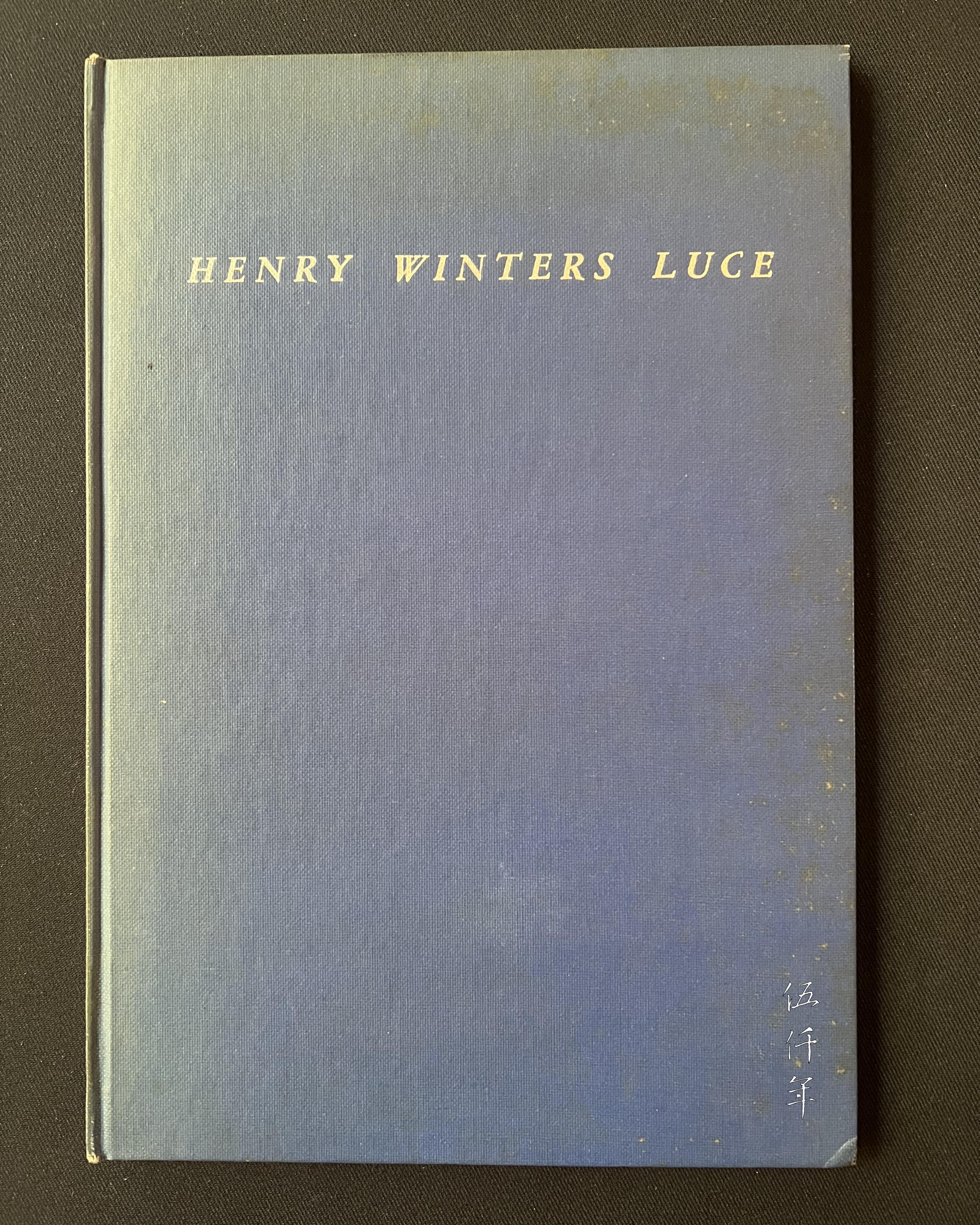
Front cover of Henry Winters Luce
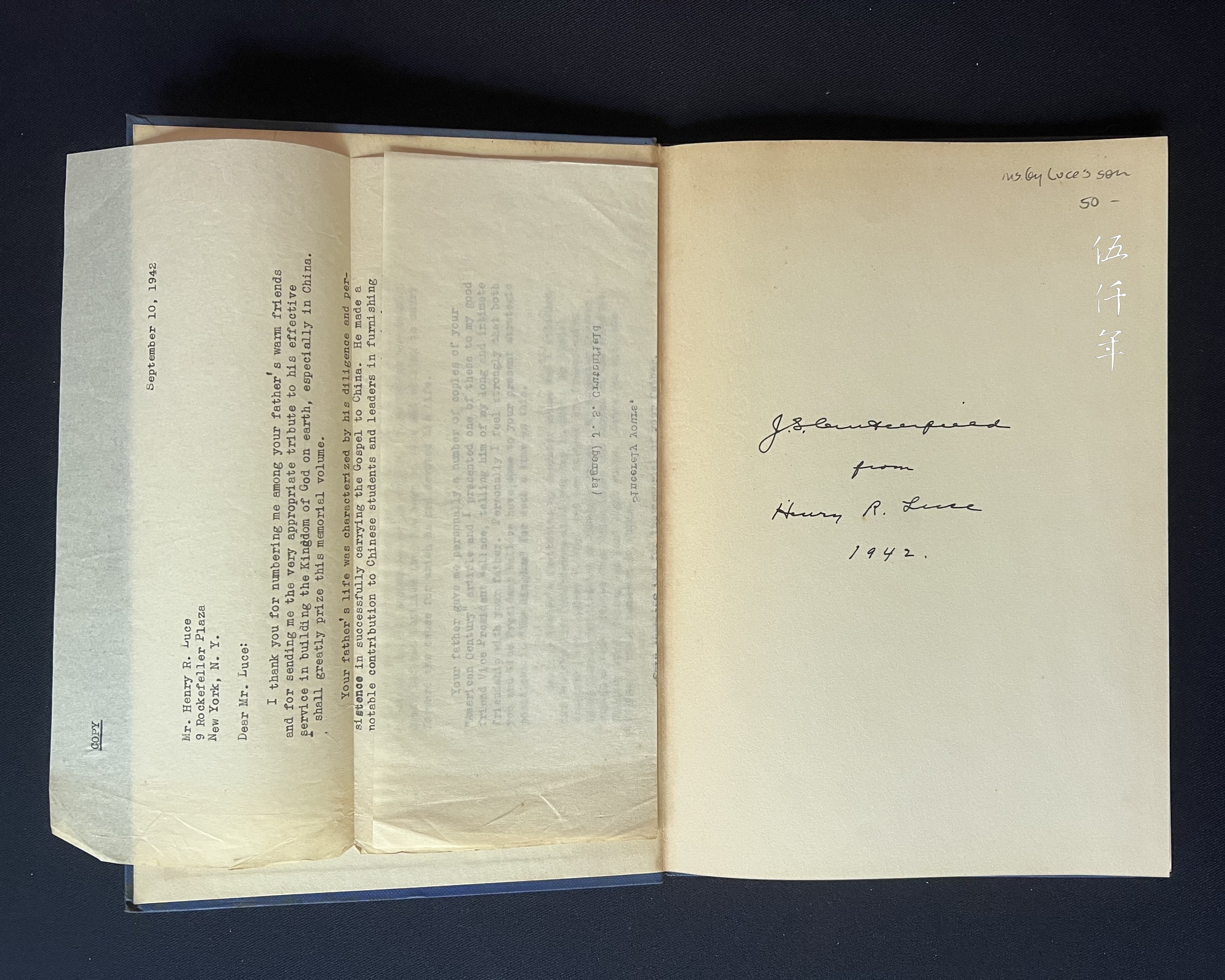
Inside page of Henry Winters Luce, inscribed by son Henry Robinson Luce
(147) Henry Robinson Luce 1898-1967 (亨利‧盧斯)
(147-1) Henry Winters Luce, privately printed. Inscribed by H. R. Luce to J. S. Crutchfield, dated 1942. Inserted typed draft letter by J. S. Crutchfield to H. R. Luce, dated 10 September 1942.
(147-2) Letter by H. R. Luce to Henry Justin Smith (1875-1936), managing editor of the Chicago Daily News.
(148) Freda Utley 1898-1978 (烏特來)
(148-1) The China Story. Chicago: Henry Regnery Company, 1951. First edition. Inscribed by the author to Sydney, dated May 1951.
(149) Representative Walter Henry Judd 1898-1994 (周以德議員)
(149-1) A small card inscribed in English and Chinese by W. H. Judd.
(149-2) Typed letter by W. H. Judd to J. J. Weigand, dated 18 February 1963.
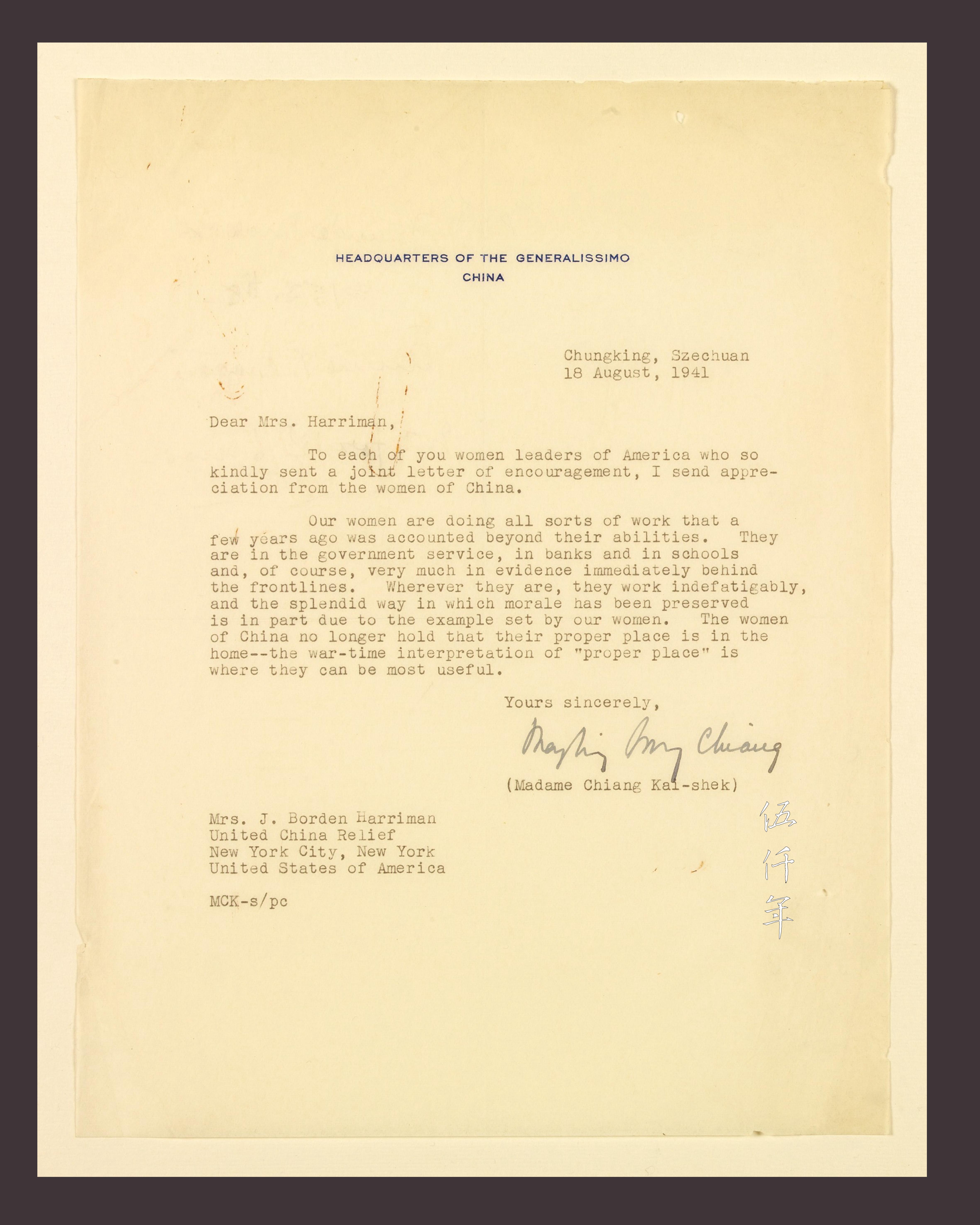
Letter by Madame Chiang to Florence Jaffray Harriman, written on 18 August 1941 in Chungking
(150) Madame Chiang Kai-shek 1898-2003 (蔣宋美齡夫人)
(150-1) Letter by Madame Chiang to Florence Jaffray Harriman (1870-1967), American ambassador to Norway, written in Chungking, the wartime provisional capital of China, dated 18 August 1941.
(150-2) Addresses Delivered Before the House of Representatives and the Senate of the United States by Madame Chiang Kai-shek, February 18, 1943. The Overbrook Press, Stamford, Connecticut, 1943. First edition.
(150-3) A Letter from Madame Chiang Kai-shek to Boys and Girls Across the Ocean. Chungking: The China Information Publishing Company, 1940. Gifted by Attorney Roy Ian Delbyck.
(151) Minister Tien-fong Cheng 1899-1967 (程天放部長)
(151-1) A History of Sino-Russian Relations. Washington: Public Affairs Press, 1957. First edition. Inscribed by the author in Taipei to Mr. And Mrs. George A. Fitch, dated 6 November 1957.
(151-2) Selected Speeches And Writings Of Dr Tien-Fong Cheng, published by the Ministry of Education, Taipei, Taiwan, China, May, 1954. First edition.
(152)Mr. Chang Dai-chien 1899-1983 (張大千先生)
(152-1) Chang Dai-chien: A Retrospective, Center of Asian Art and Culture, The Avery Brundage Collection, San Francisco, 11 November to 17 December 1972. Inscribed by the artist to Mr. Soong Hsün-leng, writer and tz'u poet.
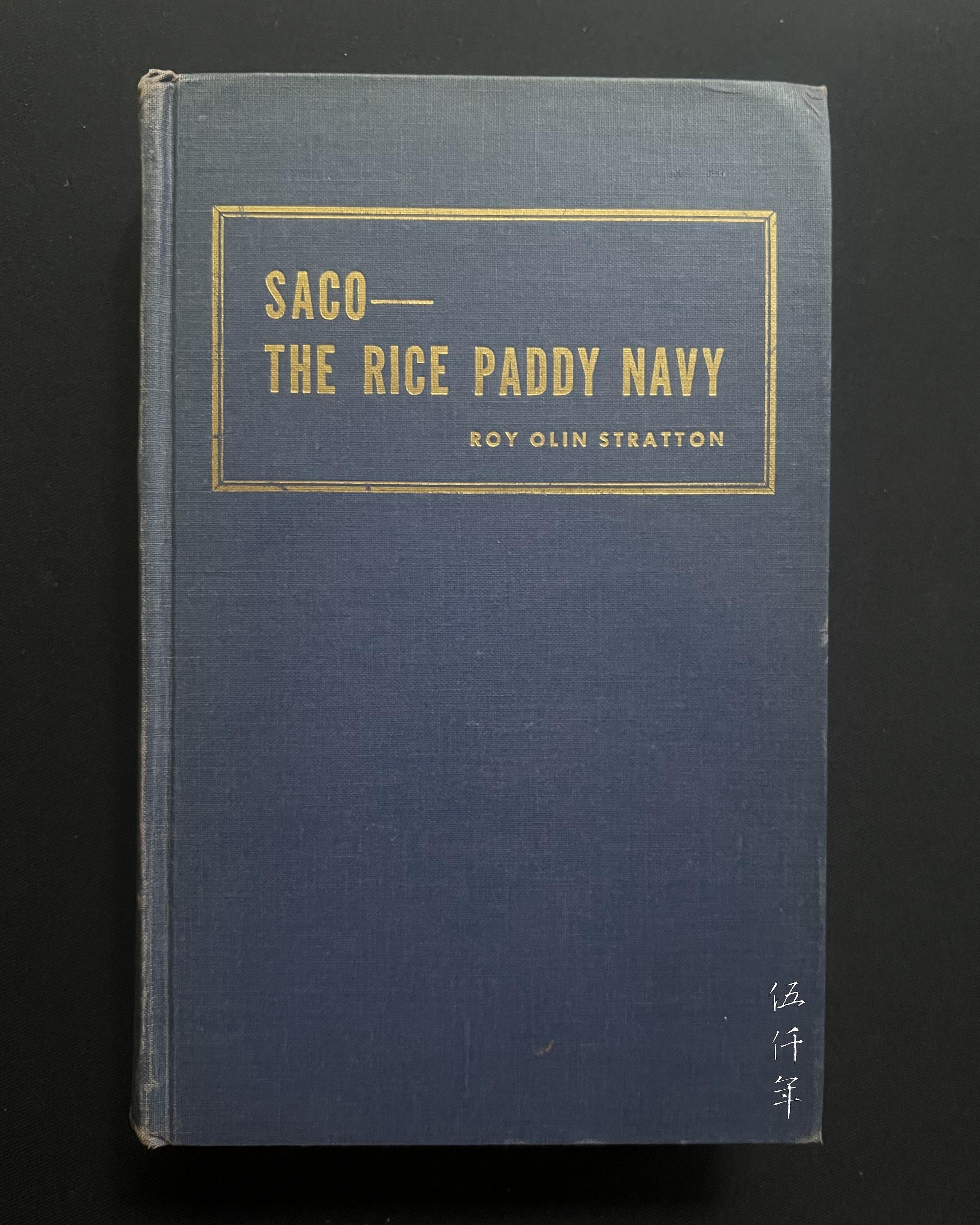
Front cover of SACO-The Rice Paddy Navy. By Roy Olin Stratton
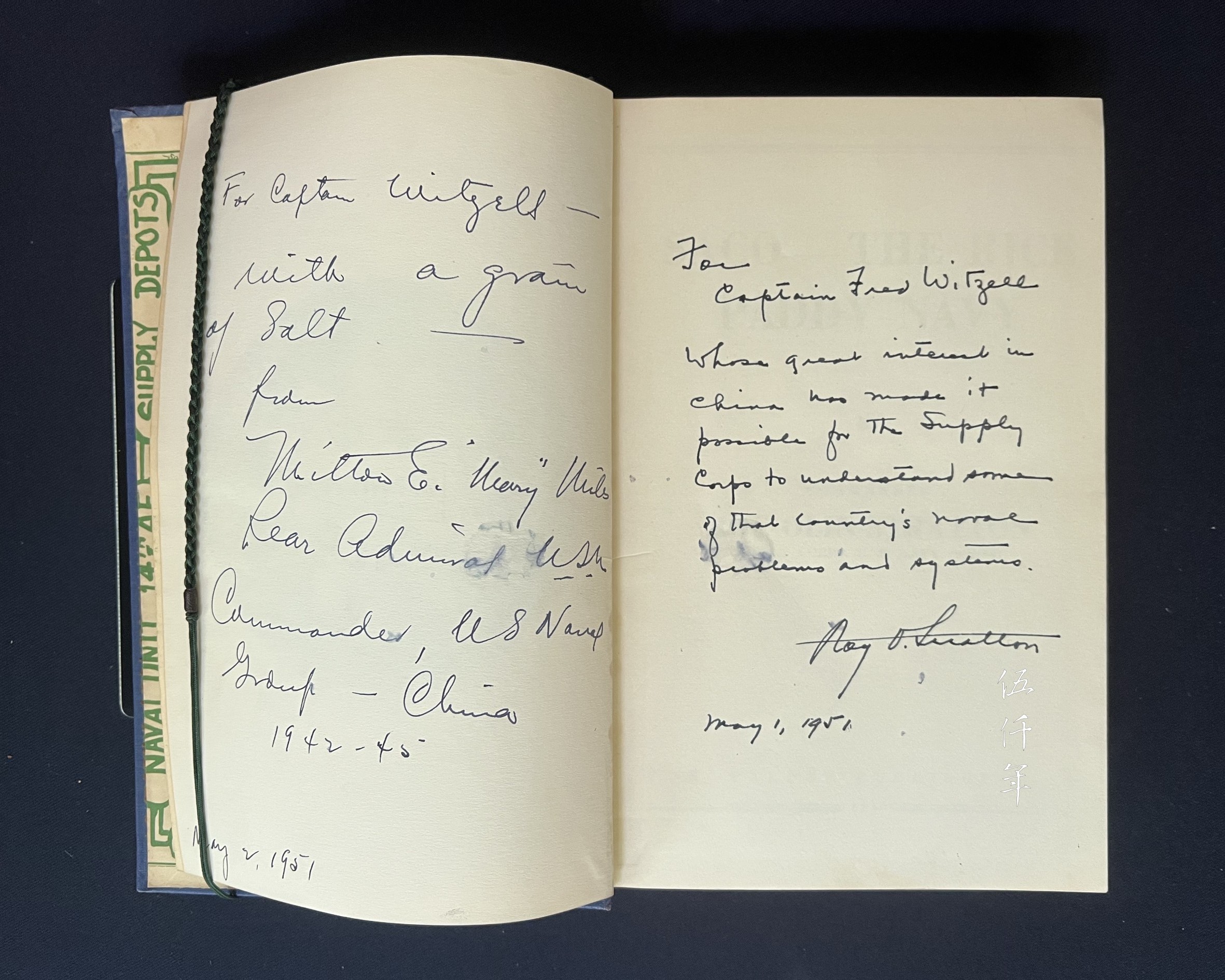
Inside page of SACO-The Rice Paddy Navy. Inscribed by Milton Edward Miles and Roy Olin Stratton
(153) Vice Admiral Milton Edward Miles 1900-1961 (梅樂斯中將)
(153-1) SACO-The Rice Paddy Navy. C. S. Palmer Publishing Co., 1950. First edition. Inscribed by Milton Edward Miles and the author Roy Olin Stratton to Captain Witzell, dated 2 May 1951 and 1 May 1951 respectively.
(153-2) A Different Kind of War: The Unknown Story of the U. S. Navy's Guerrilla Forces in World War II China. Taipei: Caves Books, Ltd., 1967. Inscribed by the author to Joe Metcalf.
(153-3) Silver box with insignia of Sino-American Cooperative Organization (SACO), gifted to General Hsiao Shin-ju (蕭信如, 名勃) from Mrs. Wilma Miles.
(154) Father Mark A. Tennien 1900-1983 (田義仁神父)
(154-1) Chungking Listening Post. New York: Creative Age Press, Inc., 1945. First edition. Inscribed by the author in English and Chinese.
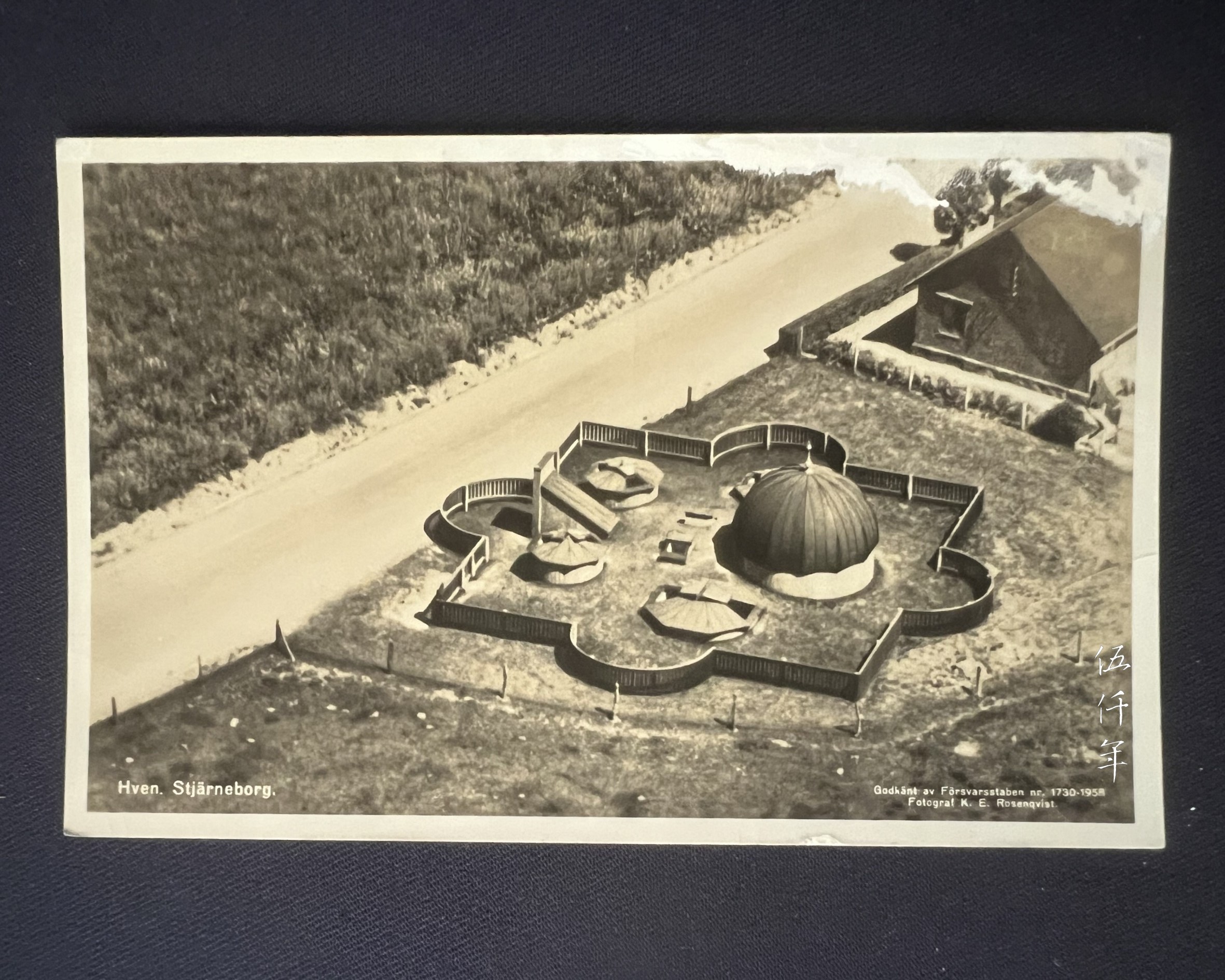
Front of postcard from Joseph Needham to Arthur Beer
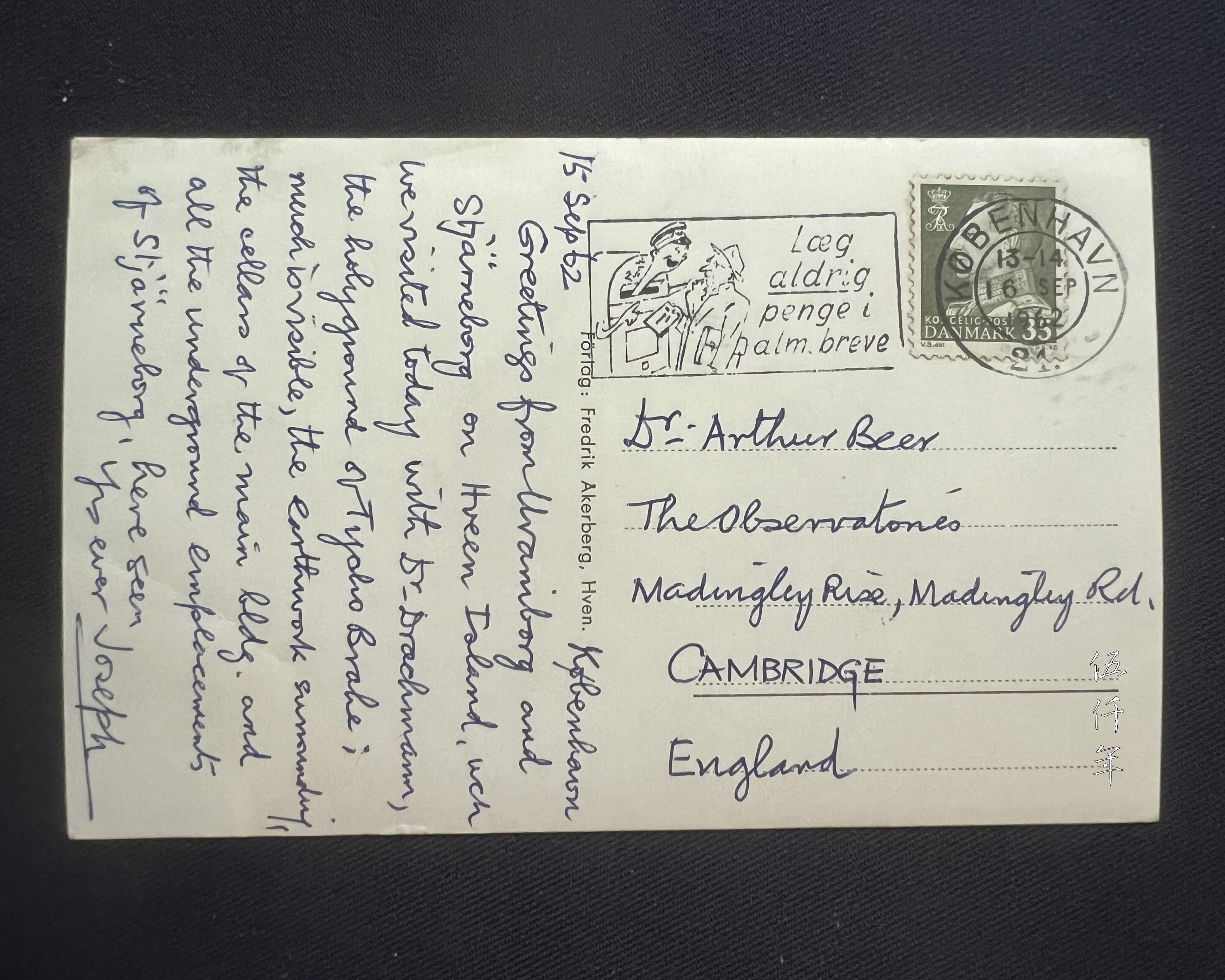
Back of postcard from Joseph Needham to Arthur Beer
(155) Joseph Needham 1900 – 1995 (李約瑟)
(155-1) Science and Civilization in China, Volume 2, History of Scientific Thought. Cambridge: At The University Press, 1956. Commentaries inscribed by J. Needham throughout. Inserted typed letter by J. Needham to Arthur D. Clegg (1914-1966), political activist and lecturer, dated 14 March 1961.
(155-2) The Pattern of Nature-Mysticism and Empiricism in the Philosophy of Science: Third Century B. C. China, Tenth Century A. D. Arabia, and Seventeenth Century A. D. Europe. Reprinted from Science, Medicine and History, essays on the evolution of scientific thought and medical practice written in honour of Charles Singer. Oxford: Oxford University Press, 1953. Inscribed in English and Chinese to Pai-ku-erh. Inserted typed letter by the recipient to J. Needham, dated 26 January 1954.
(155-3) The Coming of Ardent Water, by Lu Gwei-Djen, Joseph Needham and Dorothy Needham. Reprinted from Zambia, the Journal of the Society for the Study of Alchemy and Early Chemistry, Vol. XIX, No. 2, July 1972. Inscribed in Chinese by J. Needham in Cambridge to Walter Pagel (1898-1983), German pathologist and medical historian. dated 7 October 1972.
(155-4) The Sceptical Biologist, Ten Essays. London: Chatto & Windus, 1929. First edition. Inscribed by the author in Chungking to John Perry, dated 1945.
(154-5) Time the Refreshing River, Essays and Addresses 1932-1942. London: George Allen & Unwin Ltd., 1944. Second impression. Inscribed by the author in Chungking to John Perry, dated November 1945.
(155-6) Postcard from J. Needham to Prof. Arthur Beer (1900-1980), dated 15 September 1962.
(155-7) Publicity leaflet for a lecture on Astronomy in Classical China by J. Needham at the London Planetarium on 19 October 1961, at 5:30 pm.
(155-8) Four sheets of manuscript by J. Needham gifted to Prof. A. Beer, attached a typed letter by J. Needham to Prof. A. Beer, dated 22 January 1961. Also a handwritten draft letter by Prof. A. Beer to J. Needham, dated 24 January 1961.
(155-9) Seven pages of two typed facsimile letters by J. Needham to Dr. Hartner, dated 12 February 1954 and 19 March 1954; a handwritten note by J. Needham to Prof. A. Beer and a typed letter dated 19 March 1954.
(155-10) Five pages of typed manuscript for Chinese Astronomical Clockwork with typed note, gifted by J. Needham to Prof. A. Beer.
(155-11) Facsimile typed letter by Prof. A. Beer to J. Needham, dated 27 February 1952.
(155-12) Two pages of facsimile typed letter by Prof. A. Beer to J. Needham, dated 6 January 1962.
(155-13) Proof copy of Heavenly Clockwork, The Great Astronomical Clocks of Medieval China. Cambridge: The University Press, 1959. Gifted to Prof. A. Beer.
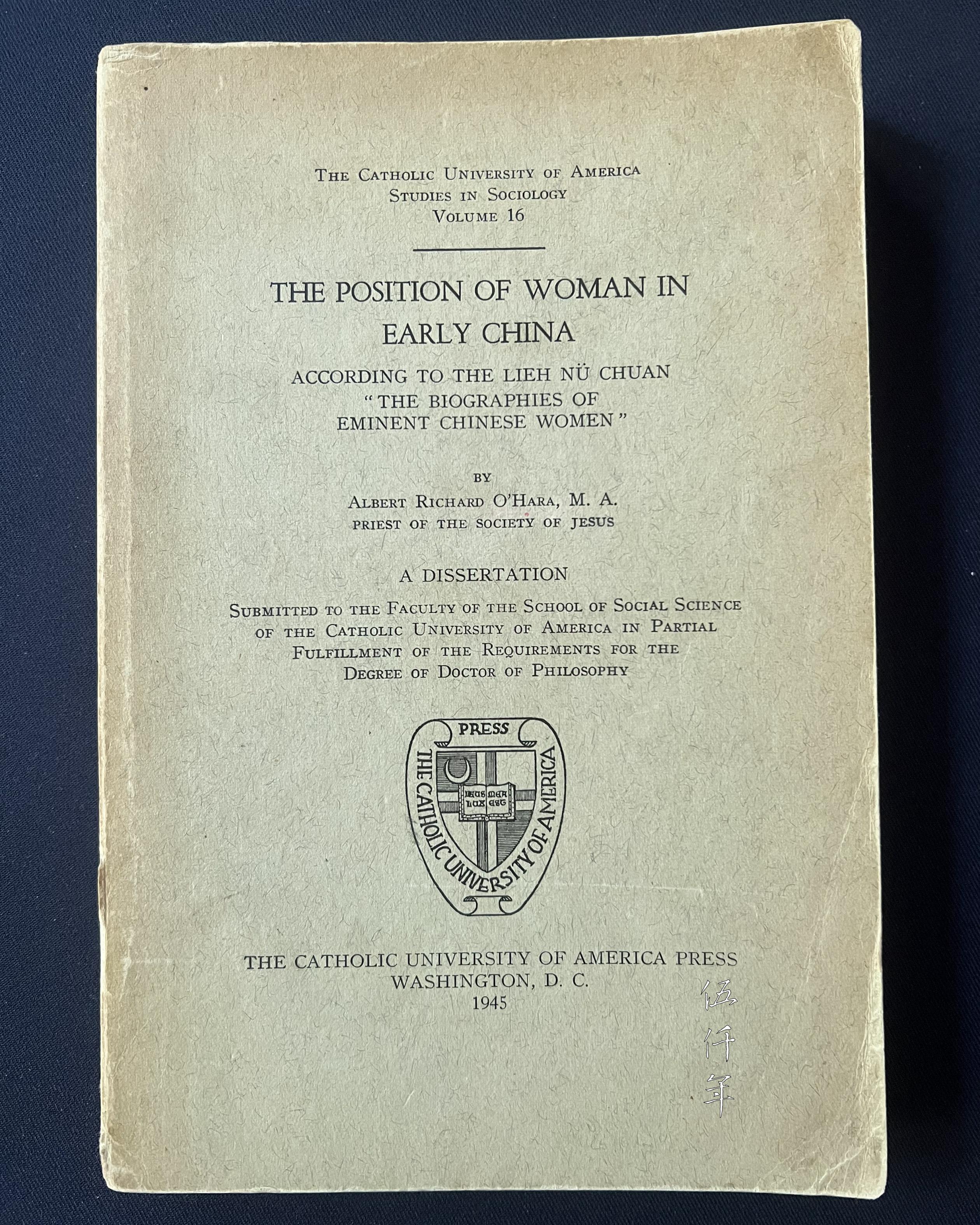
Front of The Position of Woman in Early China, According to the Lieh Nü Chuan “The Biographies of Eminent Chinese Women”. By Albert Richard O’Hara
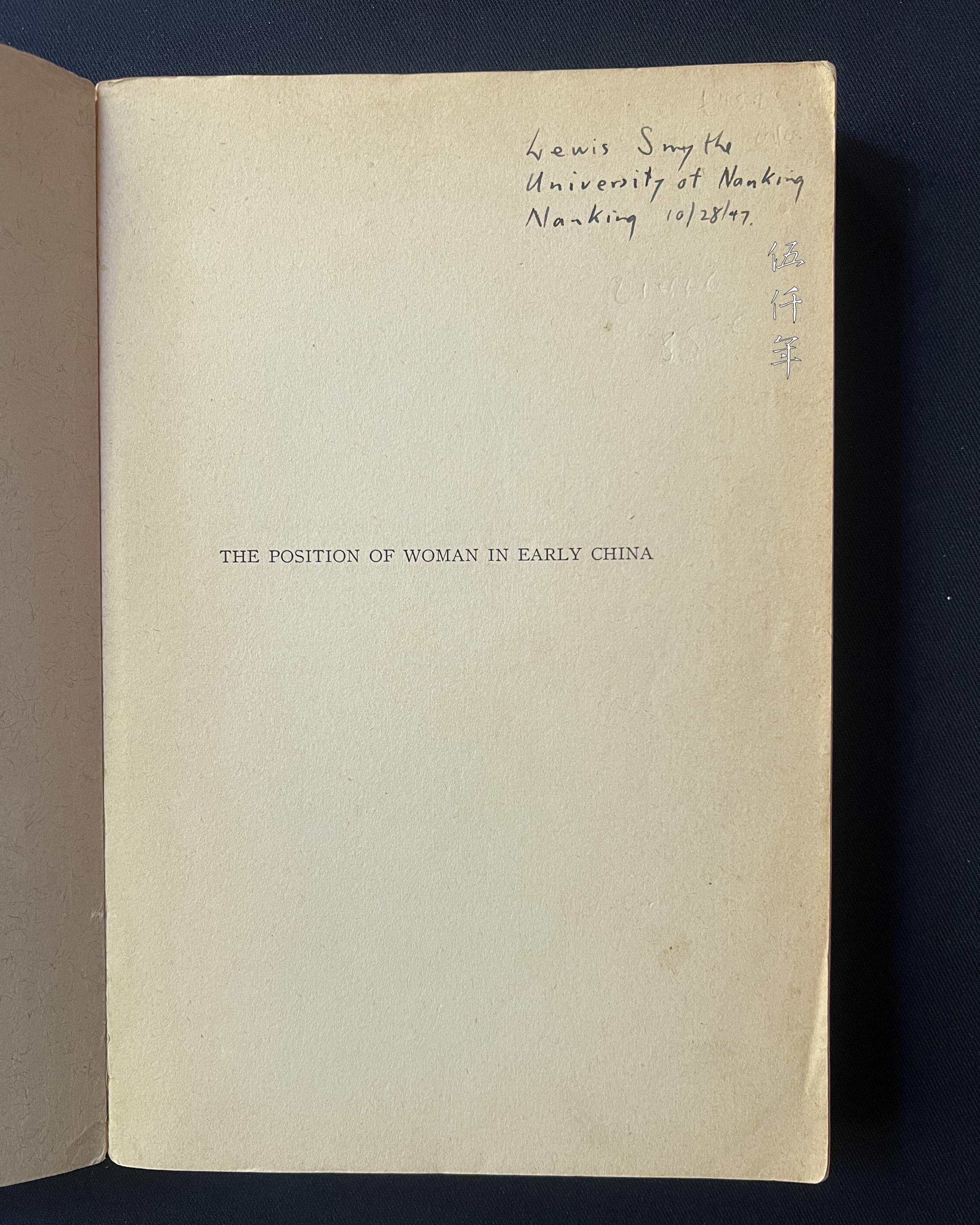
Inside page of The Position of Woman in Early China, According to the Lieh Nü Chuan “The Biographies of Eminent Chinese Women”. Inscribed by Lewis S. C. Smythe
(156) Lewis S. C. Smythe 1901-1978 (史邁士)
(156-1) From the library of S. C. Smythe and inscribed on 28 October 1947 by Smythe in Nanking: The Position of Woman in Early China, According to the Lieh Nü Chuan “The Biographies of Eminent Chinese Women,”by Albert Richard O'Hara, M. A., Priest of The Society of Jesus. Washington: The Catholic University of America Press, 1945.
(157) Cardinalate Paul Yu Pin 1901-1978 (于斌樞機)
(157-1) Eyes East, Selected Pronouncements of the Most Reverend Paul Yu-Pin, Vicar Apostolic of Nanking and Apostolic Administrator of Kiating, China. New Jersey: St. Anthony Guild Press, 1945. Inscribed by the author in Chinese and English to Father Chou, dated June of the 34th year of the Republic of China, 1945.
(158) Minister Chang Ch'i-yün 1901-1985 (張其昀部長)
(158-1) The Essence of Chinese Culture. Taipei: The China News Press, 1957. First edition. Inscribed by the author to John Milton Steeves (1905-1998), American diplomat who served as deputy-assistant secretary of state for far eastern affairs from 1959-1962.
(159) Ambassador Dr. Feng Shan Ho 1901-1997 (何鳳山大使)
(159-1) China Verteidigt Sich (China Defends Herself). Wein, Leipzig: Michael Winkler Verlag, 1937.
(160) Bishop Quentin K. Y. Huang 1902-1973 (黃奎元主教)
(160-1) Now I Can Tell, The Story of a Christian Bishop Under Communist Persecution. New York: Morehouse-Gotham Co., 1954. Second printing. Inscribed by the author in English and Chinese, dated 10 June 1956.
Front cover of Lady Precious Stream, An Old Chinese Play Done into English According to Its Traditional Style. By S. I. Hsiung
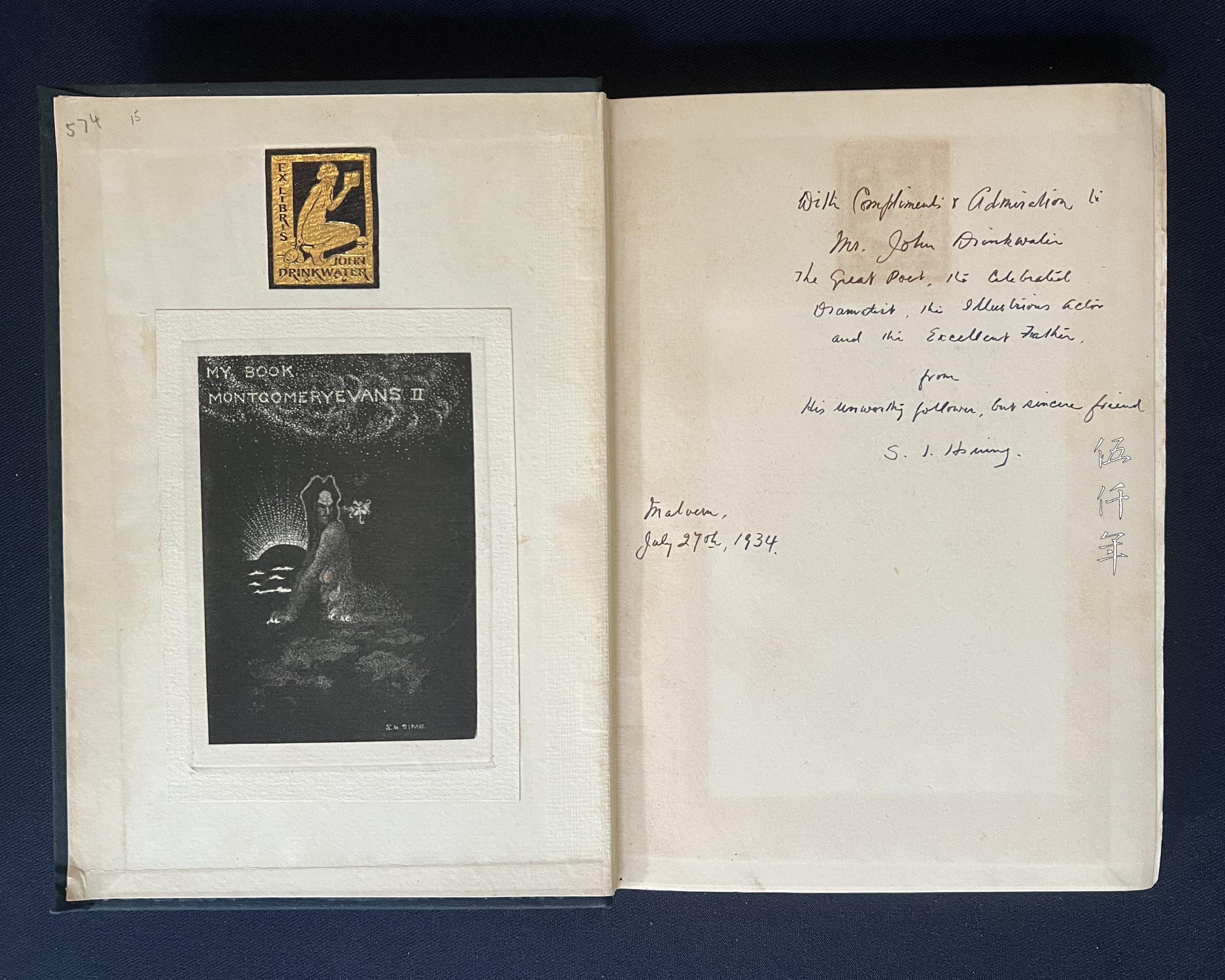
Inside page of Lady Precious Stream, An Old Chinese Play Done into English According to Its Traditional Style. By S. I. Hsiung
(161) S. I. Hsiung 1902-1991 (熊式一)
(161-1) Lady Precious Stream, An Old Chinese Play Done into English According to Its Traditional Style. London: Methuen & Co. Ltd., 1934. First edition. Inscribed by the author in Malvern to John Drinkwater (1882-1937), English poet and dramatist, dated 27 July 1934.
(161-2) Little Theatre Presents Lady Precious Stream, First European Production of a Traditional Chinese Play in Four Acts, by S. I. Hsiung. September 1935.
(161-3) Savoy Theatre, Nancy Price Presents Lady Precious Stream, First European Production of a Traditional Chinese Play in Four Acts, by S. I. Hsiung. May 1950.
(161-4) Flowering Exile, by Dymia Hsiung (1910-1987), wife of S. I. Hsiung. London: Peter Davies, 1952. First Edition. Inserted letter by S. I. Hsiung to Maurice, dated 1 October 1952. Inserted photograph of Dymia Hsiung by Arnold Genthe (1869-1942).
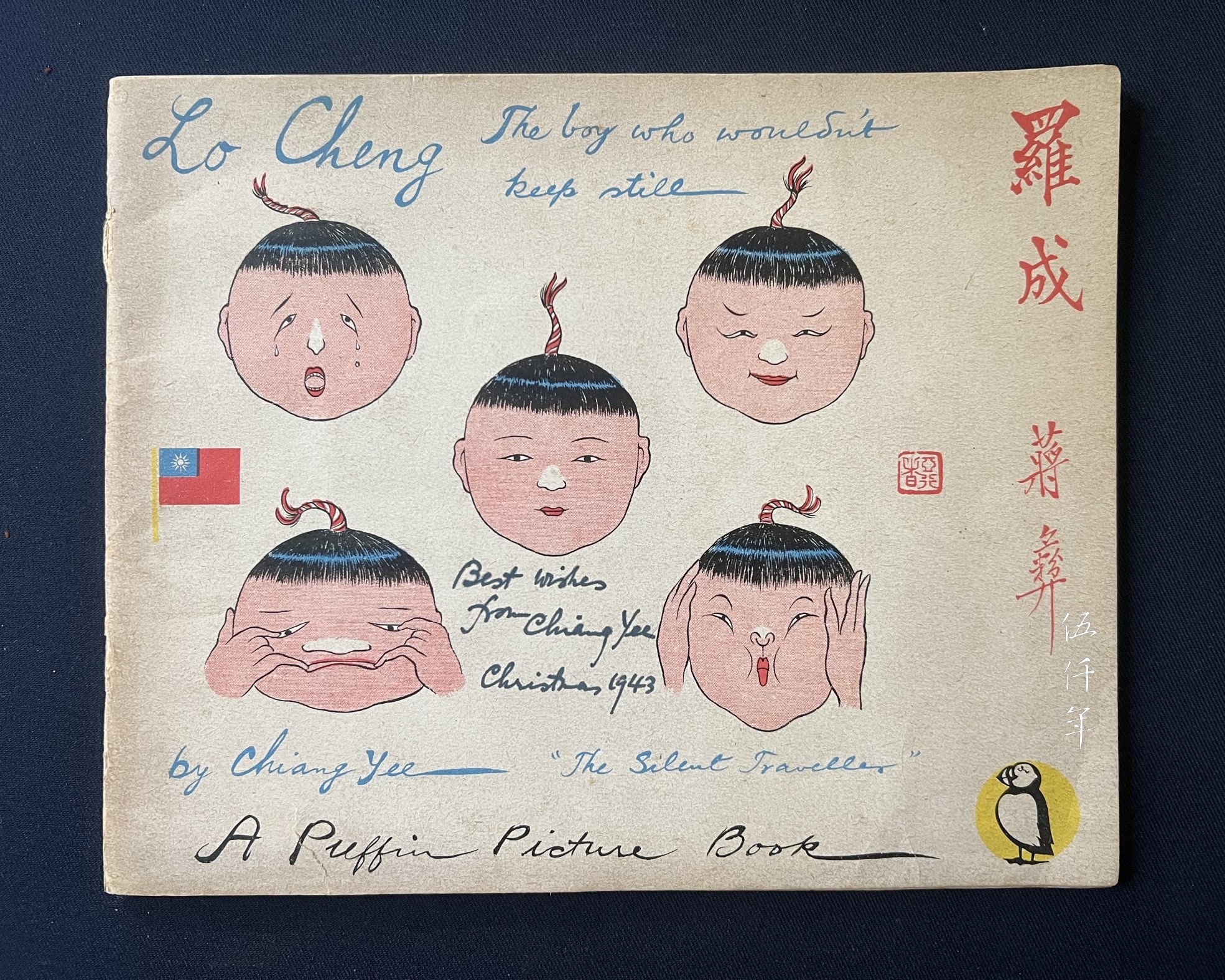
Front cover of Lo Cheng, The Boy Who Wouldn't Keep Still. By Chiang Yee
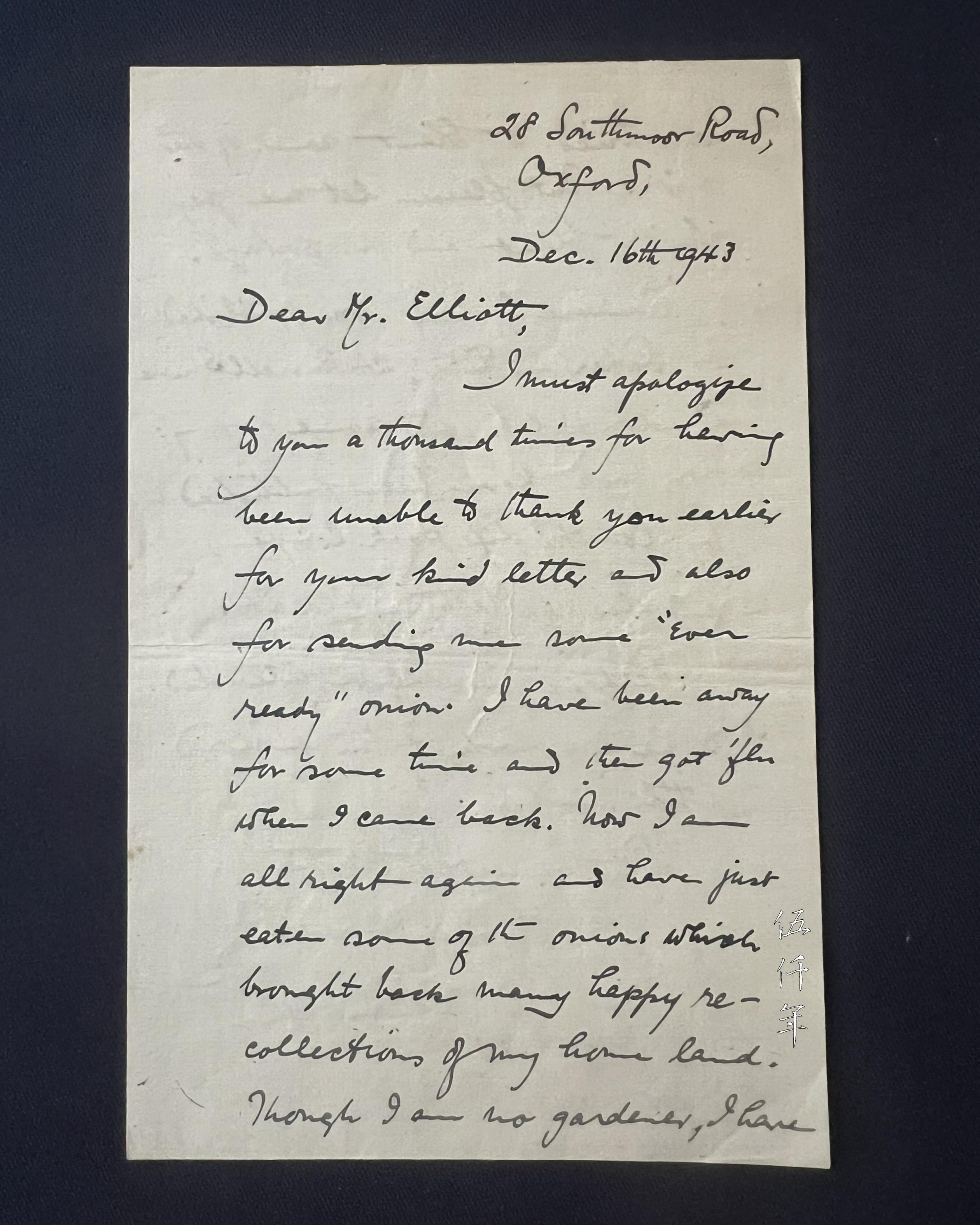
Letter by Chiang Yee to Elliott, written on 16 December 1943 in Oxford
(162) Chiang Yee 1903 – 1977 (蔣彝)
(162-1) Yebbin- A Guest from the Wild. London: Methuen & Co. Ltd., 1947. First edition. Inscribed by the author in English and Chinese to the Becks, dated July 1947. Inserted letter by Chiang Yee to Mrs. Walter Beck, dated 10 October 1950. Inserted card inscribed by Chiang Yee to Marion and Walter Beck, dated 27 July 1954.
(162-2) Lo Cheng, The Boy Who Wouldn't Keep Still. A Puffin Picture Book. Inscribed on book cover are these words: “Best wishes from Chiang Yee, Christmas, 1943.” Inserted letter by the author to Mr. Elliott, written in Oxford, dated 16 December 1943.
(163) Director Liang Yuen-li 1903-1979 (梁鋆立司長)
(163-1) The Pact of Paris as Envisaged by Mr. Stimson: It's Significance in International Law. Inscribed by the author, dated 10 August 1932. Presented to the Library of Congress.
(164) Ambassador Chang Ch’un-ming 1903-1984 (張純明大使)
(164-1) Portrait of Chang Ch’un-ming
(164-2) Two photographs of Chang Ch’un-ming being awarded the medal of Order of Practice First Class from the representatives of the Central Committee of the Chinese Nationalist Party in New York, for his translation of Chiang Kai-shek: His Life and Times from the Japanese, written by Keiji Furuya, circa 1981.
(164-3) Chiang Kai-shek: His Life and Times, by Keiji Furuya, abridged English edition by Chun-ming Chang. Published by St. John's University, 1981.
(165) Minister Han Lin-wu 1903-1991 (杭立武部長)
(165-1) Taiwan Today. Taiwan: Cheng Chung Book Company, 1982. Inscribed by the author to William Henry Gleysteen (1926-2002), American ambassador to Korea, dated 23 November 1982.
(166) Alfred Emmons Hudson 1904-1956 (阿爾弗雷德‧哈德遜)
(166-1) Kazak Social Structure, Yale University Publications in Anthropology. New Haven: Yale University Press, London: Humphrey Milford, Oxford University Press, 1938. First edition. Inscribed by the author to Wayne Suttler, dated 1940.
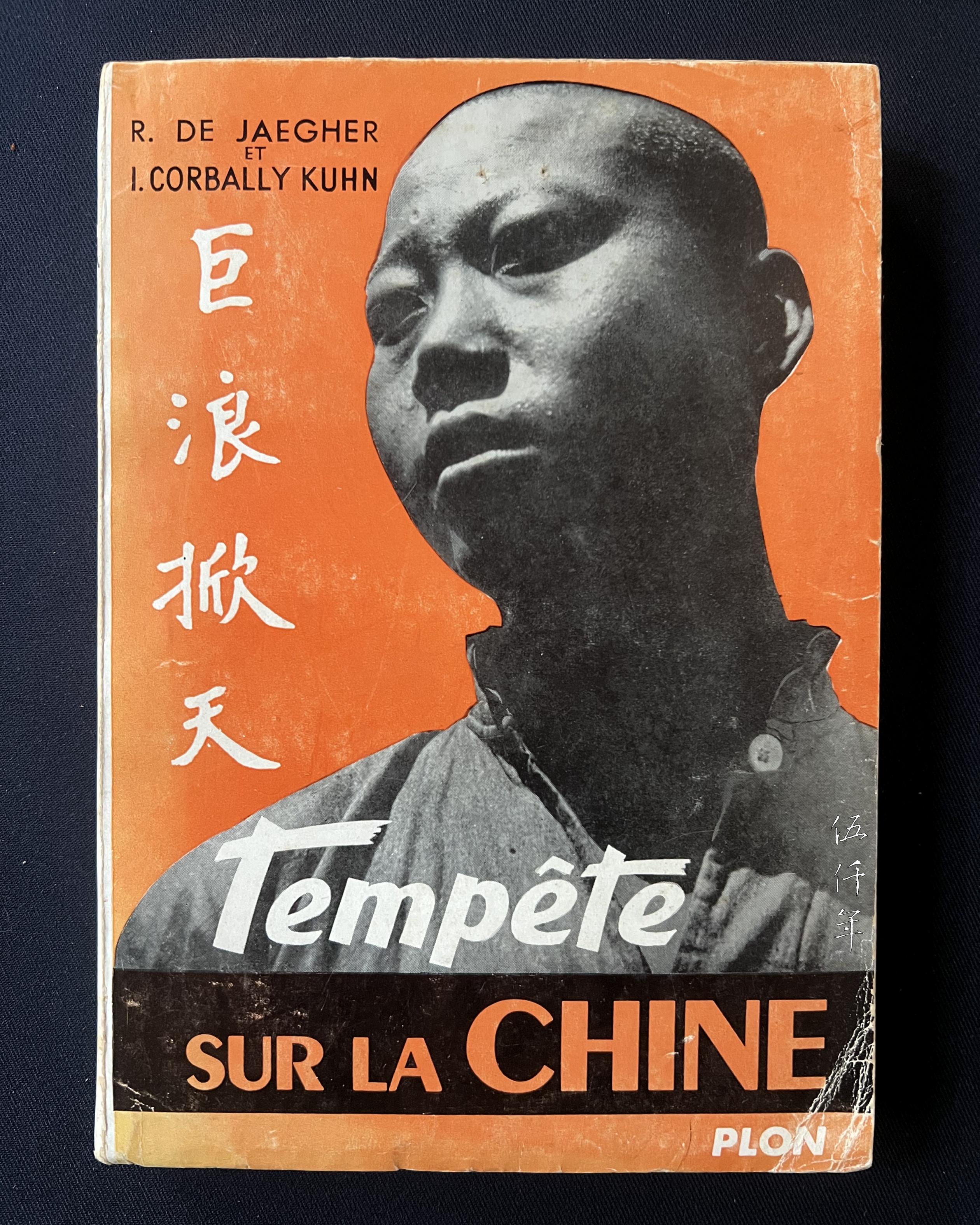
Front cover of Tempete Sur La Chine. By Raymond De Jaegher and Irene Corbally Kuhn
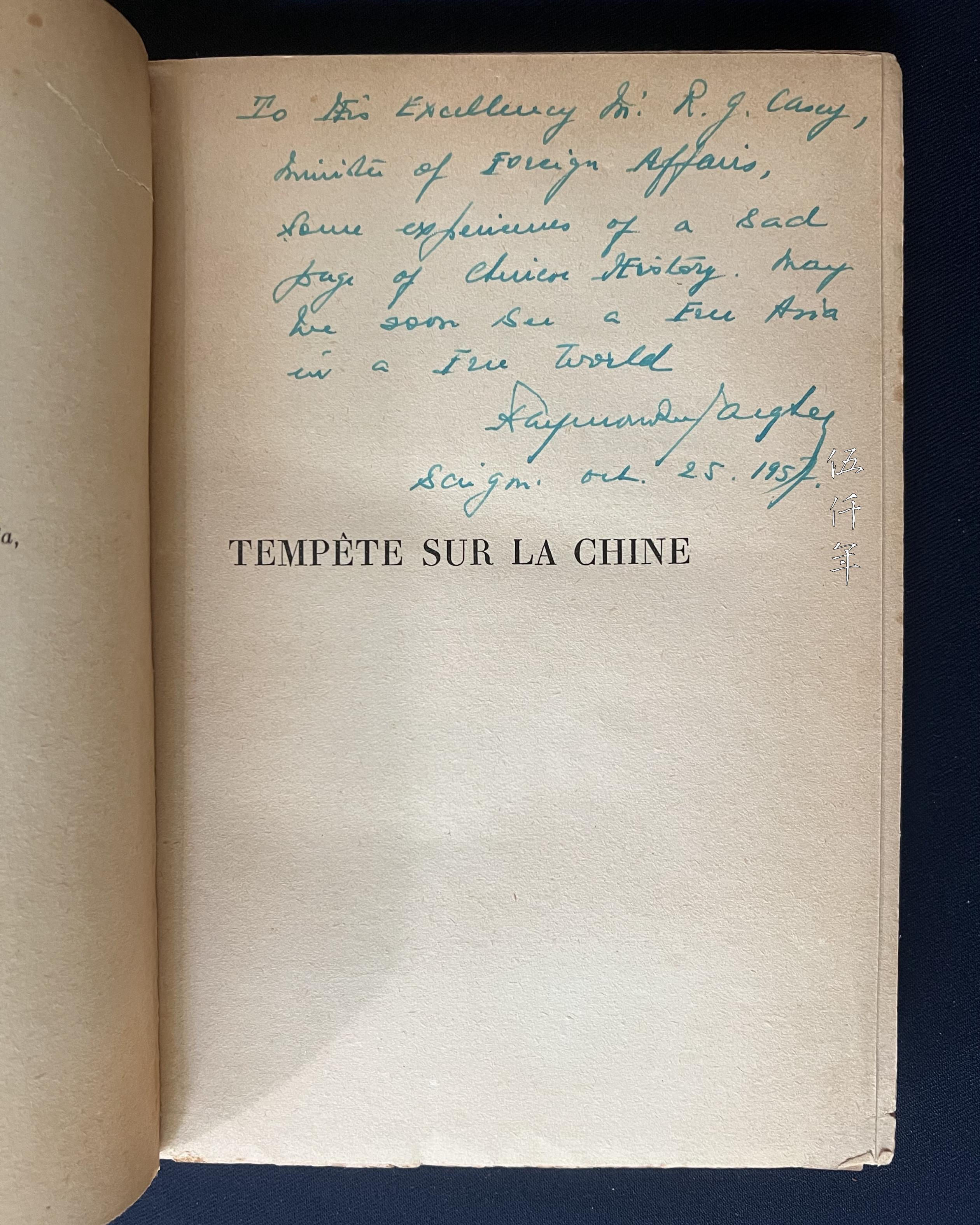
Title page of Tempete Sur La Chine. By Raymond De Jaegher and Irene Corbally Kuhn
(167) Father Raymond De Jaegher 1905-1980 (雷震遠)
(167-1) Tempete Sur La Chine, by Raymond De Jaegher and Irene Corbally Kuhn. Paris: Librairie Plon, 1953. Inscribed by R. De Jaegher to Richard Gavin Gardiner Casey (1890-1976), Australian statesman who served as the 16th governor-general of Australia, dated 25 October 1957.
(168) Pan Chao-ying 1905-1987 (潘朝英)
(168-1) China Fights On, An Inside Story of China's Long Struggle Against Our Common Enemies. New York: Fleming H. Revell Company, 1945. First edition. Inscribed in English and Chinese by the author to Representative Walter Henry Judd (1898-1994).
(169) Rey Scott 1905-1992 (雷伊‧斯科特)
(169-1) Rey Scott's “Kukan: The Battle Cry of China”. Produced by H. T. Edwards, in full natural colour.
(169-2) William Alexander and Herbert Edwards Present Rey Scott's “Kukan: The Secret of Unconquerable China”. Souvenir Programme, 1941.
(170) Lo Hsiang-lin 1906-1978 (羅香林)
(170-1) Hong Kong & Western Cultures. Tokyo: The Centre for East Asian Cultural Studies, Honolulu: East West Centre Press, 1964. Second printing. Inscribed by the author to David Carver. Inserted New Year greeting card from the author. Group portrait of the founding members of the Chinese History Society in Chungking on the cover of a greeting card.
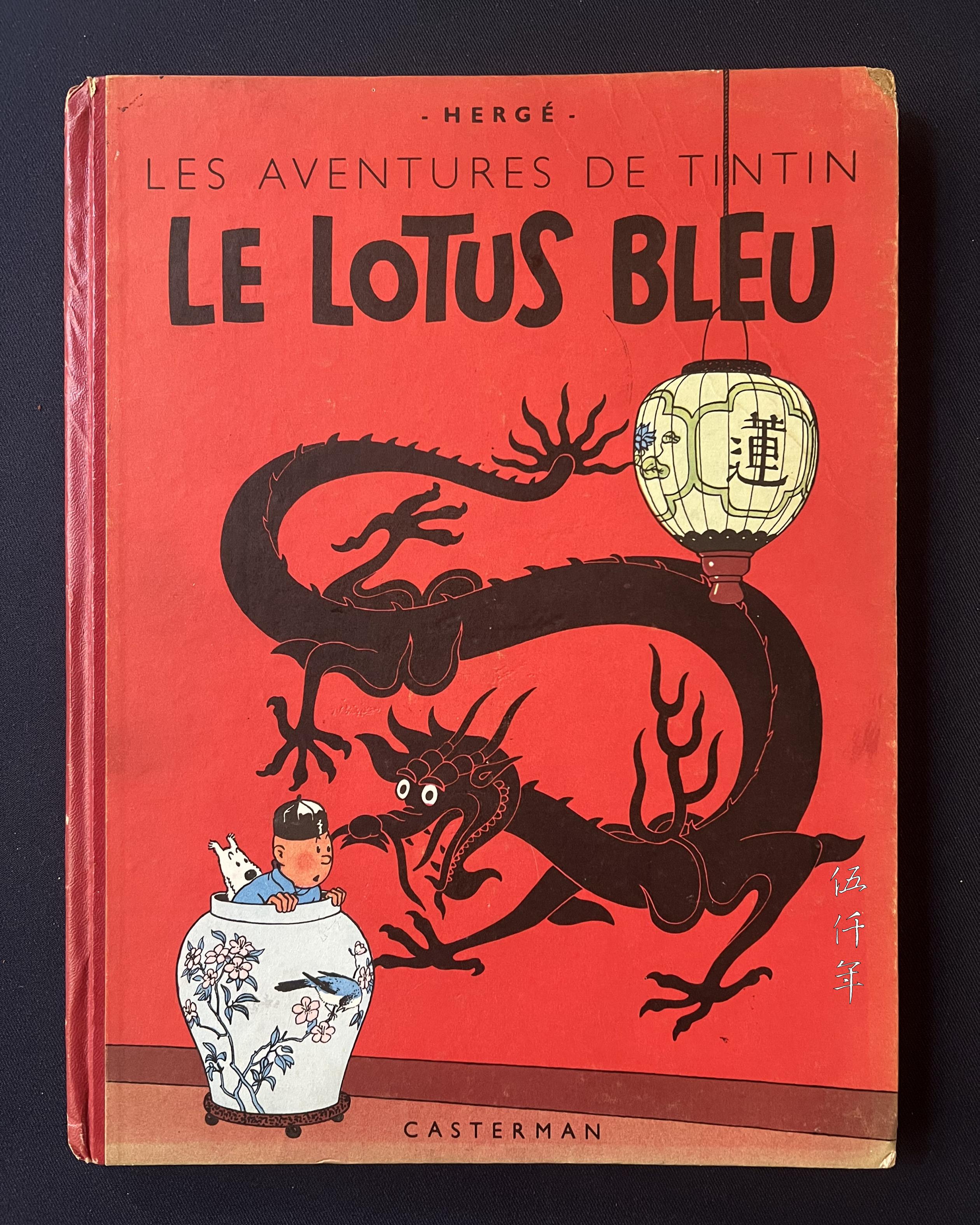
Front cover of Les Adventures de Tintin, Le Lotus Bleu. By Herge
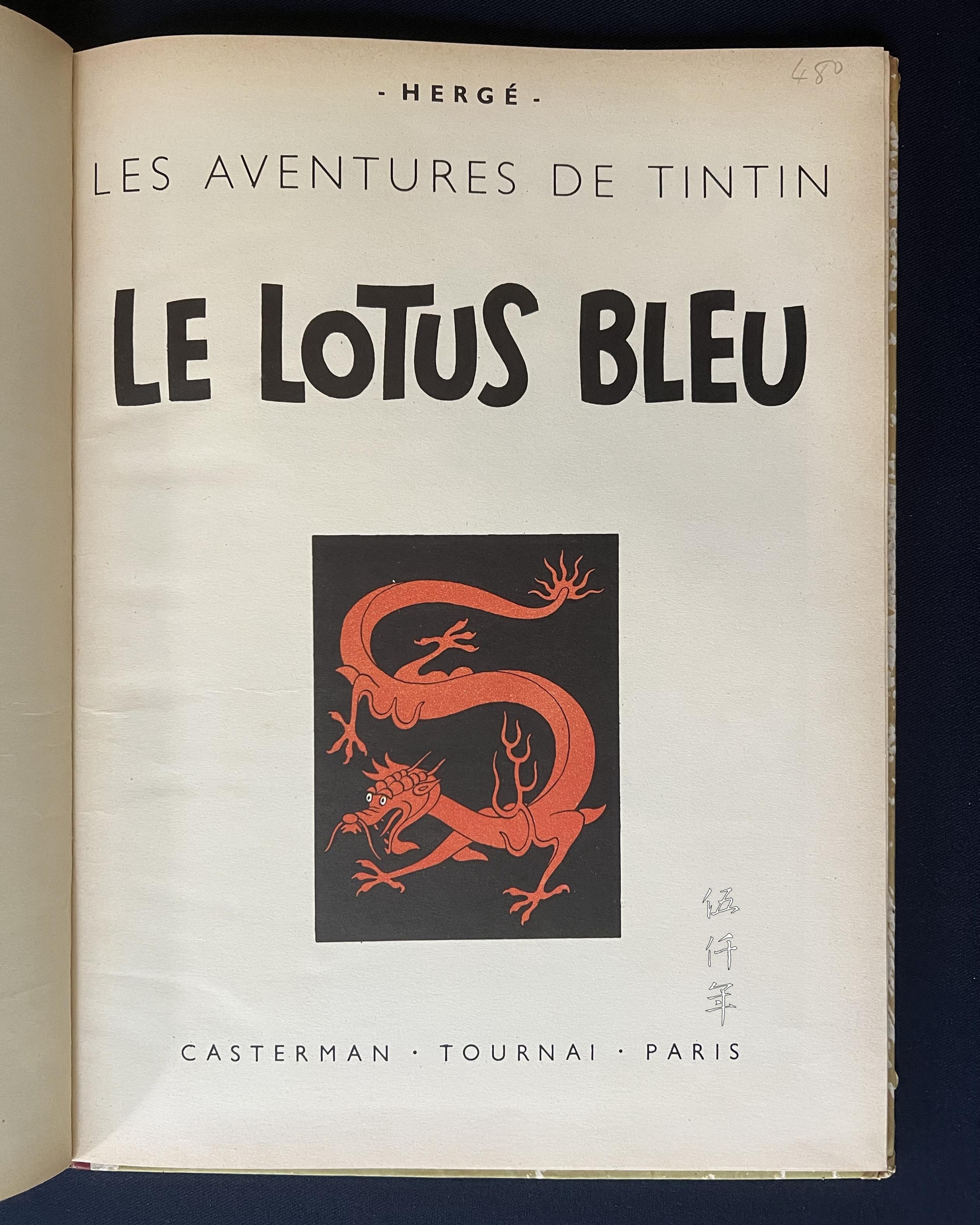
Title page of Les Adventures de Tintin, Le Lotus Bleu. By Herge
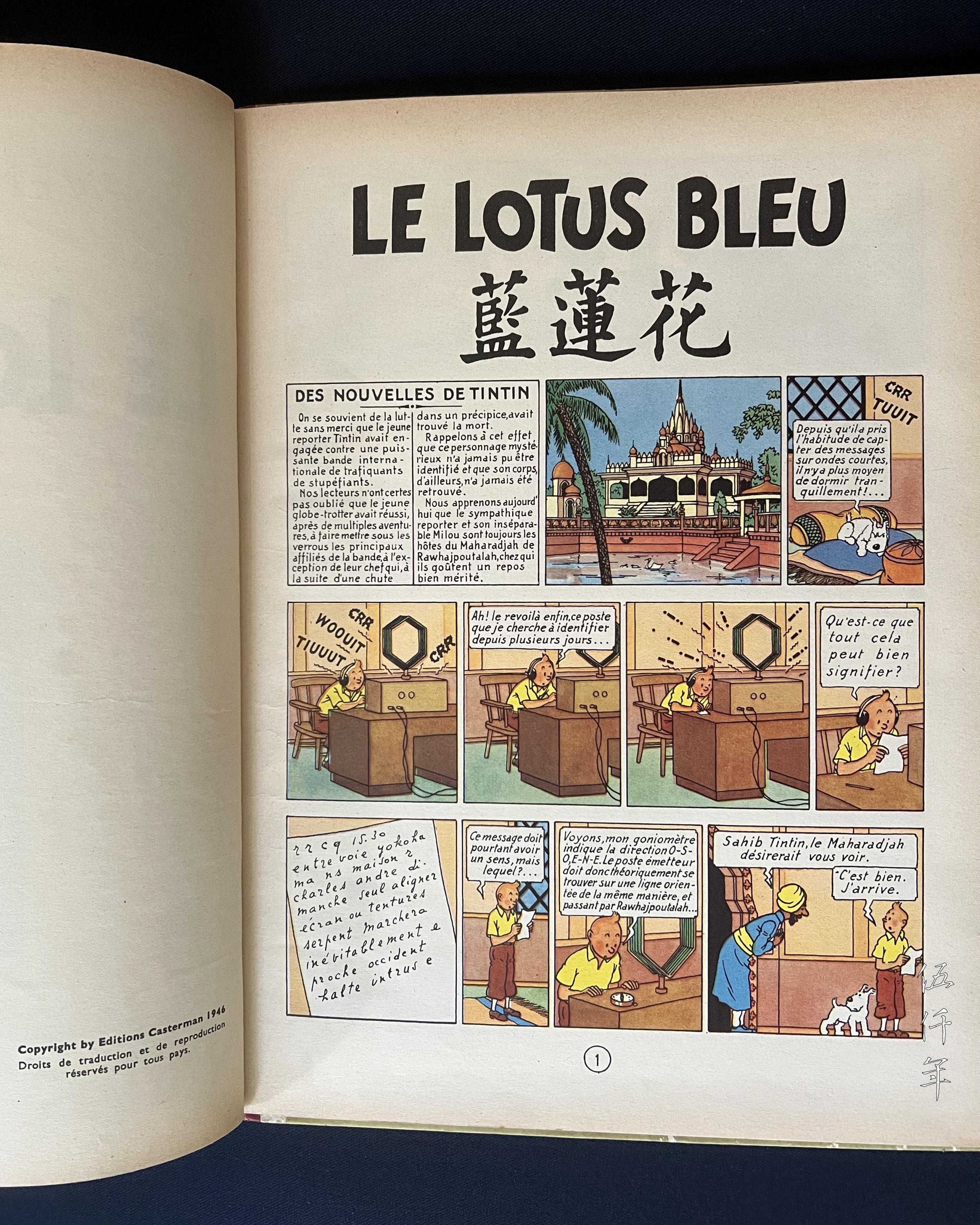
Inside page of Les Adventures de Tintin, Le Lotus Bleu. By Herge
(171) Georges Prosper Remi, nom de plume Herge 1907-1983 (喬治‧波斯貝勒米(艾爾吉))
(171-1) Les Adventures de Tintin, Le Lotus Bleu. Paris: Casterman, 1946. The first colour edition.
(172) Senator William Fife Knowland 1908-1974 (威廉‧諾蘭參議員)
(172-1) Typed letter by W. F. Knowland to Rabbi Edgar Magnin (1890-1984), American spiritual leader of Wilshire Boulevard Temple, dated 4 January 1950.
(172-2) Typed letter by W. F. Knowland to Rabbi Edgar Magnin (1890-1984), American spiritual leader of Wilshire Boulevard Temple, dated 4 April 1950.
(173) Ambassador Patrick Pichi Sun 1908-1986 (孫碧奇大使)
(173-1) Recollections of a Floating Life. Philippines: The Phoenix Press, 1972. First edition. Inscribed by the author to K. R. Richardson, dated 1976.
(174) Na Chih-liang 1908-1998 (那志良)
(174-1) The Emperor's Procession, text by Na Chih-liang, Color Photography by William Kohler. Taipei: The National Palace Museum, 1970. Inscribed by the author, dated 16 April 1970.
(175) Senator Barry Morris Goldwater 1909-1998 (高華德參議員)
(175-1) Portrait of Barry M. Goldwater, signed by himself.
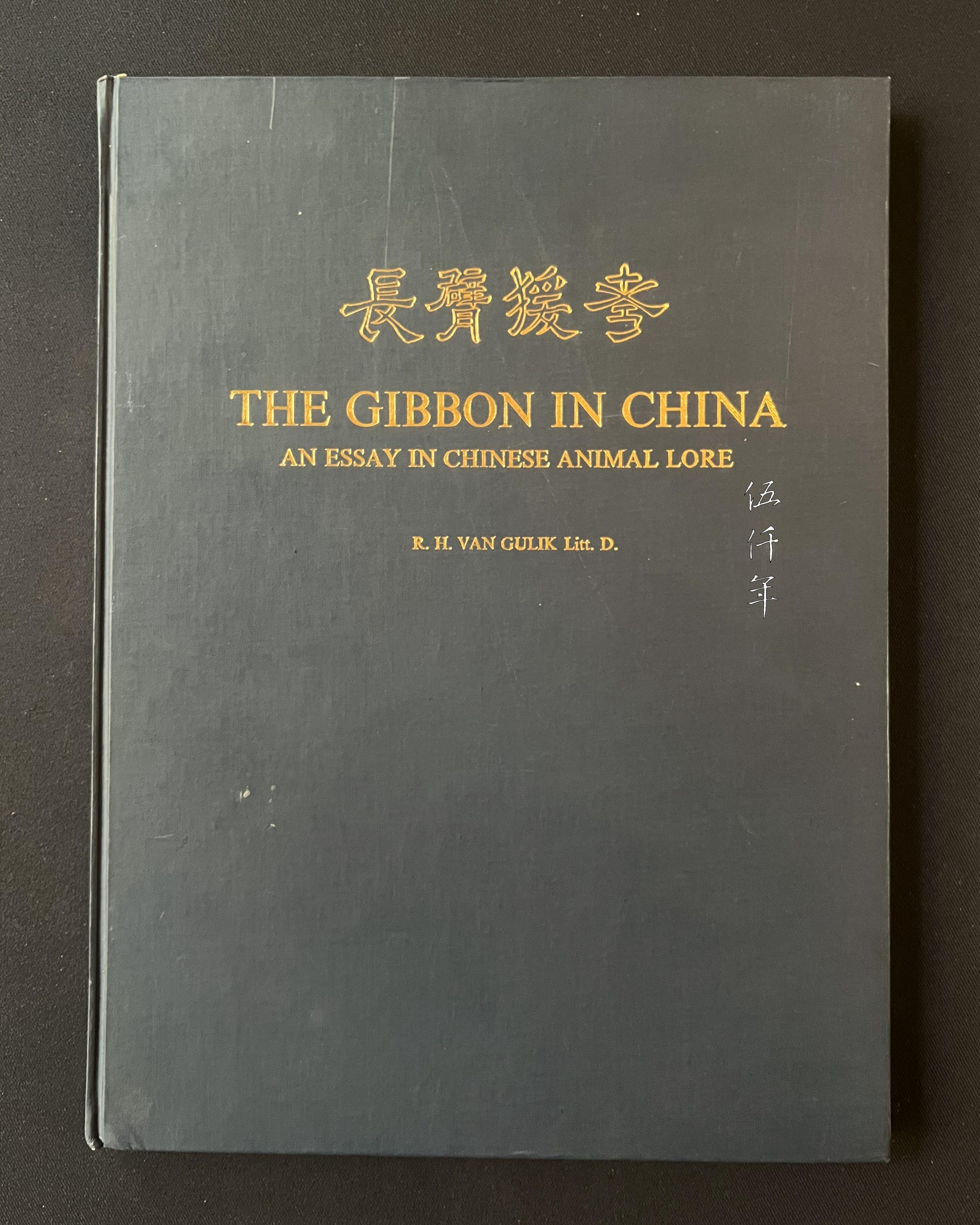
Front cover of The Gibbon in China, An Essay in Chinese Animal Lore. By Robert Hans van Gulik
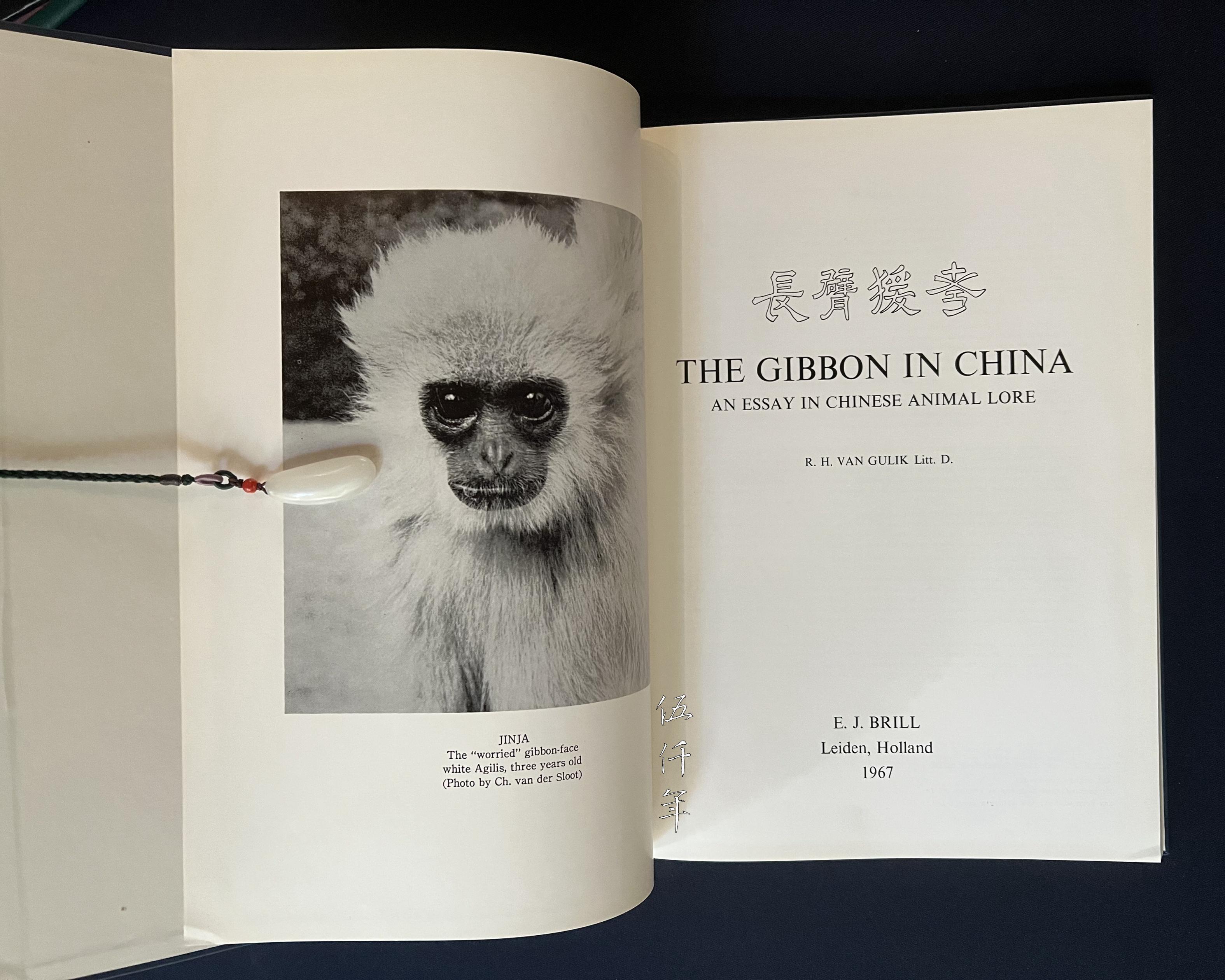
Title page of The Gibbon in China, An Essay in Chinese Animal Lore. By Robert Hans van Gulik
Back of The Gibbon in China, An Essay in Chinese Animal Lore. By Robert Hans van Gulik
(176) Robert Hans van Gulik 1910 – 1967 (高羅佩)
(176-1) Letter by R. H. van Gulik to Charles Vincent Emerson Starrett (1886-1974), Canadian-born American writer and bibliophile, written in Tokyo, dated 30 September 1950.
(176-2) Letter by R. H. van Gulik to Charles Vincent Emerson Starrett (1886-1974), Canadian-born American writer and bibliophile, written in Tokyo, dated 30 January 1951.
(176-3) Hanging scroll of landscape painting in oriental style by R. H. Van Gulik, with original wooden box, dated Spring 1939.
(176-4) The Gibbon in China, An Essay in Chinese Animal Lore. Leiden: E. J. Brill, 1967. First edition.
(176-5) The Van Gulik Collection of Fine Chinese, Japanese, Tibetan Paintings and Calligraphy; Oriental Ceramics and Works of Art, including a Fine Collection of Rhinoceros Horn Libation Cups and Jades. Wednesday 7 December 1983. Christie's Amsterdam.
(177) Paul K. T. Sih 1910-1978 (薛光前)
(177-1) From Confucius to Christ. New York: Sheed & Ward, Inc., 1952. First edition. Inscribed in English and Chinese by the author in New Jersey to Madeline Bisson, dated 16 April 1953.
(177-2) Decision for China: Communism or Christianity. Chicago: Henry Regnery Company, 1959. First edition. Inscribed by the author in New York to John N. Hart, dated 26 January 1960.
(178) Liang Tsai-ping 1910-2000 (梁在平)
(178-1) Chinese Musical Instruments and Pictures. Taipei: Chinese Classical Music Federation, 1970. Inscribed by the author to Deputy Minister Shen Chien-hung, dated 11 December 1970.
(179) Minister Kwoh -Ting Li 1910-2001 (李國鼎部長)
(179-1) The Experience of Dynamic Economic Growth on Taiwan. Taipei, New York: Mei Ya Publications Inc., 1976. Second printing. Inscribed by the author in Taipei to Roy A. Matthews, dated 4 December 1980.
(180) Consul Huan-lai Cho 1912-1945 (卓還來領事)
(180-1) Les Origines du Conflit Franco Chinois, a propos du Tonkin Justus'en 1883. Saigon : Imprimerie Albert Portail, 1938. Second edition. Seal of the author impressed on title page.
(181) Alfred Elton van Vogt 1912-2000 (范沃格特)
(181-1) The Violent Man. New York: Farrer, Straus and Cudahy, 1962. First edition. Inscribed by the author to Ruby and Jim, inserted a four page letter to Jim from his father.
Front cover of Catalogue of the Exhibition of Chinese Calligraphy and Painting in the Collection of John M. Crawford
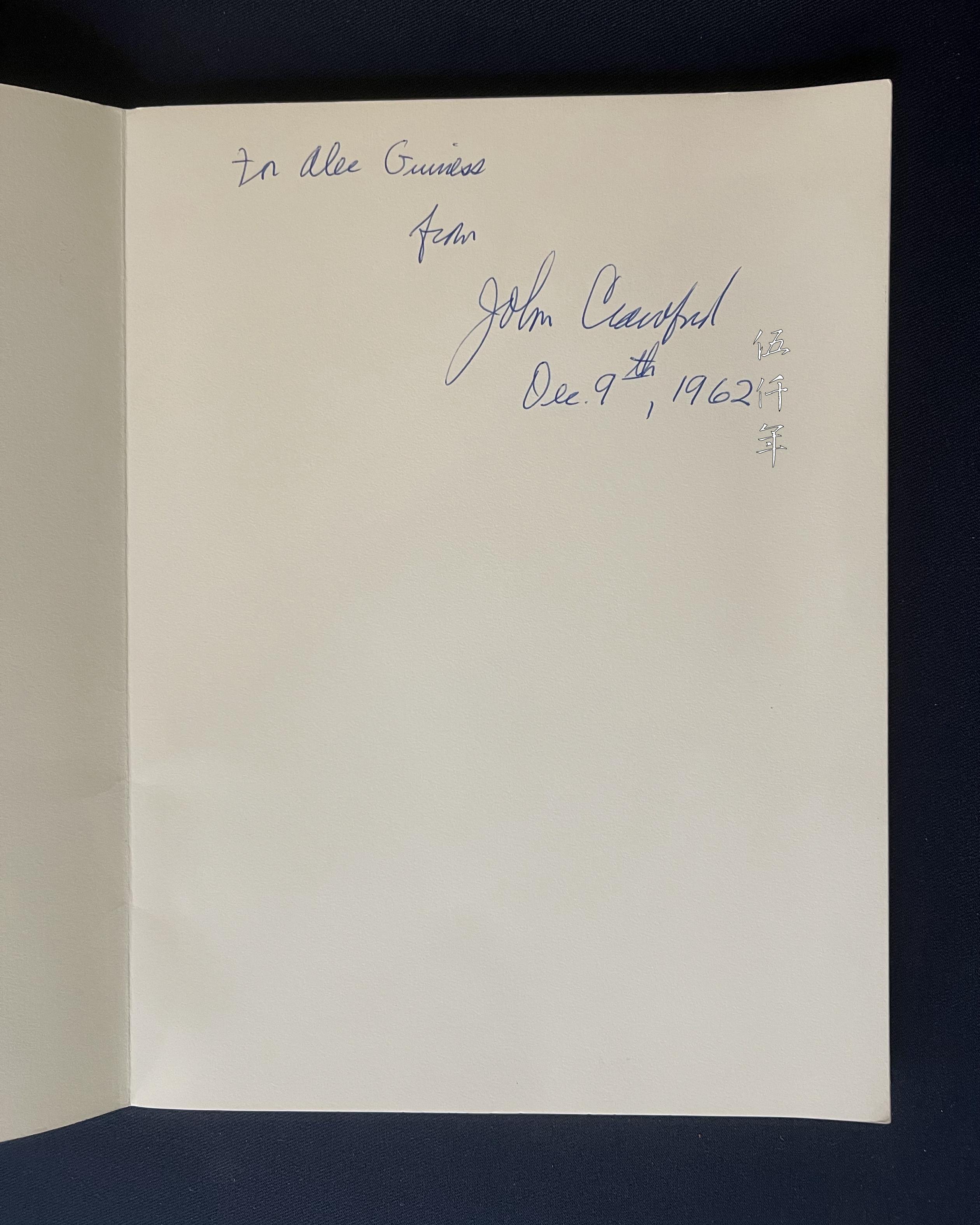
Inside page of Catalogue of the Exhibition of Chinese Calligraphy and Painting in the Collection of John M. Crawford
(182) John M Crawford Jr. 1913-1988 (顧洛阜)
(182-1) Catalogue of the Exhibition of Chinese Calligraphy and Painting in the Collection of John M Crawford, Jr. New York: The Pierpont Morgan Library, 1962. Inscribed by J. M. Crawford to Alec Guinness, dated 9 October 1962.
(183) Richard Tregaskis 1916-1973 (理查德‧特雷加斯基斯)
(183-1) Last Plane to Shanghai. New York: The Bobbs-Merrill Company, Inc., 1961. First edition. Inscribed by the author to Claire Booth Luce (1903-1987), American writer and politician, dated Christmas 1971.
(184) General Chiang Wei-kuo 1916-1997 (蔣緯國將軍)
(184-1) Mellow Offensive: A Global Strategy to Restore Human Order. Taipei: Society for Strategic Studies, Republic of China, 31 July 1989. Inscribed by the author to Ray, dated 8 September 1989.
(185) Lyle Hugh Munson 1918-1973 (萊爾‧蒙森)
(185-1) Who Will Volunteer? The Quemoy Story in Pictures. New York: The Bookmailer, Inc., 1961. First edition. Inscribed by L. H. Munson to Emmanuel Lobato (1919-2006), Lieutenant Commander of United States Navy.
(186) Lin Hai-yin 1918-2001 (林海音)
(186-1) Green Seaweed and Salted Eggs, translated by Nancy Chang Ing. Taipei: The Heritage Press, 1963. First edition. Inscribed by the author in Chinese and English, dated 9 August 1970.
(187) Flight Lieutenant Harold John Alfred Wright 1919-1991 (空軍上尉哈羅德‧萊特)
(187-1) Taiwan-Red China-and World Conscience. Brisbane: Citizens for Freedom, circa 1971. Inserted two typed letters from the author, dated 20 October 1971 and 26 October 1971 respectively.
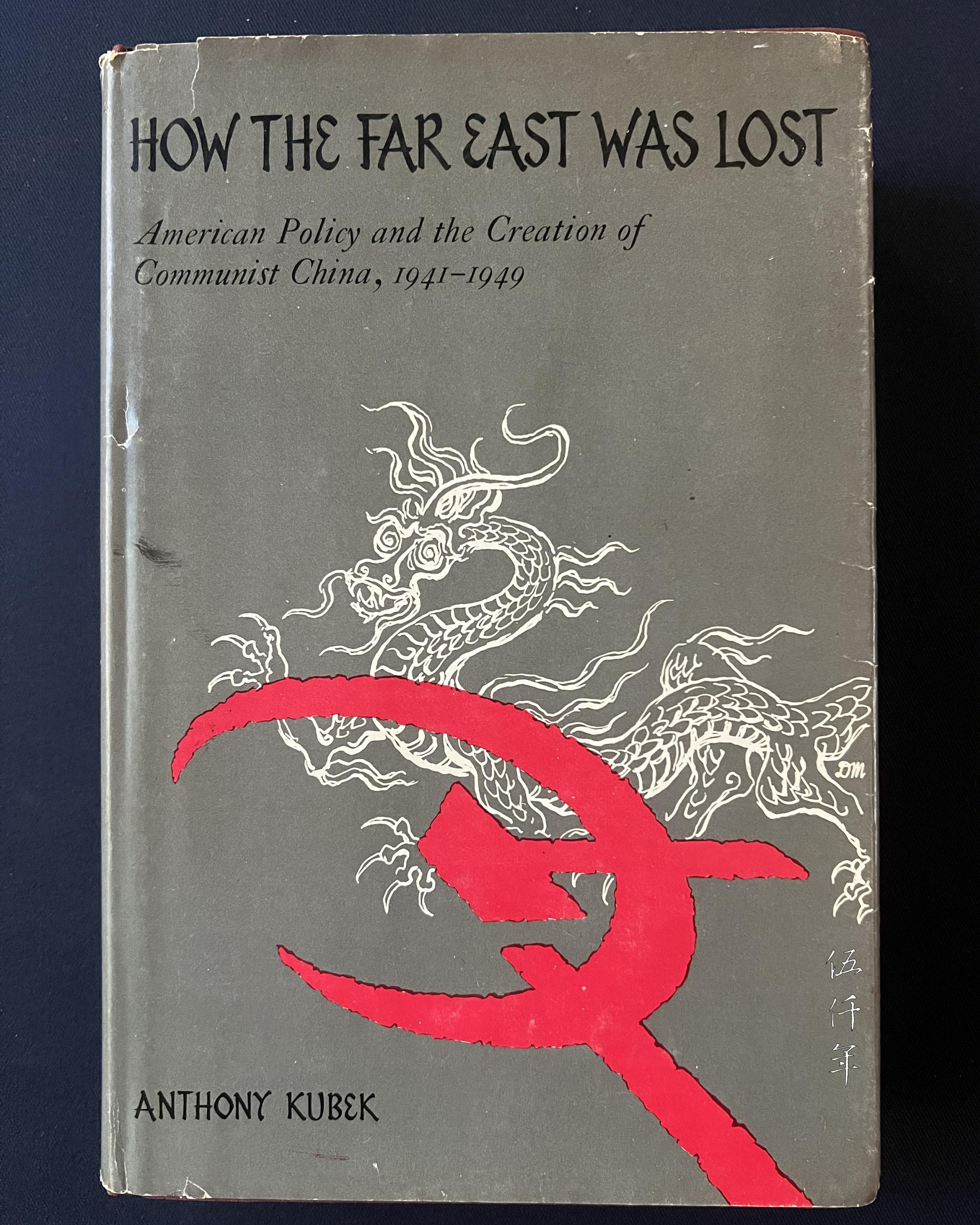
Front cover of How the Far East was Lost, American Policy and the Creation of Communist China, 1941-1949. By Anthony Kubek
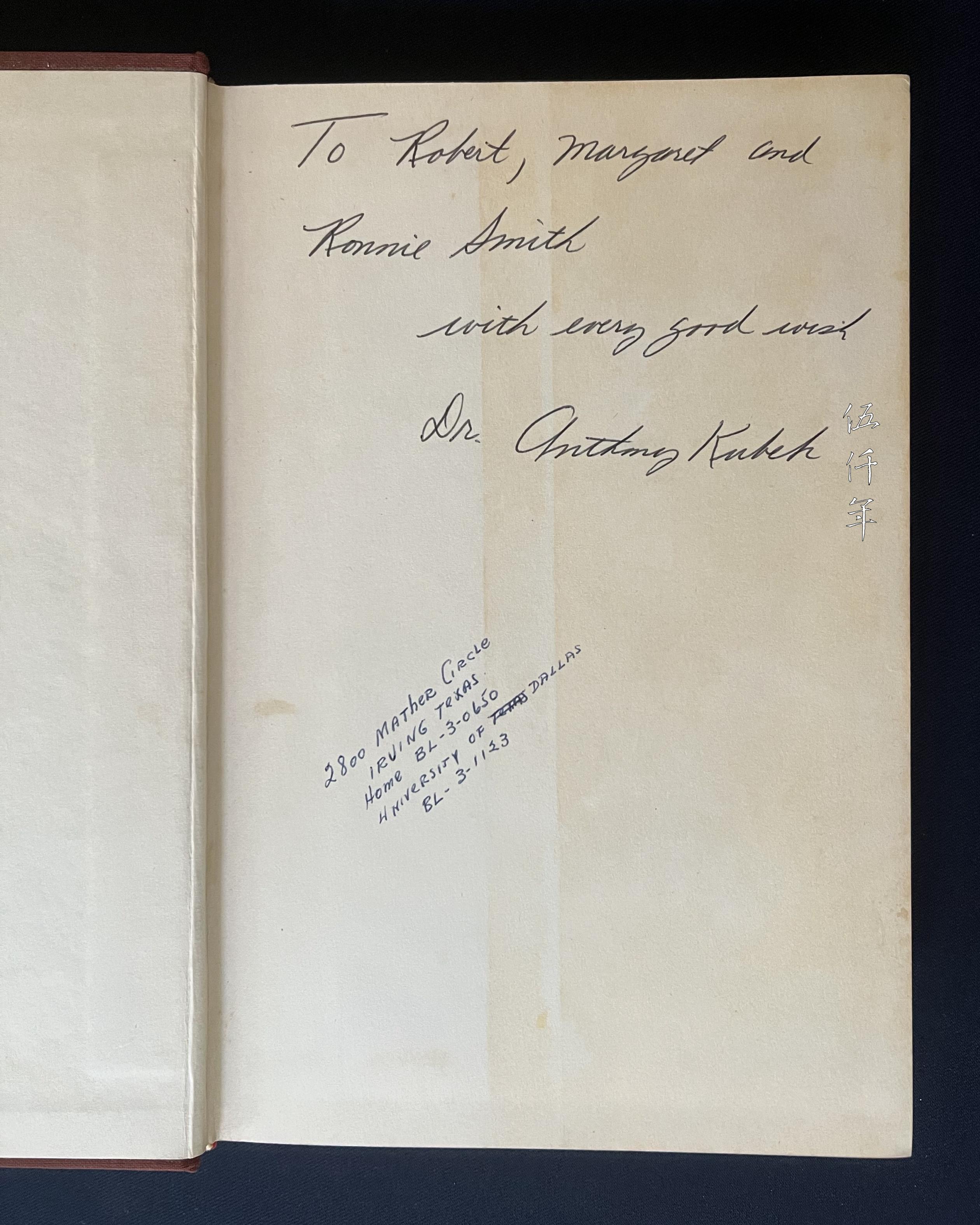
Inside page of How the Far East was Lost, American Policy and the Creation of Communist China, 1941-1949. By Anthony Kubek
(188) Anthony Kubek 1920-2003 (柯貝克)
(188-1) How the Far East was Lost, American Policy and the Creation of Communist China, 1941-1949. Chicago: Henry Regnery Company, 1963. First edition. Inscribed by the author to Robert, Margaret and Ronnie Smith.
(189) Lo Kung Yuan b. 1920 (羅公遠)
(189-1) Nowhere is My Home. Beacon Press, 1965. First edition. Inscribed by the author in English and Chinese to Richard Gentry, dated 20 January 1967. Inserted facsimile typed reply letter by Pearl S. Buck to the author.
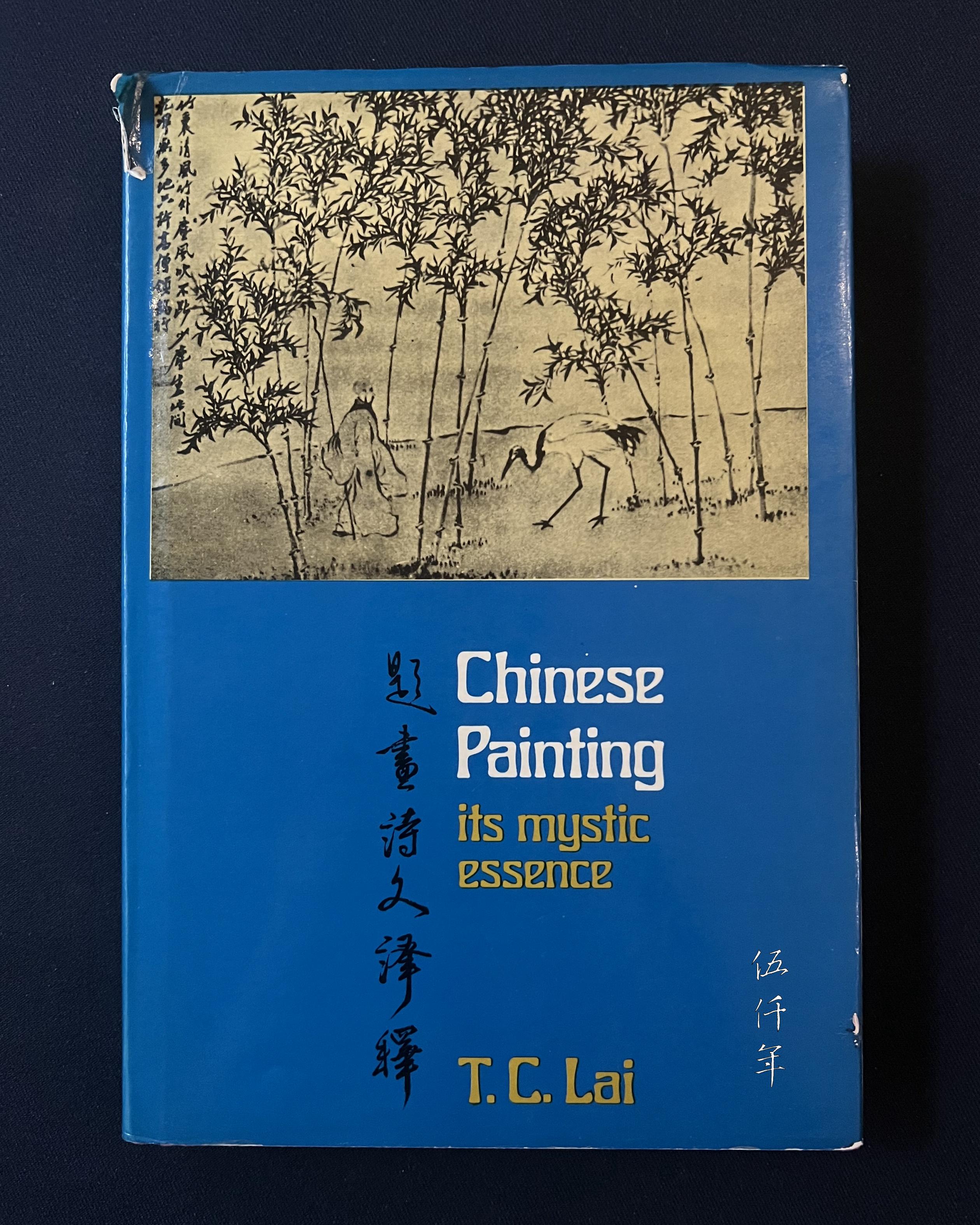
Front cover Chinese Painting, Its Mystic Essence. By Mr. T. C. Lai
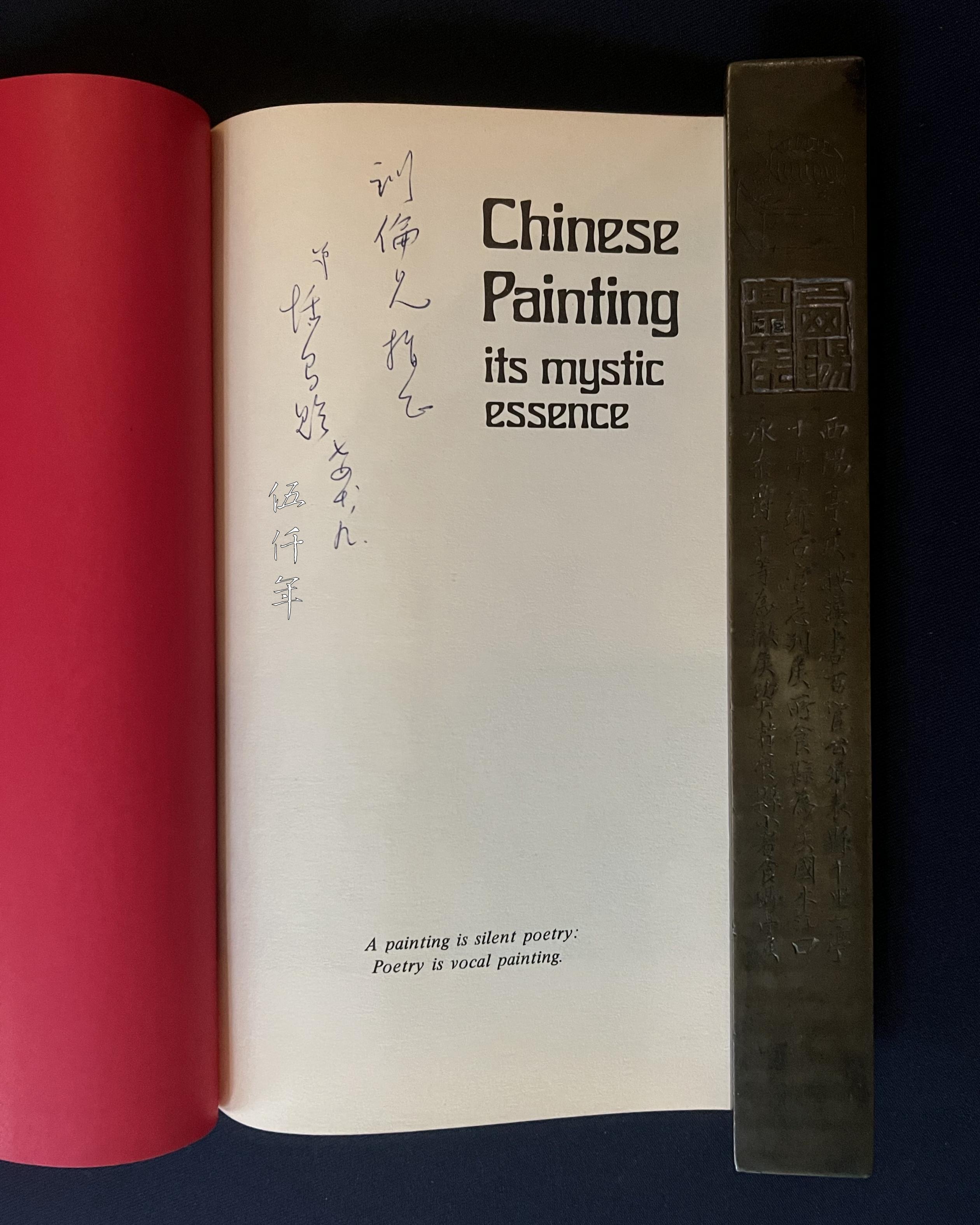
Back of Chinese Painting, Its Mystic Essence. By Mr. T. C. Lai
(190) Mr. T. C. Lai 1921-2022 (賴恬昌先生)
(190-1) A Scholar in Imperial China. Hong Kong: Kelly & Walsh Ltd., 1970. Inscribed in English by the author to Mr. Soong Hsün-leng, writer and tz'u poet, dated 12 June 1973.
(190-2) Chinese Calligraphy, Its Mystic Beauty. Hong Kong: Swindon Book Company, 1973. Inscribed in Chinese by the author to Mr. Soong Hsün-leng, writer and tz'u poet, dated 19 May 1974.
(190-3) Ch’i Pai Shih. Hong Kong: Swindon Book Company, 1973. First edition. Inscribed in English by the author to Mr. Soong Hsün-leng, writer and tz'u poet, dated 28 June 1973.
(190-4) Chinese Painting, Its Mystic Essence. Hong Kong: Swindon Book Company, 1974. First edition. Inscribed in Chinese by the author to Mr. Soong Hsün-leng, writer and tz'u poet, dated 9 October 1974.
(190-5) Chinese Seals. Washington: University of Washington Press, 1976. First edition. Inscribed in Chinese by the author to Mr. Soong Hsün-leng (1910-2010), writer and tz'u poet, dated 14 September 1976.
(190-6) Noble Fragrance, Chinese Flowers and Trees. Hong Kong: Swindon Book Company, 1977. First edition. Inscribed in Chinese by the author to Mr. Soong Hsün-leng (1910-2010), writer and tz'u poet.
(190-7) Rhapsodic Essays from the Chinese, by Monica Lai and T. C. Lai. Hong Kong: Kelly & Walsh Ltd., 1979. Inscribed in Chinese by T. C. Lai to Mr. Soong Hsün-leng, writer and tz'u poet, dated 31 July 1979.
(190-8) Understanding Chinese Painting. Hong Kong: Kelly & Walsh, 1980. First edition. Inscribed in Chinese by the author to Mr. Soong Hsün-leng (1910-2010), writer and tz'u poet, dated 19 February 1981.
(191) Marvin Liebman 1923-1997 (馬文‧利布曼)
(191-1) Coming Out Conservative, An Autobiography. San Francisco: Chronicle Books, 1992. First edition. Inscribed by the author to Richard.
Front cover of Diary, 3 Oct. 1966 to 11 Sept. 1967. By Prof. David Hawkes
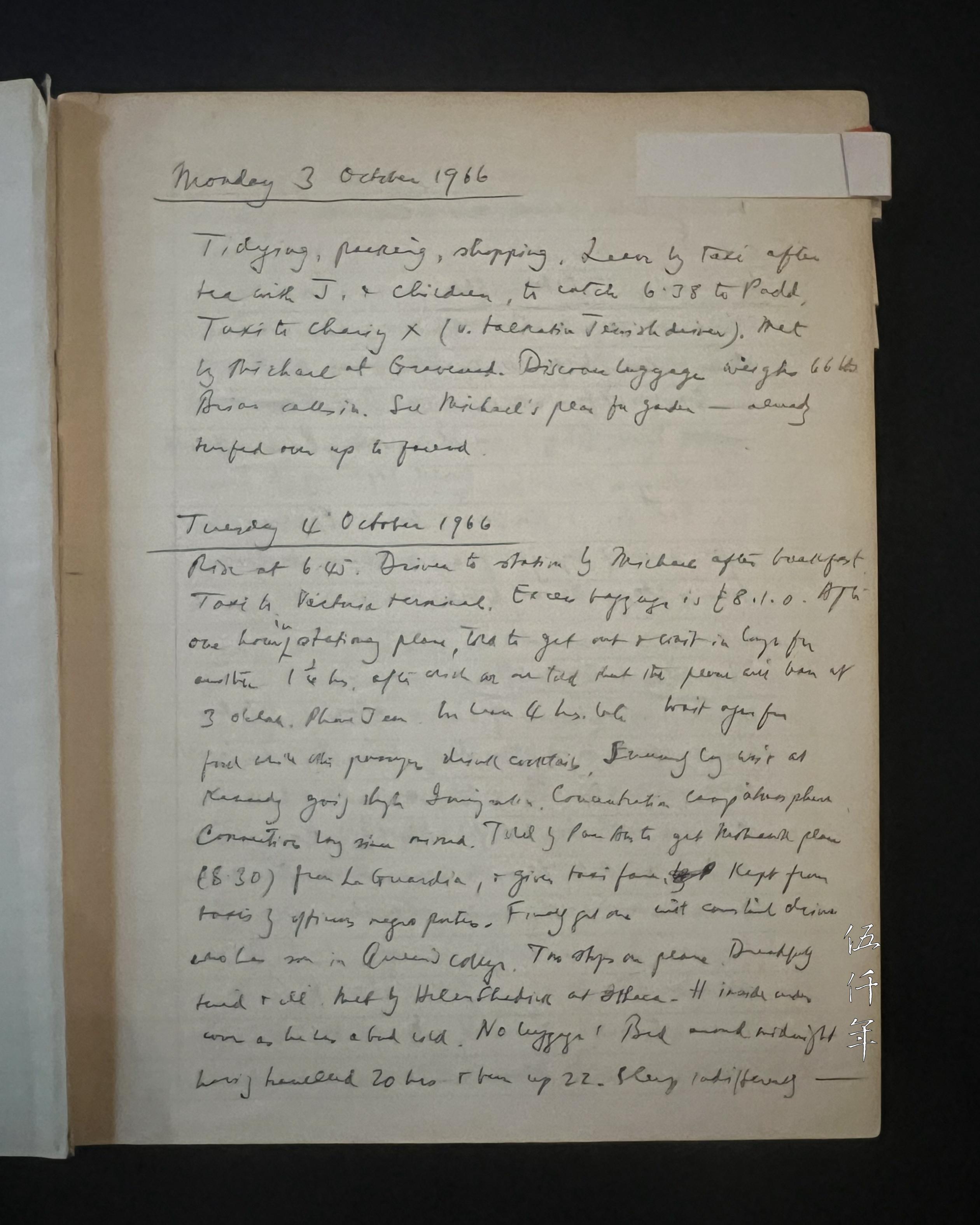
Inside page of Diary, 3 Oct. 1966 to 11 Sept. 1967. By Prof. David Hawkes
(192) Prof. David Hawkes 1923 – 2009 (霍克斯教授)
(192-1) Chinese Classical, Modern and Humane. An Inaugural Lecture delivered before the University of Oxford on 25 May 1961 by David Hawkes. Oxford: At The Clarendon Press, 1961. Inscribed in Cambridge by the author, dated 1961.
Items 192-2 to 192-4 were generously gifted by Prof. John Minford.
(192-2) Seventy-five letters by Prof. D. Hawkes to Prof. J. Minford, a facsimile letter to Dr. Fan, three postcards from Prof. D. Hawkes to Prof. J. Minford, written between 1970 and 1991.
(192-3) A volume of diary from Monday 3 October 1966 to Monday 11 September 1967, inserted two photographs of Prof. D. Hawkes.
(192-4) Marriage Certificate of Prof. D. Hawkes and Ms. Jean, issued in Peking on 5 May 1950.
(193) Secretary-General Chen Chi-lu 1923-2014 (陳奇祿秘書長)
(193-1) People and Culture. Taipei: Southern Materials Centre, Inc., 1987. Inscribed by the author to Frederick Kuthe, dated 9 February 1988.
(194) Fang Lizhi 1936-2012 (方勵之)
(194-1) Bringing Down the Great Wall: Writings on Science, Culture and Democracy in China. New York: Alfred A. Knoff, 1991. Signed by the author at China Institute in America, dated 21 November 1991.
(195) Prof. Pierre Ryckmans, nom de plume Simon Leys 1935-2014 (李克曼教授)
(195-1) The Angel and the Octopus. Sydney: Duffy & Snellgrove, 1999. Inscribed by the author in French to Rene Servoise, written in Canberra, dated April 1999.
(195-2) Chinese Shadows. New York: The Viking Press, 1977. First English edition.
Items 195-3 to 195-5 were generously gifted by Prof. Geremie Barme
(195-3) Letter by Prof. P. Ryckmans to Prof. Geremie Barme, sinologist and student of Prof. P. Ryckmans, written in Canberra, dated 11 May 2011. Attached note by Prof. G. Barme to Soong Shu Kong, dated 9 April 2018.
Front of postcard from Prof. Pierre Ryckmans to Prof. Geremie Barme
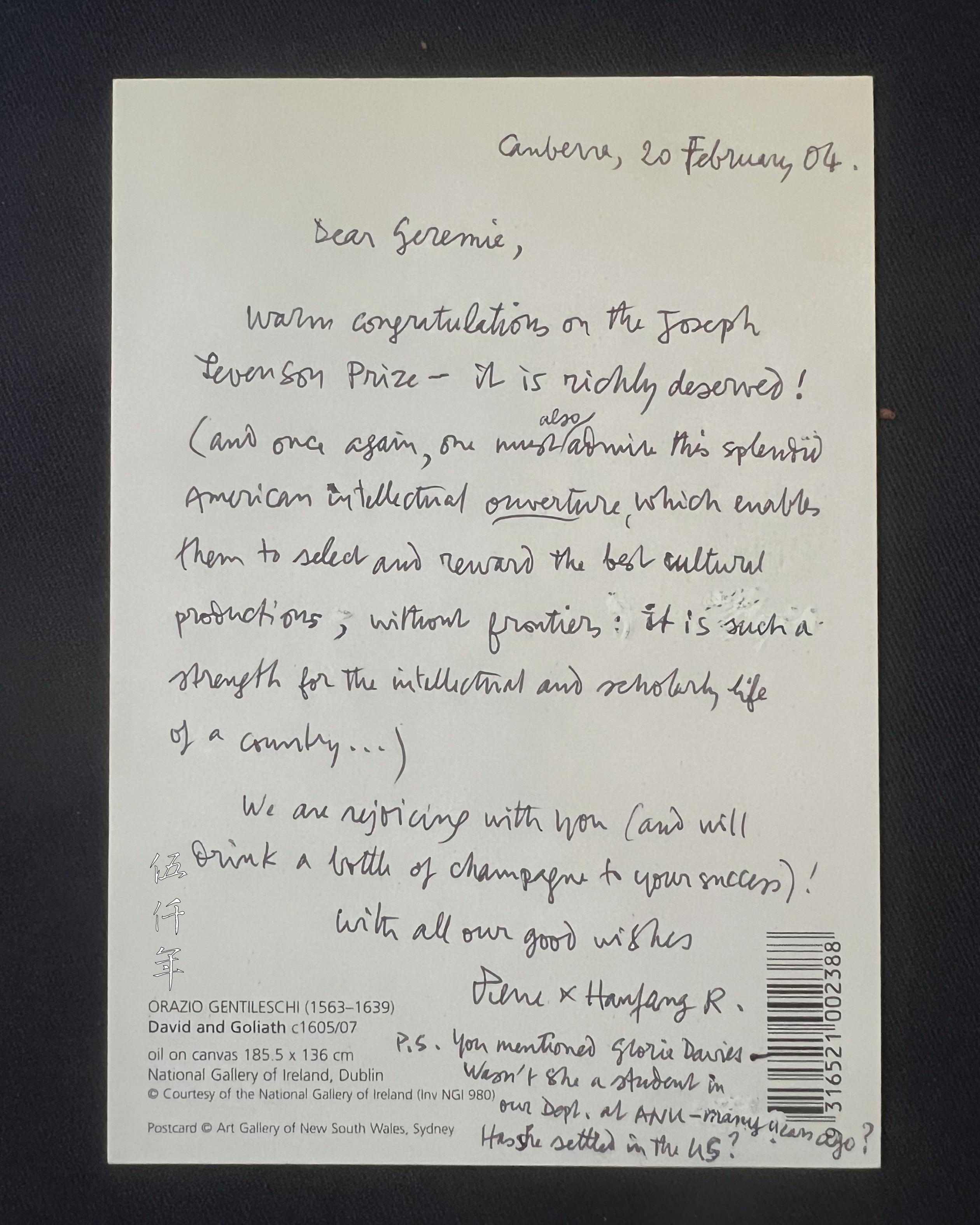
Front of postcard from Prof. Pierre Ryckmans to Prof. Geremie Barme
(195-4) Postcard from Prof. P. Ryckmans to Prof. G. Barme, sinologist and student of Prof. P. Ryckmans, written in Canberra, dated 20 February 2004.
(195-5) Postcard from Prof. P. Ryckmans to Prof. G. Barme, sinologist and student of Prof. P. Ryckmans, written in Canberra, dated 30 May 2008.
Items 195-6 to 195-81 were generously gifted by Mrs. Hanfang Chang Ryckmans.
Photographs
(195-6) Photograph of Prof. P. Ryckmans on a sailing boat, February 1987.
(195-7) Two invitation cards for a Chinese painting exhibition at the Art Gallery of New South Wales to celebrate the 80th birthday of Prof. P. Ryckmans.
(195-8) Two memorial cards with different texts used during the memorial service of Prof. P. Ryckmans, produced in August 2014.
Calligrad Paintings
(195-9) Two practice sheets of regular script calligraphy by Prof. P. Ryckmans.
(195-10) Two practice sheets of running script calligraphy by Prof. P. Ryckmans.
(195-11) Personal seal with the words: “There is Peace Every Year”, carved by Prof. P. Ryckmans.
Watercolour of Man Fishing. By Prof. Pierre Ryckmans, 1985
(195-12) Watercolour of himself fishing by Prof. P. Ryckmans, painted in 1985 at the age of fifty.
(195-13) Crayon figure painted for wife Mrs. Hanfang Ryckmans by Prof. P. Ryckmans, dated Christmas 2003.
(195-14) A set of four cartoon drawings by Prof. P. Ryckmans, dated 1949-50.
(195-15) Hand-drawn map of Ankhor Wat by Prof. P. Ryckmans.
(195-16) Two printed greeting cards with illustrations by Prof. P. Ryckmans.
(195-17) Coloured copy of a cartoon by Prof. P. Ryckmans.
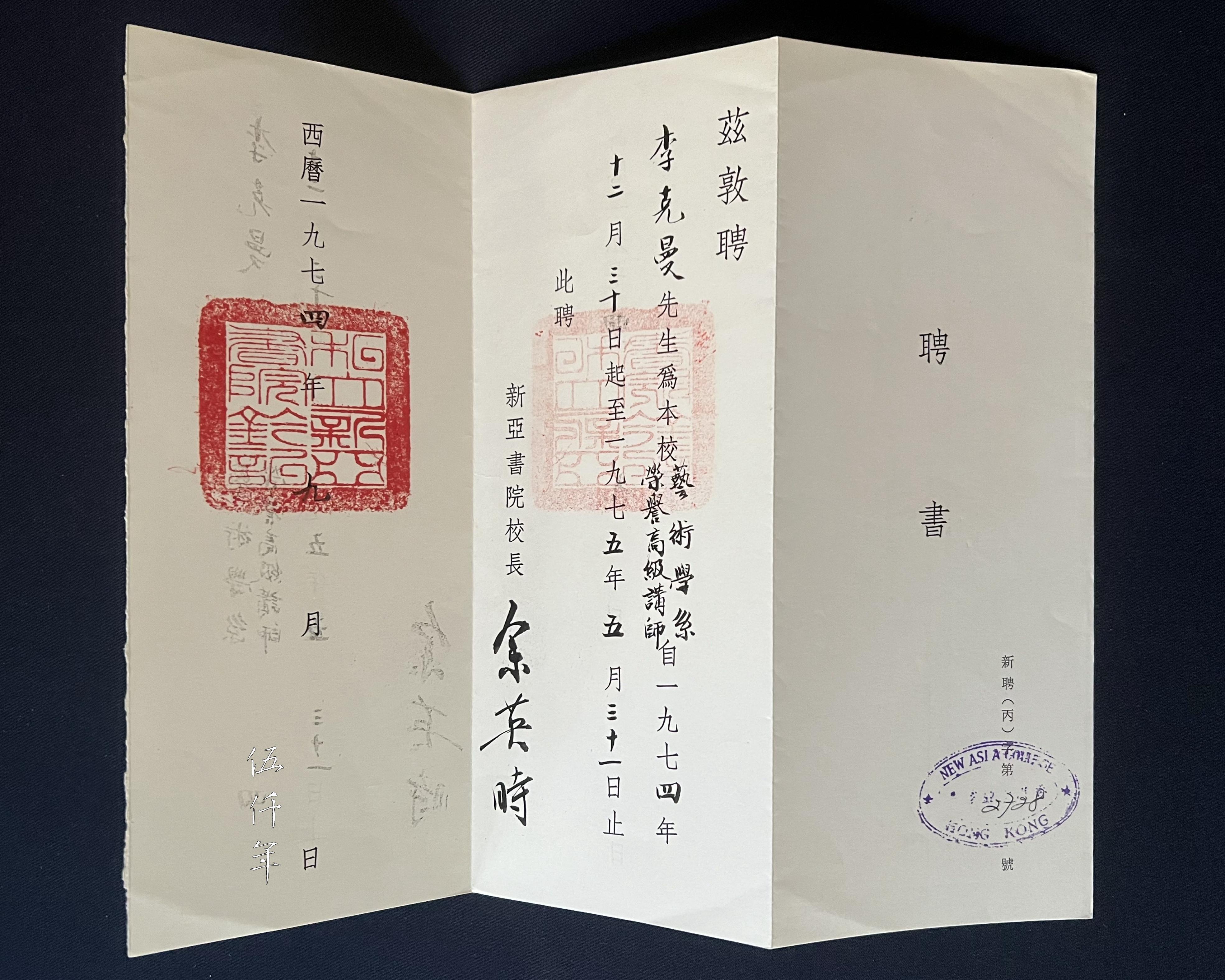
Certificate to appoint Prof. Pierre Ryckmans as honorary senior lecturer at the Department of Fine Arts of New Asia College. Signed by Prof. Yu Ying-shih
(195-18) Certificate to appoint Prof. P. Ryckmans as honorary senior lecturer at the Department of Fine Arts of New Asia College, signed by Prof. Yu Ying-shih, appointment period from 30 December 1974 to 31 May 1975.
Letters by Prof. P. Ryckmans
(195-19) Facsimile letter by Prof. P. Ryckmans to Dr. Han, written in Canberra, dated 29 June 1987.
(195-20) Facsimile letter by Prof. P. Ryckmans to Dr. Richard Rigby, dated 22 July 1987.
(195-21) Letter by Prof. Prof. P. Ryckmans to publisher Jacaranda Wiley, attention Shawn Casey or Mathew Howard, written in Canberra, dated 2 April 1997.
Manuscripts
(195-22) Two notebooks used by Prof. P. Ryckmans for Chinese paleography. The first notebook has forty nine pages of writings in French and Chinese. The second notebook has twenty three pages of writings in French and Chinese, inserted are a piece of paper inscribed with French and Chinese, a page of writing in French and Chinese, two pages from Chinese paleography class, a typed letter by Ezra F. Vogel (1930-2020) to Prof. P. Ryckmans, a New Year greeting card from Chiang Yee enclosed with a photograph, and a handwritten tz'u poem by Prof. Jao Tsung-i (1917-2018).
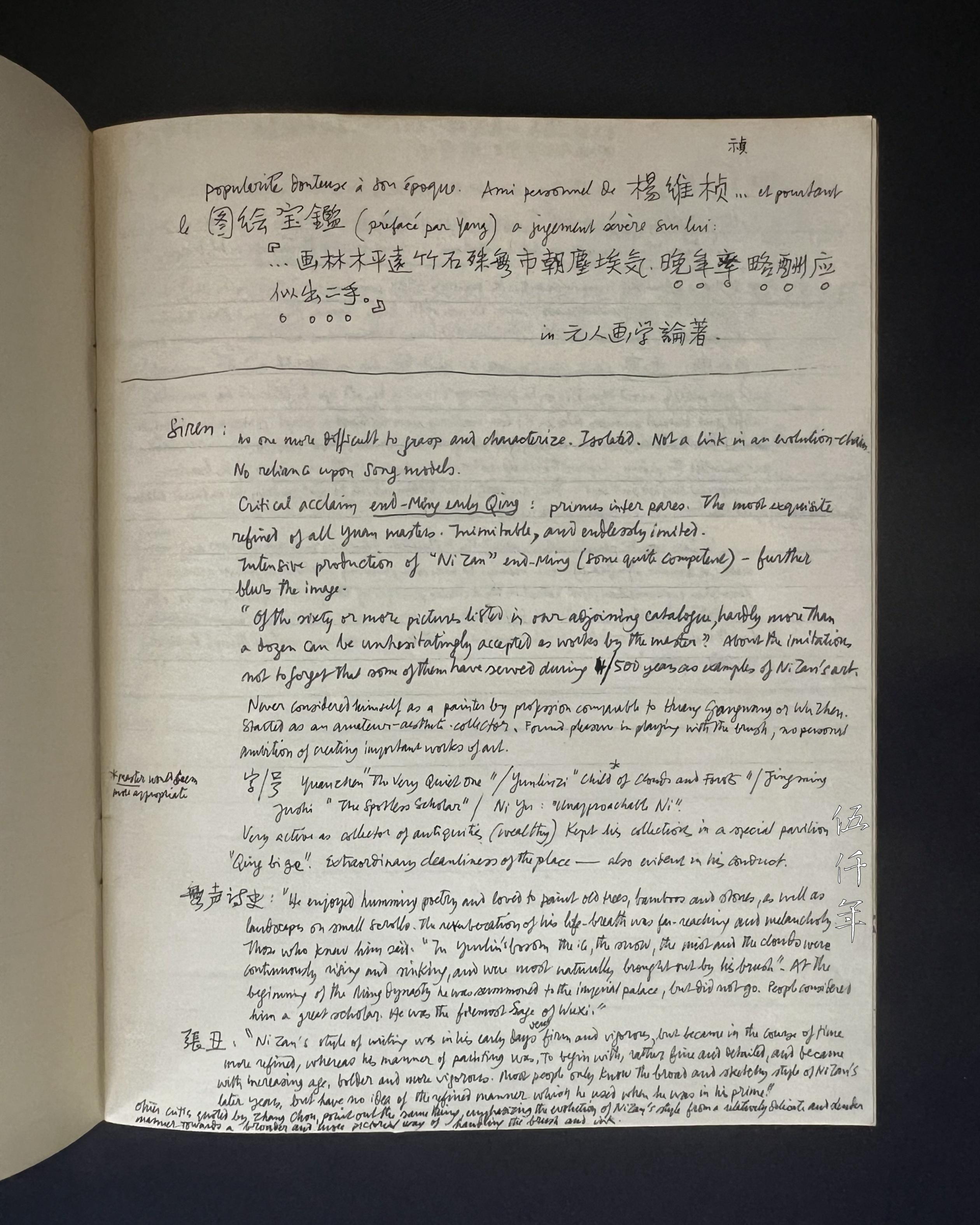
A page from one of the three notebooks used by Prof. Pierre Ryckmans, between spring and summer of 2014 before he passed away
(195-23) Three notebooks used by Prof. P. Ryckmans between spring and summer of 2014 before he passed away. The first notebook has eight pages of writings in French and Chinese on Classical Chinese literature. The second notebook has eleven pages of writings in English on the Bible and the Church. The third notebook has fifteen pages of writings in French, English and Chinese on Chinese literature and painting, another two cards, a sheet of writings and a photocopy of biographies of ancient Chinese artists inserted.
Works
(195-24) Comparisons of the Underlying Principles Between Chinese and Western Paintings and Their Contact Processes, published in University Life Volume 9 Issue 4, dated 5 July of the 52nd year of the Republic.
(195-25) Artistes Chinois Contemporains, Introduction by Prof. P. Ryckmans. Bruxelles, 12 November to 5 December 1965.
(195-26) Why I Translated Six Records of a Floating Life, by Prof. P. Ryckmans, published in Thought and Speech, Volume Five Issue One, dated 15 May 1967.
(195-27) Book review written in Chinese by Prof. P. Ryckmans on Art et sagesse en Chine: Mi Fou, by N. Vandier-Nicolas, three pages of photocopy and a reprint by The Chinese University of Hong Kong, 1969.
(195-28) The Analects of Confucius, translation and notes by Simon Leys. New York, London: W. W. Norton & Company, 1997. Inscribed by Mrs. Hanfang Ryckmans to Soong Shu Kong.
(195-29) La Mer Dans La Litterature Francaise: De Victor Hugo A Pierre Loti, compiled by Simon Leys. Pilon: 2003. Inscribed by Mrs. Hanfang Ryckmans, dated 19 March 2023.
(195-30) Ethique et esthethique: La lecon Chinoises, by Prof. P. Ryckmans, published in Magazine Litteraire, March 2004, three pages of photocopy.
(195-31) Incomplete one photocopy page of article in English by Prof. P. Ryckmans, published in The Diplomat Aug / Sept 2004.
(195-32) Les idees des autres, idiosyncratiquement compiles par Simon Leys. Pilon, 2005. Inscribed by Mrs. Hanfang Ryckmans to Soong Shu Kong, dated 19 March 2023.
(195-33) Fable d'Academe. College De'Pataphysique, attached an official letter dated 27 July 2017 and a handwritten letter from Thieri Foulc dated 9 December 2017.
(195-34) One photocopy page of article in French by Prof. P. Ryckmans for a column in a French magazine.
Files
(195-35) Analects / Jacaranda File
Contents:
Newspaper clippings, photocopies of newspaper articles, book reviews. Four letters by Prof. P. Ryckmans to Mathew Howard, Shawn Casey, Kate Nash, Susan Morris-Yates. Heat 9 Quarterly 1998.
(195-36) Prof. Yu Ying-shih File
Contents:
The first notebook has nine pages of writings in French on Anti-Intellectualism and Chinese Political Tradition by Prof. P. Ryckmans. The second notebook has thirty pages of writings in French and Chinese on the same subject by Prof. P. Ryckmans. The third notebook has twenty seven pages of writings in French and Chinese on the same subject by Prof. P. Ryckmans. Another four pages of writings in French on the same subject by Prof. P. Ryckmans.
(195-37) Boyer File
Contents:
Newspaper clippings, photocopies of newspaper clippings, book reviews. Letter by Milton Thom, two letters by Catrina Sibley, a letter by Marie V. Heaney, a letter by Tim Gaze, a letter by John W. Keany, a letter by Bruce Anderson, a letter by Janne, two letters by Moya Henderson. Reply by Prof. P. Ryckmans to Dino Bressan, letter by Prof. P. Ryckmans to Martin Krygier, one page of notes by Prof. P. Ryckmans.
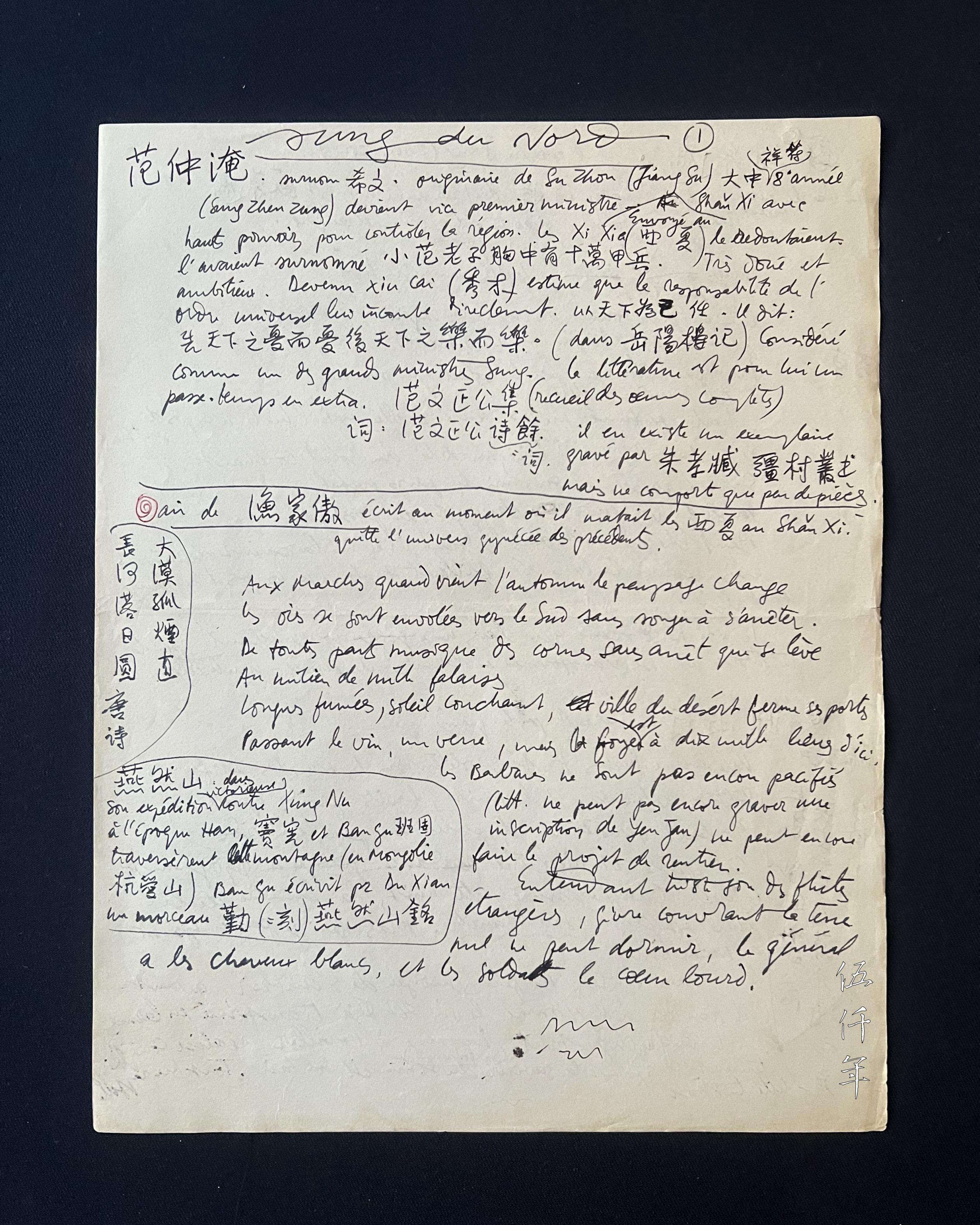
A page from a notebook on the Tz'u Lyrics from the T'ang Dynasty, Five Dynasties and Sung Dynasty
(195-38) Tz'u Lyrics from the T'ang Dynasty, Five Dynasties and Sung Dynasty
Contents:
The first notebook has forty one pages of writings in French and Chinese on tz'u lyrics by Prof. P. Ryckmans, inserted twelve pages of writings. The second notebook has seventy two pages of writings in French and Chinese on tz'u lyric by Prof. P. Ryckmans, inserted two pages of writings. Photocopies of articles. Interpretation of a Poem by Ho Kuang-chung. Translations from Tz'u Poetry (詞) by Harry Simon, inscribed by translator, dated 23 March 1974, inserted seventy seven pages of writings in French and Chinese by Prof. P. Ryckmans. A page of writing in Chinese and French, nine pages of writings in Chinese, four pages of writings in Chinese and French by Prof. P. Ryckmans. A set of tz'u lyrics in Chinese copied by Prof. P. Ryckmans with photocopies. A card inscribed with tz'u lyrics, nineteen pages of writings in French and Chinese on tz'u lyrics by Prof. P. Ryckmans.
(195-39) Li I-che File
Contents:
Two pages of writings in English and Chinese, three pages of writings in French, one page of writing in French by Prof. P. Ryckmans. Newspaper clippings, photocopies of articles, faxed letter. A page of writing in Chinese and photocopy, two pages of writings in French and Chinese, five pieces of paper with writings in English, French and Chinese, a page of writing, a typed page, a page of writing, five pages of writings on Lu Hsün and seventeen typed manuscript on Lu Hsün by Prof. P. Ryckmans. Lusin: A Chronological Record 1881-1936, by Chi-Ch'en Wang.
(195-40) Lu Hsün File
Contents:
Magazine article, photocopies of articles. A piece of paper with writings in English and Chinese, nine pages of writings in English, French and Chinese by Prof. P. Ryckmans.
(195-41) Confucius Reviews File
Contents:
The Australian's Review of Books, July 1997. Photocopies of articles.
Letters by friends and acquaintances
(195-42) Letter in Chinese by Prof. Shen I-chen (1900-1993), written in Hong Kong.
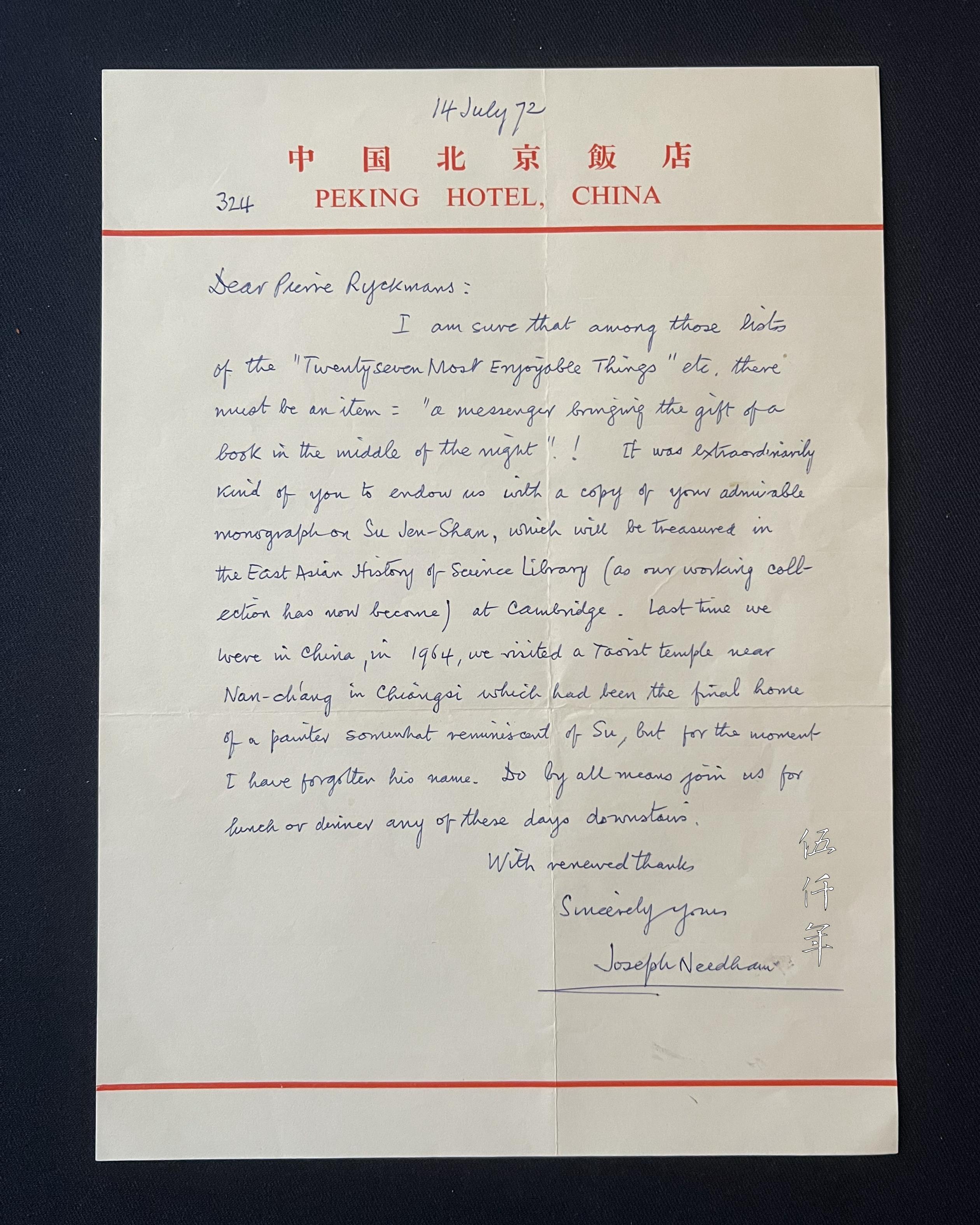
Letter from Prof. Joseph Needham to Prof. Pierre Ryckmans, written on 14 July 1972 in Peking
(195-43) Letter by Prof. Joseph Needham (1900-1995) to Prof. P. Ryckmans, written in Peking, dated 14 July 1972.
(195-44) Typed letter by Alice Boney (1901-1988) to Prof. P. Ryckmans, written in Hong Kong, dated 3 August 1969.
(195-45) Two page letter in Chinese by Prof. Wu Chün-sheng (1901-2000) to Prof. P. Ryckmans, written in Hong Kong.
(195-46) Typed letter by Chiang Yee (1903-1977) to Prof. P. Ryckmans, written in New York, dated 27 June 1974.
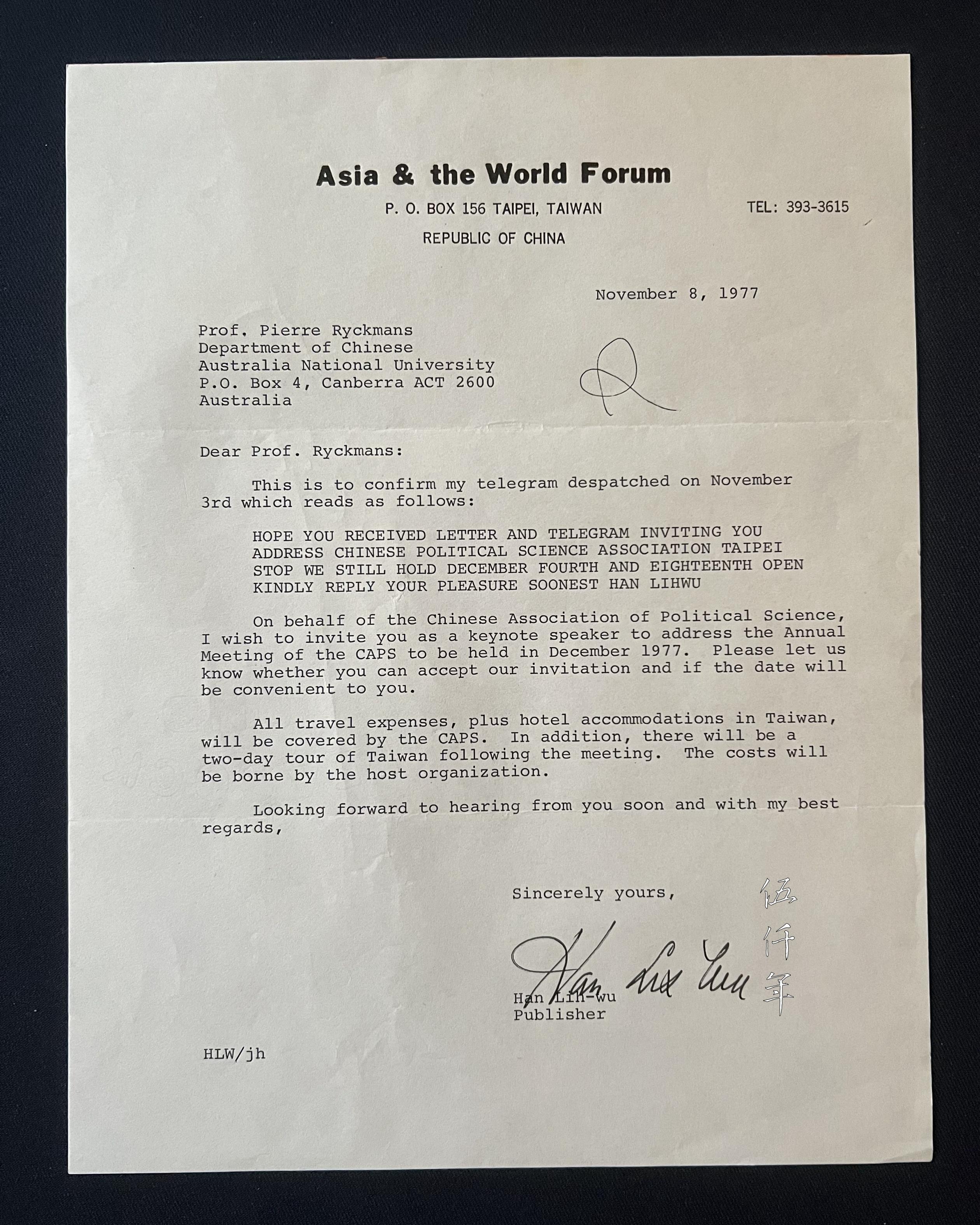
Letter from Minister Hang Lih-wu to Prof. Pierre Ryckmans, written on 8 November 1977 in Taipei
(195-47) Three typed letters by Minister Hang Li-wu (1903-1991) to Prof. P. Ryckmans, written in Taipei, dated 11 October, 8 November and 1 December 1977.
(195-48) Typed recommendation letter in French signed by Father Jean de Leffe (1906-1979) in Taipei, dated 3 October 1961, name card inserted.
(195-49) Typed letter in French by Prof. Rene Etiemble (1909-2002), written in Paris, dated 5 November 1973.
(195-50) Typed letter by Han Suyin (1916-2012) to Prof. P. Ryckmans, written in Peking, dated 14 November 1960.
(195-51) Aerogramme in Chinese by Prof. Jao Tsung-i (1917-2018), written in Singapore, dated 18 December 1969.
(195-52) Typed letter by Prof. Chu-tsing Li (1920-2014) to Prof. P. Ryckmans, written at the University of Kansas, dated 7 February 1970.
(195-53) Typed letter by Prof. Hsu Kai-yu (1922-1982) to Prof. P. Ryckmans, dated 14 May 1979.
(195-54) Letter by Emily Mote, wife of Frederick Wade Fritz Mote (1922-2005), to Prof. P. Ryckmans, written at Princeton University.
(195-55) Letter in French and Chinese by Prof. Shih Jai-yuin (1926-1983), also known as Robert Shih, to Prof. P. Ryckmans, written in Louvain of Belgium, dated 14 November 1960.
(195-56) Aerogramme in Chinese by Prof. Shih Jai-yuin (1926-1983), also known as Robert Shih, to Prof. Tang Kuin-yi (1909-1978), written in Louvain of Belgium, dated 27 December 1958.
(195-57) Two page letter in Chinese by writer Hu Chu Jen (1932-2025) to Prof. P. Ryckmans, circa 1977.
(195-58) Aerogramme by painter Liu Kuo-sung (b. 1932) to Prof. P. Ryckmans, written in Hong Kong, dated 31 March 1978.
(195-59) Typed letter by Prof. Jacques Pimpaneau (1934-2021) to Prof. Yu Ying-shih (1930-2021), written in Paris, dated 13 January 1975.
(195-60) Typed letter in French by Prof. Jacques Pimpaneau (1934-2021) to Prof. P. Ryckmans, dated 13 January 1975, attached a typed letter by Prof. Yu Ying-shih (1930-2021) to Prof. J. Pimpaneau, dated 1 November 1974.
(195-61) Typed aerogramme by Joseph Shiu-ming Lau (1934-2023) to Prof. P. Ryckmans, written in Wisconsin of America, dated 28 June 1978.
(195-62) Aerogramme by Prof. Glen Dudbridge (1938-2017) to Prof. P. Ryckmans, written in Cambridge, dated 20 October 1964.
(195-63) Two page letter in Chinese by painter Li Wen-ch’ien (b. 1938) to Prof. P. Ryckmans.
(195-64) Typed letter in French by Prof. Jean Francois Billeter (b. 1939) to Prof. P. Ryckmans, written in Basel of Switzerland, dated 7 September 1968.
(195-65) Letter in Chinese by writer Liu Chieh, also known as Sydney Liu, to Prof. P. Ryckmans, dated 29 December 1973. Sydney Liu was a journalist with Newsweek Magazine.
(195-66) Letter in Chinese by Huang Pu-nao to Prof. P. Ryckmans, written in Taipei.
(195-67) Postcard in French from Chinese zither artist George Goormaghtigh to Prof. P. Ryckmans, dated 14 May 1979.
(195-68) Postcard from writer Murray Bail to Prof. P. Ryckmans, dated 13 March 2013.
Gifts
(195-69) Name card of Na Chih-liang (1908-1998).
(195-70) Photograph of Robert Van Gulik (1910-1967) name card.
(195-71) Van Gulik Collection: Rare Chinese books on microfiche. Part 1 Novels.
(195-72) Early Netherlandish Paintings. Pieter Bruegel the Elder, the Netherlandish Proverbs, 1559.
(195-73) Collection of Personal Seals by Ch'en Feng-tzu, inscribed photograph inserted, dated 1970.
(195-74) Two copies of Selected Seals by Ch'en Feng-tzu, inscribed to Prof. P. Ryckmans, a group of seal impressions inserted.
(195-75) Poetry, Calligraphy and Painting News, Issue No. 17, inscribed by Huang Miao-tzu (1913-2012) to Prof. P. Ryckmans, dated 10 November 1985.
(195-76) Poetry, Calligraphy and Painting News, Issue No, 18, inscribed by Yü Feng (1916-2007) to Prof. P. Ryckmans, dated 10 November 1985.
(195-77) Fang Yi-chih's Theory on Painting, by Jao Tsung-i, inscribed by Jao to Prof. P. Ryckmans, reprinted by The Chinese University of Hong Kong, 1974.
(195-78) Facsimile manuscript of The Paintings of Huang Pin-hung by Yüan-shang.
News
(195-79) Photocopy of French newspaper article titled: Bonheur des dames: Le jury Femina fete son centenaire en couronnant aujourd'hui l'ecrivain Simon Leys, dated 7 December 2004.
(195-80) Newspaper clipping of an article by Wen Ch'uan-shan titled: An Occidental Who Loves China: The Story of Dr. Pierre Ryckmans, Author of Chinese Shadows; published in Shih Pao Chou-K'an, dated 22 October 1978.
(195-81) Photocopy of newspaper clipping of an article by Fang Ming-k'ung titled: Pierre Ryckmans, the Chivalrous Spirit of a Sinologist, published in Hsin-k’uai Pao, dated 27 August 2014.
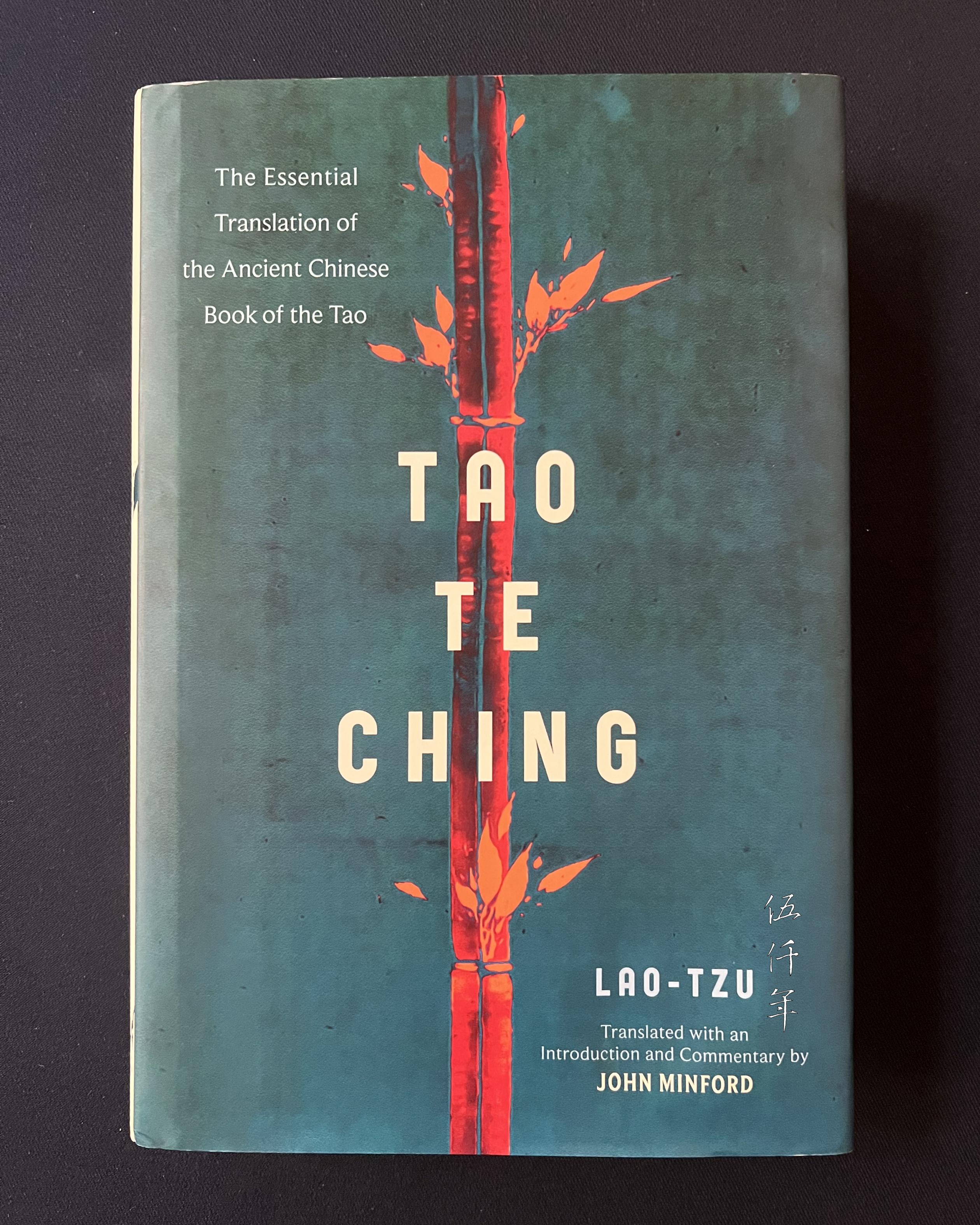
Front cover of Tao Te Ching. Translated by Prof. John Minford
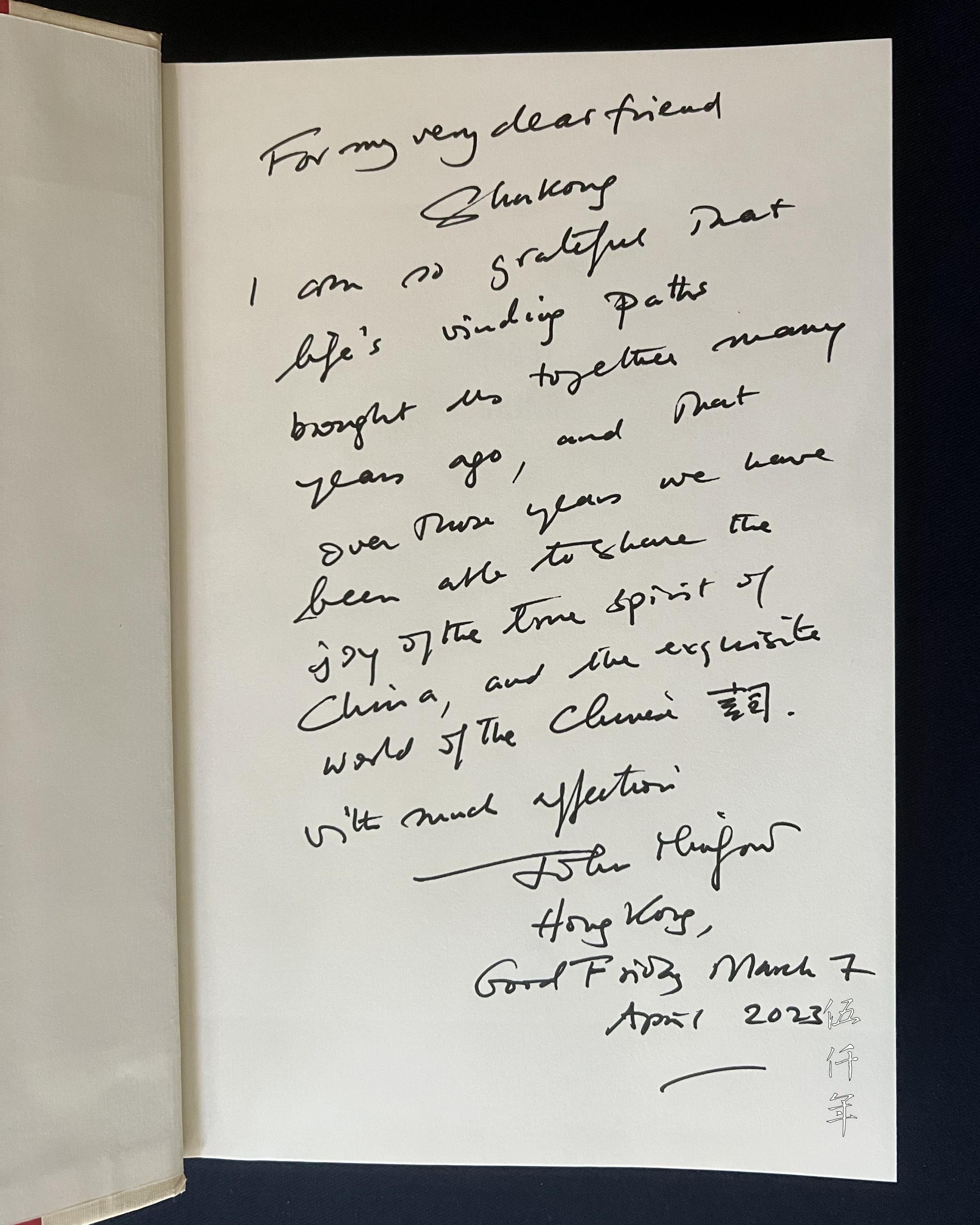
Inside page of Tao Te Ching. Translated by Prof. John Minfor
(196) Prof. John Minford b.1946 (閔福德教授)
Items 196-1 to 196-4 were generously gifted by Prof. John Minford
(196-1) Seventy-one letters from Prof. J. Minford to Prof. David Hawkes, four postcards from Prof. J. Minford to Prof. D. Hawkes, five pieces of documents, two letters to friends and two reply letters, two letters from grandchildren.
(196-2) An inscription on a large sheet of paper by Prof. J. Minford to Soong Shu Kong, written at Luk Yu Teahouse in Hong Kong, dated 5 March 2016.
(196-3) I Ching (Yi Jing), The Book of Change. Translated with an Introduction and Commentary by John Minford. Viking: 2014. First edition. Inscribed in Hong Kong by the translator to Soong Shu Kong, dated 12 November 2016.
(196-4) Tao Te Ching (Dao De Jing), The Tao and the Power, Lao-tzu. Translated with an Introduction and Commentary by John Minford. Viking: 2018. First edition. Inscribed in Hong Kong by the translator to Soong Shu Kong, dated April 2023.
(196-5) The Fragrant Hermitage, by Mr. Soong Hsün-leng, translated by Prof. John Minford. Taipei: S. K. Soong Design Co. Ltd., 2005.
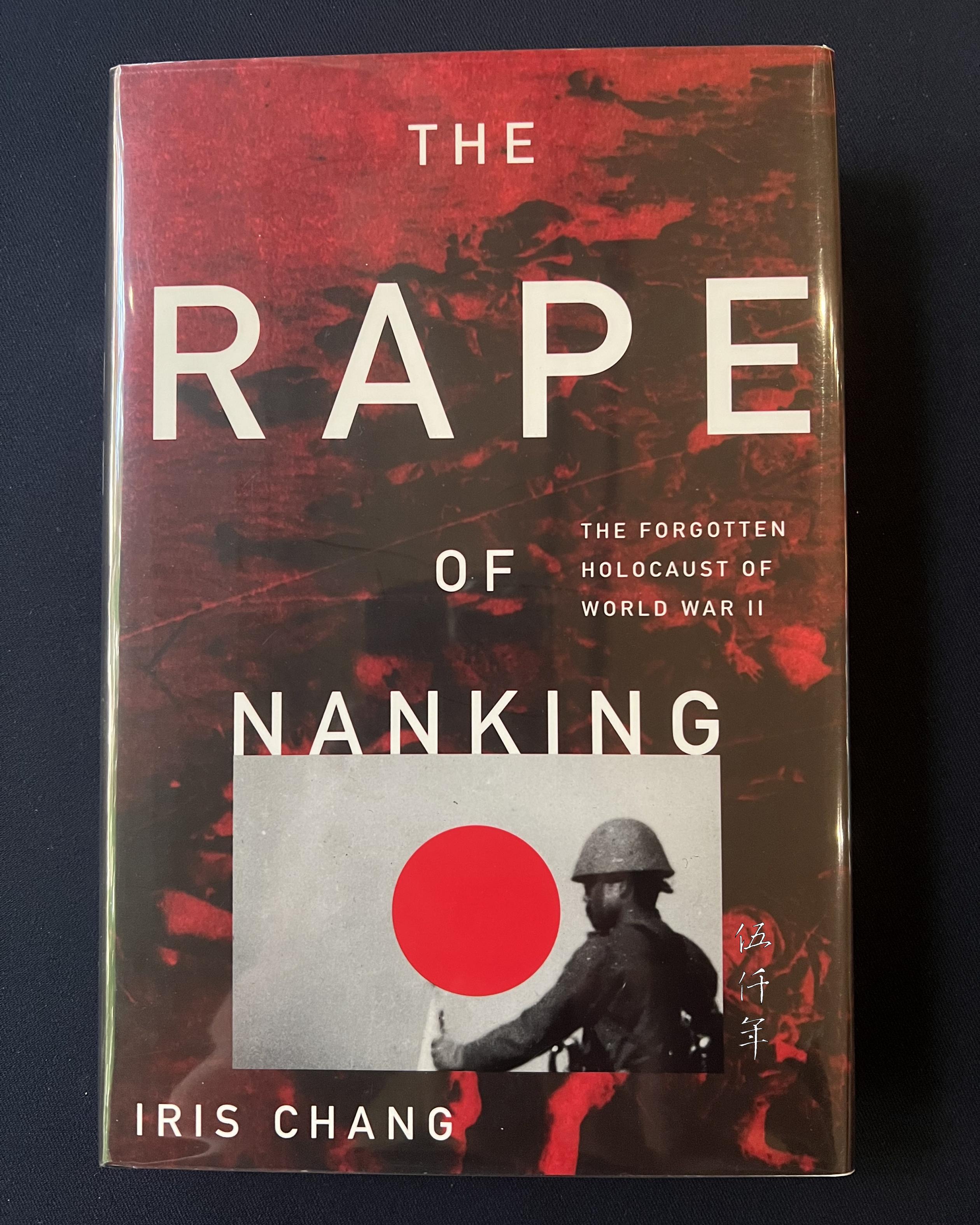
Front cover of The Rape of Nanking. By Iris Shun-ru Chang
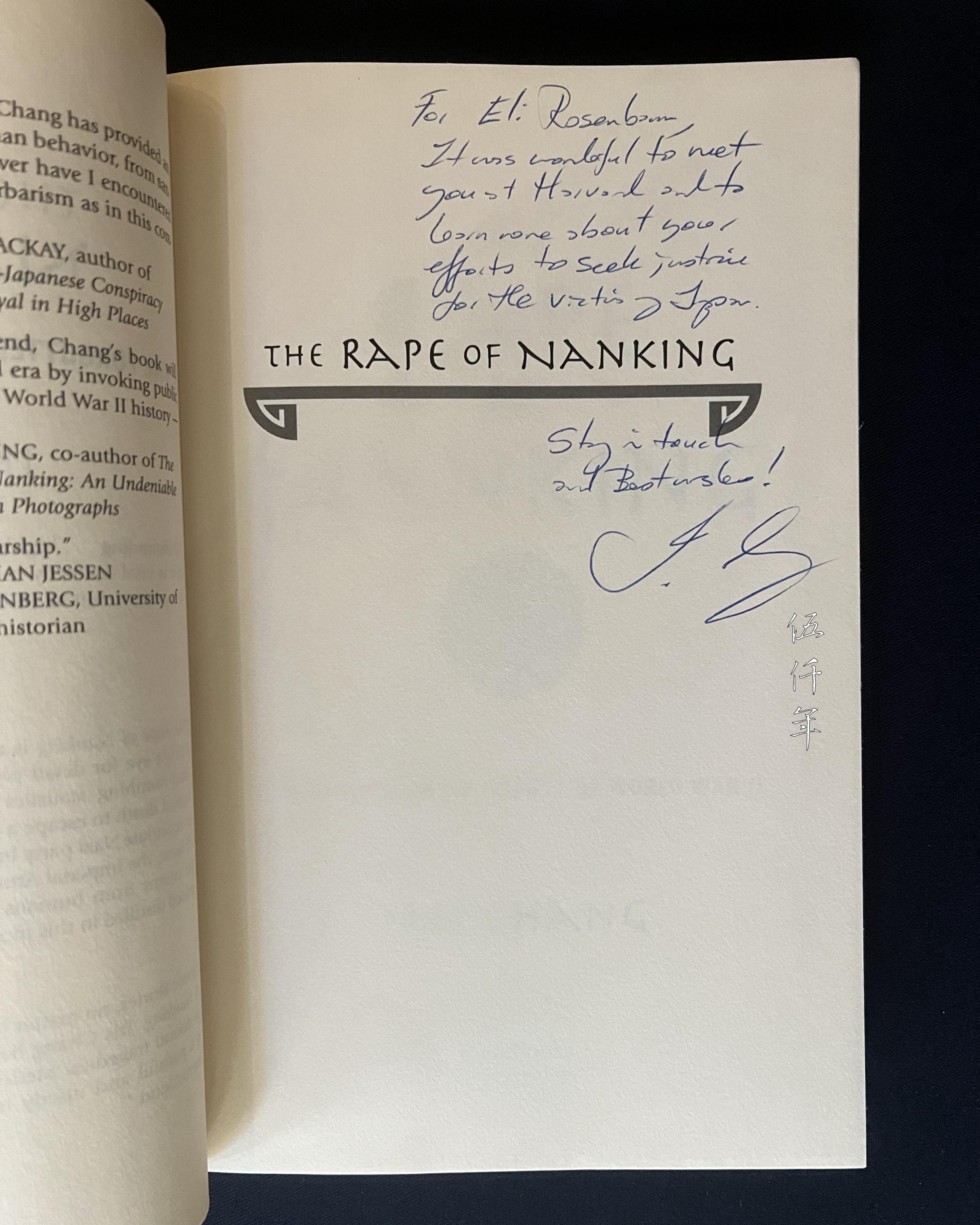
Title page of The Rape of Nanking. By Iris Shun-ru Chang
(197) Iris Shun-Ru Chang 1968-2004 (張純如)
(197-1) The Rape of Nanking, The Forgotten Holocaust of World War II. Basic Books, 1997. First edition. Inscribed by the author to Eli M. Rosenbaum, lawyer and director of the United States Department of Justice, Office of Special Investigations.
(197-2) The Rape of Nanking, The Forgotten Holocaust of World War II. Basic Books, 1997. First edition. Inscribed by the author, dated 18 January 1998.
Seal of the Studio of Prunus Ode