Surveying Chinese history, in the span of a few thousand years, the only Occidental scholar who became tutor to a Chinese emperor, namely P’u-i (溥儀 1906-1967), is Reginald F. Johnston (莊士敦). Johnston was erudite on Confucianism, Taoism and Buddhism. He was also a firm advocate of Chinese traditional culture. His work Twilight in the Forbidden City brims with thoughts on loyalty and righteousness, no different to some Chinese scholars from the Confucian school. This year happens to be the 120th birth anniversary of Emperor P’u-i, we thus recount the devotions and friendships between emperor and subject, teacher and student.
Curatorial and Editorial Department
In the final years of the Ch’ing dynasty, the imperial court extensively enlisted Western advisers to cope with the great calamities that had befallen China. Despite the differences between Chinese and Western cultures, there were a great number of Western individuals who privately committed themselves to join those Chinese dedicated to stem the tide of decline. Notable among them were the American nationals Frederick Townsend Ward and Anson Burlingame, and the British nationals Charles George Gordon and Robert Hart. Their names were recorded for posterity in the Draft History of Ch’ing. As Confucius instructed: “The ruler employs his ministers with propriety, the ministers serve their ruler with loyalty.” This principle was upheld across generations by Chinese scholar-officials and likewise validated by certain Western advisers.
These Western advisers who long admired Classical Chinese Culture were motivated by genuine interest and respect, culminating in personal actions deemed righteous and honourable, magnanimously rendering assistance to support China. Their appreciation of Classical Chinese Culture was the wellspring of such commitment. Surveying the barely visible traces of Classical Chinese Culture today, there is little left to inspire admiration from the West, and little left to sustain and bolster the Chinese themselevs.
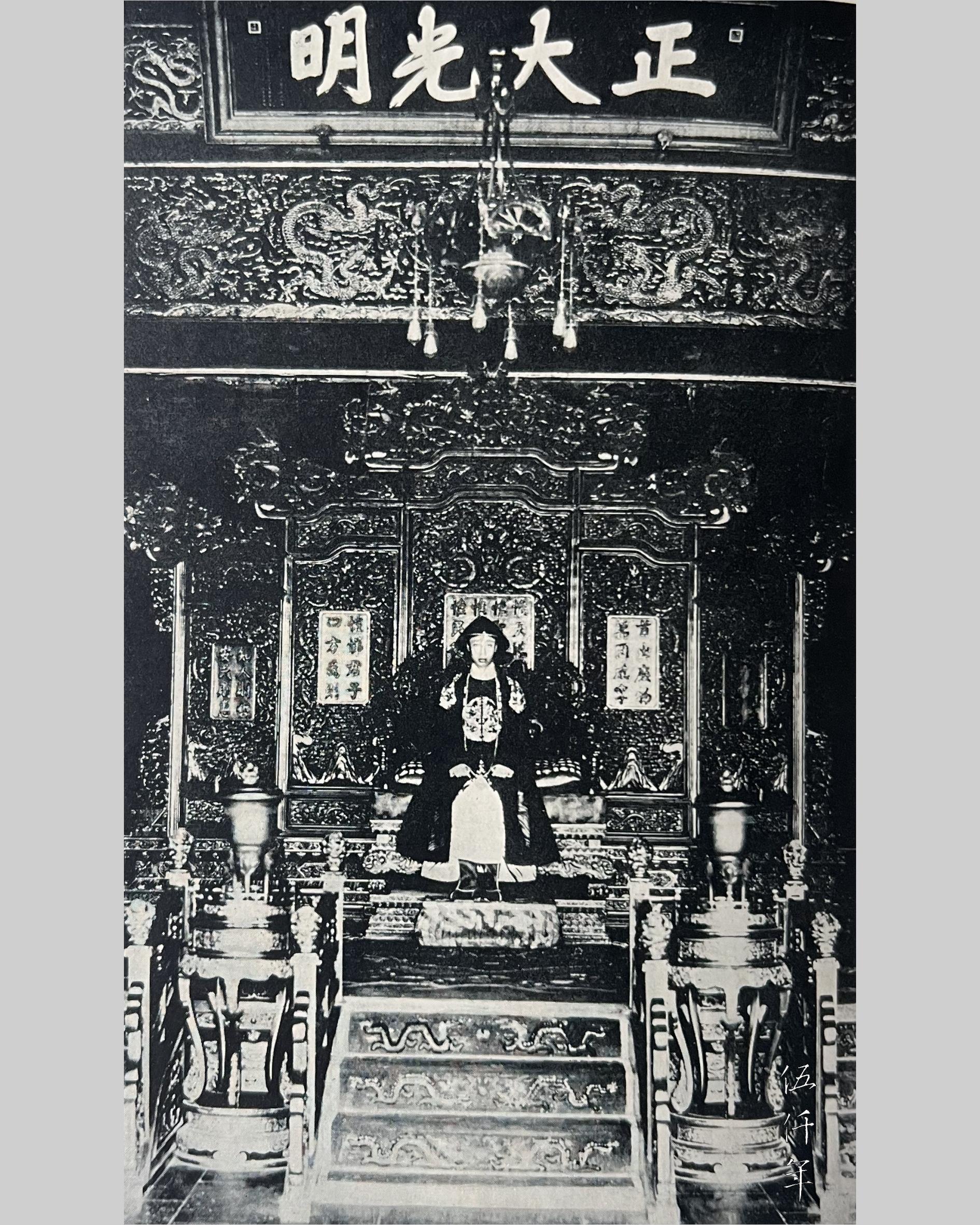
Emperor P’u-i on his throne in the Palace of Cloudless Heaven, Forbidden City
The last Ch’ing emperor P’u-i (溥儀) abdicated shortly after the founding of the Republic of China, yet the Forbidden City continued as a piece of imperial property. In late November, the 7th year of the Republic 1918, the British national Reginald Fleming Johnston was appointed English tutor to the former Ch’ing emperor P’u-i. The following year, in the 8th year of the Republic 1919, Johnston met P’u-i for the first time in the Forbidden City. P’u-i was thirteen years old then. Johnston chronicled this meeting in his work Twilight in the Forbidden City. He wrote:
“He was dressed for the occasion in court dress, and was attended by a number of functionaries in uniform. On being conducted into the audience-chamber I advanced towards the emperor and bowed three times. He then descended from his seat, walked up to me and shook hands in European fashion. He remained standing during the rest of this short interview and asked me a few conventional questions, mainly about my official career in China. When the interview was over I withdrew to a waiting-room and was informed that the emperor wished to begin his English lessons immediately and would receive me again in a less formal manner as soon as he had changed his clothes.”
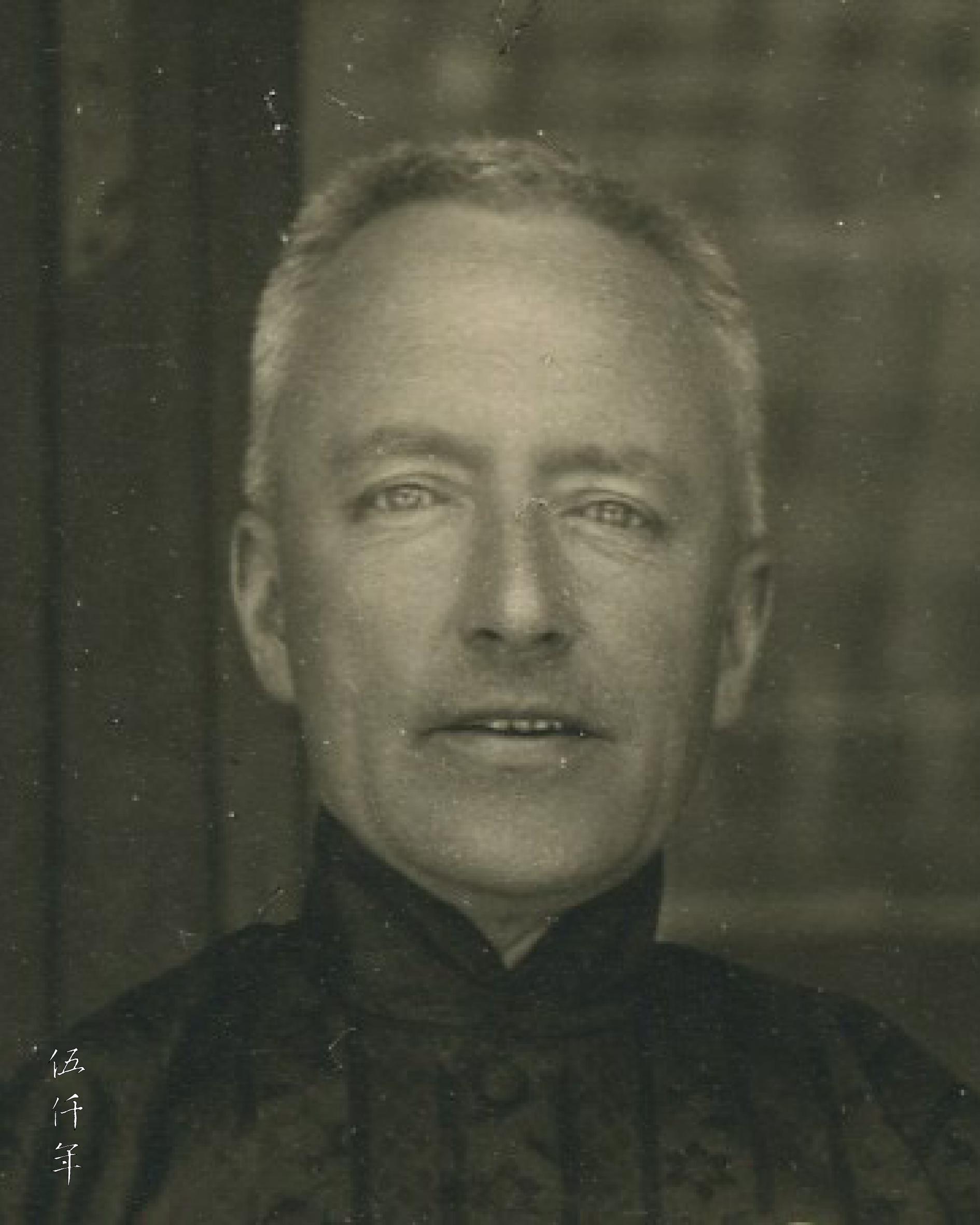
Portrait of Reginald F. Johnston, English tutor to Emperor P’u-i
The year Reginald Johnston was appointed tutor to the emperor, he had not only lived in China for almost twenty years, he was also serving as the British district officer and colonial magistrate of Weihaiwei. His writings were widely known at the time. His publications included From Peking to Mandala: A Journey from North China to Burma through Tibetan Ssuch’uan and Yunnan, published in the 34th year of the Kuang-hsü reign 1908; Lion and Dragon in Northern China, published in the 2nd year of the Hsüan-t’ung reign 1910; A Chinese Appeal to Christendom Concerning Christian Missions, written under the pseudonym of Lin Shao-yang, published in the 3rd year of the Hsüan-t’ung reign 1911; Buddhist China, published in the 7th year of the Republic of China 1918. Many of Johnston’s writings were sympathetic to China’s position, and for this reason he formed close friendships with China’s scholar-officials. His appointment of imperial tutor was recommended by Li Ching-mai (李經邁 1876-1940), the third son of Li Hung-chang (李鴻章 1823-1901).
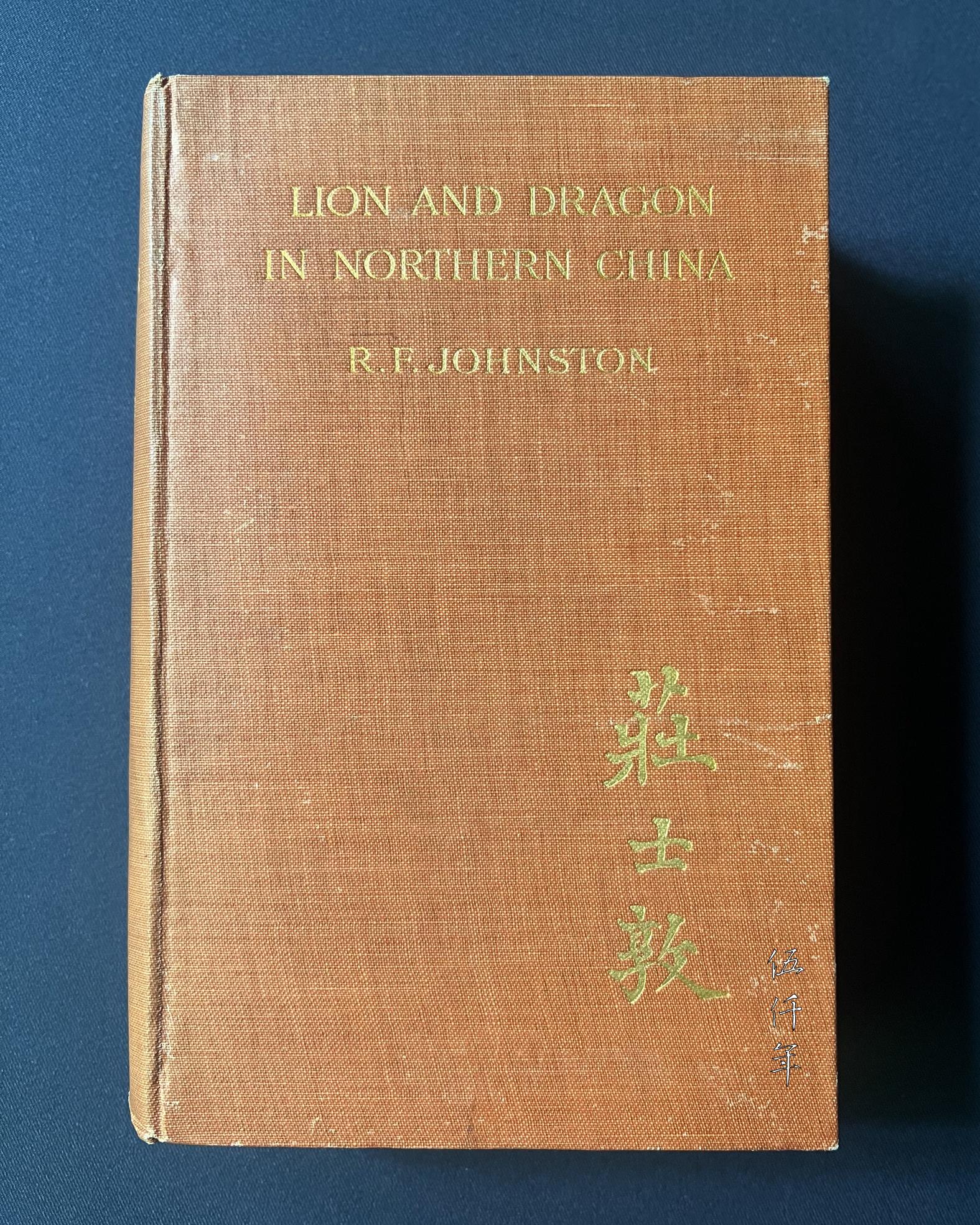
Front cover of Lion and Dragon in Northern China, by Reginald F. Johnston. London: John Murray, 1910. First edition
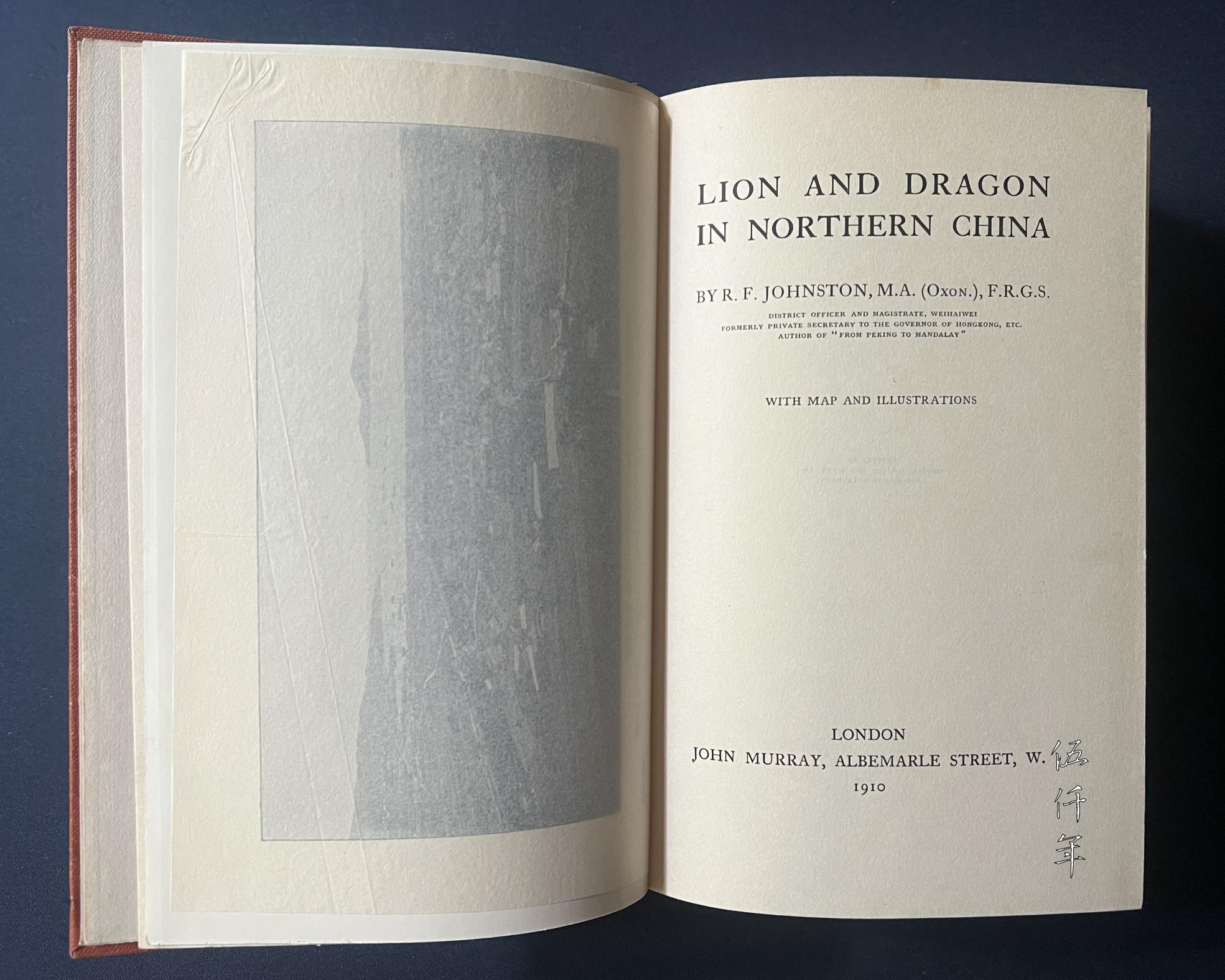
Title page of Lion and Dragon of Northern China
Reginald Johnston was born on 31 October 1874 and died on 6 March 1938 at the age of sixty-three. A native of Edinburgh, Scotland, he was educated at the University of Edinburgh and later at Magdalen College, University of Oxford. In 1898, he was posted to Hong Kong by the British Colonial Office. In 1906, he was posted to Weihaiwei in Shantung province. In 1919, he was appointed imperial tutor. In 1924, after P’u-i was expelled from the Forbidden City, Johnston became secretary to the Sino-British Indemnity Commission. From 1927 to 1930, he was promoted to commissioner of Weihaiwei. On 1 October 1930, when Weihaiwei was returned to China by the British government, Johnston’s official career came to an end. In the same year, he returned to Britain, having lived in China for a total of thirty-three years. In 1931, he was appointed professor of Chinese Studies at the School of Oriental and African Studies, University of London. His personal library of 16,000 volumes were later all donated to the SOAS Library. The bookplate with the design of the Five Sacred Mountains is a distinct feature of the Johnston Collection.
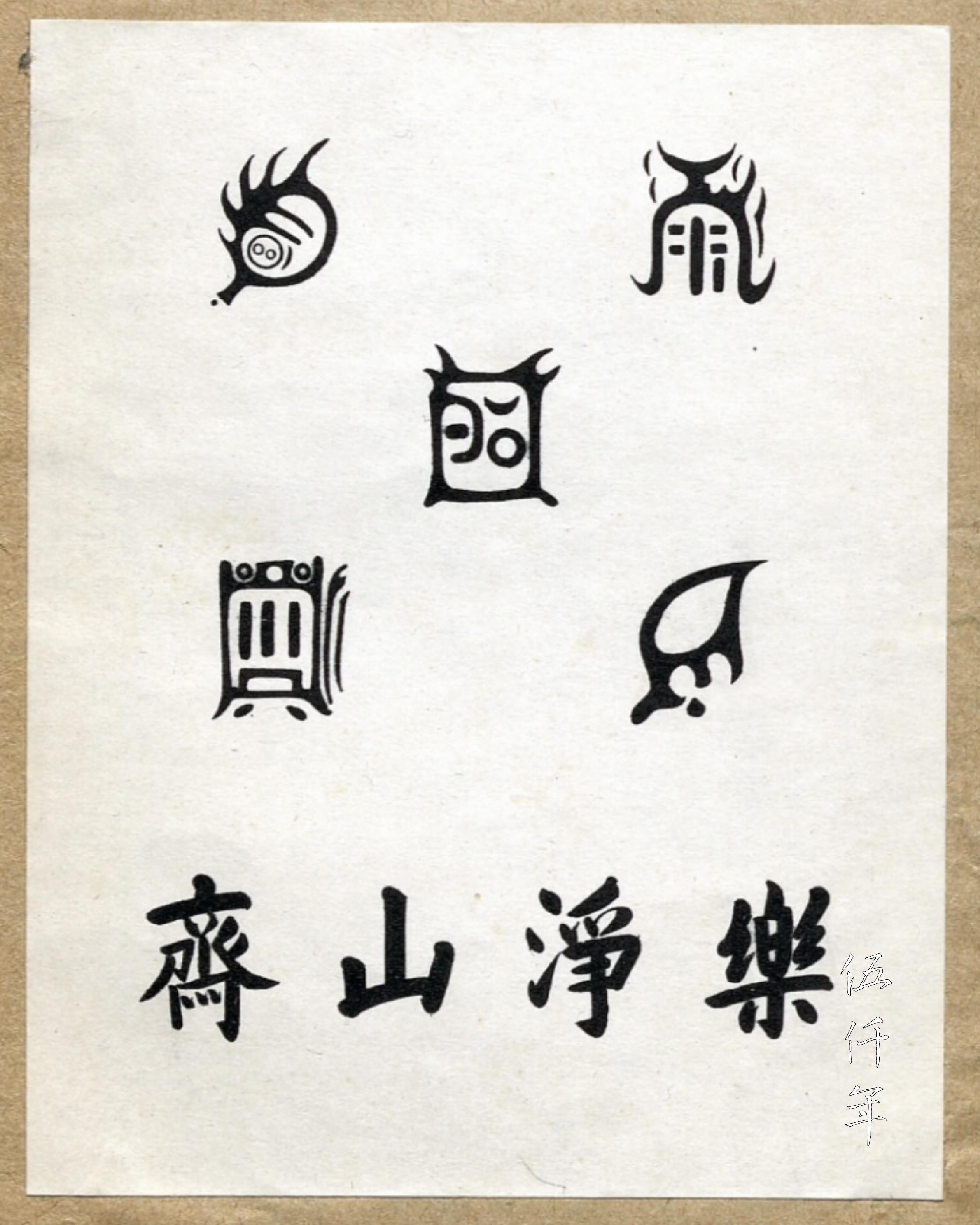
Bookplate used by Reginald F. Johnston, depicting the archaic symbols of the Five Sacred Mountains of China
Johnston possessed a deep understanding of Chinese culture. He was exceptionally perceptive of the teacher-student relationship, a central pillar of Confucian ethics that even emperors were bound to observe with due reverence. He explained this in Twilight in the Forbidden City:
“It has always been the custom in China for the ruler to sit enthroned with his back to the north, facing the south. Those who approach him, therefore, must face the north. This marks the distinction between ruler and subject. But this relationship of ruler and subject is not the relationship of teacher and pupil; therefore the teacher when addressing a ruler who is also his pupil is not expected to assume the usual attitude. The interesting point is that this ancient rule was observed to the last in the imperial schoolroom. At his studies the emperor sat at the north side of a square table, facing south. The place assigned to the tutor was a seat at the east side of the table, facing west. That was my own position during all my formal interviews with the emperor in the Yü-ch’ing palace.
Another mark of respect shown by the emperor to each of his tutors - even the barbarian from overseas - was to rise when the tutor entered the room. The tutor advanced to the middle of the room, bowed once, and emperor and tutor then sat down simultaneously in their proper places. If the tutor, in the course of the lesson-hours, had occasion to rise for the purpose of fetching a book from a shelf or for any other reason, the emperor rose too, and remained standing till the tutor returned to his place.”
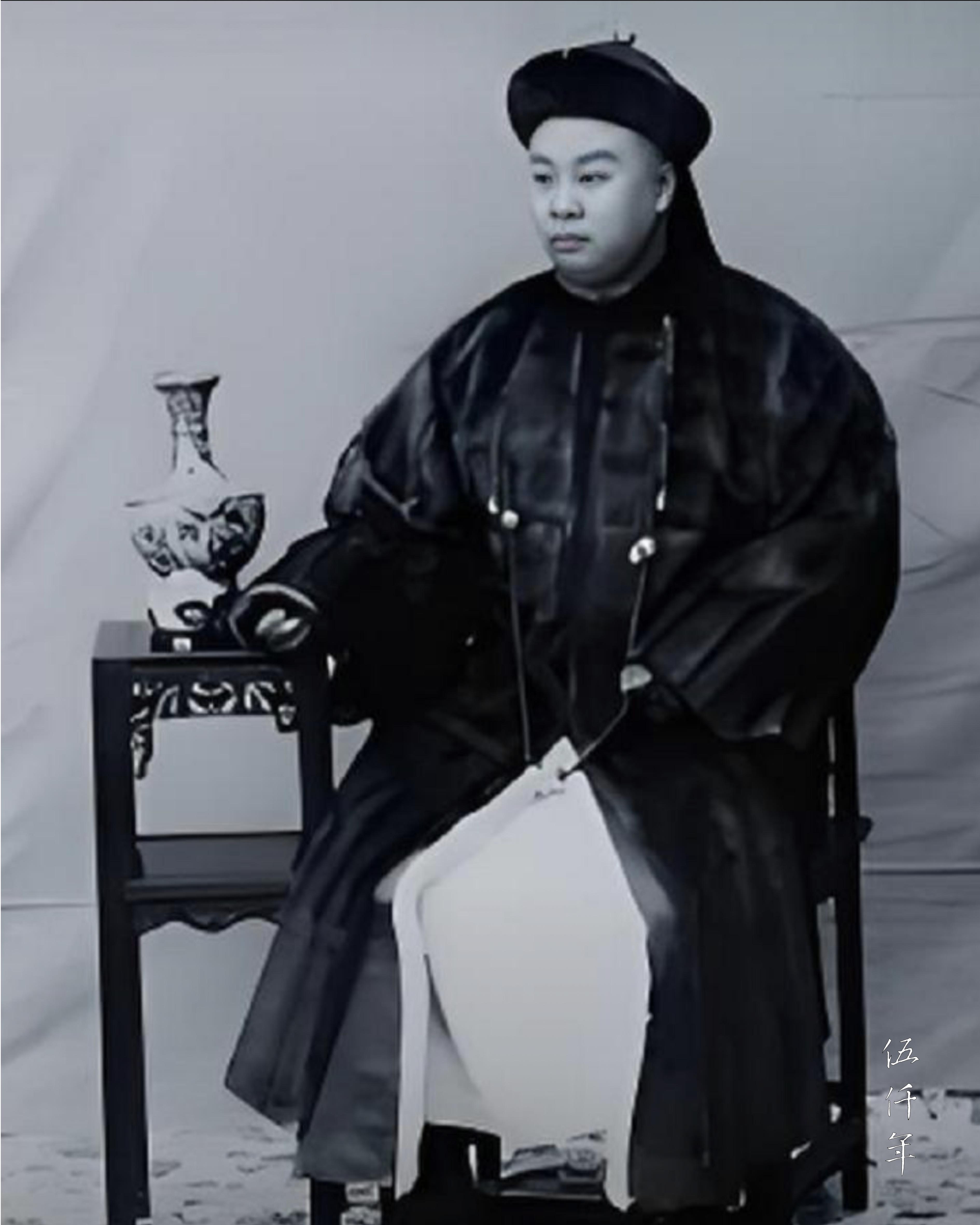
Portrait of Minister Li Ching-mai
There is much to be said that is common to Chinese and Western cultures. Living through a time of epochal transition in China, Johnston frequently judged men by the standards of loyalty and integrity. The passage on Li Ching-mai reads:
“During the critical days of the revolution in 1911, he found refuge in the British leased territory of Weihaiwei where I was then district officer and magistrate. In happier days, under the monarchy, Lord Li had served his country as Chinese minister at the court of Vienna. When Prince Tsai T’ao (戴濤), a brother of the emperor Tê Tsung visited Germany as head of a military mission, shortly before the revolution, he was accompanied by Lord Li. Since then he has steadfastly refused all offers of official employment under the republic, though he was repeatedly pressed by his friend president Hsü Shih-ch’ang (徐世昌) to accept a high diplomatic post. He and his family have always remained loyal to the old dynasty, and it was mainly through his influence both with the president and with the Manchu court that the appointment of English tutor to the emperor was offered to me.”
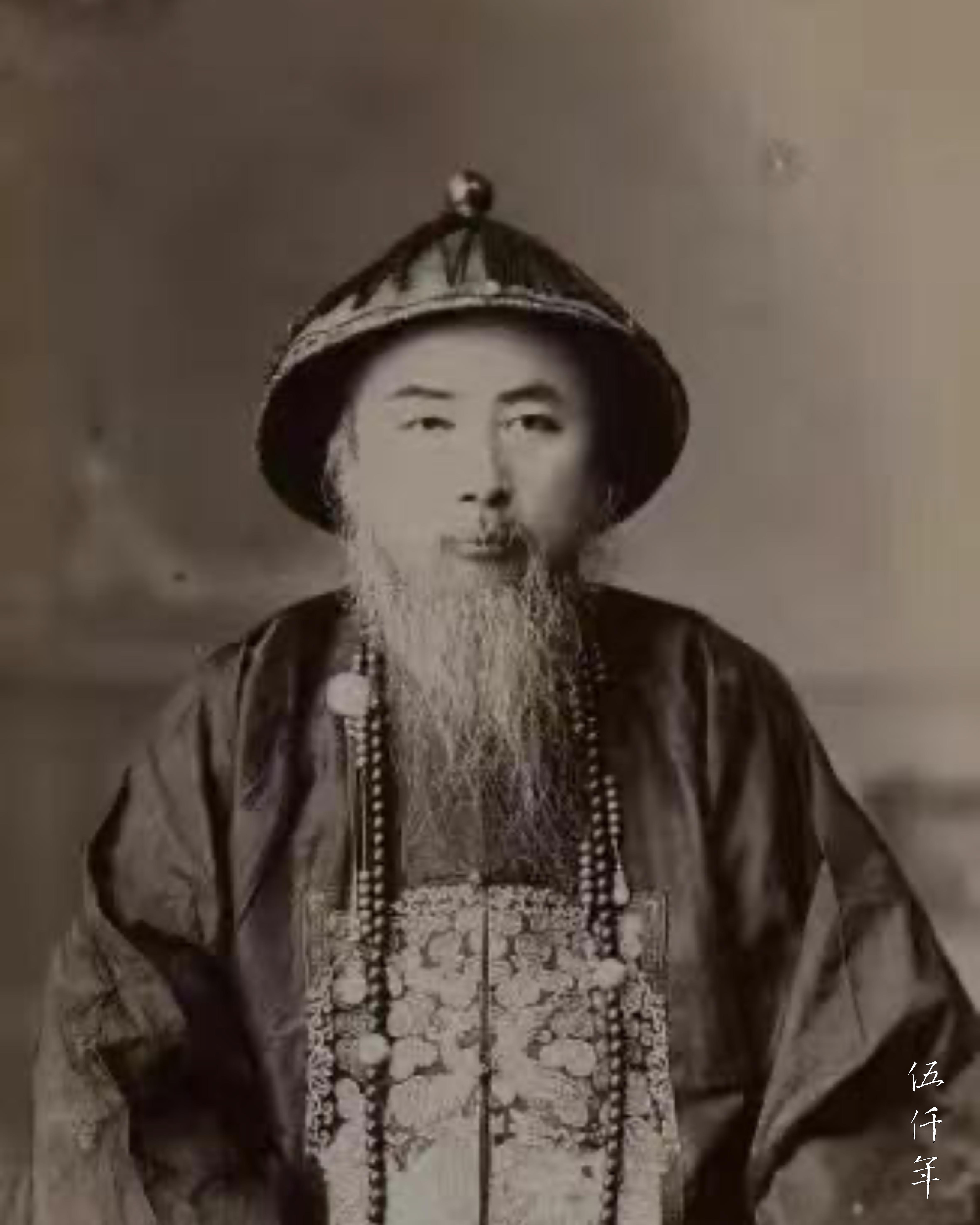
Portrait of Liang Ting-fen, Chinese tutor to Emperor P’u-i
P’u-i also studied under other tutors including the Kwangtung Hanlin Academician Liang Ting-fen (梁鼎芬1859 - 1919), the Fukien Hanlin Academician Ch’en Pao-ch’en (陳寶琛1848 - 1935), the Kiangsi Hanlin Academician Chu I-fan (朱益藩1867 - 1937), and the Manchu Hanlin Academician I-k’o-t’an (伊克坦 1862–1922). In March of the 8th year of the Republic 1919, when Johnston joined the palace, he knew of Liang Ting-fen only by reputation, for Liang was already gravely ill with scant chance of recovery. On 14th November that year, Liang died in the capital. Johnston deeply admired the loyalty and integrity of Liang Ting-fen and wrote of him in considerable detail:
“I must now give some account of my colleagues in the imperial schoolroom. When I first entered the Forbidden City in 1919 they were four in number, three being Chinese and one a Manchu. The first to be mentioned is one whom I never met. He was a very sick man, half paralysed when I arrived, and he died towards the end of the year. He was a Cantonese named Liang Ting-fen…
His father, who was a government official and brought him up well, emphasised the importance of self-discipline and self-respect, and impressed his mind with the principle that if ever the choice lay between death and disgrace he should choose the former…
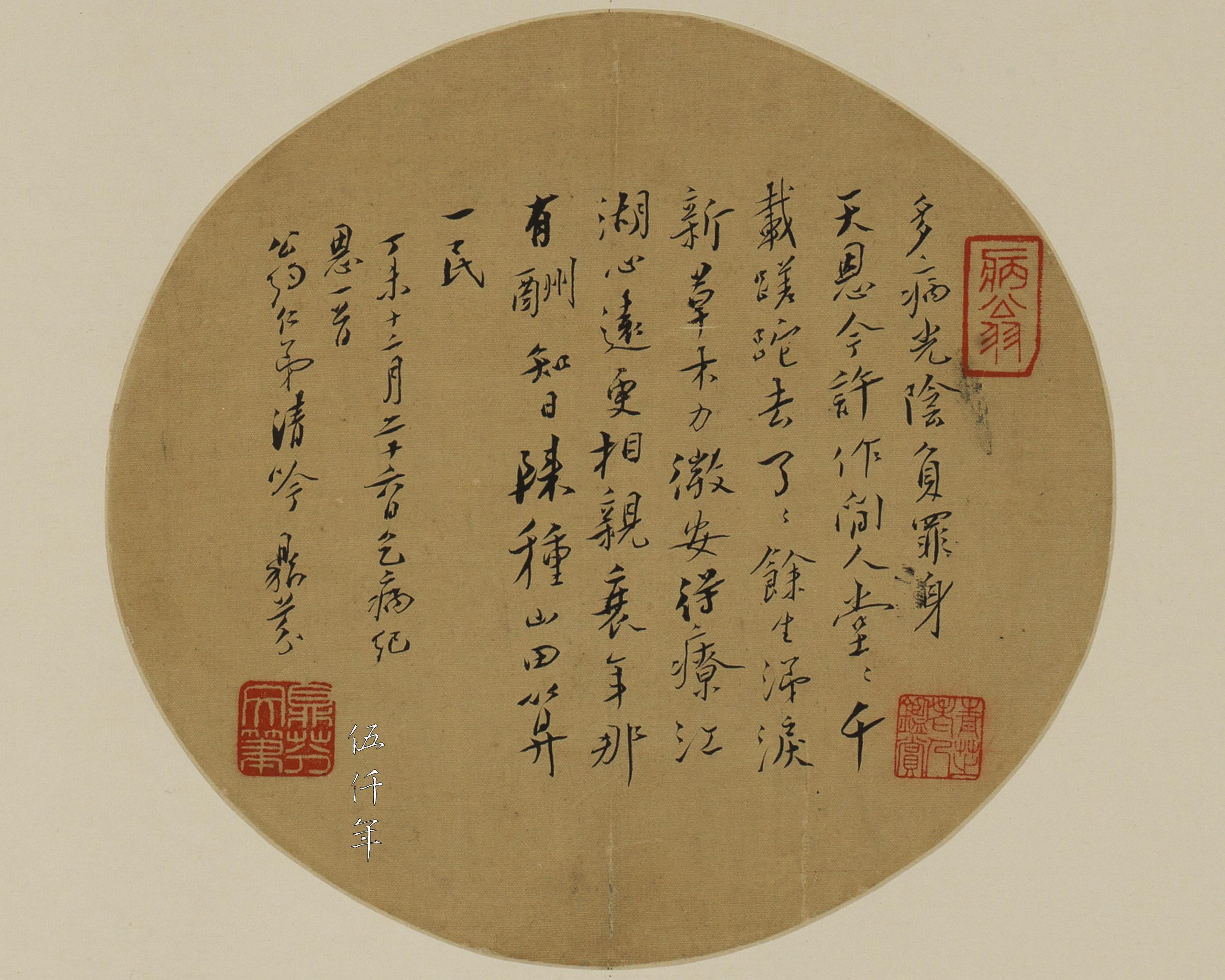
Poem and calligraphy on circular fan by Liang Ting-fen, dated the 33rd year of the Kuang-hsü reign, corresponding to 1907. Formerly in the collection of Lin Sen (1868-1943), chairman of the National Government of the Republic of China.
Perhaps he had this parental counsel in his mind when the testing time came in the summer of 1917. At the time of his death I heard his colleagues in the palace speak of the courage and loyalty displayed by him at the time of the Restoration episode. Some of the fighting between Chang Hsün’s (張勳) troops and those of Tuan Ch’i-jui (段祺瑞) took place in the immediate vicinity of the Forbidden City. When fighting was going on in that locality, the hour came for Liang Ting-fen’s usual attendance on his imperial pupil. To reach the palace-gates he had to drive in his pony-carriage through streets thronged with undisciplined soldiers. He refused to remain at home or to turn back when the danger was pointed out to him. On his arrival at the great gates opposite the Coal Hill, he found his official sedan-chair awaiting him as usual, but the bearers earnestly advised him not to go into the palace as the opposing forces were exchanging shots over the palace roofs and it was perilous to cross the open courtyards. Stepping out of his carriage and seating himself in his chair he ordered the bearers to take him forthwith to the Yü-ch’ing palace. They obeyed with evident reluctance – thinking no doubt of their own safety as well as his - and they had gone only a little way when rifle-bullets struck a wall alongside which they were passing and a shower of fragments of brick and plaster struck the chair. The bearers begged him to let them carry him into one of the side-buildings to take cover till the firing was over. Pu k’o wu ch’ai shih, pu k’o wu chai shih (My duty is not to be neglected, my duty is not to be neglected) was all he replied, and they had the courage to obey him. It would have been a disgrace worse than death if through seeking safety for his own person he had failed to keep his appointment with his imperial master and pupil. We may surmise that not much was done that day in the way of lessons, but not through failure on the part of the imperial tutor to present himself at the usual hour.”
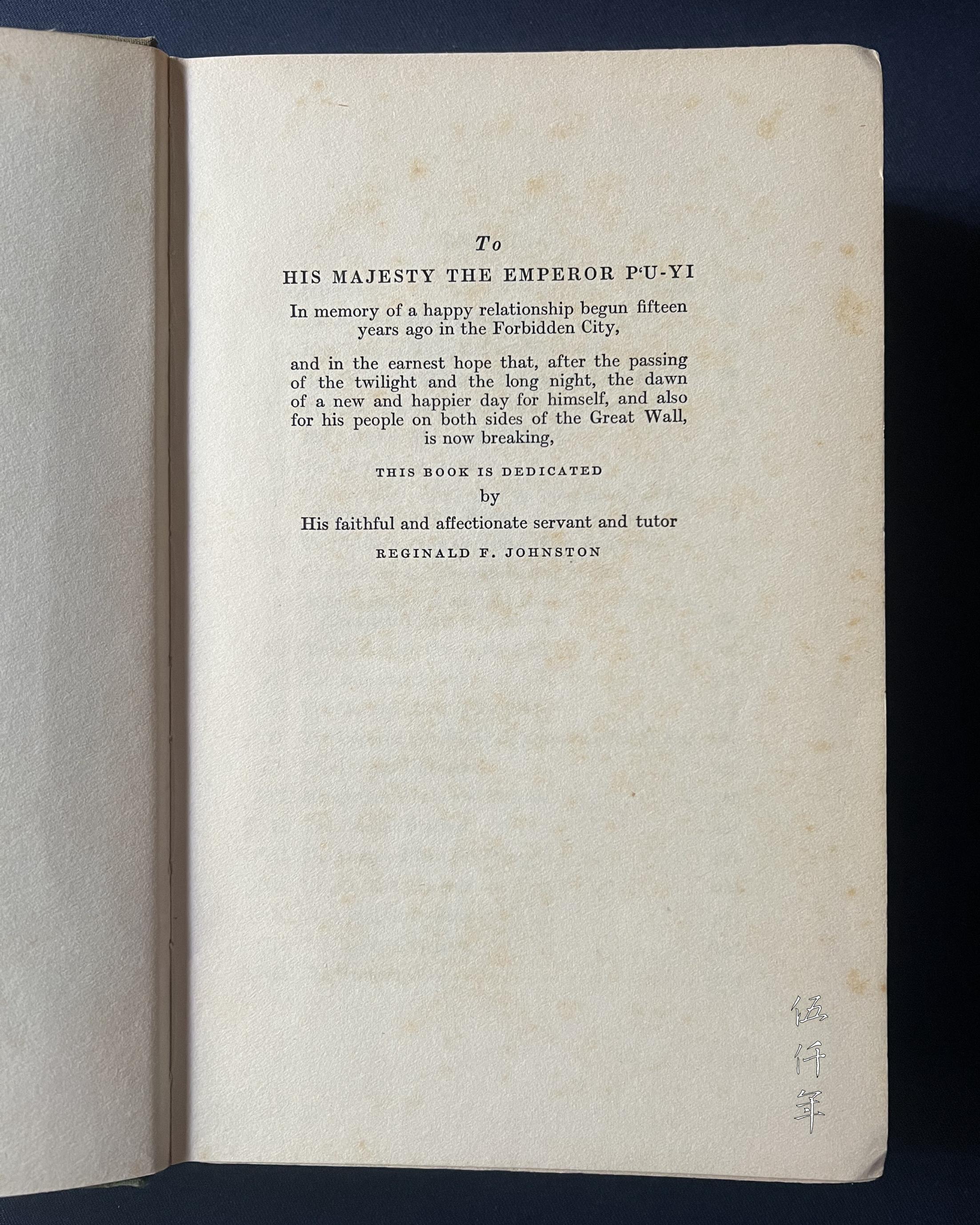
Dedication to Emperor P’u-i on the inside page of Twilight in the Forbidden City by Reginald F. Johnston
Johnston’s advocation of loyalty and integrity was not just consigned to empty words, his own conduct reinforced those values and was worthy of commendation. In the 23rd year of the Republic 1934, Twilight in the Forbidden City was published in London, and the dedication on the first page reads:
“To
His Majesty The Emperor P’u-Yi,
In memory of a happy relationship begun fifteen
years ago in the Forbidden City,
and in the earnest hope that, after the passing
of the twilight and the long night, the dawn
of a new and happier day for himself, and also
for his people on both sides of the Great Wall,
is now breaking.
This Book is Dedicated
by
His faithful and affectionate servant and tutor
Reginald F. Johnston”
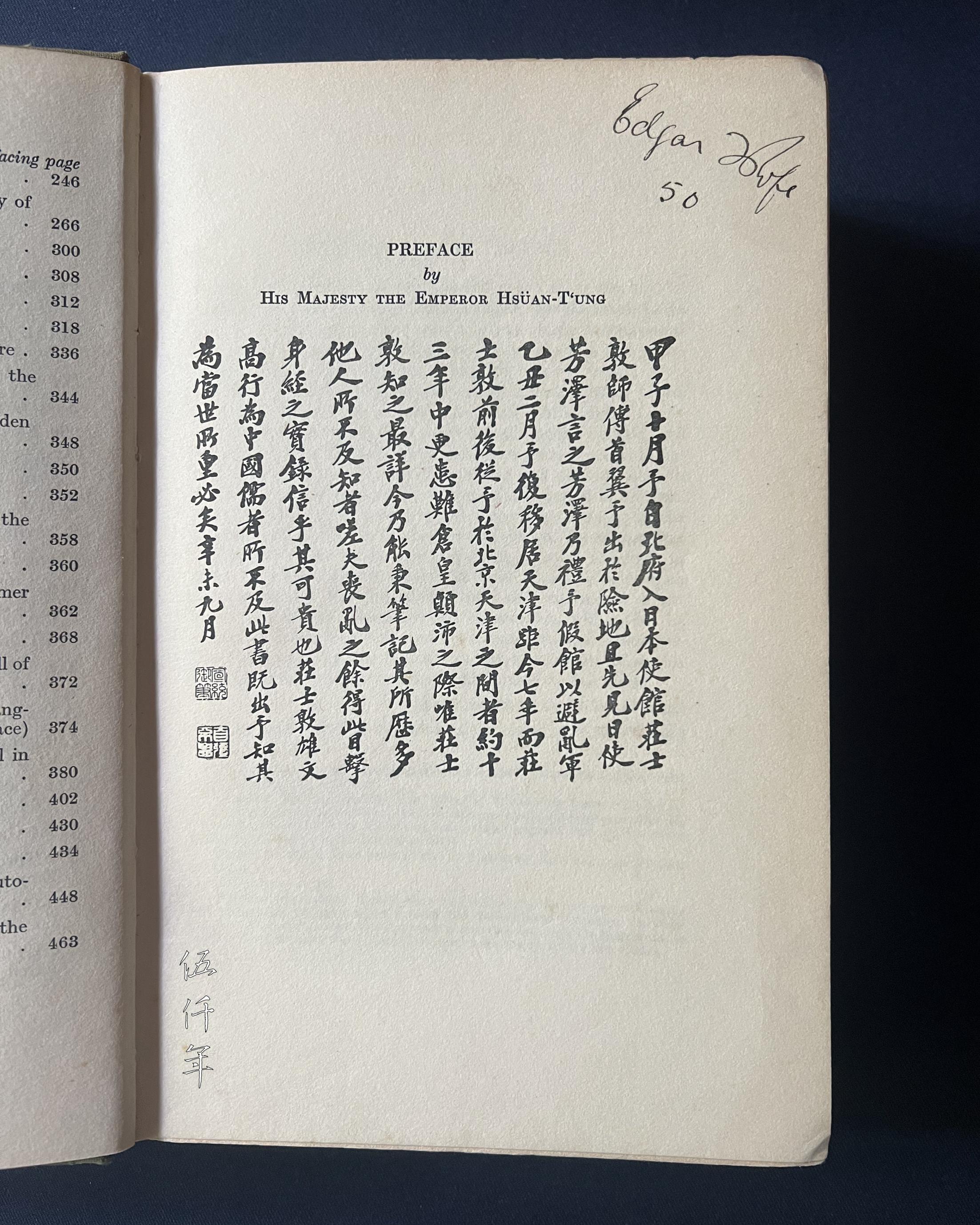
Foreword by Emperor P’u-i
P’u-i wrote a short Foreword which reads:
“In the tenth month of chia-tzu (甲子) year, I left the Government Palace (Forbidden City) and entered the Japanese Legation. My tutor, Johnston, was the first to protect me from danger. Moreover he first visited the Japanese minister Yoshizawa to speak on my behalf. Yoshizawa thereupon courteously granted me refuge at the legation to avoid the mutinous troops.
In the second month of i-ch’ou (乙丑) year, I moved to Tientsin. It has now been seven years. Johnston accompanied me in between Peking and Tientsin for approximately thirteen years. During this period of peril and panic, dislocation and uncertainty, only Johnston is knowledgeable of the full picture. Now he is able to write and chronicle this experience, most of which is unknown to others.
Alas, in the aftermath of turmoil and disaster, to obtain such a true account based on personal witness and lived experience, how precious it is indeed. Johnston’s powerful writing and lofty conduct are even beyond the reach of China’s Confucian scholars. Once this book is published, I know it will be valued.
Written in the ninth month of hsin-wei (辛未) year.”
The year hsin-wei corresponds to 1931. Thus, three years before the publication of Twilight in the Forbidden City, P’u-i had already written the Foreword, indicating that Johnston had devoted several years writing the book. When it was finally published in 1934, it had been twenty-two years since the founding of the Republic of China. By then both Chinese and foreigners were competing to align themselves and curry favours with the new leaders of China, Johnston alone remained mindful of the former dynasty, his sentiments no less steadfast than those Chinese loyalists of the Ch’ing dynasty.
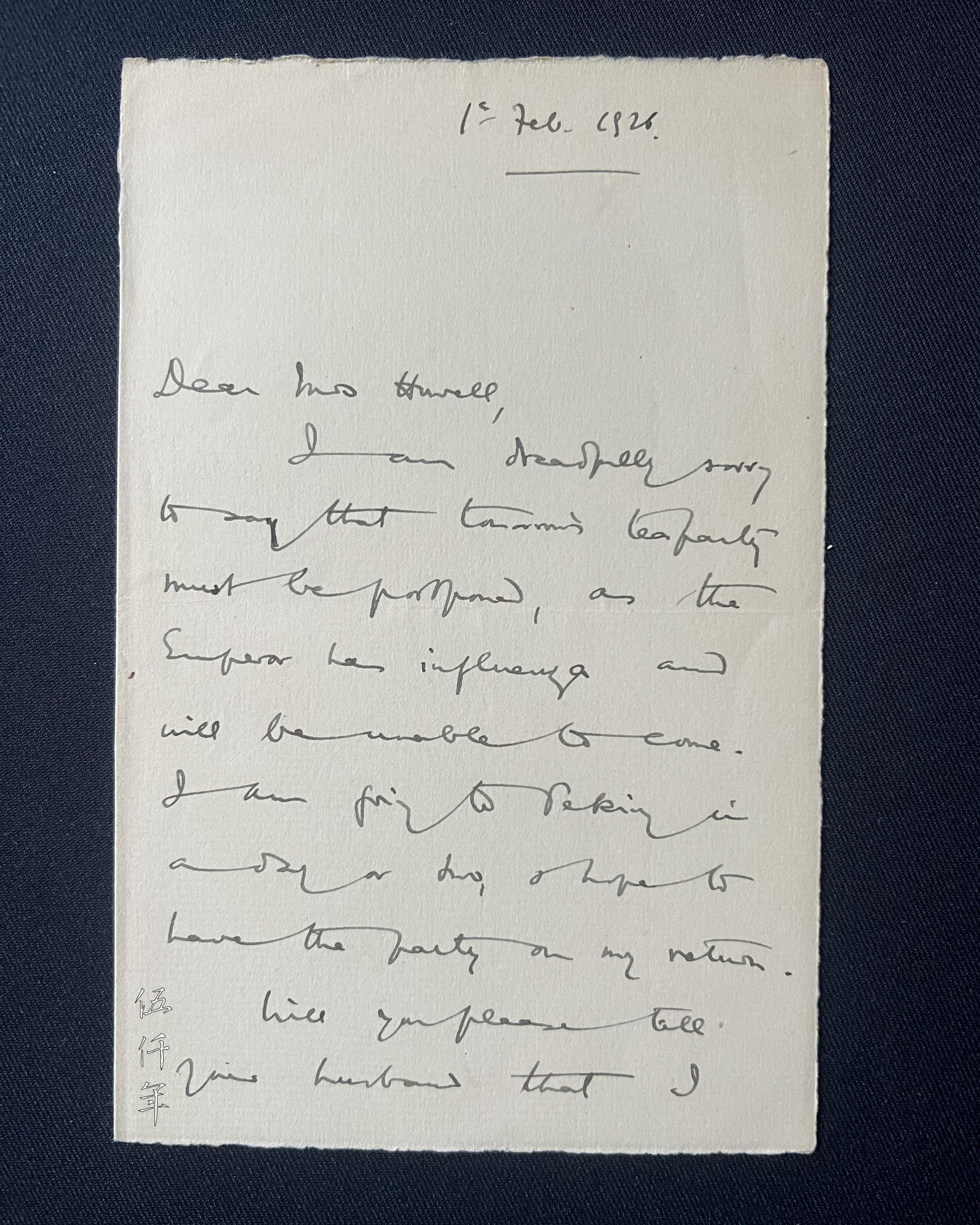
First page of letter by Reginald F. Johnston to Mrs. Howell
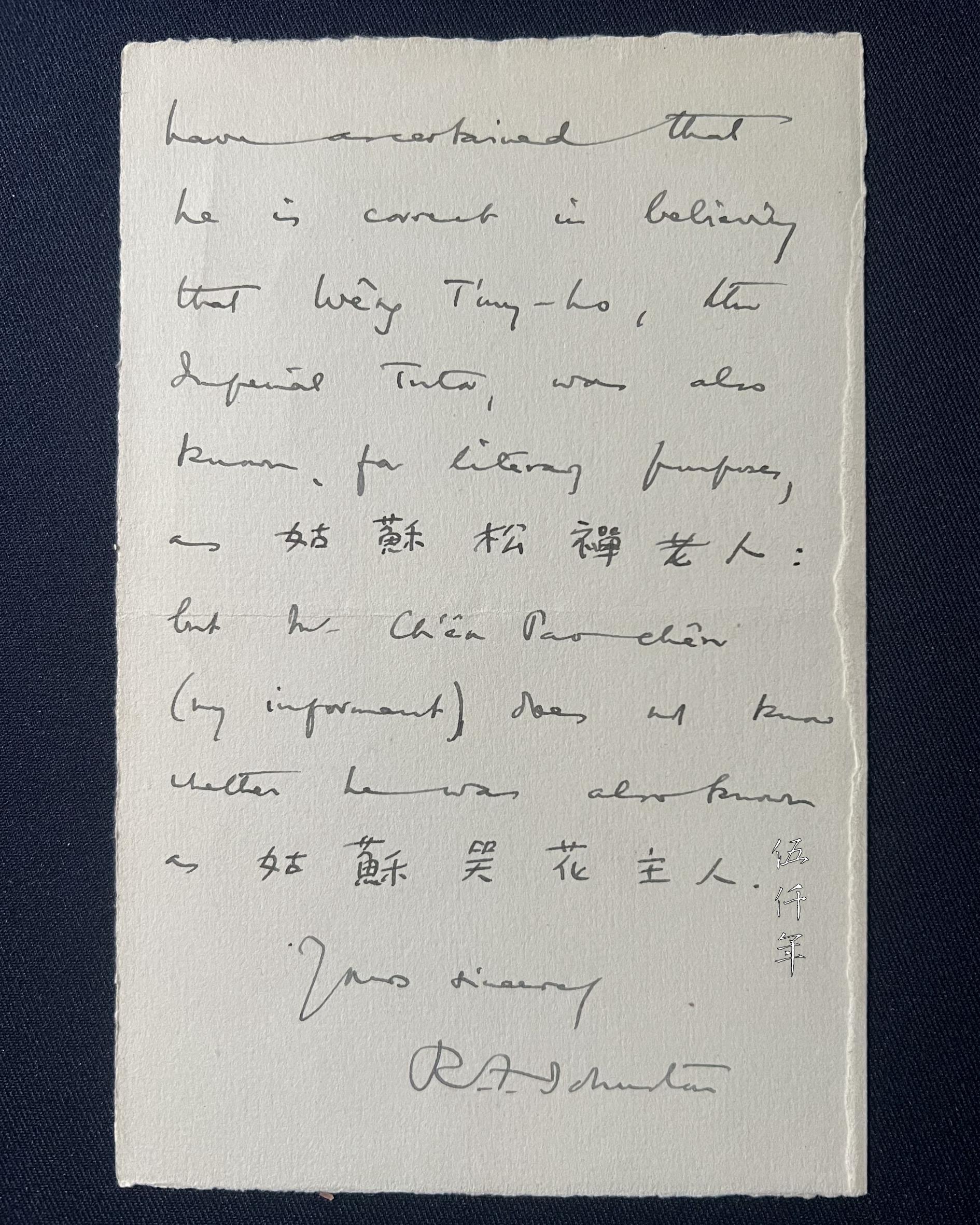
Second page of letter by Reginald F. Johnston
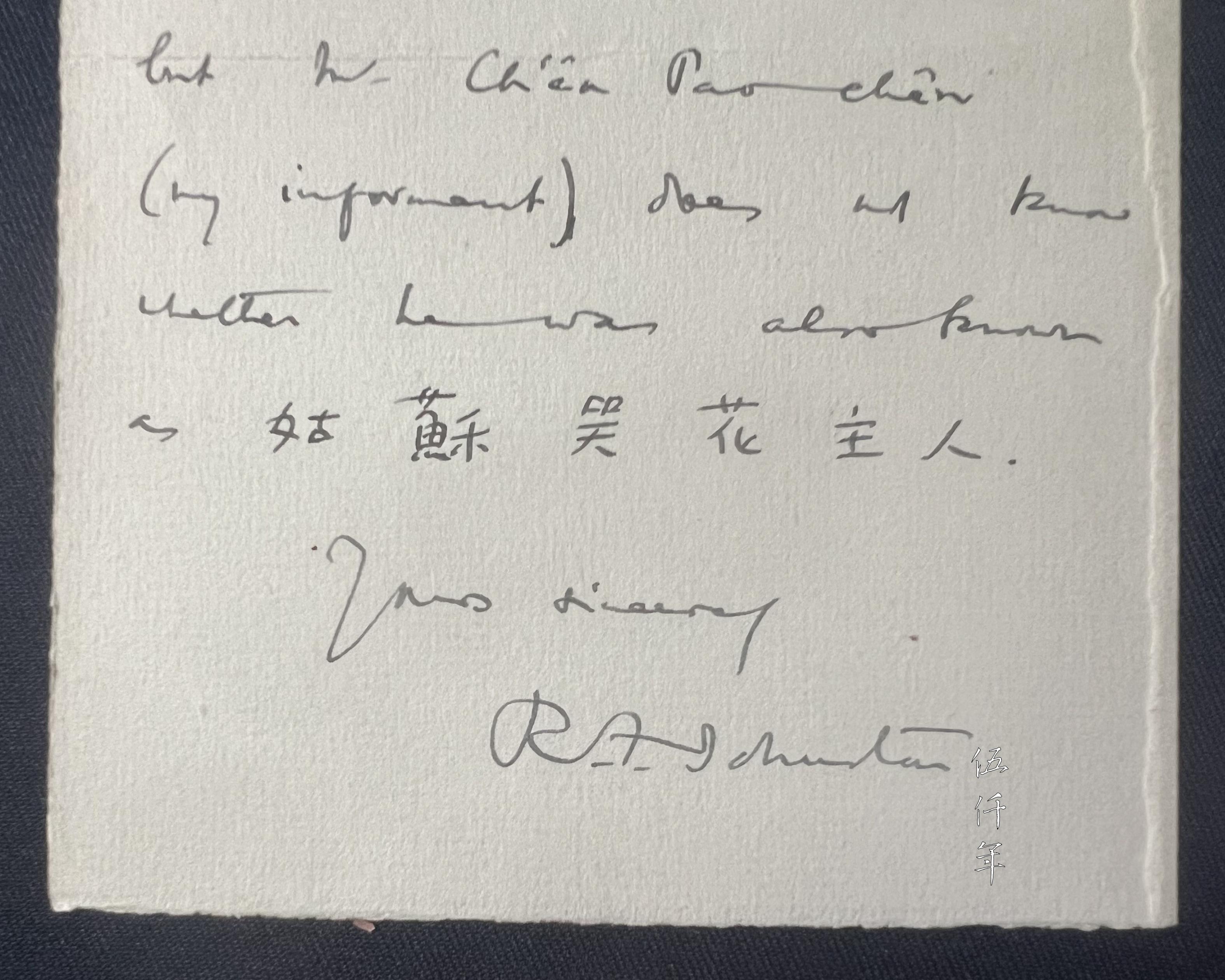
Detail of signature by Reginald F. Johnston
In my collection there is a letter by Johnston to Mrs. Howell, regarding a tea party to be hosted by P’u-i. It was dated 1 February 1926 when P’u-i was living in Tientsin after being expelled from the Forbidden City.
The letter reads:
“1st Feb. 1926
Dear Mrs. Howell,
I am dreadfully sorry
to say that tomorrow’s tea party
must be postponed, as the
Emperor has influenza and
will be unable to come.
I am going to Peking in
a day or two, and hope to
have the party on my return.
Will you please tell
your husband that I
have ascertained that
he is correct in believing
that Wên T’ung-ho, the
Imperial Tutor, was also
known for literary purposes,
as 姑蘇松禪老人:
but Mr. Ch’ên Pao-chên
(my informant) does not know
whether he was also known
as 姑蘇笑花主人.
Yours sincerely,
R. F. Johnston”
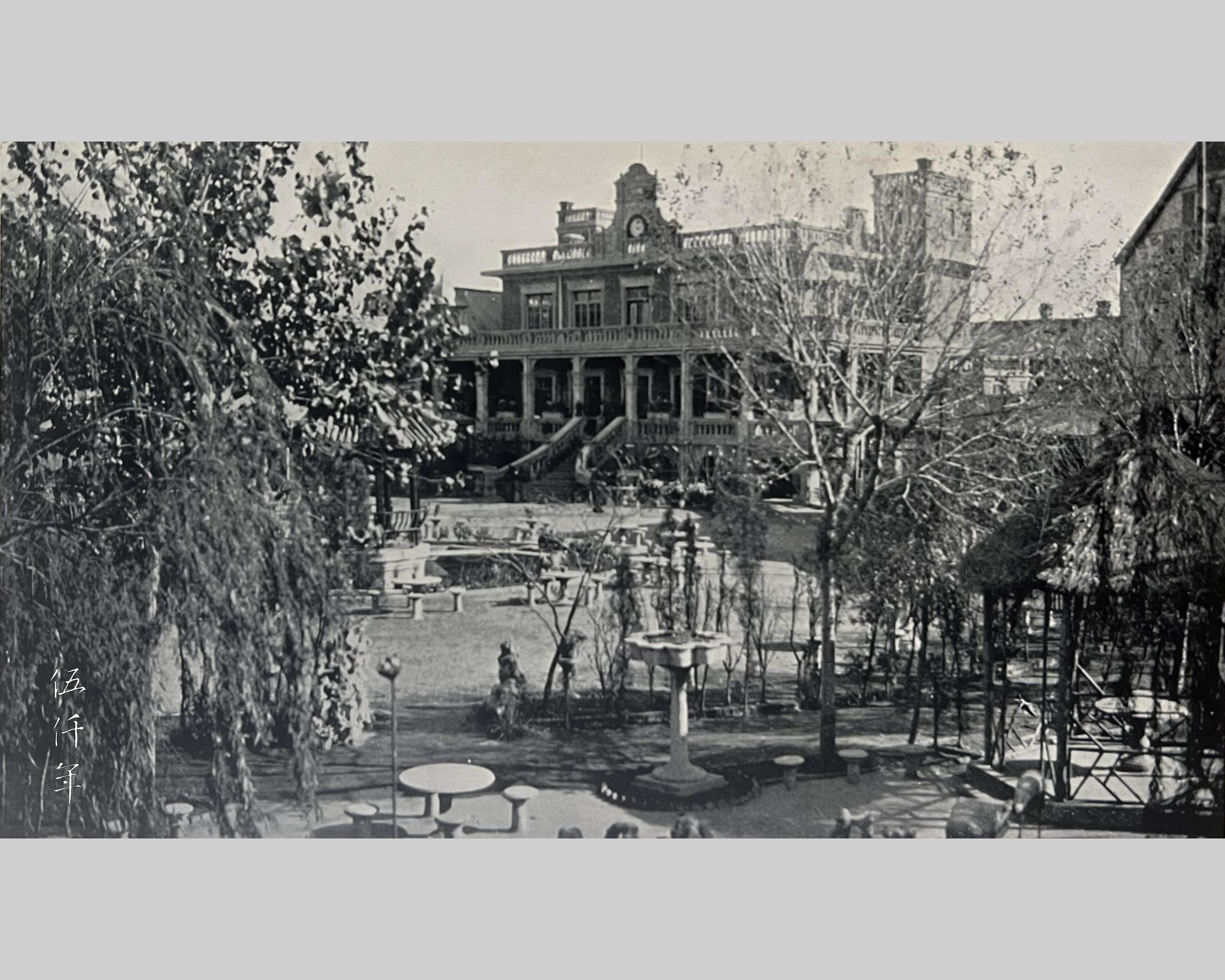
Chang Yüan, Emperor P’u-i’s house in Tientsin
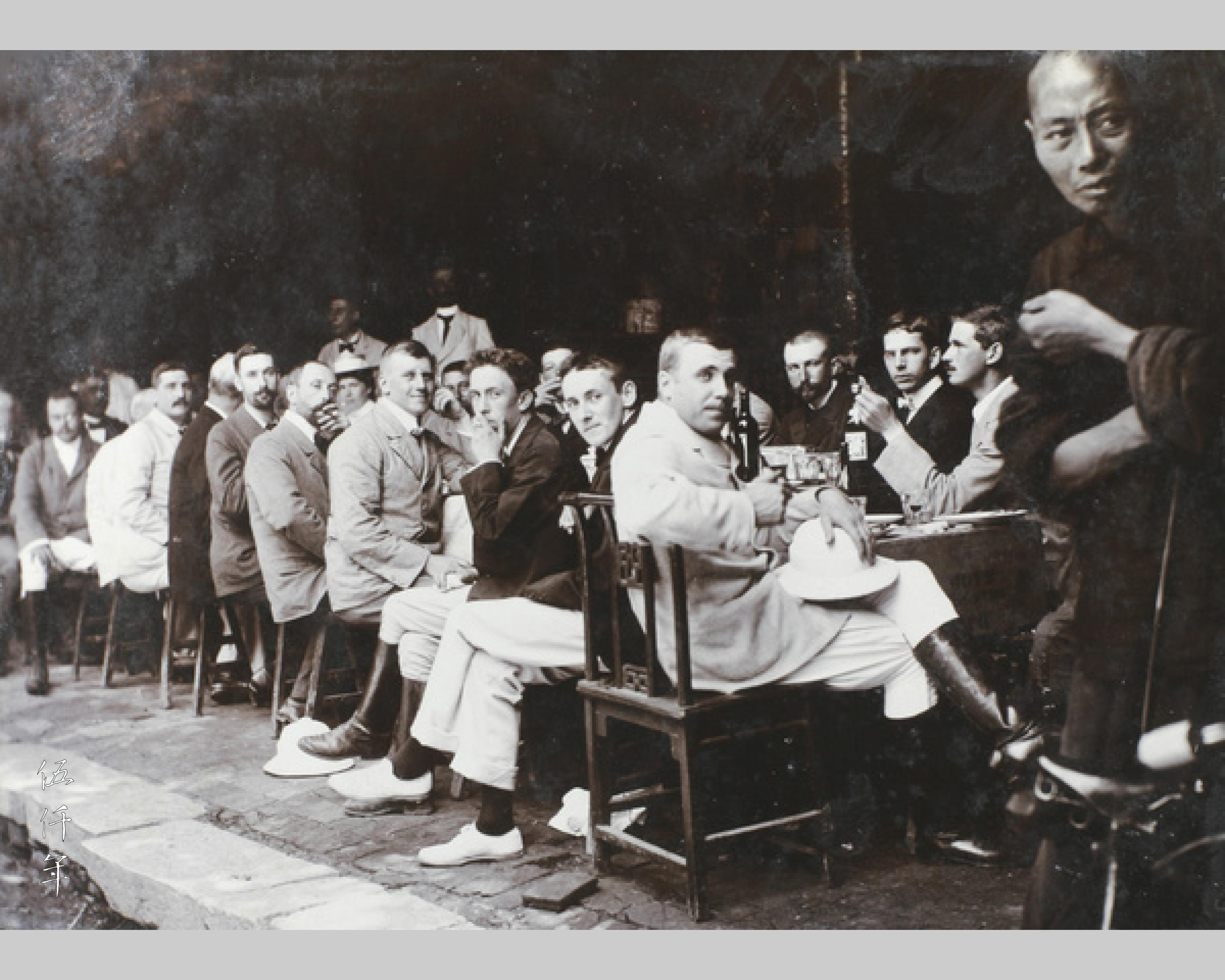
Staff banquet of the Chinese Maritime Customs in Nanking, seated first right in the first right row was Edward Butts Howell, his left hand holding a plant. Photograph courtesy University of Bristol, Historical Photographs of China Archive
One may venture to conjecture the identity of Mrs. Howell. At that time, the commissioner of the Tientsin office of Chinese Maritime Customs Service was the British national Edward Butts Howell (1879–1952), a botanist, translator, and sinologist. His translation work is titled The Inconstancy of Madam Chuang, and Other Stories from the Chinese, published in 1924. This is a translation of selected chapters from Chin-ku ch’i-kuan (今古奇觀 Strange Tales Old and New).
The name of Ku-su Hsiao-hua Chu-jen (姑蘇笑花主人) referred in the letter appears as the author of a foreword in Chin-ku ch’i-kuan. It is therefore very likely that Howell inquired about the identity of the author, and Johnston replied in writing to his wife.
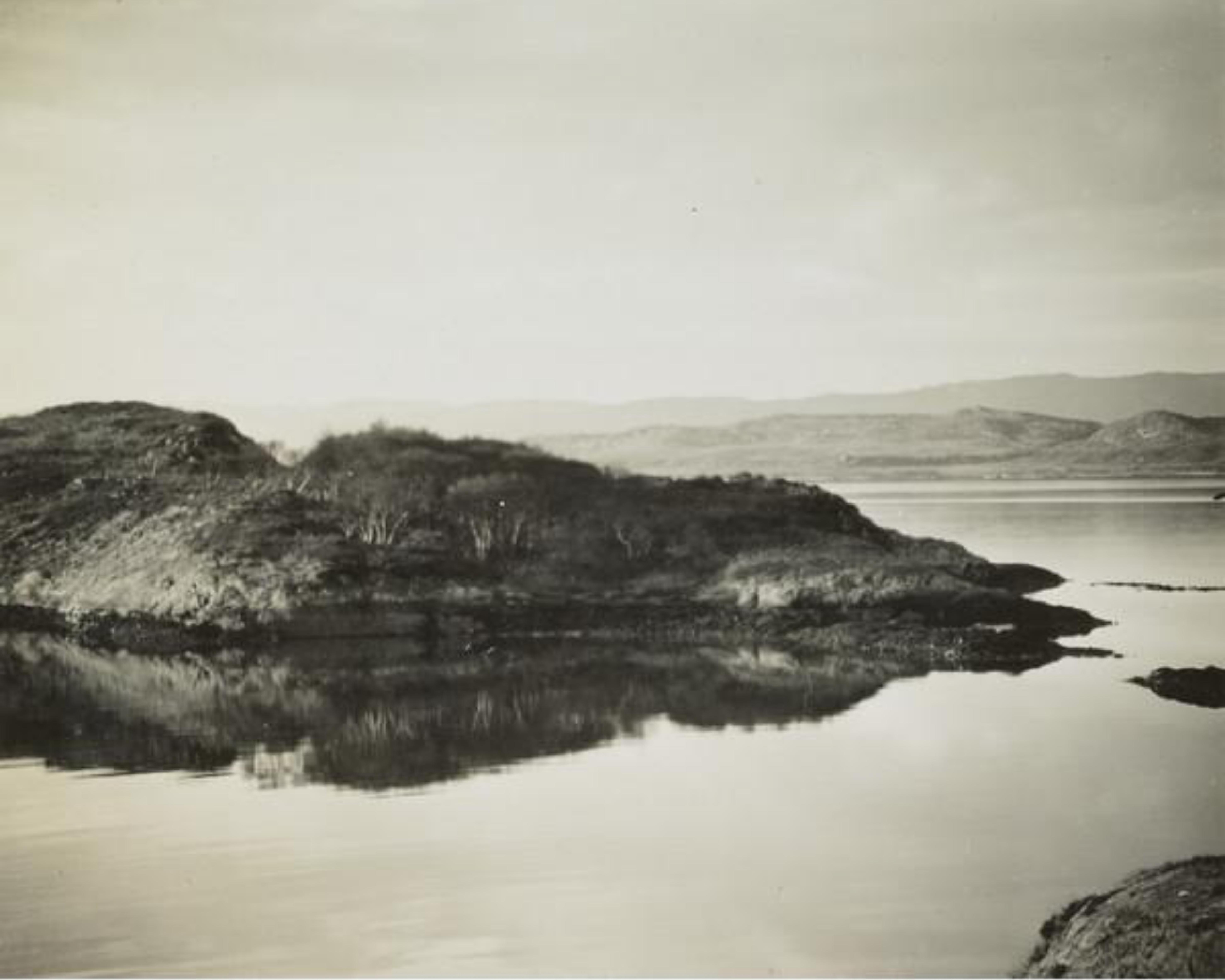
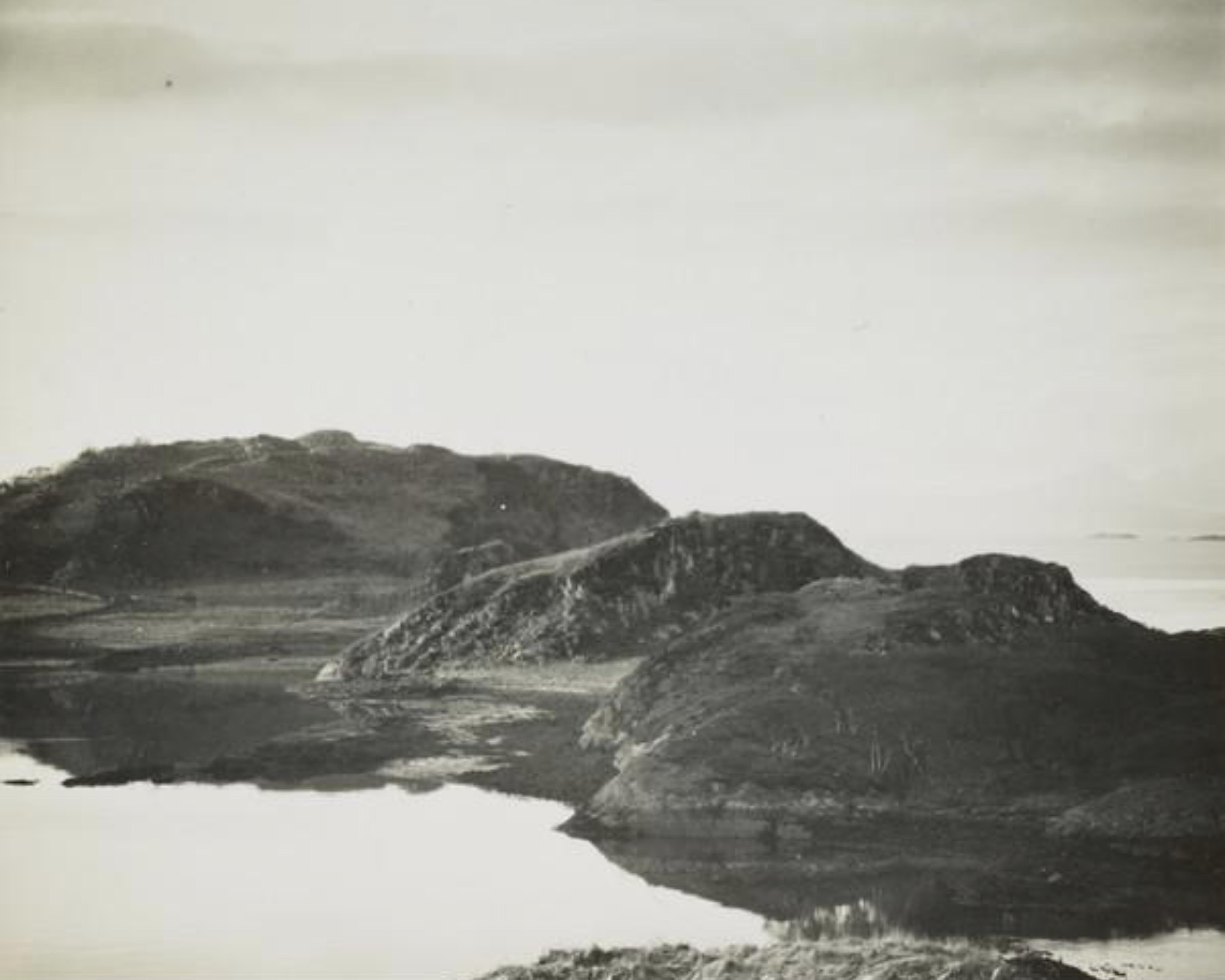
A view of Eileen Righ in Scotland, taken by Reginald F. Johnston in 1930. Photograph courtesy The Stewart Lockhart Photographic Archive of George Watson’s College
Another view of Eileen Righ in Scotland, taken by Reginald F. Johnston in 1930. Photograph courtesy The Stewart Lockhart Photographic Archive of George Watson’s College
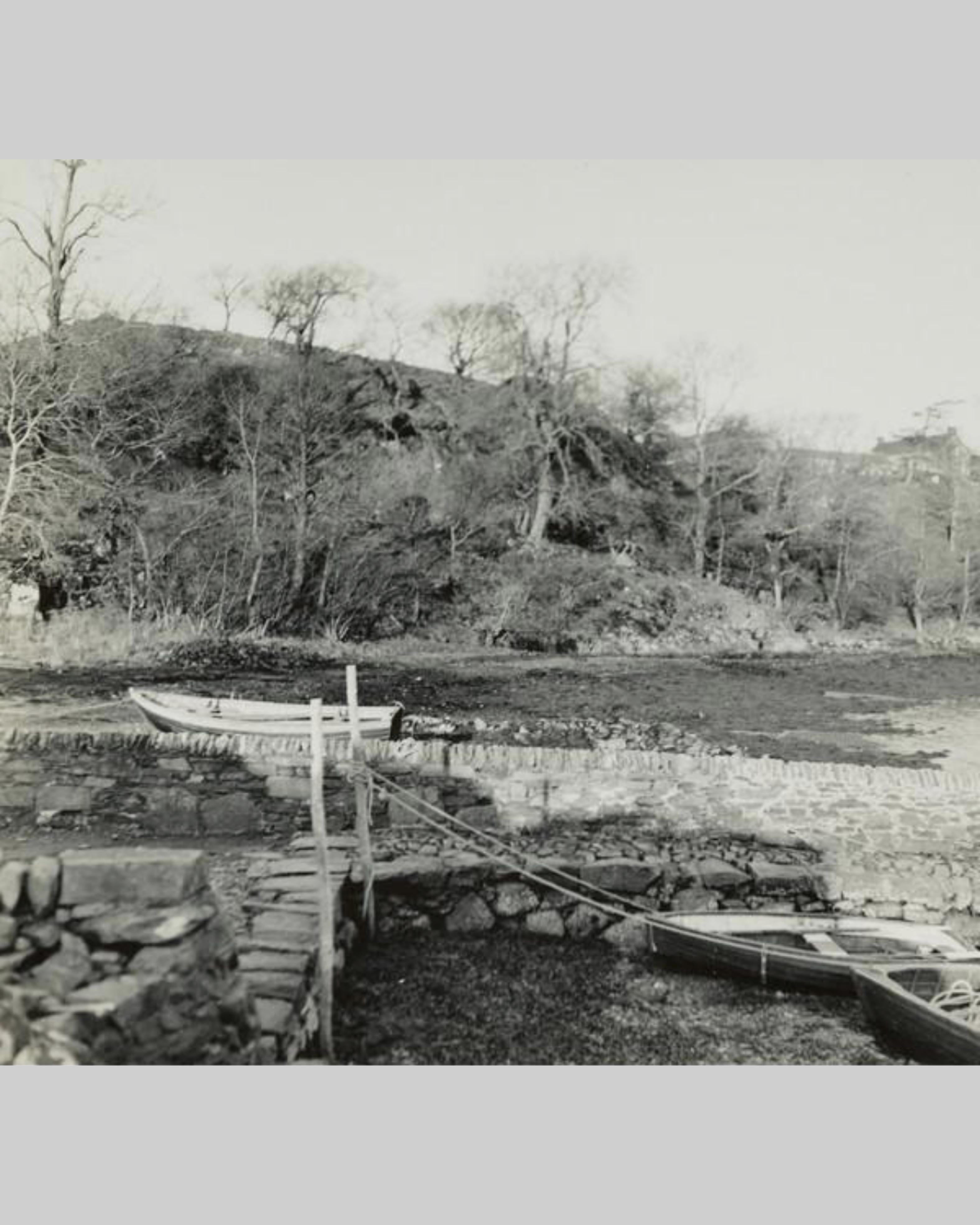
View of landing pier on Eileen Righ in Scotland, taken by Reginald F. Johnston on 30 January 930. Photograph courtesy The Stewart Lockhart Photographic Archive of George Watson’s College
In 1934, Johnston purchased an island named Eileen Righ in Scotland. In 1937, when his academic appointment came to an end, he moved there for retirement. “Eileen Righ” is Scottish Gaelic, meaning “King’s Island”. The island covers eighty-six hectares, or 860,000 square meters, and lies some 300 meters offshore. It was an uninhabited and desolate place. It is said that Johnston built a Buddhist shrine and laid out a Chinese garden there, employed Chinese servants, and raised the imperial flag of Manchukuo every day to convey his attachment to the Ch’ing court.
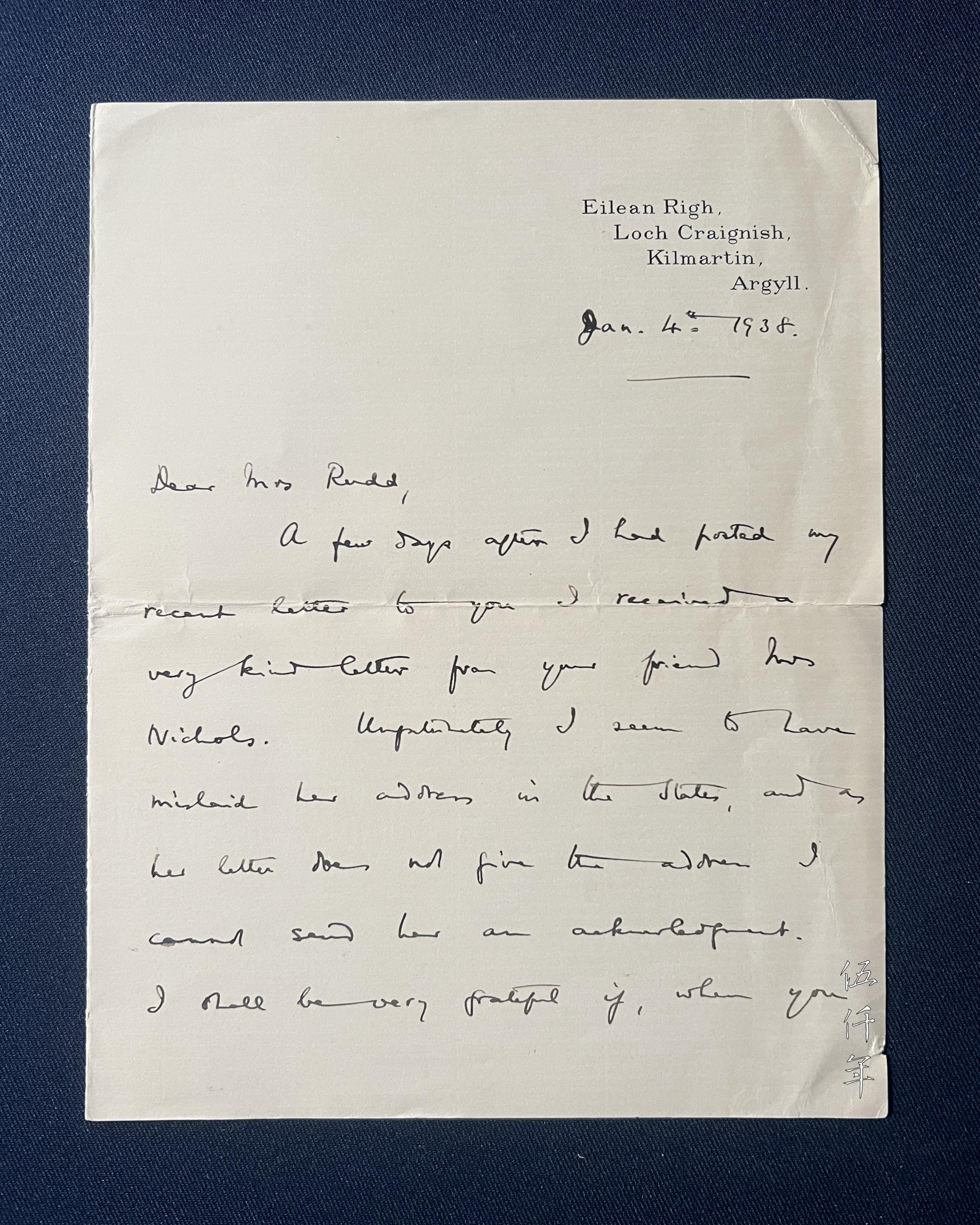
First page of letter by Reginald F. Johnston to Mrs. Rudd
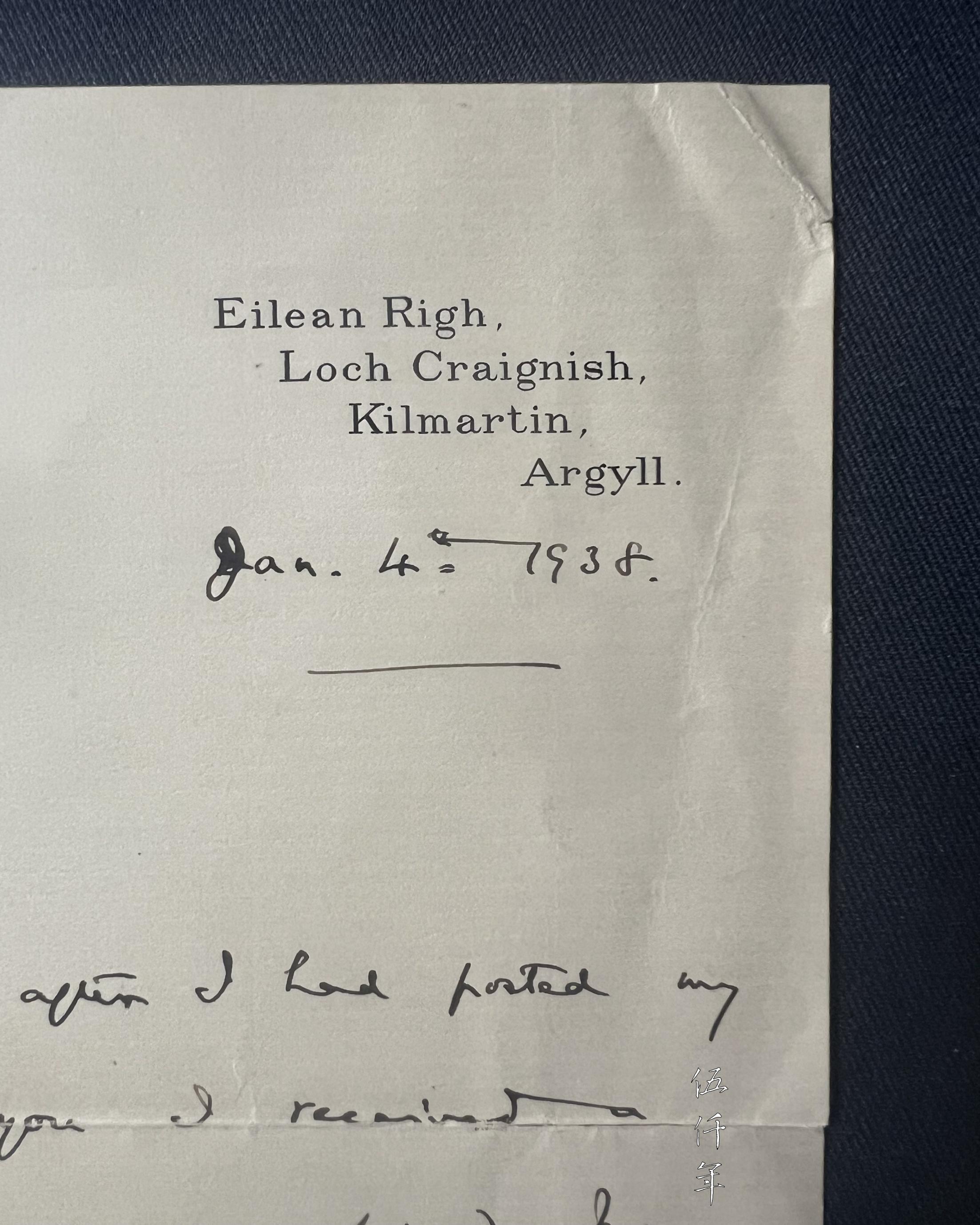
Detail of Eileen Righ address on letter sheet
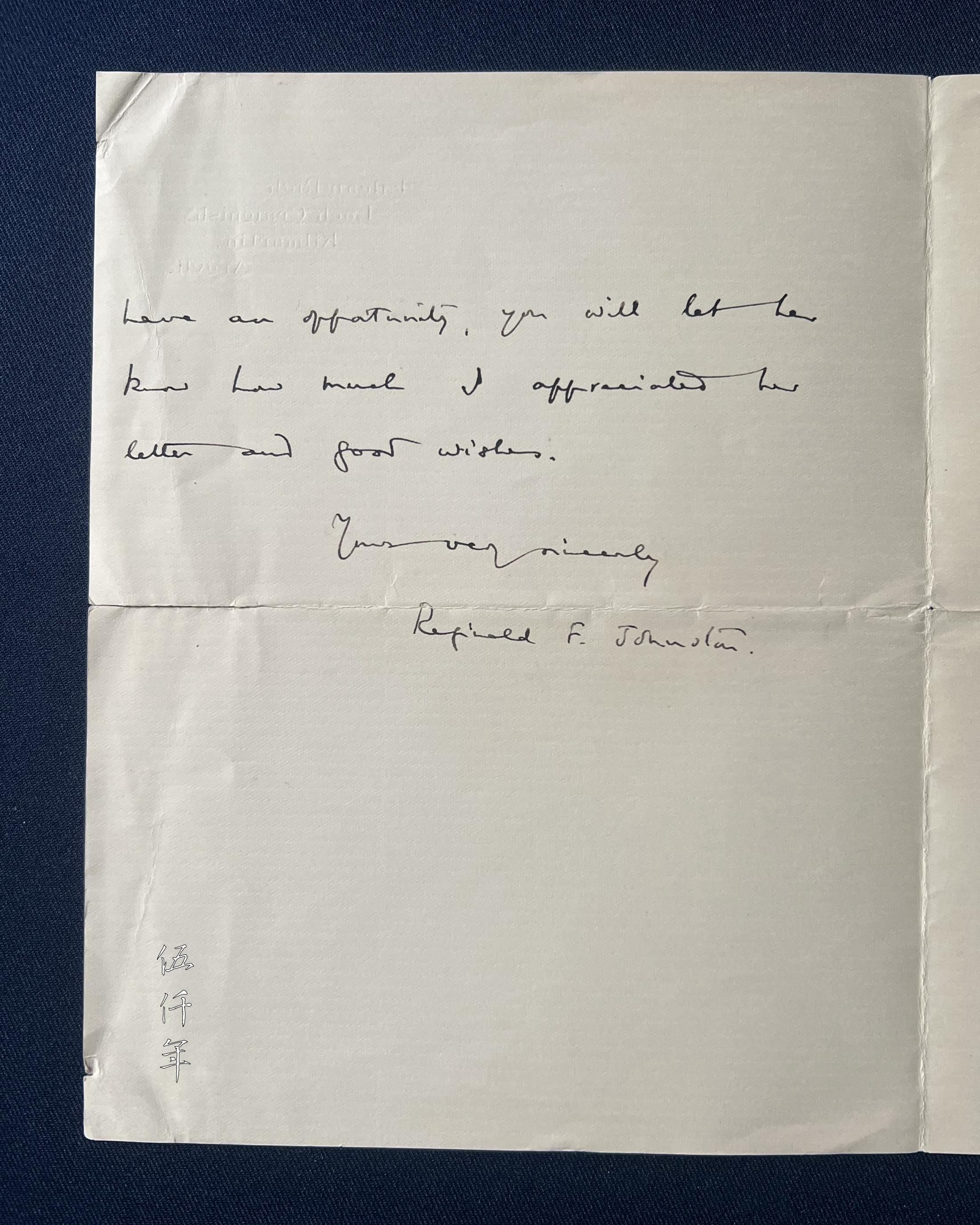
Second page of letter by Reginald F. Johnston to Mrs. Rudd
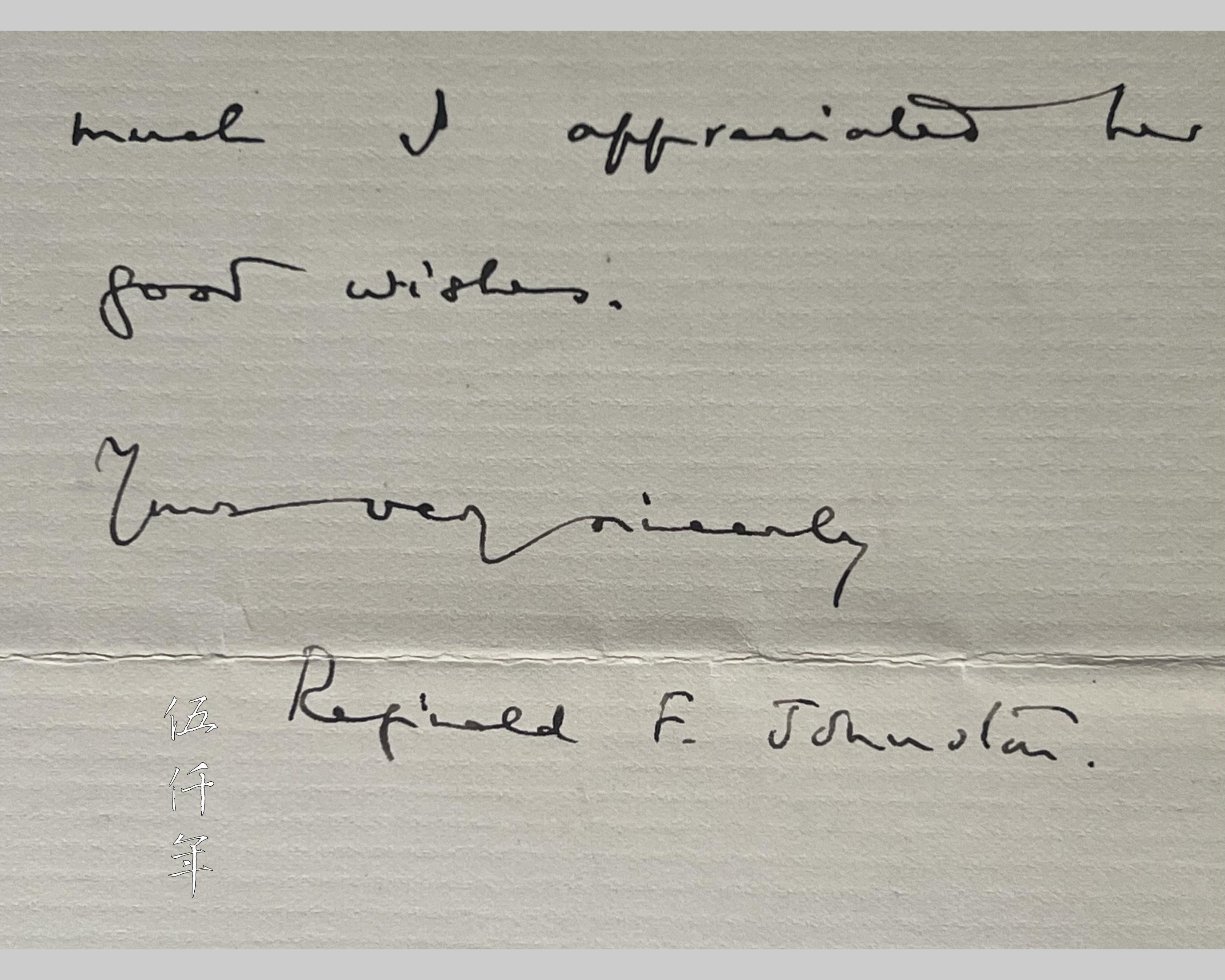
Detail of signature by Reginald F. Johnston
There is another letter in my collection by Johnston to an American named Mrs. Rudd. It was dated 4 January 1938 when he was already living in Eileen Righ. On the letterhead, the full address of Eileen Righ was printed on the upper right corner:
“Eileen Righ,
Loch Craignish,
Kilmartin,
Argyll.”
The letter reads:
“Jan. 4, 1938
Dear Mrs. Rudd,
A few days after I had posted my
recent letter to you I received a
very kind letter from your friend Mrs.
Nichols. Unfortunately I seem to have
mislaid her address in the States, and as
her letter does not give the address I
cannot send her an acknowledgement.
I shall be very grateful if, when you
have an opportunity, you will let her
know how much I appreciate her
letter and good wishes.
Yours very sincerely,
Reginald F. Johnston”
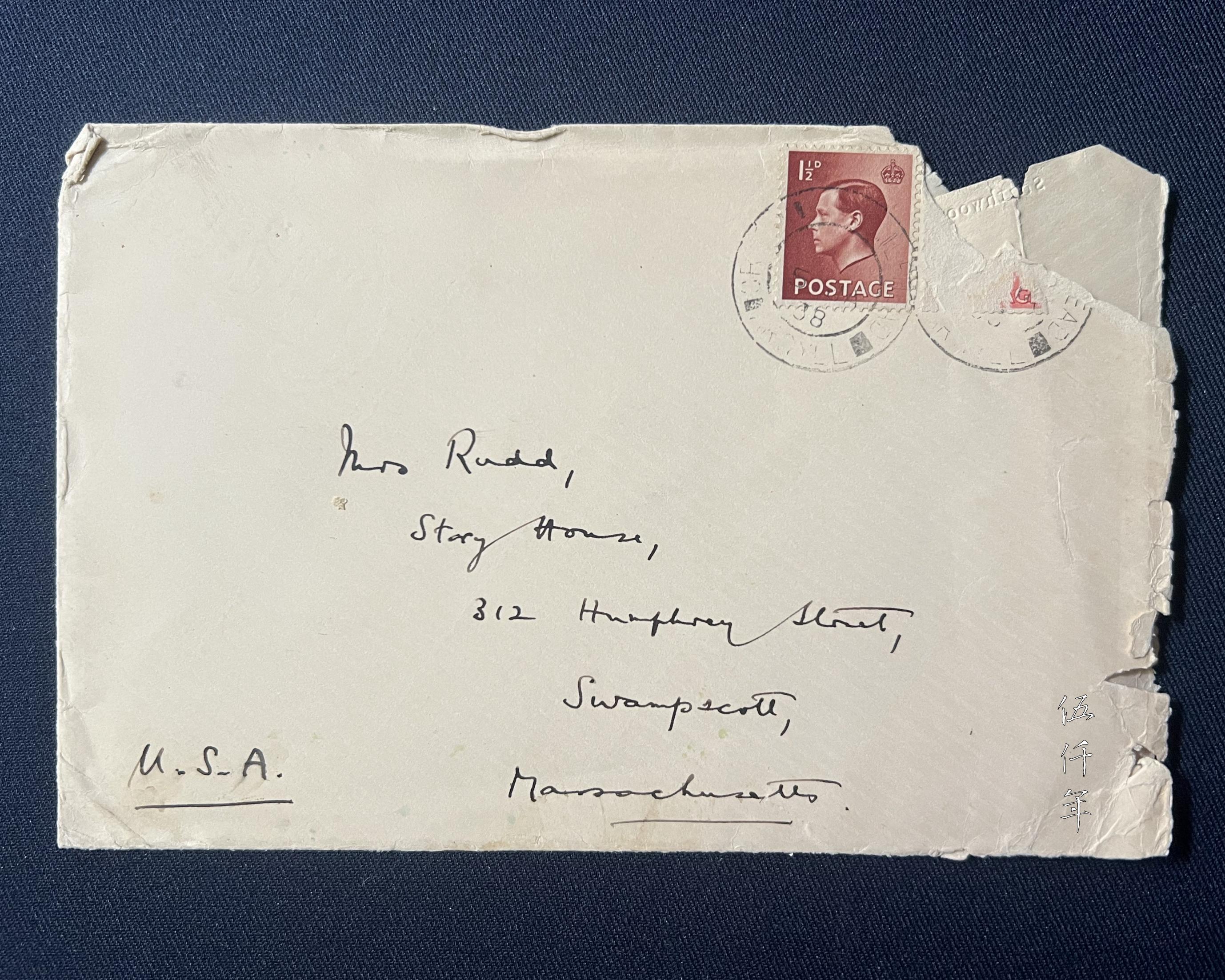
Envelope written by Reginald F. Johnston to Mrs. Rudd
The address on the envelope is:
“Mrs. Rudd,
Story House,
312 Humphrey Street,
Swampscott,
Massachusetts,
U.S.A.”
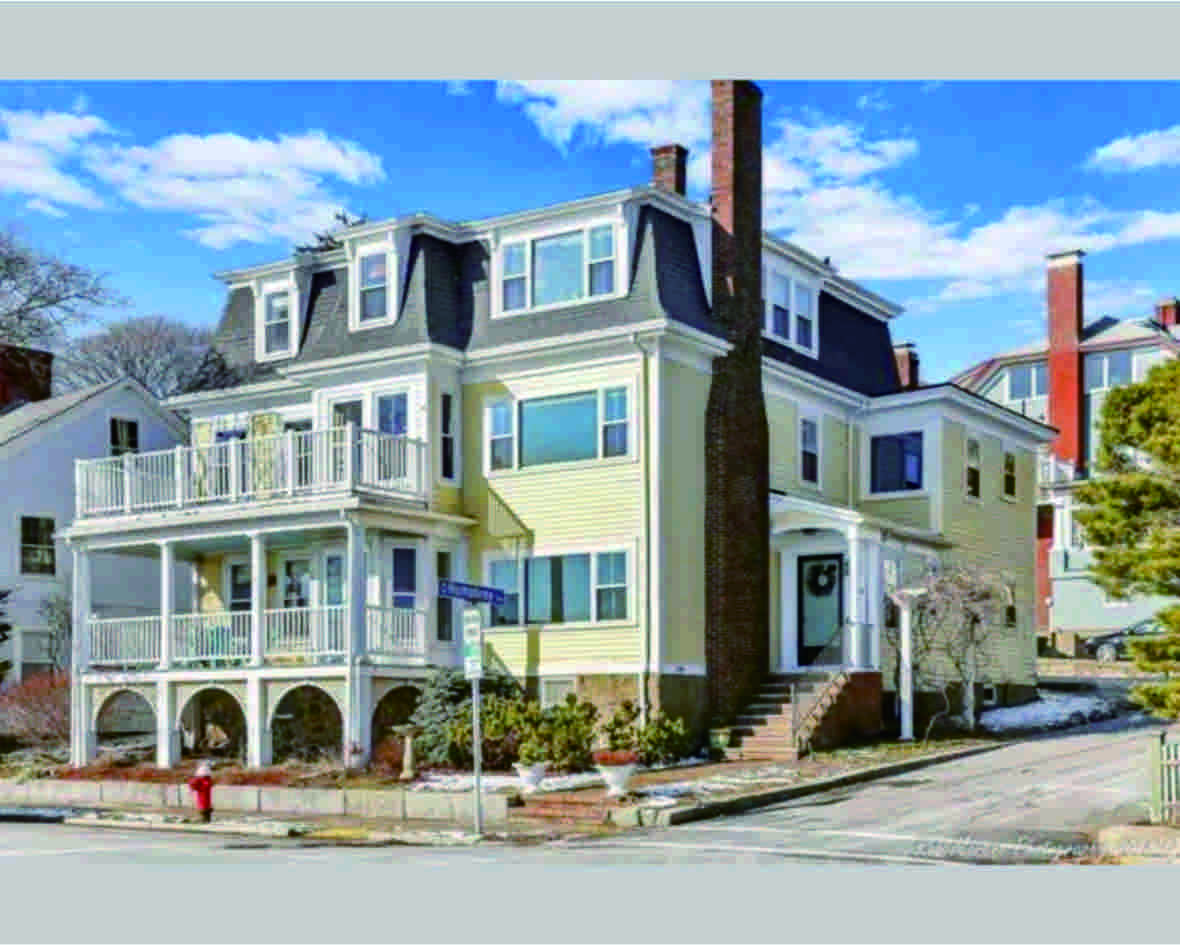
Former residence of Mrs. Mabel Ward Rudd at 312 Humphrey Street, Swampscott, Massachusetts
Upon checking Mrs. Rudd’s address in Massachusetts, the house she lived in still stands today. It is a three-storey nineteenth-century American-style building. The full name of Mrs. Rudd was Mabel Ward Rudd (1877–1958), and her husband was Frederick J. Rudd (1880–1960). Mrs. Rudd was a poetress, her works include To the Bluebird, published in 1924 and Cornelius to Mary Gay, published in 1934. Johnston’s letter to Mrs. Rudd was written on 4 January 1938. A mere fifty-four days later, on 6 March, Johnston died from illness. On 20 February, he underwent surgery at a hospital in Edinburgh for the removal of kidney stones, complications ensued, and the condition proved fatal. This letter may well be his final written words to have survived.
After Reginald Johnston’s death, his fiancee, Elizabeth Sparshott, quickly burned all his manuscripts. The hidden stories and intricacies of many historic figures and events were reduced to ashes and smoke, how can one not feel profound regret? For the same reason, it is rare to come across any of his writing on paper. Had Johnston not died when he did, but instead lived to witness from afar China’s War of Resistance Against Japanese Aggression, her final victory, subsequent fall of mainland China to the communists, the Cultural Revolution, and P’u-i being a political puppet for thirty-five years, while Classical Chinese Culture itself dissipated like a dream; the measure of his sorrows and reflections would likely have been beyond the comprehension of most people, not even just a fraction.
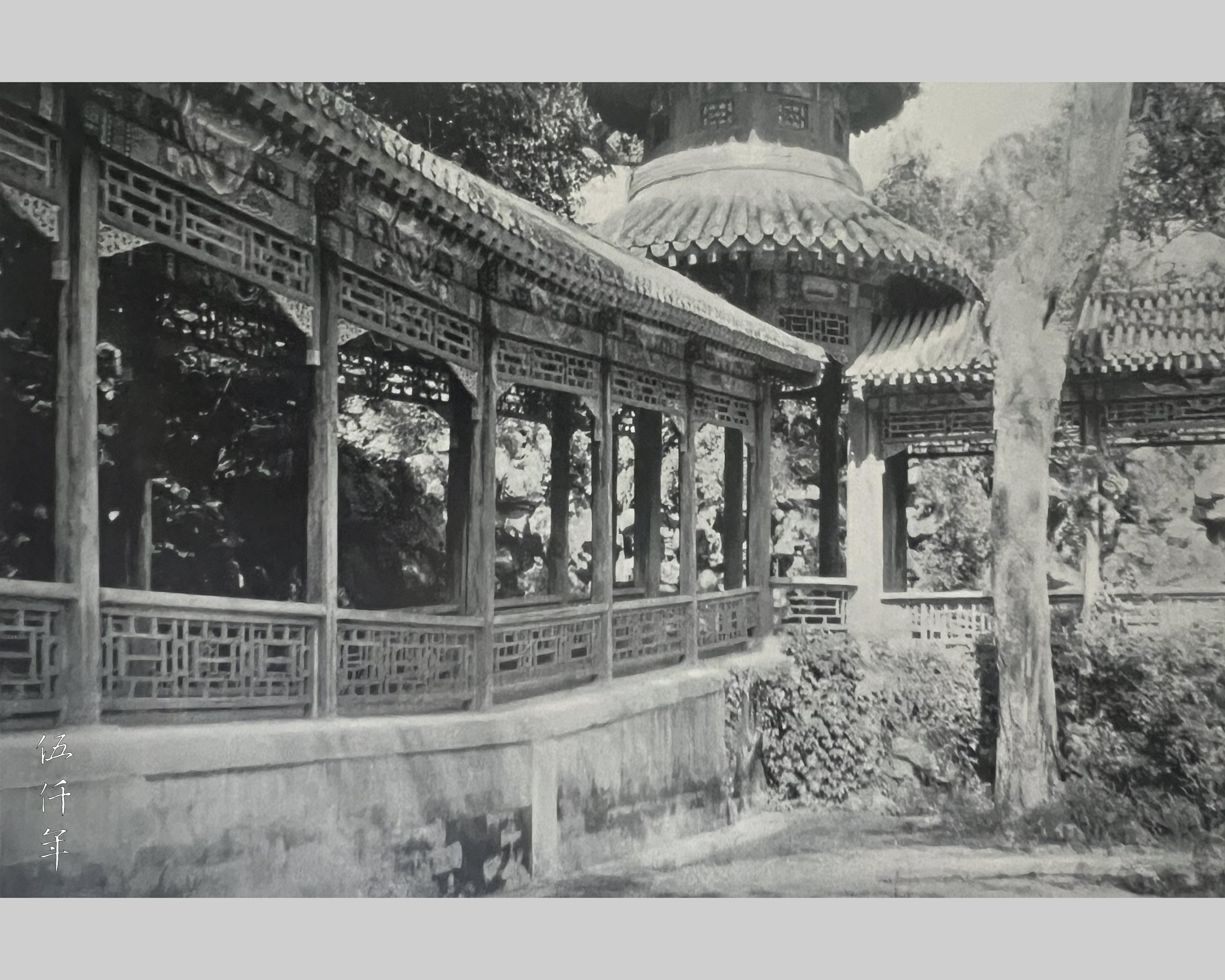
Garden view of the quarters of Reginald. F. Johnston in the Summer Palace