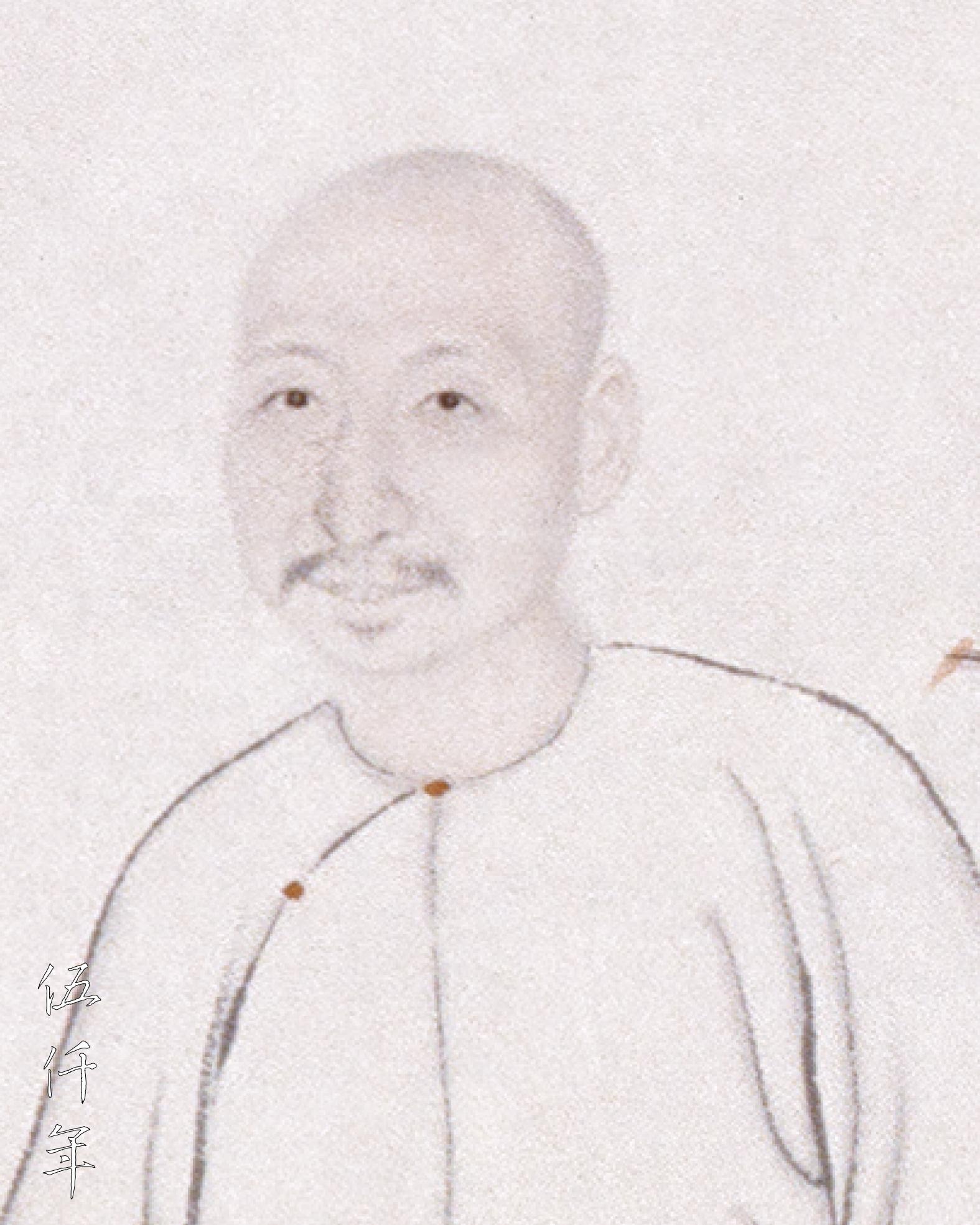
Gathering Acorns with Monkeys (隨狙拾橡圖), painted by the master tz’u poet Chiang Ch’un-lin (蔣春霖), is his only extant self-portrait, as well as his only extant painting. After Chiang Ch’un-lin committed suicide for abandoned love, this painting was passed down to his nephew Chiang Yü-leng (蔣玉棱). Later on, he asked the celebrated artist Wu Ch’ang-shuo (吳昌碩) to inscribe the painting, and the famous literatus Mao Kuang-sheng (冒廣生) chronicled the painting in Tz’u Commentaries from the Hsiao-san-wu Pavilion (小三吾亭詞話). There is nothing extravagant to claim that this painting is an extraordinary treasure in the world of Chinese classical literature. Perusing the images of Tz’u Lyrics from the Water-and-Cloud Pavilion (水雲樓詞) and Gathering Acorns with Monkeys, it is ever more woeful to contemplate the life adversities of a talented poet.
Curatorial and Editorial Department
Tz’u (詞) lyrics in the Ch’ing dynasty far surpass those of the Yüan and Ming dynasties, the multitude of tz’u poets, the profusion of tz’u publications, both exceed previous dynasties. Chiang Ch’un-lin (蔣春霖) is the master tz’u poet of the Chia-ch’ing and Tao-kuang reigns. He wrote Tz’u Lyrics from the Water-and-Cloud Pavilion (水雲樓詞, Shui-yün Lou Tz’u), comprising two volumes and a supplementary volume.
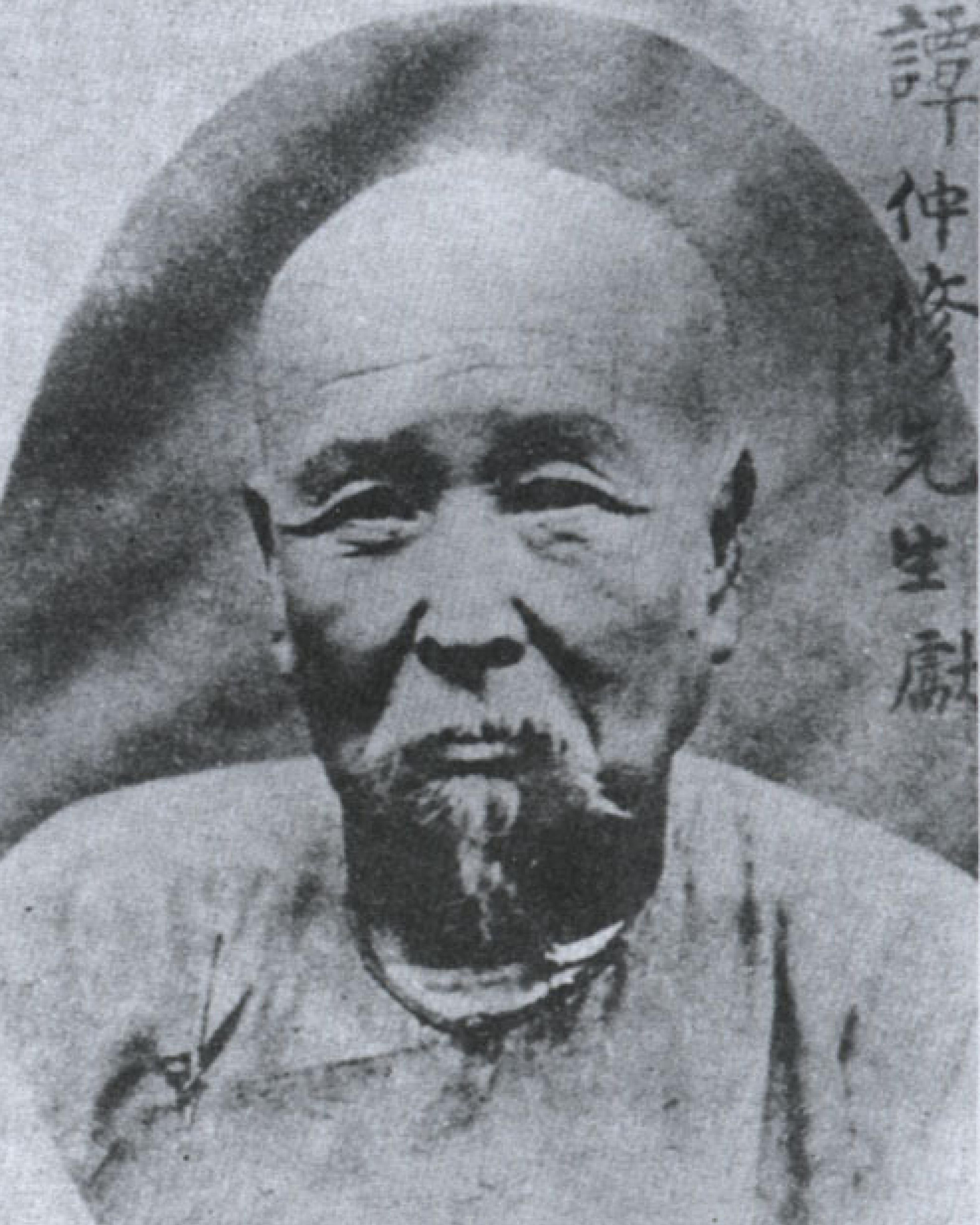
Portrait of T’an Hsien
T’an Hsien (譚獻 1832-1901) whose tzu (字) was Chung-hsiu (仲修) and his hao (號) was Fu-t’ang (復堂), is a tz’u poet in late Ch’ing. In his work Tz’u Lyrics from the Library Trunk (篋中詞, Ch’ieh-chung Tz’u), he commented on the tz’u lyrics of Chiang Ch’un-lin:
“Tz’u Lyrics from the Water-and-Cloud Pavilion is indeed made up of mournful and plaintive tones, as well as solemn and stirring notes. Yet its lineage is thoroughly orthodox and its sources of inspiration remarkably broad. Together with Na-lan Hsing-te (納蘭性德) and Hsiang Hung-tso (項鴻祚), they stand as the three great pillars of tz’u literature over the past two centuries. Amid the wars of the Hsien-feng reign, providence had favoured the talent of Chiang Ch’un-lin. His standing in tz’u tradition is akin to that of the renowned poet Tu Fu (杜甫 712-770) in the verse tradition. The pines and lamentations common in literary expressions of late T’ang, Northern Sung and Southern Sung dynasties are more curtailed. Some may venture to ask: ‘Why should he be ranked alongside Na-lan Hsing-te and Hsiang Hung-tso?’ I will reply: ‘The tz’u lyrics of Wang Shih-chen (王士禎 1634-1711), hao Yüan-t’ing (阮亭); and Ch’ien Fang-piao (錢芳標), tzu Pao-feng (葆馚) are works by men of talent. The tz’u lyrics of Chang Ch’i (張琦1764-1833), hao Wan-lin (宛鄰); and Chou Chi (周濟 1781-1839), hao Chih-an (止庵) are works by men of learning. The tz’u lyrics of the three great pillars are works by men with the soul of tz’u. Their tz’u lyrics are as meticulous as those by Chu I-tsun (朱彝尊 1629-1709) and Li O (厲鶚 1692-1752) but with different poetic qualities. All other tz’u poets play the role of supporting cast.”
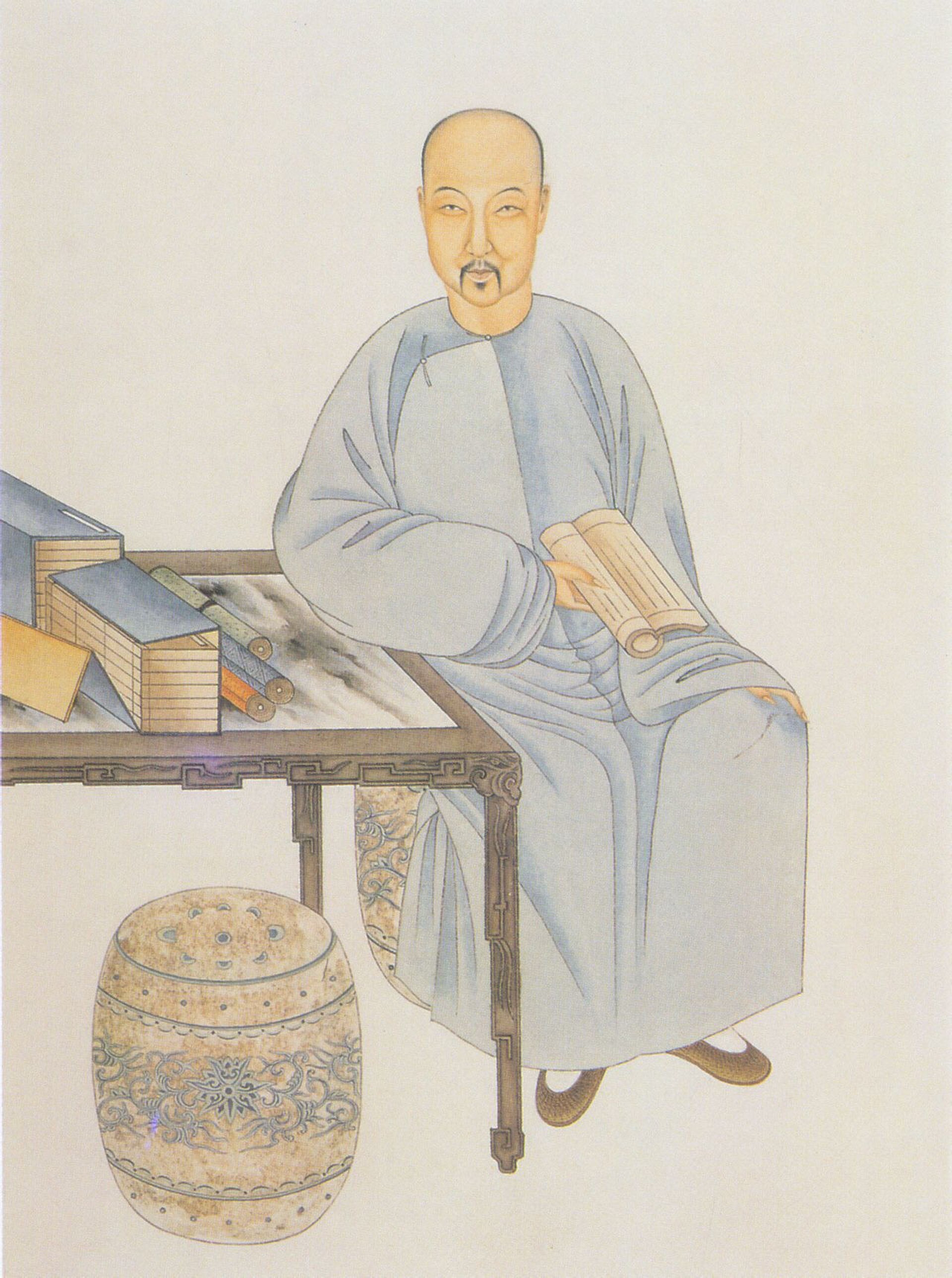
Portrait of Na-lan Hsing-te
T’an Hsien had thus suggested that Na-lan Hsing-te (納蘭性德 1655-1685), tzu Jung-jo (容若); Hsiang Hung-tso (項鴻祚1798-1835), tzu Lien-sheng (蓮生); and Chiang Ch’un-lin (蔣春霖), tzu Lu-t’an (鹿潭) were the three great pillars of tz’u literature for over two centuries during the Ch’ing dynasty.
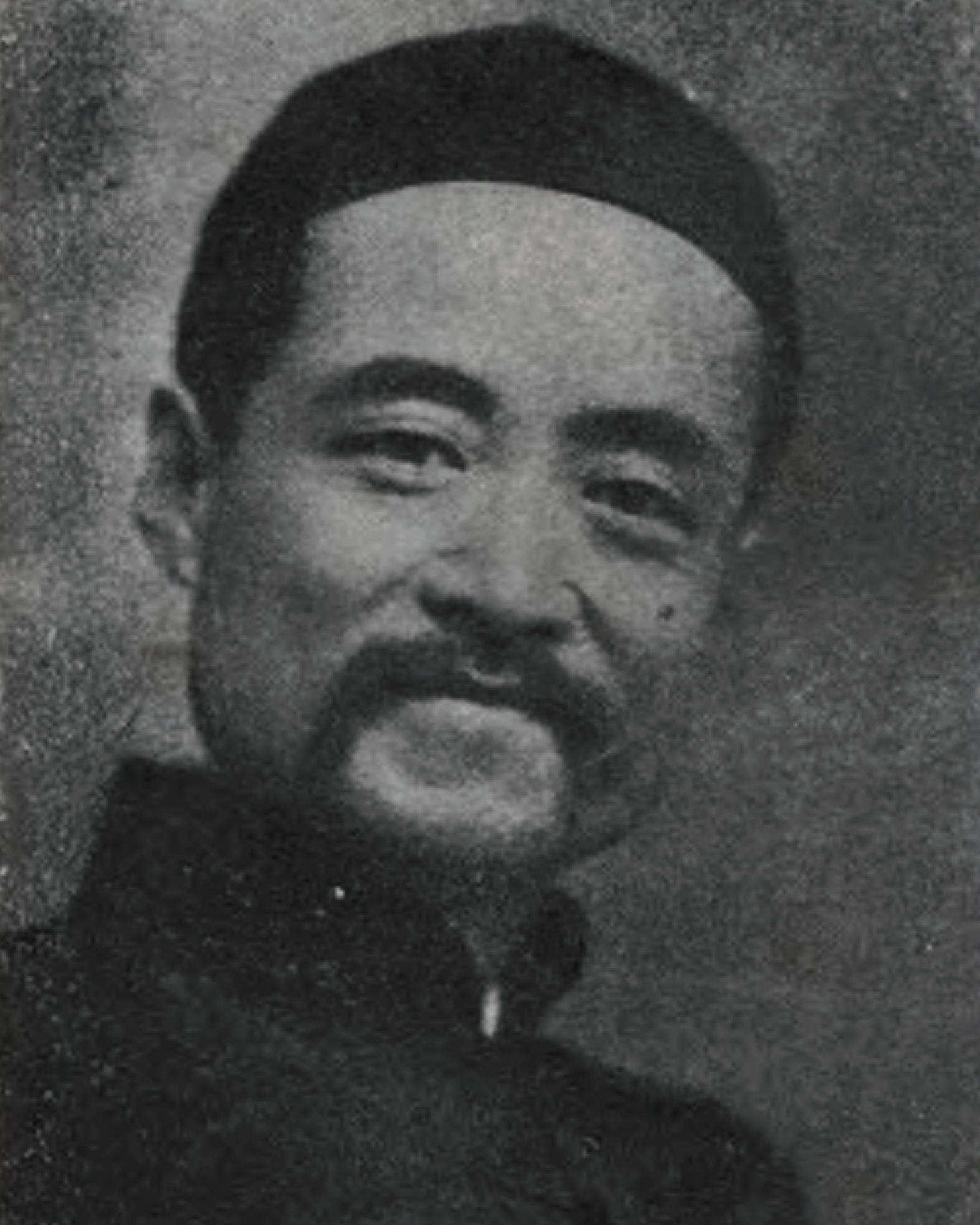
吳瞿安先生遺影Portrait of Wu Mei
The early Republican-period lyricist Wu Mei (吳梅 1884-1938), tzu Ch’ü-an (瞿安), wrote A General Treatise of Tz’u Literature (詞學通論, Tz’u-hsüeh T’ung-lun ). An excerpted passage on the tz’u lyrics of Chiang Ch’un-lin reads:
“Prior to the Chia-ch’ing reign, tz’u poets are for the most part overshadowed by Ch’en Wei-sung (陳維崧 1625-1682), tzu Ch’i-nien (其年); and Chu I-tsun (朱彝尊 1629-1709), hao Chu-ch’a (竹垞). Chang Hui-yen (張惠言 1761-1802), tzu Kao-wen (皋文); and Chou Chi (周濟 1781-1839), tzu Pao-hsü (保緒) raised the banner of allegorical significance, moving beyond mere imitation of the Southern Sung masters, and discreetly rivalled Li O (厲鶚 1692-1752), hao Fan-hsieh (樊榭). Such, in broad outline, is the development of various schools of tz’u lyrics in the Ch’ing dynasty. Chiang Ch’un-lin, tzu Lu-t’an (鹿潭), however, swept aside all such entanglements, aligning himself with no school in particular. He adhered only to the concept of poetic refinement as his highest literary principle. Indeed, his tz’u lyrics surpass even those by Chang Hui-yen (張惠言) and Chou Chi (周濟) in the realization of poetic refinement. With Chiang Ch’un-lin, tz’u literature reached its zenith. It is true T’an Hsien (譚獻) held Chuang Yü (莊棫1830-1878), tzu Chung-pai (中白) in high esteem. Ch’en T’ing-ch’ao (陳廷焯 1853-1892), tzu I-feng (亦峯) also applauded Chuang Yü. If we examine the artistry attained by Chuang Yü, it is not enough to challenge Chiang Ch’un-lin... The meticulous prosody of Chiang Ch’un-lin is without equal, while the excellence of his literary craftsmanship sets him apart from all others. At the same time his work possesses a dignified and spontaneous elegance, entirely free from affectation or self-conscious display. It will not be undeserving to rank Tz’u Lyrics from the Water-and-Cloud Pavilion as the foremost tz’u publication of the entire Ch’ing dynasty.”
Wu Mei offered his highest endorsement of Tz’u Lyrics from the Water-and-Cloud Pavilion, even claiming it to be the crowning accomplishment of all tz’u literature in the Ch’ing dynasty.
Chiang Ch’un-lin was born in the 23rd year of the Chia-ch’ing reign 1818, and died in the 7th year of the T’ung-chih reign 1868. His tzu was Lu-t’an (鹿潭). He once lived in the Water-and-Cloud Pavilion (水雲樓, Shui-yün Lou) at the Ku-shou-sheng Temple (古壽聖寺), located in Tung-t’ai county of Kiangsu province. Hence he adopted the name of Water-and-Cloud Pavilion for the title of his tz’u collection: Tz’u Lyrics from the Water-and-Cloud Pavilion (水雲樓詞, Shui-yün Lou Tz’u). However, it has also been said that because he so admired Tz’u Lyrics of Drinking Water (飲水詞, Yin-shui Tz’u) by Na-lan Hsing-te (納蘭性德) and Tz’u Lyrics of Remembering Clouds (憶雲詞, I-yün Tz’u) by Hsiang Hung-tso (項鴻祚), he named his own work Water-and-Cloud by quoting the titles of these two tz’u publications. Both suppositions may be equally grounded.
Chiang Ch’un-lin was a native of Chiang-yin in Kiangsu province, but his place of residence was officially registered at Ta-hsing County of Shun-t’ien prefecture in northern China. His father, Chiang Tsun-tien (蔣尊典), served as department magistrate of Ching-men. He displayed exceptional poetic talent as a child, prompting his elders to praise him as a “tiger cub”. He travelled repeatedly to the capital to sit for the metropolitan examinations, but after successively failing to secure a graduate title, he abandoned the route of public examination to reach higher position. In the 1st year of the Hsien-feng reign (1851), he was appointed salt official in Huai-nan. He organized and trained local militia forces to defend against bandit incursions and earned a reputation as a capable administrator. In the 7th year of the Hsien-feng reign 1857, upon the death of his mother, he resigned from his post to observe the prescribed period of mourning. He moved to Tung-t’ai in Kiangsu province with his family whereby he became quite impoverished. For several years, local merchants and townspeople provided him with food and support.
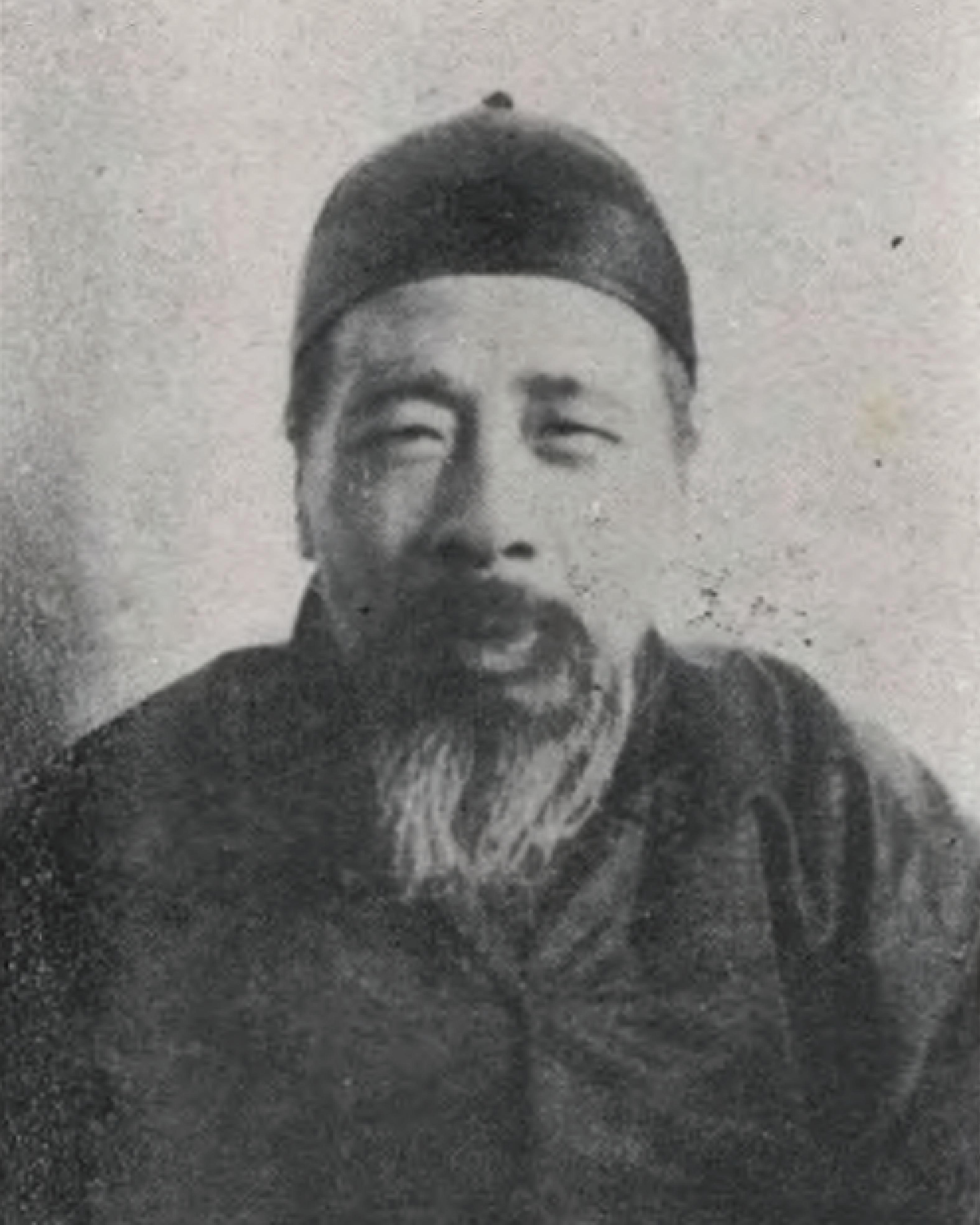
Portrait of Chang Erh-t’ien
Chang Erh-t’ien (張爾田 1874-1945), tzu Meng-ch’ü (孟劬), a Ch’ing loyalist scholar, wrote about the death of Chiang Ch’un-lin in Anecdotes of Chiang Lu-t’an (蔣鹿潭遺事, Chiang Lu-t’an I-shih):
“Lu-t’an (Chiang Ch’un-lin) was never adept at managing his livelihood. Whatever money came to him was quickly dissipated in sing-song parlours and taverns. In his later years, he formed an inseparable attachment to a woman named Huang Wan-chün (黃婉君) and brought her to live with him in T’ai-chou. Owing to poverty, she became dissatisfied with her domestic circumstances. Lu-t’an was deeply angered by this and travelled to Su-chou to see his friend Hsiao-fang (小舫). At the time, Hsiao-fang had just been promoted to judicial commissioner and did not see much of him. Disappointed and dejected, Lu-t’an embarked on the return voyage. That evening when his boat was moored at Ch’ui-hong Bridge (垂虹橋), he composed a sorrowful lyric full of grievances. He held it to his bosom, took some poison, and killed himself. Hsiao-fang subsequently arranged his funeral. When Wan-chün learned of his death, she too committed suicide. My cousin’s wife by the surname Huang also lived in T’ai-chou. She personally saw Wan-chün’s corpse and recounted this in great detail. Such is the tragedy that can befall a tz’u poet.”
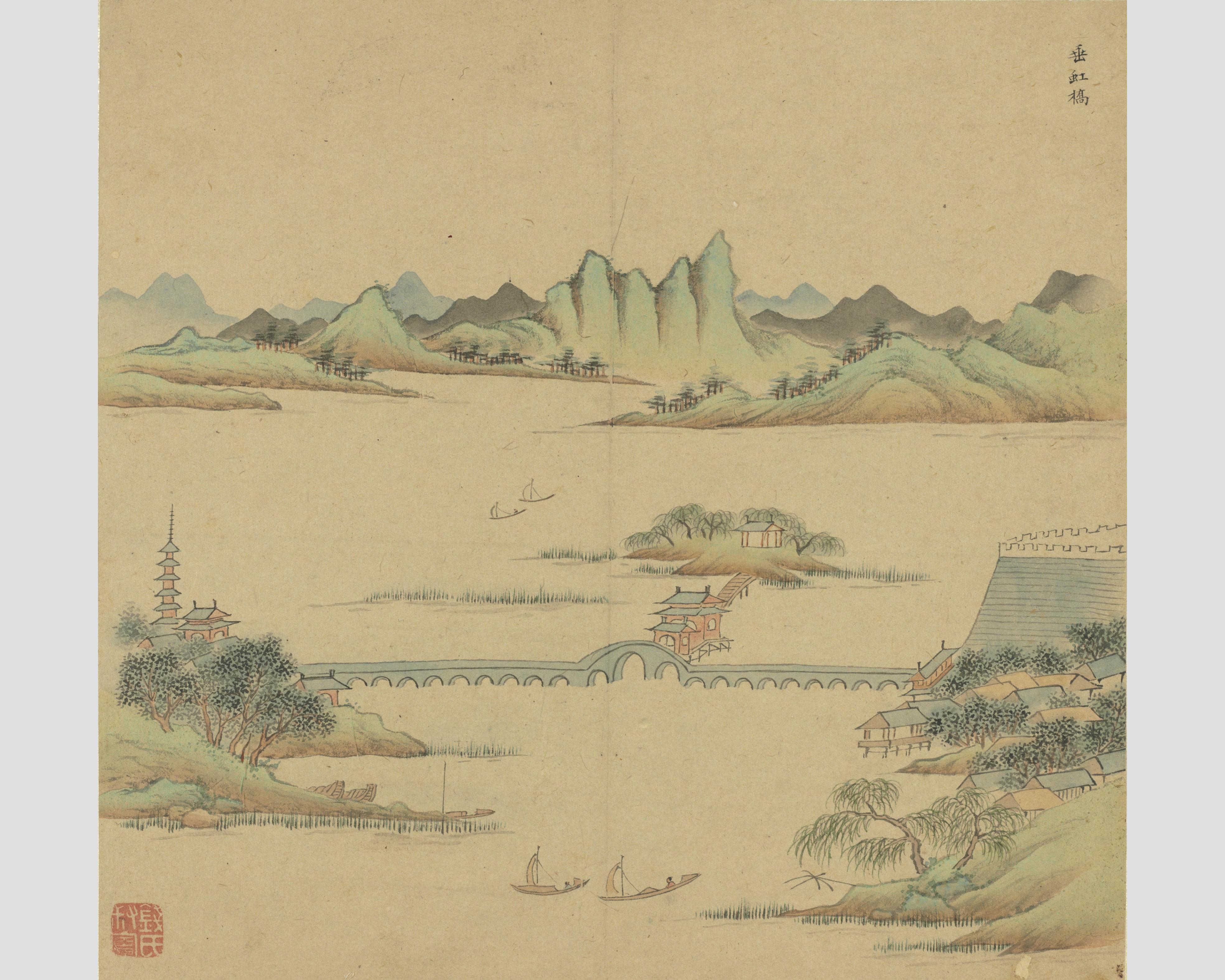
Ch’ui-hong Bridge in a painting album by Ch’ien Ku (錢穀) of the Ming dynasty. Photograph courtesy National Palace Museum
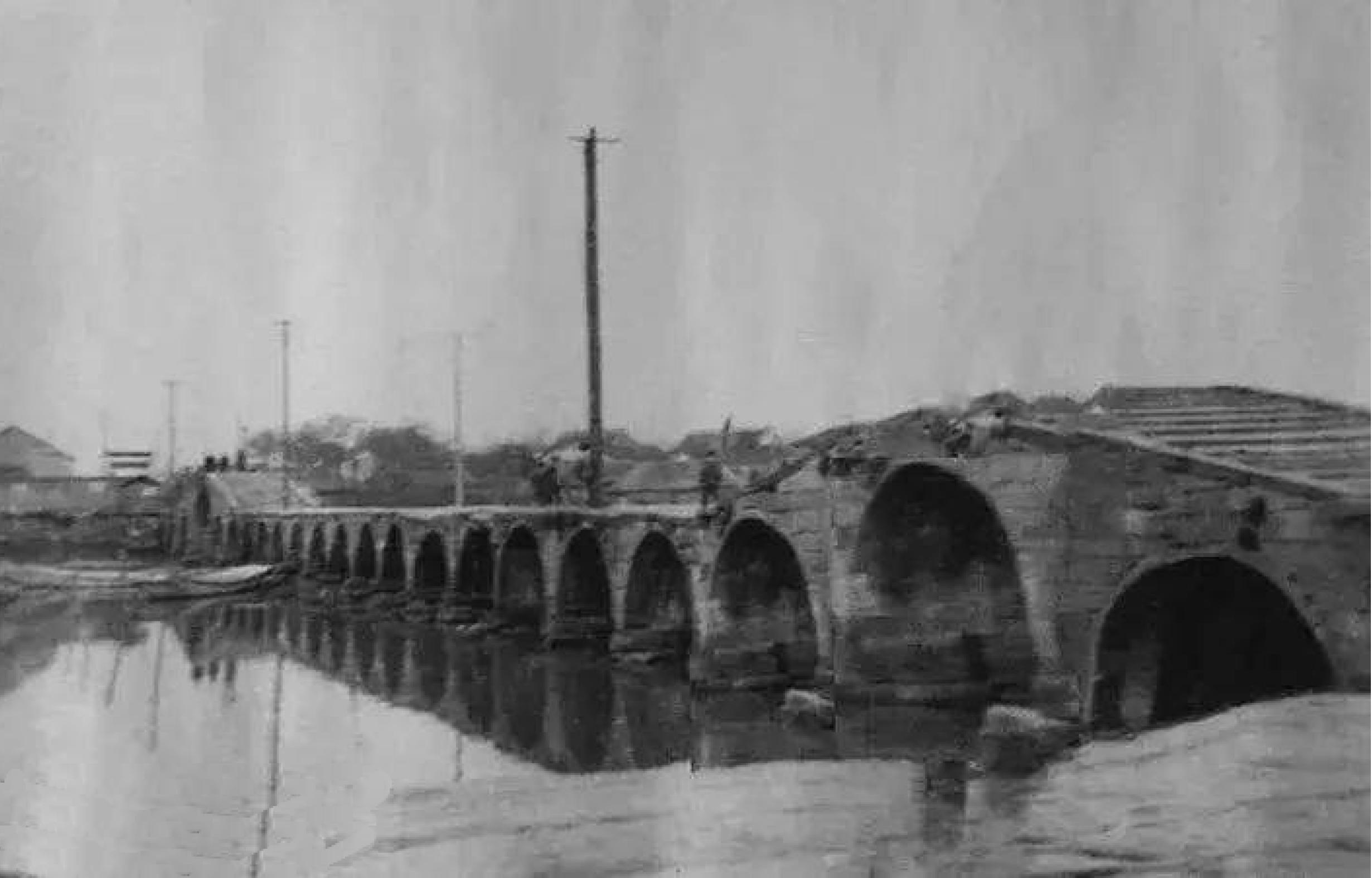
Photograph of Ch’ui-hong Bridge taken in the winter of 1965
Hsiao-fang (小舫) was the tzu of Tu Wen-lan (杜文瀾 1815-1881), which can also be written as Hsiao-fang (筱舫). He was a native of Hsiu-shui in Chekiang province. He served successively as expectant circuit censor of Kiangsu province and salt distribution commissioner of the Two-Huai Areas. He was a literary friend of Chiang Ch’un-lin, many of his tz’u compositions were entrusted to Chiang for revisions and improvements. His work was titled Tz’u Lyrics of Ts’ai-hsiang (采香詞, Ts’ai-hsiang Tz’u), also known as Tz’u Lyrics from the Mandala Flower Pavilion (曼陀羅花閣詞, Man-t’o-lo Hua-ko Tz’u). He was also the author of A Brief Record of the Suppression of the Kwangtung Rebels (平定粵寇記略, P’ing-ting Yüeh-k’ou Chi-lüeh).
Chiang Ch’un-lin’s old friend Tsung Yüan-han (宗源翰, 1834 -1897), tzu Hsiang-wen (湘文), also wrote about the death of Chiang Ch’un-lin in A Foreword to Supplementary Tz’u Lyrics from the Water-and-Cloud Pavilion (水雲樓續集, Shui-yün Lou Hsü-chi ):
“As for Huang Wan-chün (黃婉君) who was mentioned in the tz’u lyric, her relationship with Lu-t’an was marked by separations and reunions, estrangements and reconciliations. Affection carried to its extreme gave rise to resentment. In the end, old Lu-t’an died because of Wan-chün, and Wan-chün likewise died for Lu-t’an. When she was close to death, she bowed twice before Ch’en Pai-sheng (陳百生) and begged him to write a worthy account of her life. Then, with complete composure, she embraced death. Commentators have said that this should have brought consolation to Lu-t’an, yet in truth, this could only make Lu-t’an sadder still.”
However a different account is found in a letter to Lung Mu-hsün (龍沐勛 1902-1966), tzu Yü-sheng (榆生) from the tz’u poet Wu Hsiang (吳庠 1878-1961), tzu Mei-sun (眉孫). The letter is hereby referred as Letter to Lung Yü-sheng on Some Anecdotes of Chiang Lu-t’an (與龍榆生言蔣鹿潭遺事). An excerpted passage reads:
“In my letter yesterday I mentioned that Huang Wan-chün bowed twice before Ch’en Pai-sheng (陳百生), begging him to write a worthy biography of her. Today, while visiting my old friend Ch’in Ying-an (秦嬰庵), our conversation turned to Tz’u Lyrics from the Water-and-Cloud Pavilion. Ying-an said: ‘The Foreword by Tsung Yüan-han (宗源翰) recounted Wan-chün’s request for a worthy biography, this is a distorted description concealing the truth. Originally, Ch’en Pai-sheng and Lu-t’an were close friends. After Lu-t’an died on account of Wan-chün, Pai-sheng said to her: ‘If you are willing to follow Lu-t’an in death, I shall certainly petition for an imperial commendation in your honour.’ At that time Pai-sheng had already entered the Hanlin Academy, and he could indeed accomplish such a thing. After Wan-chün died, however, the petition for commendation was submitted and rejected. Pai-sheng was thus unable to fulfill the promise he made. Not long afterwards, he travelled outside the capital. As his carriage journeyed northward along the road, whirlwinds repeatedly swelled before him, carrying clouds of sand, as though taking the form of Wan-chün’s aggrieved and indignant spirit. Terrified, he hastened home. From then on, he abandoned his official career and never again returned to the capital, for he carried the burden of guilt in his heart. As it was difficult for Tsung Yüan-han to speak openly about the petition for commendation in his Foreword, he amended his words and claimed that Wan-chün begged for a fine biography... Lu-t’an’s death was due in part to Wan-chün’s dissatisfaction with the poverty of their household, and in part to Hsiao-fang (Tu Wen-lan) neglecting an old friend after his attainment of high office. For Lu-t’an to write an aggrieved lyric and took poison was a tragedy of the most pitiable kind. One need only to consider that his coffin was left in a Buddhist temple at Chiang-yin for decades, with no one to arrange a proper burial, to know there is little substance behind Hsiao-fang’s supposed funeral arrangement.”
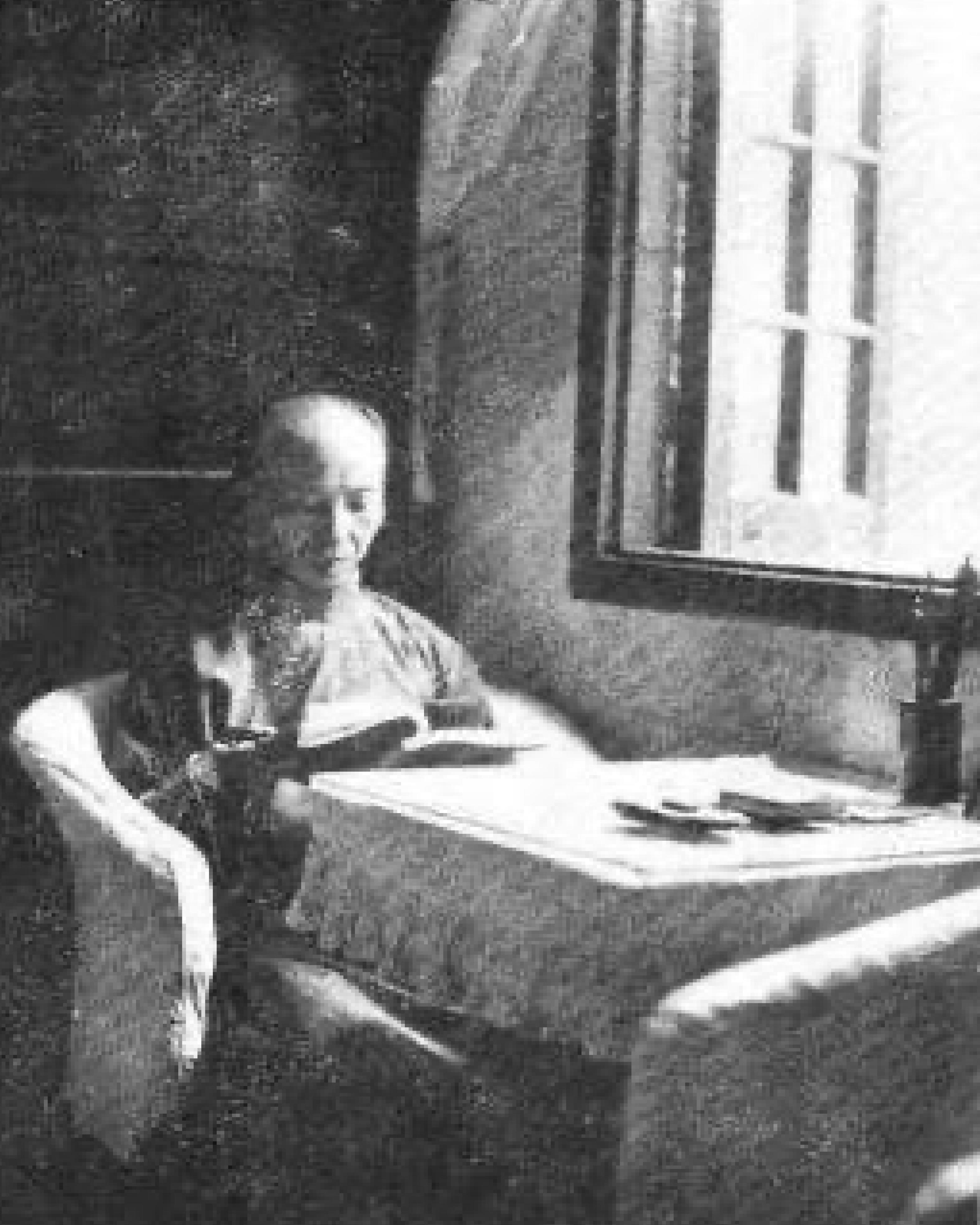
Portrait of Ch’in Keng-nien
“My old friend Ch’in Ying-an (秦嬰庵)” mentioned in the passage was Ch’in Keng-nien (秦更年 1885-1956), original name Sung-yün (松雲). His tzu was Man-ch’ing (曼青), also written as Man-ch’ing (曼卿), his hao was Ying-an (嬰闇), also written as Ying-an (嬰庵) or Ying-an (嬰盦), he was known as Tung-hsüan (東軒) and Ying-an Chü-shih (嬰闇居士). A native of Yangchow in Kiangsu province, he was accomplished in poetry and calligraphy, and was also an avid book collector. Reading Ying-an’s account hastens even more sadness, the fickleness of human relationships, hypocrisies and calculations, reckon a weary heart.
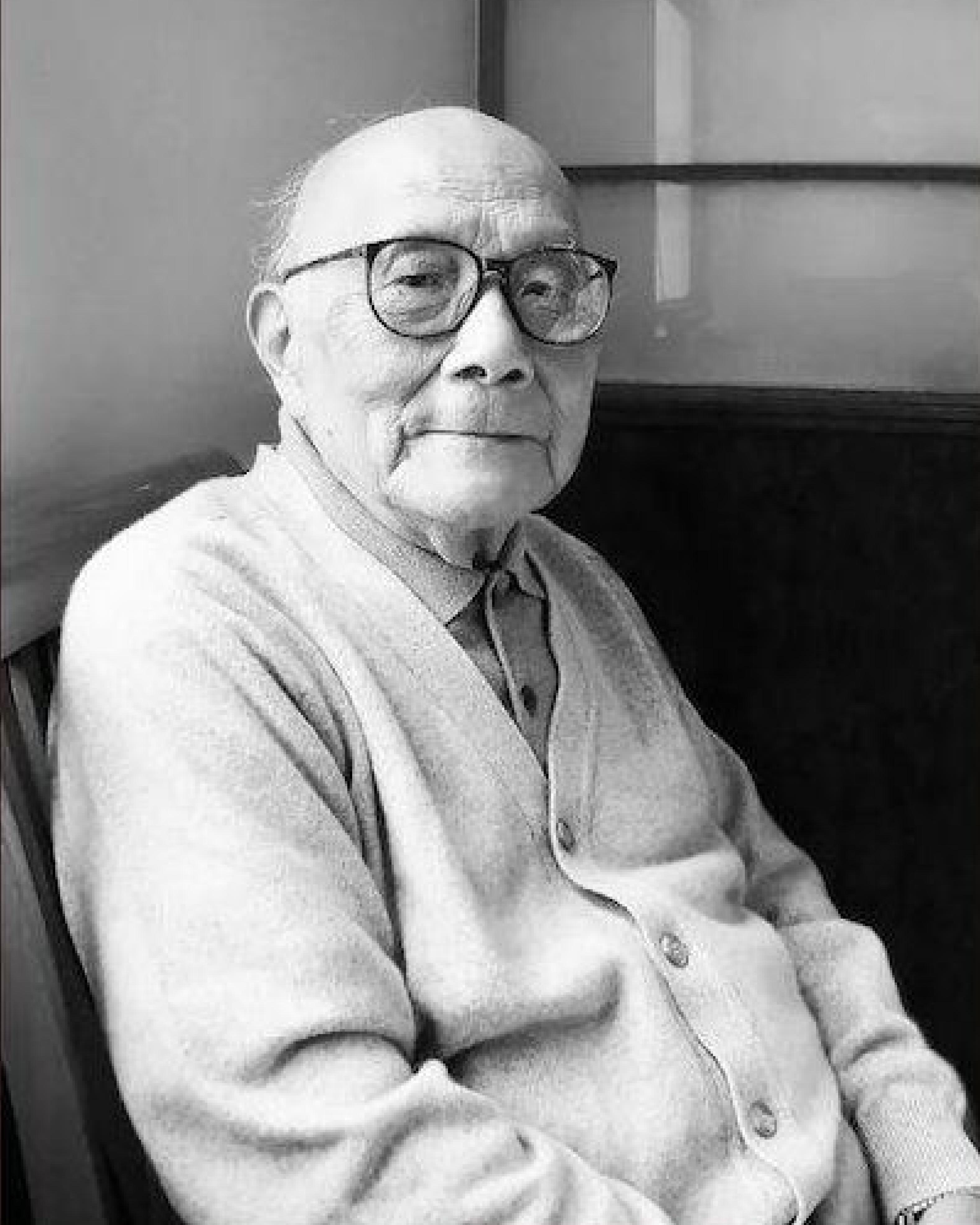
Portrait of Chou T’ui-mi
There is a copy of Tz’u Lyrics from the Water-and-Cloud Pavilion in my collection. It was reprinted in the 26th year of the Republic 1937, by Shih-ts’un Studio (適存廬) of the Ting family in Su-chou. This edition comprises the two volumes of Tz’u Lyrics from the Water-and-Cloud Pavilion, together with Supplementary Tz’u Lyrics from the Water-and-Cloud Pavilion (水雲樓續集Shui-yün Lou Hsü-chi). This copy previously belonged to Chou T’ui-mi (周退密), a scholar of literature and history. There are numerous inscriptions by him, attesting to the depth of his attachment.
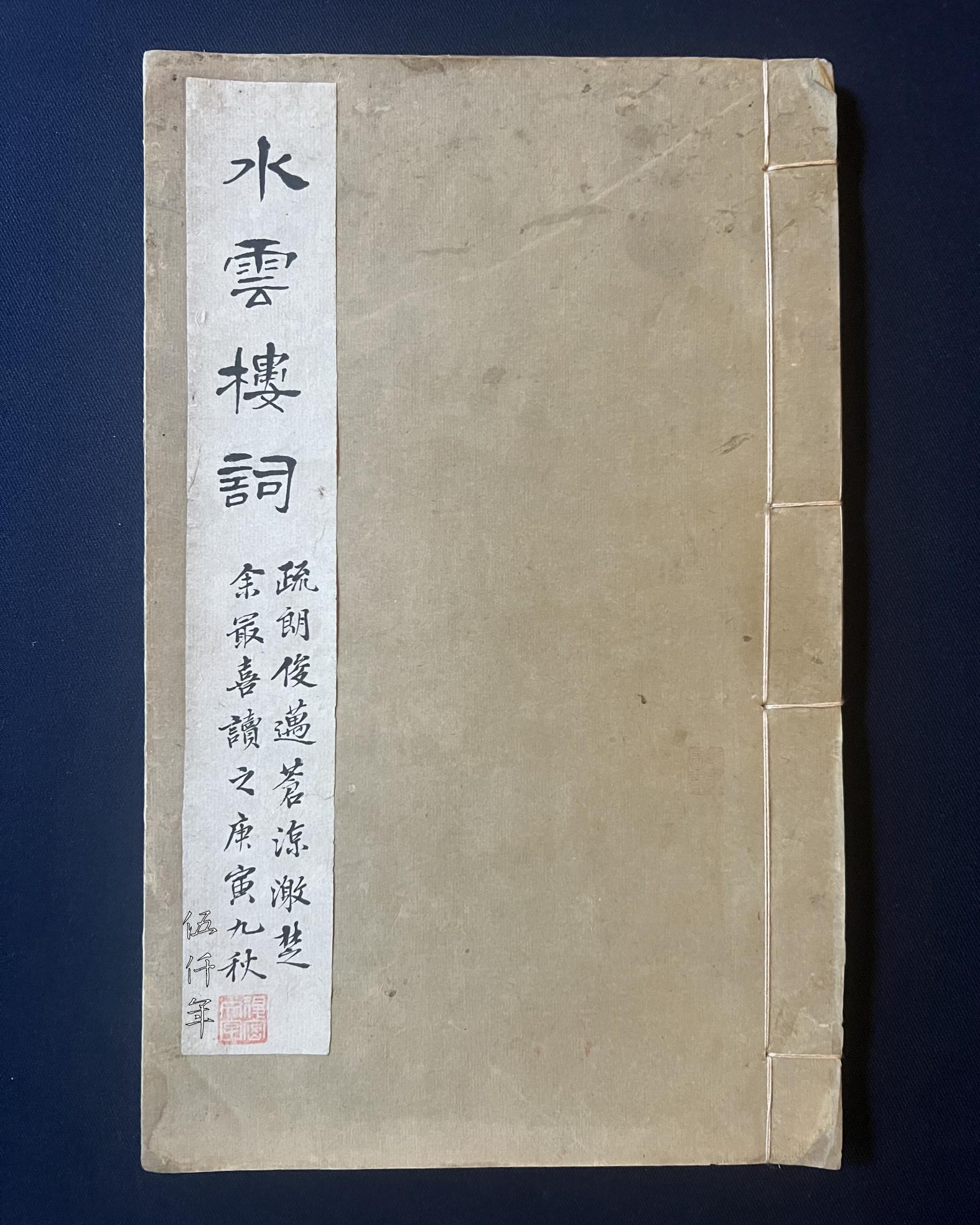
Front cover of Tz’u Lyrics from the Water-and-Cloud Pavilion. Title slip by Chou T’ui-mi
The title slip on the book cover was inscribed by Chou T’ui-mi with these words:
“Tz’u Lyrics from the Water-and-Cloud Pavilion. The work is free, expansive and rises above all others. It is imbued with a desolate and fervent pathos. I enjoy reading it the most. In the ninth month of keng-yin (庚寅) year.”
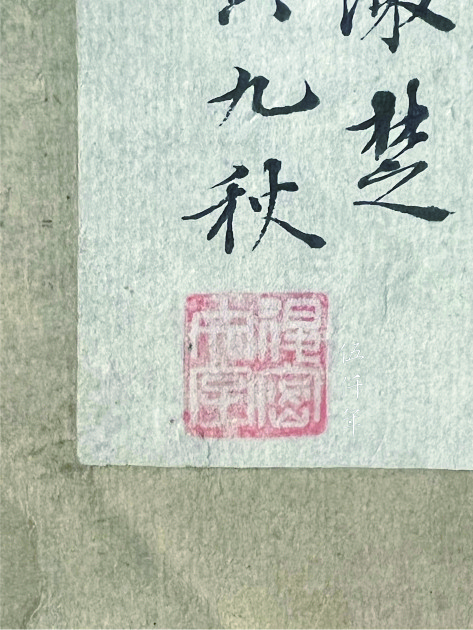
Seal impression of “Writings of T’ui-mi”
Seal impression: “Writings by T’ui-mi (退密文字, T’ui-mi wen-tzu)”.
Keng-yin year corresponds to 1950.
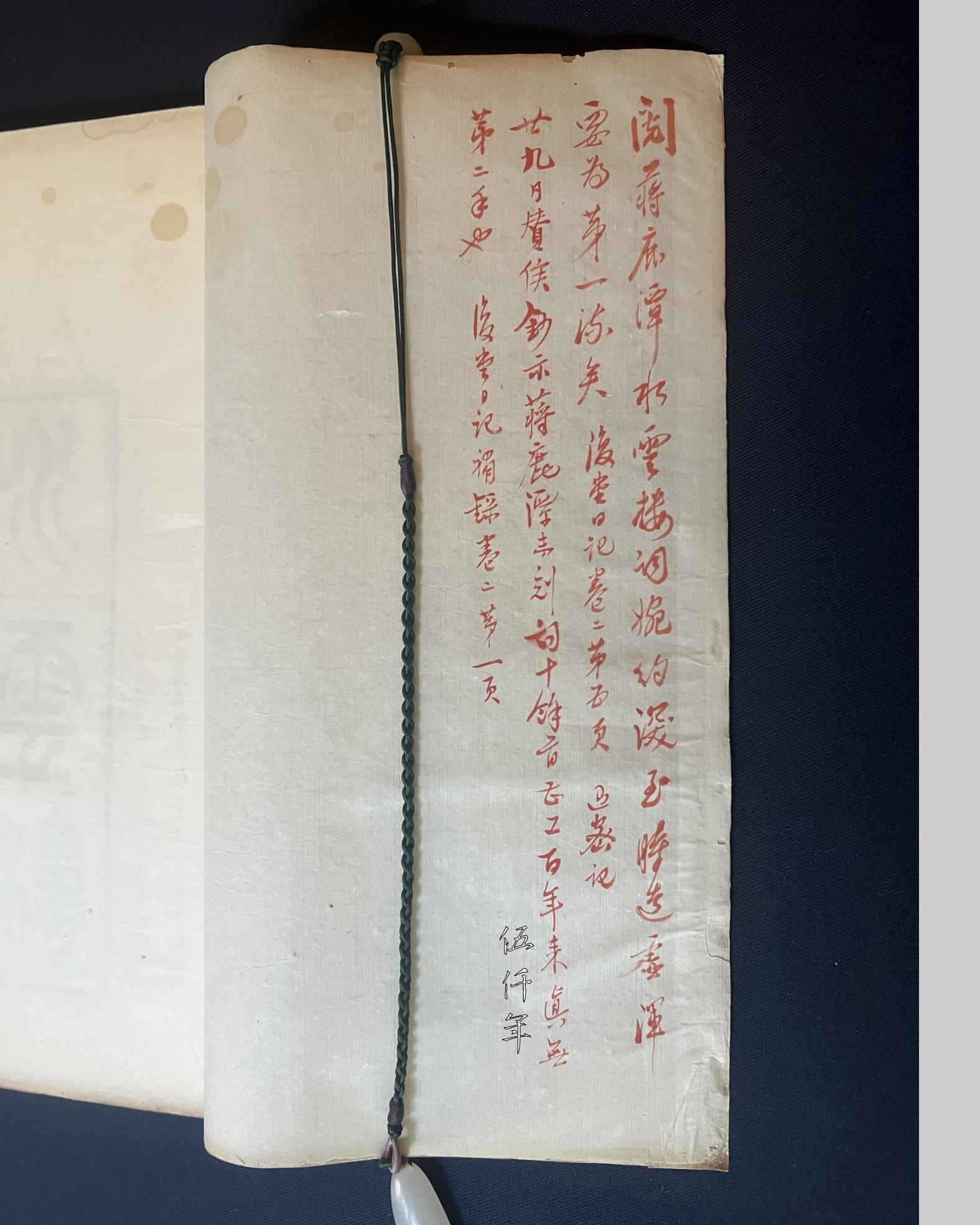
Inscriptions by Chou T’ui-mi at the back of book cover
There are some more inscriptions at the back of the book cover:
“Reading Tz’u Lyrics from the Water-and-Cloud Pavilion by Chiang Lu-t’an, one encounters exquisite delicacy and profound depth. A state of serene vastness and subtle perfection is regularly created. This must be counted as one of the finest tz’u volumes. An excerpt from Fu-t’ang Diary (復堂日記), Volume 2 page 5. Recorded by T’ui-mi.”
“On the 29th day, Tsan-hou (贊侯) showed me a manuscript he copied that contained more than ten unpublished tz’u lyrics by Chiang Lu-t’an. They are exquisitely crafted. In the past hundred years there has truly been no other tz’u poet who can rival him.
An excerpt from Supplement of Fu-t’ang Diary (復堂日記補錄Fu-t’ang Jih-chi Pu-lu), Volume 2 page 1.”
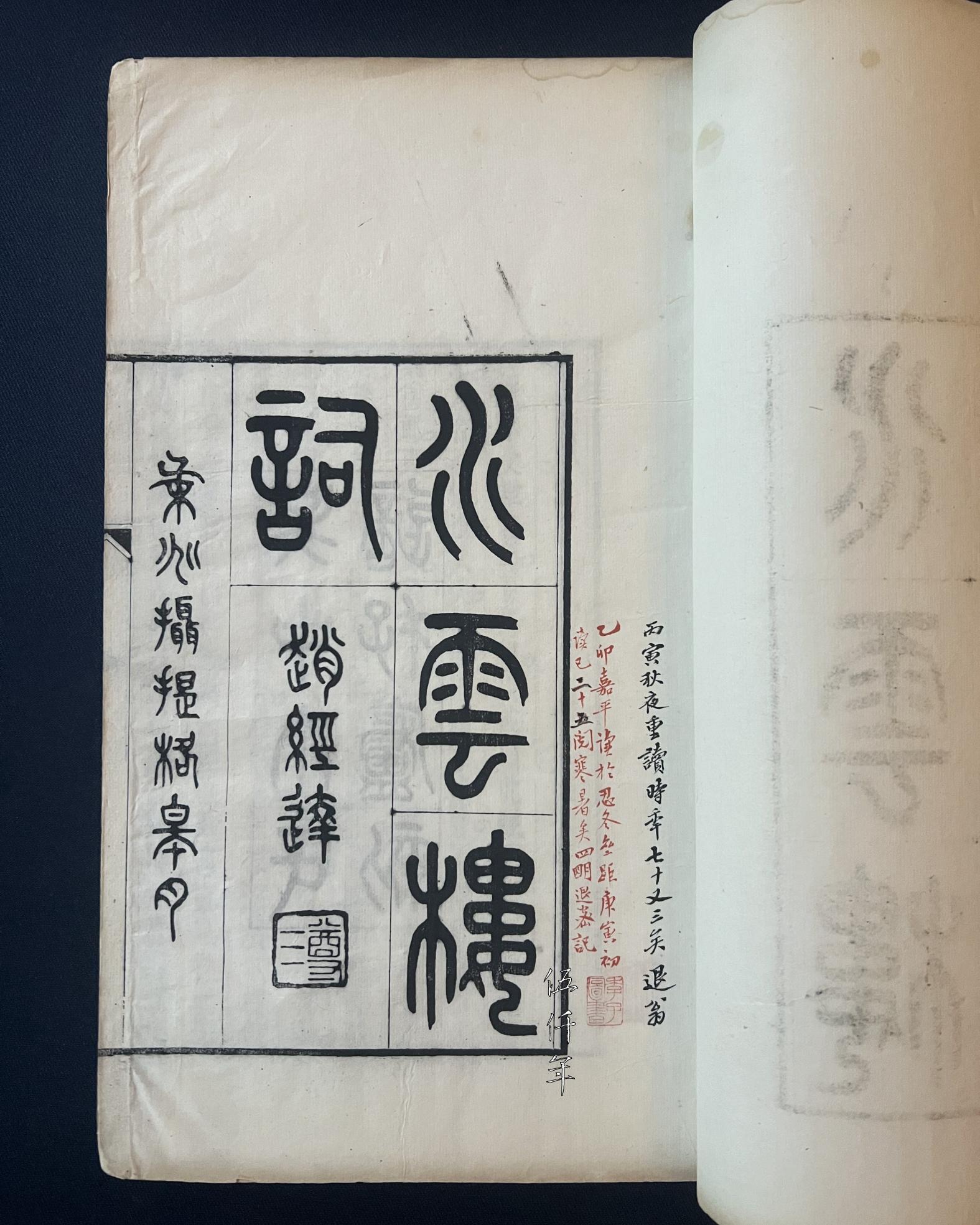
Title page of Tz’u Lyrics from the Water-and Cloud Pavilion
There are more inscriptions on the title page:
“In the twelfth month of i-mao (乙卯) year, I read this work in Jen-tung Studio (忍冬齋). Twenty-five cycles of summer and winter have passed since I first read this in keng-yin (庚寅) year. Recorded by T’ui-mi of Ssu-ming.”
“One autumn night in ping-yin (丙寅) year, I read this again at the age of seventy-three. Old Man T’ui.”
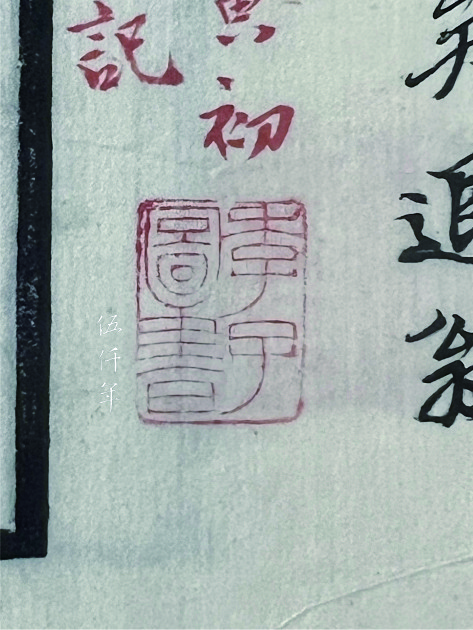
Seal impression of “Book of Chi-tzu”
Seal impression: “Book of Chi-tzu (季子圖書 Chi-tzu T’u-shu)”.
Keng-yin year corresponds to 1950, Chou T’ui-mi was thirty-seven years old. I-mou year corresponds to 1975, Chou was sixty-two years old. Ping-yin year corresponds to 1986, Chou was seventy-three years old.
This volume had belonged to Chou for almost four decades. It has also been in my possession for over twenty years. Chou likely sold it to some antiquarian bookseller in his old age.
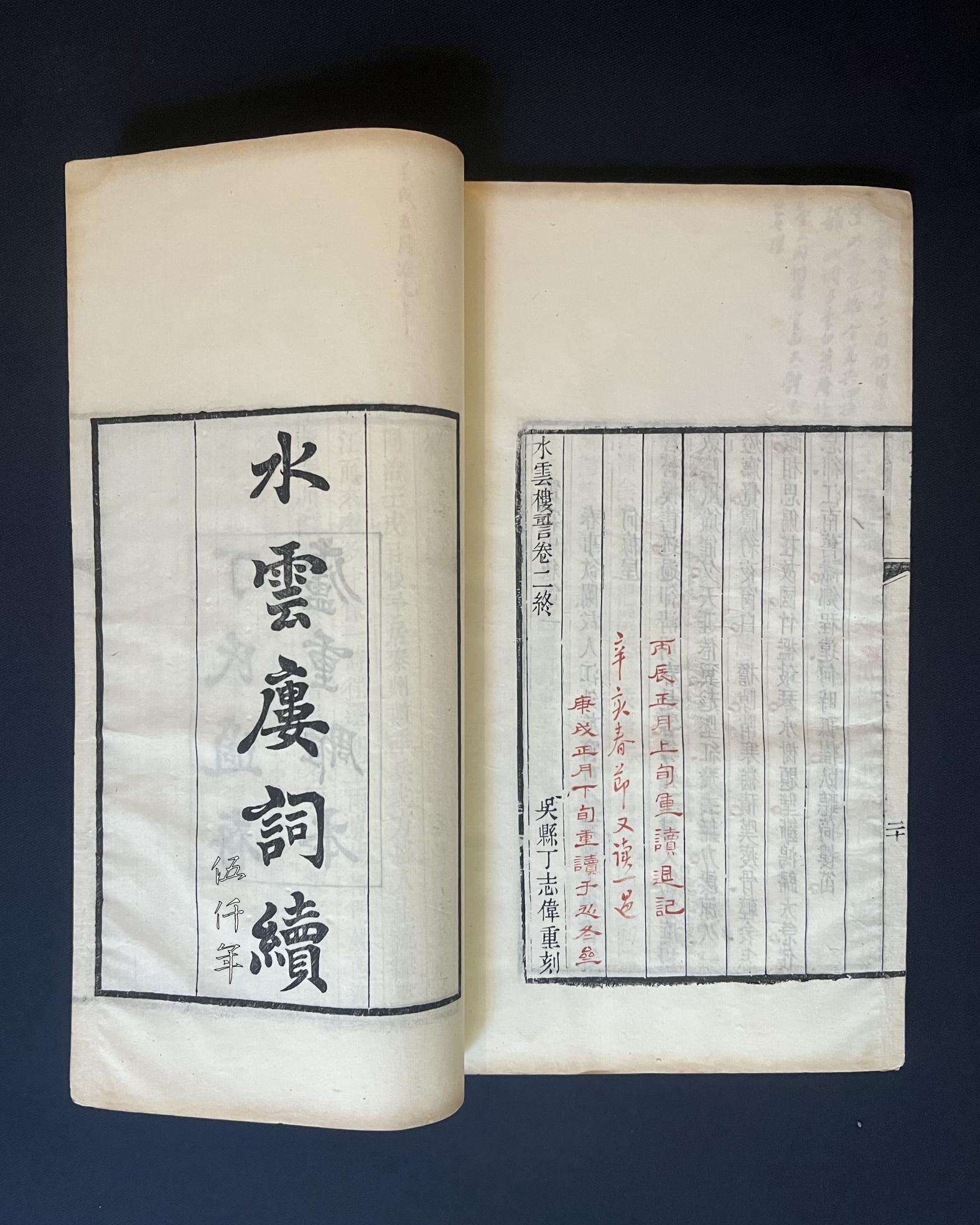
Inside page of Tz’u Lyrics from the Water-and-Cloud Pavilion
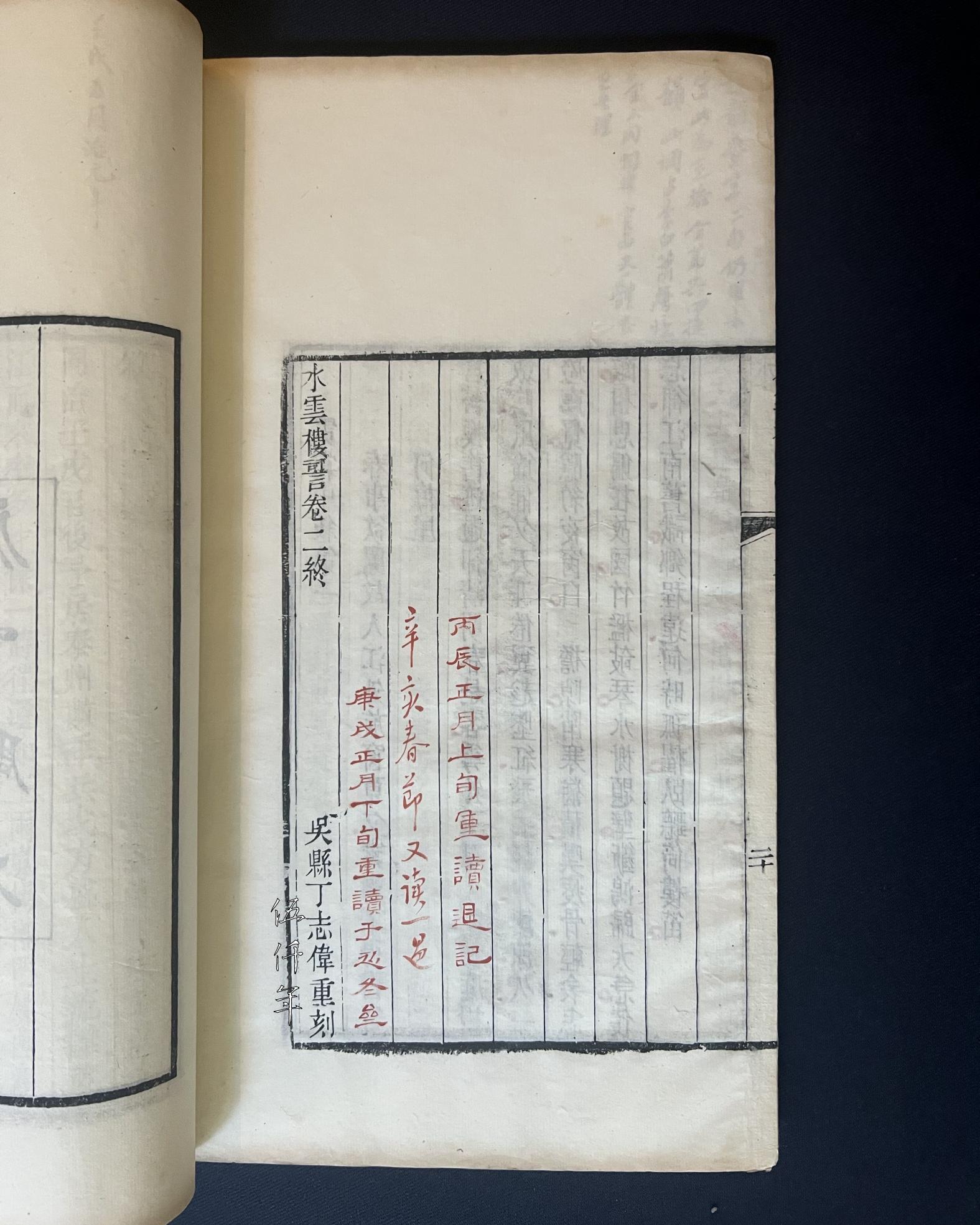
Inscriptions by Chou T’ui-mi on inside page
At the end of Tz’u Lyrics from the Water-and-Cloud Pavilion and immediately before Supplementary Tz’u Lyrics from the Water-and-Cloud Pavilion, there are three more inscriptions by T’ui-mi:
“In the latter part of the first month of keng-hsü (庚戌) year, I read this again at Jen-tung Studio”.
“During the Spring Festival of hsin-hai (辛亥) year, I read this again.”
“In the early part of the first month of ping-ch’en (丙辰) year, I read this again. Recorded by T’ui-mi.”
Keng-hsü year corresponds to 1970, Chou was fifty-seven years old. Hsin-hai year corresponds to 1971, Chou was fifty-eight years old. Ping-ch’en year corresponds to 1976, Chou was sixty-three years old.
Surveying the inscriptions between the title page and the last page, spanning a period from 1950 to 1986, Chou read this volume repeatedly six times. The prudence, reverence and scrupulous attentiveness applied by earlier generations to the endeavor of reading inspire the deepest admiration.
Chou T’ui-mi (周退密) was born in 1914 and died in 2020. His original name was Chou Ch’ang-shu (周昌樞), his hao was Shih-ch’uang (石窗), his studio names include Jen-tung Studio (忍冬齋), North-East Quarters of Hung-tou (紅豆宦), T’ui-mi Building (退密樓), and An-t’ing Rustic Attic (安亭草閣). A native of Ningpo in Chekiang province, he mostly lived in Shanghai. He studied at the Shanghai College of Traditional Chinese Medicine, the Shanghai Aurora University, and the Faculty of Law of Futan University. During his academic career, he was professor of the Shanghai College of Law and Commerce, Tatung University, the Harbin Foreign Languages Institute, and the Shanghai Foreign Languages Institute. He excelled in poetry and tz’u lyrics, and was proficient in calligraphy.
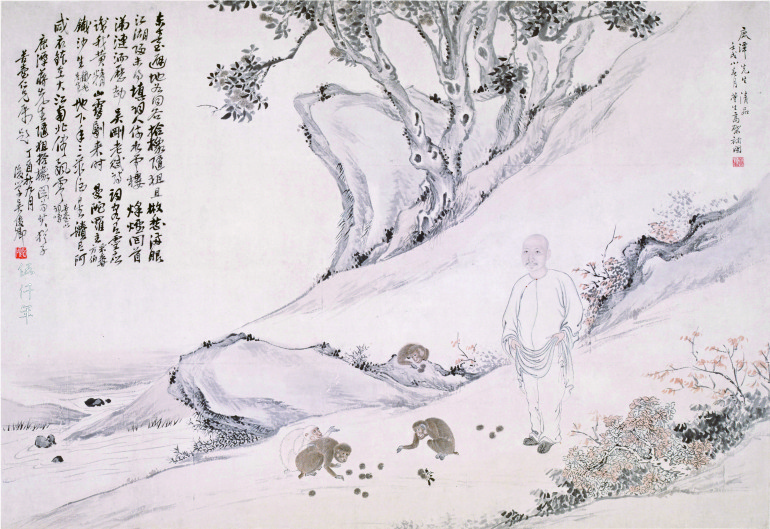
Gathering Acorns with Monkeys by Chiang Ch’un-lin
There is a painting by Chiang Ch’un-lin titled Gathering Acorns with Monkeys (隨狙拾橡圖, Sui-chü Shih-hsiang T’u) in my collection. It is the only known painting by Chiang Ch’un-lin and the only known portrait of him. It is indeed a rare treasure in the world of literature. The noted literatus Mao Kuang-sheng (冒廣生 1873-1959), tzu Ho-t’ing (鶴亭), wrote in Tz’u Commentaries from the Hsiao-san-wu Pavilion (小三吾亭詞話Hsiao-san-wu T’ing Tz’u-hua):
“During ping-shen (丙申) and ting-yu (丁酉) years, I was living in Su-chou. I became acquainted with his nephew Yü-leng (玉棱), who was also skilled in tz’u lyrics. He asked me to inscribe Gathering Acorns with Monkeys by the Elder Chiang Lu-t’an. Only then did I read the old gentleman’s collection of tz’u lyrics, as well as his other work titled Miscellaneous Poems of Tung-t’ao (東淘雜詩Tung-t’ao Tsa-shih ).”
Ping-shen year corresponds to 1896, and ting-yu year corresponds to 1897.
From this we know that the painting Gathering Acorns with Monkeys was originally in the possession of Chiang Ch’un-lin’s nephew Yü-leng. Yü-leng asked his friend Mao Kuang-sheng to inscribe it, and Kuang-sheng later chronicled this episode in his Tz’u Commentaries from the Hsiao-san-wu Pavilion. It may therefore be presumed that he did fulfill the request and completed the inscription. However, the inscription by Mao Kuang-sheng does not appear on the painting. A plausible explanation is that Mao made an inscription on the silk border rather than the painting proper. The painting was later sold to a collector in Japan where it was remounted, and the inscription was probably lost during the restoration. Today the painting still retains the Japanese-style mounting of that time.
There are two inscriptions on the painting, a few lines by Kao Ch’i (高棨), tzu Yün-sheng (蕓生), on the right, and a poem by Wu Ch’ang-shuo (吳昌碩) on the left.
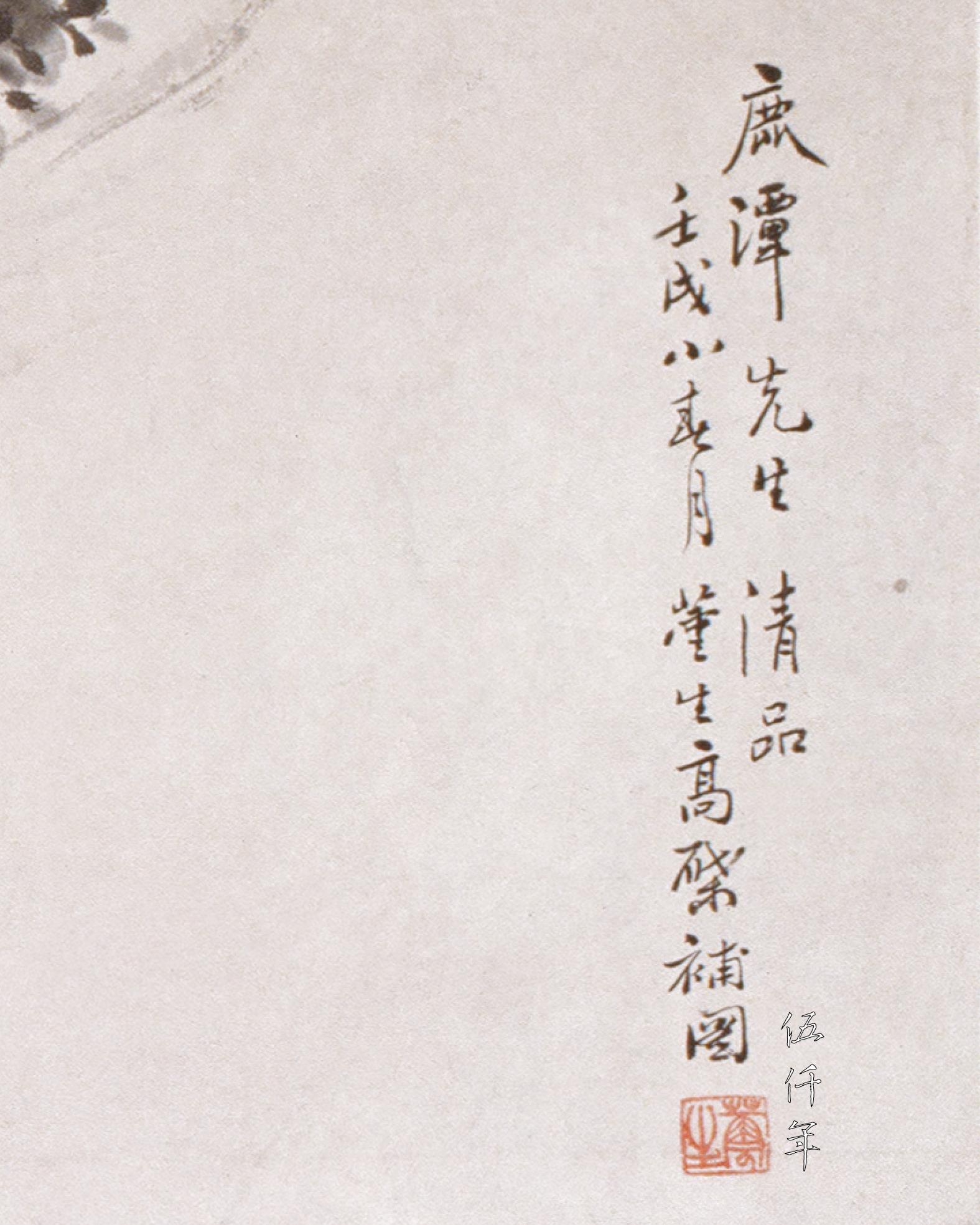
Inscription by Kao Ch’i on upper right of painting
The inscription by Kao Ch’i on the right reads:
“An exceptional work by Mr. Lu-t’an.
In the tenth month of jen-hsü (壬戌) year,
Yün-sheng (蕓生) Kao Ch’i (高棨) made a few embellishments.”
Seal impression: “Yün-sheng (蕓生).”
Jen-hsü year corresponds to 1862, the 1st year of the T’ung-chih reign. The sentence “An exceptional work by Mr. Lu-t’an” leaves little doubt that the painting was executed by Chiang Ch’un-lin. The year Chiang Ch’un-lin painted this is likely to be the same year when Kao Ch’i made his embellishments onto the painting, or at least very close to that year. If one adopts 1862 as the year it was painted, Chiang Ch’un-lin was then forty-five years old, six years before his suicide by poison. Kao Ch’i’s contributions to the painting probably consist of details not typically within the repertoire of the literati painter, such as the figure’s face or the four monkeys.
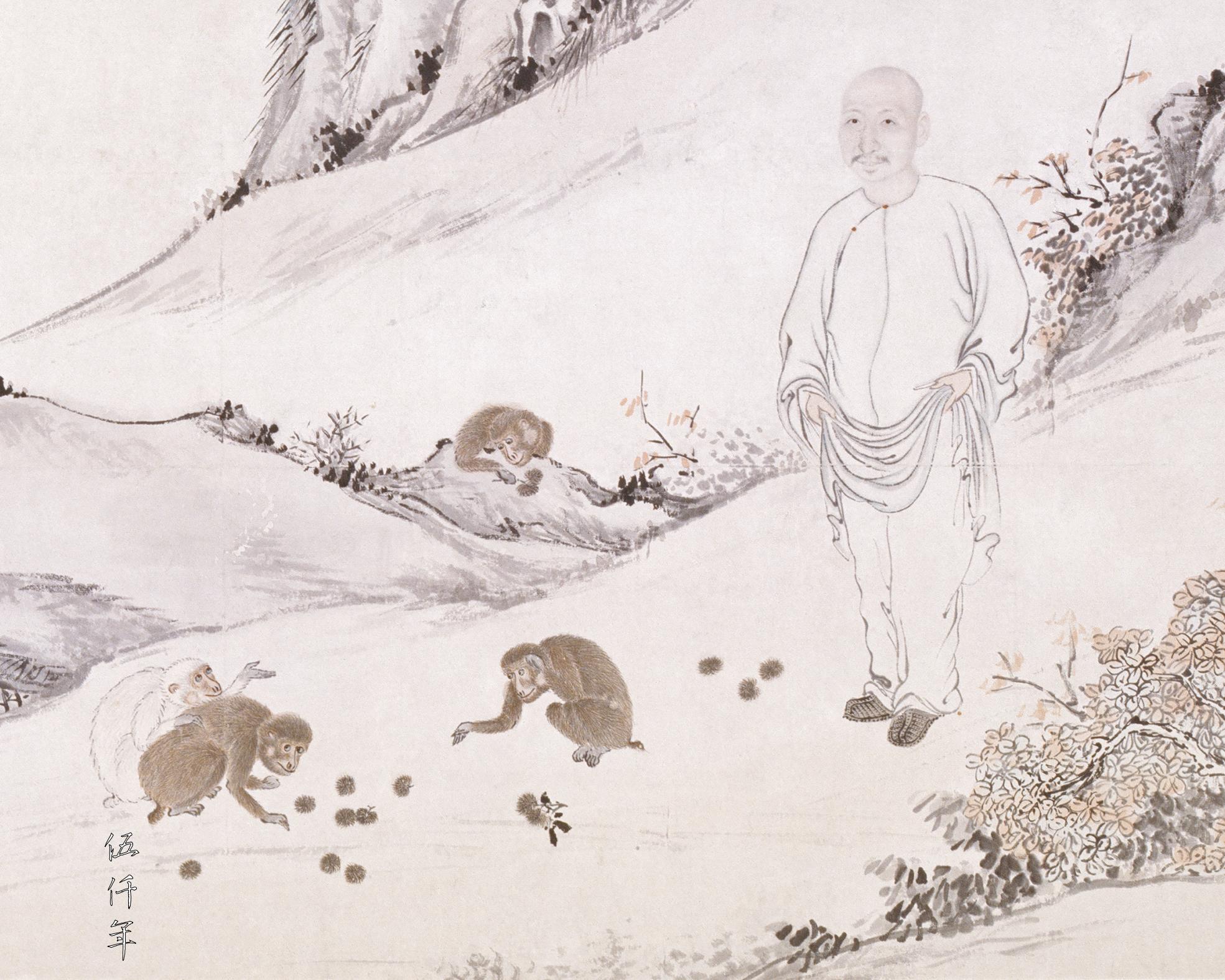
A detail view of Gathering Acorns with Monkeys by Chiang Ch’un-lin
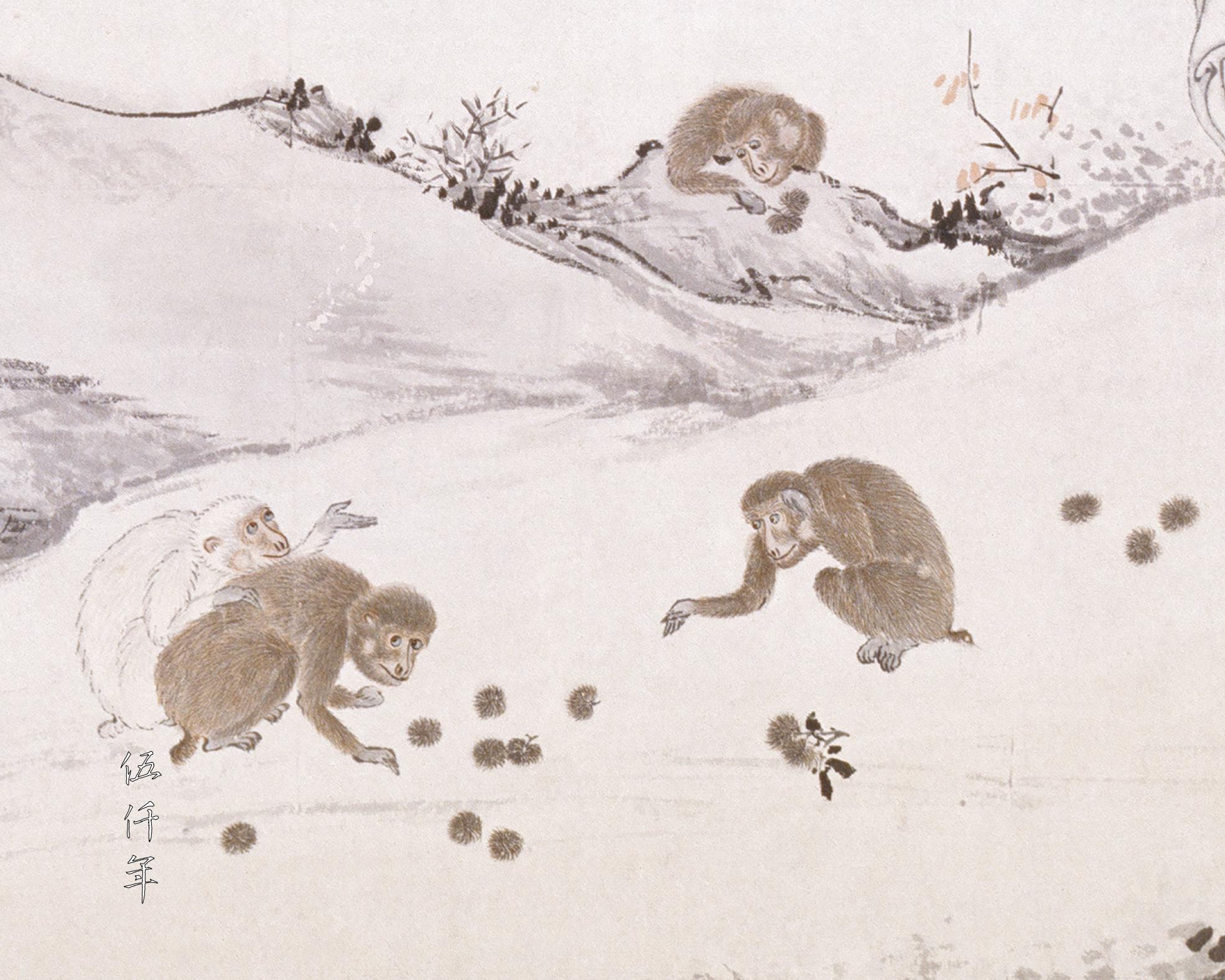
Another detail view of Gathering Acorns with Monkeys by Chiang Ch’un-lin
Kao Ch’i (高棨) was born in the 24th year of the Chia-ch’ing reign 1819, the year of his death is not known. His tzu was Yün-sheng (蕓生), also written as Yün-sheng (耘生), and his hao was Yün Tao-jen (耘道人). A native of Han-chiang in Yang-chou city, he was accomplished in painting and was a master of the art of literary riddle. His young wife, surname Fan (樊), was widowed at the age of twenty-four and remained single for the rest of her life. She was remembered in Supplementary Compilation of the Yang-chou Prefecture Gazette (續纂揚州府志, Hsü-tsuan Yang-chou Fu-chih).
The famous Yang-chou riddle master K’ung Chien-ch’iu (孔劍秋), original name Ch’ing-jung (慶鎔), of the late Ch’ing and early Republican periods wrote in Riddle Commentaries from the Studio of Yearning Aspirations (心嚮往齋謎話, Hsin Hsiang-wang Chai Mi-hua):
“On my journey home, I visited various bookshops in search of riddle manuscripts. Finally I came to Chü-wen T’ang (聚文堂) bookshop, where I purchased a copy of Yin-yü Ch’ing-shou (隱語鯖膄) for a hundred bronze coins.
That evening by candlelight, I tried to figure it out on my own. Although I had not yet grasped the true essence of the art of riddle, I was no longer a complete outsider. Yet when I came upon the riddle clue: ‘The painted cloth called cheng (正), the roosting outer layer called ku (鵠)’, the answer being a line in a T’ang poem: ‘Moonlight shrouds over Ch’ang-an.’ I pondered on this for a long time, unable to discover its underlying rationale.
Next morning, I sought instruction from Mr. Kao Yün-sheng. He was a celebrated painter, and had collected books on riddles from far and wide, classifying and organizing them into categories. He had thoroughly ingested the knowledge of riddles. He then explained to me: ‘As for the term Ch’ang-an, do not think of it as the name of a city. Imagine a single vertical line at the center of an archery target, with a crescent moon attached to it. That is what is meant by “deriving the meaning through imaginative association.’ Thereupon I was enlightened. …
Mr. Kao Yün-sheng was gentle, cultivated, and refined. To behold him was to see the bearing of a true Confucian scholar. Within our riddle club, I regarded him to be the exemplar by which all others were measured. His riddles appealed to both the refined and the common reader, combining literary elegance and substance in just the right proportion. I therefore record below some of his compositions that enjoyed wide circulation in his day. …”
K’ung Chien-ch'iu (孔劍秋) once wrote a poem to mourn Kao Ch’i:
“Shih K’ei-fa (史可法) Shrine on Plum Blossom Ridge,
A quick rest in spring opens heart and mind.
Since Yün-sheng's passing no literary tiger remains,
No one to emulate the Riddle Stele of Ts’ao O (曹娥).”
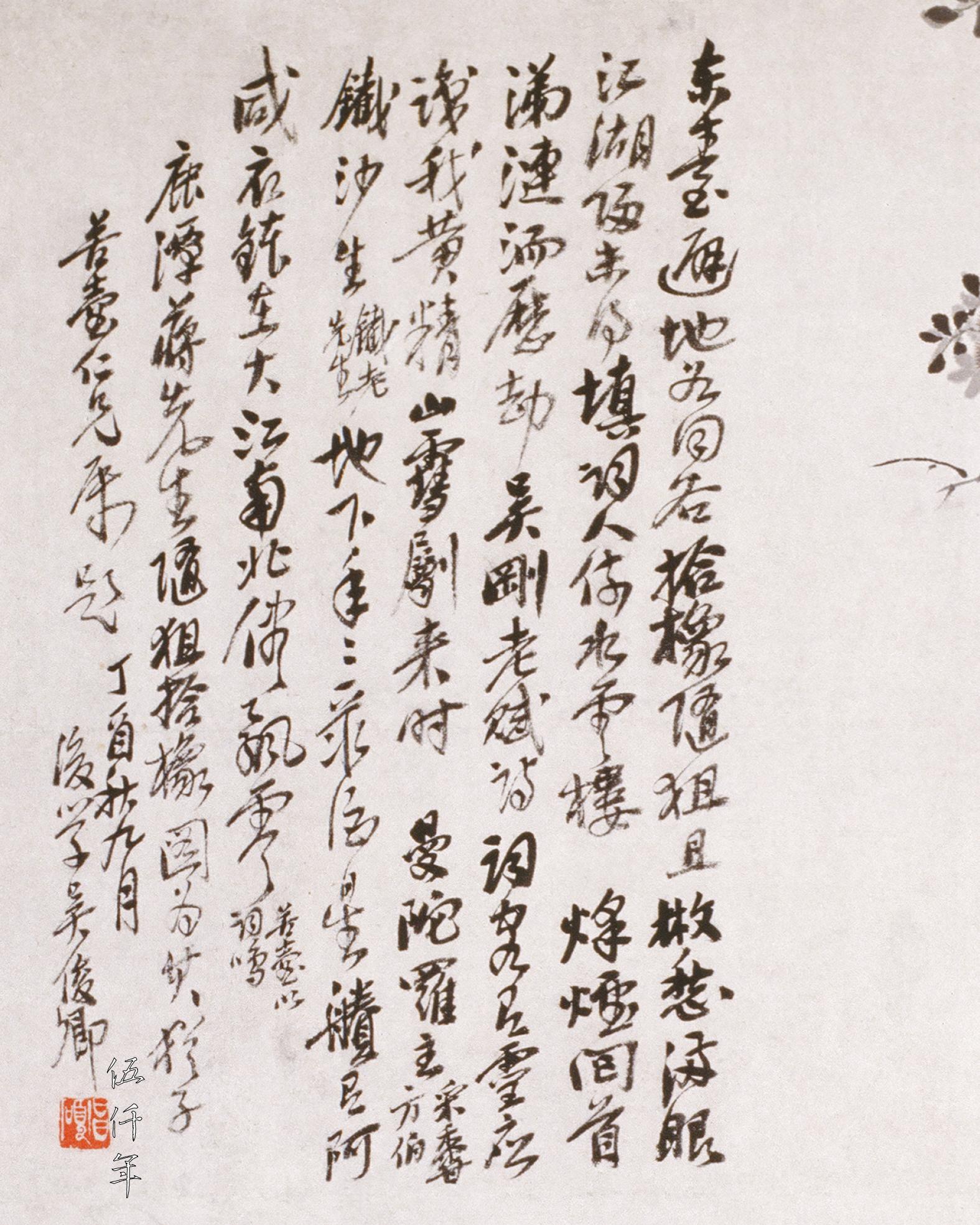
Inscription by Wu Ch’ang-shuo on upper left of painting
The poem by Wu Ch’ang-shuo (吳昌碩) on the left reads:
“Refuge in Tung-t’ai (東臺),
Like Tu Fu (杜甫) in T'ung-ku (同谷).
Gathering acorns with monkeys,
To dispel your heart’s sorrows.
Landscape seems unending,
Yet no passage leads to home.
The Water-and-Cloud Pavilion,
A poet hails it paradise.
Recall the fightings and the fires,
Tears cannot stop flowing.
Countless trials at senile age,
Yet lyrics can still flow forth.
If your tz’u spirit is here today,
Surely I’ll be greeted aloud.
Scraping for medical plants,
Deep in mountain mist.
Master of Mandala Hall
(Commissioner Ts’ai-hsiang 采香方伯),
And Scholar T’ieh-sha (鐵沙),
(Known too as Mr. T’ieh-lao 鐵老先生),
Drinking with you every year
Reach out to the world beyond.
A boat now carries your nephew,
Heir to name and legacy.
Time and again adrift,
Along the river south and north.
(Nephew Ku-hu 苦壺 is also an acknowledged tz’u poet)
Inscribing Gathering Acorns with Monkeys by Mr. Chiang Lu-t’an at the request of his nephew, my elder brother Ku-hu. The ninth month in the autumn of ting-yu (丁酉) year, by junior scholar Wu Chün-ch’ing (吳俊卿).”
Seal impression: “Ch’ang-shuo (昌碩).”
Ting-yu year corresponds to the 23rd year of the Kuang-hsü reign 1897. Wu Ch’ang-shuo was fifty-four years old, and Chiang Ch’un-lin had already passed away for twenty nine years. As Wu Ch’ang-shuo was inscribing the work of a tz’u poet from an older generation, he modestly referred to himself as a junior scholar.
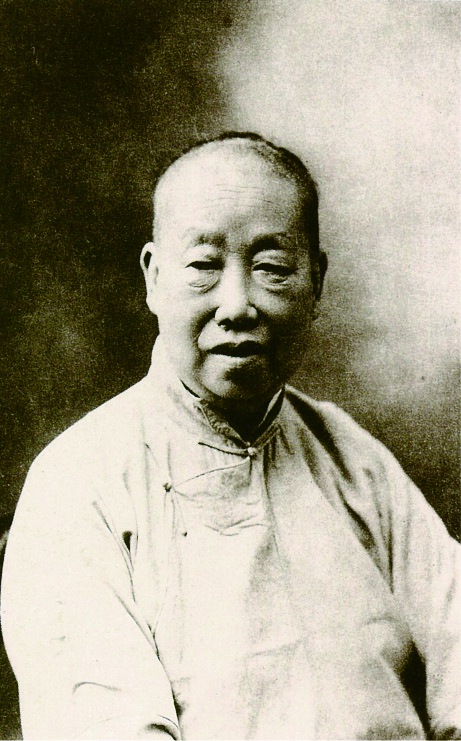
Portrait of Wu Ch’ang-shuo
Wu Ch’ang-shuo (吳昌碩) was born in the 24th year of the Tao-kuang reign 1844, and died in the 16th year of the Republic 1927. His original name was Chün-ch’ing (俊卿), tzu Ch’ang-shuo (昌碩, 蒼碩), Ch’ang-shih (蒼石, 倉石, 昌石). His hao included Fou-lu (缶廬), K’u-t’ieh (苦鐵), and Ta-lung (大聾). A native of An-chi in Chekiang province, he attained the hsiu-ts’ai (秀才) degree in the 4th year of the T’ung-chih reign 1865. He excelled in seal carving, calligraphy and painting. His works include Poems from the Fou Studio (缶廬詩, Fou-lu Shih) and Collected Seals from the Fou Studio (缶廬印存, Fou-lu Yin-ts’un).
In the inscription by Wu Ch’ang-shuo, there is a sentence “Master of Mandala Studio (Commissioner Ts’ai-hsiang 采香方伯)”. This refers to Tu Wen-lan (杜文瀾), the author of Tz’u Lyrics of Ts’ai-hsiang (采香詞), from which he derived the appellation “Commissioner Ts’ai-hsiang” (采香方伯Ts’ai-hsiang Fang-po).
“Scholar T’ieh-sha (鐵沙)” refers to Chin Shu-pen (金樹本). His year of birth is unknown and he died in the 12th year of the Kuang-hsü reign 1886. His tzu was T’ieh-lao (鐵老), a native of Ch’ien-t’ang in Chekiang province. He later moved to live in Shanghai. Accomplished in calligraphy and poetry, he authored Collected Poems from the Huai-yüeh Hall (懷越堂詩鈔, Huai-yüeh T’ang Shih-ch’ao). In Poems from the Fou Studio (缶廬詩) by Wu Ch’ang-shou, there is a poem titled Mourning T’ieh-lao (哭鐵老先生) with a line of annotation:
“T’ieh-lao and myself were both guests at the Mandala Hall of Tu Wen-lan in chia-hsü (甲戌) year.”
Chia-hsü (甲戌) year corresponds to the 13th year of the T’ung-chih reign 1874. Wu Ch’ang-shuo was thirty-one years old. It was at the Mandala Hall in Chia-hsing city which belonged to Tu Wen-lan that he first met T’ieh-lao, Chin Shu-pen. T’ieh-lao was also a literary friend of Chiang Ch’un-lin.
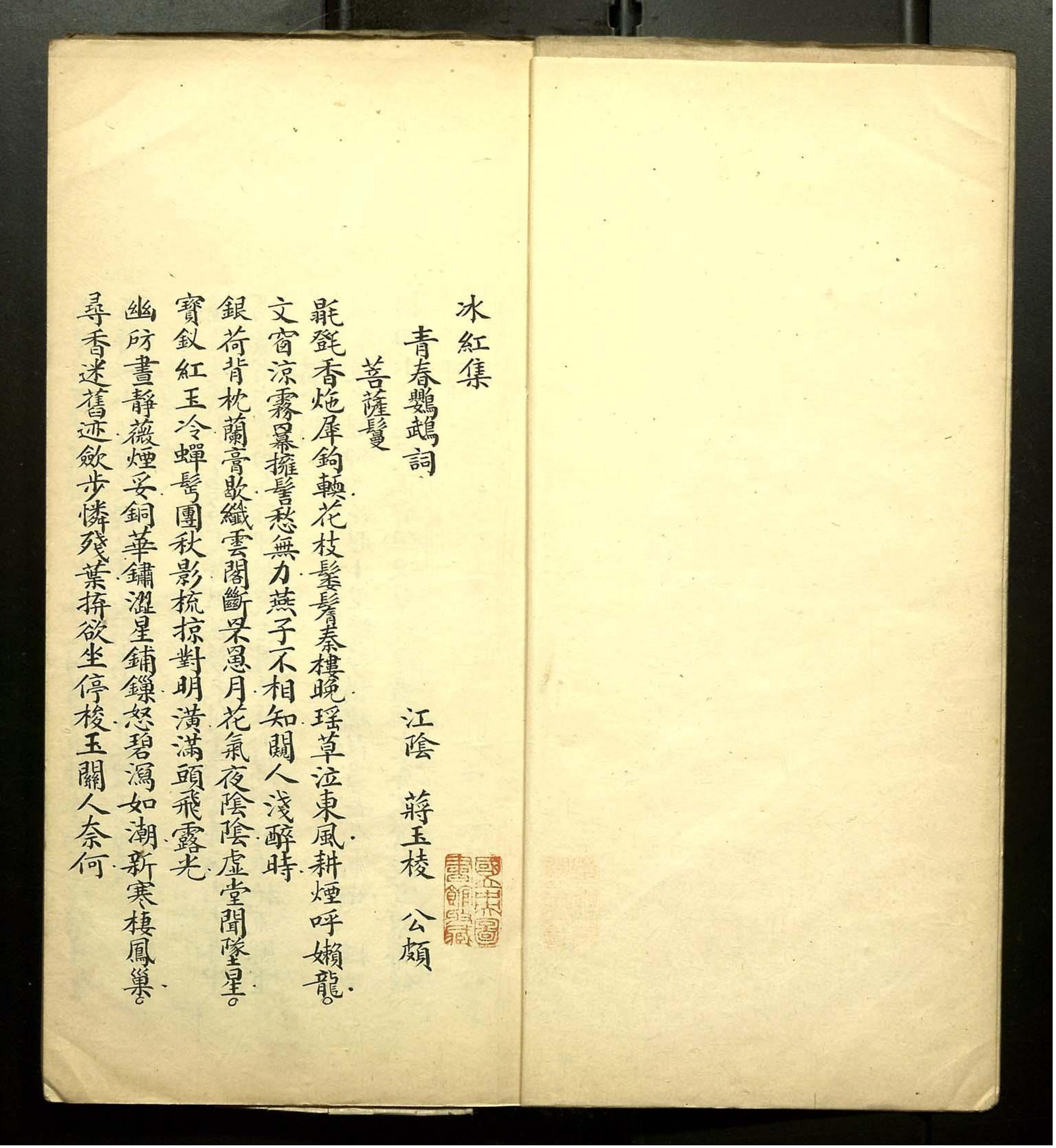
Inside page of Tz’u Lyrics of Red Ice by Chiang Yü-leng
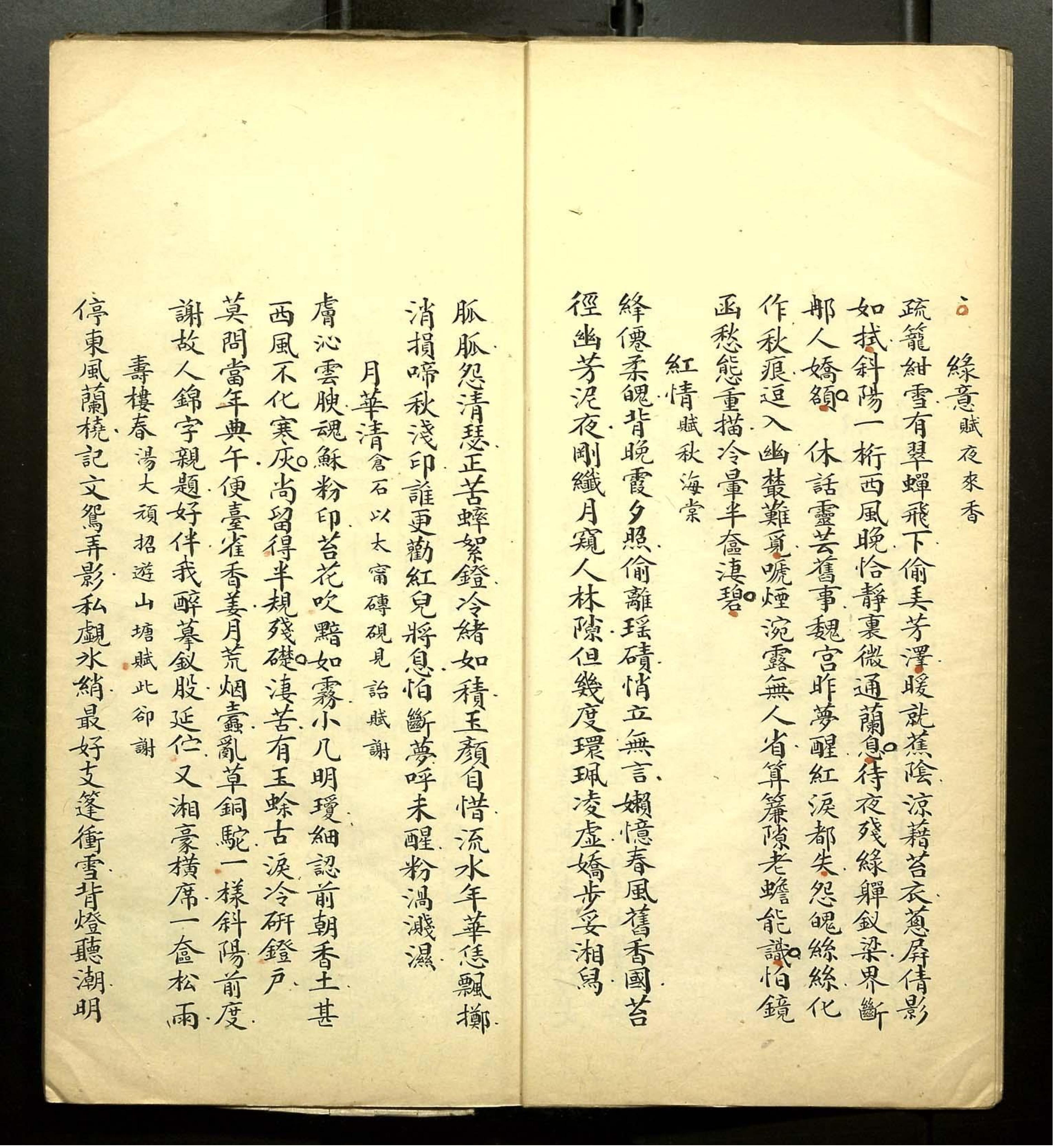
To the tune Yüeh-hua ch’ing by Chiang Yü-leng
The phrase “Nephew Ku-hu (苦壺)” refers to Chiang Yü-leng (蔣玉棱 1848-1911). His tzu were Kung-p’o (公頗), Hui-min (悔民), Fu-ch’ing (頫青), and Shou-yin (受因), his hao was Ku-hu (苦壺). A native of Chiang-yin in Kiangsu province, he was Chiang Ch’un-lin’s nephew. He authored Tz’u Lyrics of Red Ice (冰紅詞, Ping-hung Tz’u) and was a friend of Wu Ch’ang-shuo. In Tz’u Lyrics of Red Ice, there is a lyric titled To the tune Yüeh-hua ch’ing (月華清詞), its prefatory note reads:
“(Wu) Ch’ang-shuo gave me a brick inkstone from the T’ai-ning reign in the Chin dynasty. I composed this tz’u lyric to thank him.”
This is illustrative of their friendships.
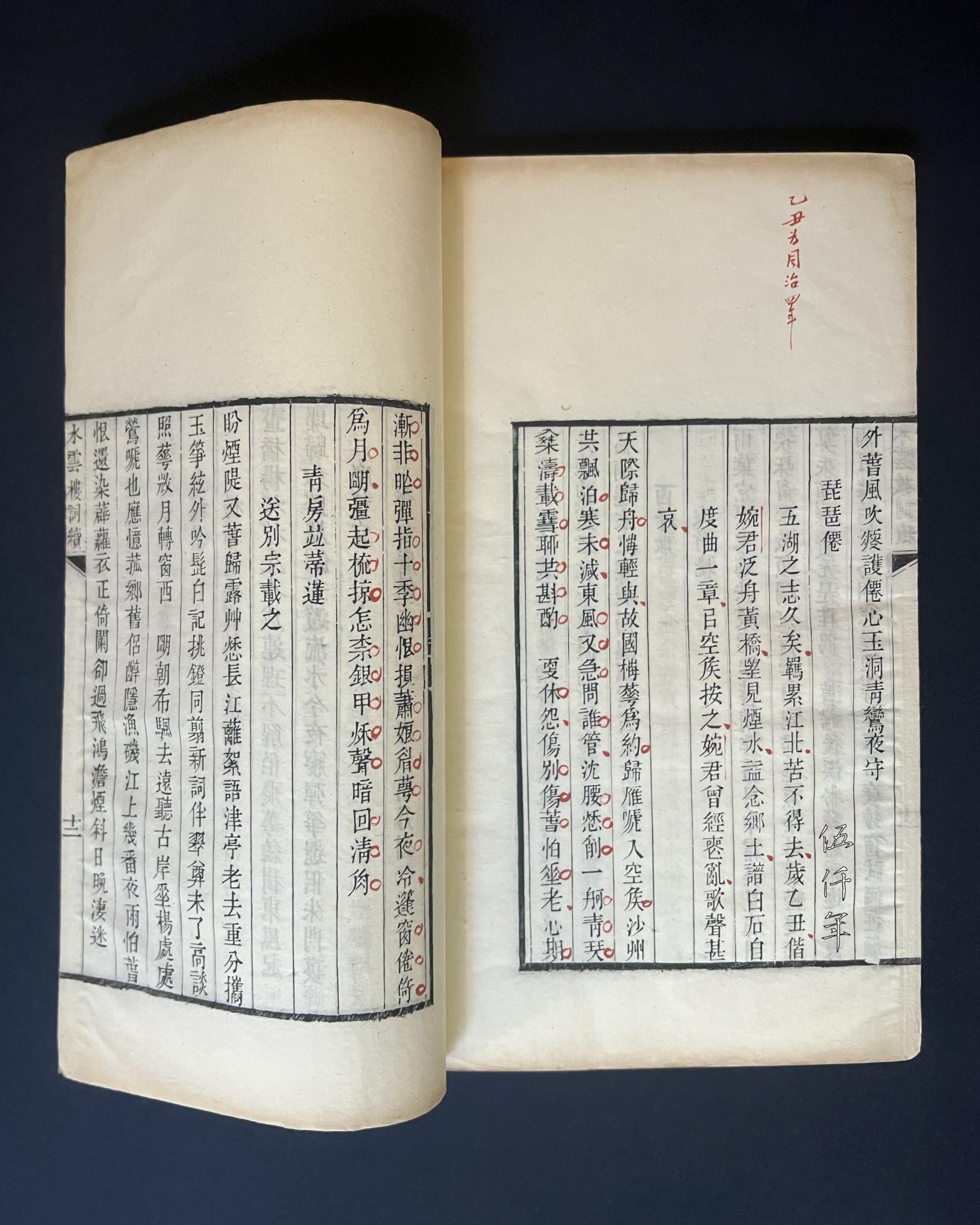
Tz’u lyric To the tune P’i-p’a hsien by Chiang Ch’un-lin to Huang Wan-chün
Examining the two volumes of Tz’u Lyrics from the Water-and-Cloud Pavilion and Supplementary Tz’u Lyrics from the Water-and-Cloud Pavilion, we learned that Chiang Ch’un-lin only managed to write one tz’u lyric for Huang Wan-chün: To the tune P’i-p’a hsien (琵琶僊). It was written in the 4th year of the T'ung-chih reign 1865. On the day it was written, both Chiang Ch’un-lin and Huang Wan-chün were cruising in a boat through the ancient market town of Huang-ch’iao in T’ai-hsing, Kiangsu province. Fog and water, misty and blurred, with Wan-chün softly singing the tz’u lyric. How could Chiang Ch’un-lin foresee, three years later, he would die for Wan-chün, and that Wan-chün would sacrifice herself to follow him in death? Today, reading To the tune P’i-p’a hsien, one can still tread the lingering marks of devotion, resentment, entanglement and bewilderment of those bygone days.
To the tune P’i-p’a hsien
“For a long time I have wished to return to the Five Lakes. Yet I was detained in the north of the Yangtze River, encumbered and unable to leave. In i-ch’ou (乙丑) year, I cruised in a small boat with Wan-chün in Huang-ch’iao. Looking at the mist-veiled waters, I longed even more for my native home. I composed a lyric that emulates the new melodies of Chiang K’uei (姜夔1155-1209) and complemented it with the musical instrument k’ung-hou (箜篌). Wan-chün had lived through demise and turmoil, her singing was quite melancholic.
Homebound skiff
At sky’s far edge.
I rue this vow
Too lightly made,
To meet plum blossom
From my native land.
Wild geese return,
Singing with harp.
An arid desert,
Together we roam.
The wintry cold
Is still to ease.
Gusts of east wind,
Swift and furious.
Care not for me,
Gaunt and worried.
On this boat
A fairy-beauty,
Riding the waves,
Hauling the snow.
We may as well
Drink to each other.
Do not grieve,
Parting or Spring.
Fearful that age
Warps hope of yore.
Ten years pass by
The snap of fingers.
These eyebrows
Tired and worn.
Sure it is chilly
This very night.
Wearily I lean
On cabin window.
A luminous moon,
Make me rise
To smooth the hair.
Yet sounds of
Armour plates,
Autumn wind,
Faintly resonate
In mournful melody.”
「隨狙拾橡圖」蔣鹿潭自繪像詳圖