On the 80th Victory Anniversary of the Sino-Japanese War, the Chinese-Heritage Virtual Museum hereby publishes the Catalogue of Historic Documents, Writings, Certificates and Letters in the Wang Ch'ung-hui Collection. In good time all the items in this Catalogue will be published and exhibited. Wang Ch’ung-hui was an early revolutionary, an elder statesman in foreign affairs and a giant of the judiciary. He served as the Republic of China's first minister of foreign affairs and first minister of the Judicial Yuan, as well as minister of foreign affairs during the Sino-Japanese War. Now that Chinese history has been purposefully misrepresented, this Catalogue may be of value.
Curatorial and Editorial Department
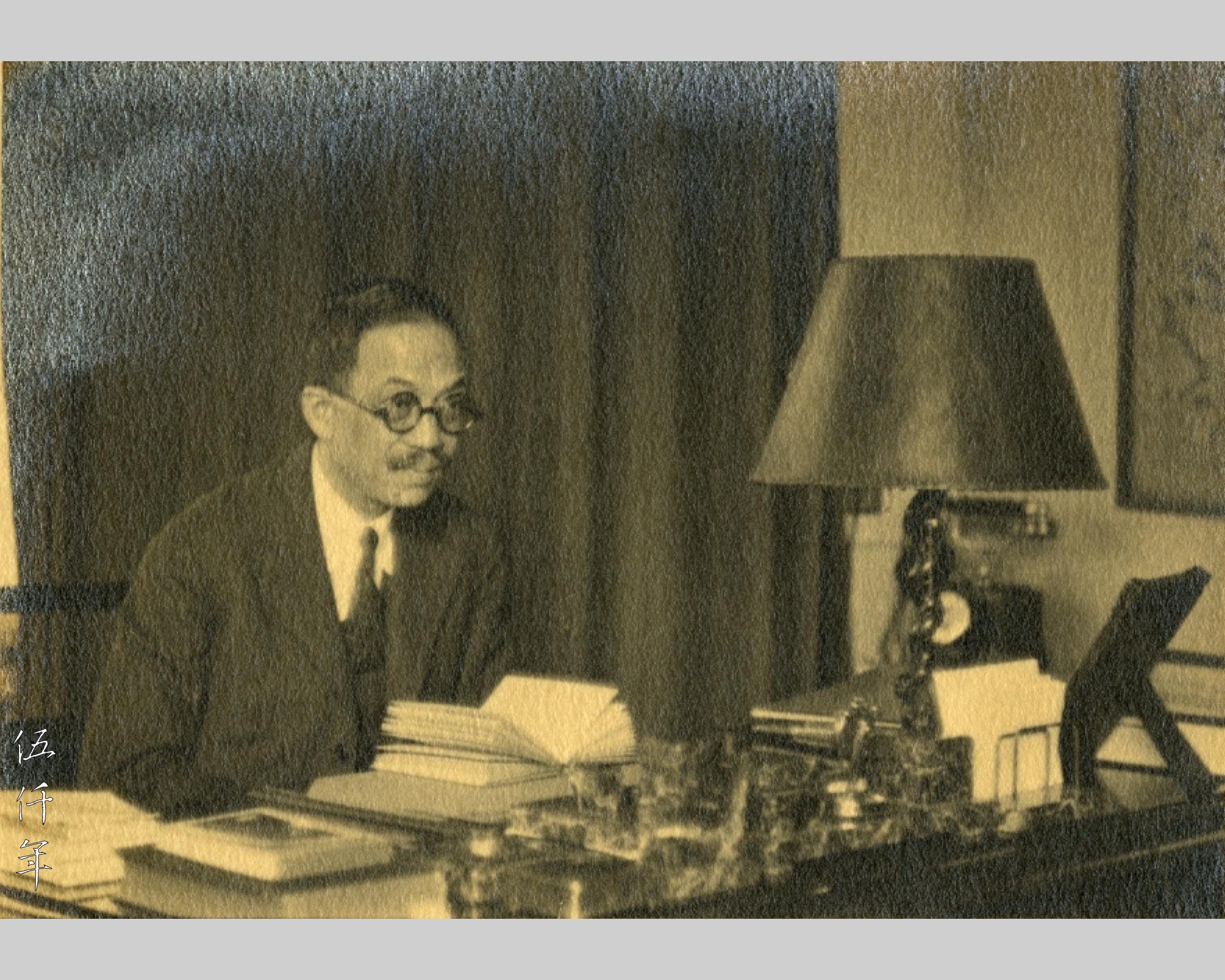
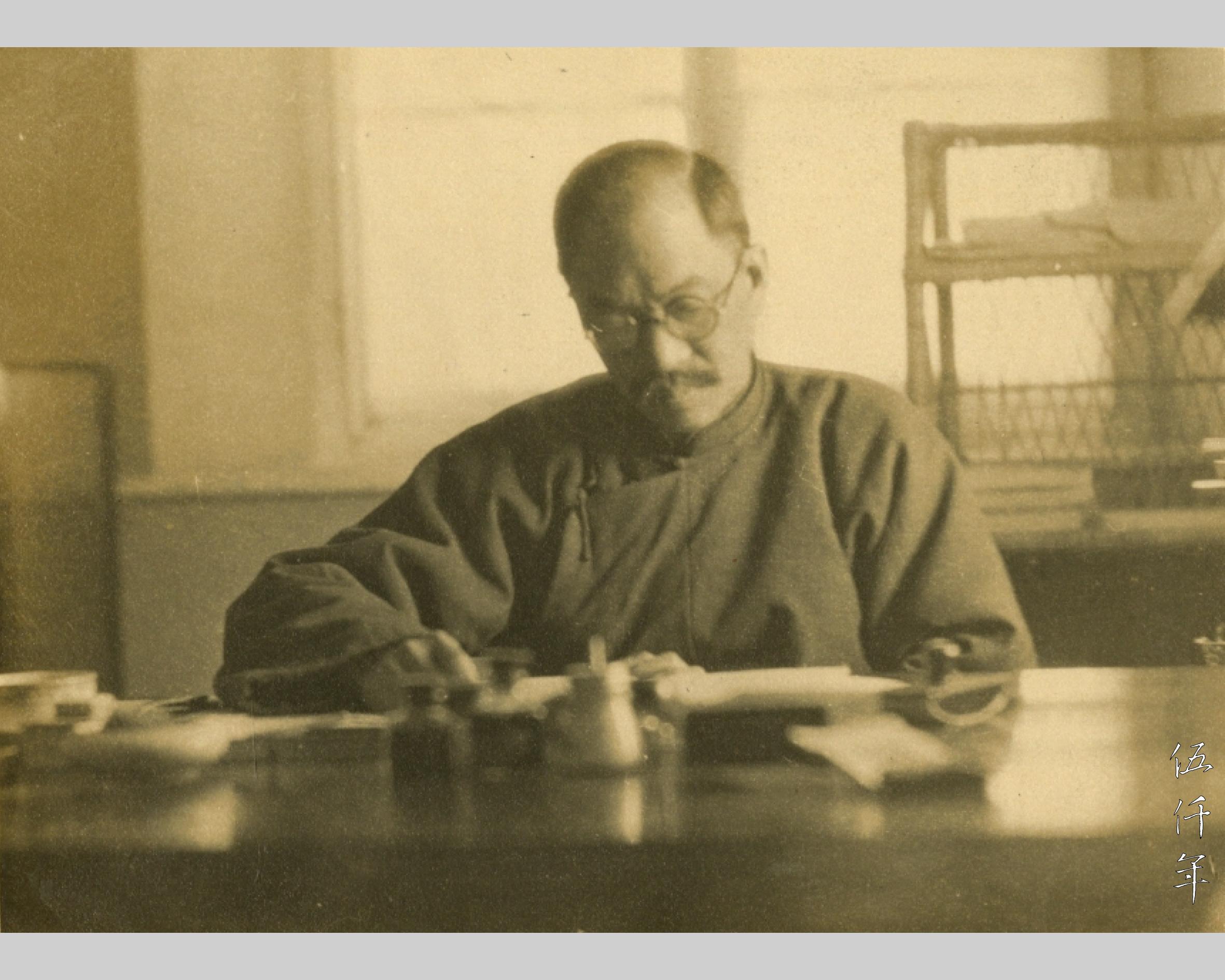
Portrait of Wang Ch’ung-hui, taken in The Hague in 1933
The Studio of Prunus Ode is honoured to celebrate the 80th Victory Anniversary of the Sino-Japanese War by publishing the Catalogue of Historic Documents, Writings, Certificates and Letters in the Wang Ch’ung-hui (王寵惠) Collection. Between March 1937, the 26th year of the Republic of China, to April 1941, the 30th year of the Republic of China, Wang Ch’ung-hui served as the foreign minister of China. Starting from April 1941, the 30th year of the Republic of China, he served as secretary-general of the Supreme National Defense Council. Wang Ch’ung-hui was appointed in succession to prominent positions in the Central Government. When President Chiang Kai-shek visited India in February 1942, the 31st year of the Republic of China, and when he attended the Cairo Conference in November 1943, the 32nd year of the Republic of China, he asked Wang Ch’ung-hui to attend and to counsel him. Between April and June 1945, the 34th year of the Republic of China, at the United Nations Conference on International Organization in San Francisco, Wang Ch’ung-hui was one of the eight delegates representing China and one of the eight signatories who signed the United Nations Charter on behalf of China. In his early life, Wang Ch’ung-hui was a confidant of Dr. Sun Yat-sen, the Founding Father of the Republic of China, and in his later life, he was a trusted adviser to President Chiang Kai-shek.
The Historic Documents, Writings, Certificates and Letters in the Wang Ch’ung-hui Collection were items that had long accompanied him for many years. They were also the sole belongings he carried to Taiwan after the fall of mainland China to the communists, an indication of the depth of his attachment. The many pages of these items are able to reveal the spirit of the founding of the Republic of China, the principles of the constitution, the paths of historic events, and those years of war against Japan when China was nearly obliterated by foreign invasion, when President Chiang Kai-shek resolutely led the soldiers and the civilians in a protracted war, when Chinese of all ages were united in one purpose, when heroism and sacrifice were commonplace across the country.
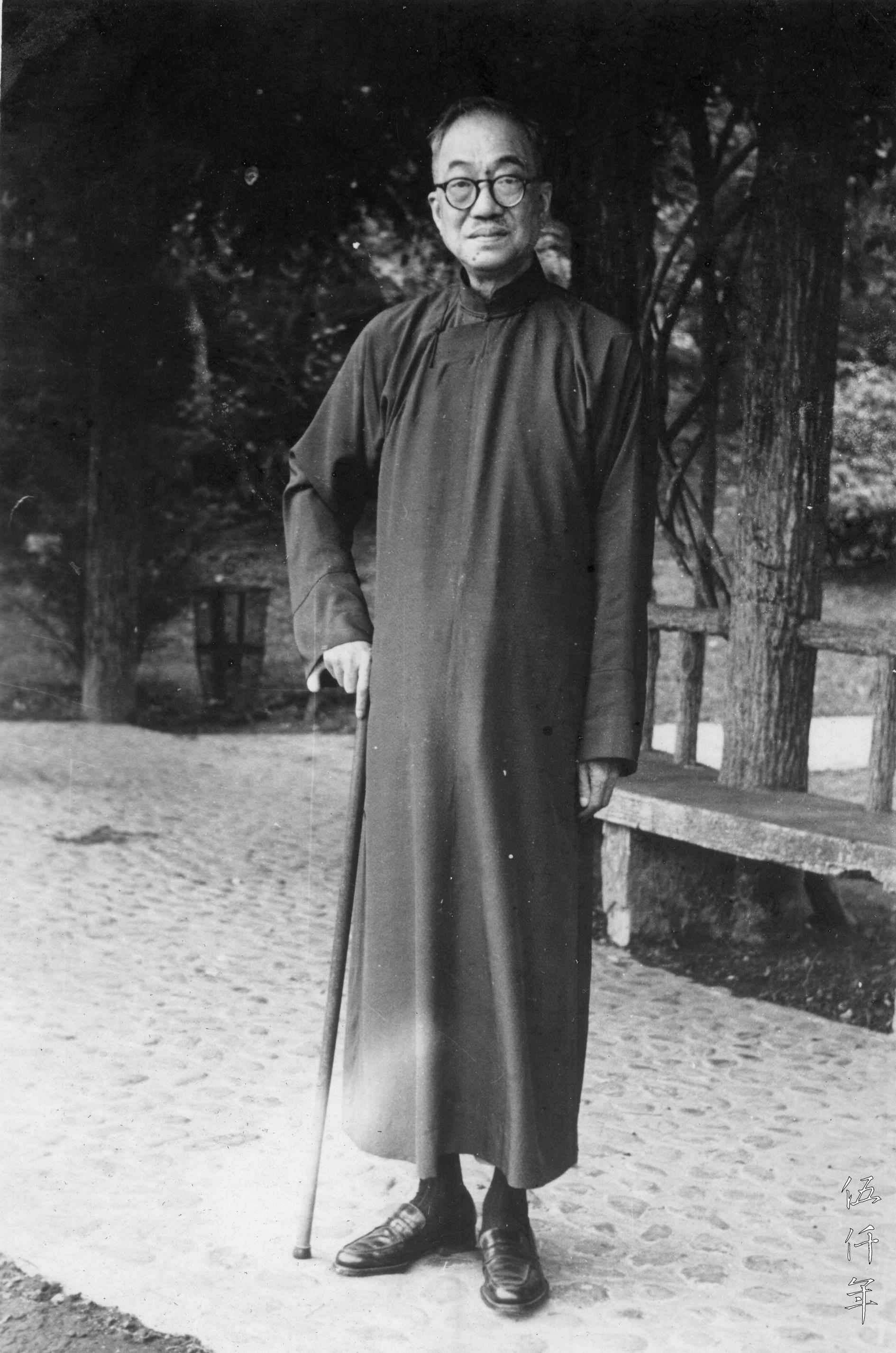
Portrait of Wang Ch’ung-hui, taken in Taipei
Wang Ch’ung-hui, tzu Liang-ch’ou (亮疇), was a native of Tung-kuan in Kwangtung province. He was born in the 7th year of the Kuang-hsü reign, or 1881, and died in the 47th year of the Republic of China, or 1958. There are altogether ninety eight items in his Collection, thirty five items belong to a personal nature, such as articles, certificates, family letters, friends’ letters and calligraphy. The remaining items are related to important historic events of modern China, especially abundant are those from the years of the Sino-Japanese War.
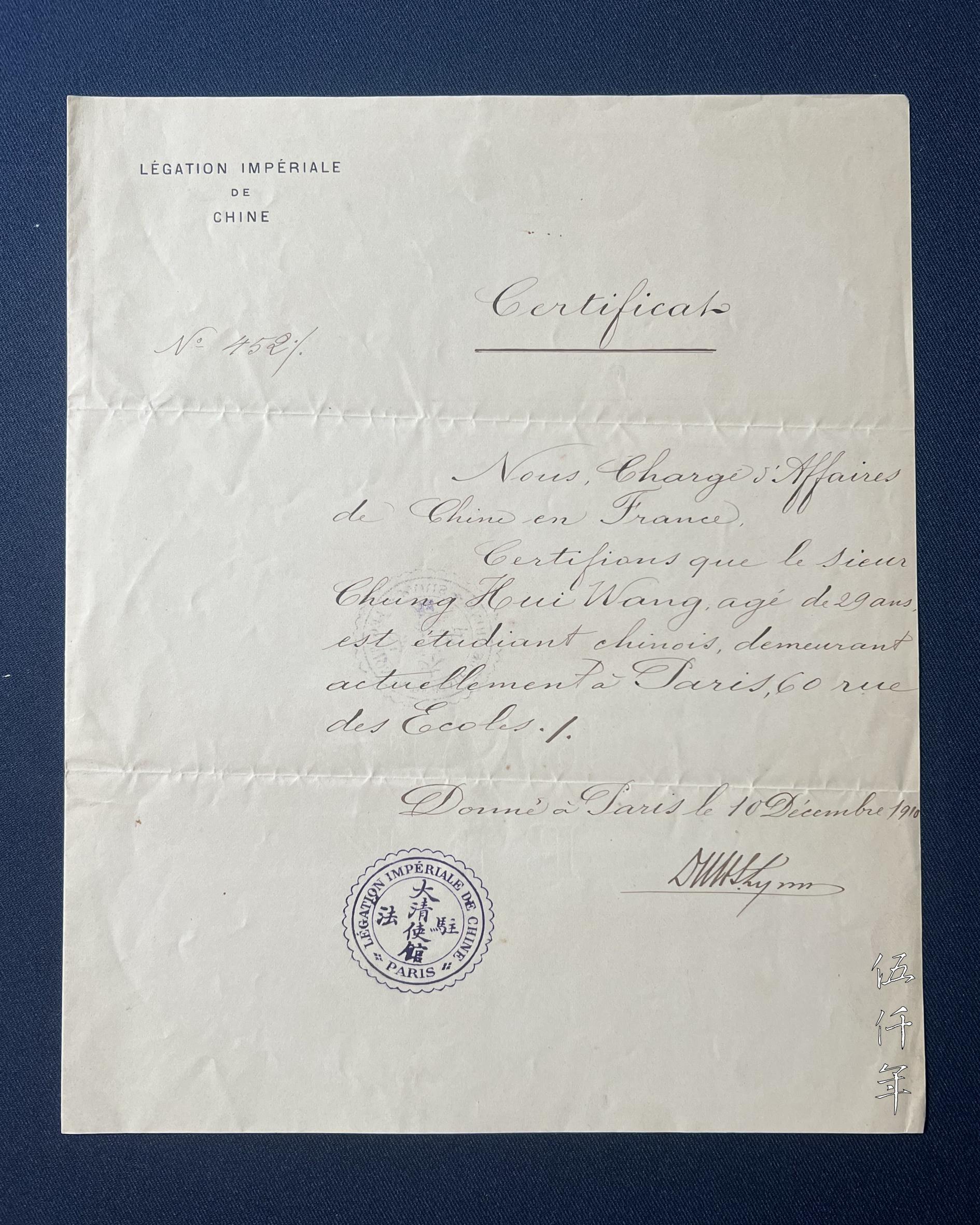
Student Identity Document issued by the Ch’ing Embassy
Material of a personal nature consists of eight articles by Wang Ch’ung-hui, which can be divided into two essays and six introductions. Certificates include a visa application from the Ch’ing Foreign Ministry to the Foreign Office of the Netherlands, Graduation Certificate from Yale University, Student Identity Document issued by the Ch’ing Embassy, Marriage Certificates etc. The earliest certificate is the Graduation Certificate from Yale University dated 23 November 1908.
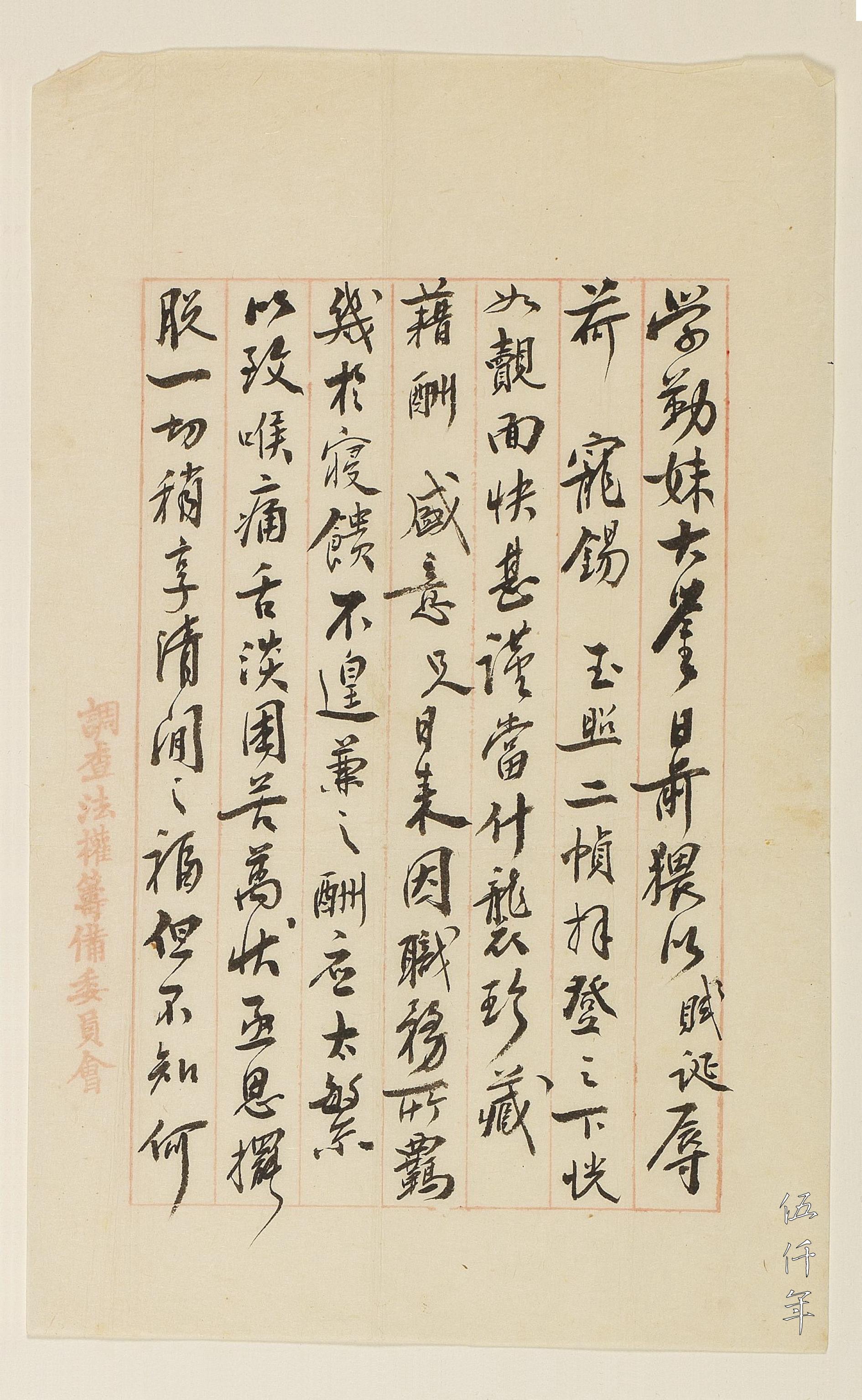
First page of letter by Wang Ch’ung-hui to wife Chu Hsüeh-ch’in
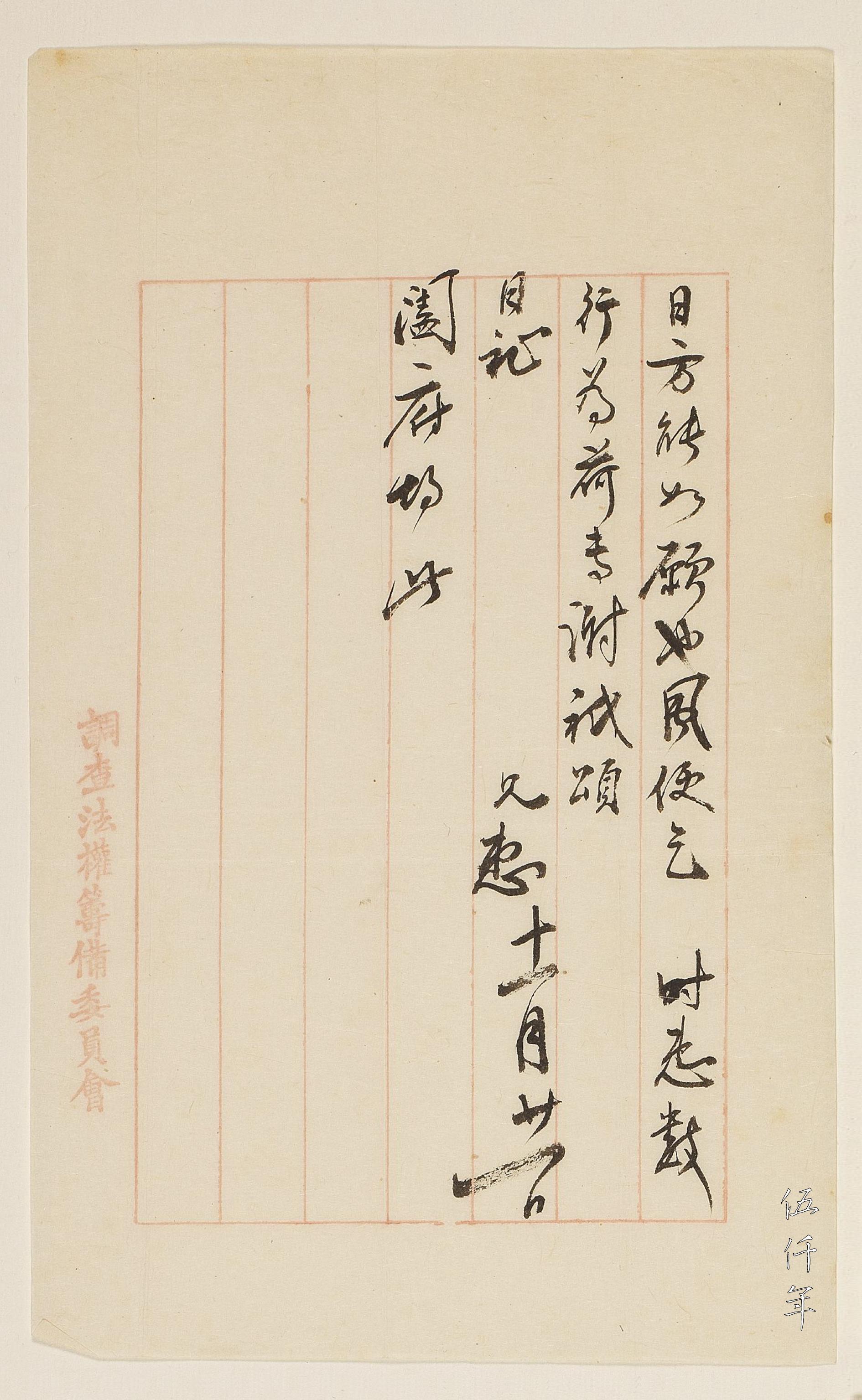
Second page of letter by Wang Ch’ung-hui to wife Chu Hsüeh- ch’in
Family letters include a letter by grandfather Wang Yüan-shen (王元深), dated 8 February 1908, and letters by Wang Ch’ung-hui to wife Chu Hsüeh-ch’in (朱學勤).
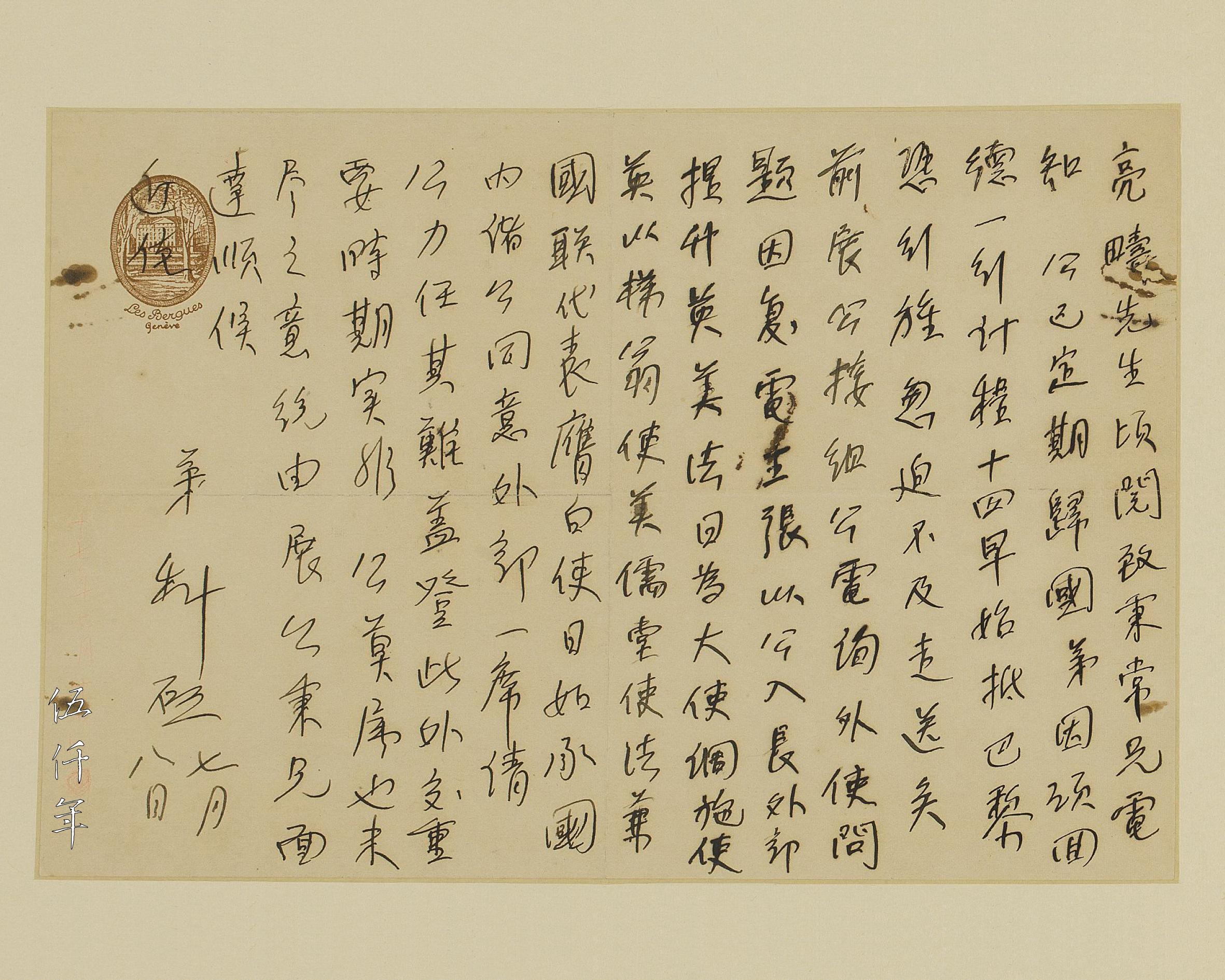
Letter by Sun Fo to Wang Ch’ung-hui
Friends’ letters include those by Wu Ching-heng (吳敬恆), Hsü Ch’ien (徐謙), Hu Han-min (胡漢民), Sun Fo (孫科) etc. The last item is a hanging scroll by Wu Ching-heng given to Wang Ch’ung-hui on his 70th birthday, dated May 1951. From the earliest family letter to the last item of a calligraphy scroll, altogether it spanned a period of forty three years.
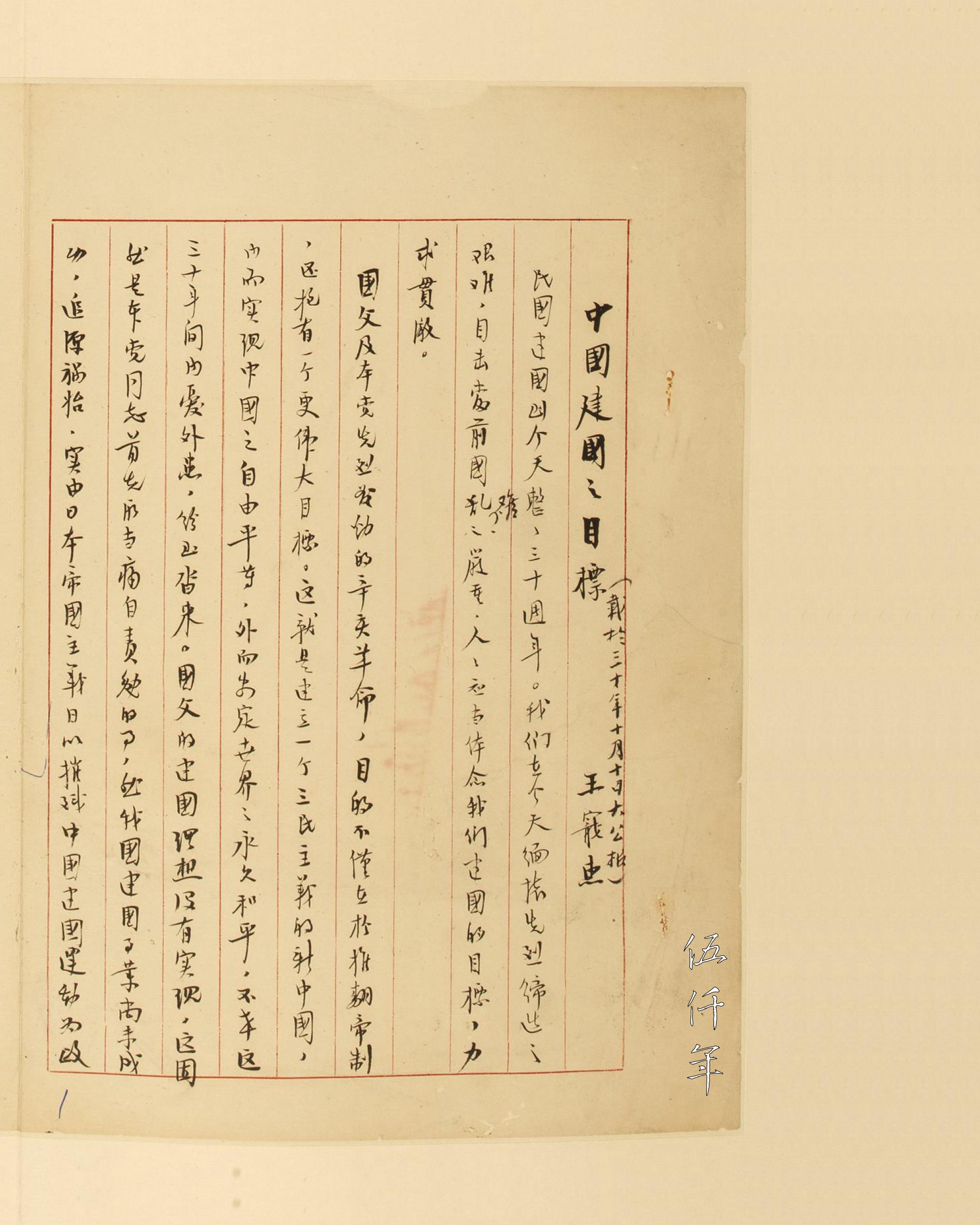
Manuscript titled The Goals of Establishing the Republic of China by Wang Ch’ung-hui
The earliest material that is related to a historic event is the Foreign Minister’s Certificate of Appointment signed by Dr. Sun Yat-sen and presented to Wang Ch’ung-hui, dated 5 January 1912, four days after the founding of the Republic of China. At the time Wang Ch’ung-hui was thirty one years old. The last piece of writing is Some Thoughts on the National Day by Wang Ch’ung-hui, published in the Central Daily News, dated October 1951, two years after the fall of mainland China. He was seventy at that time. From the earliest Certificate of Appointment to the last piece of newspaper article, it spanned a period of thirty nine years.
Reviewing all the material in the Collection and classifying them into Historic Material and Personal Material, there are eighteen categories:
Historic Documents
A) Founding the Republic of China
1 January 1912, the 1st year of the Republic of China.
B) Death of Dr. Sun Yat-sen
12 March 1925, the 14th year of the Republic of China.
C) Tsinan Incident or 3 May Tragedy
3 May 1928, the 17th year of the Republic of China.
D) Organic Law of the National Government of China
8 October 1928, the 17th year of the Republic of China.
E) Northern Expedition and the Unification of China
29 December 1928, the 17th year of the Republic of China.
F) Making and Using the National Seal
10 October 1929, National Day of the 18th year of the Republic of China.
G) The Mukden Incident
18 September 1931, the 20th year of the Republic of China.
H) Establishing the Administrative Court
23 June 1933, the 22nd year of the Republic of China.
J) The Sino-Japanese War
7 July 1937, the 26th year of the Republic of China, to 15 August 1945, the 34th year of the Republic of China.
K) Surrender of Japan
15 August 1945, the 34th year of the Republic of China.
L) Founding the United Nations
24 October 1945, the 34th year of the Republic of China.
M) 60th Birthday of President Chiang Kai-shek
31 October 1946, the 35th year of the Republic of China.
N) Implementation of the National Constitution
25 December 1947, the 36th year of the Republic of China.
O) Relocation of the Central Government to Taiwan
7 December 1949, the 38th year of the Republic of China.
Personal Documents
P) Articles and Introductions
Q) Miscellaneous Certificates
R) Family Letters
S) Friends’ Letters and Calligraphy
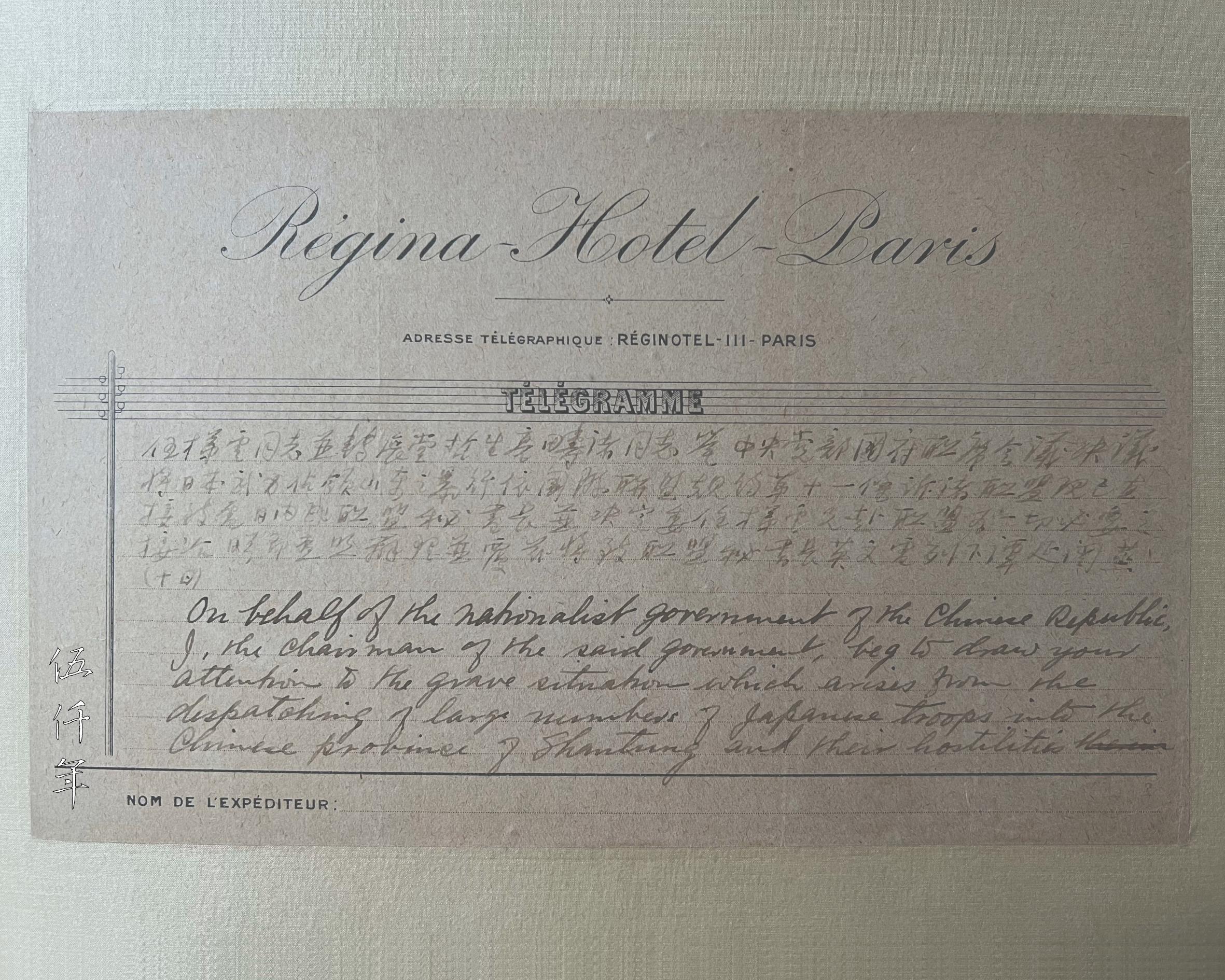
First page of English telegram draft signed by T’an Yen-kai addressed to the League of Nations after the Tsinan Incident
There is no shortage of rare and important historic documents in the Wang Ch’ung-hui Collection. To cite a few examples. After the outbreak of the Tsinan Incident in 1928, there are correspondences about the Incident among senior officials and drafts of telegrams addressed to the League of Nations requesting assistance to stop Japanese aggression. When the French Government closed down the Yunnan-Vietnam Railway in 1940, there is the manuscript titled A Proclamation by the Chinese Government, edited by President Chiang Kai-shek. There is a manuscript by Wang Ch’ung-hui titled The Repeal of Unequal Treaties and International Relationships, and another one titled The Terms of Japan’s Unconditional Surrender and Important Post-War Issues. There are just too many to count.
Most of the material in the Wang Ch’ung-hui Collection once belonged to the dealer and art enthusiast Mr. T’ang Hung-chien (唐鴻漸), a close friend of Wang Ta-hung (王大閎), son of Wang Ch’ung-hui. Mr. T’ang at one time printed a selection of the most important documents as posters. Some twenty years ago, Mr. T’ang started to sell me the material in separate parts, by then a small portion had already been dispersed. From what I know, a number of letters by President Chiang Kai-shek and Tai Ch’i-t’ao (載季陶) were already sold at auctions. In addition, there was an album of rare letters by numerous early revolutionaries, sold to Director Ch’in Hsiao-i (秦孝儀) for a hefty sum. Although the Wang Ch’ung-hui Collection is not wholly intact, if we survey collections of historic documents related to modern China, very few private collections can be deemed its peer.
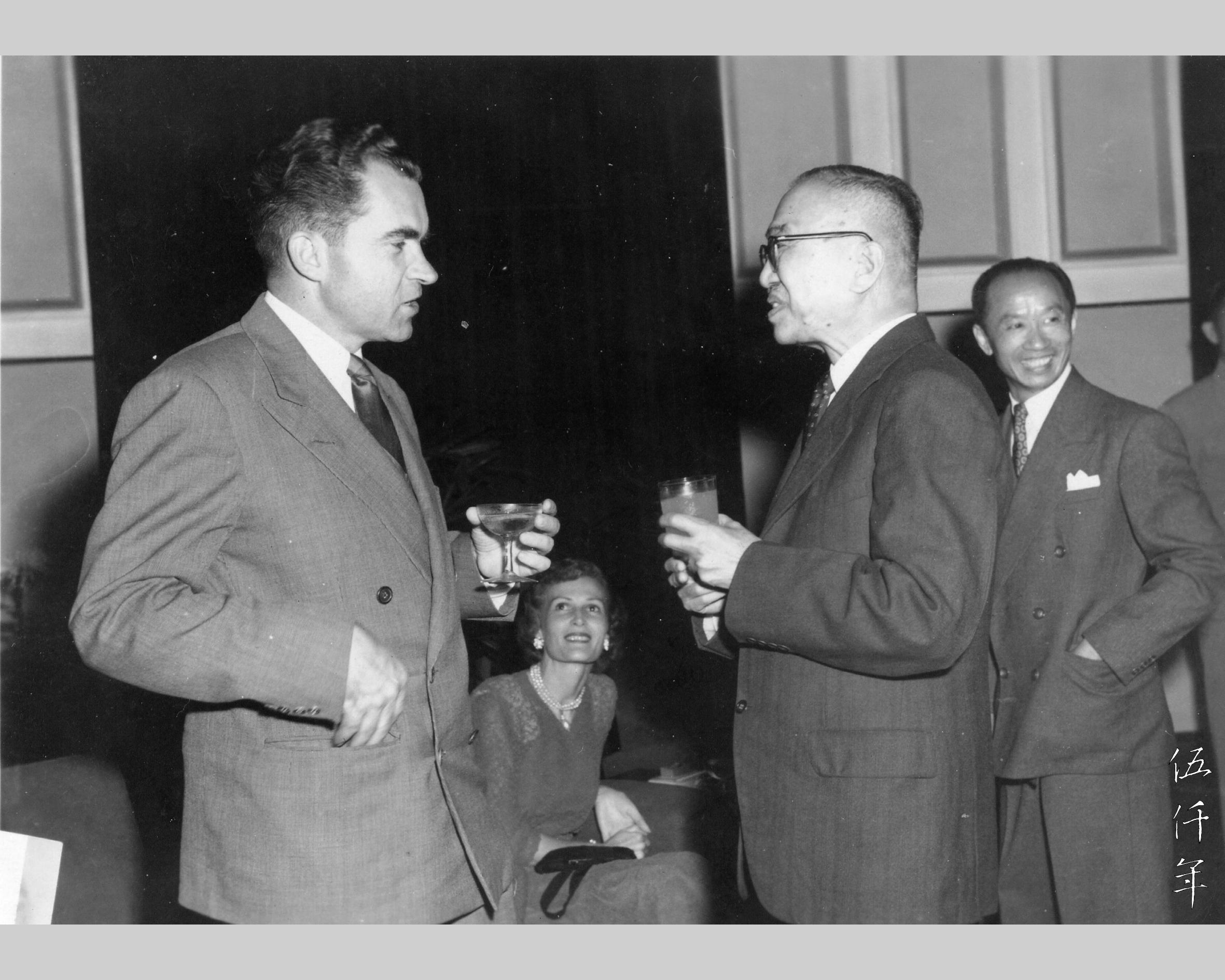
United States Vice-President Richard Nixon requested to meet Wang Ch’ung-hui when he visited Taiwan in 1956
The Catalogue of Documents, Writings and Letters in the Wang Ch’ung-hui Collection is now finally presented to the public:
Historic Documents
A) Founding of the Republic of China
1 January 1912, the 1st year of the Republic of China.
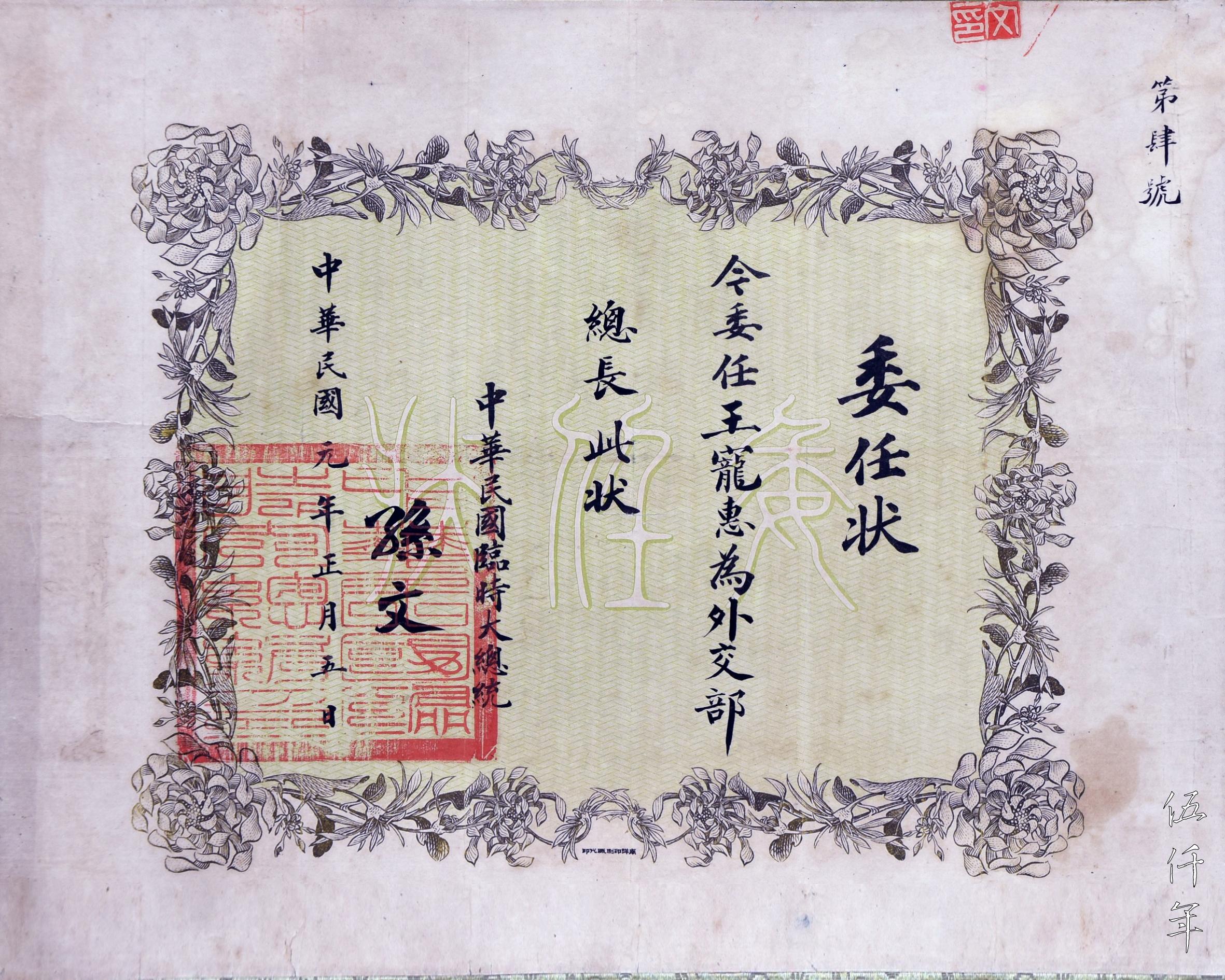
Foreign Minister’s Certificate of Appointment presented to Wang Ch’ung-hui, signed by Dr. Sun Yat-sen, the Provisional President of the Republic of China
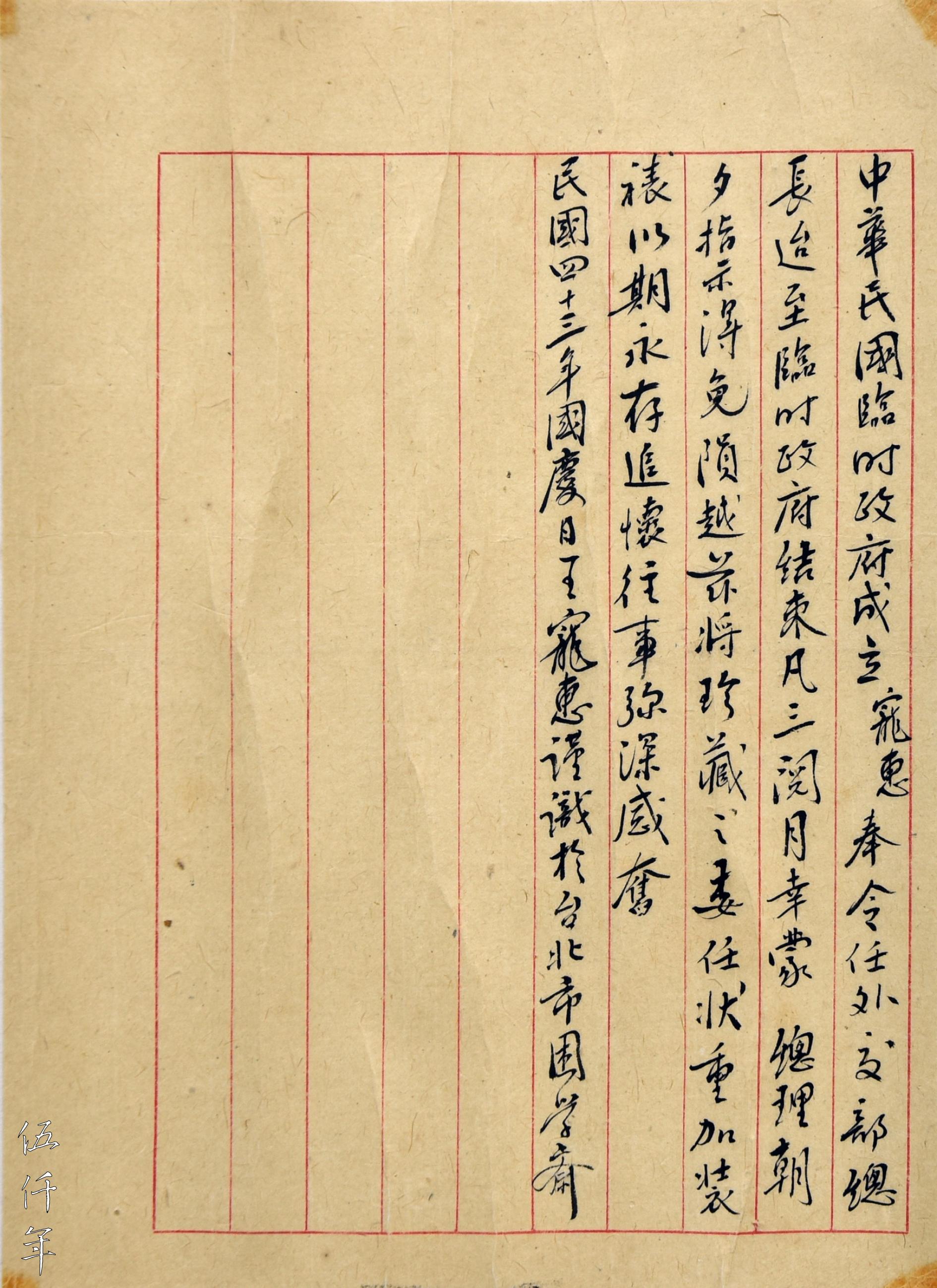
Inscription by Wang Ch’ung-hui beside the Certificate of Appointment
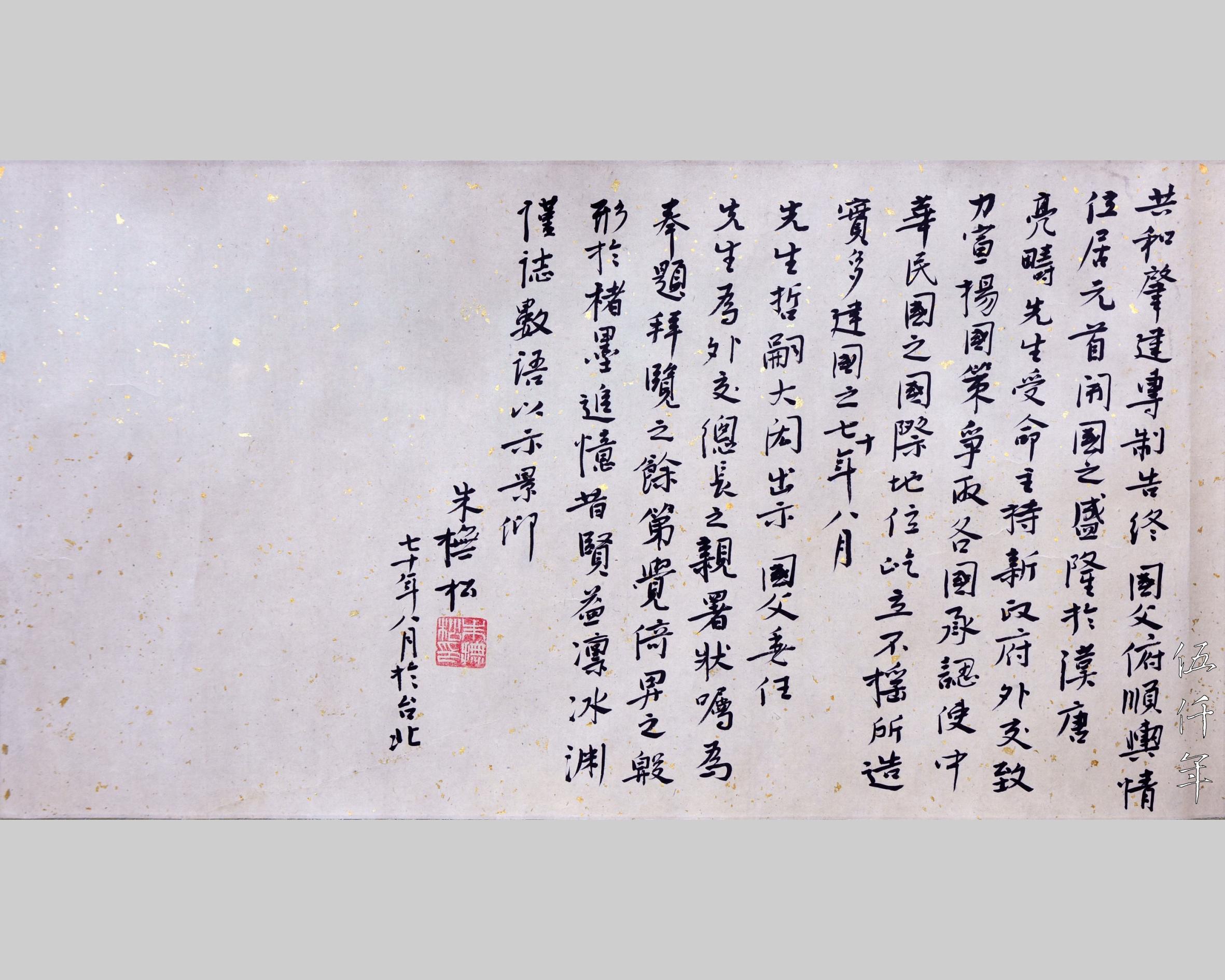
Inscription by Chu Fu-sung beside the Certificate of Appointment
i) Foreign Minister’s Certificate of Appointment presented to Wang Ch’ung-hui, signed by Dr. Sun Yat-sen, the Provisional President of the Republic of China, dated 5 January 1912, four days after the founding of the Republic of China.
B) Death of Dr. Sun Yat-sen
12 March 1925, the 14th year of the Republic of China.
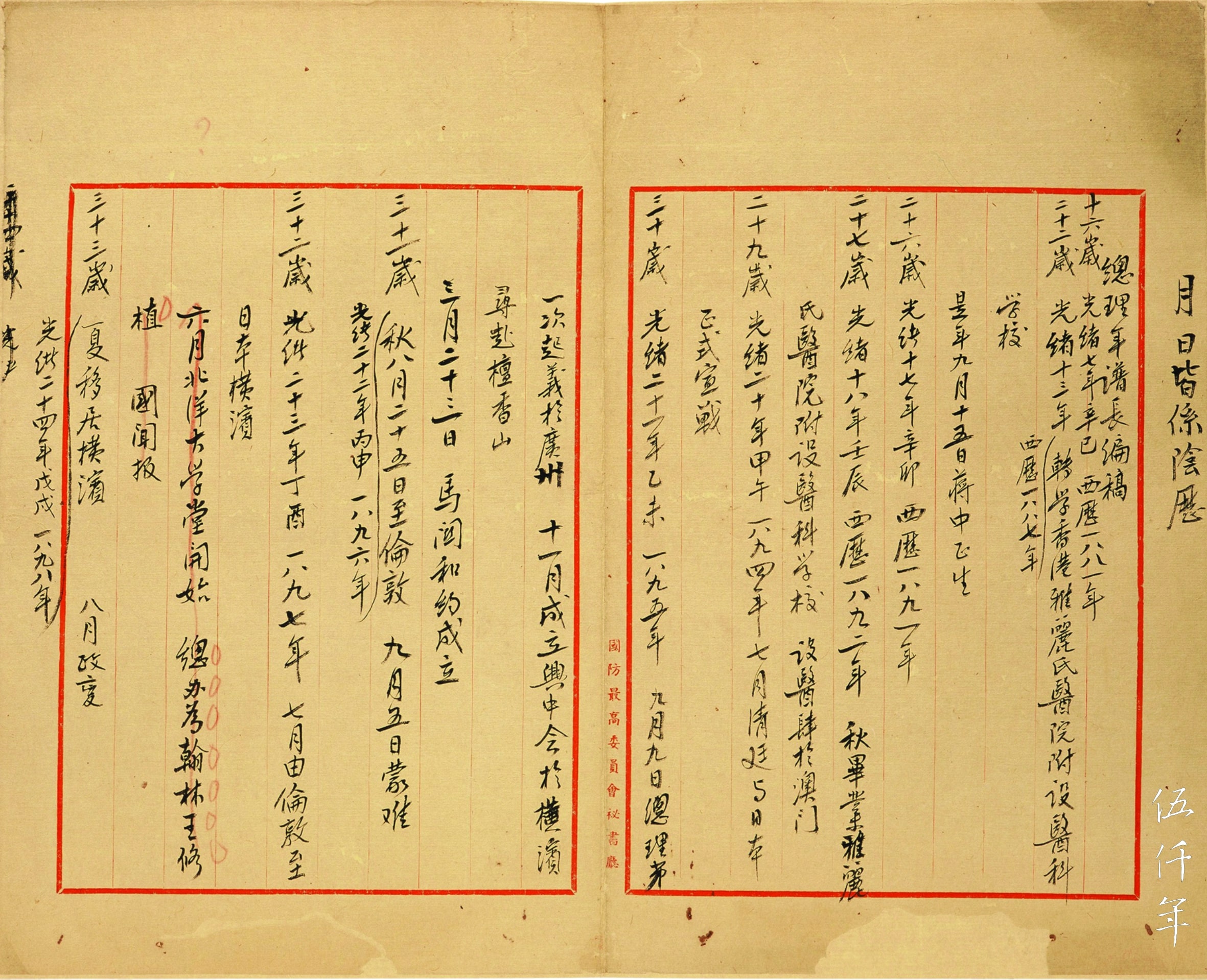
A page of the manuscript titled A Lengthy Chronology of the Life of the Provisional President Sun Yat-sen by Wang Ch’ung-hui
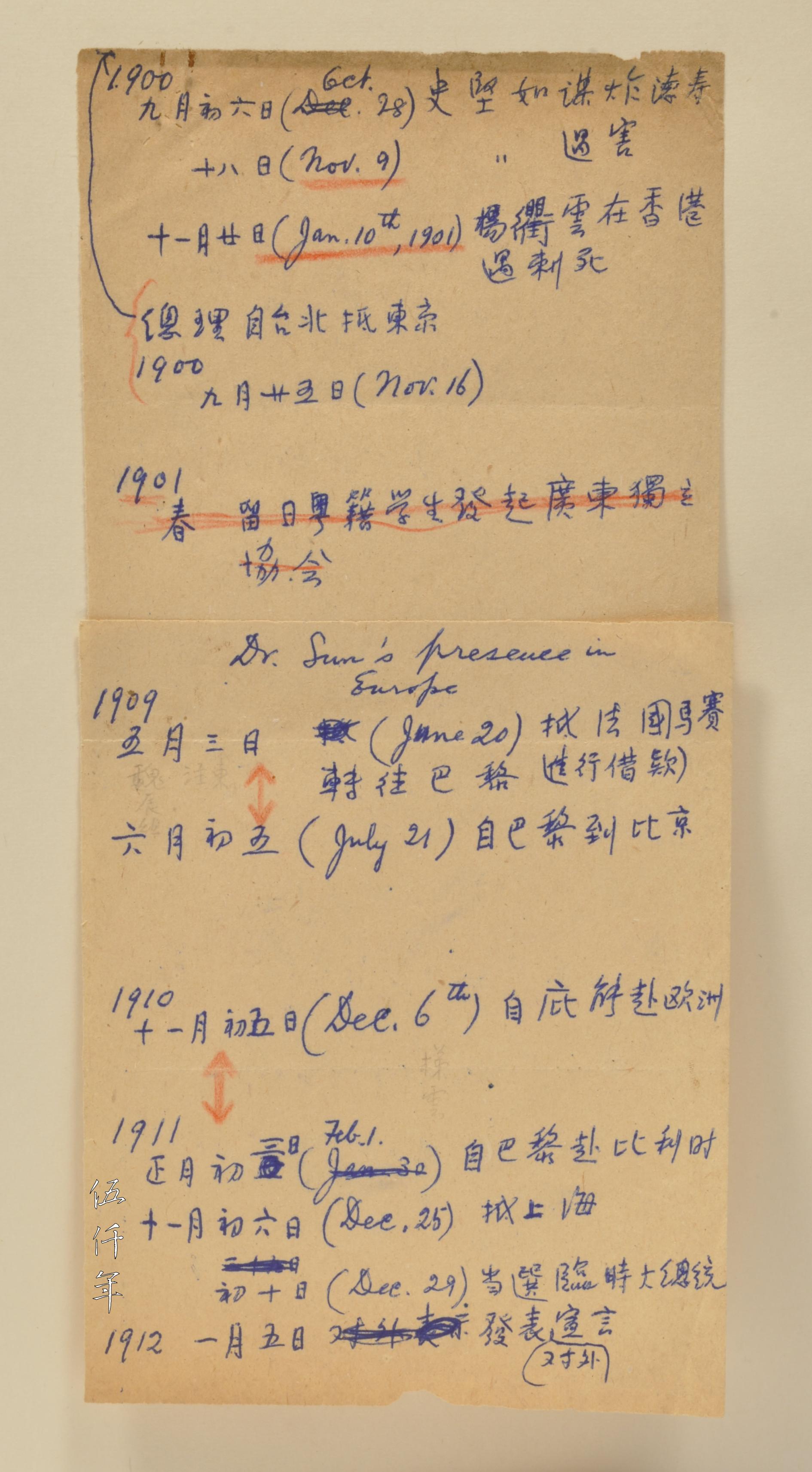
Another page of the manuscript titled A Lengthy Chronology of the Life of the Provisional President Sun Yat-sen by Wang Ch’ung-hui
i) Manuscript titled A Lengthy Chronology of the Life of the Provisional President Sun Yat-sen, handwritten by Wang Ch’ung-hui.
C) Tsinan Incident or 3 May Tragedy
3 May 1928, the 17th year of the Republic of China.
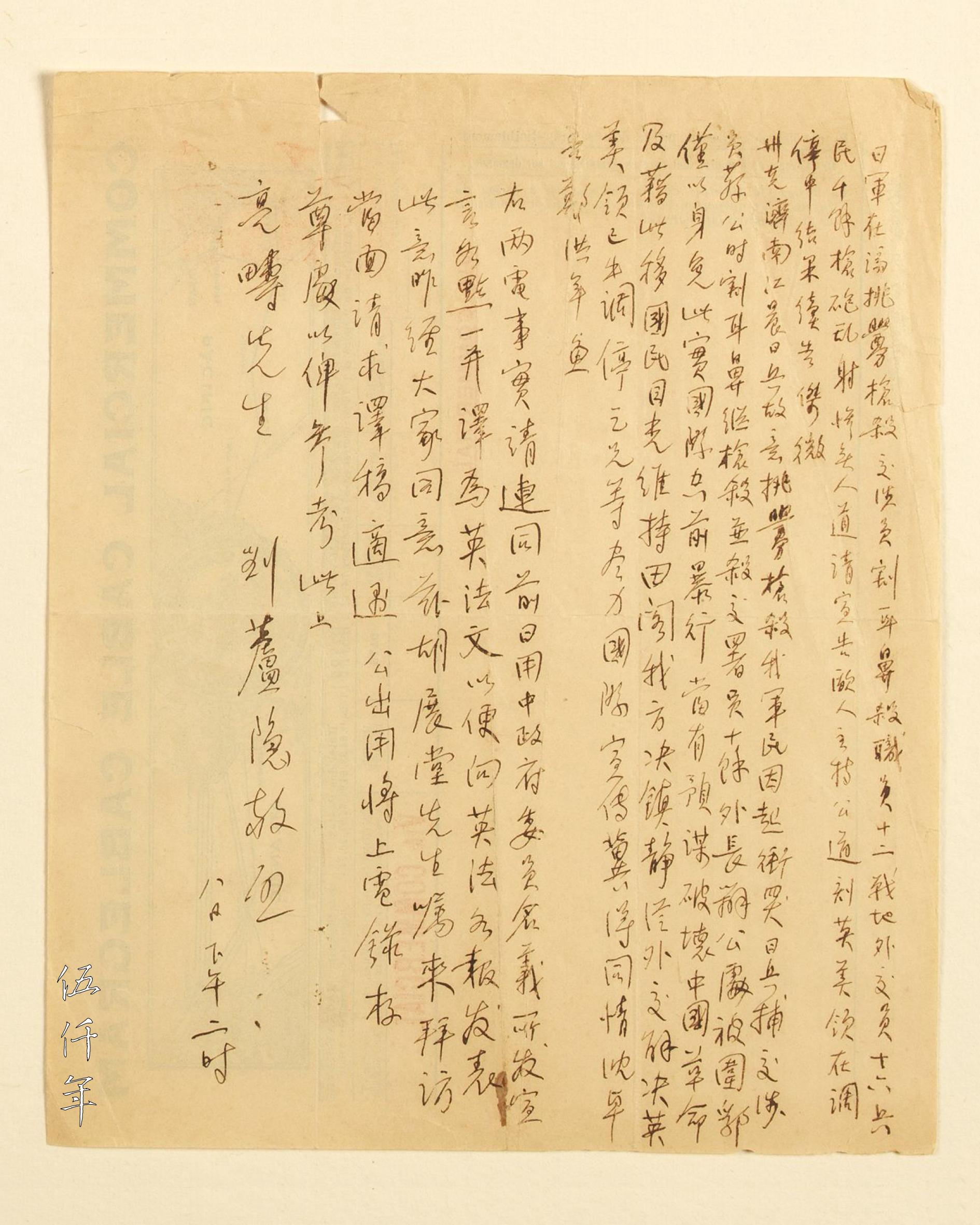
Letter by Liu Lu-yin to Wang Ch’ung-hui after the Tsinan Incident
i) Letter by Liu Lu-yin (劉蘆隱) to Wang Ch’ung-hui on the Tsinan Incident, describing how Japanese soldiers cut off the nose and ears of the diplomat Ts’ai K’ung-shih (蔡公時) and shot more than one thousand soldiers and civilians.
ii) Letter by Hu Han-min (胡漢民) to Wang Ch’ung-hui on informing the League of Nations about the Tsinan Incident.
iii) Draft of telegram from Hu Han-min, Sun Fo (孫科) and Wu Chao-shu (伍朝樞) to President Chiang Kai-shek, Huang Fu (黃郛) and T’an Yen-kai (譚延闓) on the implications of the Tsinan Incident regarding foreign and domestic policies.
iv) Draft of English telegram signed by T’an Yen-kai to the League of Nations, describing the Tsinan Incident and appealing for help to halt Japanese military aggression.
D) Organic Law of the National Government of China
8 October 1928, the 17th year of the Republic of China.
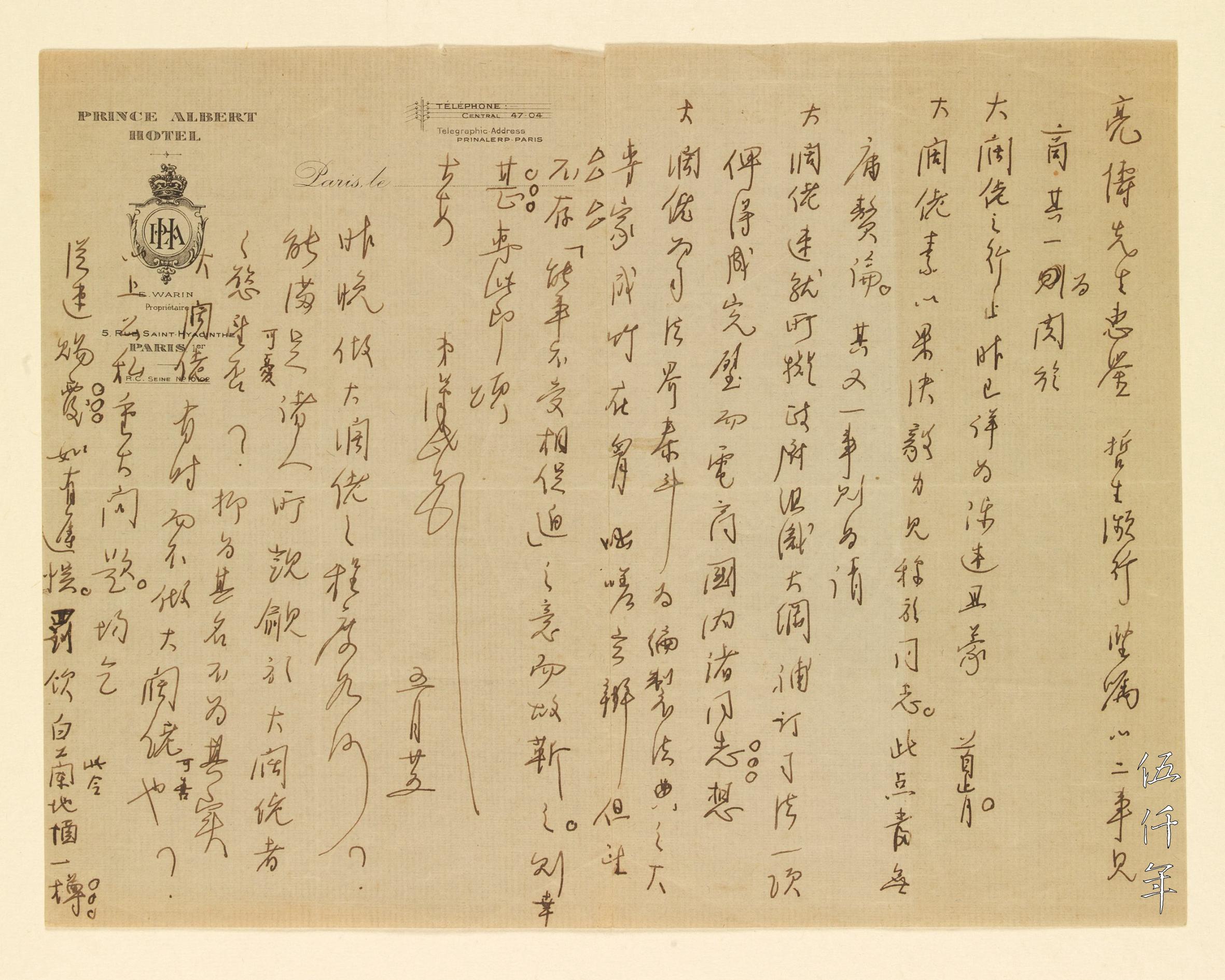
Letter by Hu Han-min to Wang Ch’ung-hui on preparing the Outline of the Organic Law of the National Government of China
i) Letter by Hu Han-min to Wang Ch’ung-hui on preparing the Outline of the Organic Law of the National Government of China and making amendments to the Organic Law.

Group portrait of Hu Han-min, seated in the middle of the front row, Wang Ch’ung-hui, standing in the middle of the back row, and others taken in Italy in December 1935
E) Northern Expedition and the Unification of China
29 December 1928, the 17th year of the Republic of China.
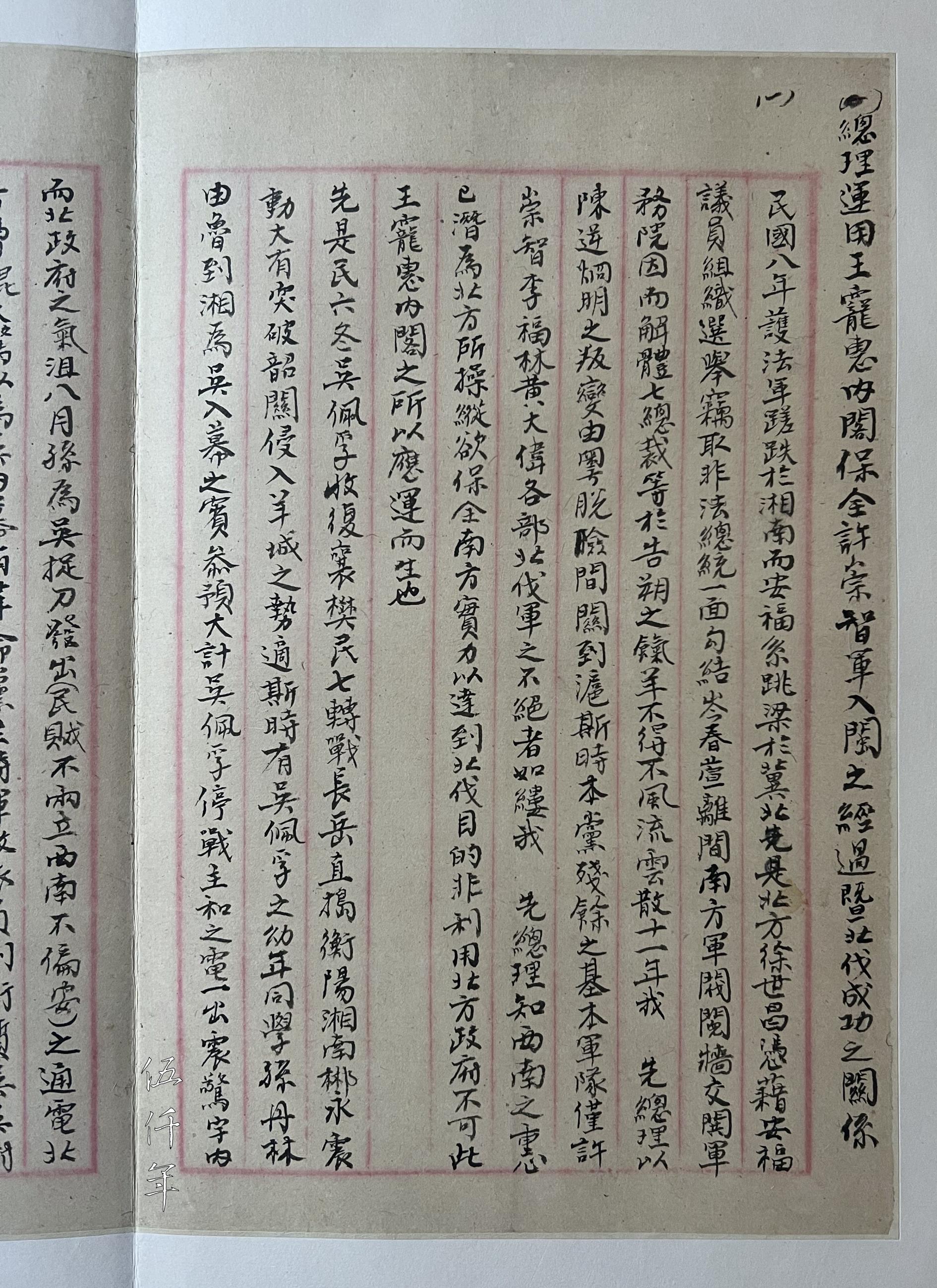
Manuscript titled An Account of the Connection Between President Sun Yat-sen Using the Cabinet of Wang Ch’ung-hui to Ensure the Army of Hsü Ch’ung-chih Could Enter Fukien Province and the Success of the Northern Expedition, by Wang Ch’ung-hui
i) Manuscript titled An Account of the Connection Between President Sun Yat-sen Using the Cabinet of Wang Ch’ung-hui to Ensure the Army of Hsü Ch’ung-chih (許崇智) Could Enter Fukien Province and the Success of the Northern Expedition, by Wang Ch’ung-hui.
ii) Letter by Wang Ching-wei (汪精衛) to Wang Ch’ung-hui on foreign and domestic conditions before the completion of the Northern Expedition.
iii) Letter by Hu Han-min to Wang Ch’ung-hui on instigations and slanders by British newspapers directed at the National Government of China.
F) Making and Using the National Seal
10 October 1929, National Day of the 18th year of the Republic of China.

First page of document on using the leftover stone material after making the National Seal to carve additional seals
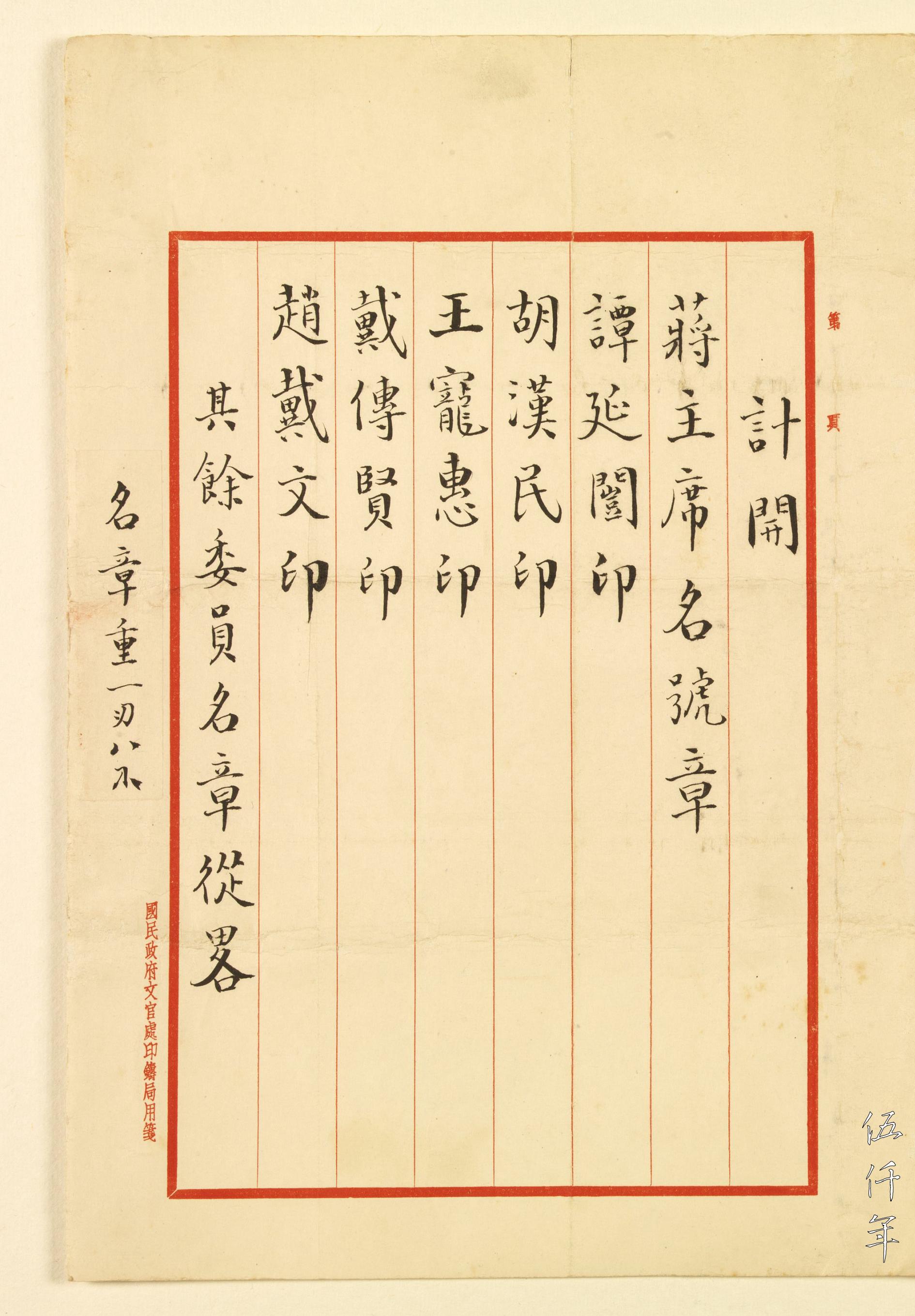
Second page of document on using the leftover stone material after making the National Seal to carve additional seals
i) Document on using the leftover stone material after making the National Seal, to carve additional seals for the president of the National Government of China and the five presidents of the Executive Yuan, Legislative Yuan, Judicial Yuan, Examination Yuan and Control Yuan.
G) The Mukden Incident
18 September 1931, the 20th year of the Republic of China.

Letter by Hu Han-min to Wang Ch’ung-hui on Japanese policy of conducting peace negotiations and military aggressions simultaneously
i) Letter by Hu Han-min to Wang Ch’ung-hui on Japanese policy of conducting peace negotiations and military aggressions simultaneously.
H) Establishing the Administrative Court
23 June 1933, the 22nd year of the Republic of China.
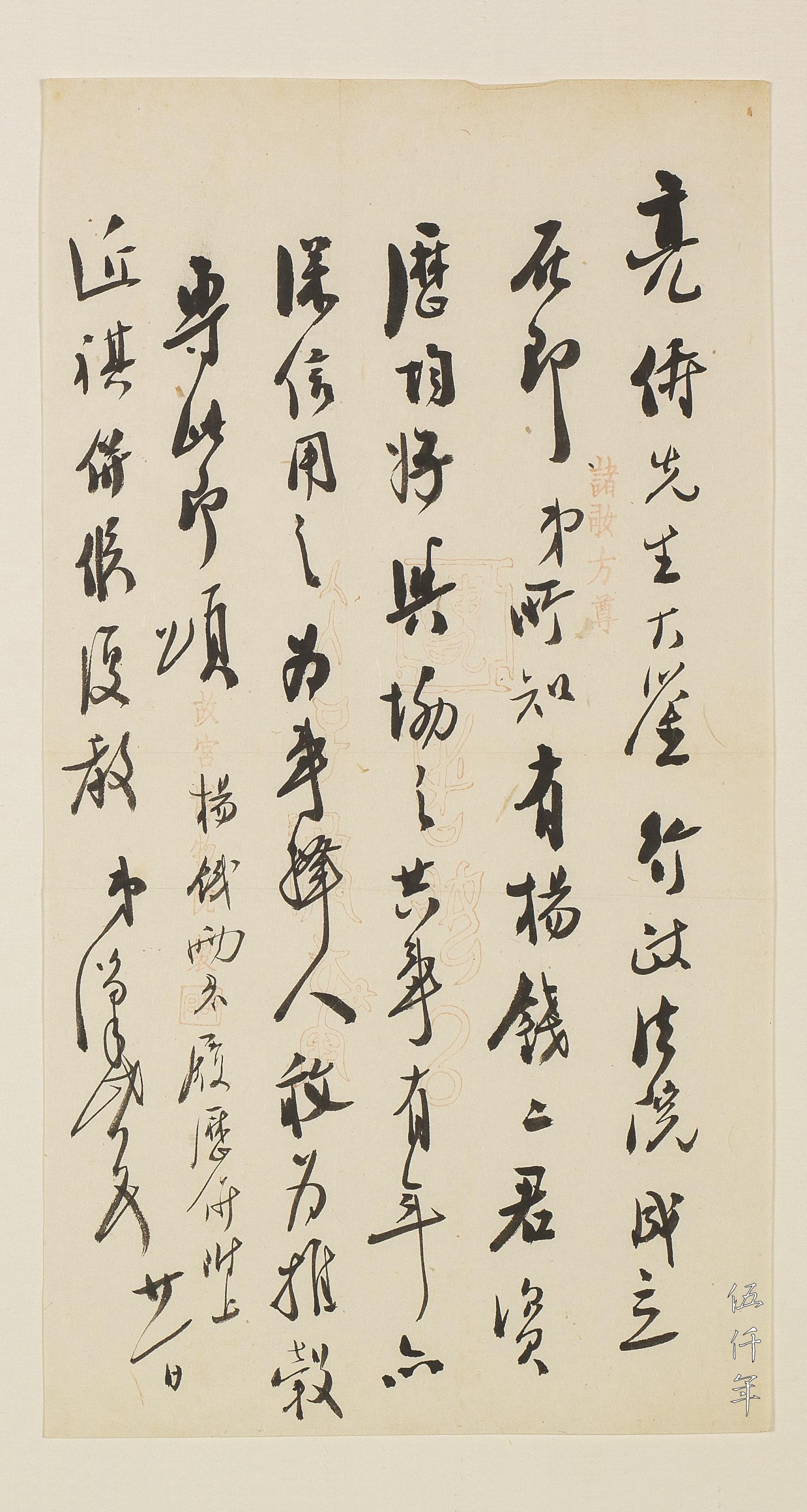
Letter by Hu Han-min to Wang Ch’ung-hui on the soon to be established Administrative Court
i) Letter by Hu Han-min to Wang Ch’ung-hui on the soon to be established Administrative Court.
J) The Sino-Japanese War
7 July 1937, the 26th year of the Republic of China to 15 August 1945, the 34th year of the Republic of China.
a) Ch’en Pu-lei (陳布雷), director of the Executive Office of the Generalissimo, requested a meeting with Wang Ch’ung-hui on behalf of Generalissimo Chiang Kai-shek, to take place at his residence in Whampoa of Kwangtung province.
29 August 1938, the 27th year of the Republic of China.
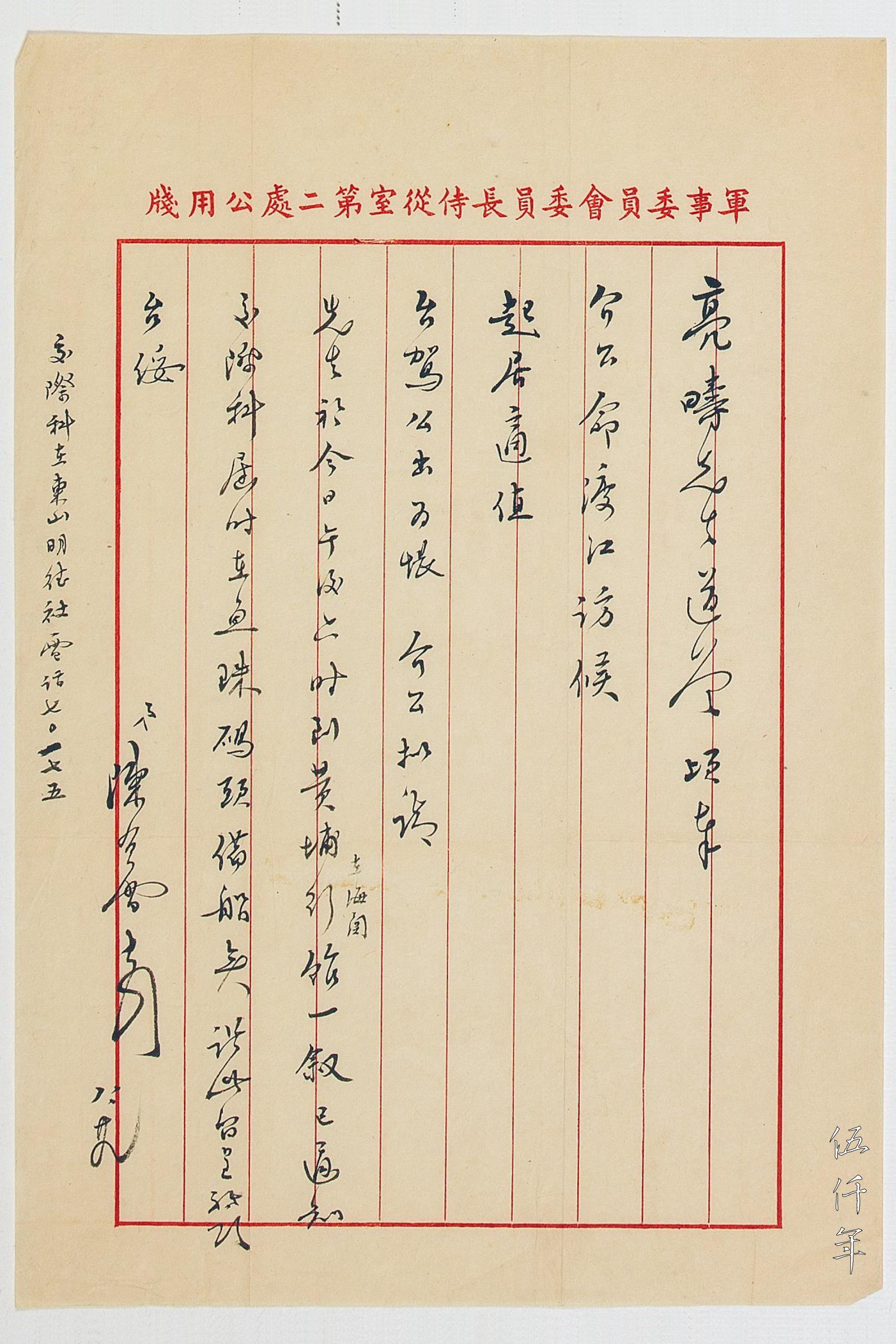
Letter by Ch’en Pu-lei to Wang Ch’ung-hui on meeting Generalissimo Chiang Kai-Shen at his residence in Whampoa
i) Letter by Ch’en Pu-lei to Wang Ch’ung-hui on meeting Generalissimo Chiang Kai-shek at his residence in Whampoa of Kwangtung province.
b) The National Government of China purchasing armaments from Czechoslovakia.
March 1939, the 28th year of the Republic of China.
i) Official telegram from President Chiang Kai-shek, commenting that the inventory of armaments from Czechoslovakia was non-essential and overpriced.
c) Cho Huan-lai (卓還來) was appointed consul of Saigon in Vietnam.
March 1939, the 28th year of the Republic of China.
i) Letter and telegram by President Chiang Kai-shek to Wang Ch’ung-hui on the appointment of Cho Huan-lai as consul of Saigon.
d) Chinese patriots assassinated a collaborator in the British Concession of Tientsin City. This developed into a major diplomatic dispute known as the Tientsin Incident.
9 April 1939, the 28th year of the Republic of China.
i) Draft of Chinese letter by President Chiang Kai-shek to British ambassador Clark Kerr on the assassination of a collaborator in the British Concession, with intent to rescue the Chinese agents Chu Tsung-liang (祝宗樑) and Yüan Chün-ling (袁俊陵), also known as Yüan Han-chün (袁漢俊), and others.
ii) Letter by President Chiang Kai-shek to Wang Ch’ung-hui on the Craigie-Arita Formula.
iii) Note by Ch’en Pu-lei on full British acceptance of Japanese demands in Tientsin.
iv) Draft of English telegram from President Chiang Kai-shek to Ambassador Kerr.
v) Draft of letter by Wang Ch’ung-hui to President Chiang Kai-shek reporting that the counselor from the British Embassy had submitted a private telegram from the British ambassador.
vi) Chinese translation of the private telegram from Ambassador Kerr to President Chiang Kai-shek.
e) The secretary-general of the Ministry of Foreign Affairs was unfit for the job.
22 April 1939, the 28th year of the Republic of China.
i) Official telegram from President Chiang Kai-shek commenting on Tuan Mao-lan (段茂瀾), secretary-general of the Ministry of Foreign Affairs, that he intentionally hindered official work and was unfit for the job.
f) After the Treaty of Non-Aggression between Germany and the Union of Soviet Socialist Republics, the National Government of China was deeply concerned that Britain would succumb to Japanese demands again, and proposed to reiterate China’s resolution to fight the war of resistance against Japanese aggression.
23 August 1939, the 28th year of the Republic of China.

First page of official telegram from President Chiang Kai-Shek regarding Britain succumbing again to Japanese demands
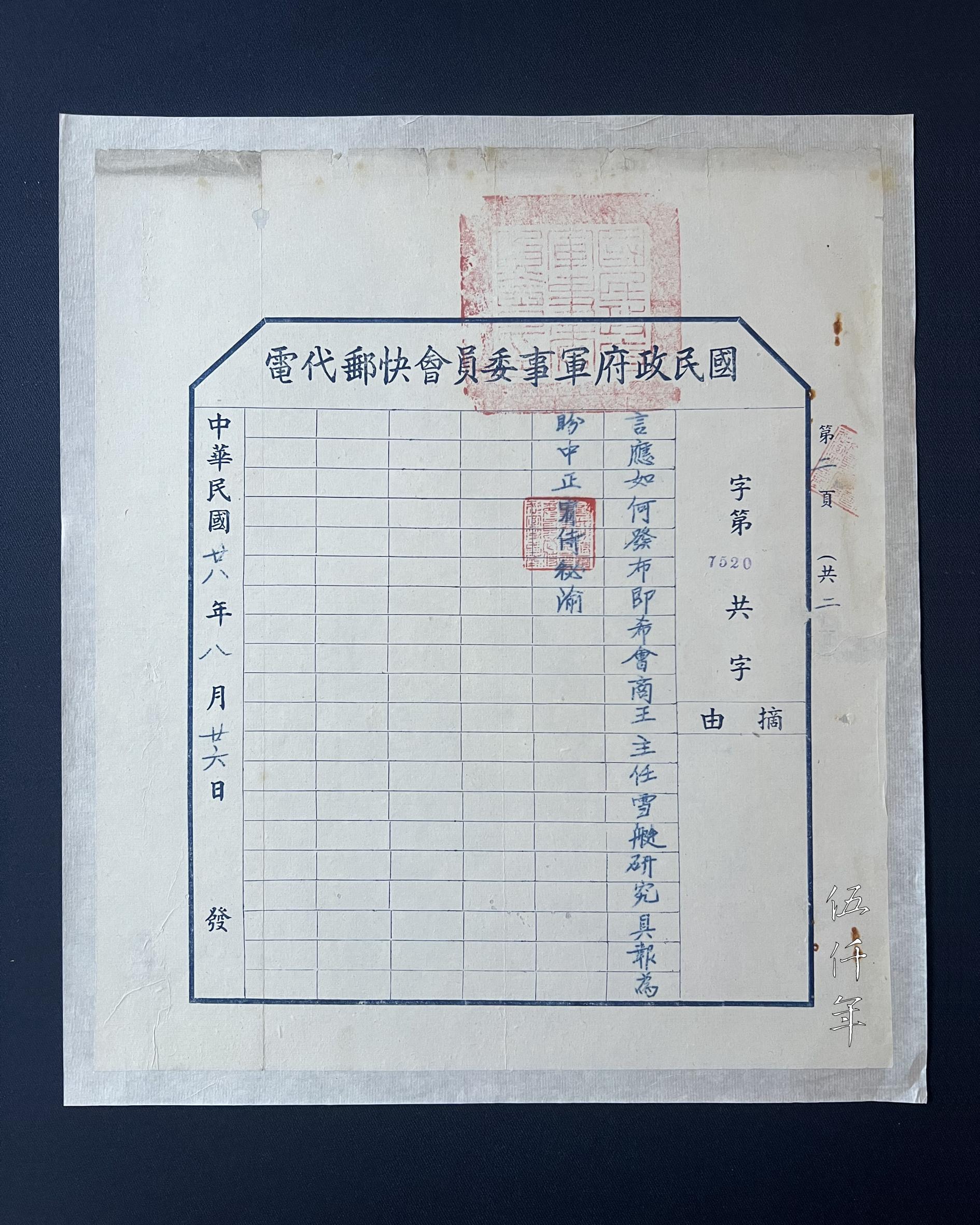
Second page of official telegram from President Chiang Kai-shek regarding Britain succumbing again to Japanese demands
i) Official telegram from President Chiang Kai-shek regarding a telegram from Fu Ssu-nien (傅斯年) and Ch’ien Tuan-sheng (錢端升) who described the new international relationships in Europe. They were anxious that Britain would succumb to Japanese demands again and advised the National Government of China to reiterate her resolution to fight the war of resistance against Japanese aggression.
g) The standpoint and position of the National Government of China after the outbreak of the European War when Germany attacked Poland.
1 September 1939, the 28th year of the Republic of China.
i) Letter from the Secretariat of the Central Executive Committee to Wang Ch’ung-hui, regarding the 129th session of the Standing Committee of the Central Committee of the Kuomintang, whereby discussions took place about the European War, the abrupt developments in international relationships, and what foreign policy standpoint and position should China take. Letter is accompanied by a manuscript titled Summary of Opinions on Foreign Affairs from the Standing Committee Members.
ii) Manuscript titled Steps the Chinese Government Should Take Regarding the European War, edited by President Chiang Kai-shek.
iii) Manuscript titled Due to German Attack on Poland, European Peace Has Been Shattered. The National Government of China Solemnly Announces Her Standpoint and Position Towards the Current European War.
iv) Letter by Ch’en Pu-lei to Wang Ch’ung-hui on preparing an English telegram to be sent to the secretary-general of the League of Nations.
v) Chinese draft titled Notes to the Secretary-General of the League of Nations, on Stopping Japanese Aggression, Keeping the Peace, and Effectively Executing the Resolutions of the League of Nations.
vi) Typed English draft with revisions titled Notes to the Secretary-General of the League of Nations.
h) President Chiang Kai-shek addressed the Fourth Session of the People’s Political Consultative Conference.
9 September 1939, the 28th year of the Republic of China.
i) Script of speech by President Chiang Kai-shek addressing the Fourth Session of the People’s Political Consultative Conference.
j) Koo Vi Kyuin (顧維鈞), ambassador to France, reported on the deteriorating relationship between France and the Soviet Union, and suggested that Britain and France might consider forming an alliance with Japan.
20 October 1939, the 28th year of the Republic of China.
i) Telegram from Koo Vi Kyuin, ambassador to France, on the deteriorating relationship between France and the Soviet Union, and that Britain and France might consider forming an alliance with Japan.
k) Koo Vi Kyuin, ambassador to France, reported that Japan was taking advantage of Sino-Soviet relationship by instigating British and French irritation with China, and suggested making a declaration immediately.
21 October 1939, the 28th year of the Republic of China.
i) Telegram from Koo Vi Kyuin, ambassador to France, reported that Japan was taking advantage of Sino-Soviet relationship by instigating British and French irritation with China, and suggested making a declaration immediately.
ii) Draft of declaration in French prepared by the Chinese embassy in Paris, stating that to preserve China’s independence, she would fight to the end despite huge losses and casualties.
iii) Chinese translation of the declaration in French prepared by the Chinese embassy in Paris, written by Wang Ch’ung-hui.
l) Koo Vi Kyuin, ambassador to France, reported on the adversarial stance developed between the Soviet Union and the two countries of Britain and France, as well as Sino-Soviet relationship.
6 December 1939, the 28th year of the Republic of China.
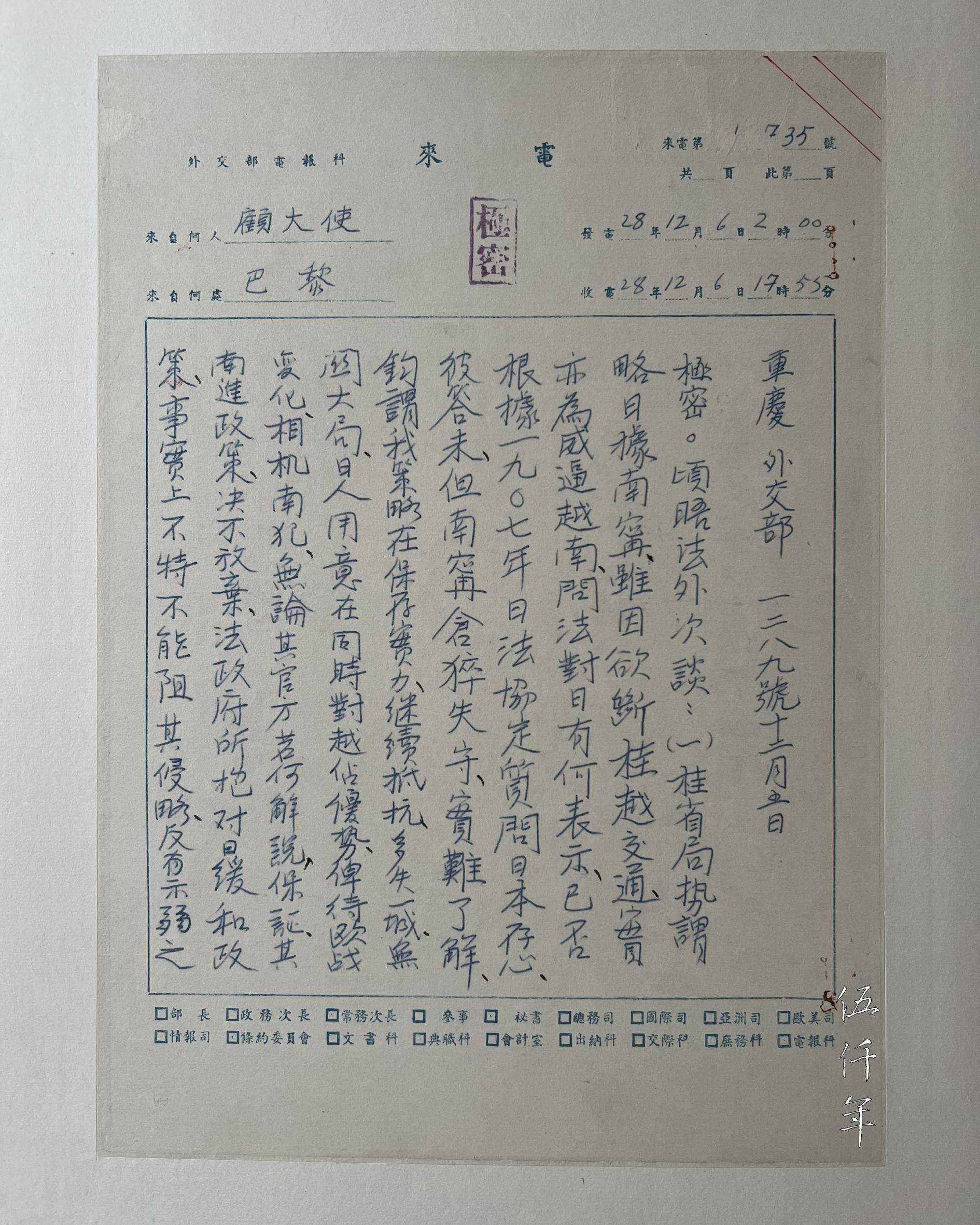
A top secret telegram from Koo Vi Kyuin on Sino-Soviet relationship
i) A top secret telegram from Koo Vi Kyuin, ambassador to France, on Sino-Soviet relationship after the adversarial stance developed between the Soviet Union and the two countries of Britain and France.
ii) Letter by Ch’en Pu-lei to Wang Ch’ung-hui on submitting the telegram from Koo Vi Kyuin to President Chiang Kai-shek.
m) The National Government of China appealed to the League of Nations for assistance, stating that Japan had violated numerous international covenants and bombed civilians indiscriminately.
11 December 1939, the 28th year of the Republic of China.
i) Manuscript and copy of the National Government’s appeal to the League of Nations for assistance, that Japan had violated numerous international covenants and bombed civilians indiscriminately.
n) Script of English speech by Wang Ch’ung-hui, the wartime Foreign Minister.
January 1940, the 29th year of the Republic of China.
i) Booklet titled China’s Wartime Foreign Minister Speaks, Dr. Wang Ch’ung-hui.
o) The National Government held the first session of the Party and Government Training Class of the Central Training Group.
1 March 1940, the 29th year of the Republic of China.
i) Index of speech titled Foreign Affairs Since the War of Resistance Against Japanese Aggression, an address by Wang Ch’ung-hui at the first session of the Party and Government Training Class of the Central Training Group on 1 March 1940.
ii) Précis of speech titled Foreign Affairs Since the War of Resistance Against Japanese Aggression, an address by Wang Ch’ung-hui at the first session of the Party and Government Training Class of the Central Training Group on 1 March 1940.
iii) Script and copy of script titled Foreign Affairs Since the War of Resistance Against Japanese Aggression, an address by Wang Ch’ung-hui at the first session of the Party and Government Training Class of the Central Training Group on 1 March 1940.
p) The first loan from the United States Government based on Tung Oil to support the war of resistance against Japanese aggression.
April 1940, the 29th year of the Republic of China.
i) Letter by Ch’en Pu-lei to Wang Ch’ung-hui on receiving a telegram from Ambassador Hu Shih affirming that the United States Government would offer a twenty million dollar loan.
q) After the Japanese cabinet of Mitsumasa Yonai stepped down, the cabinet of Fumimaro Konoe proposed the Greater East Asia Co-Prosperity Sphere.
19 July 1940, the 29th year of the Republic of Japan.
i) Letter by Wang Shih-chieh (王世杰) to Wang Ch’ung-hui that anticipated startling policy from the new Japanese cabinet.
r) A proclamation by the National Government of China protesting the closure of the Yunnan-Vietnam Railway.
20 June 1940, the 29th year of the Republic of China.
i) Manuscript titled A Proclamation by the Chinese Government, edited by President Chiang Kai-shek.
s) The 7th Plenary Meeting of the 5th Session of the Central Executive Committee of the National Government.
1 July 1940, the 29th year of the Republic of China.
i) Manuscript of A Summary of the Foreign Affairs Work Report at the 7th Plenary Meeting of the 5th Session of the Central Executive Committee of the National Government, by Wang Ch’ung-hui.
t) The National Government of China negotiated with the United States Government on aviation and economic aid.
October 1940, the 29th year of the Republic of China.
i) Draft of telegram from President Chiang Kai-shek to Soong Tse-vung (宋子文) on negotiating aviation and economic aid with the United States Government, written by Wang Ch’ung-hui and dated 20 October 1940.
u) The formation of the Axis Powers of Germany, Italy and Japan; the establishment of the puppet government of Wang Ch’ing-wei (汪精衛), were both helpful to the foreign affairs of the National Government of China.
December 1940, the 29th year of the Republic of China.
i) Script of speech titled The Latest International Situation and the Foreign Affairs of China, by Wang Ch’ung-hui.
v) The National Government strived to repeal the Unequal Treaties ratified by the government of the Ch’ing dynasty.
December 1940, the 29th year of the Republic of China.
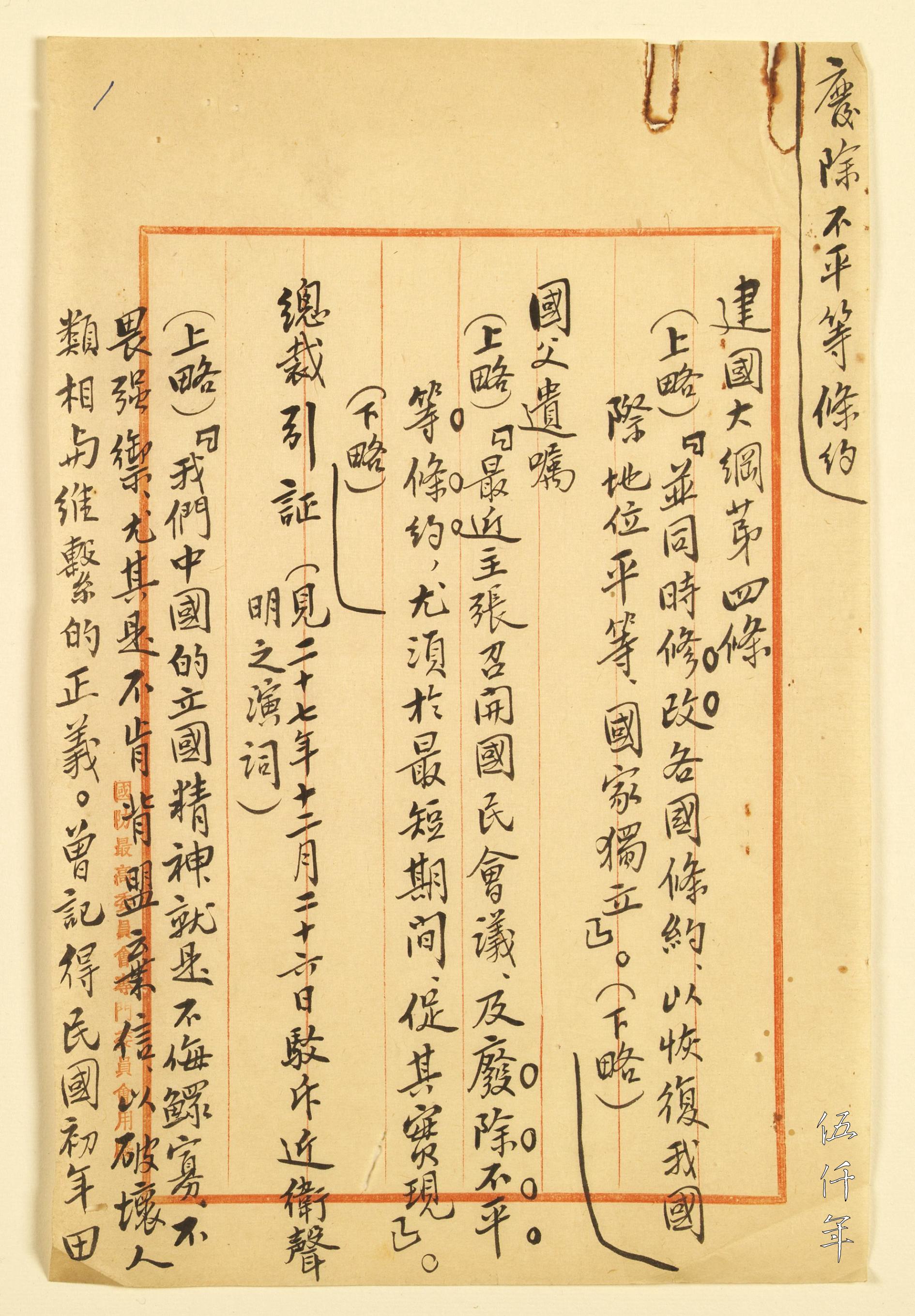
Manuscript titled The Repeal of Unequal Treaties and International Relationships by Wang Ch’ung-hui
i) Manuscript titled The Repeal of Unequal Treaties and International Relationships, by Wang Ch’ung-hui.
w) After Japan attacked Pearl Harbour, the National Government of China undertook military cooperations with the British and American governments to protect the Far East.
23 December 1941, the 30th year of the Republic of China.
i) Manuscript titled Ways to Cooperate and Defend the Far East, by Wang Ch’ung-hui.
ii) Manuscript titled Ways to Protect Overseas Chinese in Southeast Asia and in the British and French Colonies, by Wang Ch’ung-hui.
x) The Rockefeller Center in New York built the Mei-ling Garden to commemorate the 5th year of the Sino-Japanese War.
July 1942, the 31st year of the Republic of China.
i) News in English about the opening ceremony of Mei-ling Garden in New York, released by the Central News Agency on 11 July 1942.
ii) Newspaper clipping of Ta K’ung Pao (大公報) dated 12 July 1942, regarding the opening ceremony of Mei-ling Garden in New York City.
iii) Typed script of the English address by Madame Chiang Kai-shek at the opening ceremony of Mei-ling Garden.
iv) Translation of the English address by Madame Chiang Kai-shek at the opening ceremony of Mei-ling Garden. Translated by Wang Ch’ung-hui.
v) Letter by Madame Chiang Kai-shek to Wang Ch’ung-hui, thanking him for the translation and asking him to keep the original typed script.
y) Madame Chiang Kai-shek visited America to address both the Senate and the House of Representatives, and to seek support for China’s war of resistance against Japanese aggression.
18 February 1943, the 32nd year of the Republic of China.
i) Letter by Ch’en Pu-lei to Wang Ch’ung-hui, asking him to review President Chiang Kai-sheik’s letter to President Roosevelt.
ii) Letter by President Chiang Kai-shek to Wang Ch’ung-hui, asking him to translate the reply letter to President Roosevelt.
z) Sheng Shih-ts’ai (盛世才), provincial governor of Sinkiang province, clashed with the Soviet Union and defected to the National Government.
August 1944, the 33rd year of the Republic of China.
i) Manuscript of draft letter by Wang Ch’ung-hui to President Chiang Kai-shek on Sheng Shih-ts’ai clashing with the Soviet Union and defecting to the National Government.
K) Surrender of Japan
15 August 1945, the 34th year of the Republic of China.
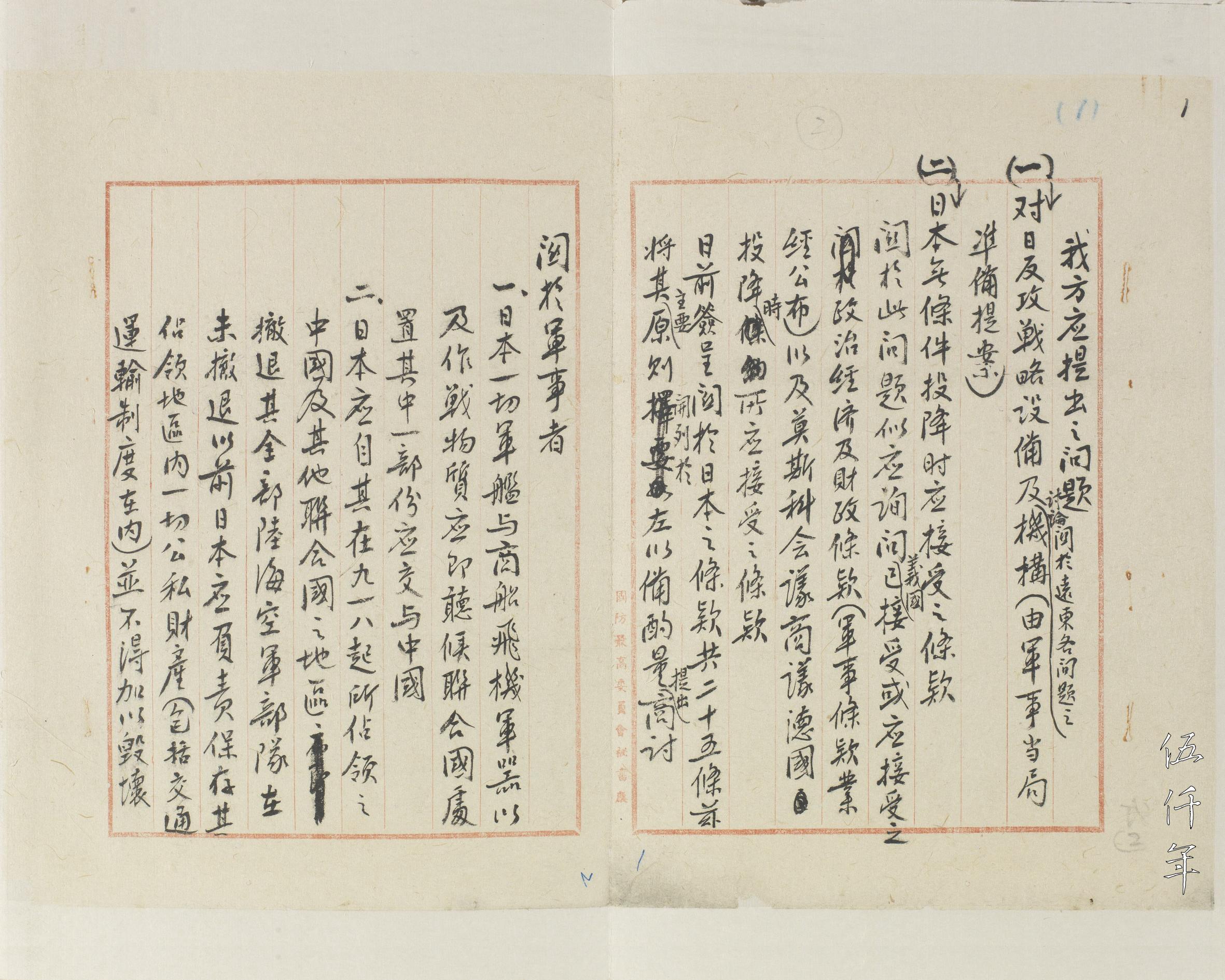
Manuscript titled The Terms of Japan’s Unconditional Surrender and Important Post-War Issues by Wang Ch’ung-hui
i) Manuscript titled The Terms of Japan’s Unconditional Surrender and Important Post-War Issues by Wang Ch’ung-hui.
L) Founding the United Nations
24 October 1945, the 34th year of the Republic of China.
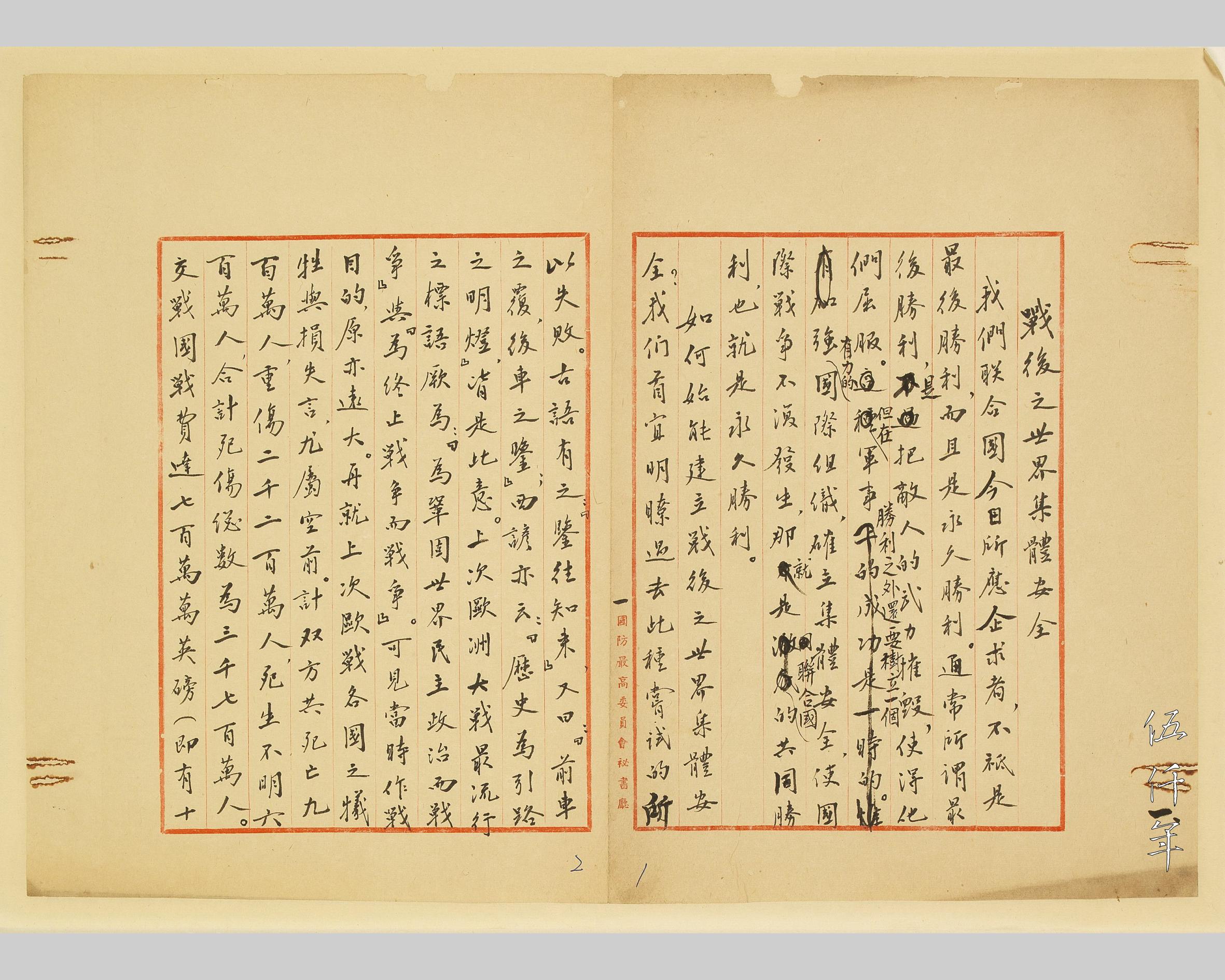
Manuscript titled the Collective Security of the Post-War World by Wang Ch’ung-hui
i) Manuscript titled The Collective Security of the Post-War World, by Wang Ch’ung-hui.
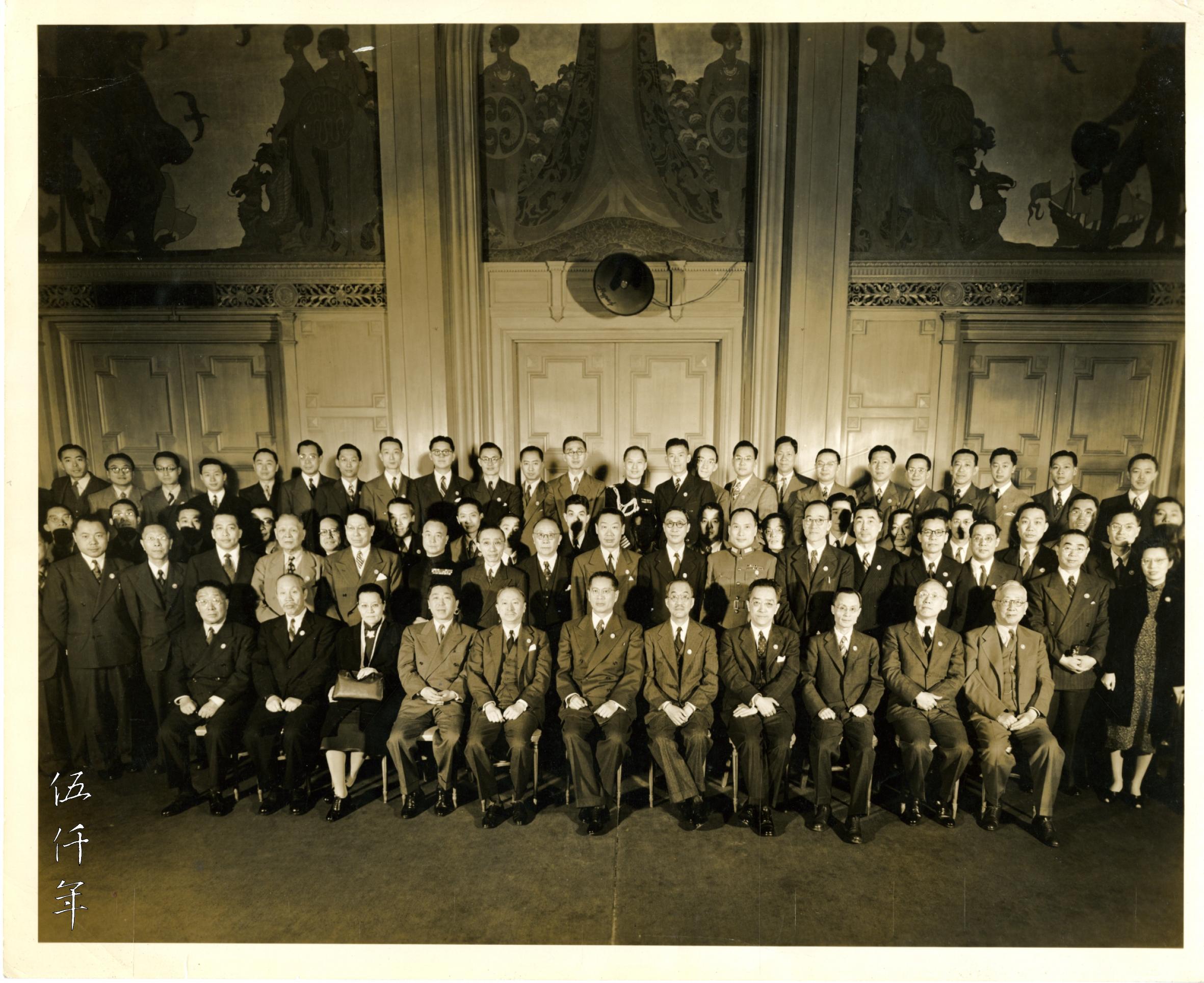
Group portrait of the Chinese Delegation to the San Francisco Conference, with Wang Ch’ung-hui seated in the front row fifth from the right, taken at Mark Hopkins Hotel on 22 May 1945
M) 60th Birthday of President Chiang Kai-shek
31 October 1946, the 35th year of the Republic of China.
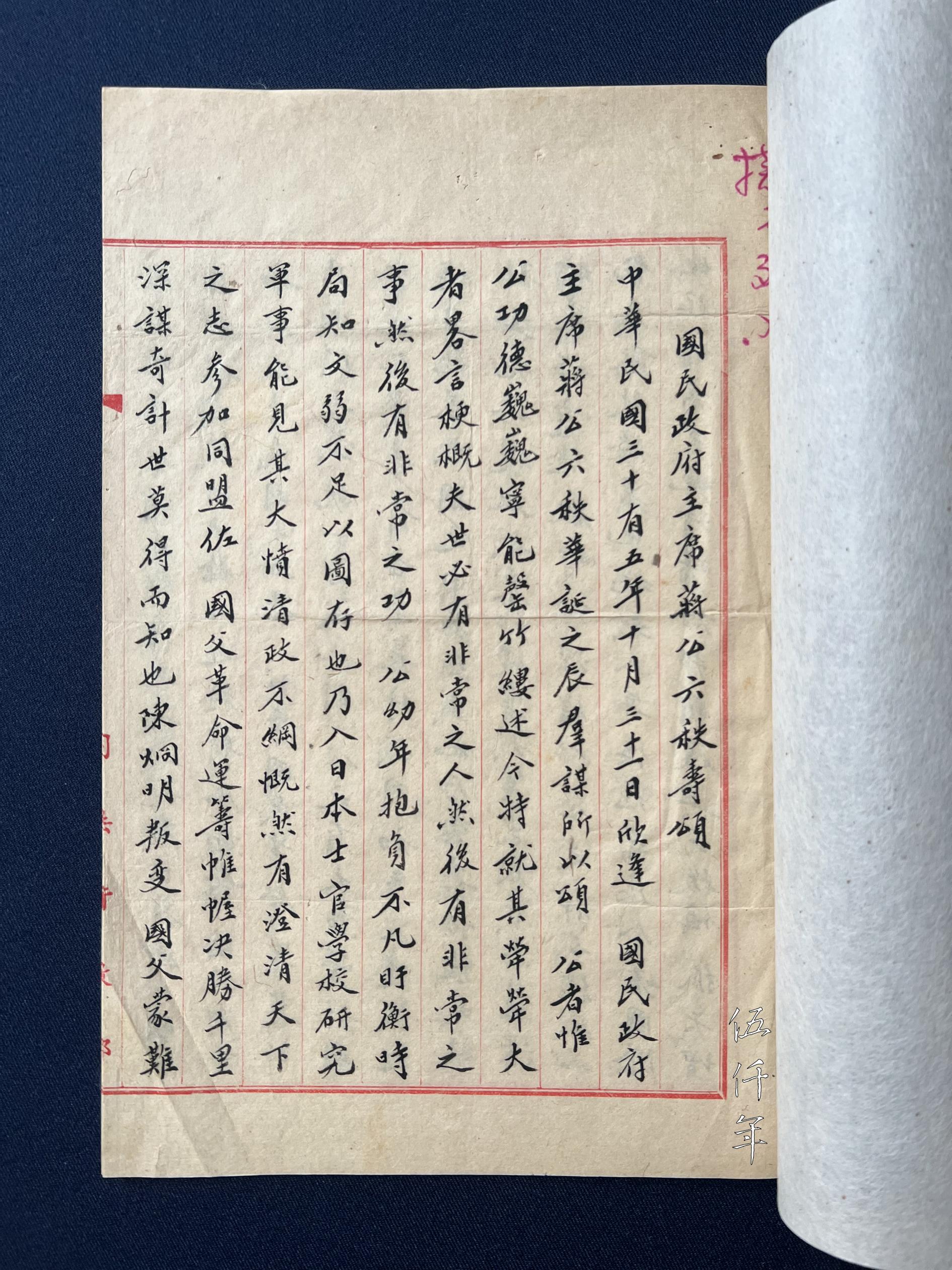
Manuscript titled A Tribute to President Chiang Kai-shek of the National Government on His 60th Birthday by Wang Ch’ung-hui
i) Manuscript titled A Tribute to President Chiang Kai-shek of the National Government on His 60th Birthday, by Wang Ch’ung-hui.
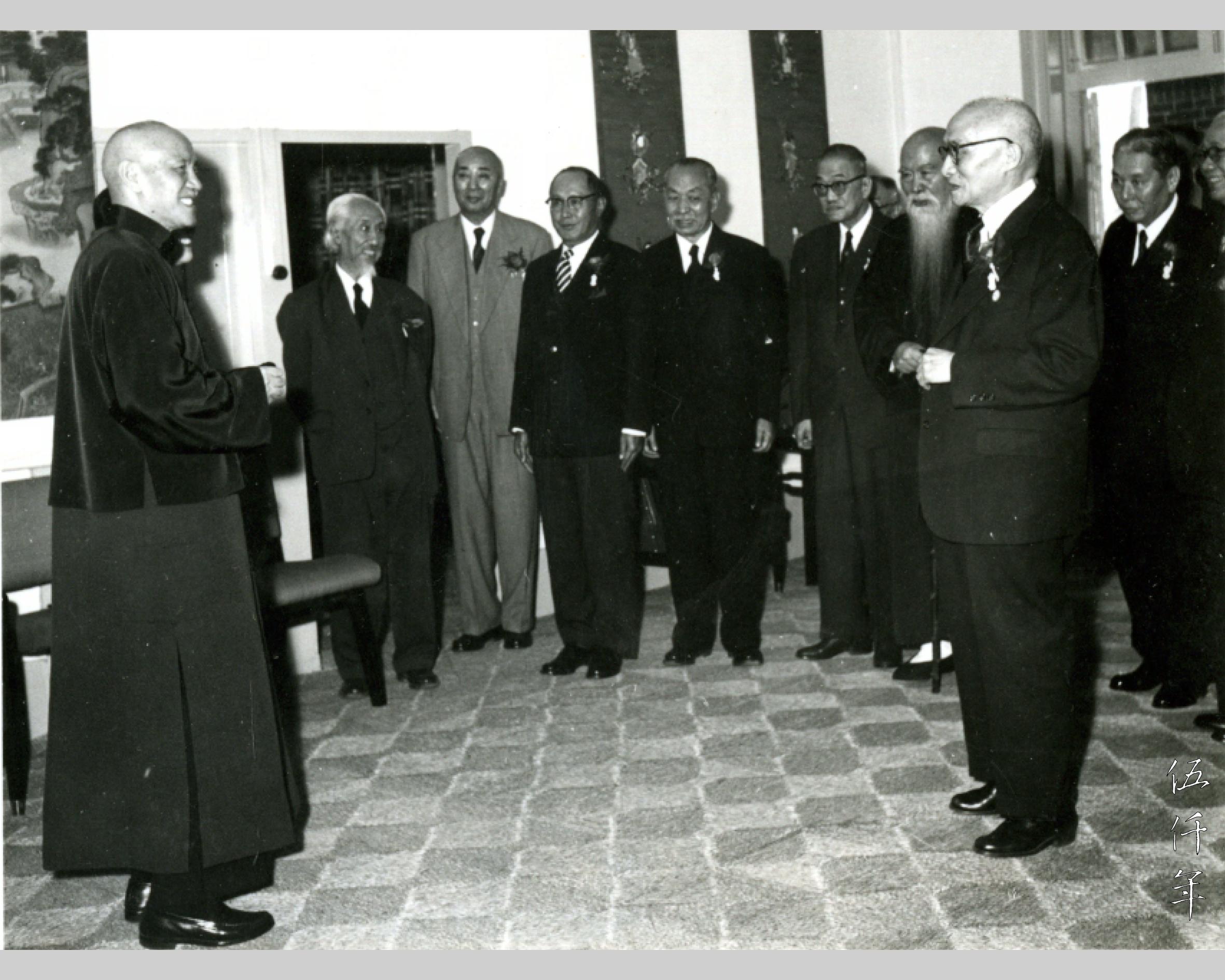
Group portrait of President Chiang Kai-shek, standing first from the left, Wang Ch’ung-Hui, standing in the back row third from the right, and others, taken in Ta-hsi on the 70th birthday of President Chiang, dated 31 October 1956
N) Implementation of the National Constitution
25 December 1947, the 36th year of the Republic of China.

First page of script of speech by Wang Ch’ung-hui titled The Process of Launching the Revised Constitution and the Keypoints of Its Content
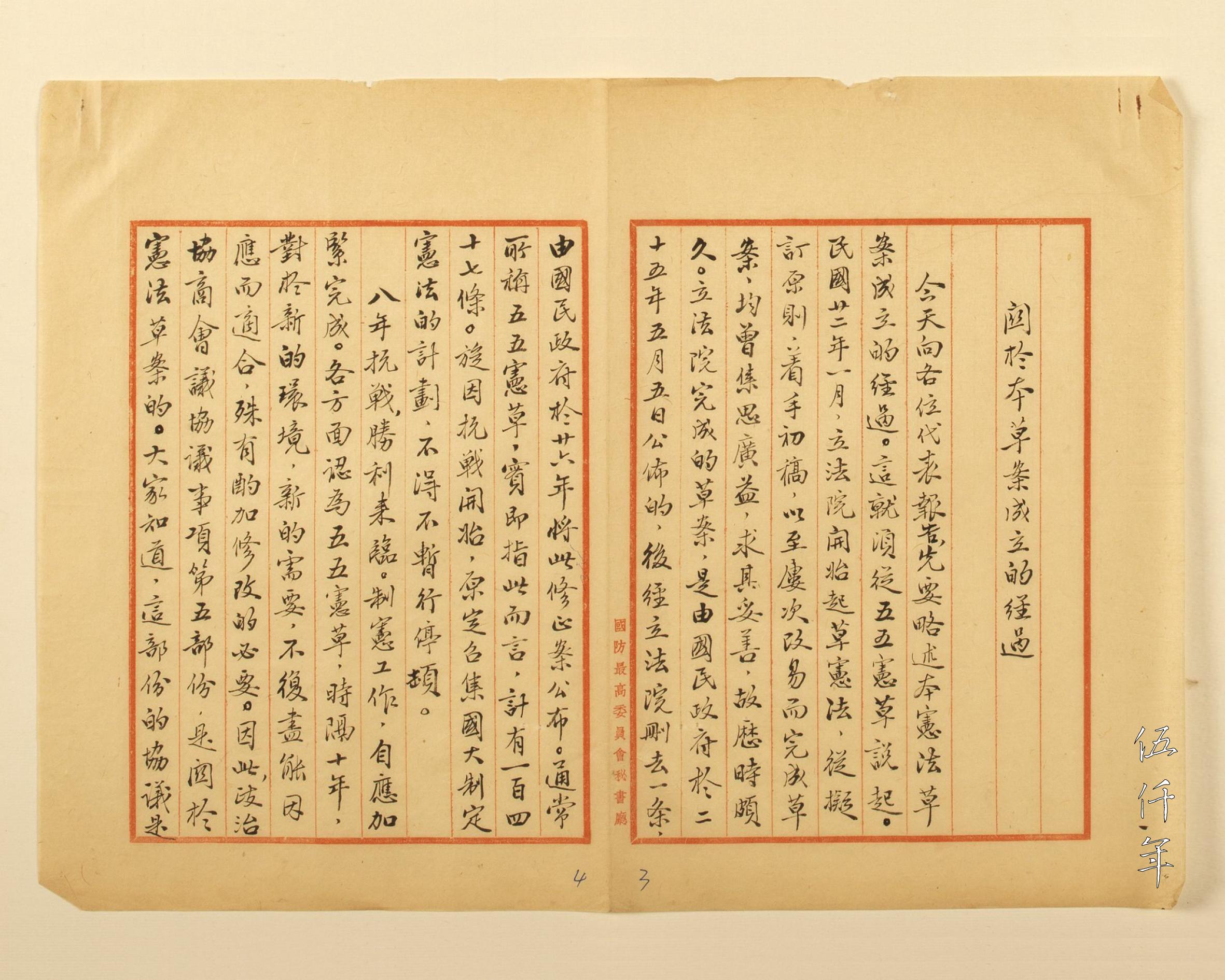
Second page of script of speech by Wang Ch’ung-hui titled The Process of Launching the Revised Constitution and the Keypoints of Its Content
i) Script of speech by Wang Ch’ung-hui titled The Process of Launching the Revised Constitution and the Keypoints of Its Content.
O) Relocation of the Central Government to Taiwan
7 December 1949, the 38th year of the Republic of China.

Manuscript titled The Goals of Establishing the Republic of China and Some Thoughts on the National Day by Wang Ch’ung-hui
i) Manuscripts titled The Goals of Establishing the Republic of China and Some Thoughts on the National Day by Wang Ch’ung-hui.
Personal Material
P) Articles and Introductions

Manuscript titled Some Thoughts on the 50th Anniversary of the Founding of the National Peiyang University by Wang Ch’ung-hui
i) Manuscript titled Some Thoughts on the 50th Anniversary of the Founding of the National Peiyang University by Wang Ch’ung-hui.
ii) Manuscript titled To Learn and Build Character by Wang Ch’ung-hui.
iii) Introduction by Wang Ch’ung-hui to the book The Collected Works of Hsin-t’ai-p’ing Shih (心太平室集) by Chang I-lin (張一麐).
iv) Introduction by Wang Ch’ung-hui to the book A Collection of Appeals Related to Civil and Criminal Cases by Wang Ch’iu-shih (王求是).
v) Introduction by Wang Ch’ung-hui to the book Self-Governance in Germany by Chu Ho-chung (朱和中).
vi) Introduction by Wang Ch’ung-hui to the book The Collected Works of Yü Chai (愚齋存稿) by Sheng Hsüan-huai (盛宣懷).
vii) Introduction by Wang Ch’ung-hui to the book The Industrial Laws of France by Sun Shao-k’ang (孫紹康).
viii) Introduction by Wang Ch’ung-hui to the Conference of International Law
Q) Miscellaneous Certificates
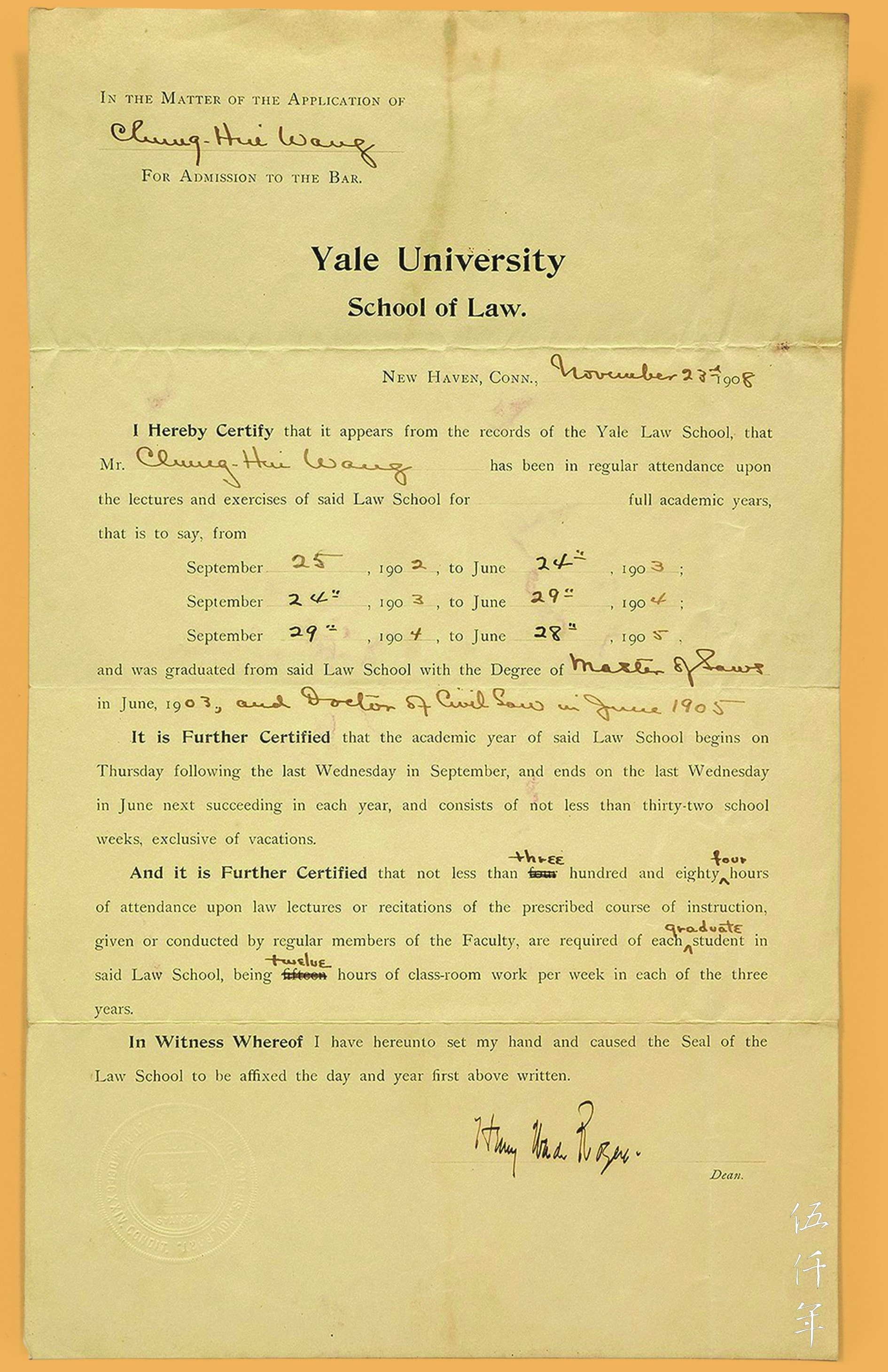
Graduation Certificate from Yale University
i) To apply for a lawyer’s license, Yale University issued a Graduation Certificate in 1908 to affirm that Wang Ch’ung-hui had attained the master and doctorate degrees from the Law School in 1903 and 1905 respectively.
ii) Two copies of Marriage Certificates of Wang Ch’ung-hui and Chu Hsüeh-ch’in (朱學勤).
iii) Student Identity Document issued by the Ch’ing Embassy in France.
iv) Letter of visa application from the Ch’ing Embassy in the Hague to the Ministry of Foreign Affairs of the Netherlands, regarding Wang Ch’ung-hui and the Secretary of the Ch’ing Embassy in the Hague to attend the International Conference of Uniform Invoice Law in The Hague.
v) The reply letter from the Ministry of Foreign Affairs of the Netherlands to the Ch’ing Embassy in The Hague, confirming that Wang Ch’ung-hui and the Secretary of the Ch’ing Embassy in The Hague would attend the International Conference of Uniform Invoice Law in The Hague as representatives.
vi) Letter from the United States Embassy in The Hague to the United States Immigration Department, ascertaining that Wang Ch’ung-hui would enter New York as counselor and substitute judge of the International Court of Justice.
R) Family Letters
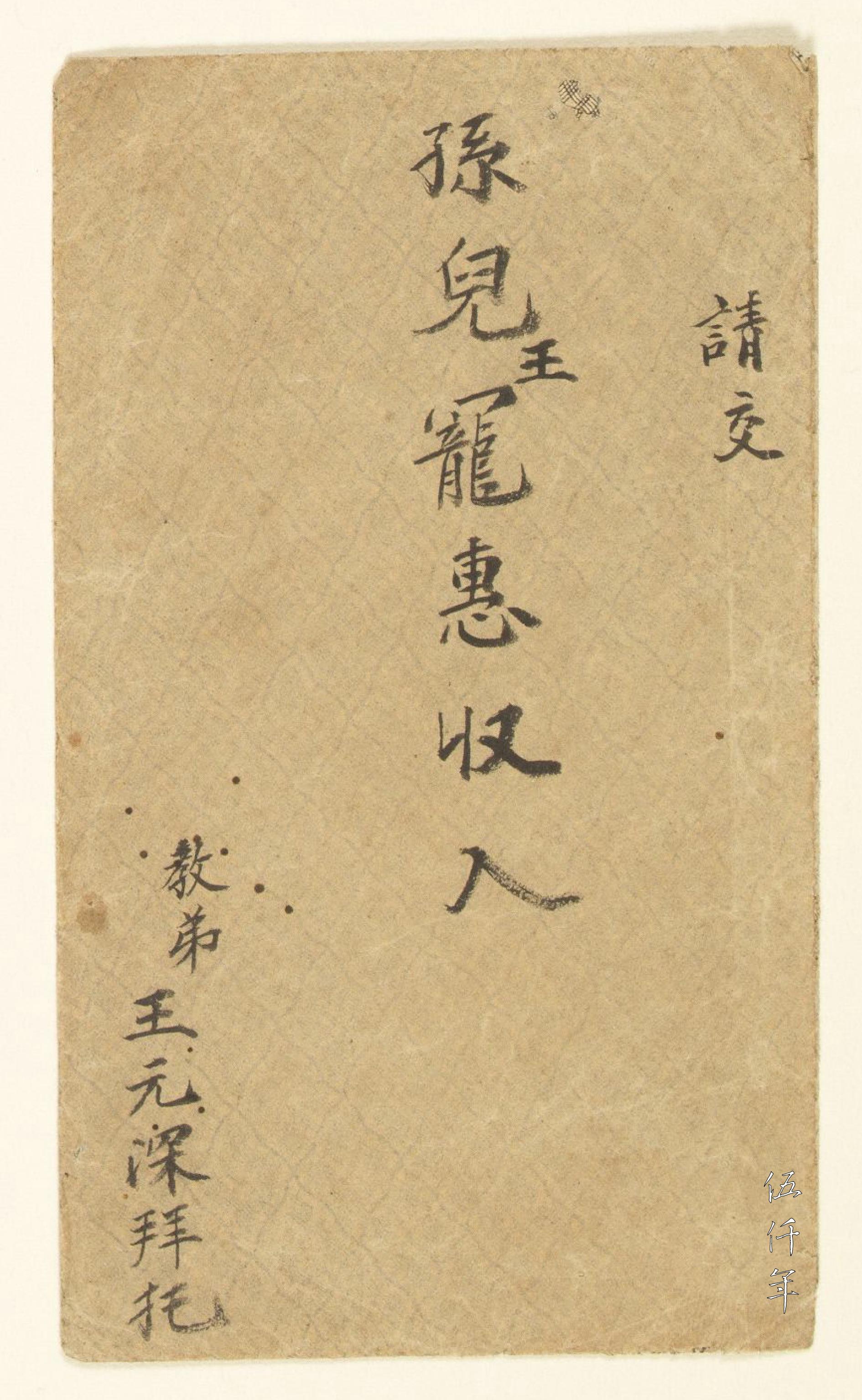
Envelope of letter from Wang Yüan-shen to grandson Wang Ch’ung-hui

Letter from Wang Yüan-shen to grandson Wang Ch’ung-hui
i) Letter by Wang Yüan-shen (王元深) to grandson Wang Ch’ung-hui.
ii) Nine letters by Wang Ch’ung-hui to wife Chu Hsüeh-ch’in (朱學勤).
S) Friends’ Letters and Calligraphy
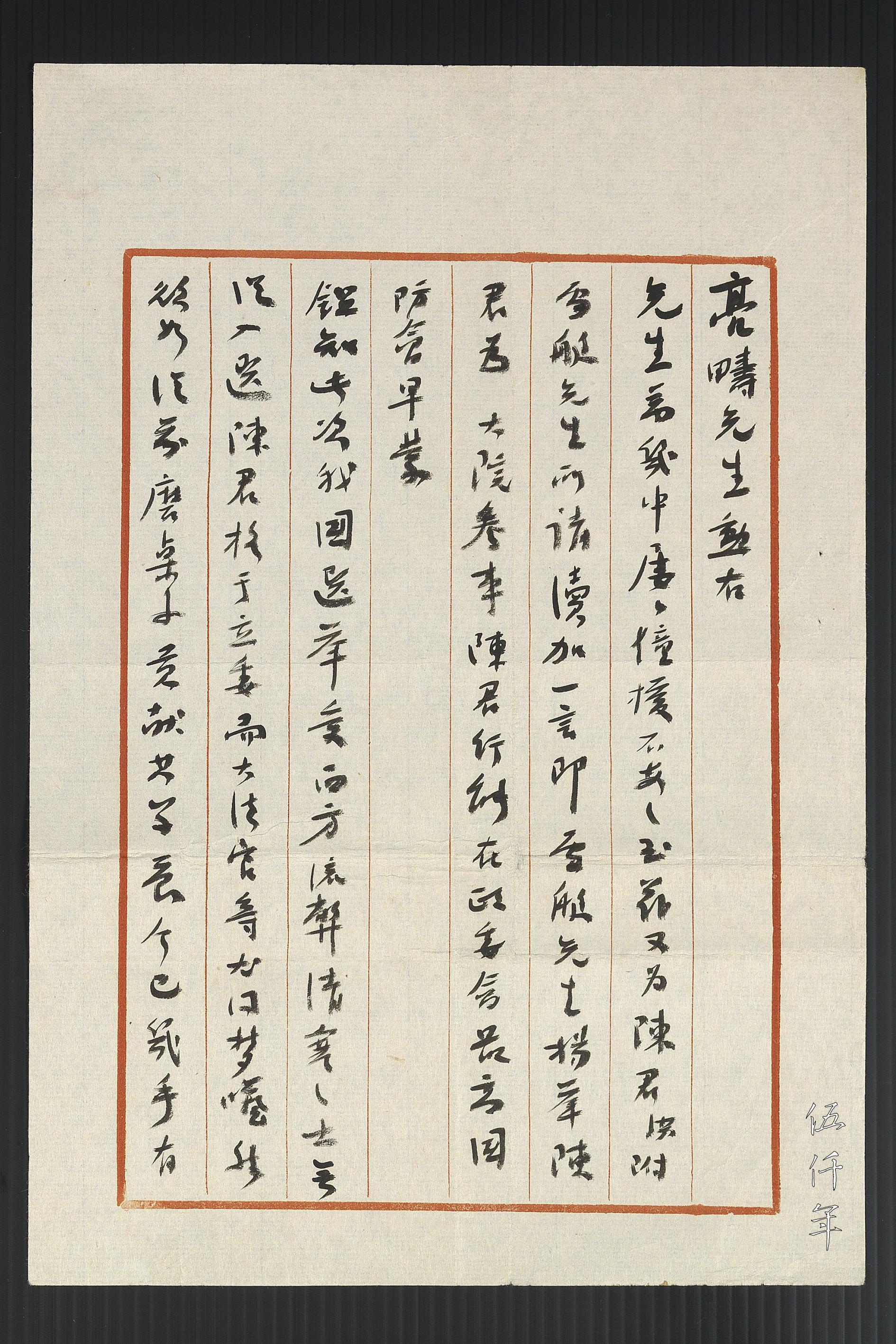
First page of from Wu Ch’ing-heng to Wang Ch’ung-hui
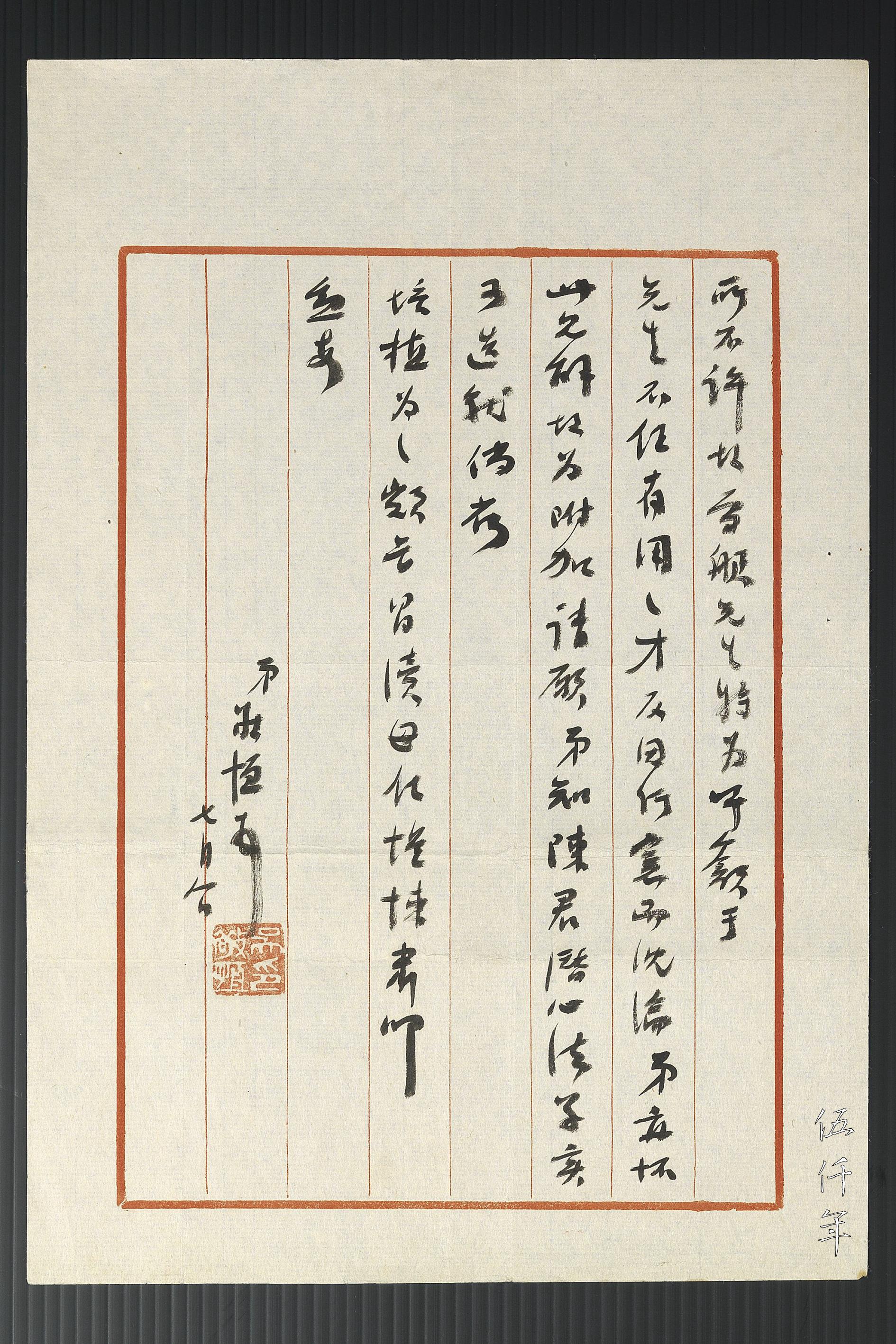
Second page of letter from Wu Ch’ing-heng to Wang Ch’ung-hui
i) Two letters by Wu Ch’ing-heng (吳敬恆) to Wang Ch’ung-hui.
ii) Calligraphy of hanging scroll by Wu Ch’ing-heng dedicated to Wang Ch’ung-hui on his 70th birthday.
iii) Letter by Chang Yüan-chi (張元濟) to Wang Ch’ung-hui
iv) Letter by Hu Han-min (胡漢民) to Wang Ch’ung-hui inviting him to Nanking.
v) Two letters by Hsü Ch’ien (徐謙) to Wang Ch’ung-hui.
vi) Letter by Sun Fo (孫科) to Wang Ch’ung-hui.
vii) Letter by Ou Yü-shu (區玉書) to Wang Ch’ung-hui.
viii) Promissory note from Hsieh I-i (謝宜挹) to Wang Ch’ung-hui’s wife.
ix) English letter by B. Pettus to Wang Ch’ung-hui on the purchase of American stocks
Portrait of Wang Ch’ung-hui, taken on 29 December 1928