Shortly after the founding of the Republic of China in 1912, T’ang En-p’u (唐恩溥) the celebrated provincial graduate from Kwangtung province, was invited to join the Bureau of Historia Ch’ing. Later he was appointed deputy secretary-general to the military staff of Wu P’ei-fu (吳佩孚). His personal integrity and proficiency in classical prose were highly respected and admired by his contemporaries.
His collection reveals Kwangtung scholarship in late Ch’ing, contents of provincial examination, principles of classical prose, friendships of literati, historic tales and anecdotes, delights of classical arts, epigraphic and tea cultures, virtues of Chinese medicine, and mystery of spirit-writing altar. The Classical World is faraway, but the dream is captured here.
Curatorial and Editorial Department
The Five Mountains of China are boundless, the Five Oceans of the World are measureless, and Chinese, well over a thousand million, are there and everywhere. However it is all too rare to encounter a scholar-official family from the past who has retained two generation of forebears’ schoolworks, examination papers, manuscripts of poetry and essays, correspondences with friends, that have not been altogether dispersed after more than a century of turmoil. I have only come across the documentary heritage of the father and son duo, Provincial Graduate T’ang Yüan-chün (唐元俊) and Provincial Graduate T’ang En-p’u (唐恩溥). Archaeologists habitually seek sites untouched by human footprints, tracing antecedent causes in the petal strewn soil and crack laden rock. Philologists are no different. Teachers and friends of one family, scholarship and sentiment of one province, history and fortunes of one era, may all be discerned and brought to light from the words, lines, writings and brushworks of schoolworks, examination papers, manuscripts and letters. The documentary significance of such patrimony may be said to be profound and far-reaching.
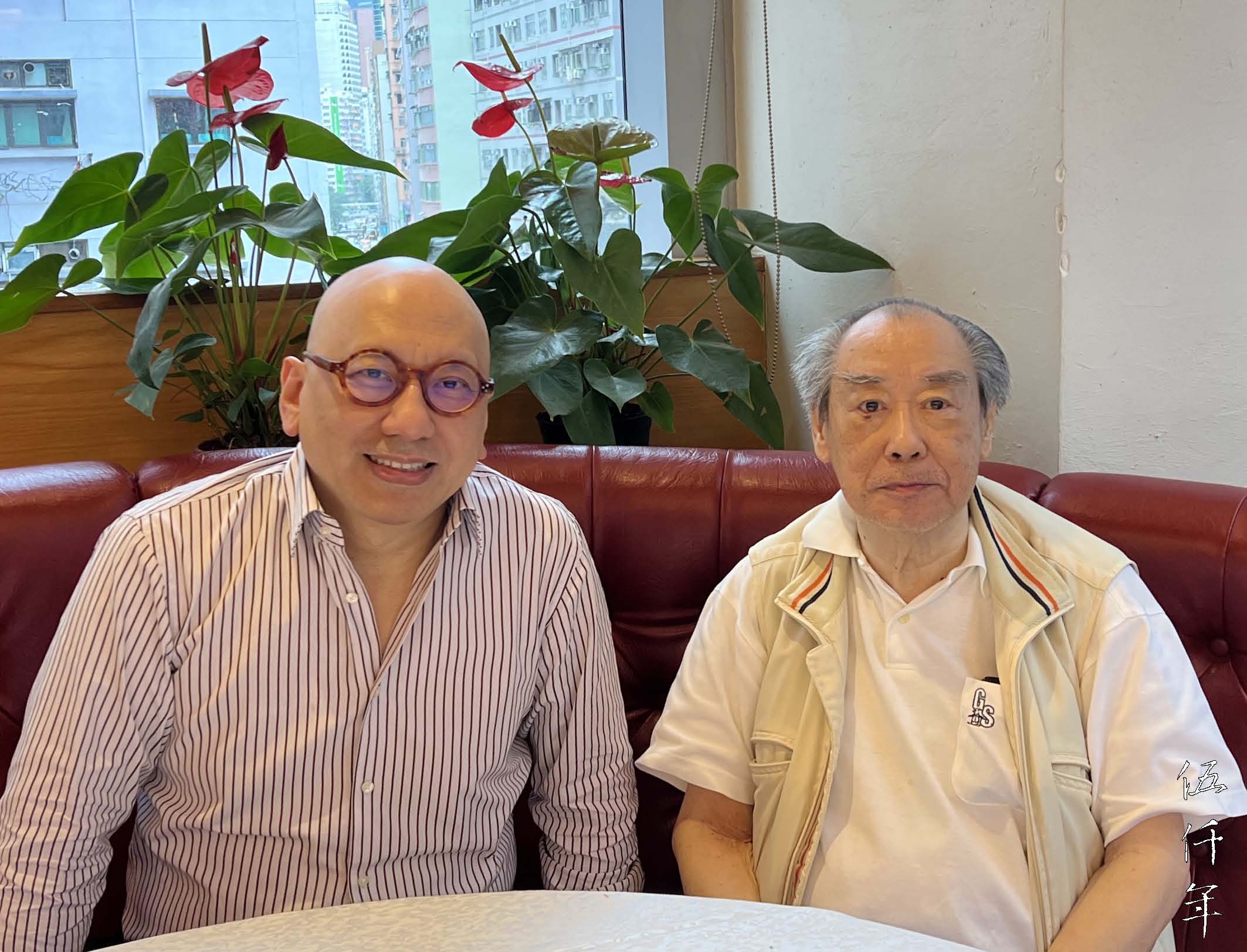
Photograph of Mr. T’ang Te-chao (唐德釗) and the author in Hong Kong
I recall more than thirty years ago, through the introduction of my friend Huang An-ta (黃安達), I had the honour of visiting the Elder T’ang Te-chao (唐德釗) at his residence on Tai Hang Road in Hong Kong. He is the youngest son of T’ang En-p’u, scion of a long lineage of distinguished scholars and heir to a virtuous family tradition.

Plan of Canton City dated 1860
Thereafter, over my subsequent years of travel to Hong Kong, I have regularly visited him and listened to his reminiscences. I had the privilege of viewing the documentary heritage of his grandfather T’ang Yüan-chün and his father T’ang En-p’u. As the seasons turned and passed, this documentary heritage is now mostly deposited at the Studio of Prunus Ode. I am embarrassed by my shallow learning, too inadequate to understand the writings of T’ang Yüan-chün and Tang En-p’u. Nevertheless I acquire great pleasure reading their works, and my admiration is notably devout.
T’ang Yüan-chün, tzu (字) Ch’ung-chih (崇智), Chieh-ch’ing (傑卿), native of Hsin-hui County, Kwangtung province. His family had long resided in Pai-shih Village. After attaining the degree of hsiu-ts’ai (秀才) or prefectural graduate, in the 2nd year of the Kuang-hsü reign, ping-tzu (丙子) year 1876, he attained the chü-jen (舉人) degree, or provincial graduate. He was selected for appointment as chih-hsien (知縣) or district magistrate, granted the prestige title of wen-lin-lang (文林郎) or gentleman-litterateur. By imperial favour he was then conferred the titular post of t’ung-chih (同知) or associate administrator, and was awarded the rank of feng-cheng ta-fu (奉政大夫) or grand master for governance.
For nearly one hundred years, the father T’ang En-p’u and the son Elder T’ang Te-chao had painstakingly retained the schoolworks and examination papers of T’ang Yüan-chün, which consists of one hundred and seventy-three schoolworks, fifty-six examination papers, forty-four manuscripts of essays, as well as seven schoolworks by fellow students, seven examination papers by brothers, two manuscript copies of poetry and prose by teachers, and four manuscript copies of essays on the Four Books by earlier scholars. I have subsequently compiled a catalogue in Chinese to be appended at the end for reference.
All of the schoolworks and examination papers by T’ang Yüan-chün were produced during the Hsien-feng and T’ung-chih reigns, dating back some one hundred and fifty to sixty years. Among these, one hundred and thirty-five schoolworks were marked by commentaries and colophons of the teachers, as well as seal impressions with their original names. It is thus possible to ascertain that T’ang Yüan-chün studied under twenty-eight chü-jen (舉人 provincial graduates) and chin-shih (進士 metropolitan graduates) from Kwangtung province. These included magistrates Chu Tz’u-ch’i (朱次琦 1807-1882) and Chou Chao-chang (周兆璋), provincial graduates Huang Ching-hu (黃敬祜), Lü Hung (呂洪), Chen Yen (陳碞), Liang Shao-hsün (梁紹訓), Liang Ju-ch’ien (梁汝謙), and others.
Magistrate Chu Tz’u-ch’i attained the chin-shih degree in the 27th year of the Tao-kuang reign 1847, while magistrate Chou Chao-chang attained the chin-shih degree in the 2nd year of the Kuang-hsü reign 1876. Apart from these two, the remaining twenty-six all attained the chü-jen degree, such as provincial graduate Liang Shao-hsün, who was granted the chü-jen degree in the 11th year of the Tao-kuang reign 1831, and provincial graduate Liang Ju-ch’ien, who was granted the chü-jen degree in the 9th year of the T’ung-chih reign 1870. Appraising the years they attained their imperial examination degrees, magistrates Chu Tz’u-ch’i and Chou Chao-chang were separated by twenty-nine years, while provincial graduates Liang Shao-hsün and Liang Ju-ch’ien were separated by thirty-nine years. In fact the twenty-eight teachers belonged to two successive generations. Their names, places of origin, degrees attained, and the number of schoolworks bearing their commentaries and colophons are listed below:
1) Master Chu Tz’u-ch’i (朱次琦 hao Chiu-chiang 九江), native of Nan-hai, Kwangtung province. He attained the chin-shih degree in the 27th year of the Tao-kuang reign 1847. His commentaries and colophons appear on twenty schoolworks.
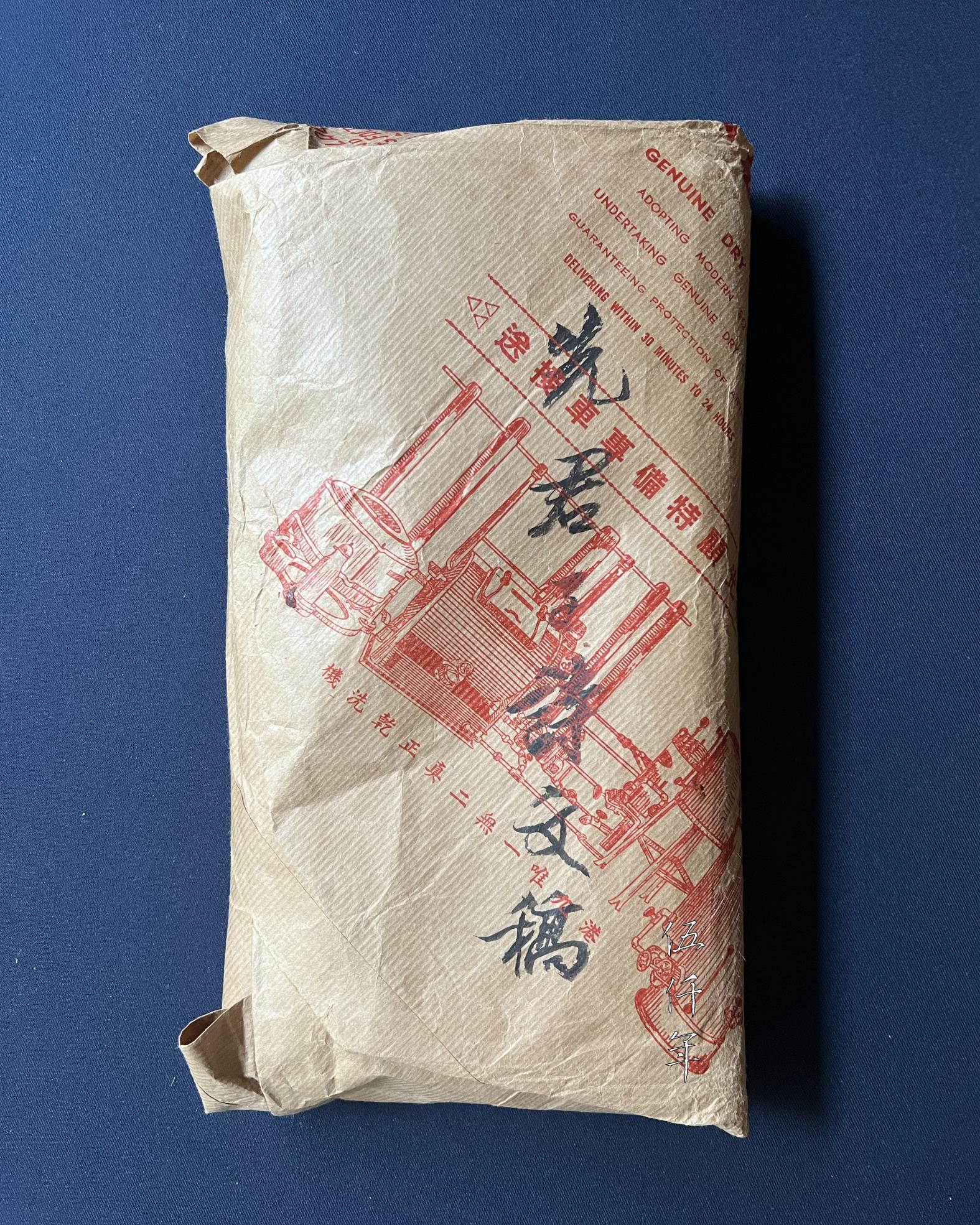
A set of schoolworks and examination papers in the original wrapping
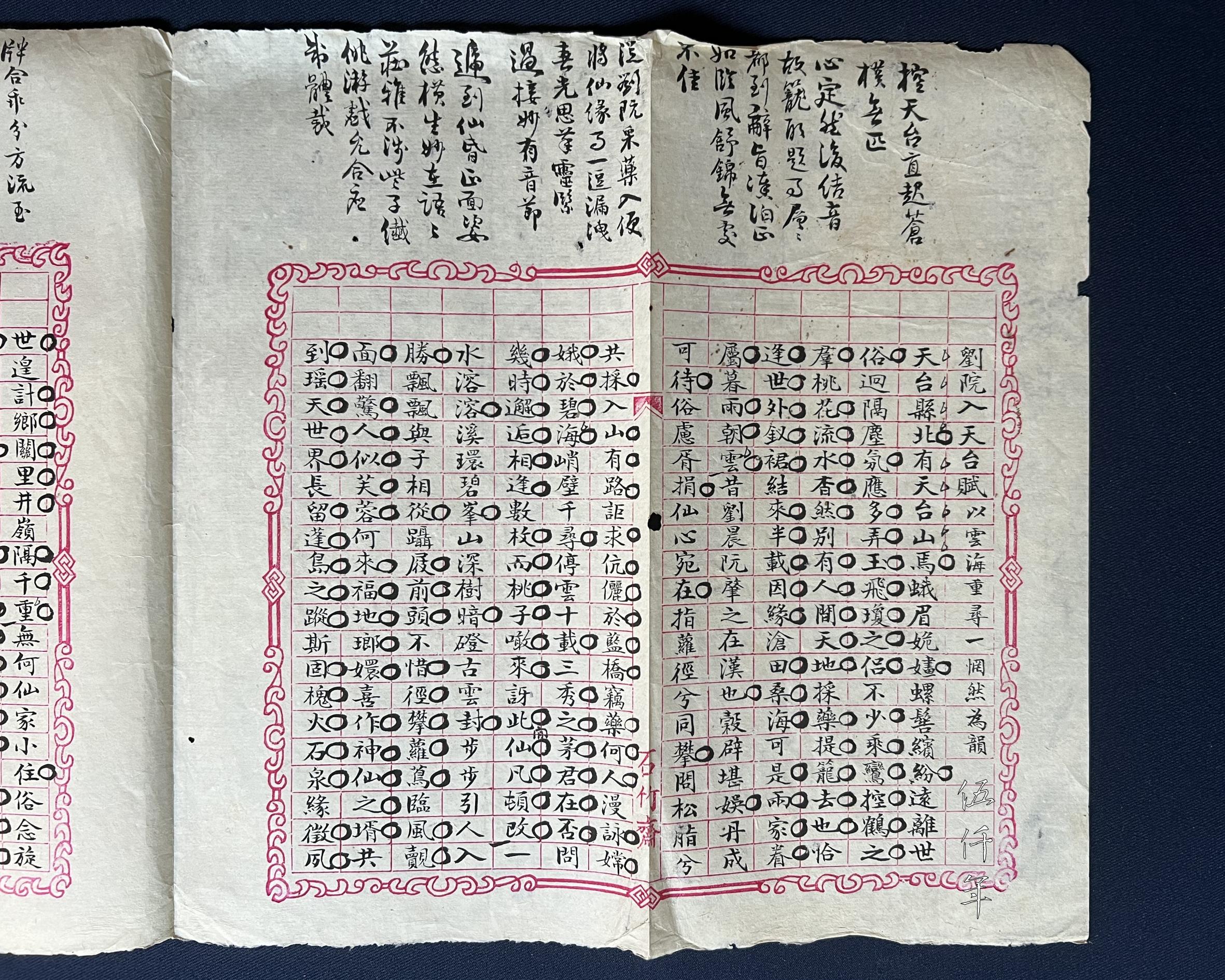
First page of schoolwork of T’ang Yüan-chün, with commentaries and colophon by Master Chu Tz’u-ch’i (朱次琦)
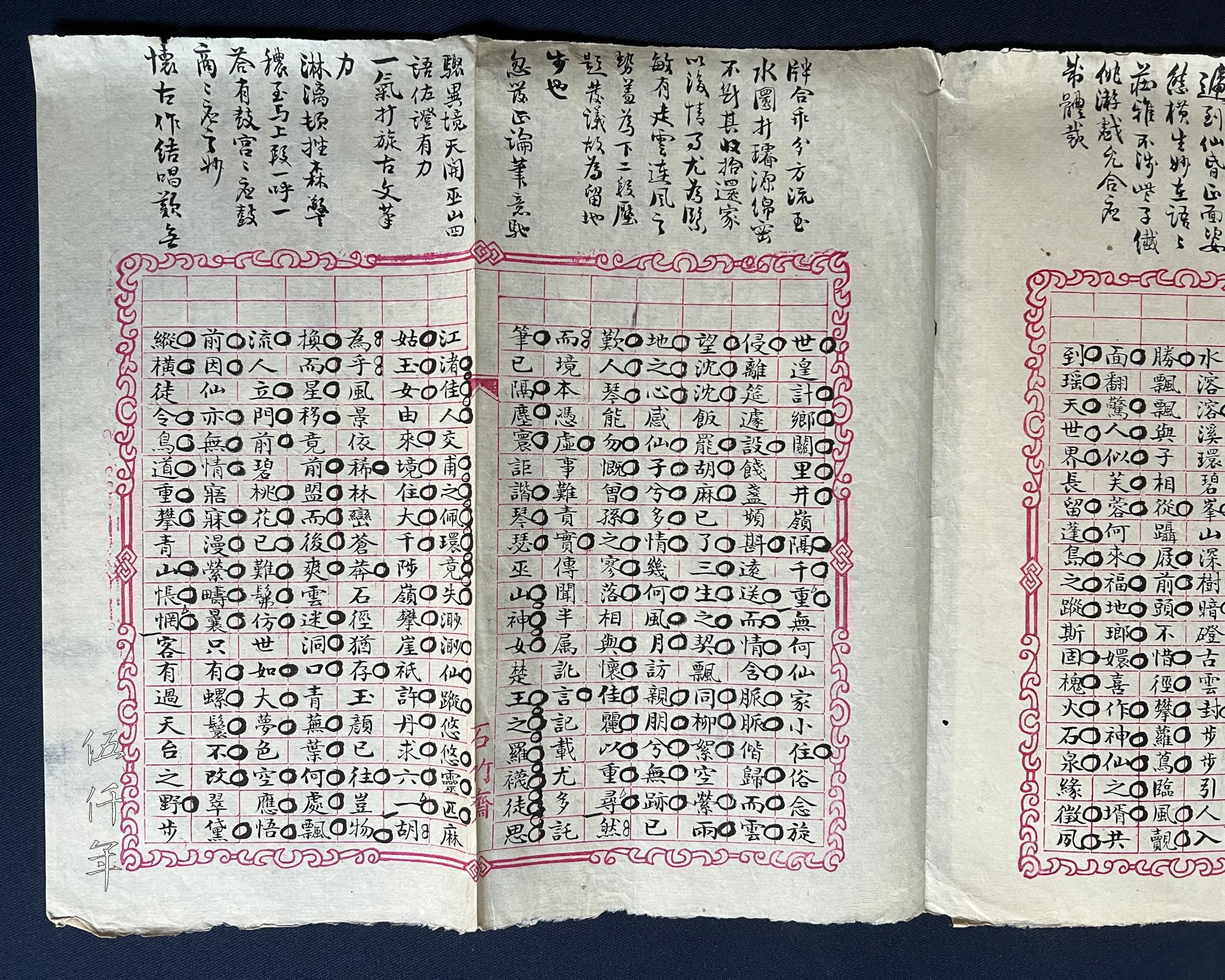
Second page of schoolwork of T’ang Yüan-chün, with commentaries and colophon by Master Chu Tz’u-ch’i (朱次琦)
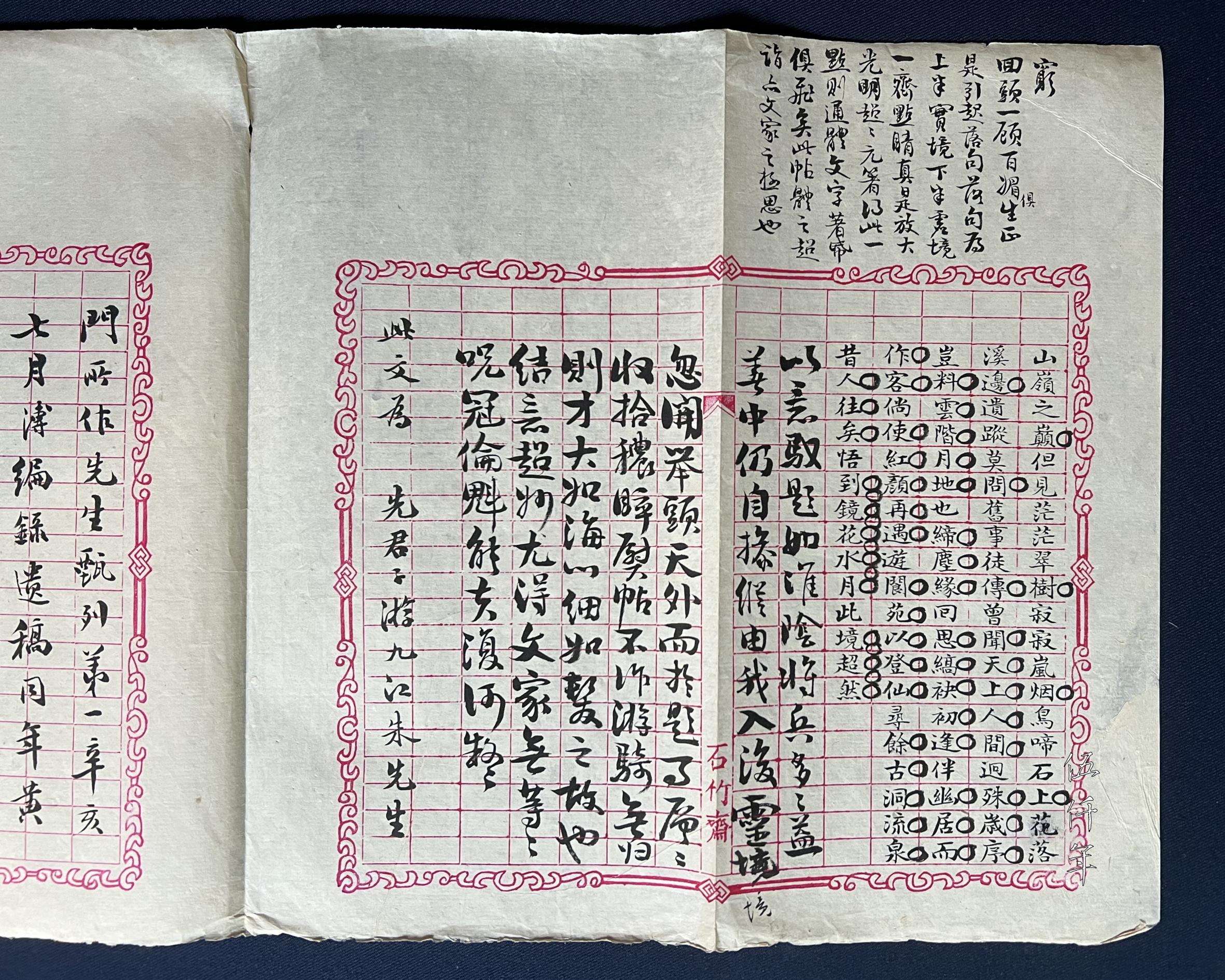
Third page of schoolwork of T’ang Yüan-chün, with commentaries and colophon by Master Chu Tz’u-ch’i (朱次琦)
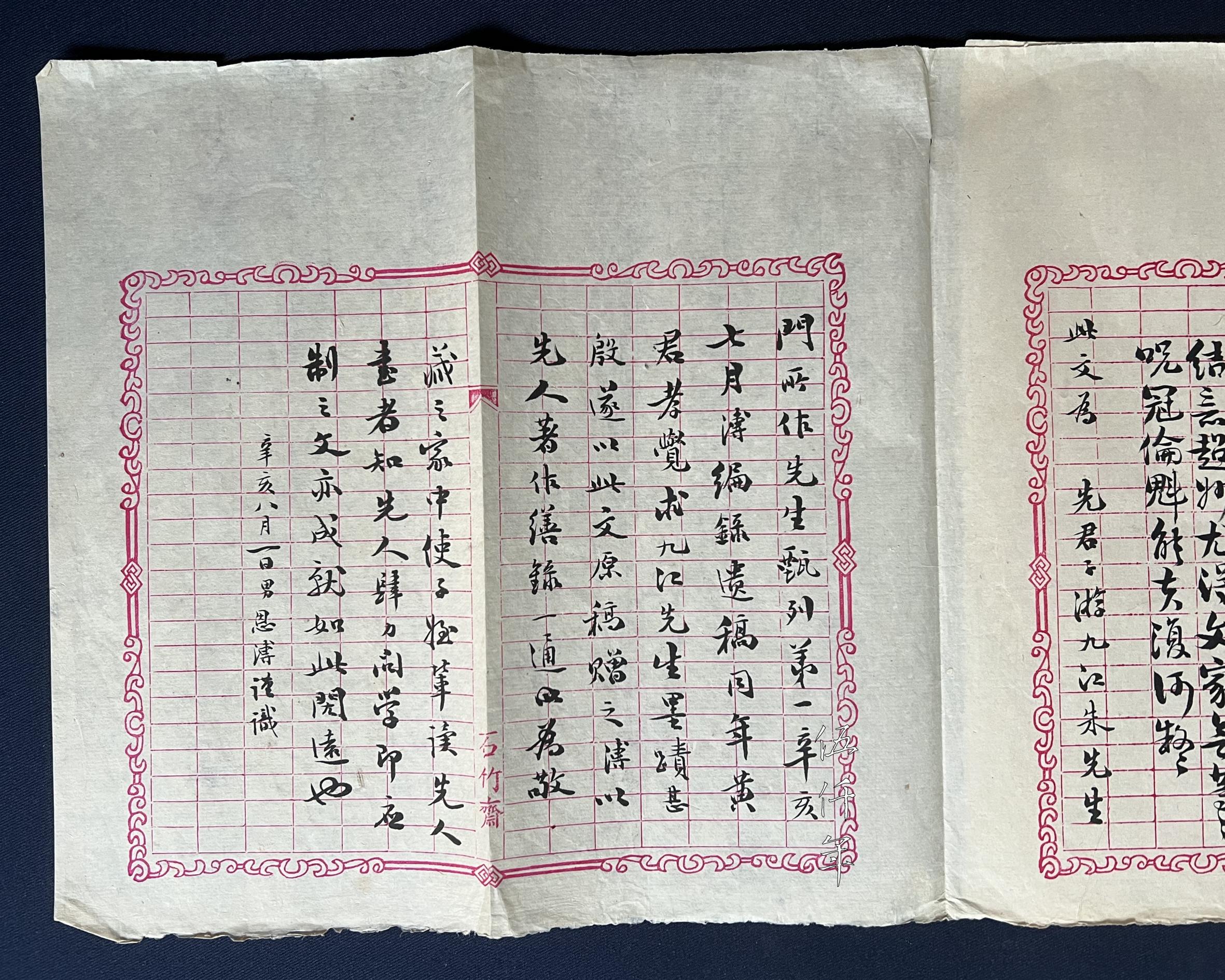
Fourth page of schoolwork of T’ang Yüan-chün, with commentaries and colophon by Master Chu Tz’u-ch’i (朱次琦)

Detail of colophon by Master Chu Tz’u-ch’i (朱次琦)
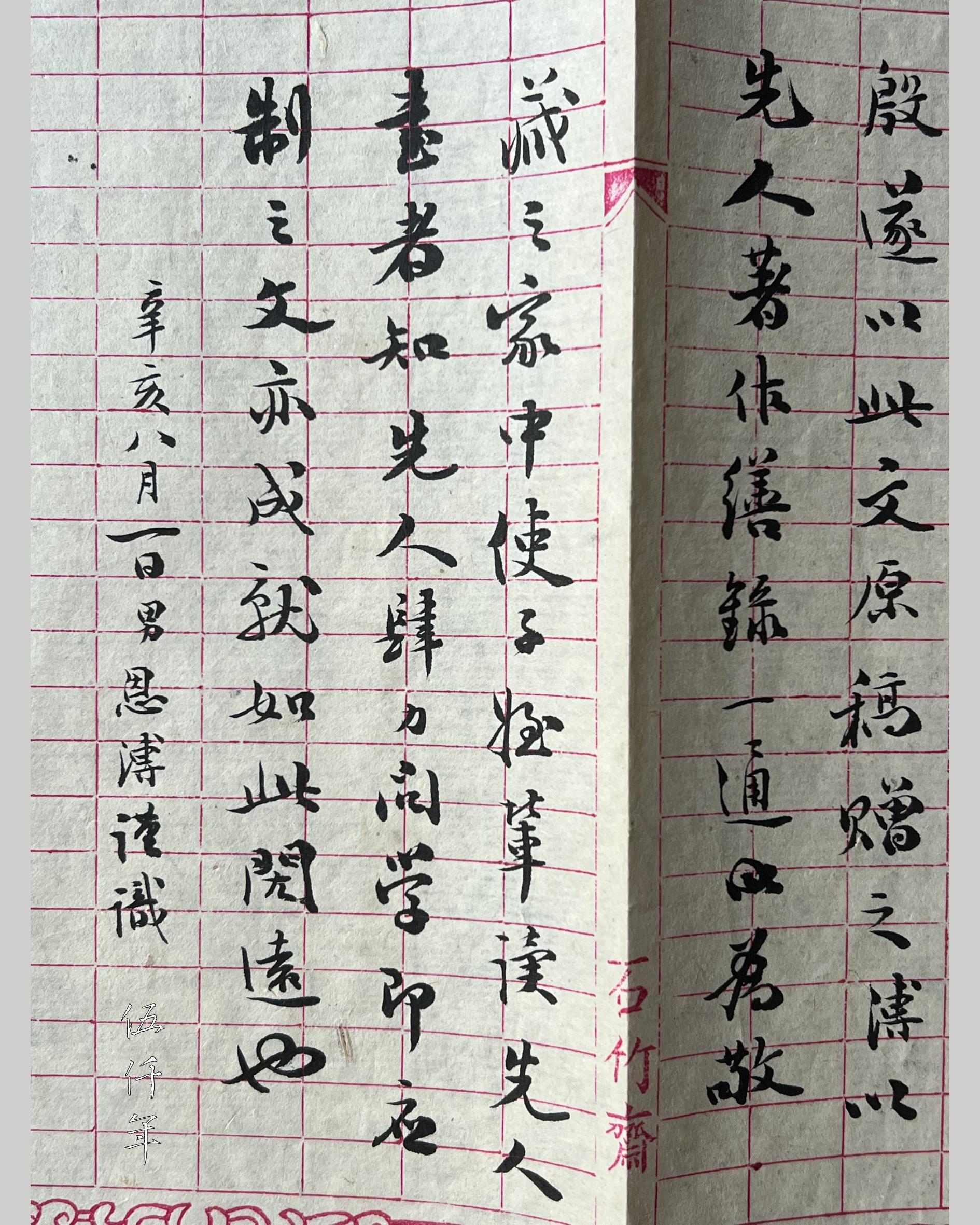
Detail of colophon by T'ang En-p'u
2) Master Huang Ching-hu (黃敬祜 tzu Ch’iu-fan 秋蘩), native of Nan-hai, Kwangtung province. He attained the chü-jen degree in the 24th year of the Tao-kuang reign 1844. His commentaries and colophons appear on forty-two schoolworks.
3) Master Lü Hung (呂洪 tzu Pa-hu 拔湖), native of Ho-shan, Kwangtung province. He attained the chü-jen degree in the 19th year of the Tao-kuang reign 1839. His commentaries and colophons appear on fifteen schoolworks.
4) Master Liang Shao-hsün (梁紹訓 tzu Mo-ch’i 墨畦), native of Nan-hai, Kwangtung province. He attained the chü-jen degree in the 12th year of the Tao-kuang reign 1832. His commentaries and colophon appear on one schoolwork.
5) Master Hsiung Tz’u-k’uei (熊次虁 tzu Hsi-yüan 樨緣), native of Nan-hai, Kwangtung province. He attained the chü-jen degree in the 29th year of the Tao-kuang reign 1849. His commentaries and colophons appear on four schoolworks.
6) Master Ch’en Kuo-yen (陳國彥 tzu Chieh-ch’en 傑臣), native of Nan-hai, Kwangtung province. He attained the chü-jen degree in the 1st year of the T’ung-chih reign 1862. His commentaries and colophon appear on one schoolwork.
7) Master Huang Mao-hsi (黃懋熺 tzu Meng-yü 夢榆), native of Nan-hai, Kwangtung province. He attained the chü-jen degree in the 29th year of the Tao-kuang reign 1849. His commentaries and colophons appear on two schoolworks.
8) Master Ts’ao Tso-lin (曹作霖 tzu Chih-t’ing 芝庭), native of Nan-hai, Kwangtung province. He attained the chü-jen degree in the 1st year of the Hsien-feng reign 1851. His commentaries and colophon appear on one schoolwork.
9) Master Ho Yu-hsiung (何又雄 tzu Tan-yü 淡腴), native of Nan-hai, Kwangtung province. He attained the chü-jen degree in the 1st year of the T’ung-chih reign 1862. His commentaries and colophons appear on four schoolworks.

First page of schoolwork of T’ang Yüan-chün, with commentaries and colophon by Master Ho Yu-hsiung (何又雄)
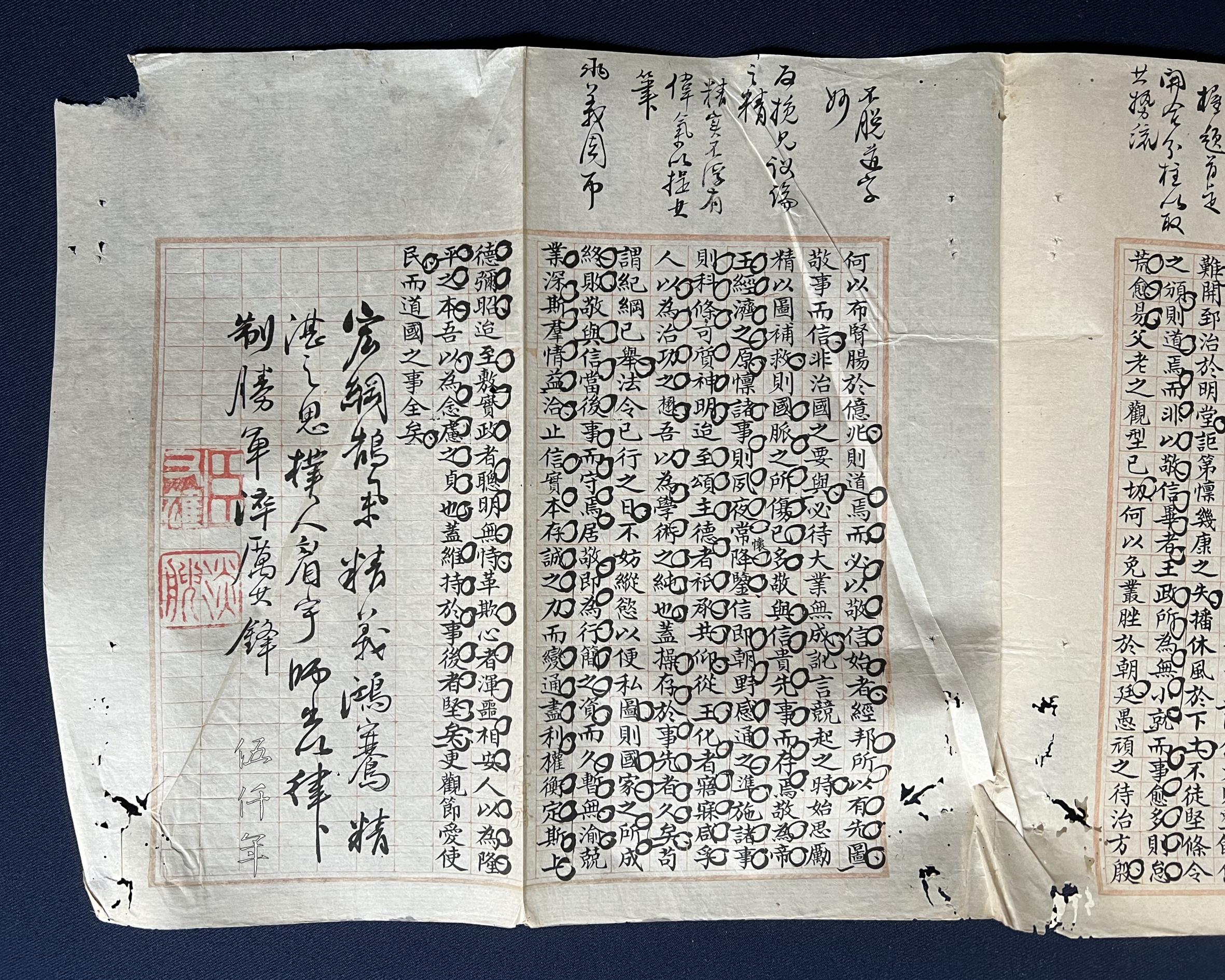
Second page of schoolwork of T’ang Yüan-chün, with commentaries and colophon by Master Ho Yu-hsiung (何又雄)
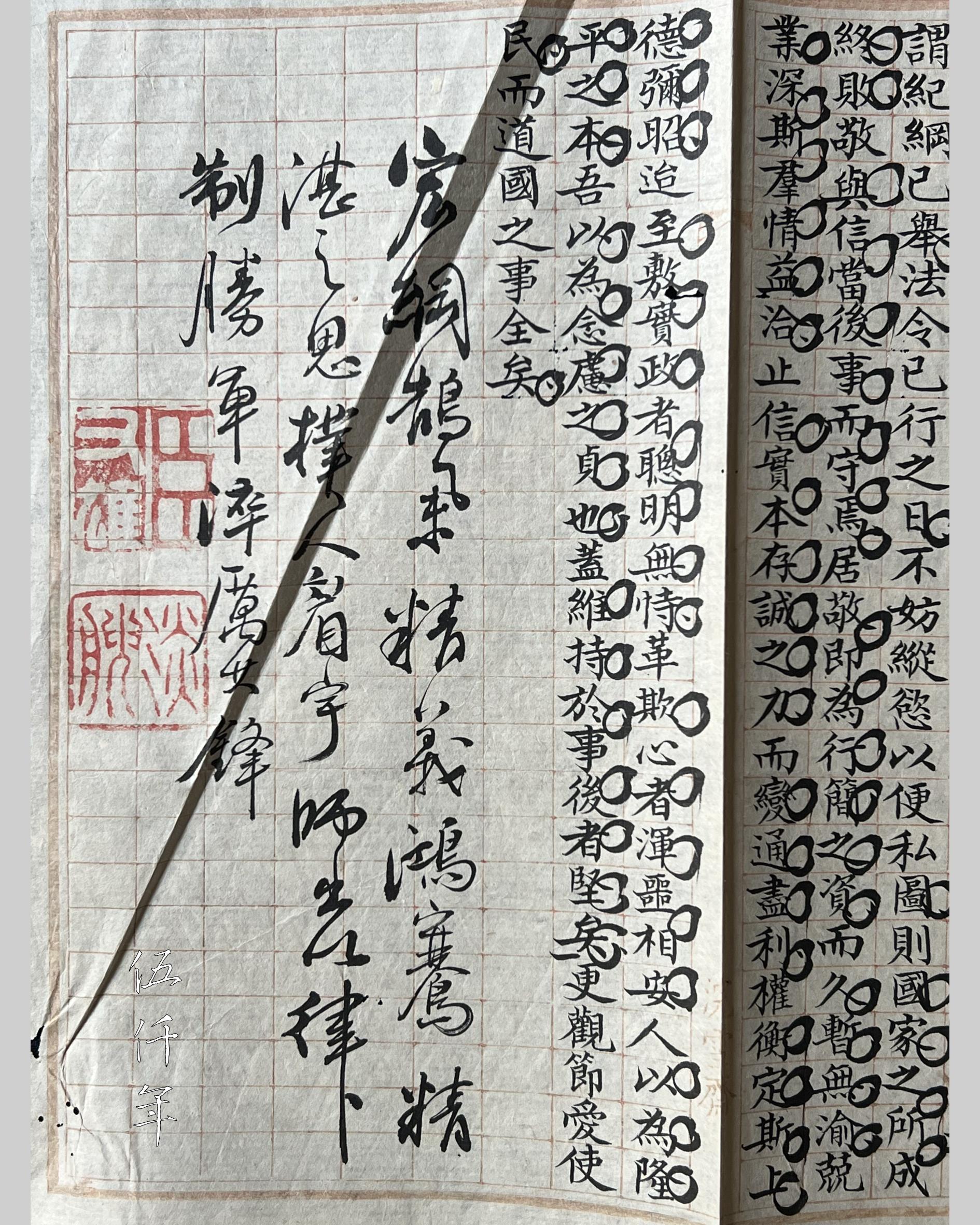
Detail of colophon by Master Ho Yu-hsiung (何又雄)
10) Master Chou Chao-chang (周兆璋 tzu Yün-chuan 雲瑑), native of Shun-te, Kwangtung province. He attained the chin-shih degree in the 2nd year of the Kuang-hsü reign 1876. His commentaries and colophons appear on two schoolworks.
11) Master Liang Jun-chien (梁汝儉 tzu Tun-ch’en 盾臣), native of Nan-hai, Kwangtung province. He attained the chü-jen degree in the 1st year of the T’ung-chih reign 1862. His commentaries and colophons appear on three schoolworks.
12) Master Lo Ying-k’eng (羅應鏗 tzu Ch’in-shih 琴石), native of Nan-hai, Kwangtung province. He attained the chü-jen degree in the 1st year of the T’ung-chih reign 1862. His commentaries and colophons appear on six schoolworks, one of which was authored by T’ang Wei-yüeh (唐維岳), whose relationship with the T’ang family is unknown.
13) Master Wang Chien-hsin (王鑑心 tzu Ju-ch’üan 茹泉), native of Nan-hai, Kwangtung province. He attained the chü-jen degree in the 17th year of the Tao-kuang reign 1837. His commentaries and colophon appear on one schoolwork.
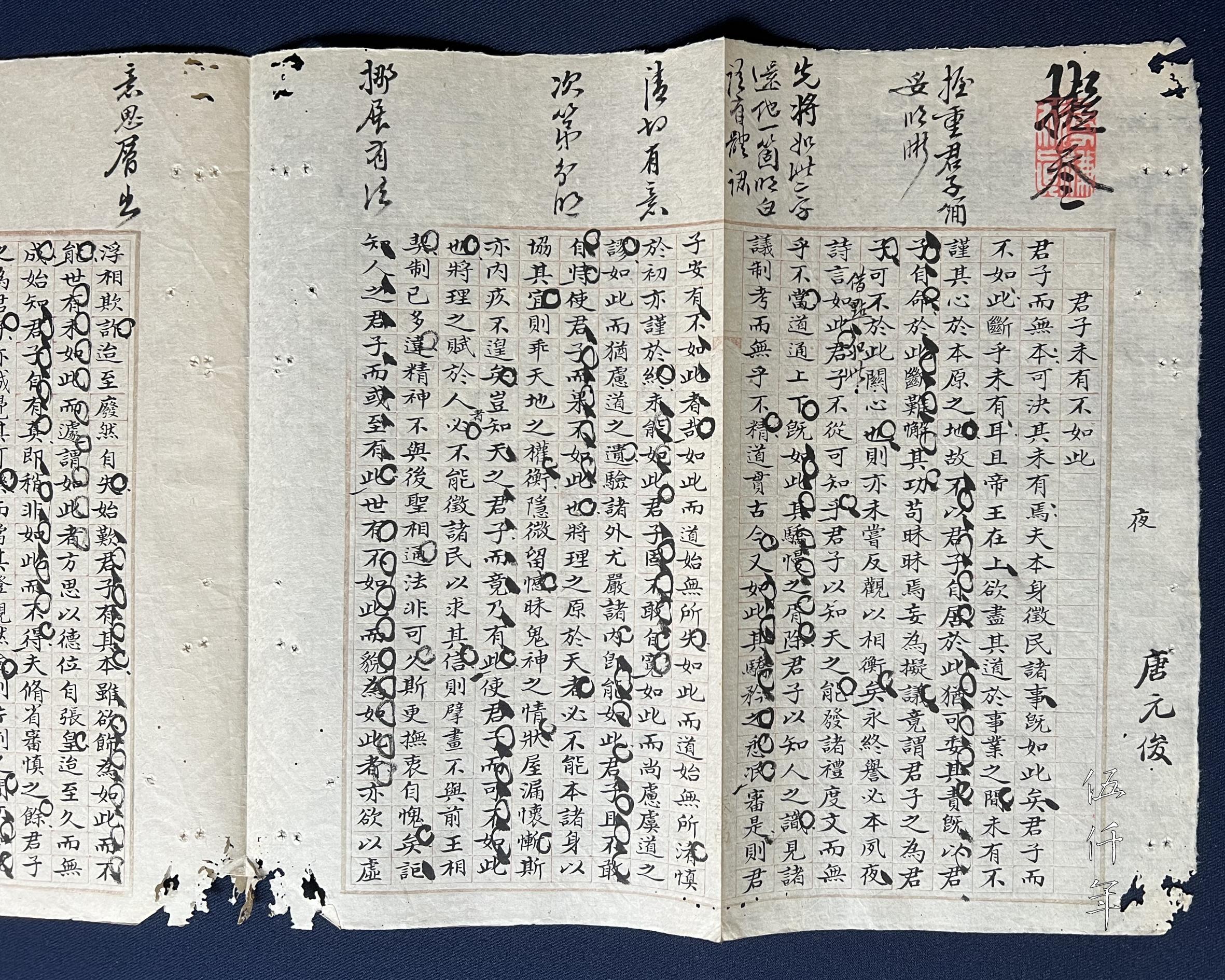
First page of schoolwork of T’ang Yüan-chün, with commentaries and colophon by Master Wang Chien-hsin (王鑑心)

Second page of schoolwork of T’ang Yüan-chün, with commentaries and colophon by Master Wang Chien-hsin (王鑑心)
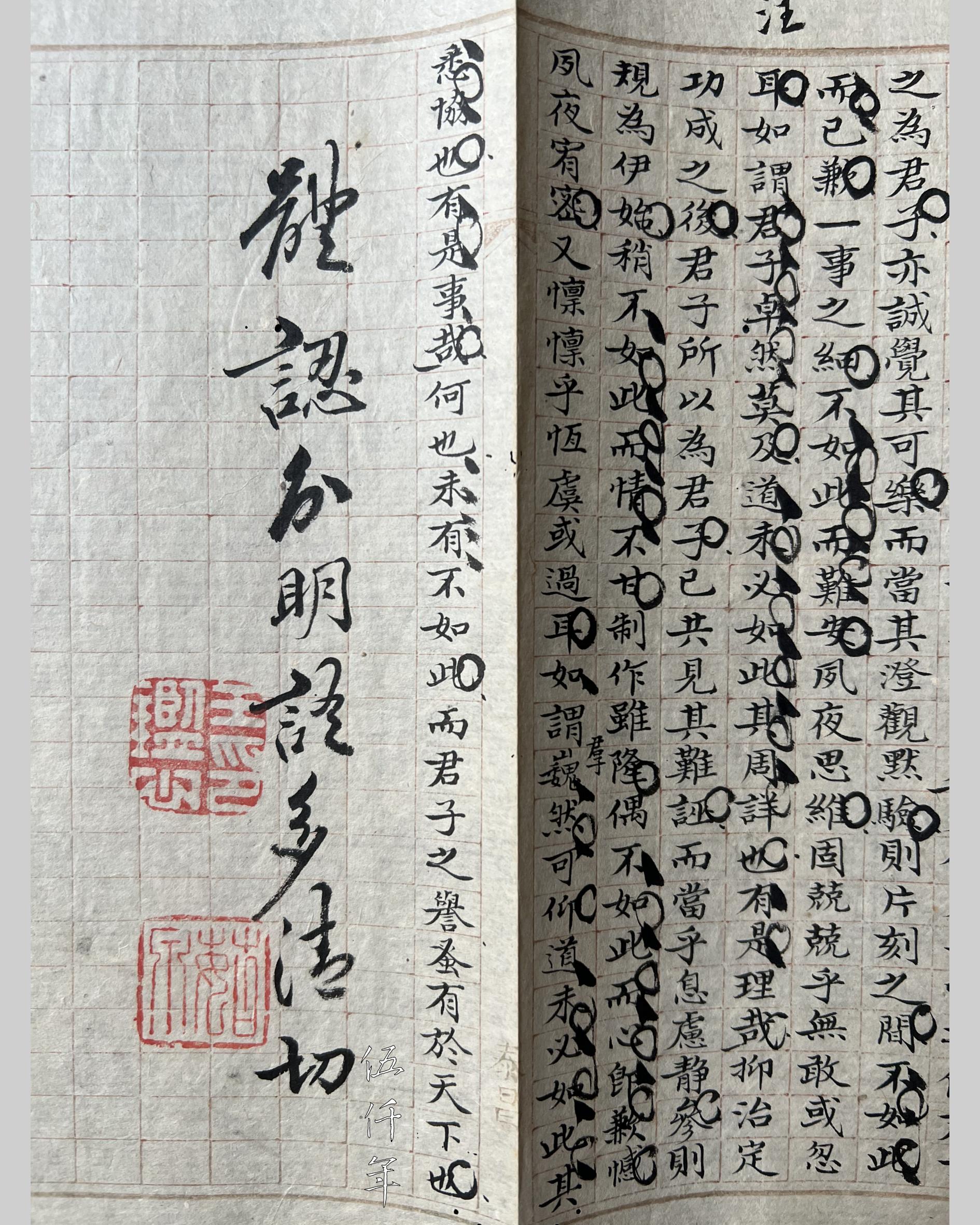
Detail of colophon by Master Wang Chien-hsin (王鑑心)
14) Master Ho Lung-chang (何龍章 tzu Ch’ih-chieh 尺階), native of Shun-te, Kwangtung province. He attained the chü-jen degree in the 2nd year of the Hsien-feng reign 1852. His commentaries and colophon appear on one schoolwork.
15) Master Ou-yang K’ai (歐陽鍇 tzu Shuang-nan 雙南), native of San-shui, Kwangtung province. He attained the chü-jen degree in the 29th year of the Tao-kuang reign 1849. His commentaries and colophon appear on one schoolwork.
16) Master Hu T’ing-yung (胡廷鏞 tzu Chien-sheng 間笙), native of Shun-te, Kwangtung province. He attained the chü-jen degree in the 14th year of the Tao-kuang reign 1834. His commentaries and colophons appear on two schoolworks.
17) Master Ch’en Chien-ch’üan (陳鑑泉 tzu Sung-hang 松方亢), native of Nan-hai, Kwangtung province. He attained the chü-jen degree in the 26th year of the Tao-kuang reign 1846. His commentaries and colophons appear on two schoolworks.
18) Master Liang Ju-ch’ien (梁汝謙 tzu Hui-shu 撝叔), native of Nan-hai, Kwangtung province. He attained the chü-jen degree in the 9th year of the T’ung-chih reign 1870. His commentaries and colophons appear on five schoolworks.
19) Master Liang Chien-hsiu (梁健修 tzu Shun-men 舜門), native of Nan-hai, Kwangtung province. He attained the chü-jen degree in the 9th year of the T’ung-chih reign 1870. His commentaries and colophons appear on two schoolworks.
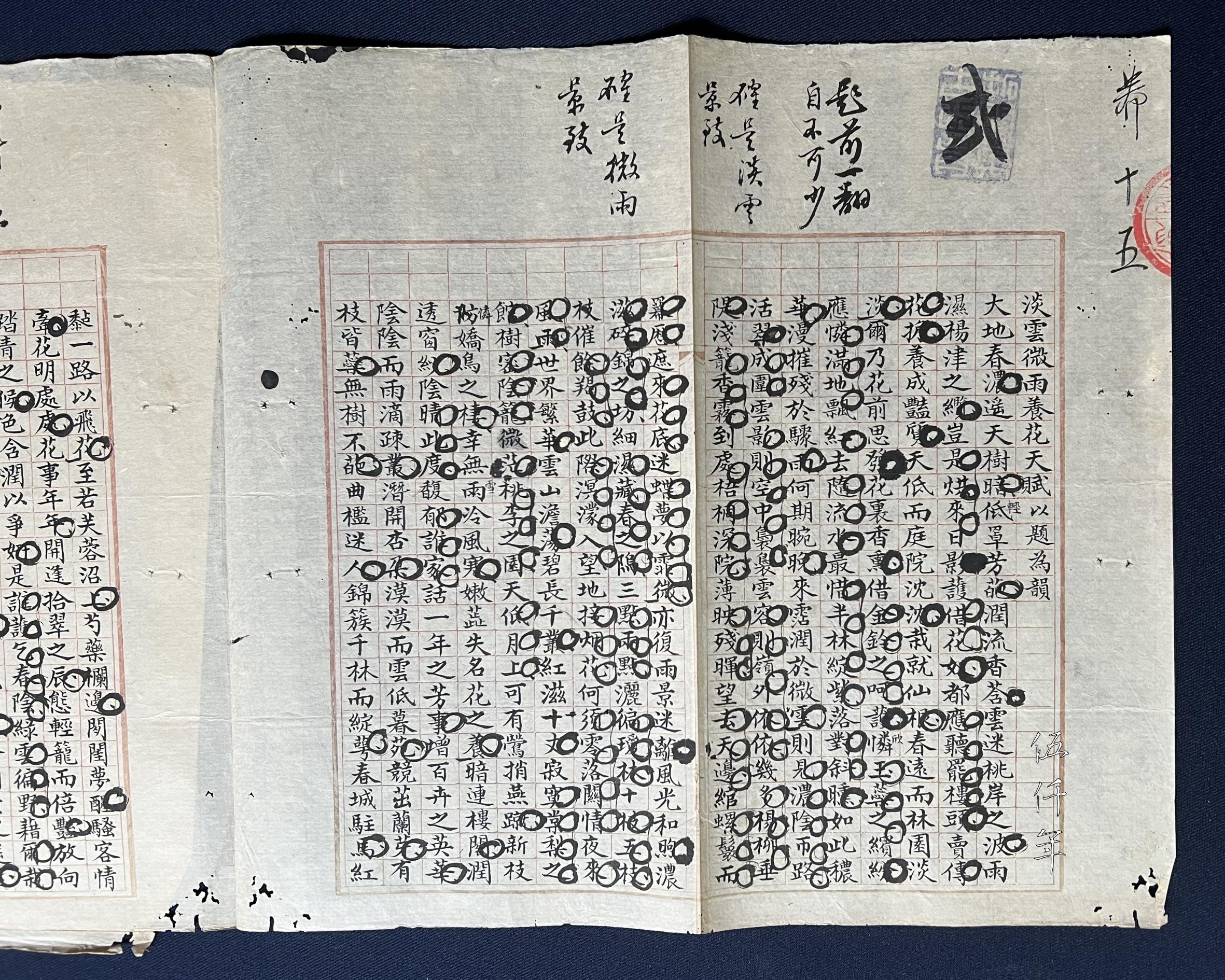
First page of schoolwork of T’ang Yüan-chün, with commentaries and colophon by Master Liang Chien-hsiu (梁健修)
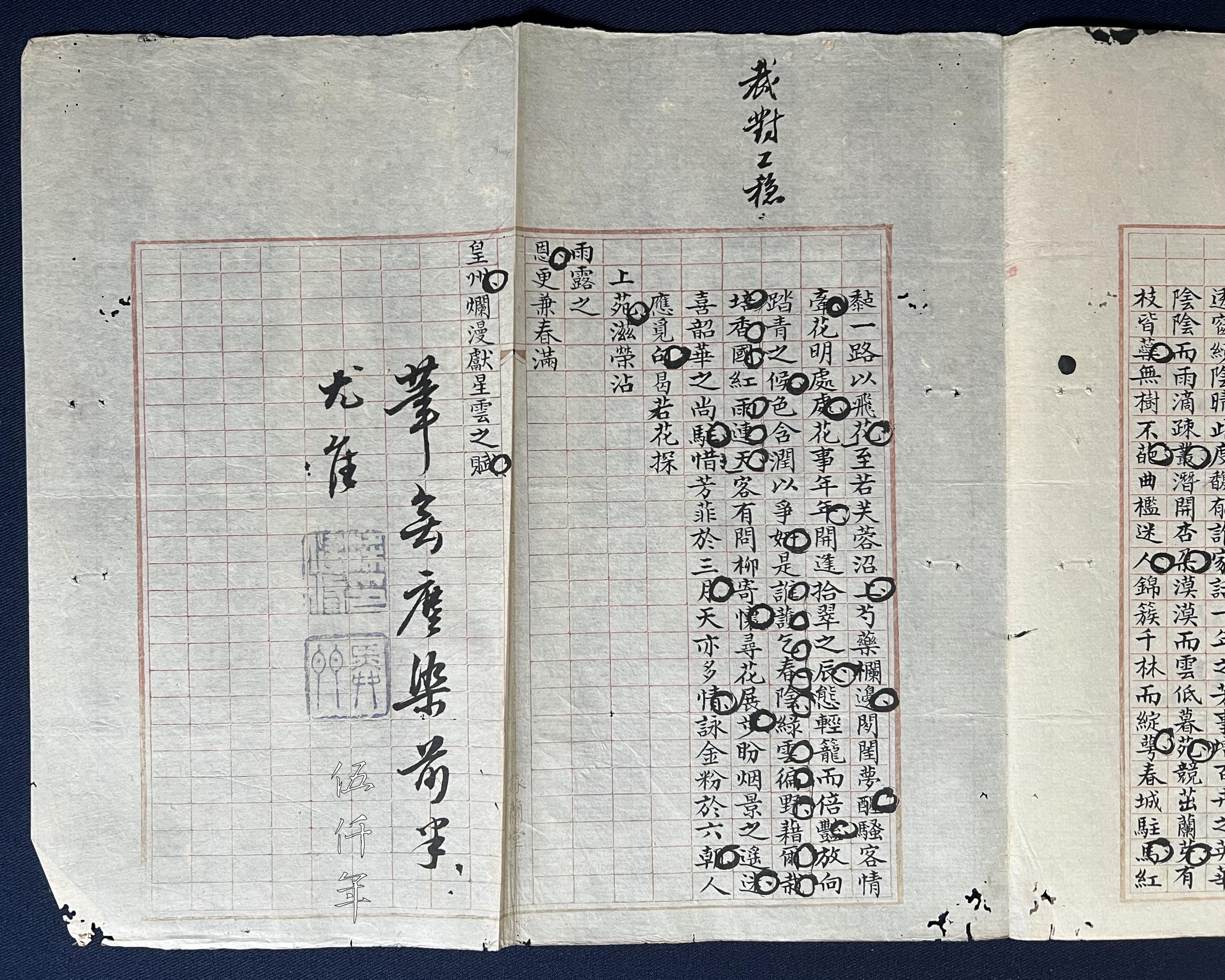
Second page of schoolwork of T’ang Yüan-chün, with commentaries and colophon by Master Liang Chien-hsiu (梁健修)
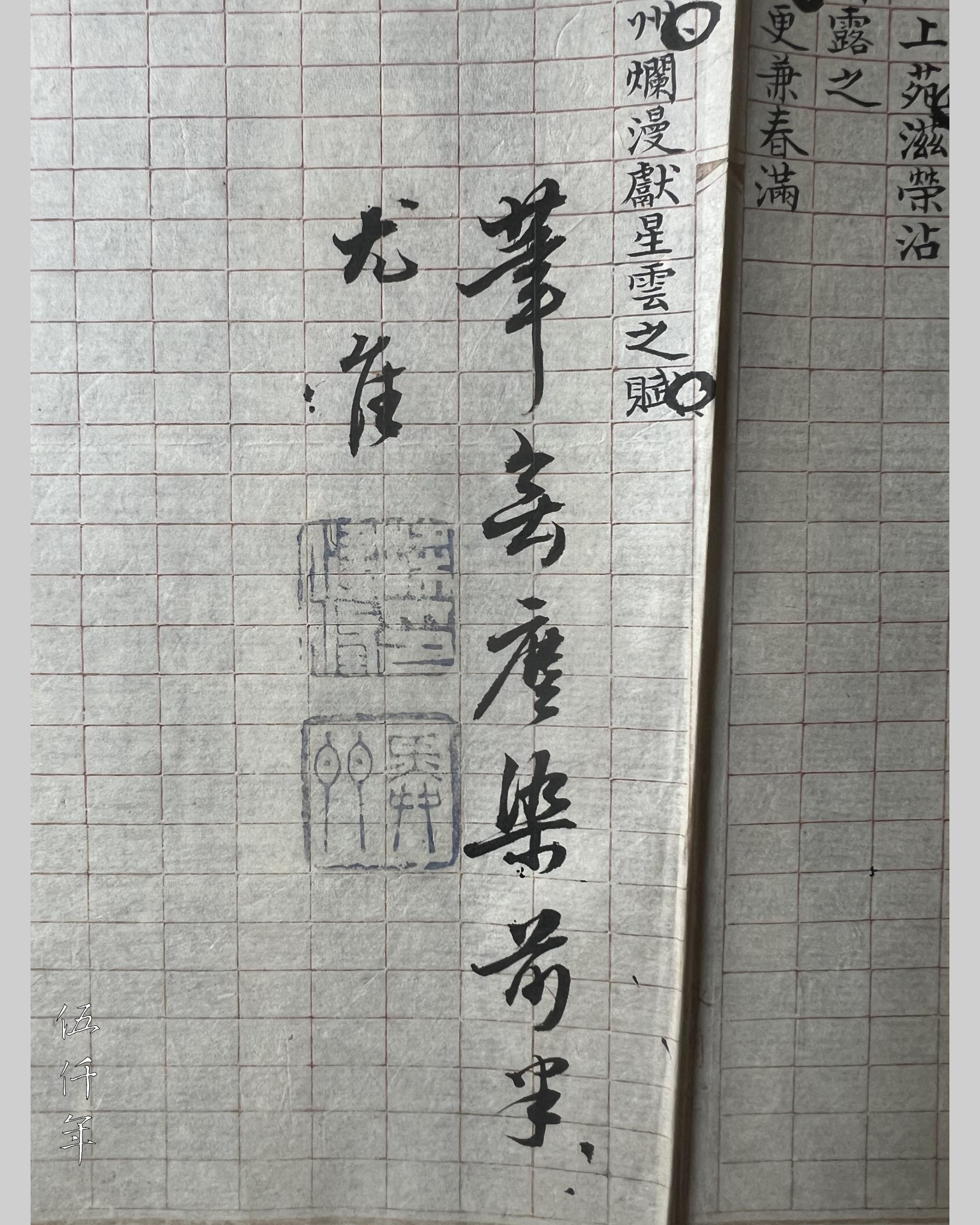
Detail of colophon by Master Liang Chien-hsiu (梁健修)
20) Master Ho Kuang-yüan (何廣源), native of Nan-hai, Kwangtung province. He attained the chü-jen degree in the 1st year of the T’ung-chih reign 1862. His commentaries and colophon appear on one schoolwork.
21) Master Wu Lan-cheng (伍蘭徵 tzu Hsia-ts’un 霞邨), native of Shun-te, Kwangtung province. He attained the chü-jen degree in the 1st year of the Hsien-feng reign 1851. His commentaries and colophon appear on one schoolwork.
22) Master Lo T’ien-p’ei (羅天培 tzu Min-shan 岷山), native of Shun-te, Kwangtung province. He attained the chü-jen degree in the 1st year of the T’ung-chih reign 1862. His commentaries and colophons appear on two schoolworks.
23) Master Liang Jung (梁融 tzu Li-p’u 荔圃), native of Nan-hai, Kwangtung province. He attained the chü-jen degree in the 11th year of the Hsien-feng reign 1861. His commentaries and colophons appear on two schoolworks.
24) Master Ch’en Yen (陳碞 tzu P’in-shih 品石), native of Nan-hai, Kwangtung province. He attained the chü-jen degree in the 1st year of the Hsien-feng reign 1851. His commentaries and colophons appear on ten schoolworks.
25) Master Ts’en Feng-ming (岑鳳鳴 tzu Chu-ch’ing 翥卿), native of Kuei-chou or Nan-hai, Kwangtung province. He attained the chü-jen degree in the 1st year of the T’ung-chih reign 1862. His commentaries and colophon appear on one schoolwork.
26) Master Lao Jen-jui (勞人瑞 tzu Chen-chai 真儕), native of Nan-hai, Kwangtung province. He attained the chü-jen degree in the 14th year of the Tao-kuang reign 1834. His commentaries and colophon appear on one schoolwork.
27) Master Wu Ping-nan (吳炳南 tzu Hsing-chai 星儕), native of Shun-te, Kwangtung province. He attained the chü-jen degree in the 29th year of the Tao-kuang reign 1849. His commentaries and colophon appear on one schoolwork.
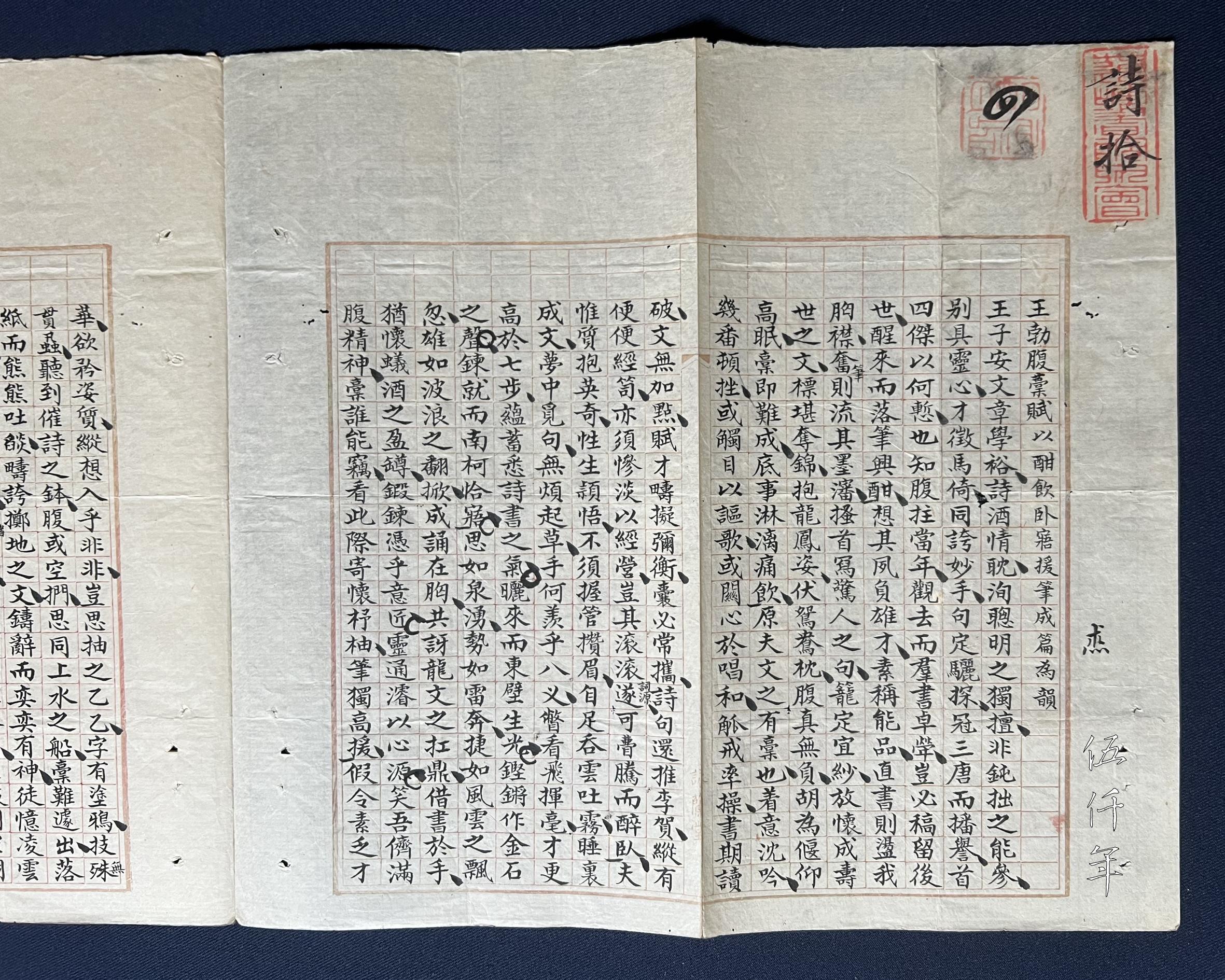
First page of schoolwork of T’ang Yüan-chün, with commentaries and colophon by Master Wu Ping-nan (吳炳南)
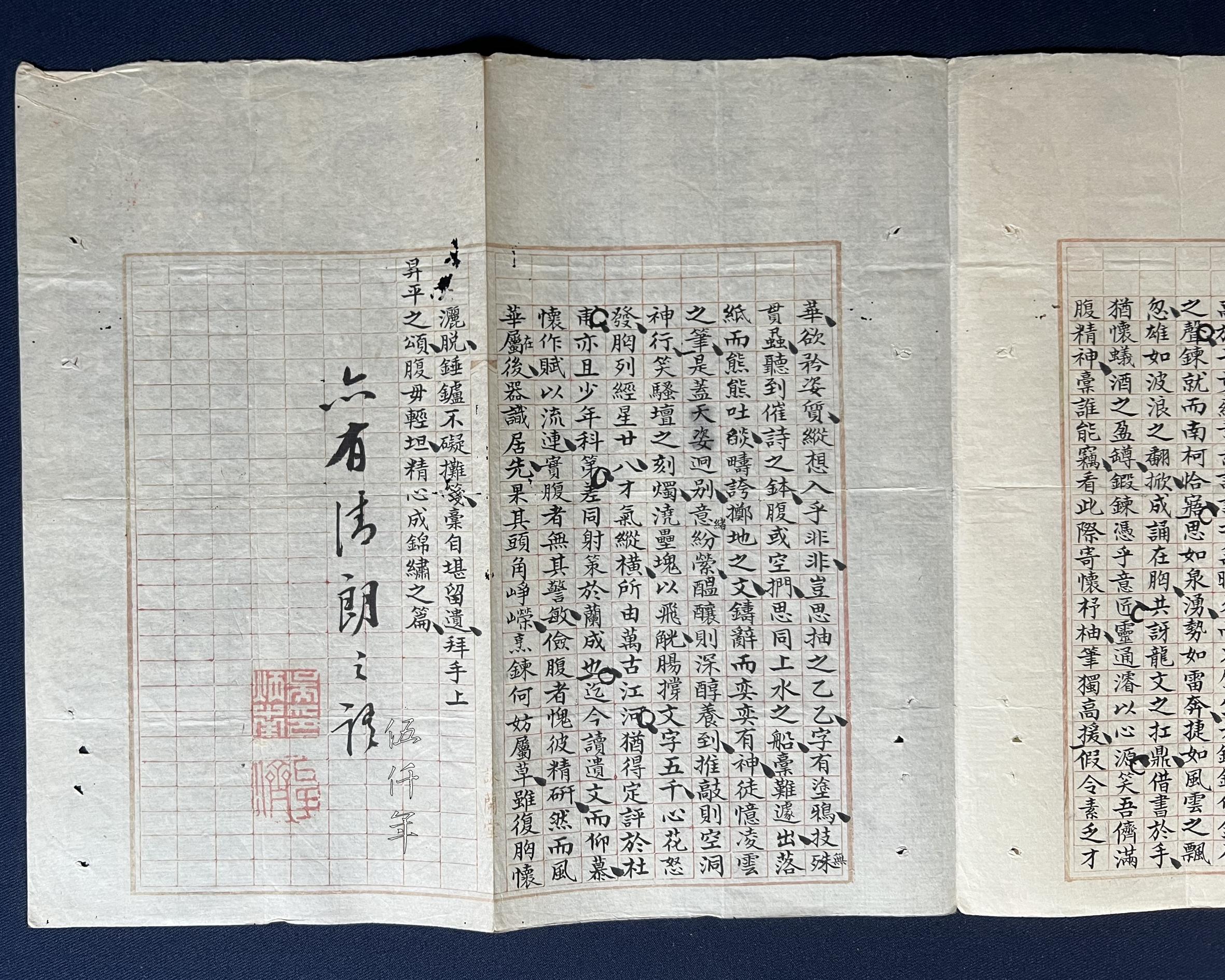
Second page of schoolwork of T’ang Yüan-chün, with commentaries and colophon by Master Wu Ping-nan (吳炳南)
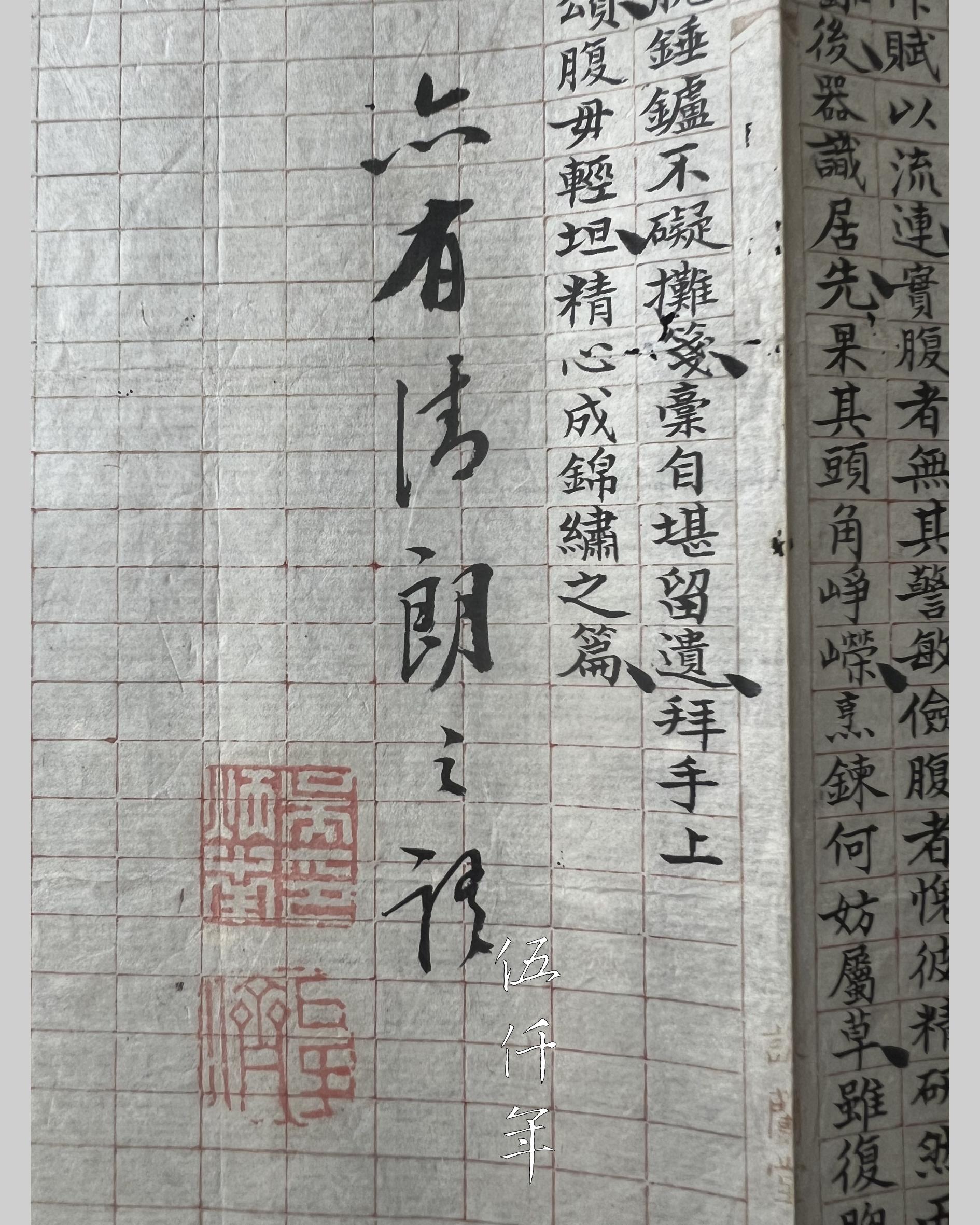
Detail of colophon by Master Wu Ping-nan (吳炳南)
28) Master Yü Chih-yung (余柣庸), native of Nan-hai, Kwangtung province. He attained the chü-jen degree in the 15th year of the Tao-kuang reign 1835. His commentaries and colophon appear on one schoolwork.
Another nine schoolworks bear the commentaries and colophons of six more teachers, with seal impressions of their names. However, their places of origin and imperial examination degrees have not been established. They are:
1) Master Liu Chüeh-hsiang (劉覺享 tzu Hsin-ch’ü 心渠), whose commentaries and colophons appear on three schoolworks.
2) Master Sung Hsiao-hsiang (宋曉湘 tzu Hsiao-ch’u 霄初), whose commentaries and colophon appear on one schoolwork.
3) Master Lu Ta-jung (陸達榮) whose commentaries and colophon appear on one schoolwork.
4) Master Kuan Chung-yang (關仲㻛 tzu Yen-nung 硯農), whose commentaries and colophons appear on two schoolworks.
5) Master Tseng Hu (增祜 tzu Ch’ing-shan 晴珊), original name Ju-lan (汝蘭), whose commentaries and colophon appear on one schoolwork
6) Master Ho Shu-ching (何述經 tzu Ts’ui-liu 醉六), whose commentaries and colophon appear on one schoolwork.
A further twenty-nine schoolworks bear the commentaries and colophons of another twenty-four teachers, with seal impressions of only their tzu (字) or hao (號). Hence their original names cannot be easily verified. The tzu or hao used are:
1) Master Shu-t’ing (曙亭), whose commentaries and colophons appear on two schoolworks.
2) Master Meng-k’uei (夢葵), whose commentaries and colophon appear on one schoolwork.
3) Master Liu-chieh (六階), whose commentaries and colophon appear on one schoolwork.
4) Master Meng-luan (孟㘘), whose commentaries and colophon appear on one schoolwork.
5) Master Yün-ch’iao (雲橋), whose commentaries and colophons appear on two schoolworks.
6) Master Feng-pai (逢佰), whose commentaries and colophon appear on one schoolwork.
7) Master Li-feng (立峰), whose commentaries and colophons appear on two schoolworks.
8) Master Ku-sheng (穀生), whose commentaries and colophons appear on two schoolworks.
9) Master Tzu-ch’ao (子超), whose commentaries and colophon appear on one schoolwork.
10) Master Pao-shan (寶珊), whose commentaries and colophon appear on one schoolwork.
11) Master Yün-shih (雲史), whose commentaries and colophons appear on two schoolworks.
12) Master Wen-yü (文予), whose commentaries and colophon appear on one schoolwork.
13) Master Lü-sheng (侶笙), whose commentaries and colophon appear on one schoolwork.
14) Master Liang-fu (亮甫), whose commentaries and colophon appear on one schoolwork.
15) Master Yü-fan (羽䑺), whose commentaries and colophon appear on one schoolwork.
16) Master Hsing-t’o (星沱), whose commentaries and colophon appear on one schoolwork.
17) Master Wu-lou (五樓), whose commentaries and colophon appear on one schoolwork.
18) Master Kuei-chieh (桂節) , whose commentaries and colophon appear on one schoolwork.
19) Master Hua-ch’ing (華卿), whose commentaries and colophon appear on one schoolwork.
20) Master Chen-chai (真儕), whose commentaries and colophon appear on one schoolwork.
21) Master P’ei-shih (培石), whose commentaries and colophon appear on one schoolwork.
22) Master Tzu-ching (子經), whose commentaries and colophon appear on one schoolwork.
23) Master Ying-sheng (瀛生), whose commentaries and colophon appear on one schoolwork.
24) Master Chün-t’ang (峻堂 also known as Te-yü 德玉), whose commentaries and colophon appear on one schoolwork.

Drawing of Ying-yüan Academy (應元書院) in Canton
The examination papers comprise a total of sixty-four items: fifty-seven examination papers by T’ang Yüan-chün and seven by T’ang Chi-ch’ang (唐繼昌). The schools they attended are listed below:
1) There are fifty-three examination papers by T’ang Yüan-chün from Yüeh-hsiu Academy (粵秀書院). The Academy was located within the walled city of Canton, and was founded in the 49th year of the K’ang-hsi reign 1710.
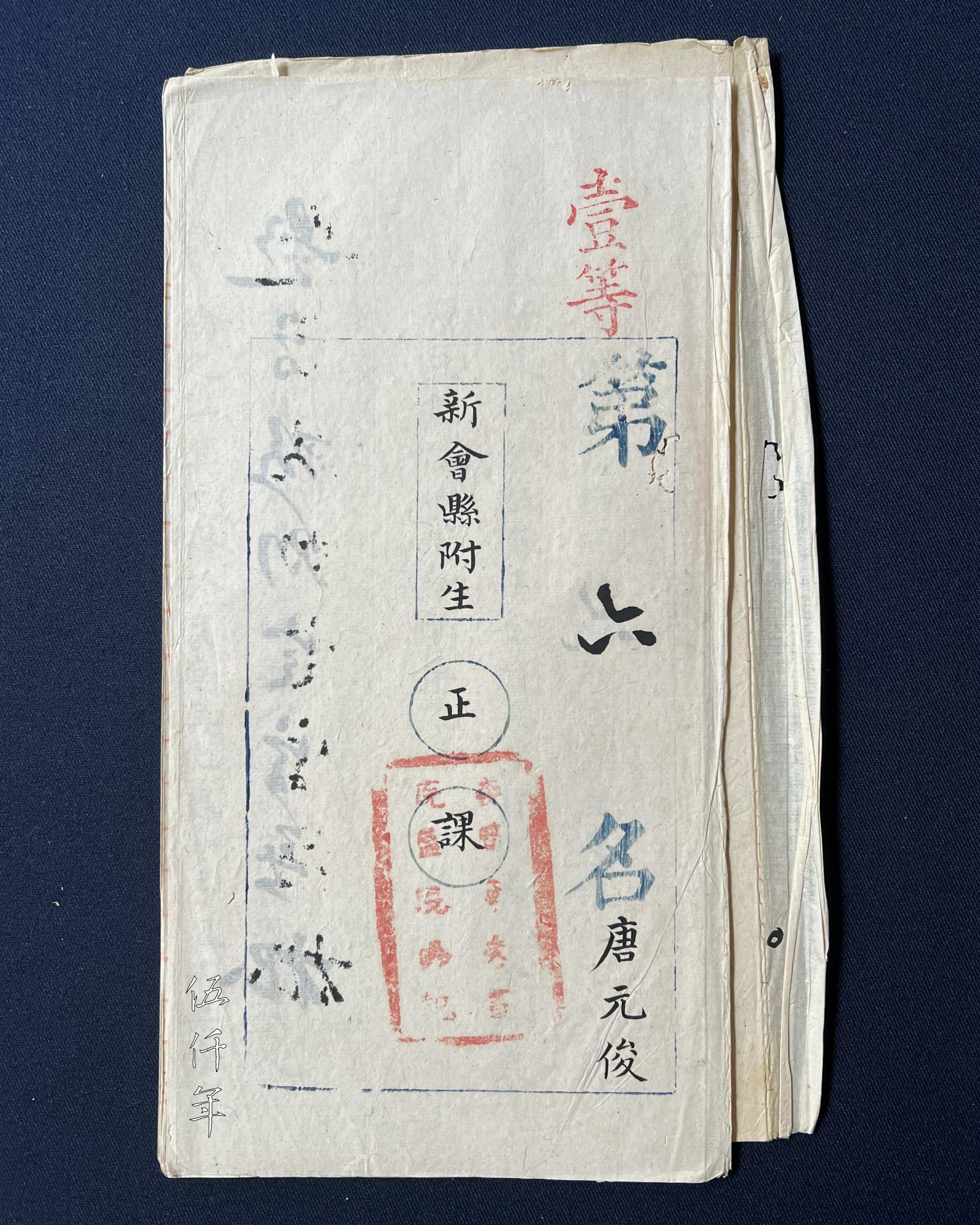
Front cover of examination paper of T’ang Yüan-chün taken at Yüeh-hsiu Academy (粵秀書院) in Canton

First page of examination paper of T’ang Yüan-chün taken at Yüeh-hsiu Academy (粵秀書院) in Canton
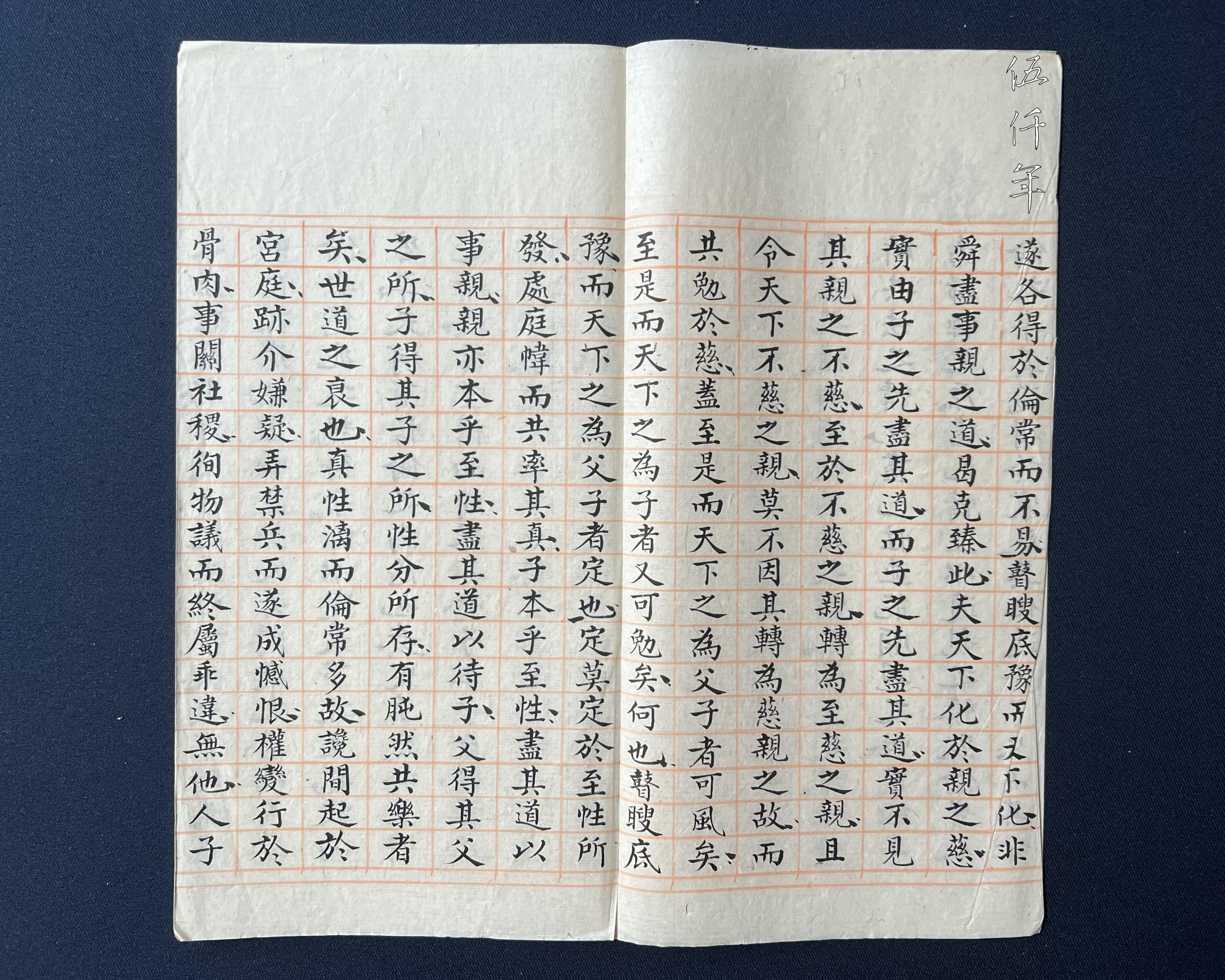
Second page of examination paper of T’ang Yüan-chün taken at Yüeh-hsiu Academy (粵秀書院) in Canton
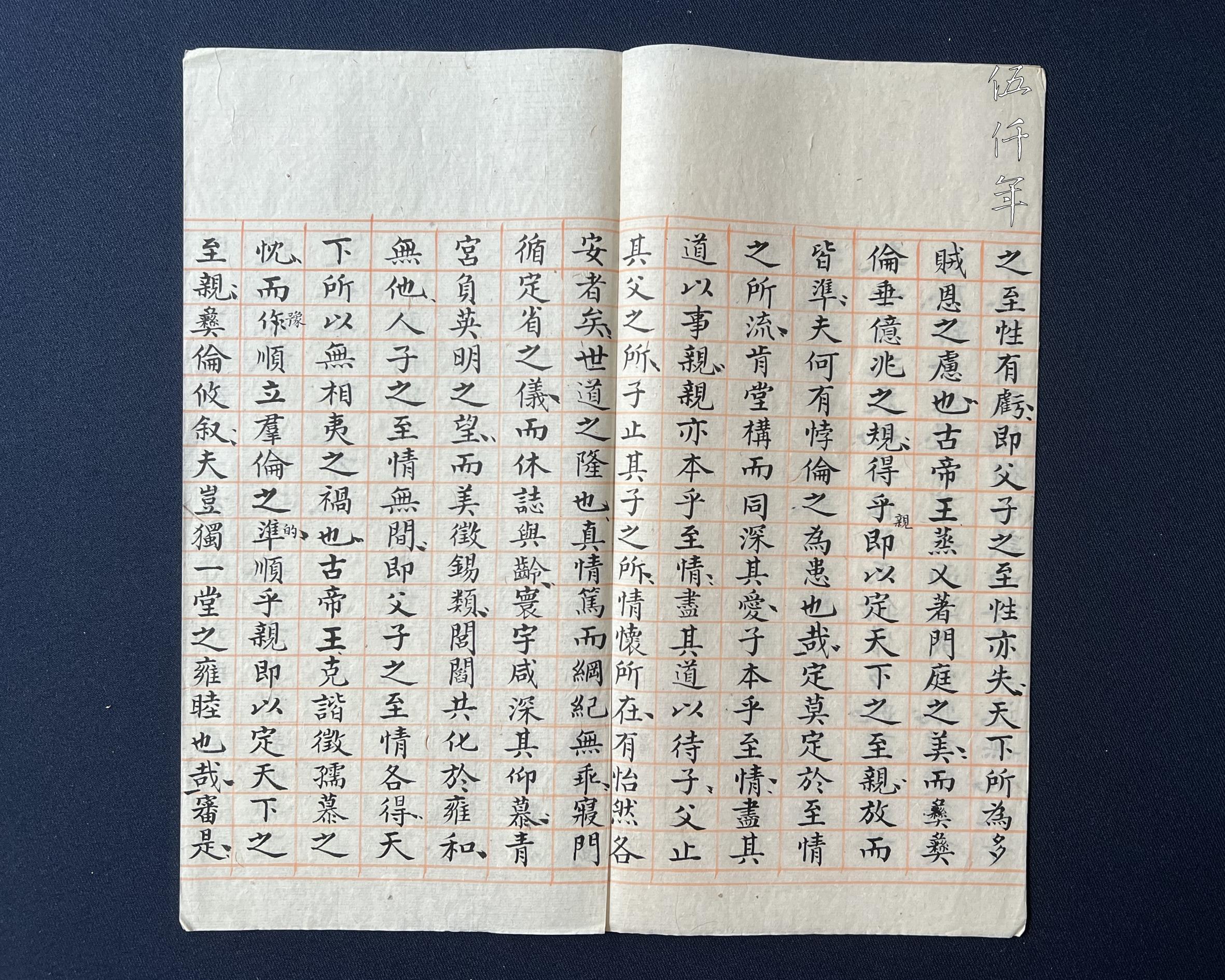
Third page of examination paper of T’ang Yüan-chün taken at Yüeh-hsiu Academy (粵秀書院) in Canton
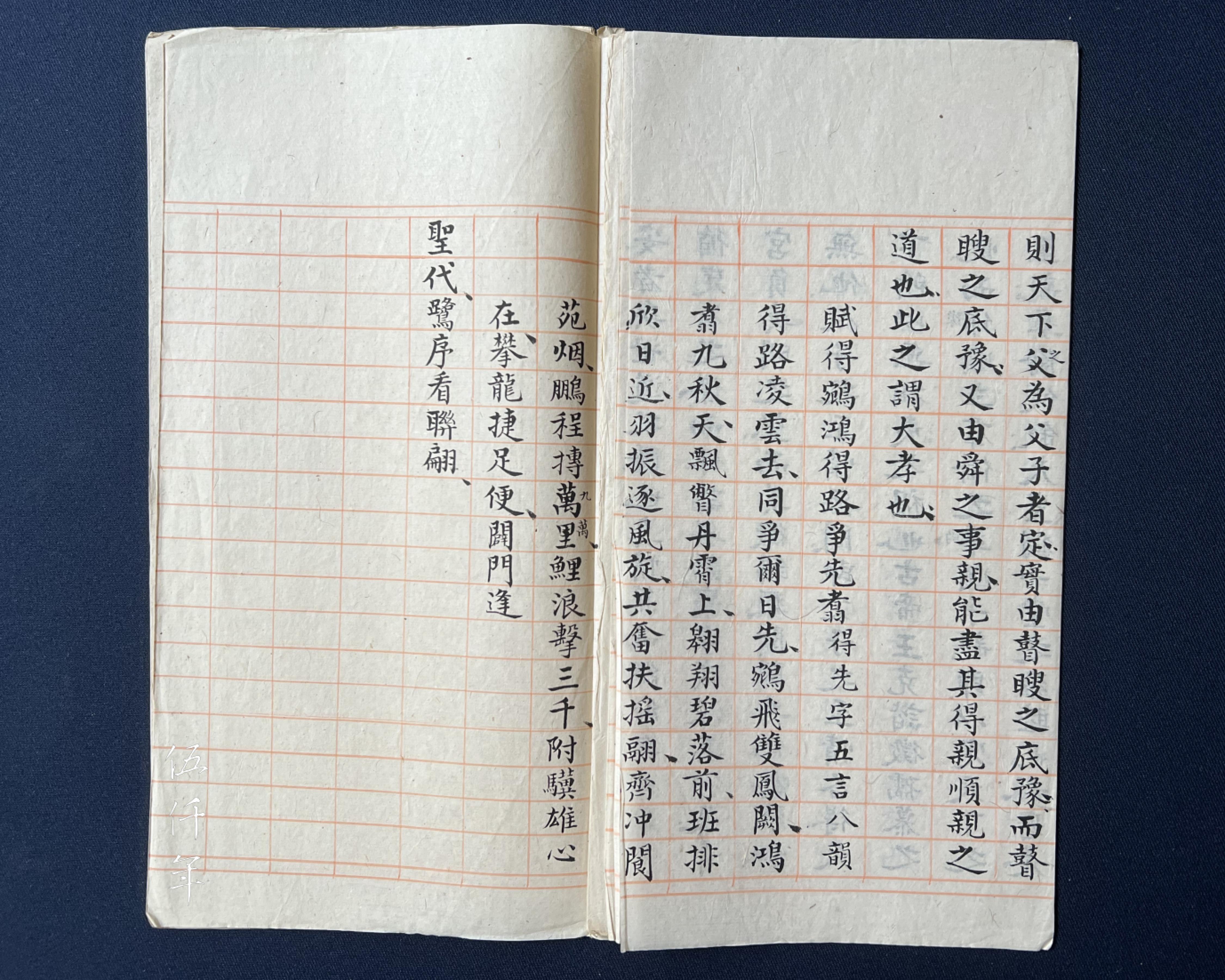
Fourth page of examination paper of T’ang Yüan-chün taken at Yüeh-hsiu Academy (粵秀書院) in Canton
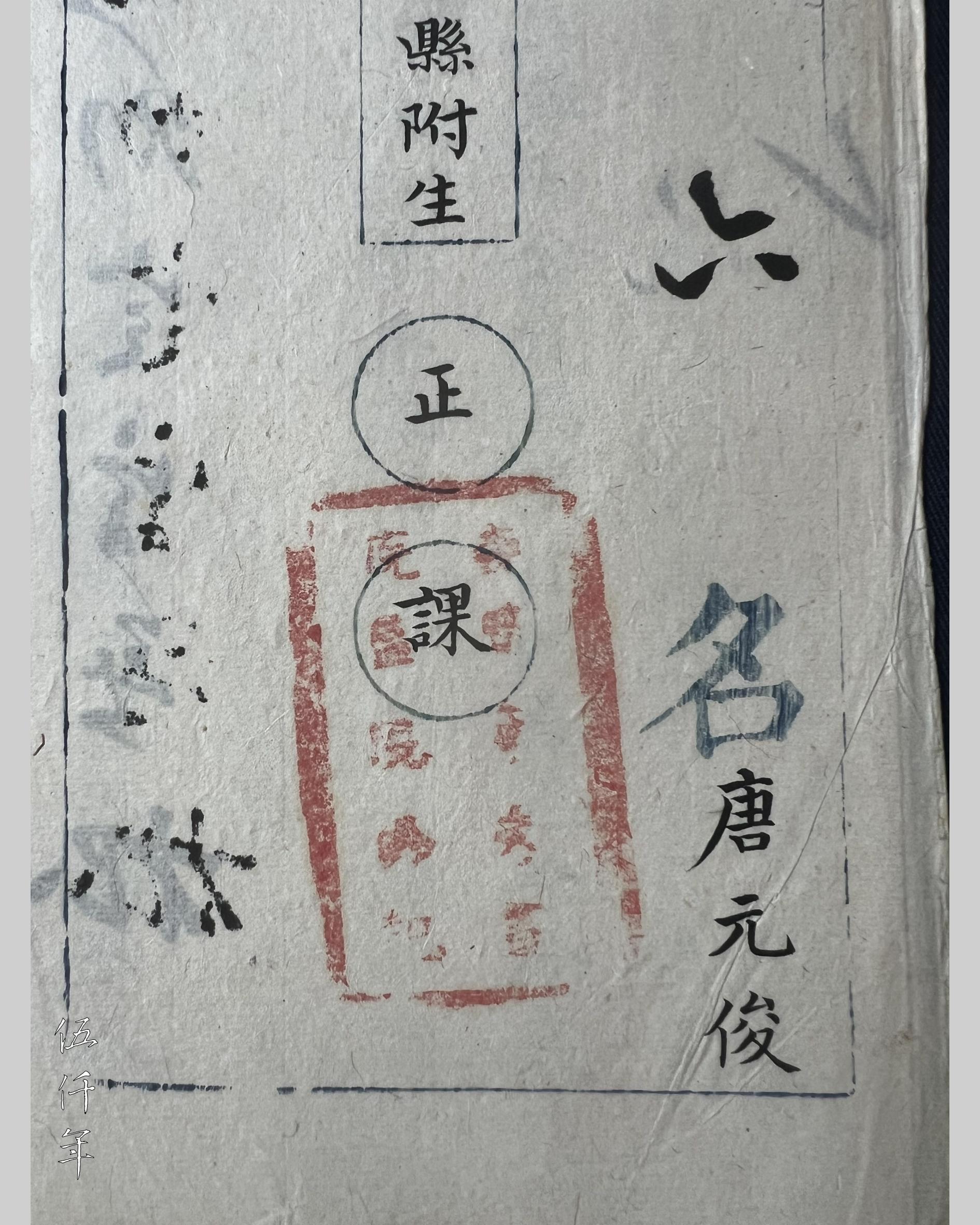
Detail of front cover highlighting the seal of Yüeh-hsiu Academy
2) There is one examination paper by T’ang Yüan-chün from Chü-p’o Ching-she (菊坡精舍). Chü-p’o Ching-she was located within the walled city of Canton, and was founded in the 6th year of the T’ung-chih reign 1867.
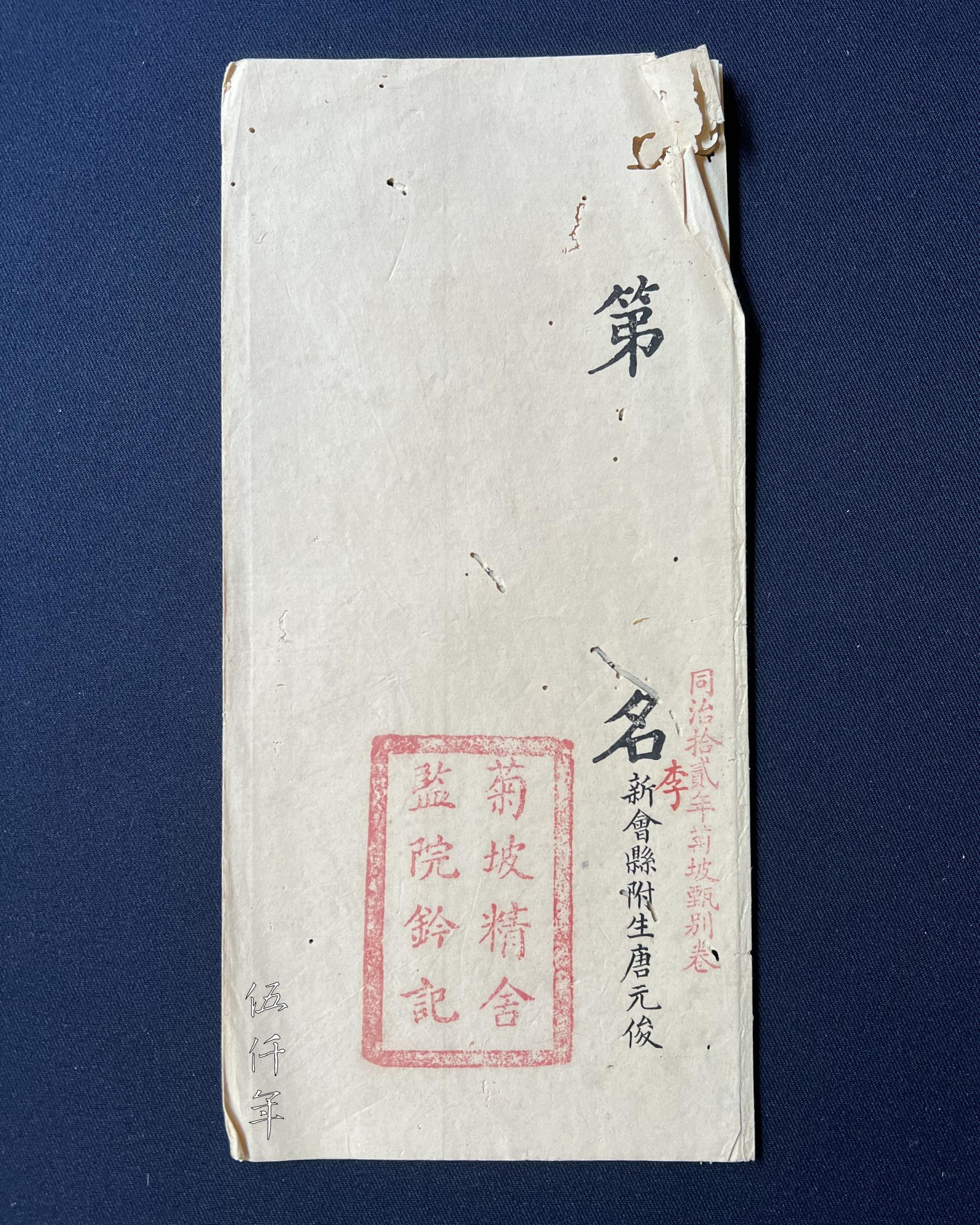
Front cover of examination paper of T’ang Yüan-chün taken at Chü-p’o Ching-she (菊坡精舍) in Canton

First page of examination paper of T’ang Yüan-chün taken at Chü-p’o Ching-she (菊坡精舍) in Canton

Second page of examination paper of T’ang Yüan-chün taken at Chü-p’o Ching-she (菊坡精舍) in Canton
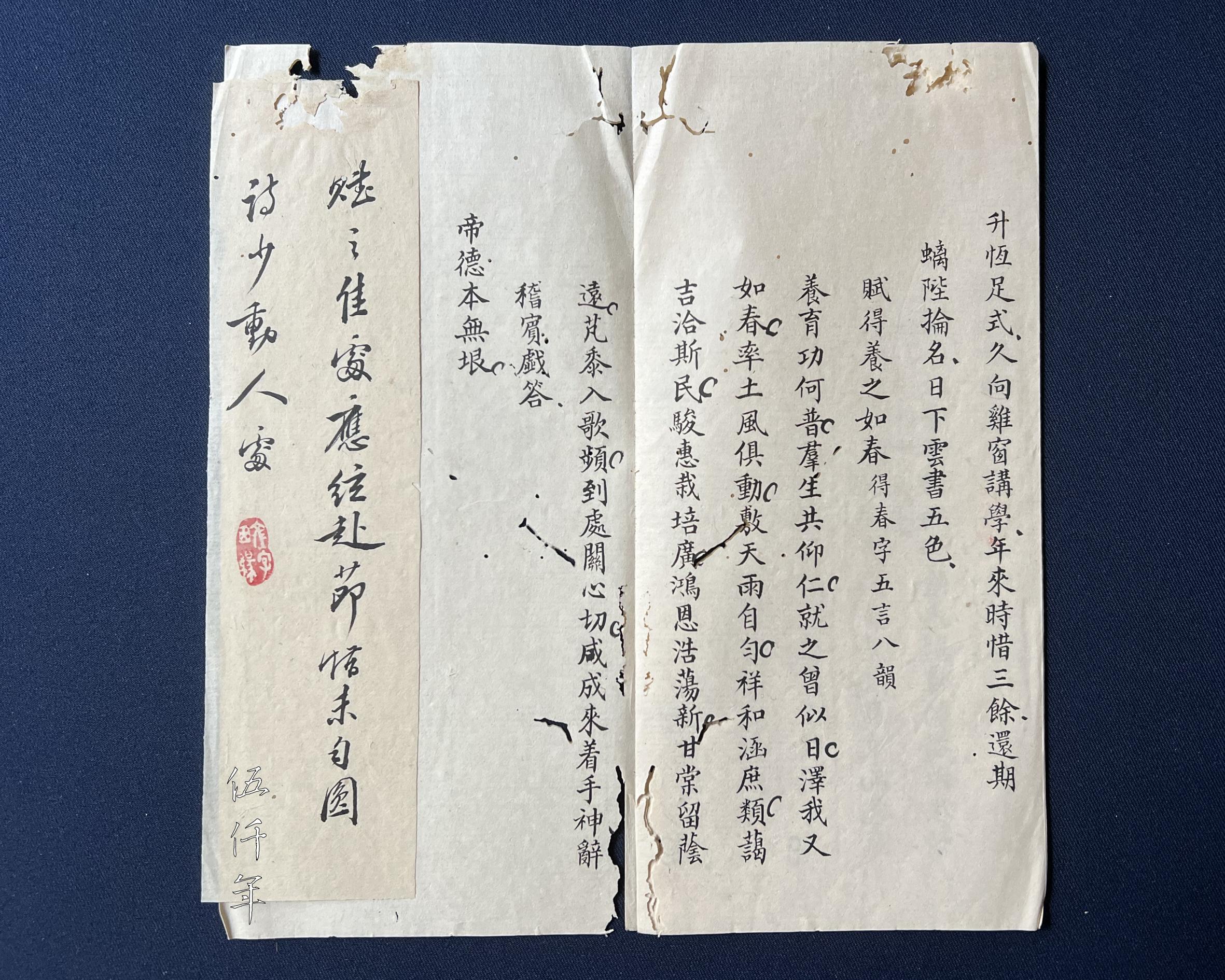
Third page of examination paper of T’ang Yüan-chün taken at Chü-p’o Ching-she (菊坡精舍) in Canton

Detail of front cover highlighting the seal of Chü-p’o Ching-she (菊坡精舍)
3) There is one examination paper by T’ang Yüan-chün from Tzu-shui I-hsüeh (紫水義學). Tzu-shui I-hsüeh was located in Hsin-hui, Kwangtung province, and was founded in the 19th year of the Chia-ch’ing reign 1814.
4) There is one examination paper by T’ang Yüan-chün from Ying-yüan Academy (應元書院). The Academy was located within the walled city of Canton, and was founded in the 9th year of the T’ung-chih reign 1870.
5) There is one sheng-yüan (生員) examination paper by T’ang Yüan-chün from Hsin-hui County.
6) There are seven examination papers by T’ang Chi-ch’ang from Yang-ch’eng Academy (羊城書院 ). The Academy was located within the walled city of Canton, and was founded in the 25th year of the Chia-ch’ing reign 1820. T’ang Chi-ch’ang was a brother of T’ang Yüan-chün. He held the status of chien-kung-sheng (監貢生 supernumerary tribute student) and bore the titular post of office manager of the Provincial Administration Commissioner.
The poetry and prose of T’ang Yüan-chün were highly admired by his eminent teachers, as revealed by their commentaries and colophons on his schoolworks.
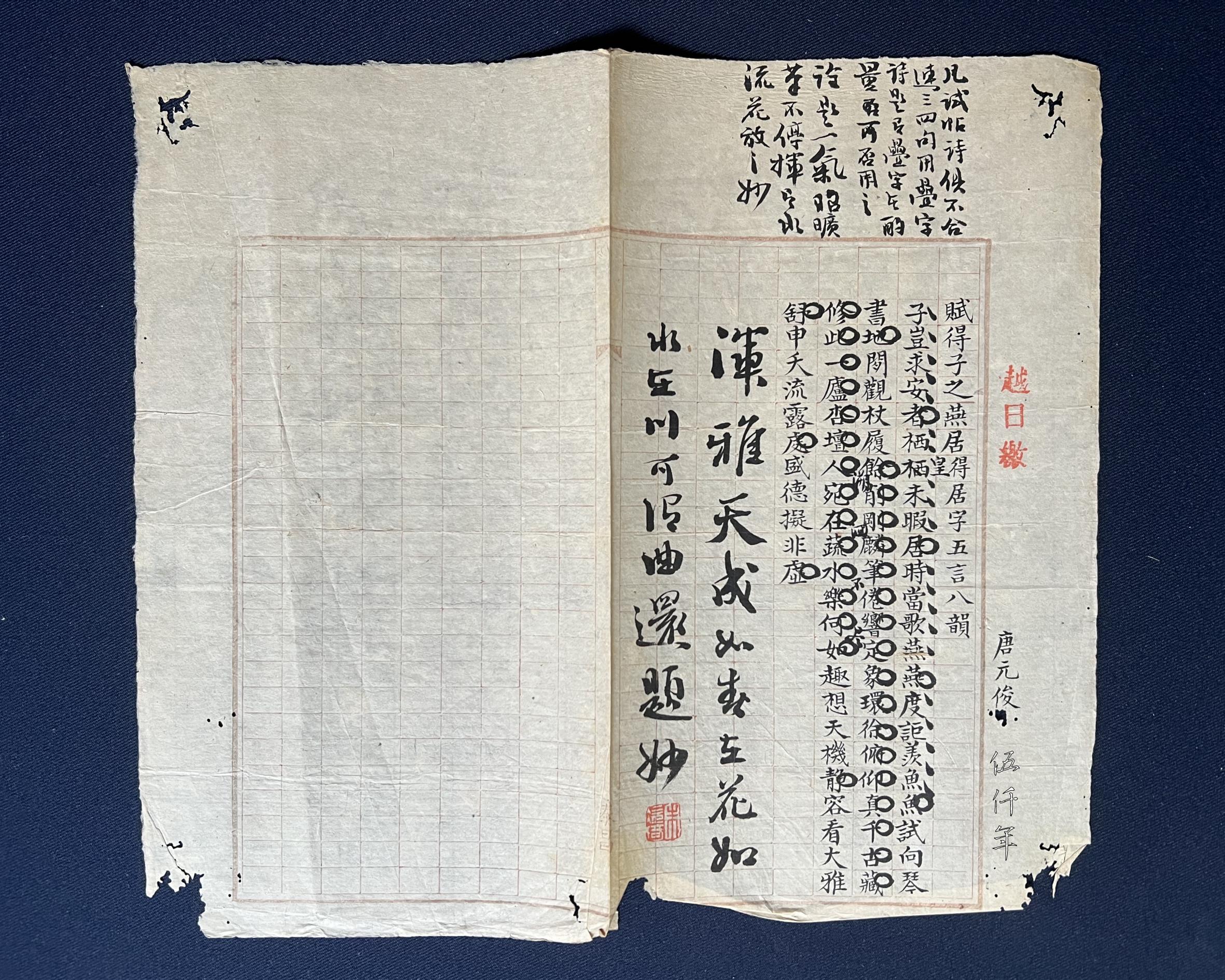
Schoolwork of T’ang Yüan-chün, with commentaries and colophon by Master Chu Tzu-ch’i (朱次琦)
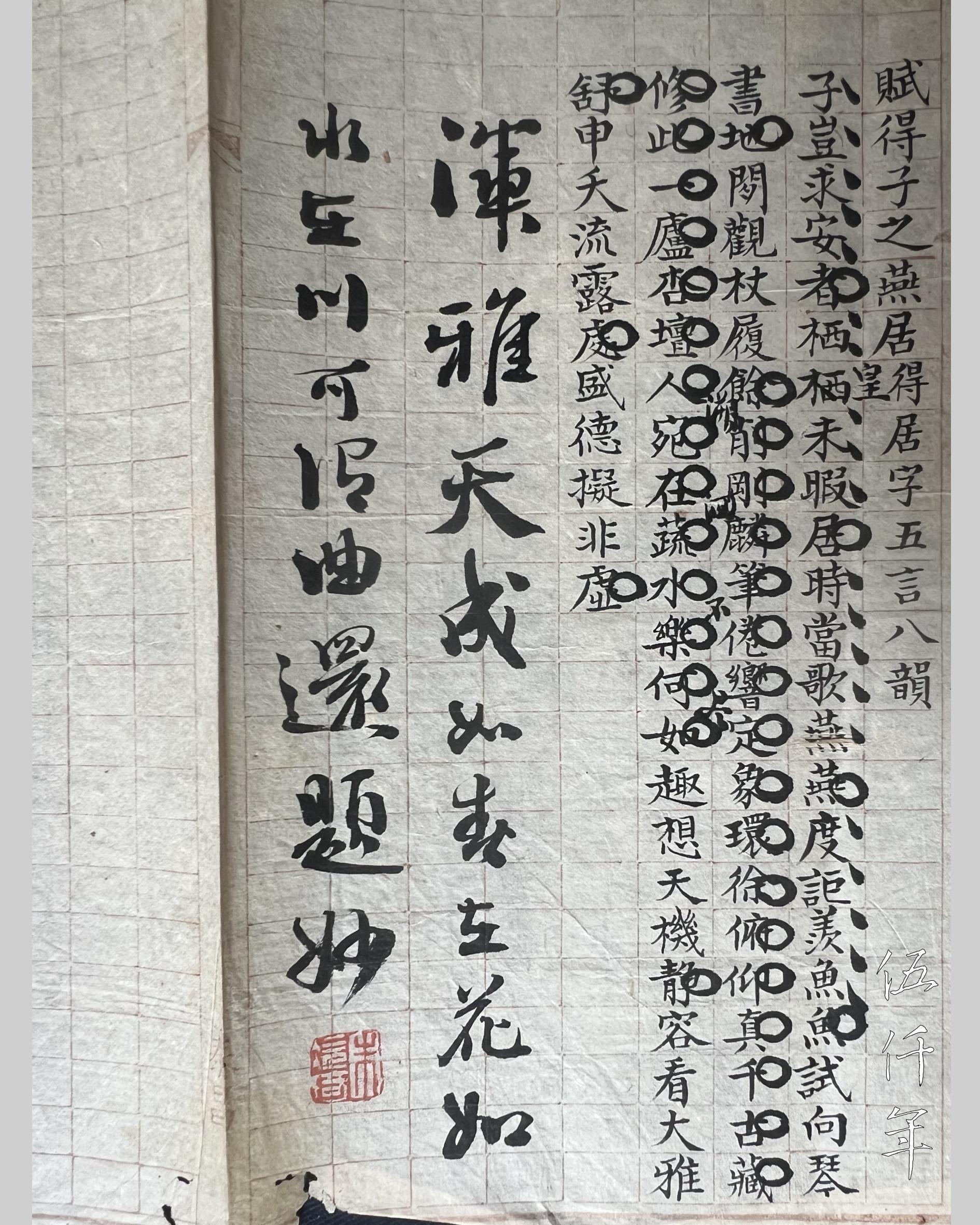
Detail of colophon by Master Chu Tzu-ch’i (朱次琦)
Master Chu Tz’u-ch’i wrote a colophon on one of the regulated five character eight rhyme poetry schoolworks by T’ang Yüan-chün titled A Response to a Sentence in the Analects: The Master was Unoccupied with Business, Composed with a Selected Character. The words of the colophon are:
“Altogether unworldly as if created by nature. Like spring in flower, like water in river. We can say the poem is exquisite.”
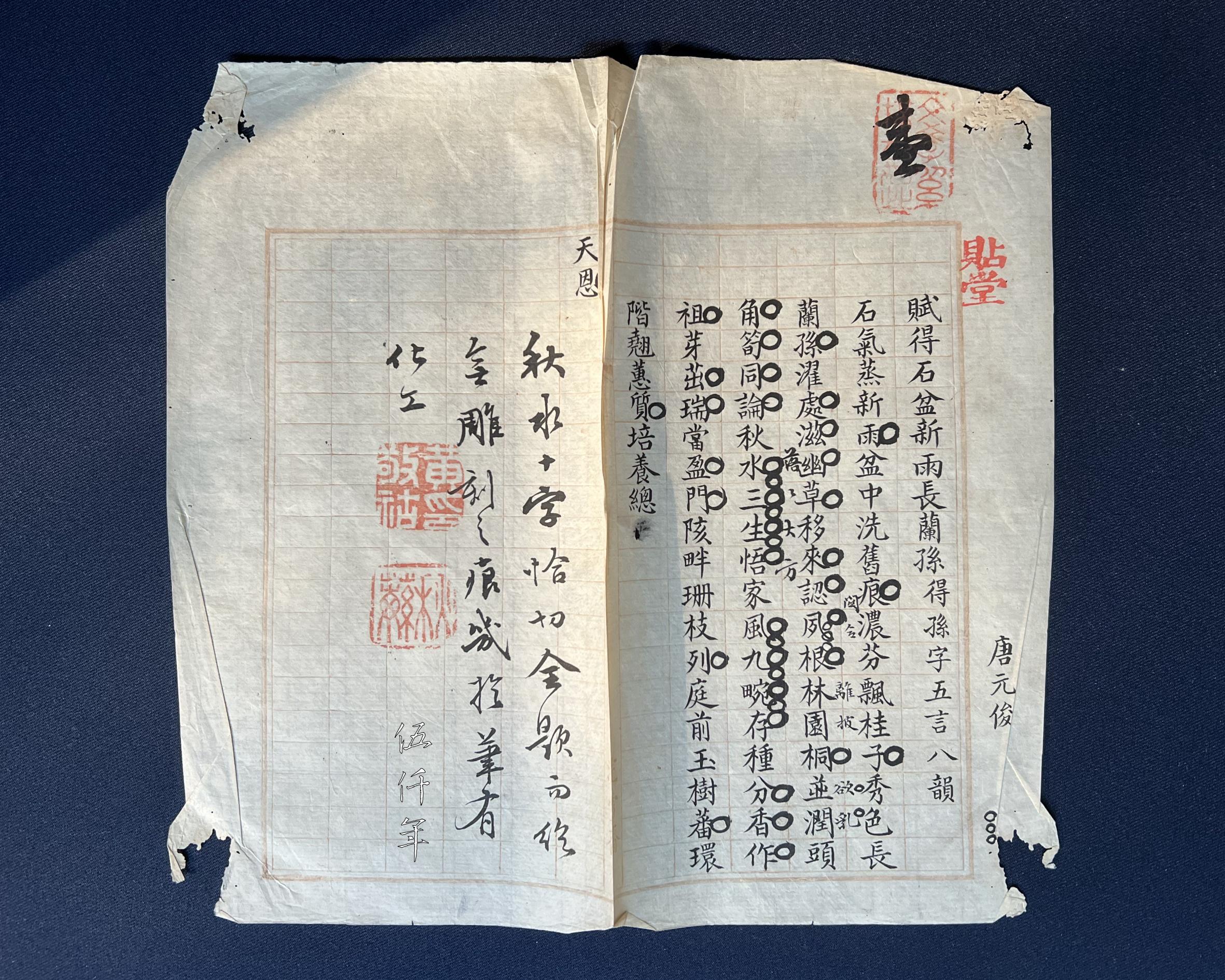
Schoolwork of T’ang Yüan-chün, with commentaries and colophon by Master Huang Ching-hu (黃敬祜)
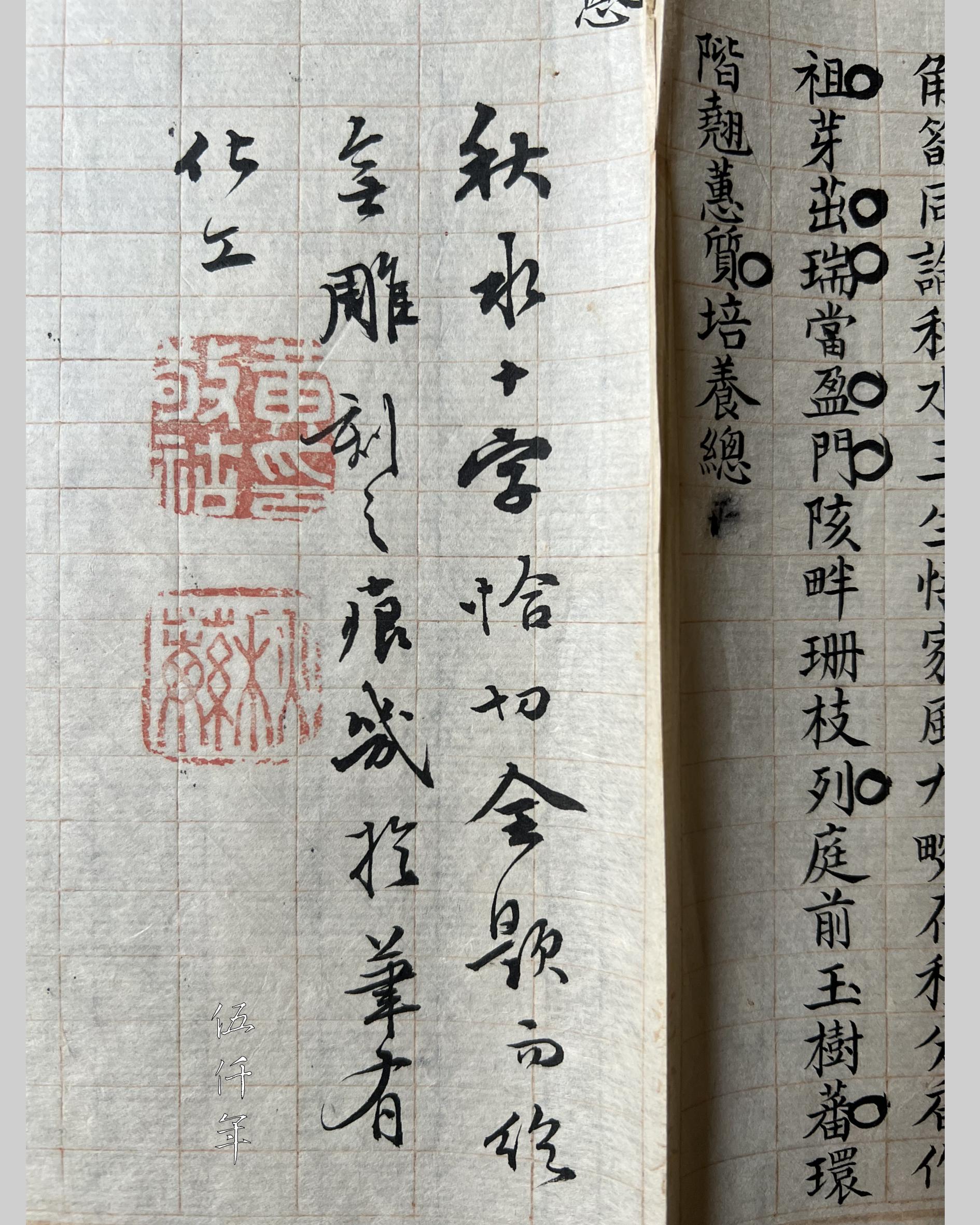
Detail of colophon by Master Huang Ching-hu (黃敬祜)
Master Huang Ching-hu wrote a colophon on another regulated five character eight rhyme poetry schoolwork by T’ang Yüan-chün titled A Response to a Sentence in a Poem by the Yüan Dynasty Poet Sa T’u-la (蕯都剌): After Fresh Rain, the Stone Basin Sprouts Fragrant Grass, Composed with a Selected Character. The words of the colophon are:
“The ten characters in the sentence of ‘autumn water’ perfectly encompass the entire theme, there is not the slightest trace of exertion, as if the brush is endowed with the transforming power of nature.”
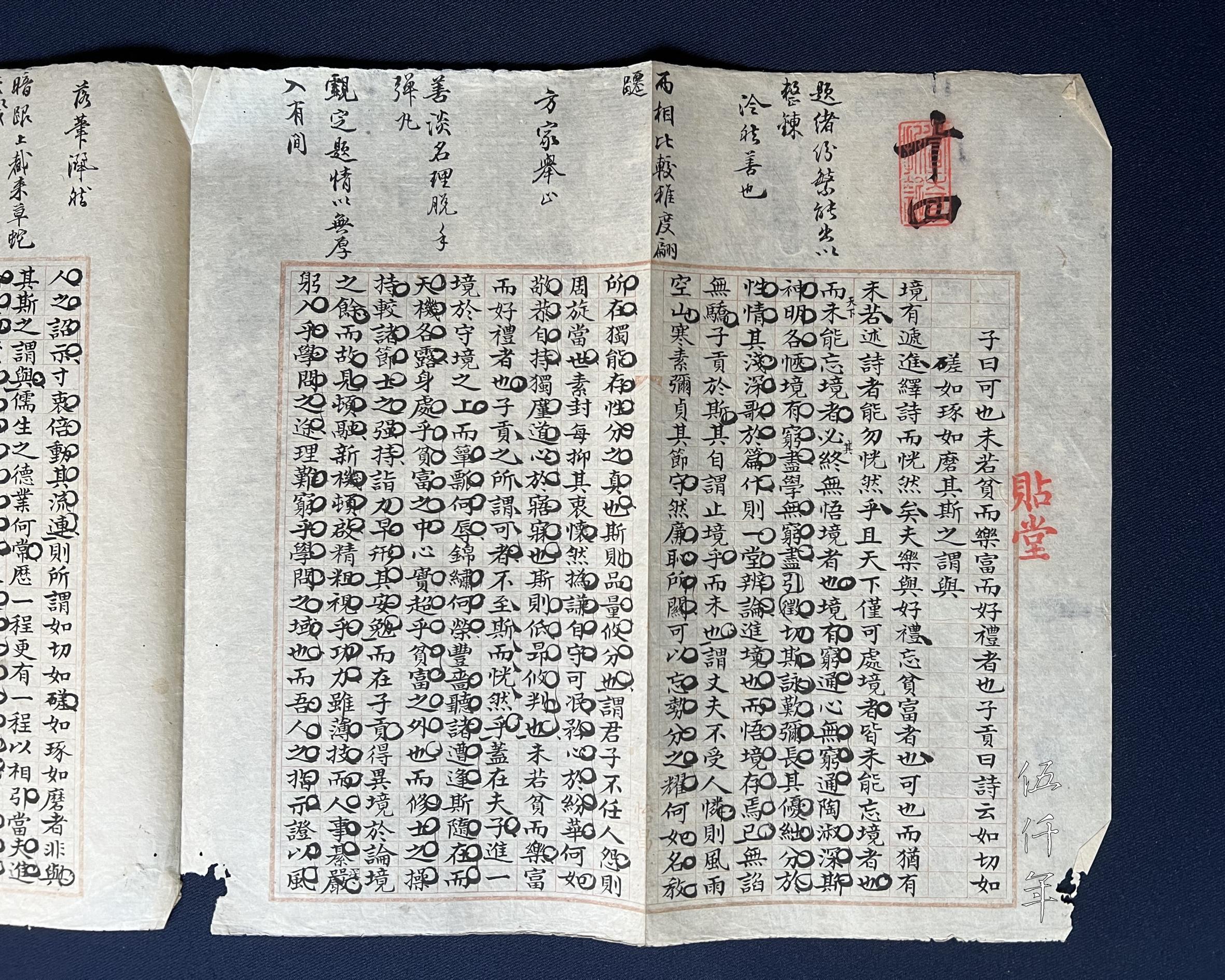
First page of schoolwork of T’ang Yüan-chün, with commentaries and colophon by Master Lü Hung (呂洪)
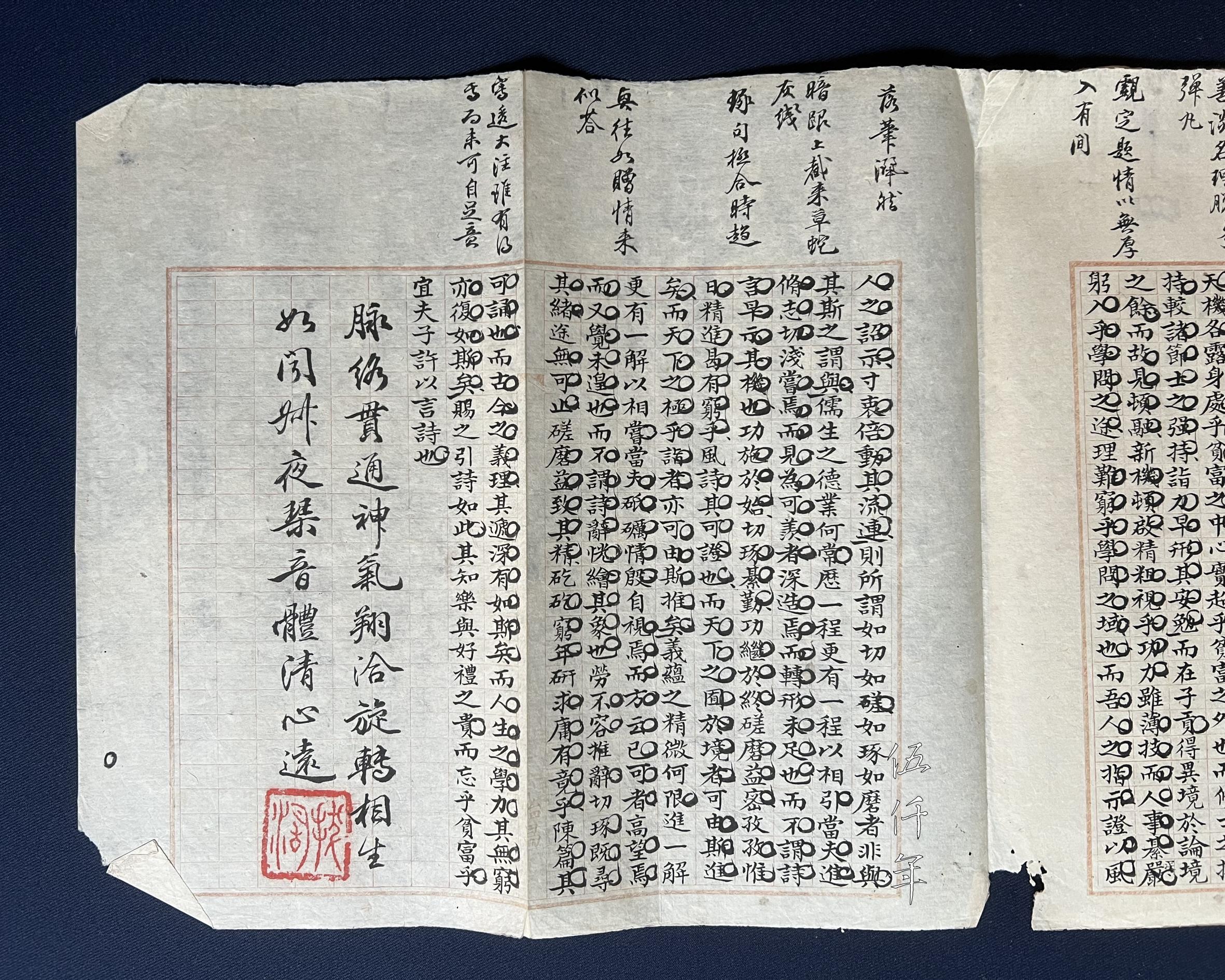
Second page of schoolwork of T’ang Yüan-chün, with commentaries and colophon by Master Lü Hung (呂洪)
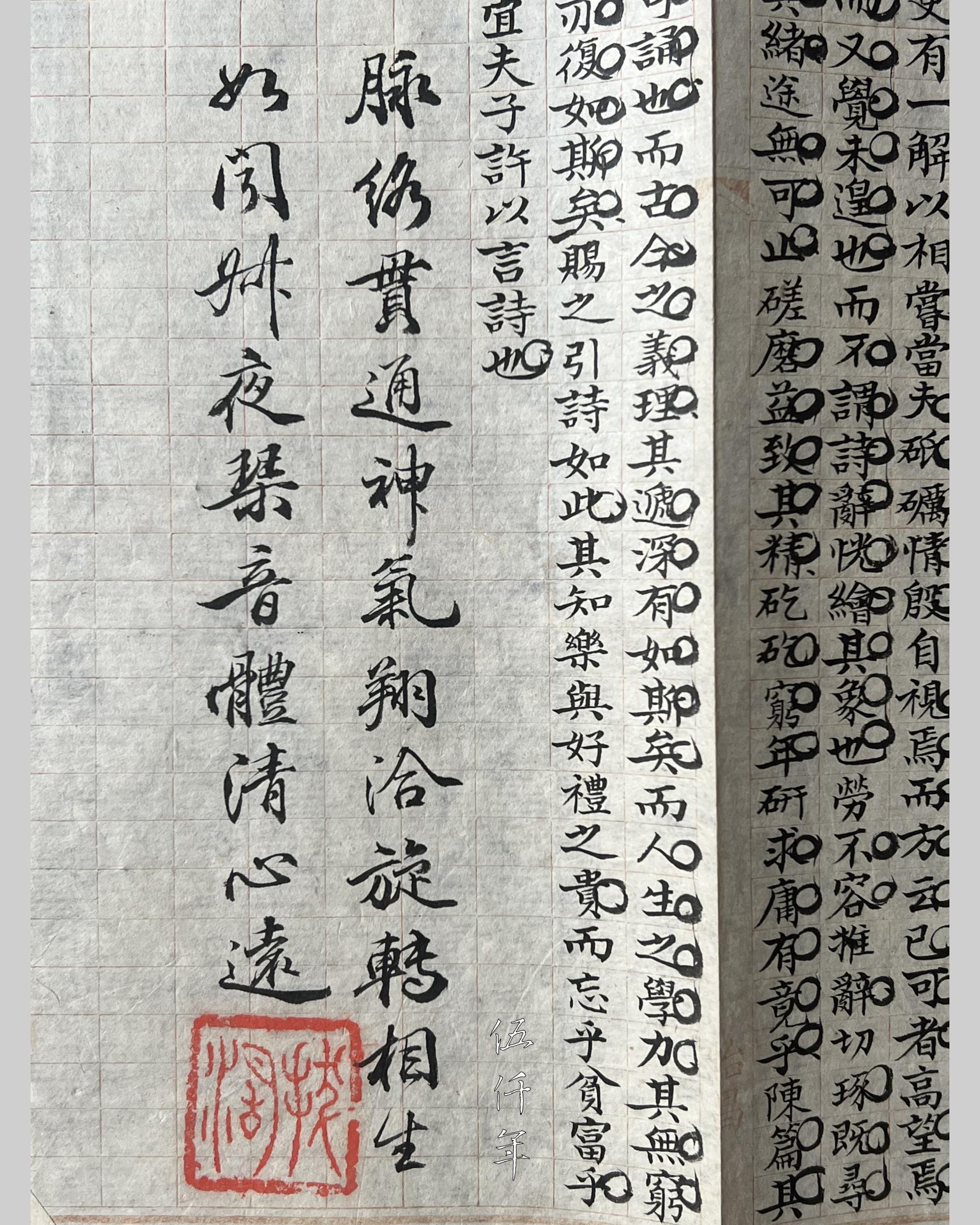
Detail of colophon by Master Lü Hung (呂洪)
Master Lü Hung wrote a colophon on an essay by T’ang Yüan-chün that interpreted some sentences from Book 1 Hsio R of the Analects: “The Master replied, ‘They will do; but they are not equal to him, who, though poor, is yet cheerful, and to him, who, though rich, loves the rules of propriety.’ Tsze-kung replied: ‘It is said in the Book of Poetry, As you cut and then file, as you carve and then polish’— The meaning is the same, I apprehend, as that which you have just expressed.” The words of the colophon are:
“The threads of thought run through seamlessly. Spirit and vitality flow in harmony, turn and unfold, rise and ebb. It is like listening to the zither music of Chi K’ang, the body is purified and the heart wanders to a distant world.”
Only three examples are cited here. As in tasting a single morsel from a cauldron, the overall excellence is easily discerned. The poetry and prose of T’ang Yüan-chün surely merit compilation and publication into a single volume, to grace the literary world and to be read by future generations. Furthermore, the commentaries and colophons by his teachers encapsulate the literary rules and standards, scholarships and rectitudes, perspectives and convictions of the twenty-eight chü-jen and chin-shih from Kwangtung province spanning the Tao-kuang to Kuang-hsü reigns.
The two hundred and ninety-three schoolworks, examination papers, manuscripts, and manuscript copies left by T’ang Yüan- chün, his brother T’ang Chi-ch’ang, and their fellow students constitute a teaching apparatus for the composition of poetry and prose, and a treasure trove for the study of Confucian learnings. Should one carefully examine the local gazetteers, collected writings, and memoirs from Kwangtung province in late Ch’ing period, it may yet be possible to uncover the names, native places, and examination degrees of the remaining thirty teachers. The exceptional proliferation of literary and scholarly pursuits in Kwangtung in those years can be vividly imagined.
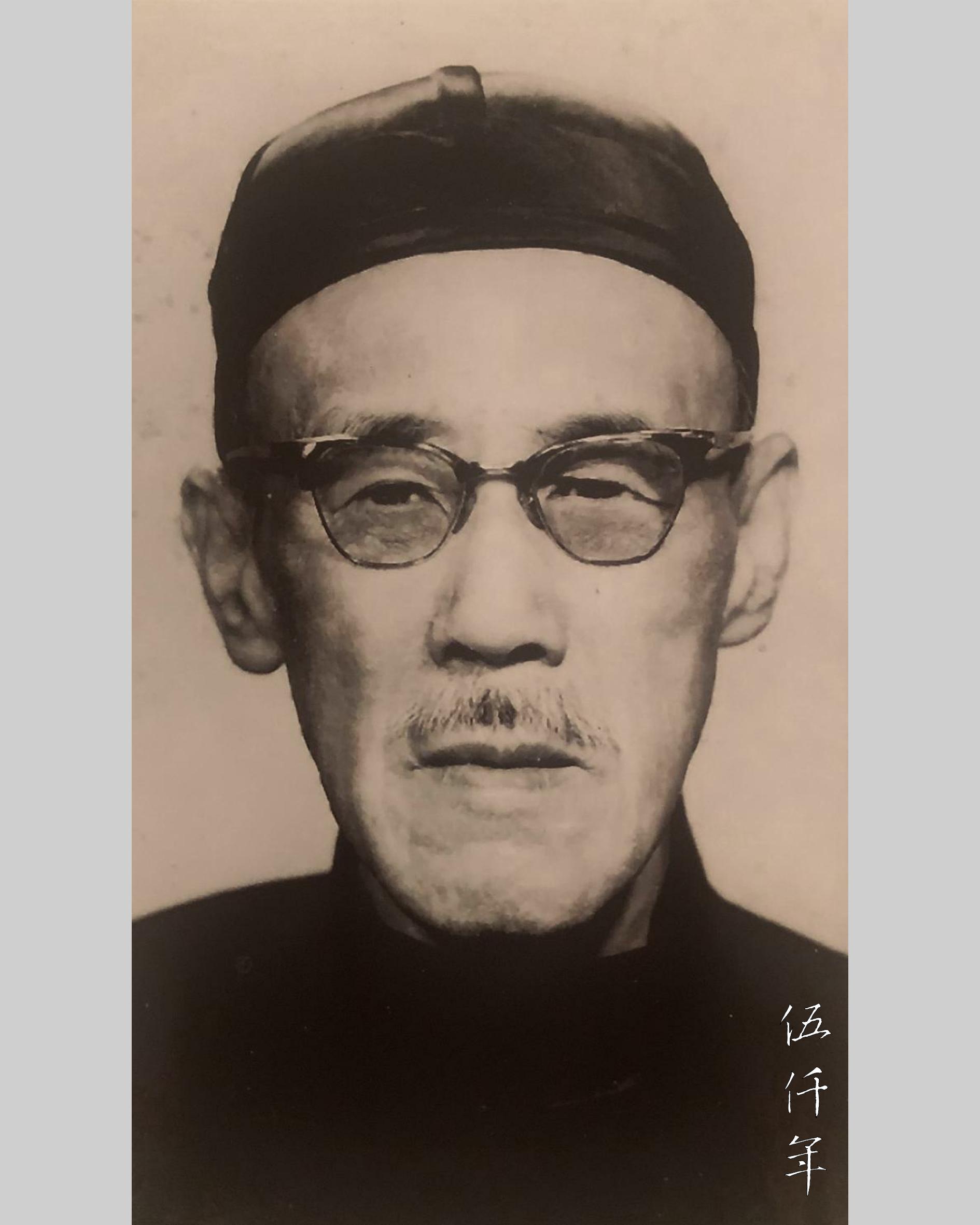
Portrait of Provincial Graduate T’ang En-p’u
T’ang En-p’u, the second son of T’ang Yüan-chün, original name Chao-p’u (兆溥), tzu Ch’i-chan (啟湛), T’ien-ju (天如), hao Lan-yin (嵐隱), and in later years he used the hao Yu-pai (友白), Yu-pai Lao-jen (友白老人), he was bestowed the Dharma name Hao-han (浩瀚) by the Red Swastika Society. His studio names included T’i-tung Kuan (題桐館) and T’eng-hsiang Shih (藤香室). He was a native of Hsin-hui, Kwangtung province.
He was born on 21st of the ninth month of the 7th year of the Kuang-hsü reign 1881, and passed away on 3rd February of the 50th year of the Republic of China 1961. His ancestral lineage had produced nine successive generations of degree-holders and officials. In the 24th year of the Kuang-hsü reign, wu-hsü (戊戌) year 1898, he attained the degree of hsiu-ts’ai (秀才). In the following year, he was placed first and fourth of First Class in the Classics Examination, gaining the recognition of Chang Pai-hsi (張百熙 1847-1907), provincial education commissioner of Kwangtung.
In the 29th year of the Kuang-hsü reign, kuei-mao (癸卯) year 1903, at the age of twenty-four, he attained the chü-jen degree, ranking tenth. Two years later, in the 31st year of the Kuang-hsü reign 1905, the Ch’ing court abolished the civil service examinations. In the following year, the 32nd year of the Kuang-hsü reign 1906, he was appointed tutor of Chinese Literature at the Kwangtung and Kwanghsi Higher Industrial Academy. In September of the 50th year of the Republic of China 1961, his lecture notes at the Kwangtung and Kwanghsi Higher Industrial Academy were compiled by his disciples and published under the title Wen-chang Hsüeh (文章學 Studies in Literary Composition). It is his only work in print.
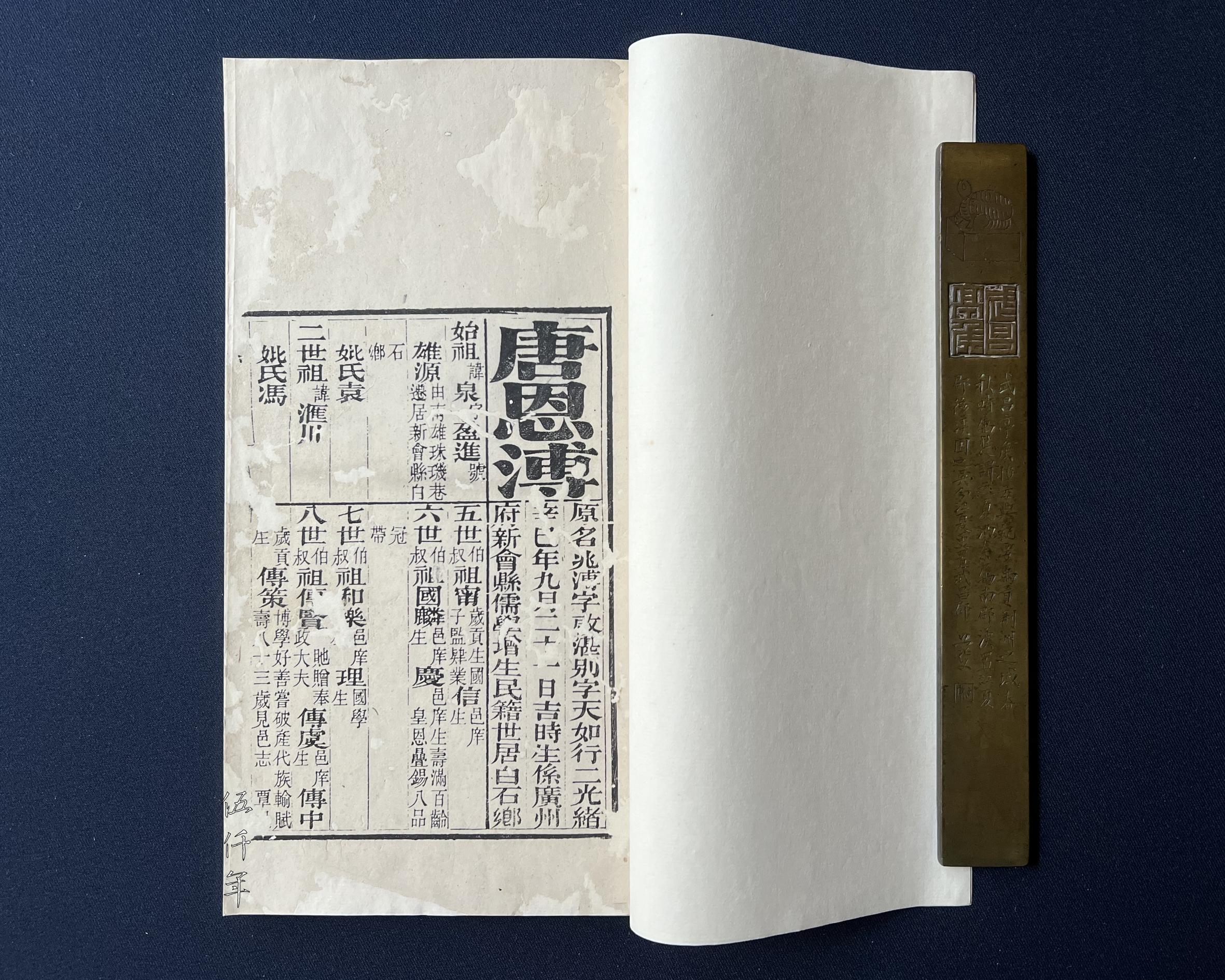
First page of Vermilion Printed Transcripts of Provincial Examination Papers by T’ang En-p’u (硃卷)
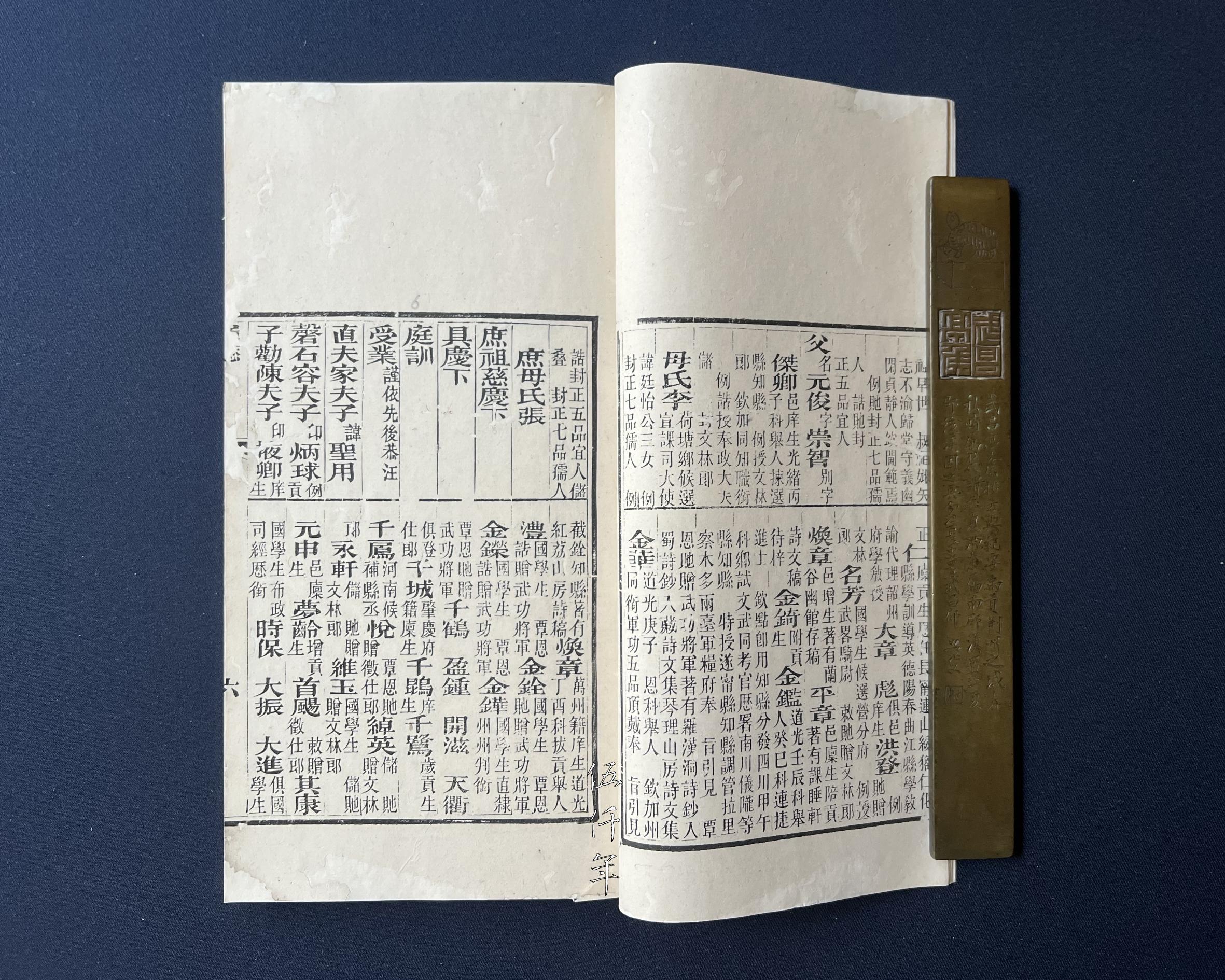
Second page of Vermilion Printed Transcripts of Provincial Examination Papers by T’ang En-p’u (硃卷)

Third page of Vermilion Printed Transcripts of Provincial Examination Papers by T’ang En-p’u (硃卷)
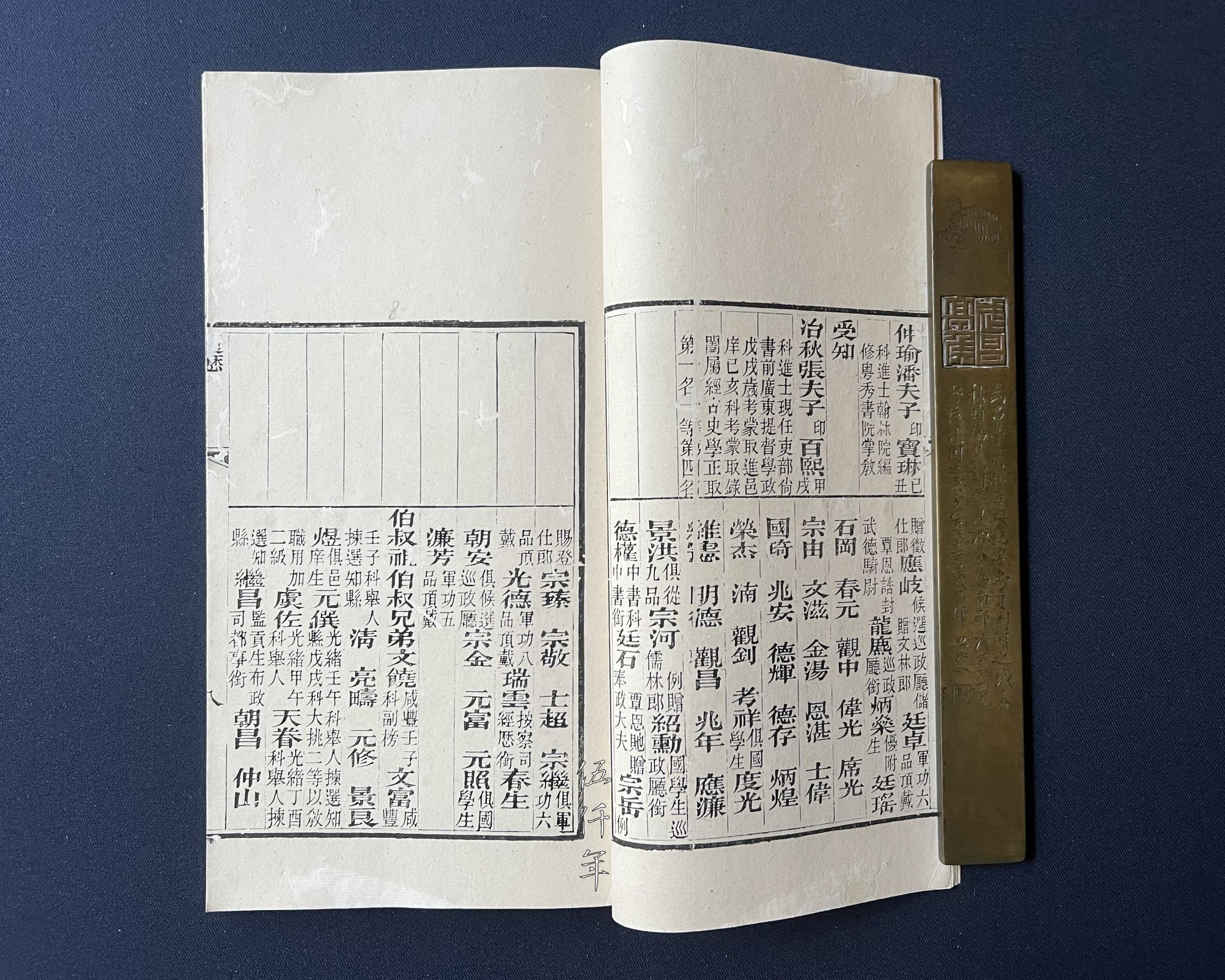
Fourth page of Vermilion Printed Transcripts of Provincial Examination Papers by T’ang En-p’u (硃卷)
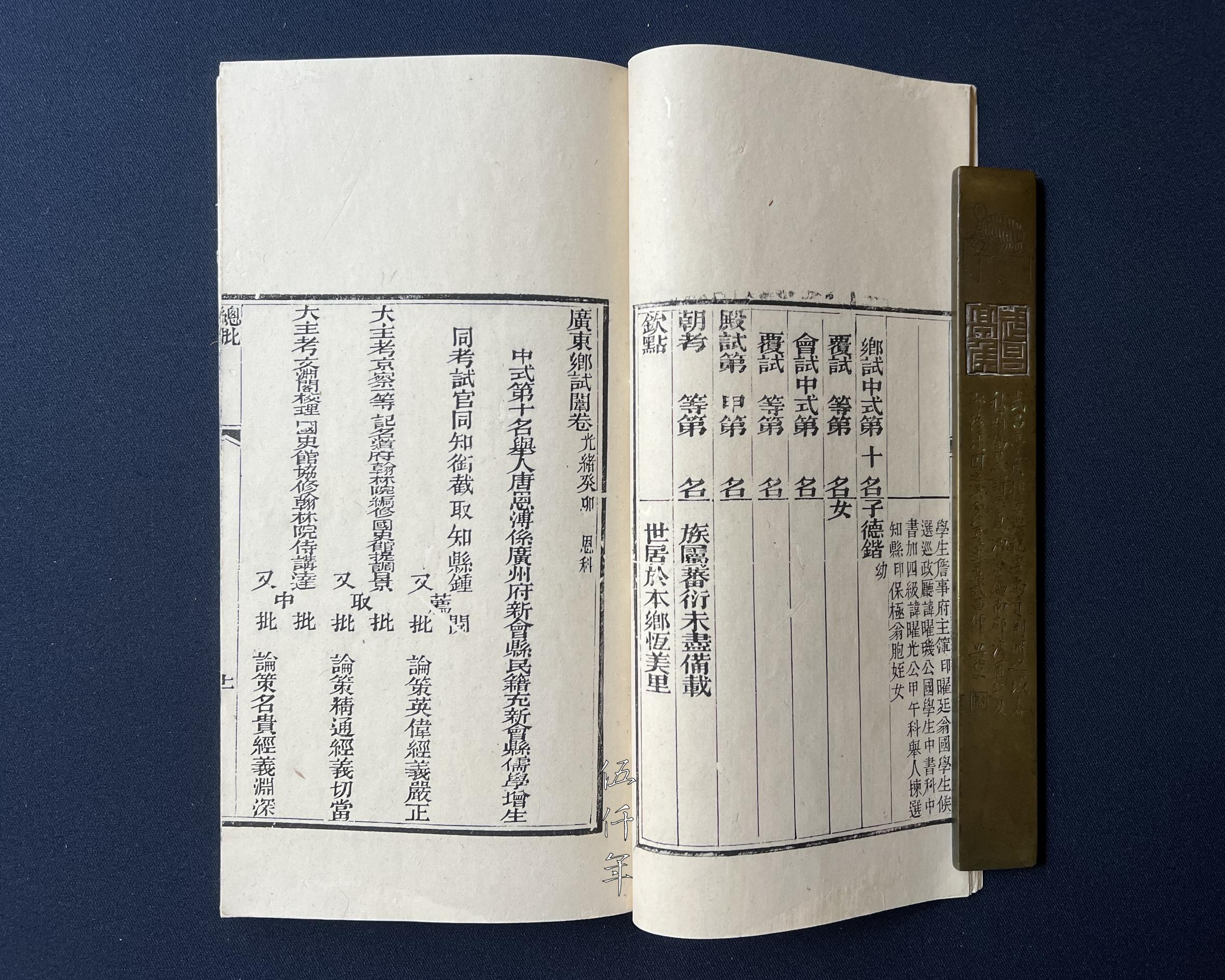
Fifth page of Vermilion Printed Transcripts of Provincial Examination Papers by T’ang En-p’u (硃卷)
In Vermilion Printed Transcripts of the Provincial Examination Papers by T’ang En-p’u (硃卷), the names of thirteen teachers were recorded:
1) Master T’ang Sheng-yung (唐聖用 tzu Chih-fu 直夫) whose familial relationship in the T’ang family is unclear.
2) Master Jung Ping-ch’iu (容炳球 tzu Ch’ing-shih 磬石) who attained the li-kung-sheng degree (例貢生 regular tribute student).
3) Master Ch’en Yeh-ch’ing (陳掖卿 tzu Tzu-chüan 子勸) who attained the hsiang-sheng degree (庠生 prefectural student).
4) Master T’ang Yü-tso (唐虞佐 tzu Ch’in-shih 琴石), a paternal grand-uncle, who attained the chü-jen degree in the 20th year of the Kuang-hsü reign 1894.
5) Master T’ang Yü-chen (唐毓真 tzu Pao-ch’u 葆初), a paternal grand-uncle, who attained the fu-kung-sheng degree (附貢生 supplementary tribute student).
6) Master Jung Chün-tsao (容濬藻 tzu Chüeh-min 覺民) who attained the hsiang-sheng degree (庠生).
7) Master Lo T’ien-lo (羅天洛 tzu Tan-yün澹雲) who attained the kuo-hsüeh-sheng (國學生 national university student) degree.
8) Master Feng Hsi-yu (馮熙猷 tzu Po-chi 伯緝), native of Fo-shan, Kwangtung province. He taught at Ho-shan and attained the chü-jen degree in the 29th year of the Kuang-hsü reign 1903, the same year as that of his student T’ang En-p’u. Such rare occurrence was customarily celebrated.
9) Master Lo Ch’uan-jui (羅傳瑞 tzu Hsi-lin 樨林), also known as Lo Hsi-lin (羅西林), native of Nan-hai, Kwangtung province. He was noted for his exemplary filial piety. He attained the chin-shih degree in the 16th year of the Kuang-hsü reign 1889, and served as secretary of the Ministry of War, served in the Bureau of Operations, and head teacher at Fo-shan Academy (佛山書院). He was a student of Master Chu Tz’u-ch’i, and compiled Chung-wai Ta-lüeh (中外大略 General Survey of China and Foreign Lands) in forty-eight volumes.
10) Master Fang Ching-o (方菁莪 tzu Mo-ku 默谷), native of Nan-hai, Kwangtung province. He was a friend of T’ang Yüan-chün. He attained the chü-jen degree in the 2nd year of the Kuang-hsü reign 1876, and served as instructor at the Confucian School in Ting-an County. He was accomplished in calligraphy and painting, and taught at Wan-mu Ts’ao-t’ang (萬木草堂) and compiled the Nan-hai Tan-kuei Fang-p’u (南海丹桂方譜 Genealogical Chronicle of the Fang Family from Tan-kuei of Nan-hai)
11) Master Lü Chien-hsi (呂鑑熙 tzu Chi-ch’en 緝臣), native of Ho-shan, Kwangtung province. He attained the chü-jen degree in the 6th year of the Kuang-hsü reign 1880, ranking Second Class in the Grand Selection. He served as magistrate of Hsiu-jen and Kuei Counties in Kwangsi province, later as prefect, and as circuit intendant of Nan-ning Circuit. He taught at Wan-mu Ts’ao-t’ang (萬木草堂) and served as head teacher at Fo-shan Academy.
12) Master Wu Lan-ch’eng (伍蘭成 tzu Chi-yü 季譽), native of Nan-hai, Kwangtung province. He attained the chü-jen degree in the 6th year of the Kuang-hsü reign (1880), ranking Second Class in the Grand Selection, and served as head teacher at Fo-shan Academy.
13) Master P’an Pao-lin (潘寶琳 tzu Chung-yü 仲瑜), native of P’an-yü, Kwangtung. He attained the chin-shih degree in the 15th year of the Kuang-hsü reign (1889) and served as junior compiler in the Hanlin Academy. He was head teacher at Yüeh-hsiu Academy (粵秀書院).
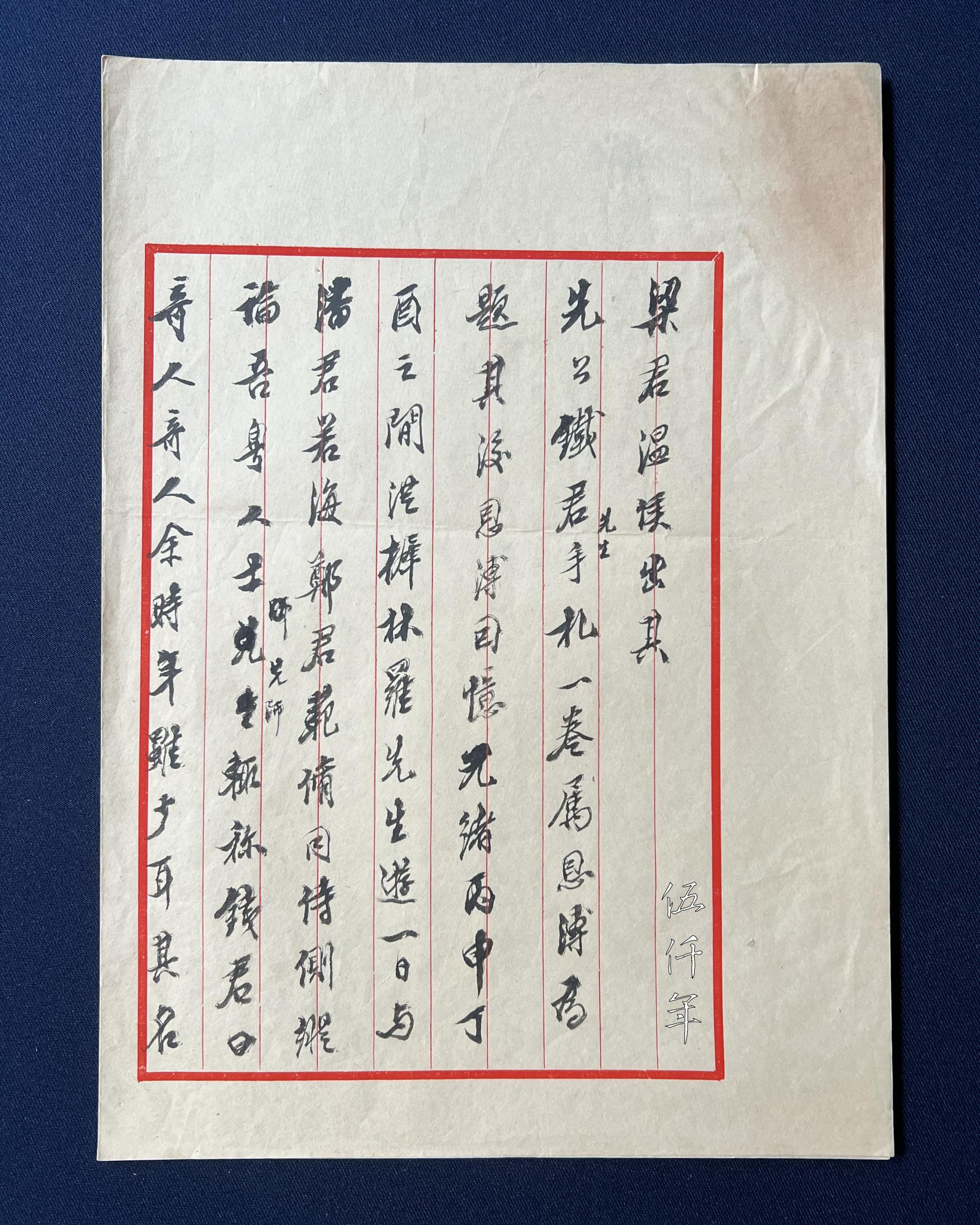
Colophon for Letters by Mr. Liang T’ieh-chün (梁鐵君)
In the summer of chia-wu (甲午) year 1954, T’ang En-p’u inscribed a handscroll titled Letters by Liang T’ieh-chün (梁鐵君), he mentioned Master Lo Ch’uan-jui in these words: “I recall studying under Master Lo Ch’uan-jui between ping-shen (丙申) year and ting-yu (丁酉) year of the Kuang-hsü reign …” From this we know when T’ang En-p’u was sixteen to seventeen years old, between 1896 to 1897, he studied under Master Lo Ch’uan-jui. Master Lo was a student of Chu Tz’u-ch’i, accordingly, T’ang En-p’u was a second-generation student of Chu. Moreover his father T’ang Yüan-chün was also a student of Chu Tz’u-ch’i, their connections were deep and genuine.
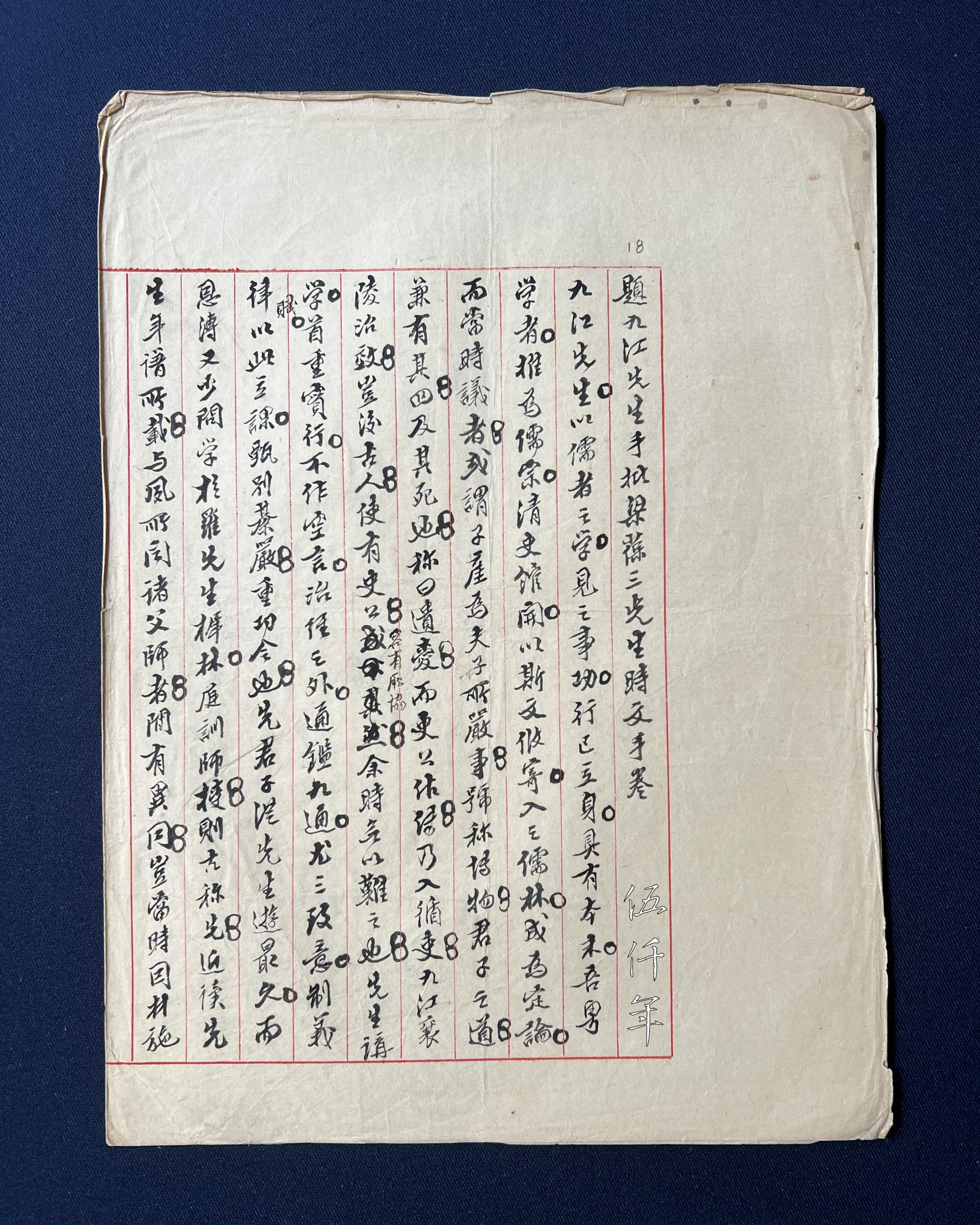
First page of Colophon for Handscroll of Examination Essays by Liang Pao-san (梁葆三) with Commentaries by Mr. Chu Tz’u-ch’i (朱次琦)
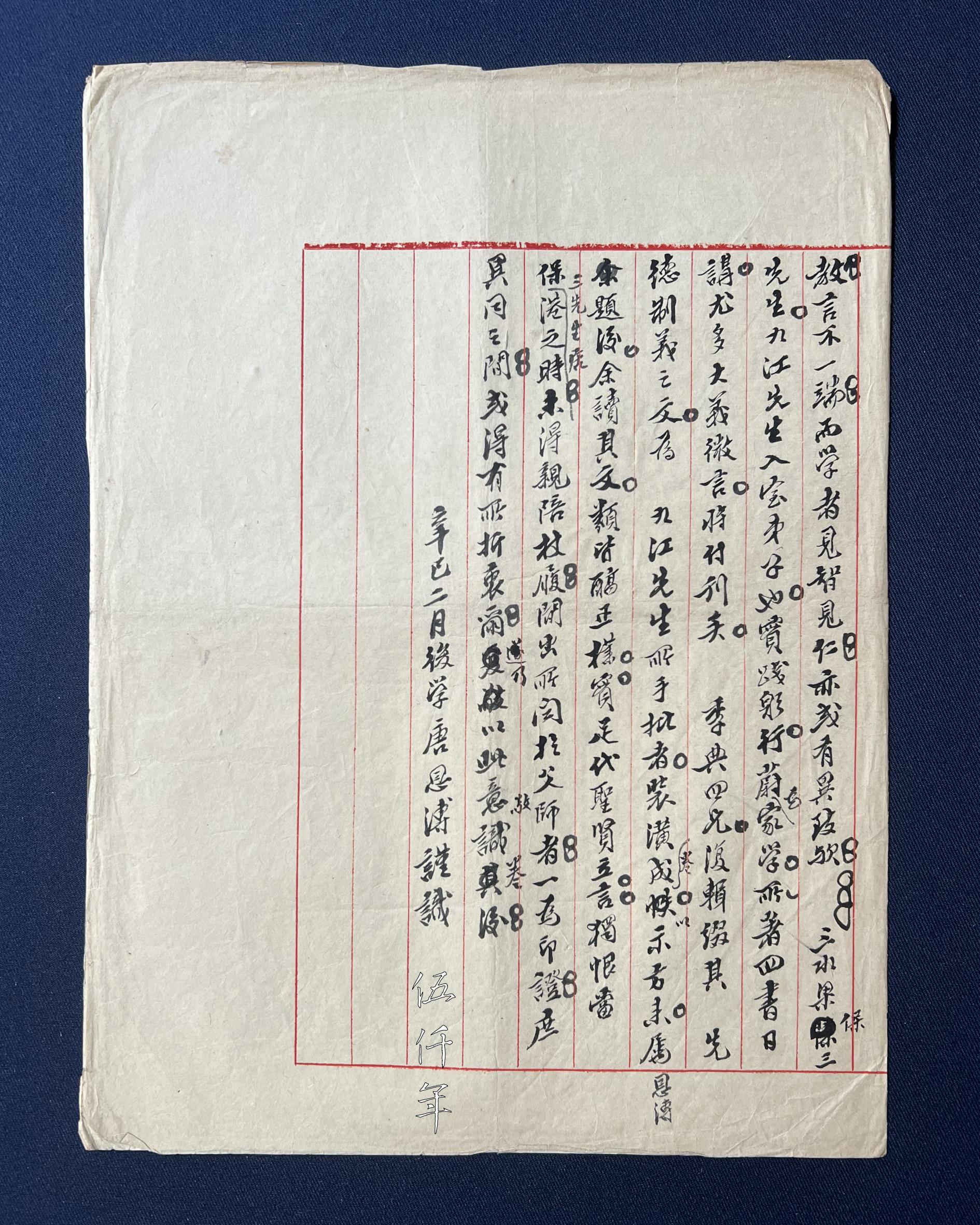
Second page of Colophon for Handscroll of Examination Essays by Liang Pao-san (梁葆三) with Commentaries by Mr. Chu Tz’u-ch’i (朱次琦)
In the second month of hsin-ssu (辛巳) year 1941, T’ang En-p’u inscribed a handscroll titled Examination Essays by Mr. Liang Pao-san (梁葆三) with Commentaries by Mr. Chu Tz’u-ch’i (朱次琦). Some of his words are:
“Mr. Chu Tz’u-ch’i applied his Confucian knowledge to accomplish great deeds. His personal conduct and moral bearing adhered to his Confucian convictions from beginning to end. Scholars in Kwangtung revered him as the patriarch of Confucian learning … My late father studied under him for the longest time, and in my youth I sought instruction from Master Lo Ch’uan-jui. Teachings from my family and my tutor enable me to follow and praise the ancient sages.”
Indeed the father and the tutor both followed the teachings of Chu Tz’u-ch’i.
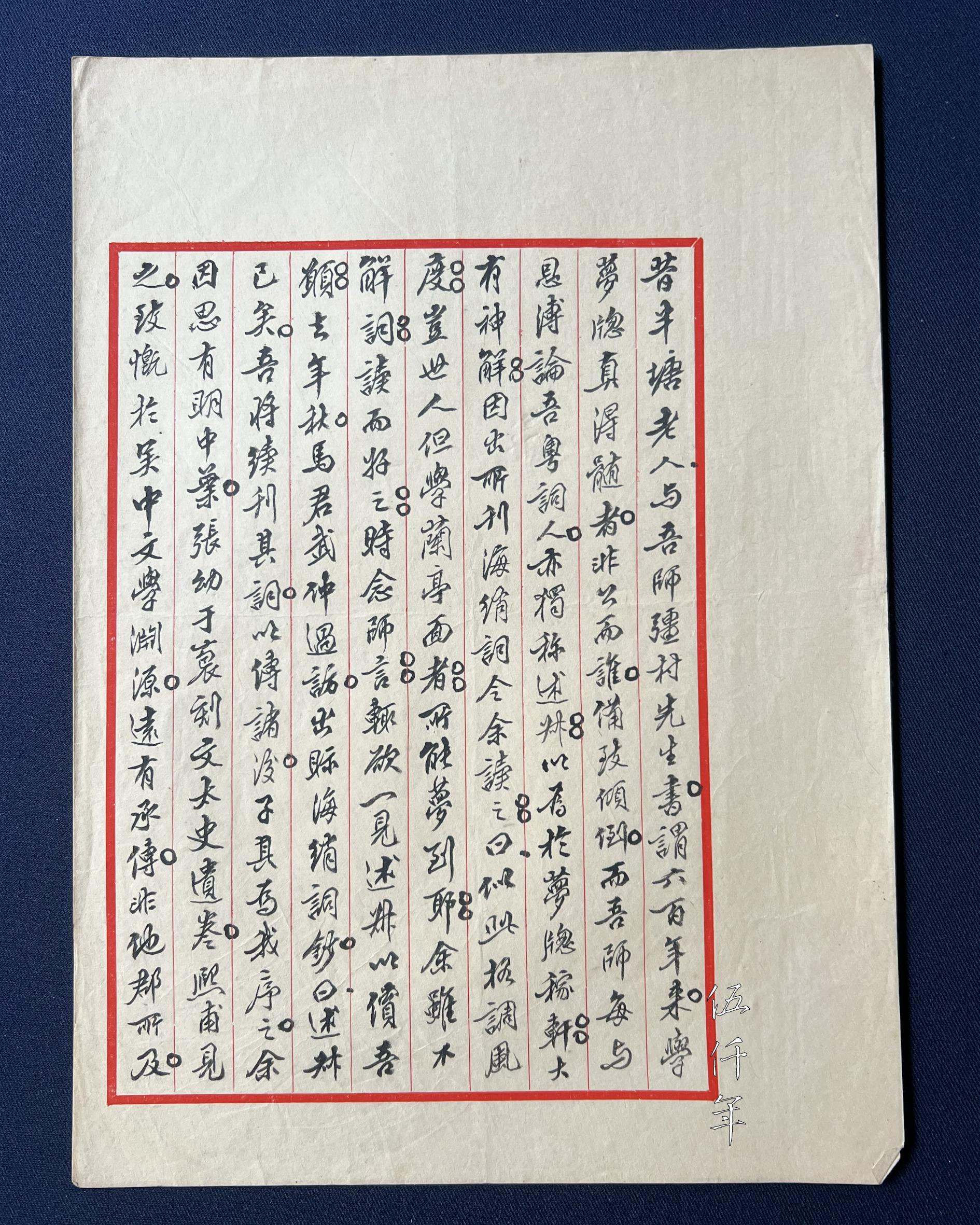
First page of Foreword to The Tz’u Lyrics of Hai-hsiao (海綃詞鈔)
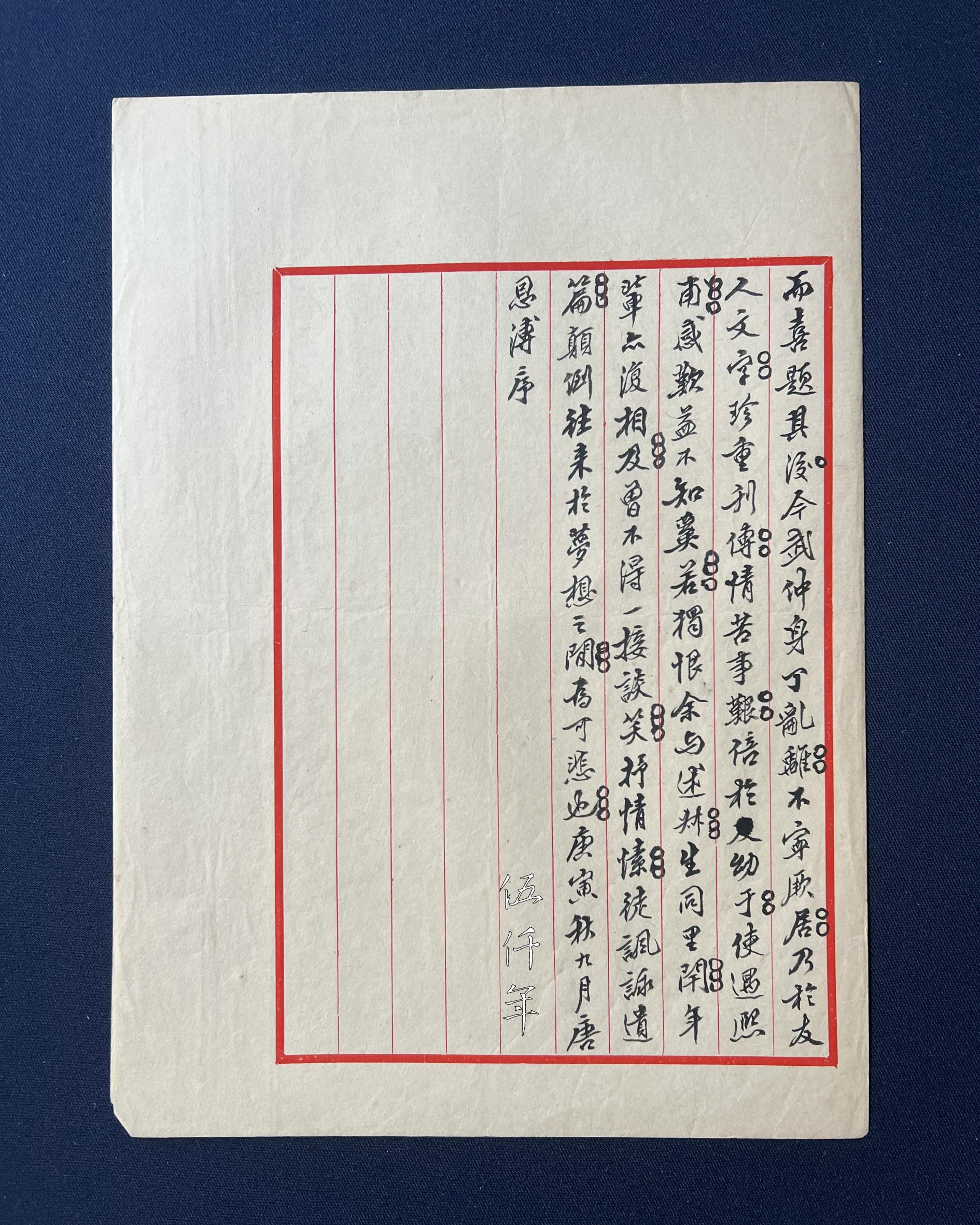
Second page of Foreword to The Tz’u Lyrics of Hai-hsiao (海綃詞鈔)
In autumn of keng-yin (庚寅) year 1950, T’ang En-p’u wrote a foreword for the new edition of The Tz’u Lyrics of Hai-hsiao (海綃詞鈔) by Chen Hsün (陳洵 1871-1942). Some of his words are:
“At one time, the Elder Wang P’eng-yün (王鵬運 1840-1904) wrote to my teacher Master Chu Tsu-mou (朱祖謀 1857-1931), saying that in the past six hundred years, the only one who emulated and truly grasped the essence of the tz’u lyric of Wu Wen-ying (吳文英 1200-1260) of the Sung dynasty, would be none other than Tsu-mou himself. The Elder Wang expressed his utmost admiration. At the same time, whenever my teacher talked to me about the tz’u poets from Kwangtung, he would single out Ch’en Hsün alone, conveying that his understanding of Wu Wen-ying and Hsin Ch’i-i (辛棄疾 1140-1207) was of a spiritual nature.”
In the 29th year of the Kwang-hsü reign, kuei-mao (癸卯) year 1903, T’ang En-p’u attained the chü-jen degree from the Kwangtung Provincial Examination. According to The Veritable Records of Emperor Te-tsung Ching (德宗景皇帝實錄), between the 28th to the 31st year of the Kwang-hsü reign, Chu Tsu-mou served as provincial education commissioner of Kwangtung province. In kuei-mao year 1903, Chu Tsu-mou supervised the examination, therefore T’ang En-p’u respectfully addressed him as “my teacher.” It may be surmised that when T’ang En-p’u later resided in Shanghai, he also frequently sought his instruction and counsel.
The extant writings by T’ang En-p’u are few. A single word, a fragment of paper, is as precious as pearl. The following items are what remain:
1. Handwritten Examination Transcripts (墨卷).
2. Vermilion Printed Examination Transcripts (硃卷).
3. Lecture Notes (講義): a handwritten examination question, a copy of Wen-chang Hsüeh (文章學).
4. Forewords (序): six pieces of writings.
5. Colophons (題跋): nineteen pieces of writings.
6. Letter to Friend (書信): one item.
7. Birthday Felicitations (壽序): two pieces of writings.
8. Accounts (記): three pieces of writings.
9. Epitaphs (墓誌銘): two pieces of writings.
10. Stele Inscription (碑碣): one piece of writing.
11. Biographical Essay (傳): one piece of writing.
12. Eulogies (頌贊): three pieces of writings.
13. Sacrificial Texts (祭文): two pieces of writings.
14. Poems and Tz’u Lyrics (詩詞): four pieces of writings.
15. Buddhist and Taoist Works (釋道詩文): ten sheets of poems and writings, a hanging scroll of Buddhist text, a horizontal scroll from members of the Red Swastika Society.
16. Advertisement (廣告): one sheet.
17. Ghostwritten Works for Others (代筆文章): eight pieces of writings.
18. Revisions to Works by Others (刪改文章): seven pieces of writings.
A Catalogue of the Extant Writings by T’ang En-p’u is as follows:
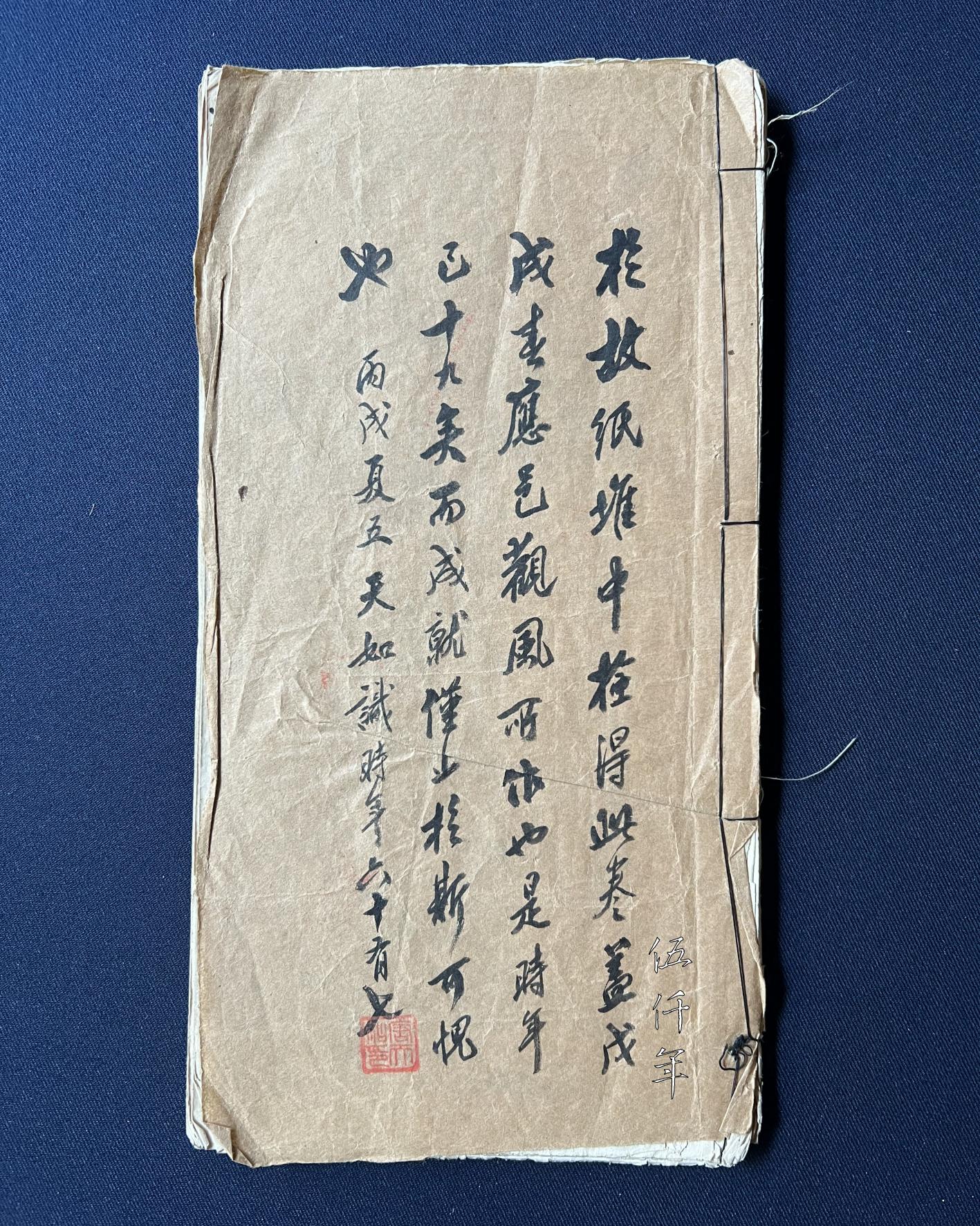
Front cover of Handwritten Transcripts of the Prefectural Examination Papers by T’ang En-p’u (墨卷)
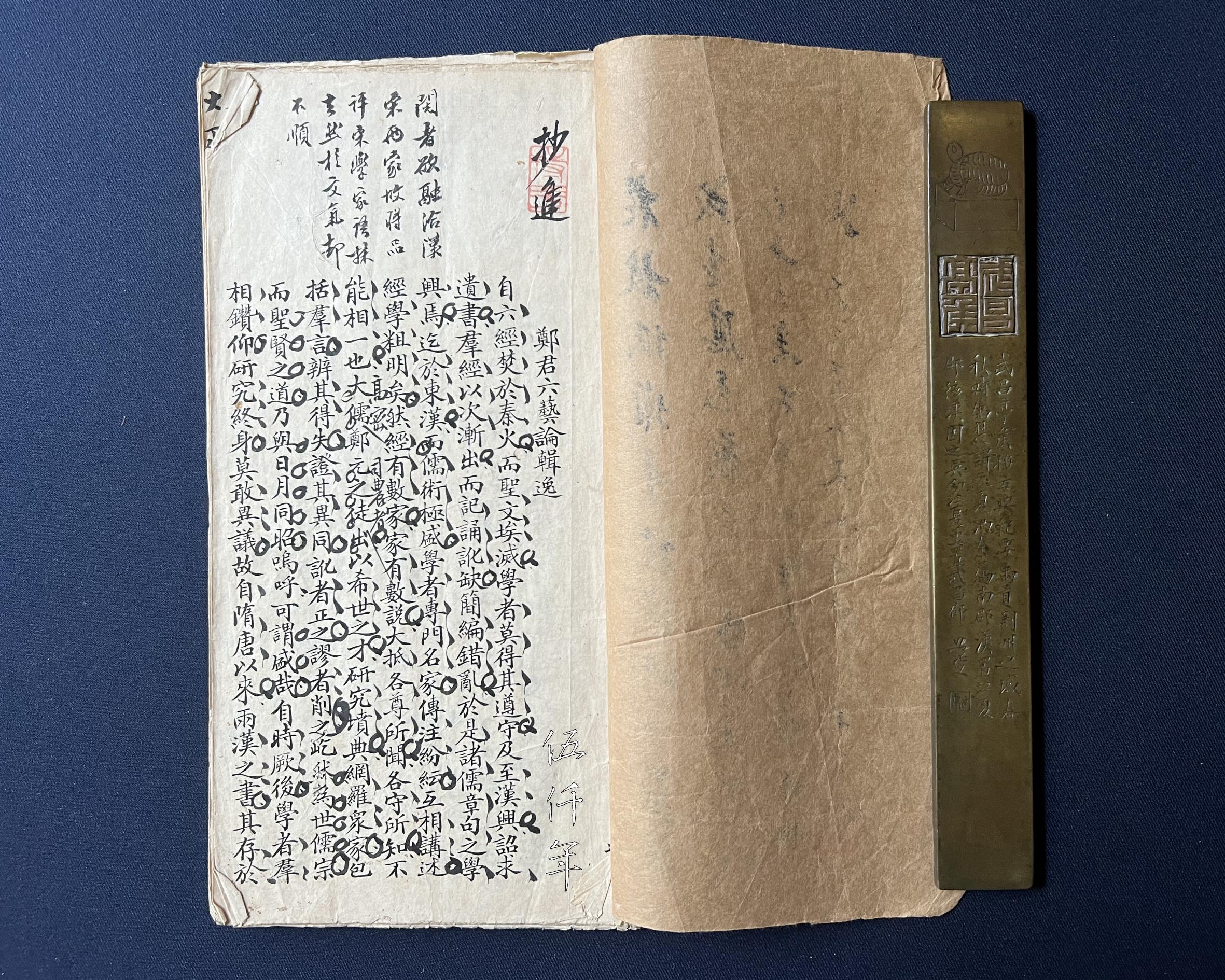
First page of Handwritten Transcripts of the Prefectural Examination Papers by T’ang En-p’u (墨卷)

Second page of Handwritten Transcripts of the Prefectural Examination Papers by T’ang En-p’u (墨卷)

Detail of front cover of Handwritten Transcripts of the Prefectural Examination Papers by T’ang En-p’u (墨卷)
1. Handwritten Examination Transcripts (墨卷)
Handwritten Transcripts of the Prefectural Examination Papers by T’ang En-p’u, written in the 24th year of the Kwang-hsü reign, wu-hsü (戊戌) year 1898. He was nineteen years old when he took the Kuan-feng (觀風) Examination in Hsin-hui.
1-1) Compilation of Lost Commentaries on the Treatise of Six Arts (六藝論) by Cheng Hsüan (鄭玄 127-200).
1-2) An Explanatory Study of the Chuan-chu (轉注) Category in Shuo-wen Chieh-tzu (說文解字).
1-3) An Exposition of the General Histories of Liao, Chin and Yüan Dynasties.
1-4) Discourse on the Scholarship of Mr. Ch’en Pai-sha (陳白沙 1428-1500) Part I.
1-5) Discourse on the Scholarship of Mr. Ch’en Pai-sha (陳白沙 1428-1500) Part II.
1-6) On Visiting Hua-shou Terrace (華首臺) and Ho-chang Cliff (合掌巖).
1-7) On Visiting Pa-kua Cliff (八卦巖 Eight Trigrams Cliff ).
1-8) On Visiting Cho-hsi Spring (卓錫泉).
1-9) On Visiting Pai-ho Abbey (白鶴觀White Crane Abbey) and Wu-lung Pool (五龍潭 Five Dragon Pool).
1-10) On Visiting the Landscapes Adjacent to Ch’ung-hsü Abbey (沖虛觀).
1-11) On Visiting the Landscapes from Chiu-t’ien Abbey (九天觀 Nine Heavens Abbey) to Su-lao Abbey (酥醪觀).
1-12) On Visiting Yao-shih Terrace (瑤石臺).
1-13) On Ascending the Summit of Fei-yün Peak (飛雲頂).
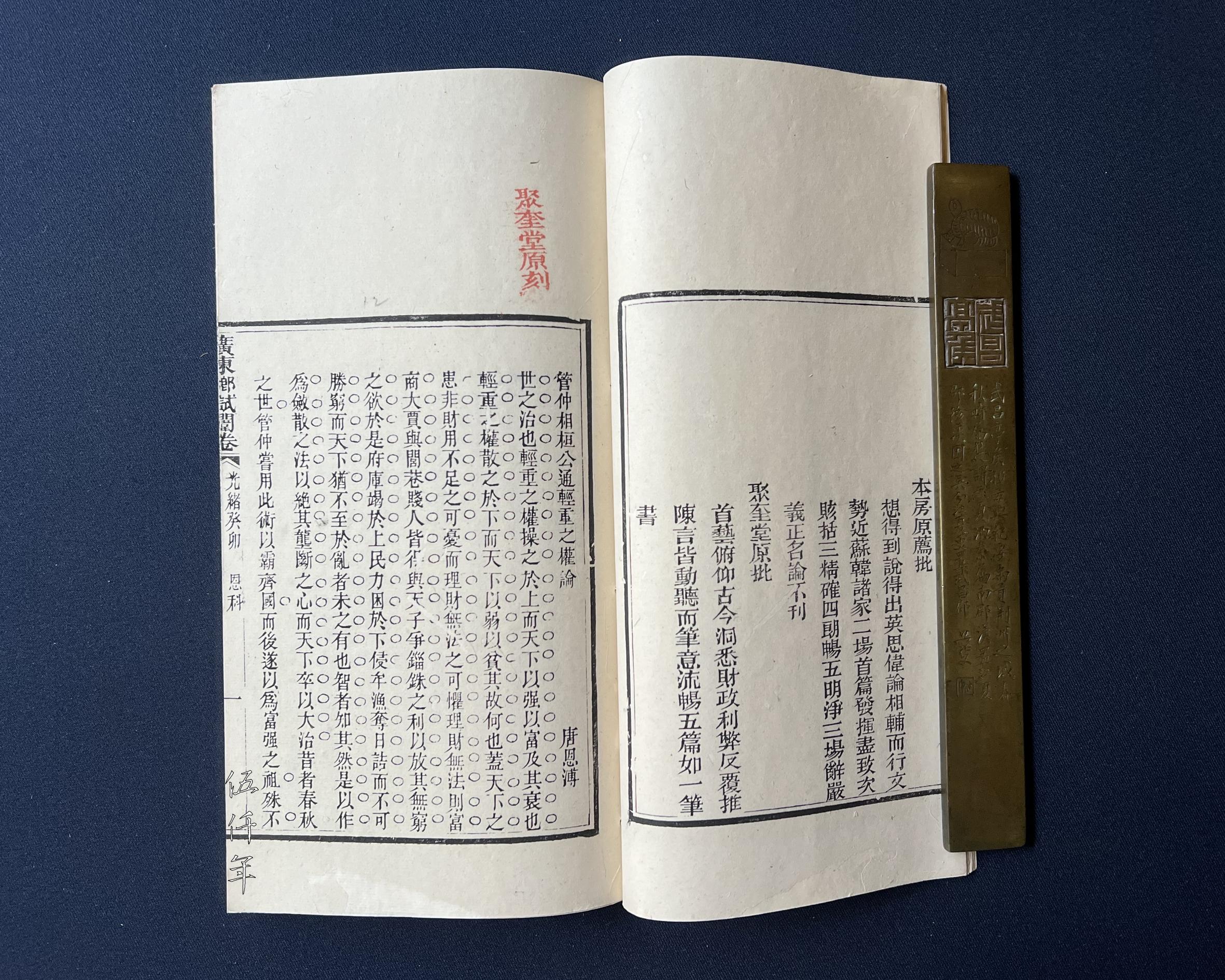
Sixth page of Vermilion Printed Transcripts of the Provincial Examination Papers by T’ang En-p’u (硃卷)

Seventh page of Vermilion Printed Transcripts of the Provincial Examination Papers by T’ang En-p’u (硃卷)
2. Vermilion Printed Examination Transcripts (硃卷)
Vermilion Printed Transcripts of the Provincial Examination Papers by T’ang En-p’u. He attained the chü-jen degree in the 29th year of the Kuang-hsü reign, kuei-mao (癸卯) year 1903, at the special imperial favour provincial examination. He was ranked tenth among the successful chü-jen candidates and aged twenty-four. The essays he wrote for the examination are:
2-1) Discuss: Kwan Chung (管仲 725 BC-645 BC) Acted As Prime Minister to the Duke Hwan (桓公 died in 643 BC) and the Mastery of Economic Levers.
2-2) Discuss: Warrior Employs Martial Force to Transgress the Law.
2-3) Discuss: Chang Shuo (張說 667-730) Submitted a Memorial to Disband More Than Two Hundred Thousand Border Troops to Return to Farming.
2-4) Discuss: Su Shih (蘇軾 1037-1101), Lü Hsi-che (呂希哲 1039-1116) and Others Petitioning to Revise the Memorial to the Throne by Lu Chih (陸贄 754-805).
2-5) Discuss: When Hsü Heng (許衡1209-1281) was Chancellor of the Directorate of Education, Students Honoured Him and Were Devoted to Learning, Even Children Understood the Three Bonds of Ruler and Subject, Father and Son, Husband and Wife, as well as the Five Constant Virtues of Compassion, Righteousness, Propriety, Wisdom and Trust as the Way of Human Life.
2-6) Advice: Western Countries Circulate Pound, Shilling and Pence, Exchangeable with French Franc and Centime, Each with Own Values. As China Considers the Adoption of Gold Coins, Silver Yüan, and Copper Yüan, Exchange Rates Should Be Set Carefully to Facilitate Payments and Benefit State Planning.
2-7) Advice: Great Benefits to the World are Derived From Agriculture, Industry, and Commerce. How Can China, Vast in Territory and Rich in Resources, Adopt Western Agricultural Science According to Local Conditions, Expand Cultivation, and Fully Utilize the Productive Capacity of the Land?
2-8) Advice: To Help Livelihood of the Poor, Factories of the Arts and Crafts Bureau are Brimming with Foreign Goods. But Profit has been Marginal. County Taxes Are Used to Maintain Charities for Orphans and the Poor, Accomplishing Many Good Deeds. If Funds Are Reallocated to Support Such Enterprises, Both Education and Nurture can be Realized. What Better Ways Are There To Raise Funds and to Promote this?
2-9) Advice: Since Extraterritorial Jurisdiction has been Exercised at the Treaty Ports, Disputes between Chinese and Foreigners Rarely Achieve Fairness. It Is Advisable to Consult and Apply Both Chinese and Western Law, to Establish Mutually Satisfactory and Applicable Codes, to Facilitate Negotiations and Avoid Unrestrained Protection.
2-10) Advice: Kwangtung is a Strategic Coastal Province, Guarding the Entry and Building Batteries are the Natural Priorities of Defence. If Warships are Deployed to Control the Southern Seas, Sea Routes of Enemy Warships Can Be Cut Off, Fukien and Shanghai will be Shielded. What are the Important Issues of Meticulous Planning?
2-11) Explain: Haste Leads to Failure, the Pursuit of Small Gains Prevents the Accomplishment of Great Affairs.
2-12) Explain: When the Track is Upright, Citizens Flourish in Righteousness.
2-13) Explain: To Advance and to Implement is Called the Eternal Principle.
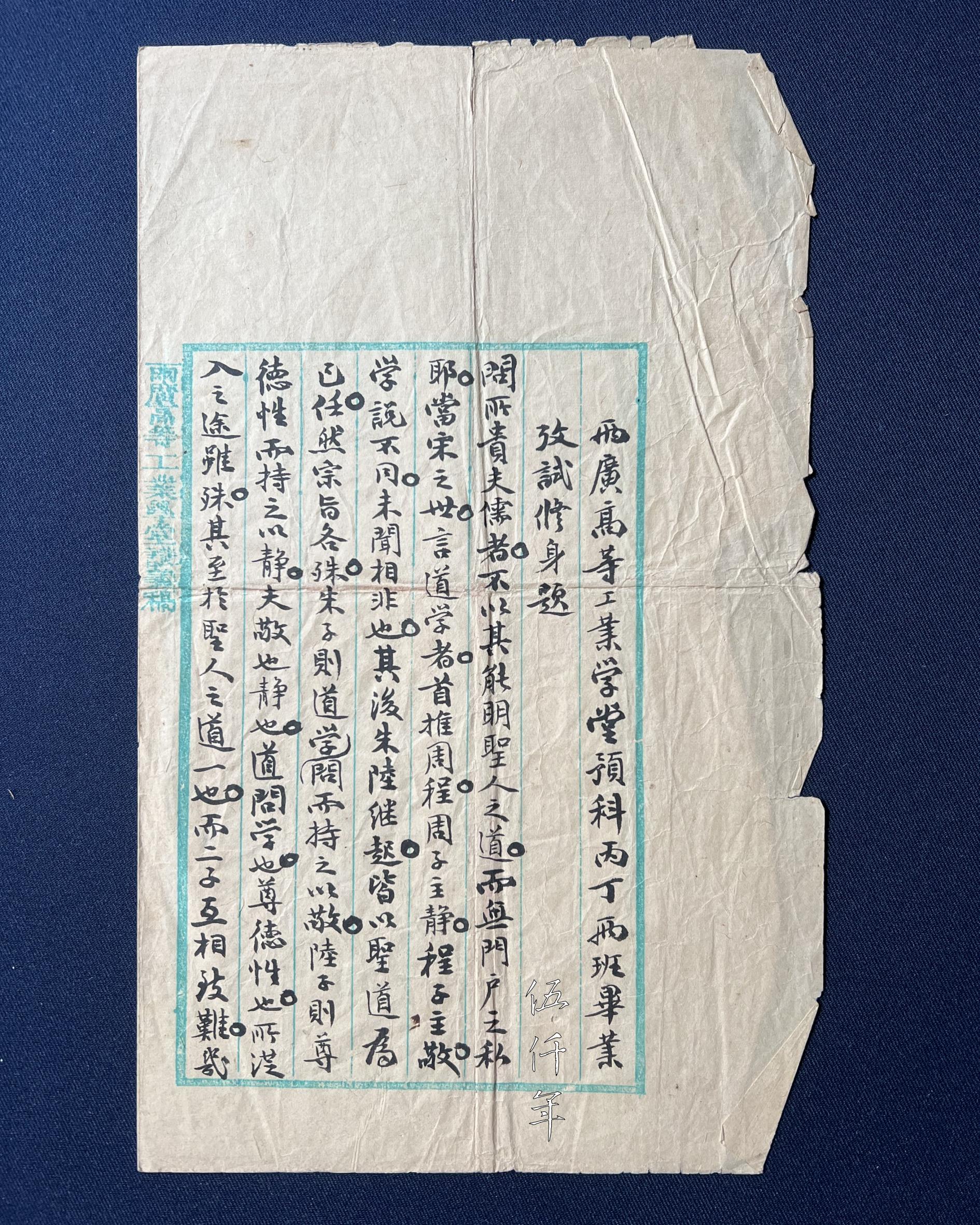
Topic on Moral Cultivation for the Graduation Examination of the Preparatory Class C and Class D of the Kwangtung and Kwangsi Higher Industrial School
3. Lecture Notes (講義)
3-1) Topic on Moral Cultivation for the Graduation Examination of the Preparatory Class C and Class D of the Kwangtung and Kwanghsi Higher Industrial School.
Prepared around the 32nd year of the Kwang-hsü reign 1906, when he was teaching at the Kwangtung and Kwanghsi Higher Industrial School.
3-2) Wen-chang Hsüeh (文章學 Studies in Literary Composition).
A compilation of lecture notes from his teaching at the Kwangtung and Kwanghsi Higher Industrial School.
Published in September of the 50th year of the Republic of China 1961.
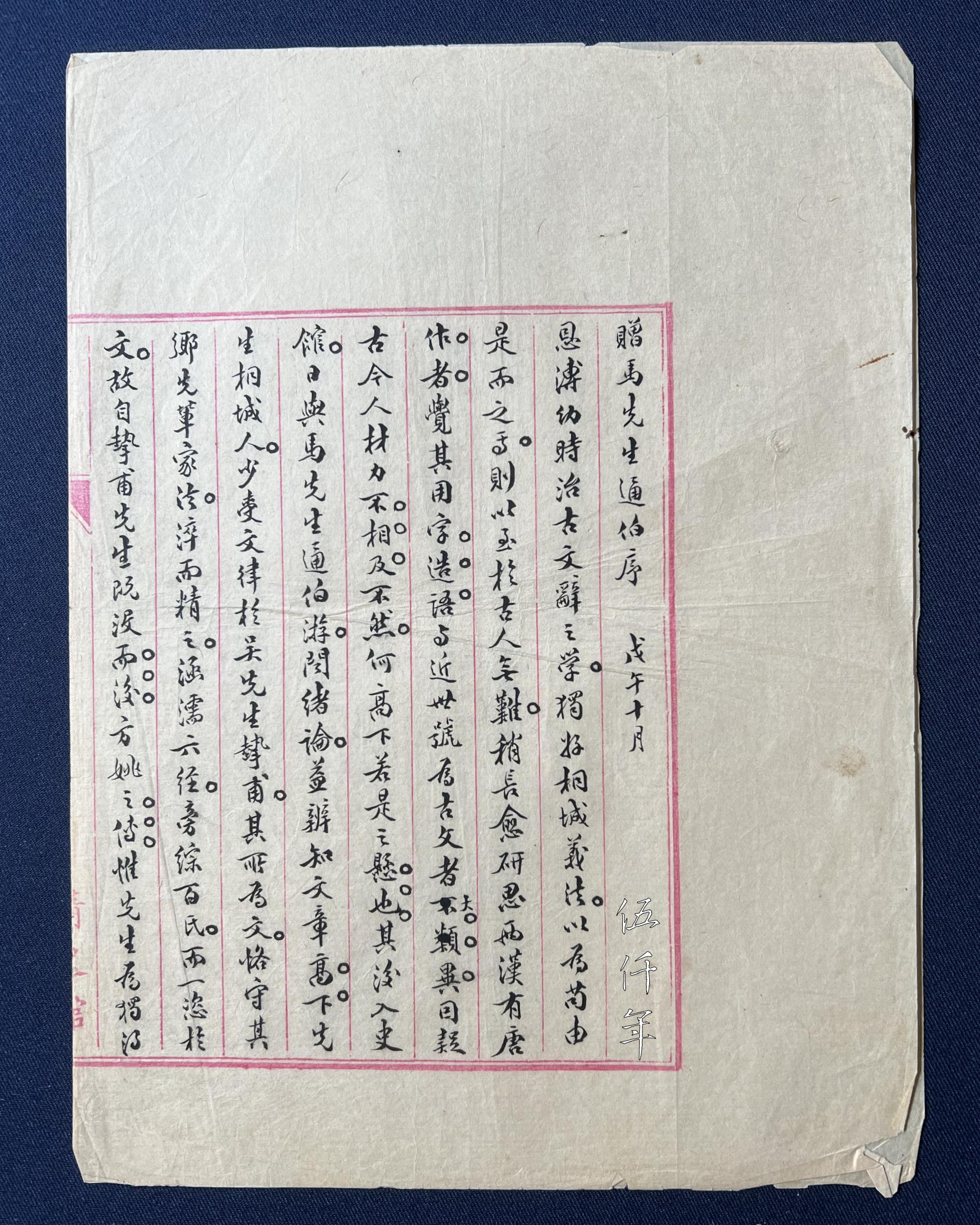
Foreword Presented to Mr. Ma T’ung-po (馬通伯)
4. Forewords (序)
4-1) Foreword Presented to Mr. Ma T’ung-po (馬通伯, original name Ma Ch’i-ch’ang 馬其昶 1855-1930).
Written in the tenth month of wu-wu (戊午) year 1918.
4-2) Foreword to Wan-li-cheng-ts’an-lu (萬里征驂彔).
Written in the seventh month of chi-ssu (己巳) year 1929.
4-3) Foreword to Poems from the Studio of Wo-wo-chou-hsüan (我我周旋室詩鈔).
Written on New Year’s Eve of ting-ch’ou (丁丑) year 1937.
4-4) Foreword to Poems on T’ien-ch’eng Temple (天成寺) at Kung-k’eng. Three sheets.
Written in the second month of hsin-ssu (辛巳) year 1941.
4-5) Foreword to The Tz'u Lyrics of Hai-hsiao (海綃詞鈔). Altogether two drafts.
Written in the ninth month of keng-yin (庚寅) year 1950.
4-6) Foreword to Collection of Portrait, Calligraphy and Paintings of Mr. Ch’en Pai-sha (陳白沙先生遺像書畫集).
Written in the autumn of keng-yin (庚寅) year 1950.
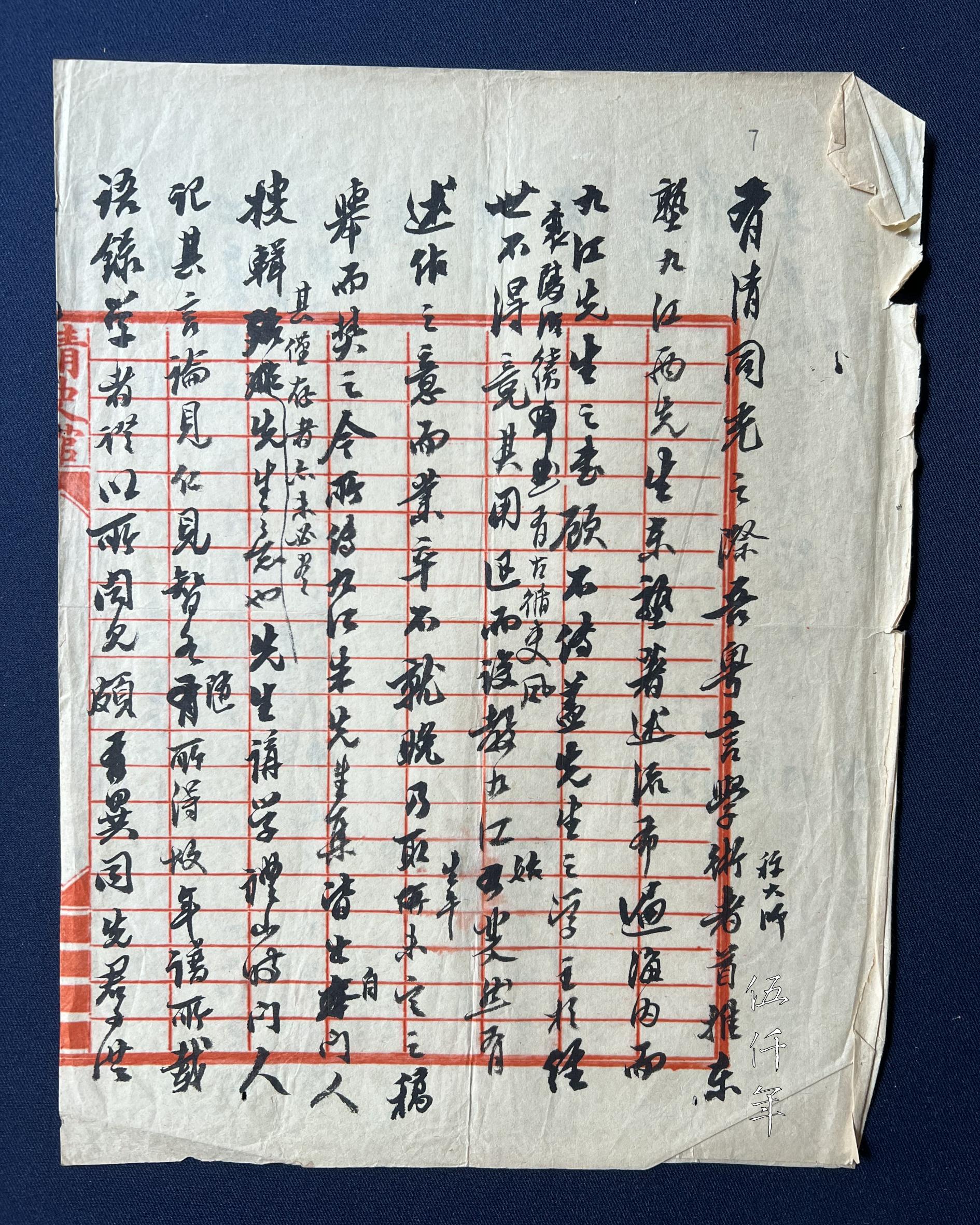
Colophon for Manuscripts by Mr. Chu Tz’u-ch’i (朱次琦) with His Family History
5. Colophons (題跋)
5-1) Colophon for Manuscripts by Mr. Chu Tz’u-ch’i with His Family History.
5-2) Colophon for Painting of Shih-shih Studio by Hsü Chih-heng (許之衡 tzu Shou-pai 守白).
Written in the second month of wu-yin (戊寅) year 1938.
5-3) Colophon for Collection of Poems by Kao Chai (高齋).
Written in the fourth month of chi-mao (己卯) year 1939.
5-4) Colophon for A Pair of Calligraphy Couplets by Mr. Chu Tz’u-ch’i (朱次琦) in the Collection of Kao Chai, Colophon for a Pair of Calligraphy Couplets by Wang K’ai-yün (王闓運 1833-1916) in the Collection of Kao Chai.
Written in the autumn of chi-mao (己卯) year 1939.
5-5) Colophon for Letters by Liang Ting-fen (梁鼎芬 1859-1919) in the Collection of Li Ching-k’ang (李景康 1890-1960), Colophon for a Small Portrait of Li Heng-fu (李蘅甫).
Written in the fourth month of keng-ch’en (庚辰) year 1940.
5-6) Colophon for Handscroll of Landscape Painting by Huang Pin-hung (黃賓虹 1865-1955) in the Collection of Tso-fu (作甫).
Written in mid-Autumn of keng-ch’en (庚辰) year 1940.
5-7) Colophon for Handscroll of Examination Essays by Mr. Liang Pao-san (梁葆三) with Commentaries by Mr. Chu Tz’u-ch’i.
Written in the second month of hsin-ssü (辛巳) year 1941.
5-8) Colophon for Painting of Double Tree Studio by Huang Pin-hung in the Collection of T’ieh-fu. Altogether two drafts.
Written in the second month of hsin-ssü (辛巳) year 1941.
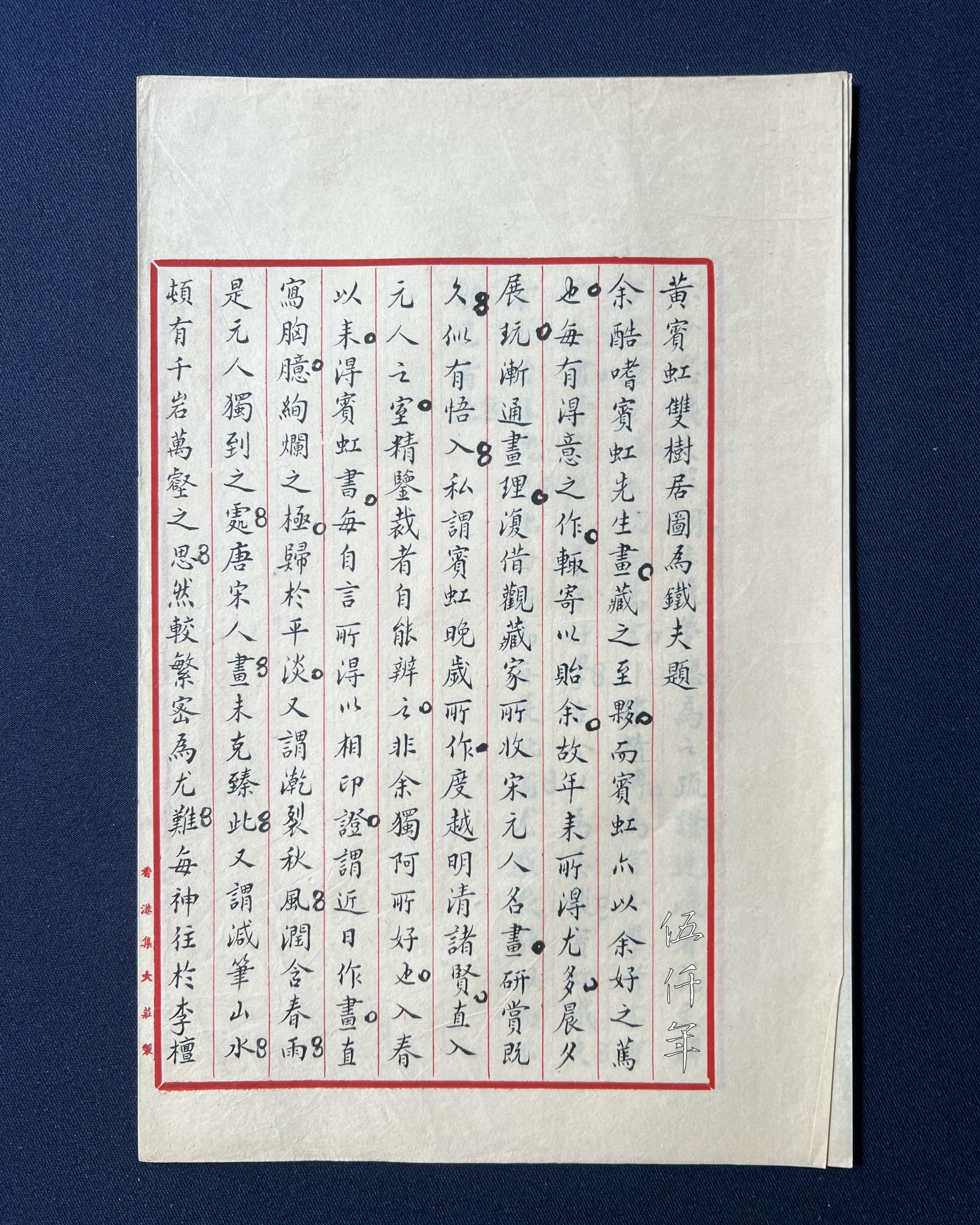
Colophon for Painting of Double Tree Studio by Huang Pin-Hung (黃賓虹) in the Collection of T’ieh-fu
5-9) Colophon for Hanging Scroll of Landscape Painting by Huang Pin-hung in the Collection of Shih-yin (始誠), Colophon for a Pair of Calligraphy Couplets by Tai Wen-ch’eng (戴文誠) in the Collection of Yao-shih (曜始).
5-10) Colophon for The Collected Works of Hsün-ch’e (撏撦集), by Wan Sheng-shih (萬繩栻 1879-1933). Altogether two drafts.
Written in early autumn of ping-hsü (丙戌) year 1946.
5-11) Colophons for Calligraphy Work on Fan by Liang Ting-fen (梁鼎芬) for Himself in the Collection of Ma Shou-nan (馬壽南), Together with Hanging Scroll of a Poem by Deputy Minister Ai-ch’ing (艾卿) Dedicated to Liang Ting-fen on His Birthday, Colophon for Hanging Scroll of Landscape Painting by Hsieh Li-fu (謝里甫 original name Lan-sheng 謝蘭生 1760-1831) in the Collection of Ma Shou-nan.
Written on New Year’s Eve of wu-tzu (戊子) year 1948.
5-12) Colophon for Poetry Couplets from Literary Games Related to Mei Lan-fang (梅蘭芳 1894-1961) of Chui-yü Studio (綴玉軒) and Ch’eng Yen-ch’iu (程硯秋 1904-1958) of Yü-shuang Studio (玉霜簃) by Lo Tun-jung (羅惇曧 1872-1924).
Written on the 8th day in the fourth month of chi-ch’ou (己丑) year 1949.
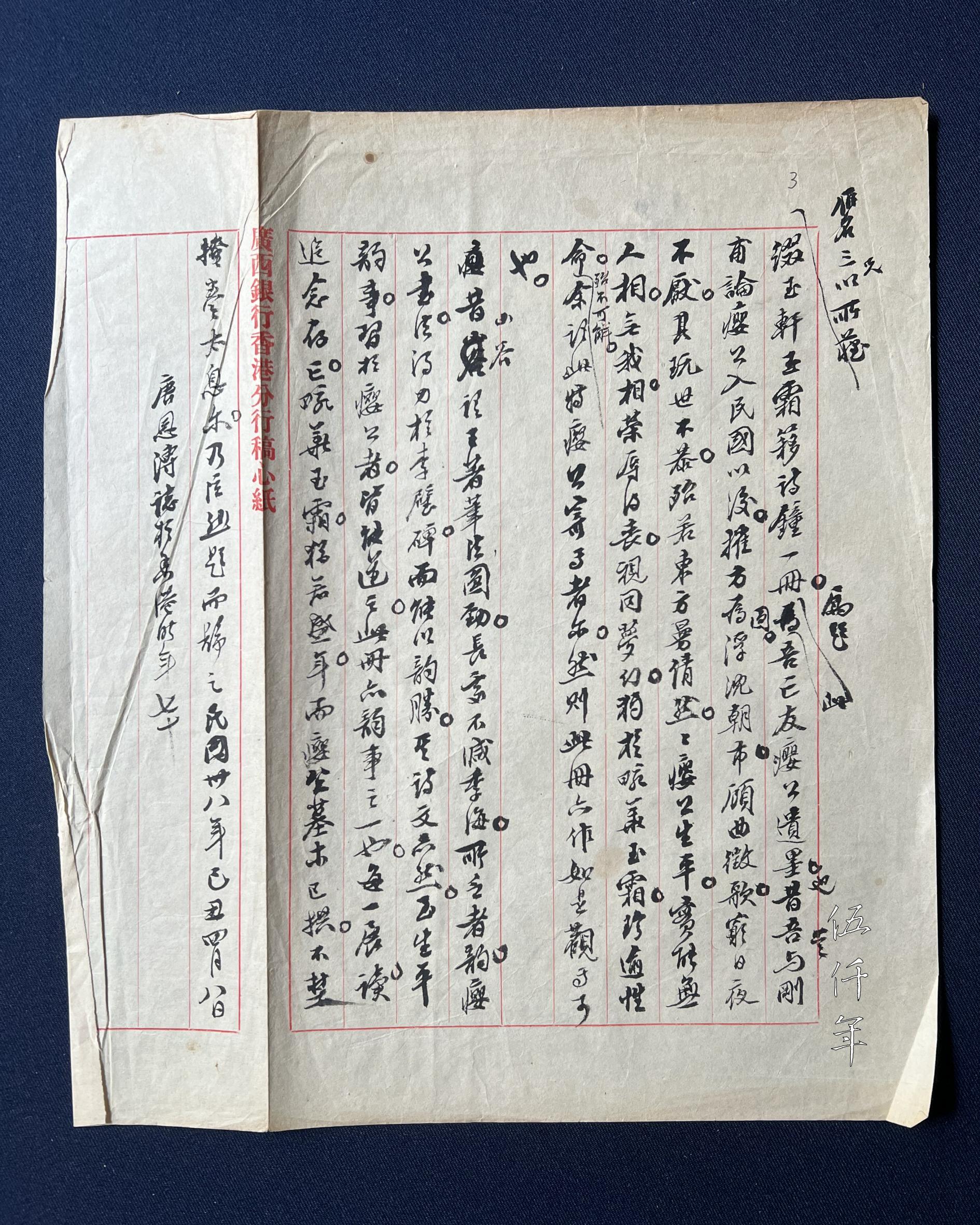
Colophon for Poetry Couplets from Literary Games Related to Mei Lan-fang (梅蘭芳) of Ch’iu-yü Studio and Ch’eng Yen-ch’iu (程硯秋) of Yü-shuang Studio by Lo Tun-yung (羅惇曧)
5-13) Colophon for the Collected Poems and Prose of An-chai (闇齋). Altogether two drafts.
Written in the twelfth lunar month of chi-ch’ou (己丑) year 1949.
An-chai was the hao used by Chang An-kung (張闇公) in his later years, his original name was Hsüeh-hua (學華), tzu Han-san (漢三).
5-14) Colophon for Tun-huang Manuscript Scroll in the Collection of Chün-shih (君軾).
5-15) Colophon for Letters by Liang Ting-fen, Colophon for Letter by Elder Wang Ching-wu (汪憬吾,名兆鏞 1861-1939), Colophon for Collected Draft Poems by Li Ts’ang-p’ing (李滄萍 1897-1949).
5-16) Colophon for Handscroll Painting by Wang Pai-an (汪白岸), Colophon for Paintings by Wu Tzu-shen (吳子深 1894-1972).
Written in the seventh month of keng-yin (庚寅) year 1950.
5-17) Colophon for Paintings by Wu Tzu-shen.
Written in the seventh month of the keng-yin (庚寅) year 1950.
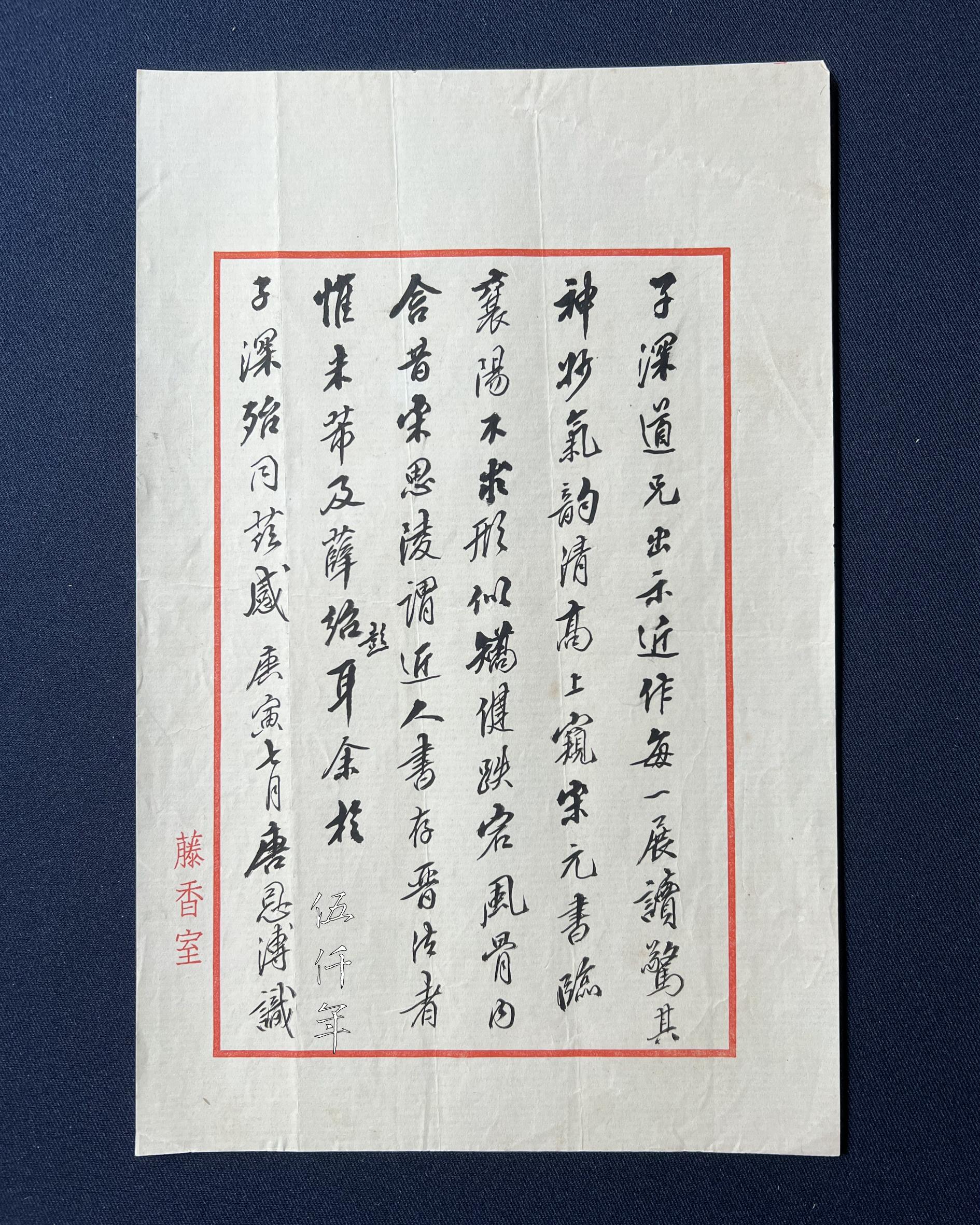
Colophon for Paintings by Wu Tzu-shen (吳子深)
5-18) Colophon for Tombstone Inscription of the Forebears of the Huang Brothers: Hsiao-chüeh (孝覺), Wu-chung (武仲), and Pin-fu (斌甫). Altogether two drafts.
Written in the ninth month of keng-yin (庚寅) year 1950.
5-19) Colophon for Letters by Mr. Liang T’ieh-chün (梁鐵君 1857-1906).
Written in the summer of chia-wu (甲午) year 1954.
Liang T’ieh-chün, original name Er-hsü (爾煦), was a grandson of the noted scholar Liang Chiu-t’u (梁九圖 1816-1880), native of Fo-shan, Kwangtung province.
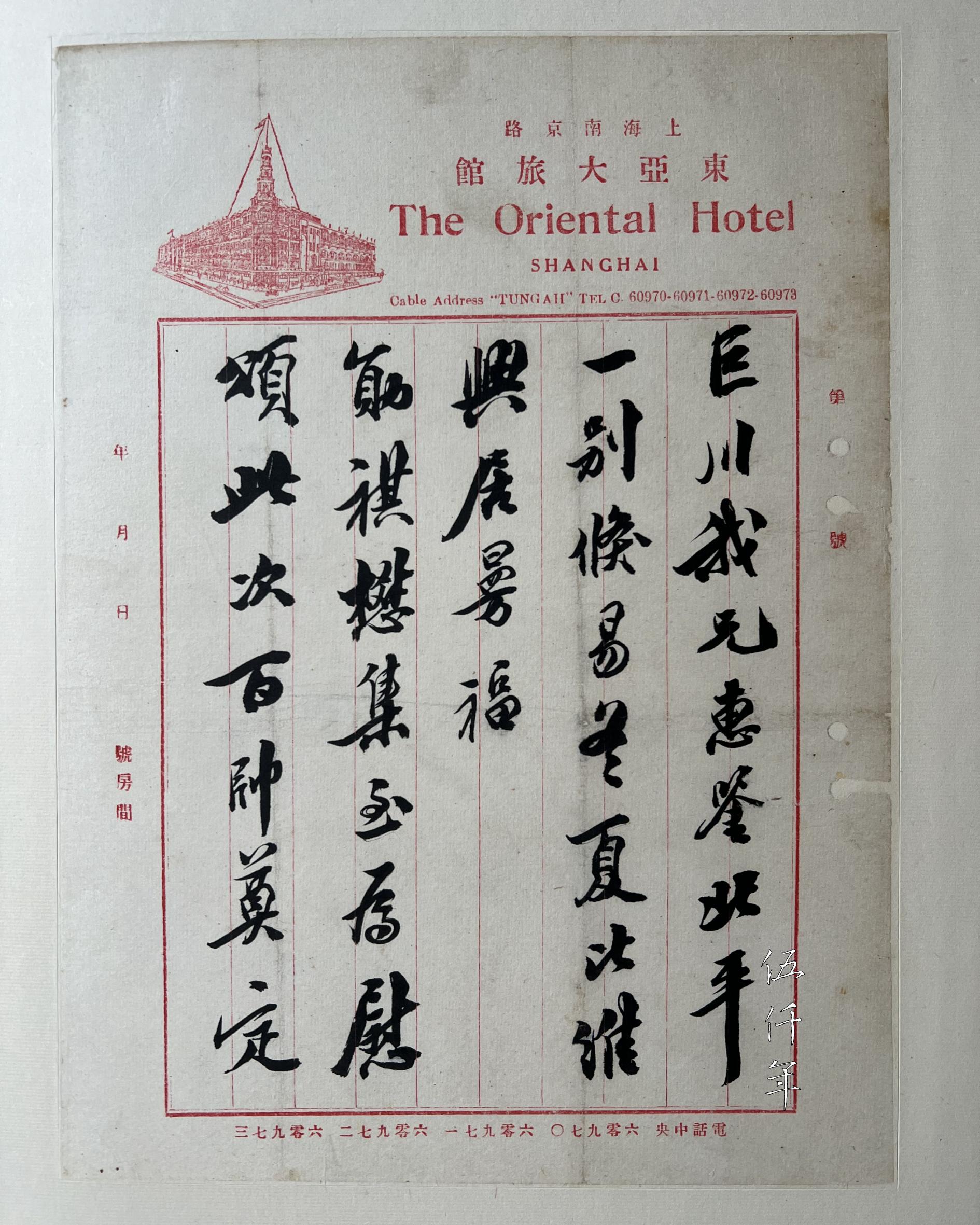
Letter to Chü-ch’uan (巨川)
6. Letter to Friend (書信)
6-1) Letter to Chü-ch’uan (巨川). Altogether four pages.
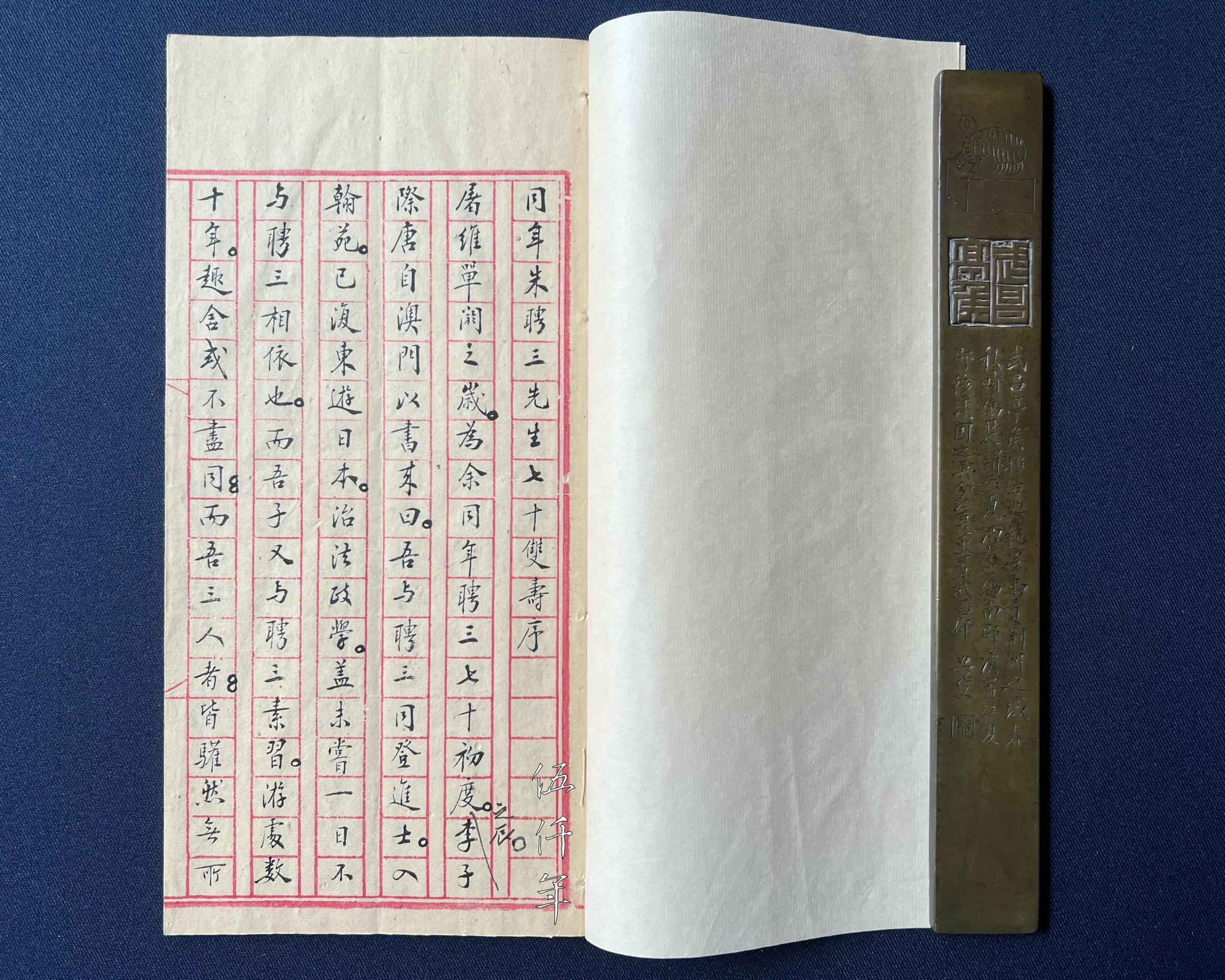
Birthday Felicitations for Fellow Graduate Mr. Chu P’in-san (朱聘三) on His Double-Seventieth Birthday with Wife
7. Birthday Felicitations (壽序)
7-1) Birthday Felicitation for Mr. K’ang (Yu-wei 康有為 1858-1927) of Nan-hai on His Sixtieth Birthday. Altogether two pages.
Written in ting-ssu (丁巳) year 1917.
7-2) Birthday Felicitation for Fellow Graduate Mr. Chu P’in-san (朱聘三, original name Ju-chen 汝珍 1870-1943) on His Double-Seventieth Birthday with Wife.
Written in keng-ch’en (庚辰) year 1940.
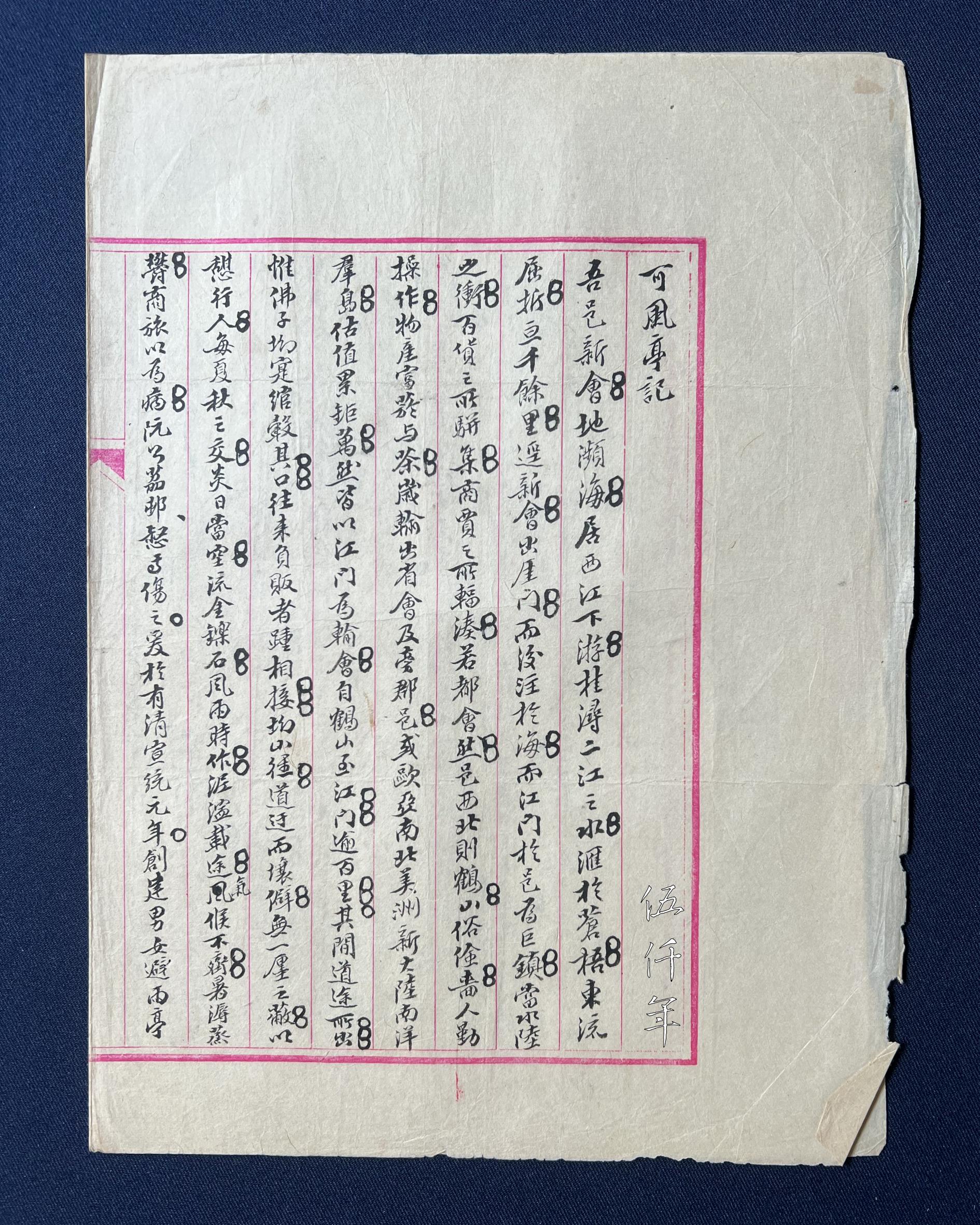
An Account of K’o-feng Pavillion
8. Accounts (記)
8-1) An Account of the I-yin Lu (醫隱廬 Medical Recluse Studio) Painting. Altogether two pages.
Written in the eighth month of ping-ch’en (丙辰) year 1916.
8-2) An Account of K’o-feng Pavilion (可風亭).
8-3) An Account of The Branch Opening of Kuang-chih Kuan (廣芝館) Supplying Pills, Powders, Pastes and Elixirs in Hong Kong.
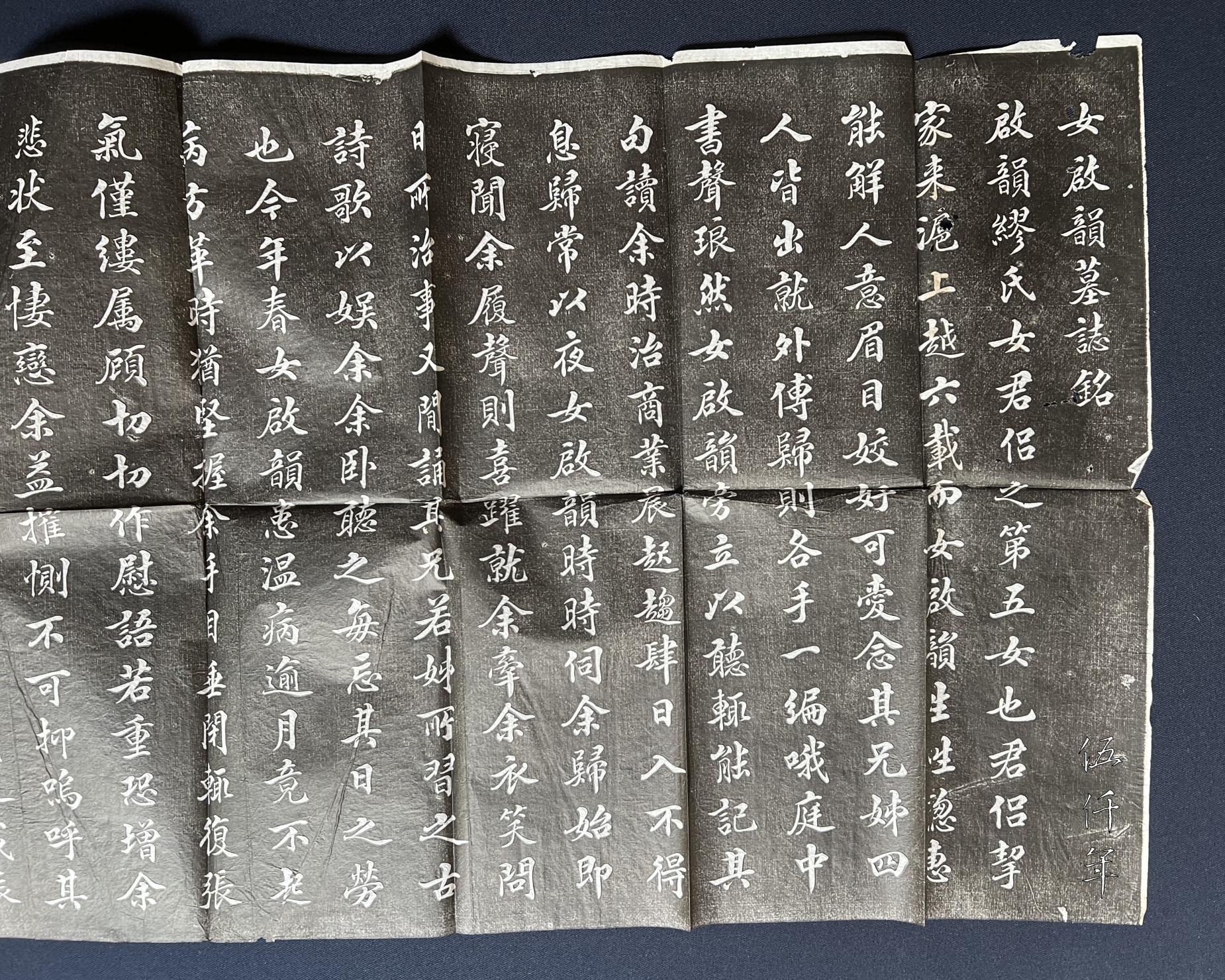
Epitaph of Daughter Ch’i-yün
9. Epitaphs (墓誌銘)
9-1) Epitaph of Mr. Ch’en, Grand Master for Governance and Expectant Appointee of Associate Administrator. With colophon by Ma Ch’i-ch’ang (馬其昶). Altogether two pages.
Written in the 3rd year of the Republic of China 1914.
9-2) Epitaph of Daughter Ch’i-yün. Altogether two ink rubbings.
Written on the 9th day of the ninth month, 17th year of the Republic of China 1928.
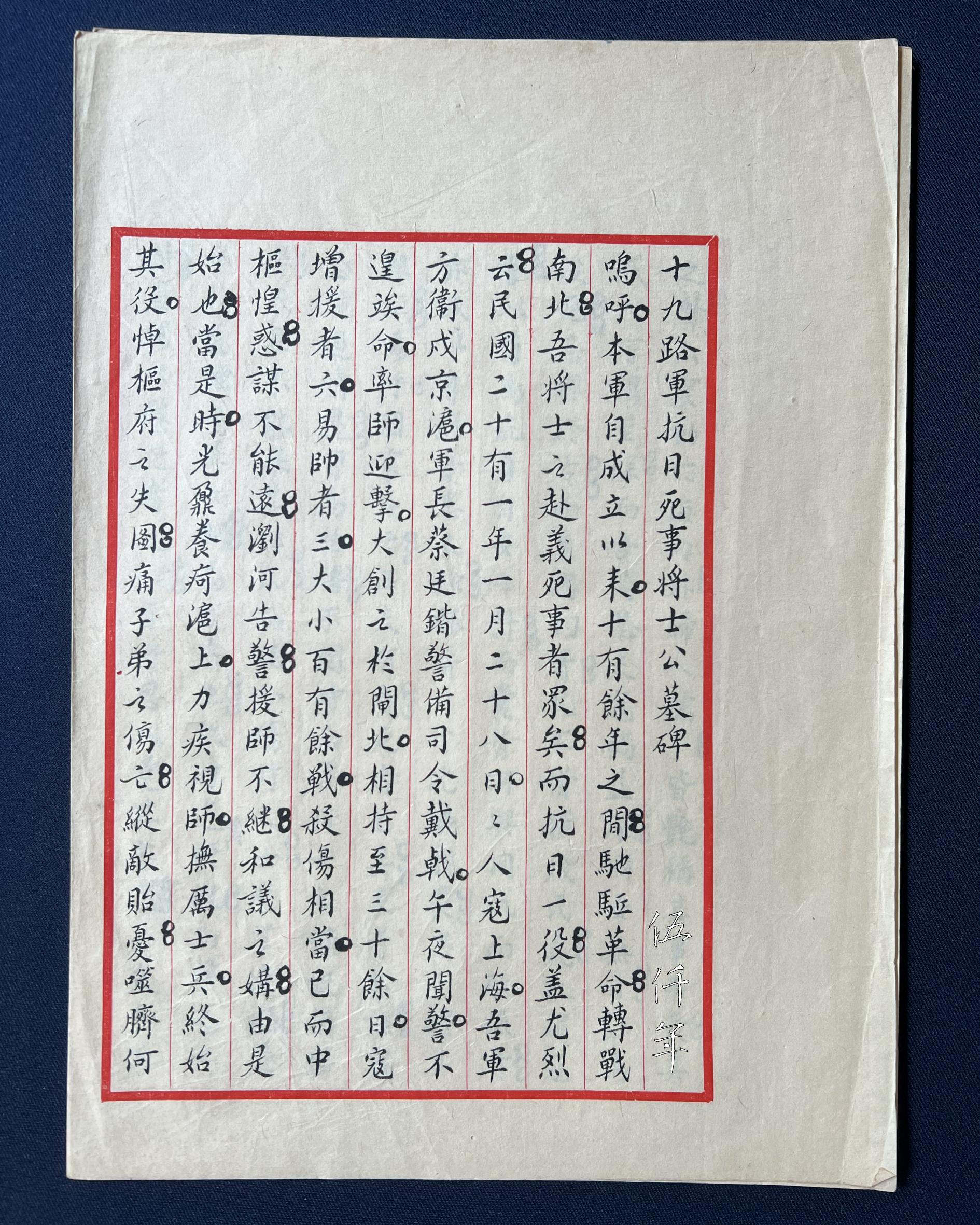
Stele Inscription for the Public Cemetery of Soldiers from the 19th Route Army Who Died in the War of Resistance Against Japanese Aggression
10. Stele Inscription (碑碣)
10-1) Stele Inscription for the Public Cemetery of Soldiers from the 19th Route Army Who Died in the War of Resistance Against Japanese Aggression. Altogether two pages.
Written in the 21st year of the Republic of China 1932.
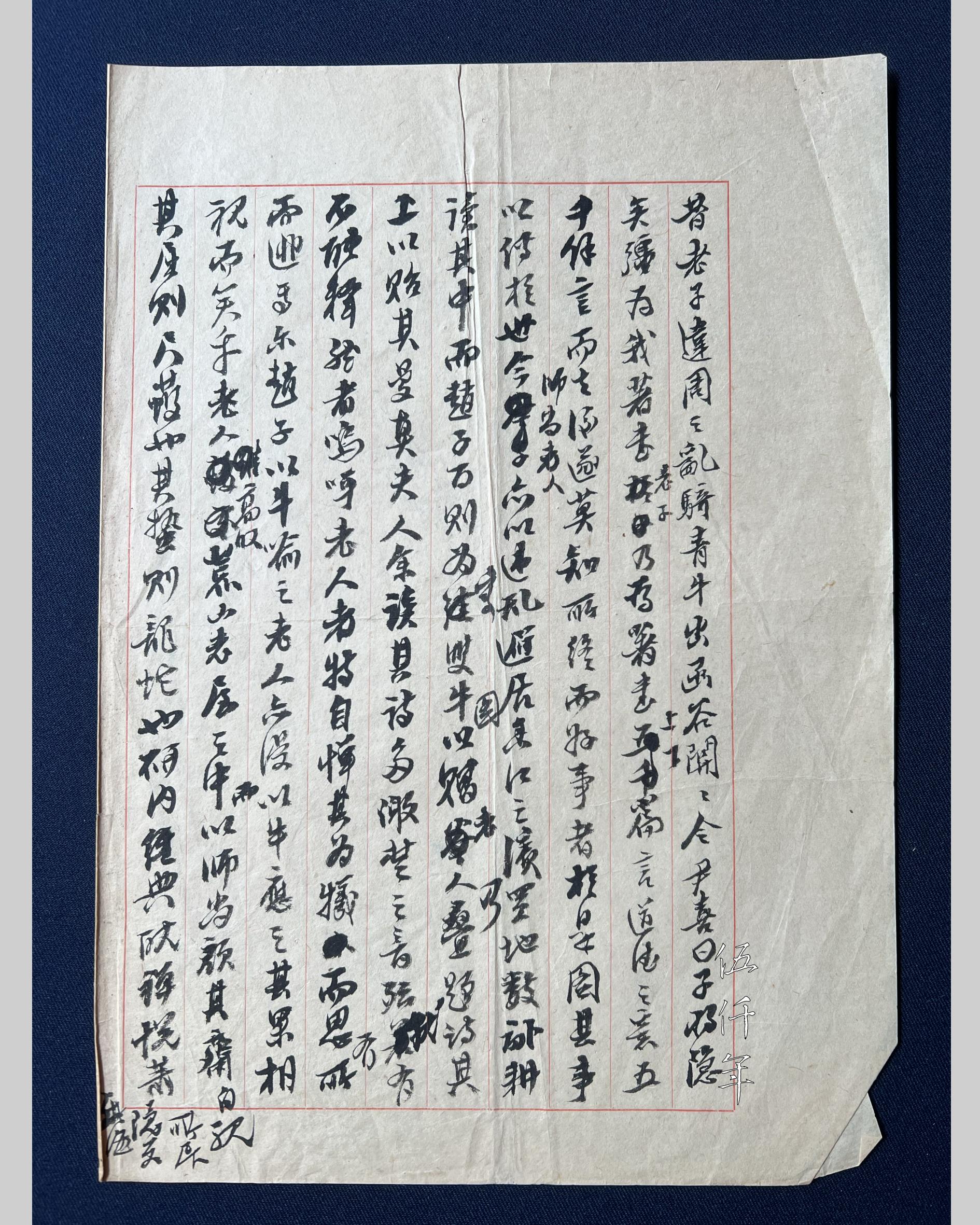
Biographical Essay of Old Man Shih-wei
11. Biographical Essay (傳)
11-1) Biographical Essay of Old Man Shih-wei (師為老人).
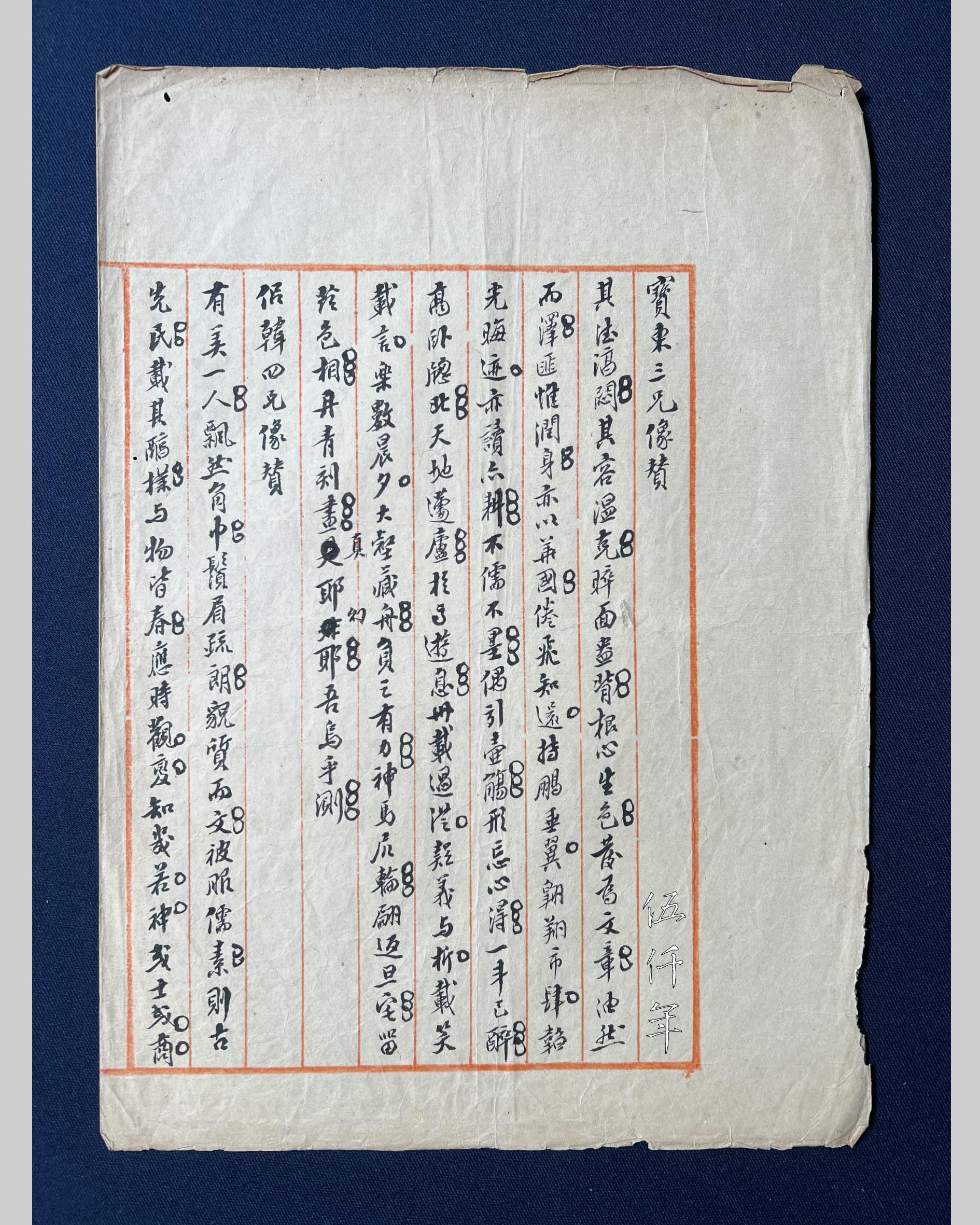
Eulogy to the Portrait of Elder Brother Pao-tung
12. Eulogies (頌贊)
12-1) Eulogy to the Portrait of Elder Brother Pao-tung (寶東), Eulogy to Elder Brother Pi-hou (璧侯).
12-2) Eulogy to Someone Unknown.
Written in the eleventh month, winter of chia-wu (甲午) year 1954.
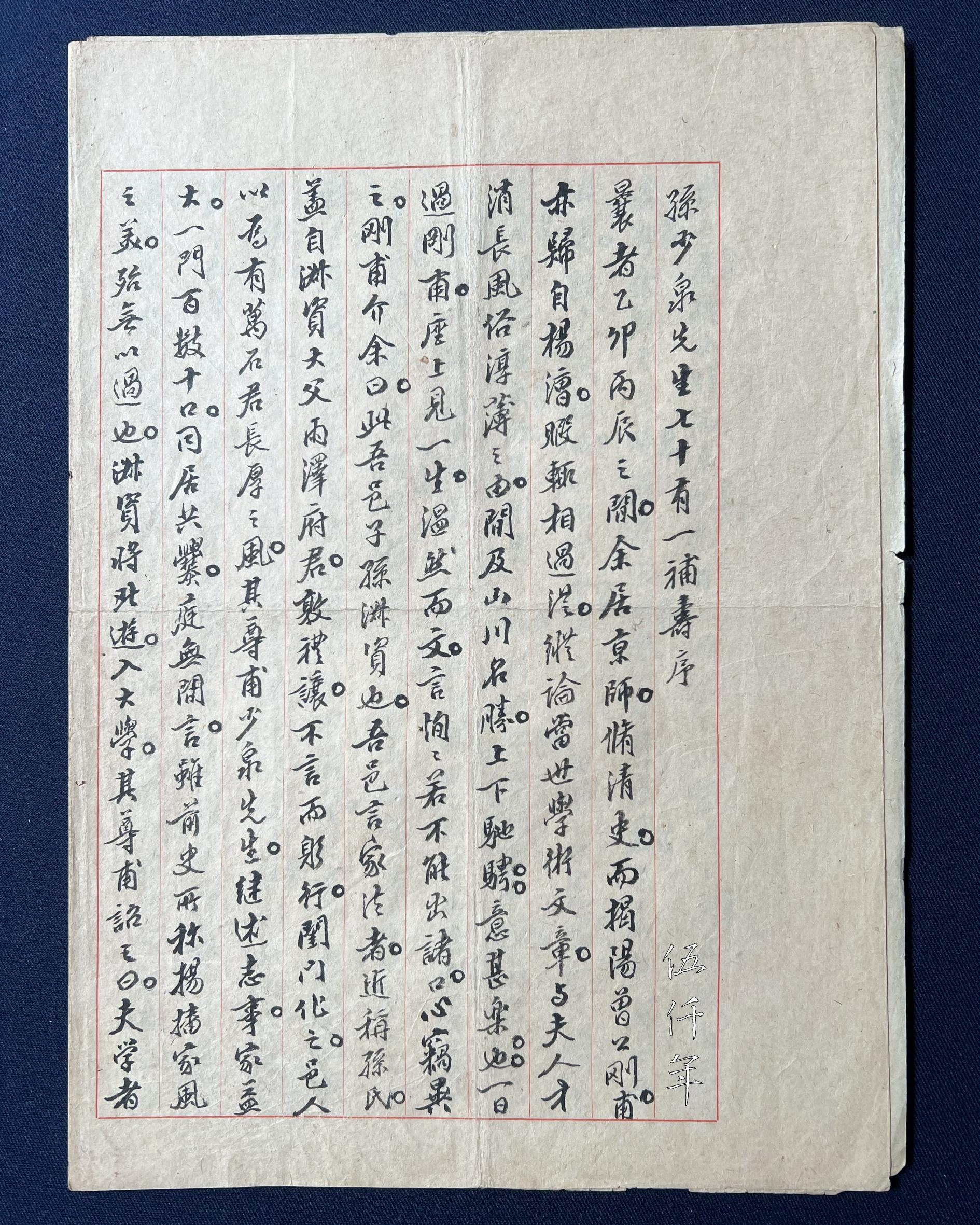
Belated Birthday Sacrificial Text for Mr. Sun Shao-ch’üan (孫少泉) on His Seventy-First Year
13. Sacrificial Texts (祭文)
13-1) Belated Birthday Sacrificial Text for Mr. Sun Shao-ch’üan (孫少泉) on His Seventy-First Year. Altogether two pages.
Written around the 25th year of the Republic of China 1936.
13-2) Anonymous Sacrificial Text
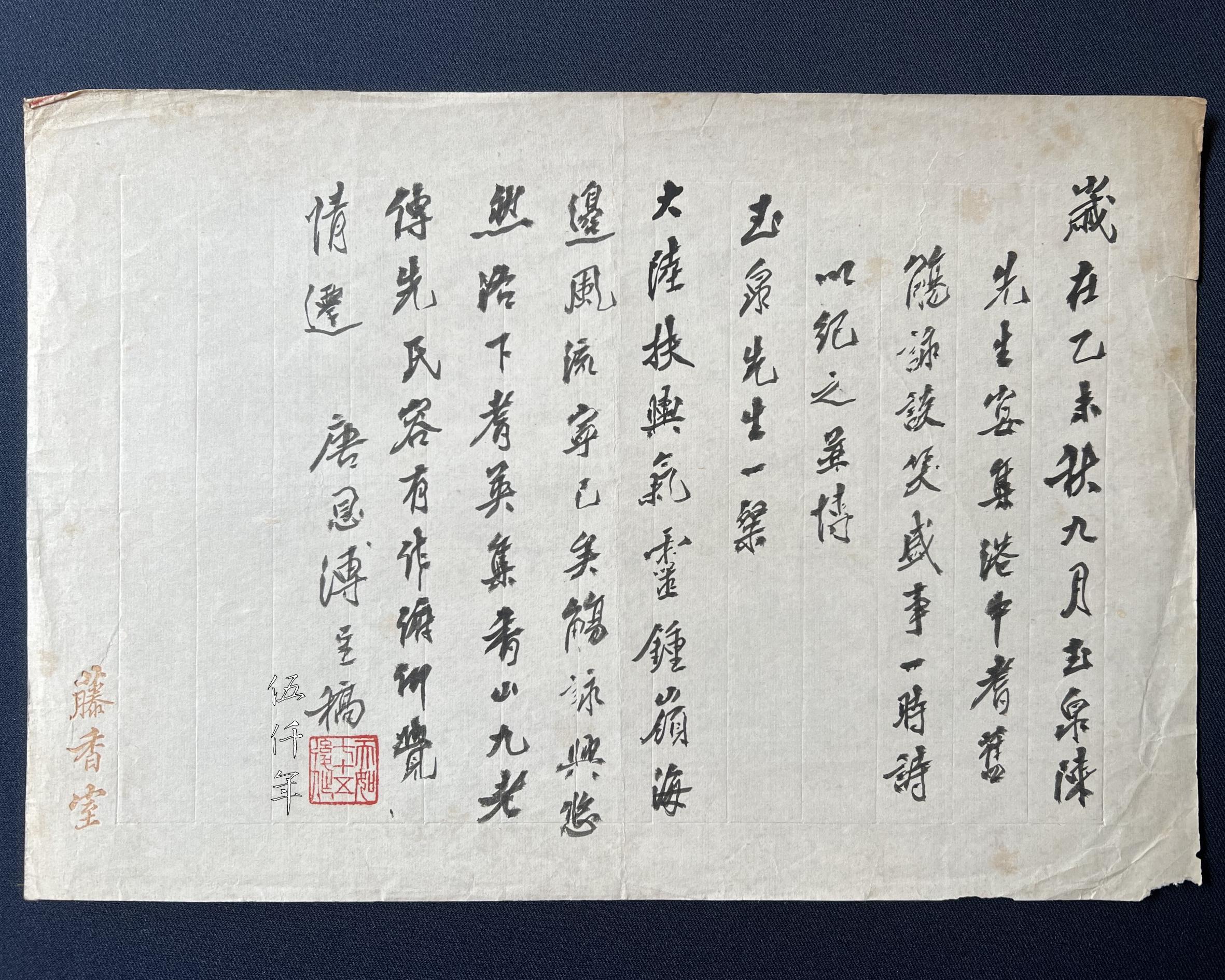
Poem of a Banquet Gathering in Hong Kong Hosted by Mr. Ch’en Yü-ch’üan (陳玉泉)
14. Poems and Tz’u Lyrics
14-1) Poem of a Banquet Gathering in Hong Kong Hosted by Mr. Ch’en Yü-ch’üan (陳玉泉).
Written in the ninth month, autumn of i-wei (乙未) year 1955.
14-2) Tz’u Lyric to the tune Kao-shan-liu-shui (高山流水 Tall Mountain Flowing River).
14-3) Tz’u Lyric to the tune Feng-ch’i-wu (鳳棲梧 Phoenix Perching on Wutong Tree) presented to Te-p’u (德譜).
14-4) A hanging scroll of seven character poem dedicated to Mr. Hui Po-lei (惠波雷).
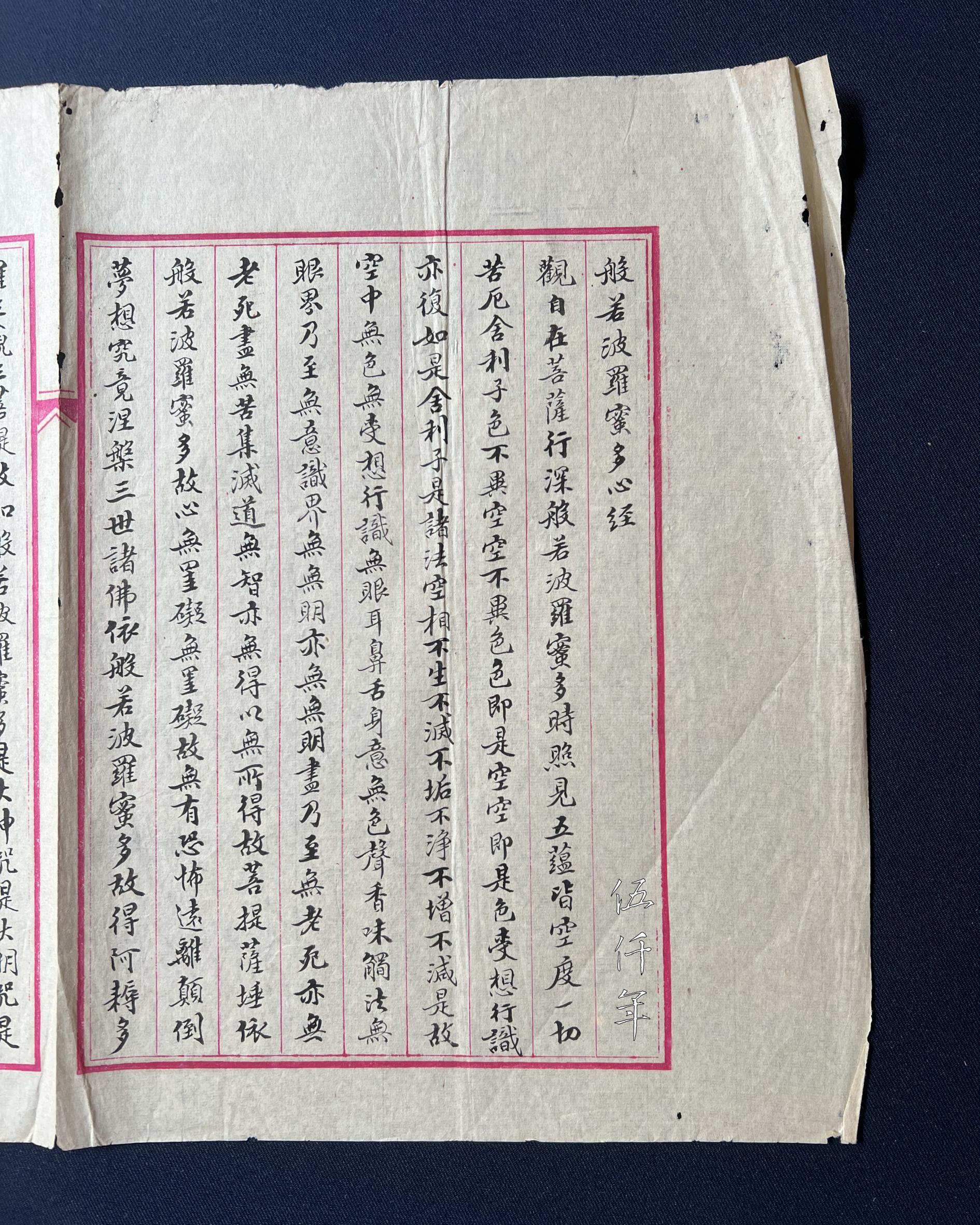
The Prajnaparamita Heart Sutra
15. Buddhist and Taoist Works (釋道詩文)
15-1) The Prajnaparamita Heart Sutra.
Copied on the 7th day of the second month of chi-ssu (己巳) year 1929.
15-2) A sheet of gatha verse.
15-3) A short poem composed on the 15th day of the eighth month at the World Red Swastika Society in Hong Kong by Chi-kung Buddha (濟公 1148-1209).
15-4) Three pairs of poetry couplets for Ch’ing-yüan Hall (清元堂), a pair of poetry couplets for Chi-le Grotto (極樂洞). Altogether two pages.
15-5) Respectfully Responding to the Original Rhyme of Master Chi-kung.
15-6) Respectfully Responding to the Original Rhyme of a Poem Bestowed through Spirit-Writing by Chi-kung Buddha.
15-7) Respectfully Responding to the Original Rhyme of a Poem Bestowed by Chi-kung Buddha upon His Descent to the Altar.
Written in the winter month of jen-ch’en (壬辰) year 1952.
15-8) Responding to the Original Rhyme of a Poem Bestowed by Chi-kung Buddha.
Written on the 15th day of the fifth month of kuei-ssu (癸巳) year 1953.
15-9) Respectfully Responding to the Original Rhyme of a Poem Bestowed by Chi-kung Buddha on the Night of 15th.
15-10) Hanging scroll of the Prajnaparamita Heart Sutra.
Written in the 12th month of chi-hai (己亥) year 1959.
15-11) Birthday Scroll Presented by Colleagues of the World Red Swastika in Hong Kong.
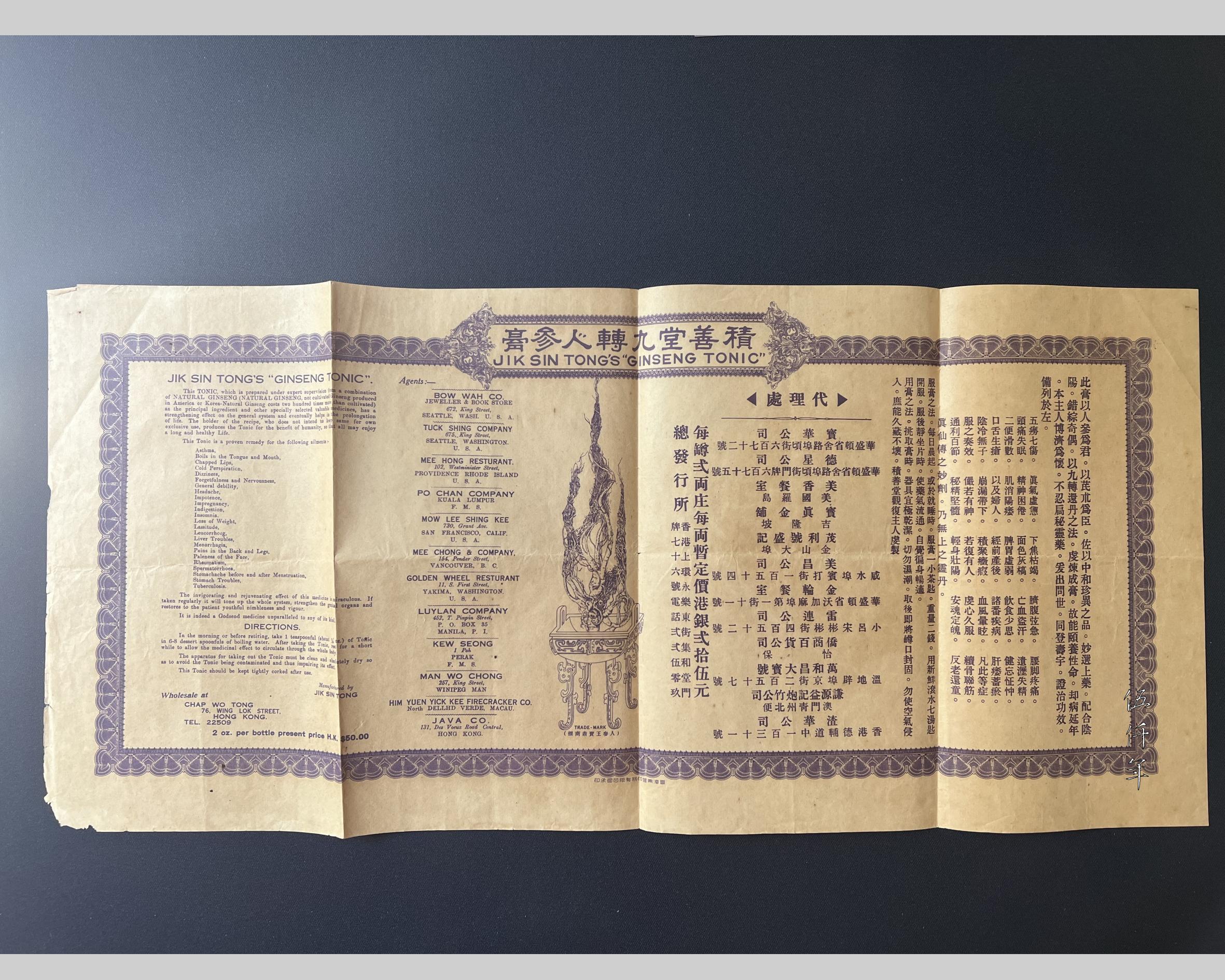
Advertisement for the “Nine-Turn Ginseng Elixir” produced by Chi-shan Hall
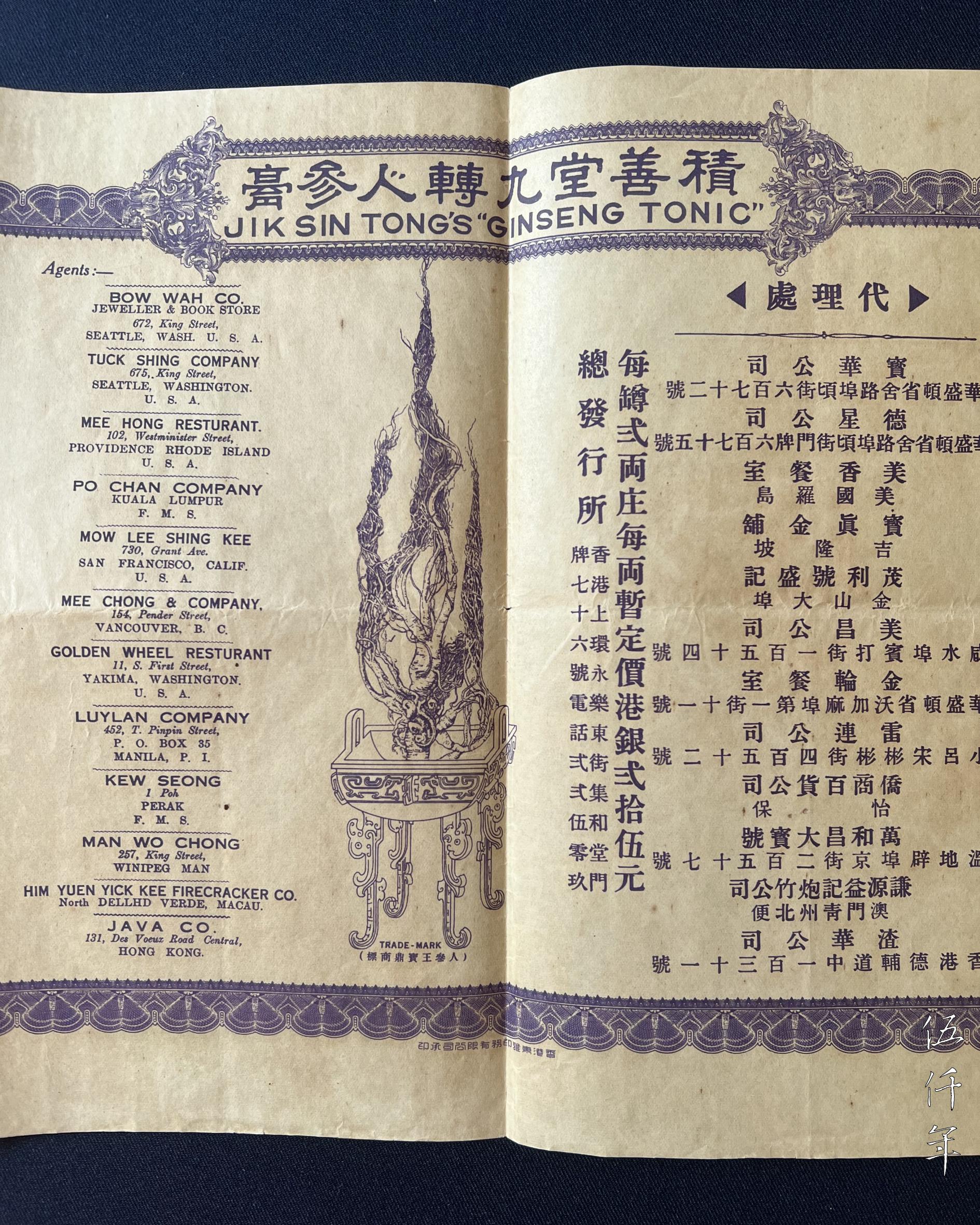
Detail of advertisement for the “Nine-Turn Ginseng Elixir” produced by Chi-shan Hall
16. Advertisement
16-1) Advertisement for the “Nine-Turn Ginseng Elixir” produced by Chi-shan Hall (積善堂).
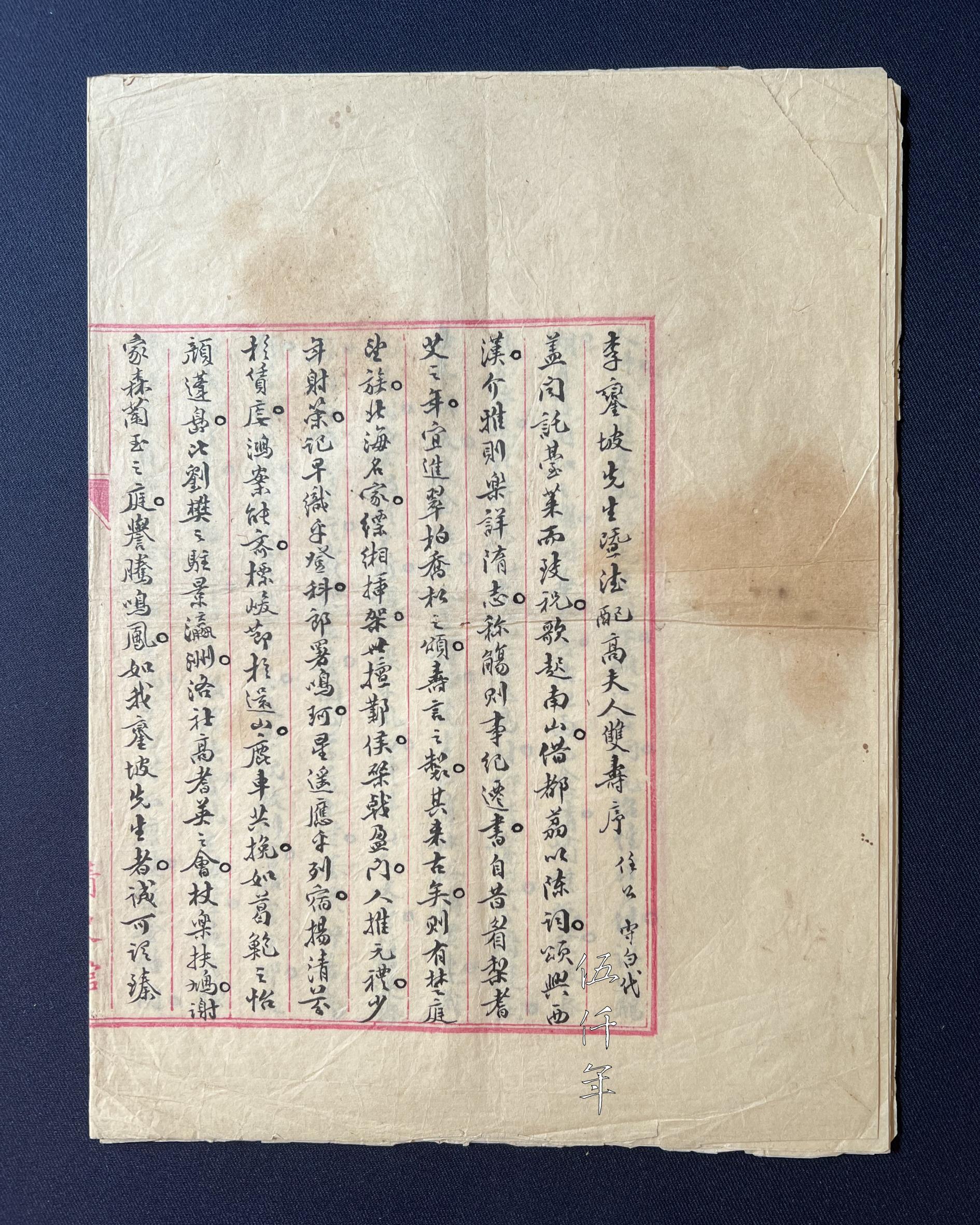
Birthday Felicitations for Both Mr. Li Luan-p’o (李鑾坡) and His Wife Madame Kao
17. Ghostwritten Works for Others (代筆文章)
17-1) Epitaph of Madame Yu, Mother of Fang Family.
Written in ping-ch’en (丙辰) year 1916, on behalf of Ma Ch’i-ch’ang (馬其昶).
17-2) Eulogium of General Ts’ai Sung-p’o (蔡松坡 original name O 鍔1882-1916) at the State Funeral. Altogether two drafts.
Written in the 5th year of the Republic of China 1916, on behalf of Liang Ch’i-ch’ao (梁啟超).
17-3) Birthday Felicitations for Both Mr. Li Luan-p’o (李鑾坡) and His Wife Madame Kao. Altogether four pages.
Ghostwritten on behalf of Liang Ch’i-ch’ao (梁啟超) and Hsü Chih-heng (許之衡).
17-4) Inscription for the Bust of Wu Lin-shu (吳麟書 1878-1930).
Ghostwritten on behalf of the staff of the T’ung-i Textile Co., Ltd.
17-5) Sixtieth Birthday Felicitations for Both Li Chi-t’ang (李際唐, original name Ch’iao-shen 翹燊) and Wife. Altogether two pages.
Ghostwritten on behalf of Hsia Sun-t’ung (夏孫桐 1857-1941).
17-6) Beseeching Birthday Felicitations for Father and Mother. Altogether two pages.
Ghostwritten on behalf of Hsü Ching-t’ang (徐景唐 1895-1967).
17-7) Foreword to the Revised Edition of the Genealogical Chronicle of the Li Clan of Yün-hsi. Altogether two pages.
Ghostwritten on behalf of Li Ch’iao-shen (李翹燊).
17-8) Ghostwritten letter on behalf of Li Ch’iao-shen.
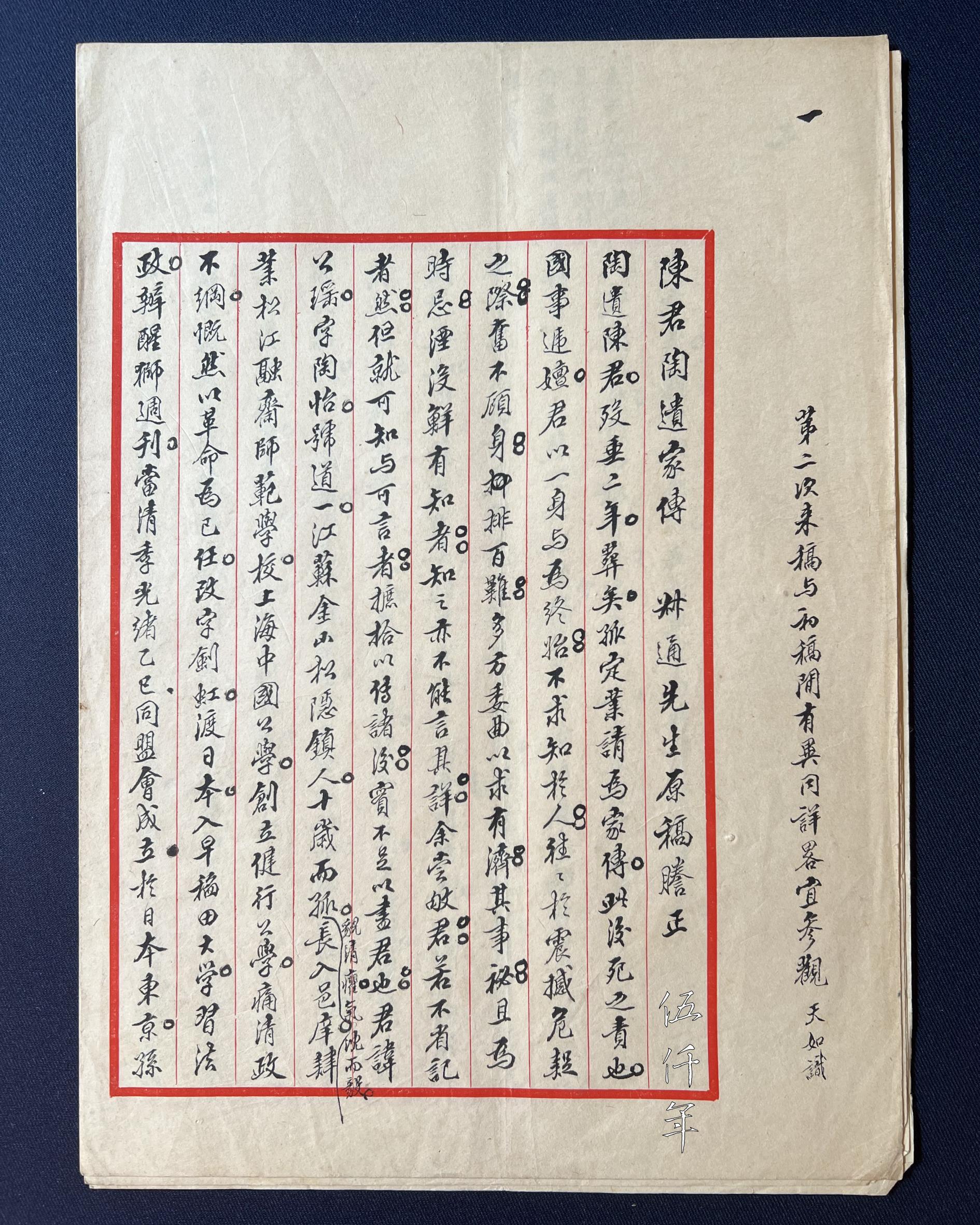
Biography of Ch’en T’ao-i (陳陶遺) Family
18. Revisions to Works by Others (刪改文章)
18-1) Biography of Ch’en T’ao-i (陳匋遺 1881-1946) Family from Chin-shan. Facsimile copy, three pages.
Written by Ch’en Shu-t’ung (陳叔通 1876-1966) in the 37th year of the Republic of China 1948, revised by T’ang En-p’u.
18-2) Biography of Ch’en T’ao-i Family, original manuscript with revisions, four pages.
Written by Ch’en Shu-t’ung (陳叔通) in the 37th year of the Republic of China 1948, revised by T’ang En-p’u.
18-3) Epitaph of Mr. Hsia of Chiang-yin, Grand Master for Assisting Toward Good Governance, Peacock Feather and Title of the Second Rank, Expectant Appointee Circuit, Prefect of Hu-chou City of Chekiang Province. Also known as Epitaph for Mr. Hsia of Chiang-yin. Altogether three pages of typescript.
Written by Ch’en Shu-t’ung in the 31st year of the Republic of China 1942, revised by T’ang En-p’u.
18-4) Obituary of Shen Ch’iu-shui (沈秋水), Concubine of Shih Liang-ts’ai (史量才 1880-1934). Two pages of manuscript copy.
Written by son Yung-keng (詠賡) in the 27th year of the Republic of China 1938, revised by T’ang En-p’u.
18-5) The Life of Ch’en Hsia-ch’ien (陳霞騫), Grand Master for Governance and Secretary of the Ministry of Personnel. Altogether two pages.
Written by Yeh Yen-hua (葉衍華 1874-1941) in the 6th year of the Republic of China 1917, revised by T’ang En-p’u.
18-6) Epitaph of My Late Father Tzu-yüan (紫園). Altogether three pages.
Written by son Ts’ai Chün-lieh (蔡君烈), revised by T’ang En-p’u.
18-7) Letter by Hsi-ch’un Nü-shih (惜春女史) T’ang Yün-ming (唐允明), revised by T’ang En-p’u.
Reading the hundred-odd pieces of writings still extant, his friendships and interests are discernible. Throughout his life he discarded most of his writings, uninterested in his own literary legacy nor to leave writings to impress others. His disciple Ch’en Ying-yao (陳應曜) later compiled his lecture notes under the title Studies in Literary Composition, some lines in his postscript read:
“I venture to think, as the Master was already advanced in age, the poems and prose he composed might easily be scattered and lost. I once implored that they be printed. The Master declined with modesty, saying that his writings were not worthy of transmission, adding that he intended to burn his manuscripts. Alas! did the Master ever need to rely on his writings to be remembered? The transmission of his writings was not the Master’s own wish, but the responsibility of those after, and my entreaties became all the more urgent.”
T’ang Yüan-chün studied under Chu Tz’u-ch’i, one may surmise that his son T’ang En-p’u wished to follow the example of his grand-teacher in later life, burning his own manuscripts as a moral admonition to restore the world. However, in the morning of 3 February 1961, T’ang En-p’u accidentally fell, his head hitting the ground, and he passed away that afternoon. Death was too abrupt, hence some of his manuscripts are still preserved in the world.
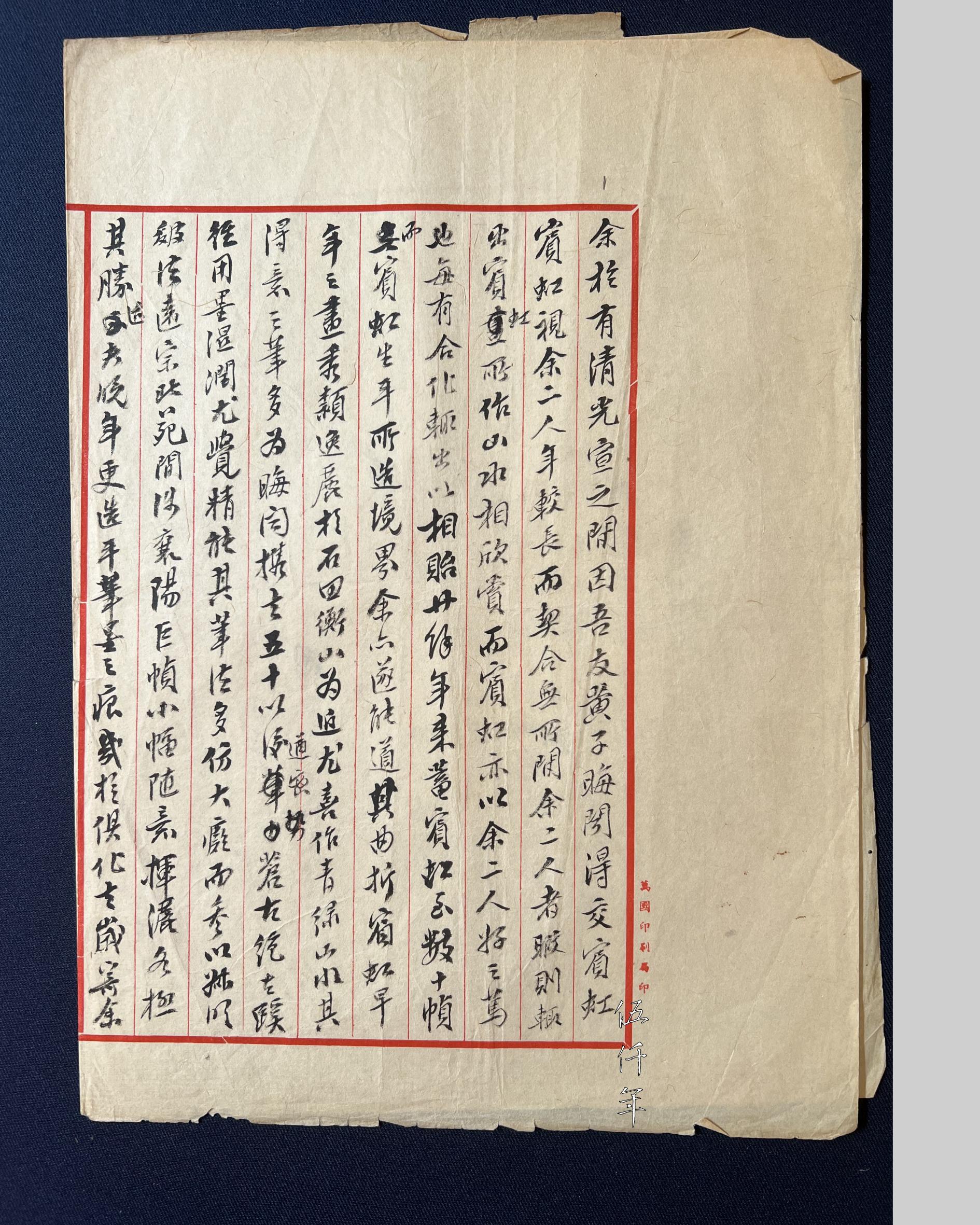
Colophon for Handscroll of Landscape Painting by Huang Pin-Hung (黃賓虹) in the Collection of Tso-fu
On the day of Mid-Autumn Festival in keng-ch’en (庚辰) year 1940, T’ang En-p’u inscribed a colophon on Handscroll of Landscape Painting by Huang Pin-hung (黃賓虹) in the Collection of Tso-fu (作甫). He recalled his travels and associations in the last days of Ch’ing dynasty with these words:
“During the Kuang-hsü and Hsüan-t’ung reigns of the Ch’ing dynasty, through my friend Huang Hui-wen (黃晦聞 1873-1935), I came to know Huang Pin-hung. Pin-hung noticed that we were both somewhat older, yet our affinity admitted no barrier. Whenever we had time, the two of us would invariably take out Pin-hung’s landscape paintings to admire, and Pin-hung, perceiving the depth of our passion would gift us works he deemed pleasing. In over twenty years, I have accumulated a few dozen paintings by Pin-hung. I am thus able to explain the intricacies of the artistic vision that Pin-hung has created in his lifetime.”
During the Kuang-hsü and Hsüan-t’ung reins, T’ang En-p’u was already traveling back and forth to Peking. Although he did not practice painting himself, he took particular delight in collecting and acquired several dozen paintings by Huang Pin-hung.
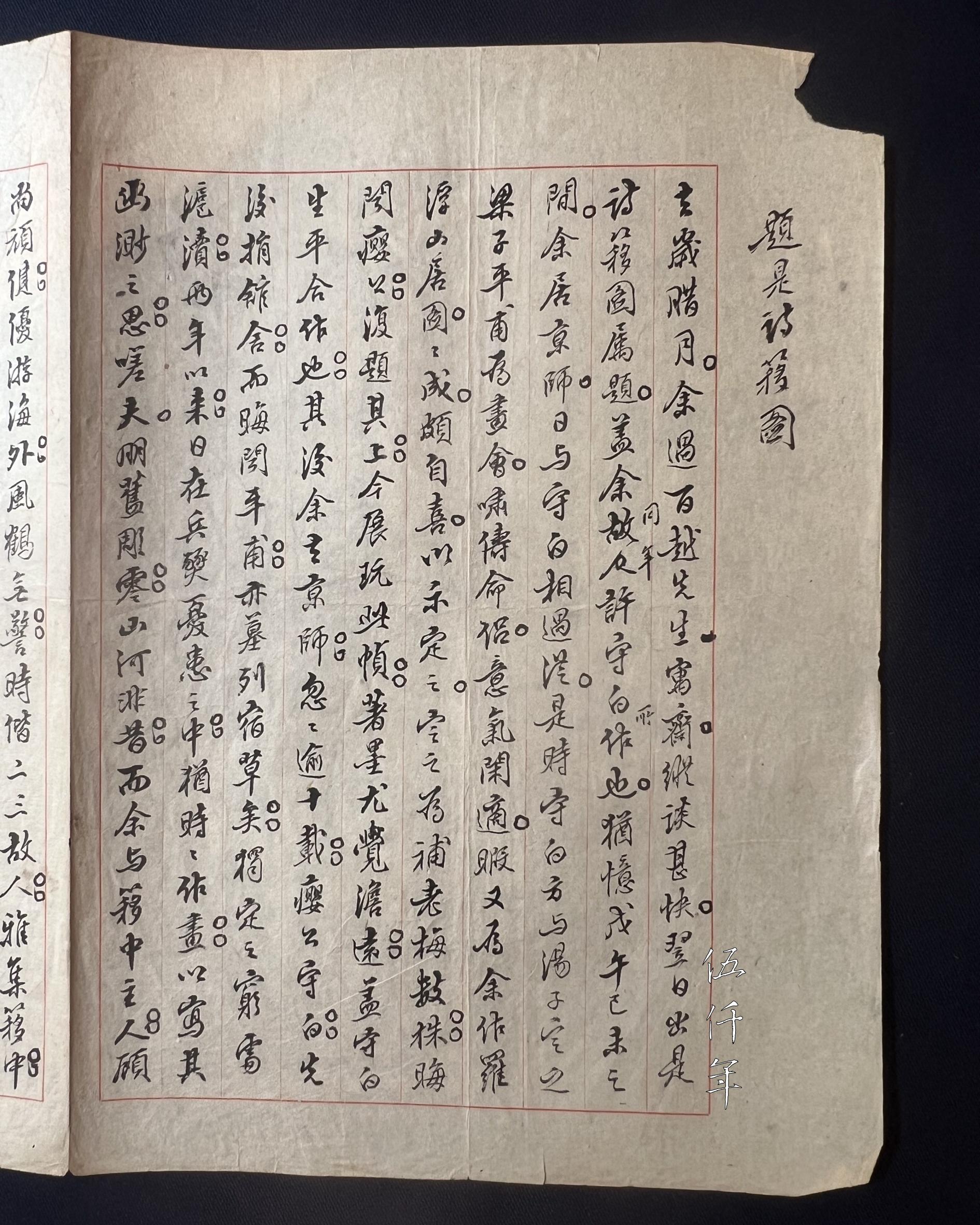
Colophon for Painting of Shih-shih Studio by Hsü Shou-pai (許守白)
In the second month of wu-yin (戊寅) year 1938, T’ang En-p’u inscribed a colophon on Painting of Shih-shih Studio by Hsü Chih-heng (許之衡 tzu Shou-pai 守白) saying:
“I still recall between the years of wu-wu (戊午) and chi-wei (己未), I was residing in the capital, I saw Shou-pai (守白) daily. At that time Shou-pai, together with T’ang Ting-chih (湯定之) and Liang P’ing-fu (梁平甫), had formed a painting society. We called each other fellow companion and our spirits were leisurely. In Shou-pai’s spare time, he painted the Lo-fu Mountain Dwelling for me. When the painting was completed, he was quite pleased and showed it to Ting-chih. Ting-chih added a few old prunus trees, Hui-wen (晦聞) and Ying-kung (癭公) then inscribed in turn. Now, as I unroll and view this painting, the brushwork appears all the more serene and unworldly—truly one of the finest in the lifework of Shou-pai.”
Wu-wu year corresponds to 1918 and chi-wei (己未) year corresponds to 1919. Shou-pai was the tzu of Hsü Chih-heng (許之衡), Ting-chih was the tzu of T’ang Ti (湯滌 1878-1948), P’ing-fu was the tzu of Liang Chin-han (梁錦漢), Hui-wen was also known by his hao Huang Chieh (黃節), and Ying-kung was the hao of Lo Tun-jung (羅惇曧 1872-1924). This colophon documents these close friends immersing themselves in painting and collaborating together.
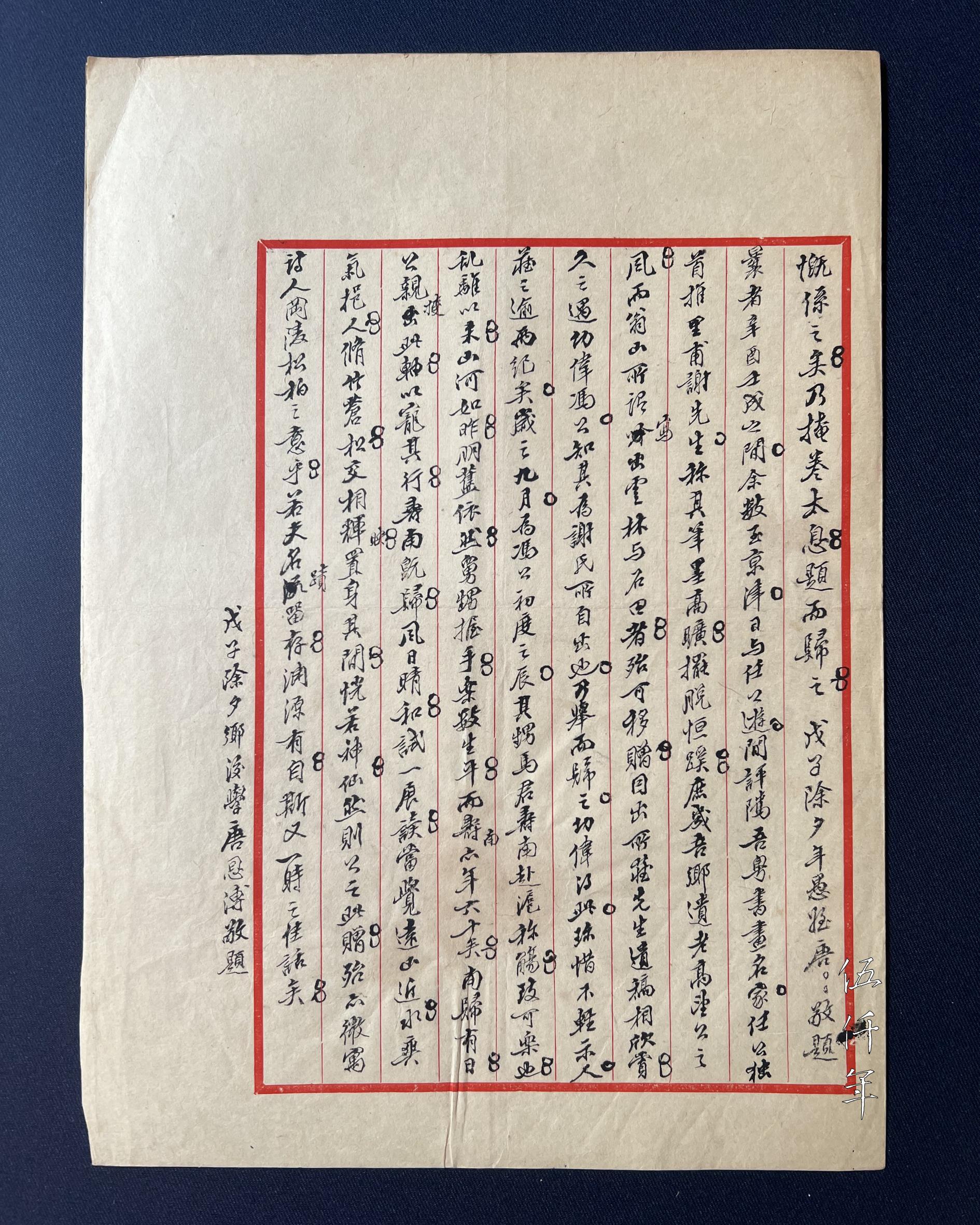
Colophon for Hanging Scroll of Landscape Painting by Hsieh Li-fu(謝里甫) in the Collection of Ma Shou-nan
On New Year’s Eve of wu-tzu (戊子) year 1948, T’ang En-p’u inscribed a colophon on Hanging Scroll of Landscape Painting by Hsieh Li-fu (謝里甫 original name Hsieh Lan-sheng 謝蘭生) in the Collection of Ma Shou-nan. Some of his words are:
“In the past, between the years of hsin-yu (辛酉) and jen-wu (壬戊), I traveled several times to Peking and Tientsin, spending my days in the company of Jen-kung (任公). Occasionally we would appraise the renowned calligraphers and painters of our home province Kwangtung. Jen-kung singularly advocated Mr. Hsieh Li-fu (謝里甫 1760-1831) to be the best, praising his brushwork as lofty and expansive, free from habitual ruts, comparable to the style of the Ming loyalist Kao Wang-kung (高望公), also from our native province. This is how Weng-shan (翁山) described, “emanating from Yün-lin (雲林) and Shih-t’ien (石田).”
Hsin-yu year corresponds to 1921 and jen-wu year corresponds to 1922. Jen-kung was the hao of Liang Ch’i-ch’ao (梁啟超). Hsieh Li-fu was born in 1760 and died in 1831, his original name Lan-sheng (蘭生), native of Fo-shan, Kwangtung province. Kao Wang-kung was born in 1616 and died in 1689, his original name was Yen (儼), native of Hsin-hui, Kwangtung province. He excelled in poetry, calligraphy, and painting. Weng-shan was the hao of Ch’ü Ta-chün (屈大均 1630-1696). Yün-lin was the hao of Ni Tsan (倪瓚 1301-1374). Shih-t’ien was the hao of Shen Chou (沈周 1427-1509).
By that time, Jen-kung had already retired from politics and was lecturing at major universities in Peking and Tientsin. He was then able to enjoy ample recreation in the company of friends, and they explored the paintings of eminent predecessors from their native province.
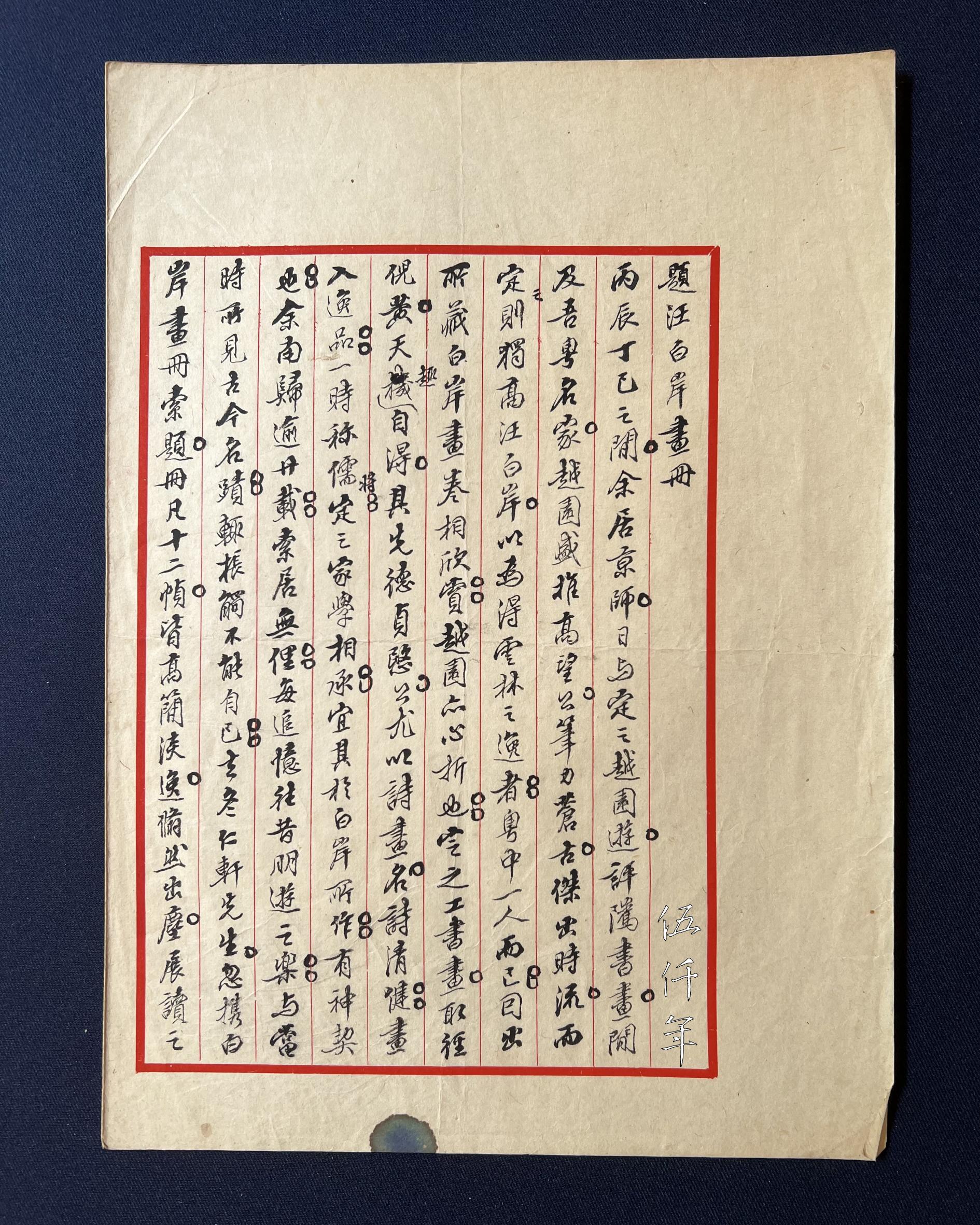
Colophon for Handscroll Painting by Wang Pai-an (汪白岸)
In the sixth month of keng-yin (庚寅) year 1950, T’ang En-p’u inscribed a colophon on Handscroll Painting by Wang Pai-an (汪白岸), some words are:
“Between the years ping-ch’en (丙辰) and ting-ssu (丁巳), I was living in the capital. Everyday I was accompanied by Ting-chih (定之) and Yüeh-yüan (越園). As we appraised and discussed calligraphy and paintings, we would also turn to the celebrated masters of Kwangtung province. Yüeh-yüan held Kao Wang-kung (高望公) in the highest esteem, praising his vigorous and archaic brushwork, exceptional among his contemporaries. Ting-chih, however, singled out Wang Pai-an (汪白岸), praising him to be the only one in Kwangtung who had truly attained the untrammeled spirit of Yün-lin (雲林). I then brought out the Handscroll Painting by Wang Pai-an in my collection to share and enjoy, and Yüeh-yüan was also deeply impressed.”
Yüeh-yüan was the tzu of Yü Shao-sung (余紹宋 1883-1949). Kao Wang-kung, original name Yen (儼 1616-1689). Pai-an was the tzu of Wang Hou-lai (汪後來1674–1752), native of P’an-yü, Kwangtung province. He was accomplished in poetry and skilled in painting. The joy of art appreciation shared among friends overflowed across the paper and the ink.
In April, the 4th year of the Republic 1915, T’ang En-p’u was appointed assistant compiler of the Bureau of Historia Ch’ing. In September, the 6th year of the Republic 1917, he was appointed compiler of the Bureau of Historia Ch’ing. Having obtained an official post and title, it was easier to reside in Peking for long. He befriended Ch’ing loyalists such as Shen Tseng-chih (沈曾植 1850-1922),Ma Ch’i-ch’ang (馬其昶 1855-1930), Hsia Sun-t’ung (夏孫桐 1857-1941) and Chang Erh-t’ien (張爾田 1874-1945).
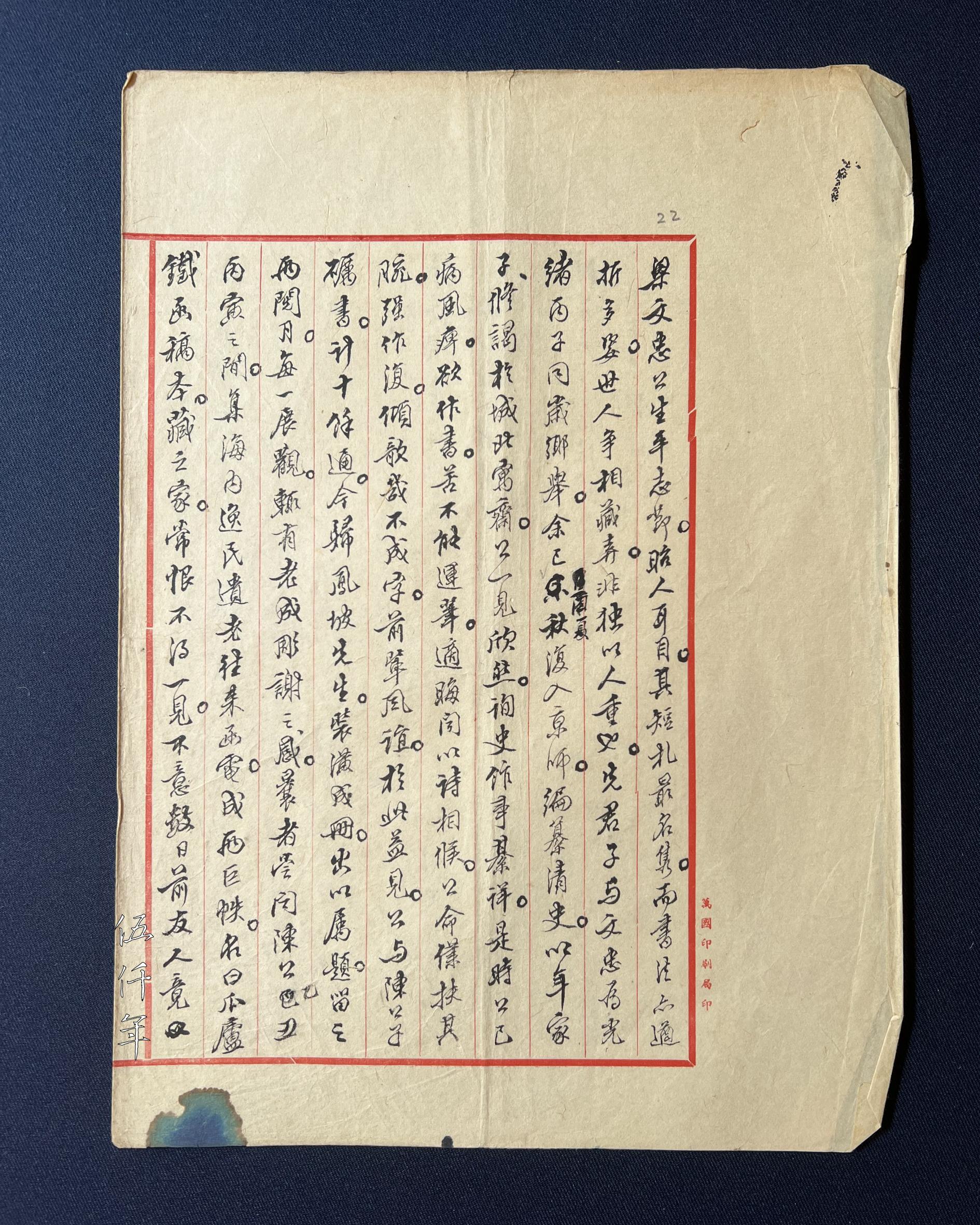
Letter of Appointment to the position of assistant editor from the Bureau of Historia Ch’ingColophon for Letters by Liang Ting-fen (梁鼎芬) in the Collection of Li Ching-k’ung
In the fourth month of keng-ch’en (庚辰) year 1940, T’ang En-p’u inscribed a colophon on Letters by Liang Ting-fen (梁鼎芬1859-1919) in the Collection of Li Ching-k’ang (李景康 1890-1960),” some of the words are:
“My late father and Liang Wen-chung-kung (梁文忠公) were both successful candidates in the provincial examinations of ping-tzu (丙子) year of the Kuang-hsü reign. In the summer of chi-wei (己未) year, I returned to Peking to compile the Draft History of Ch’ing. As the son of an examination peer, I paid a formal visit at his north-city residence. He was visibly delighted and inquired in great detail about matters at the Bureau of Historia Ch’ing. At that time he was already afflicted with paralysis, he wished to write but could not wield the brush. Then Hui-wen (晦聞) presented a poem. Liang ordered a servant to support his wrist, and with great effort he composed a response poem, the writing slanted and wavered, scarcely recognizable as characters. The comportment of the elder generation can be wholesomely revealed in this.”
Liang Wen-chung-kung was the posthumous title of the Ch’ing loyalist Liang Ting-fen (梁鼎芬). In the summer of chi-wei year 1919, T’ang En-p’u visited him, only a few months later, on the fourteenth day of the eleventh month in the same year, Liang Ting-fen passed away in Peking.

First page of Birthday Felicitation for Mr. K’ang of Nan-hai on His Sixtieth Birthday

Last page of Birthday Felicitation for Mr. K’ang of Nan-hai on His Sixtieth Birthday
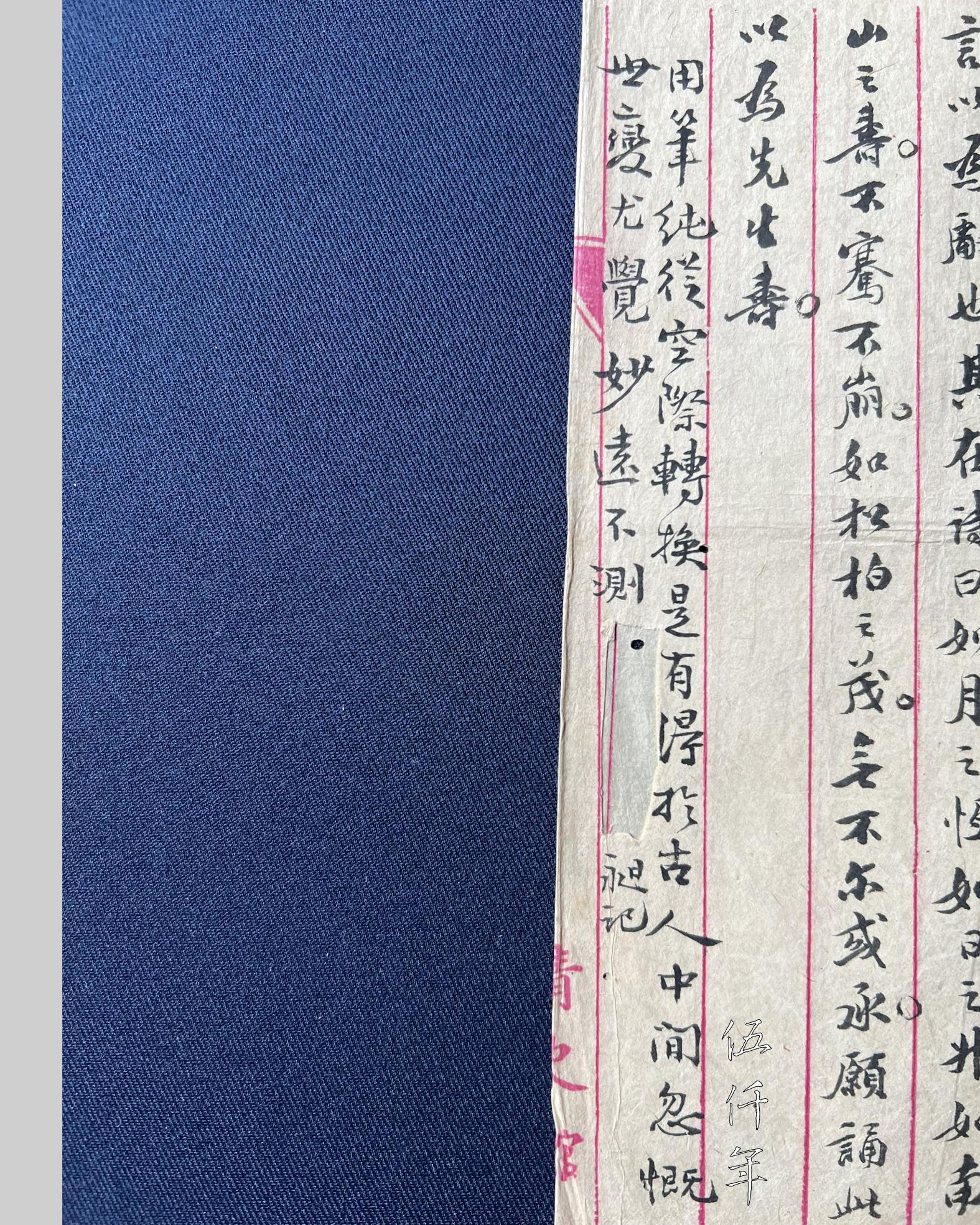
Colophon by Ma T’ung-po (馬通伯) on the last page
T’ang En-p’u was renowned in his lifetime for his mastery of classical prose, and Ma Ch’i-ch’ang was his true admirer. After T’ang En-p’u composed Epitaph of Mr. Ch’en, Grand Master for Governance and Expectant Appointee of Associate Administrator, Ma appended the following colophon:
“The style is refined and disciplined throughout. By using geographic notion in the middle to unify the whole piece, it gives an even greater impression of quiet distance and resonance.
Ch’i-ch’ang notes.”
After T’ang En-p’u wrote Birthday Felicitation for Mr. K’ang (Yu-wei 康有為) of Nan-hai on His Sixtieth Birthday, Ch’i-ch’ang again penned a colophon:
“The brush had been entirely wielded in empty space, turning and switching, this is assimilated from the ancients. In the middle there suddenly appears a lament over the changes of our time, it is particularly subtle, unchartered and unfathomable.
Ch’i-ch’ang notes.”
Like a single leaf that can tell the coming Autumn, this piece of birthday felicitation is presented here to give a flavour of his works:
“Birthday Felicitation for Mr. K’ang of Nan-hai on His Sixtieth Birthday.
I, En-p’u, have privately said before, that scholarship of our Kwangtung province, over a span of more than two thousand years, did not attain full brilliance until Master Pai-sha (白沙). After Master Pai-sha passed away, nearly five hundred years elapsed before Master Chu Chiu-chiang (朱九江 hao of Chu Tz’u-ch’i) appeared.
The learning of Chiu-chiang focused somewhat differently to that of Master Pai-sha. However, illuminating the Way of the Sages, contemplating to bring peace to the world and the country, these purposes were the same.
After the death of Chiu-chiang, among those disciples who are recognized to be capable of transmitting his learning, there is Mr. K’ang of Nan-hai (康南海). At that time, Mr. Lo Hsi-lin (羅樨林) and Mr. Chien Chu-chü (簡竹居) had been both transmitting the learning of Chiu-chiang to their own students, yet transmission by Mr. K’ang of Nan-hai was the most prolific. The objective of his learning is to proceed from substance to application, the essential focus is to bring order to the world, because this is of course the teaching of Chiu-chiang.
By the middle of the Kuang-hsü reign, Mr. K’ang was the first to advance a great proposition, to reform the political system, and the whole country looked up to him for good governance. When the calamity of factional persecution arose, he fled overseas. His disciples followed him, they could not bear to part. Although they were roaming in exile, he still expounded to his disciples the Way of the Sages every day, elucidating subtle teachings and clarifying cardinal principles. He sought to use his learning to change the world, assisted by the concept of Great Harmony. These ideas he proclaimed by word of mouth, and committed them to writing, propagating them within the country and beyond. No matter emperor, high officials, gentlemen and elders, women, children, merchants and labourers, all know and speak of Mr. K’ang of Nan-hai as the only figurehead of China.
After Mr. K’ang left the country, changes became ever more vexatious, learning became ever more heterogeneous, prejudiced speeches and perverse ideas filled the world, precepts collapsed and the established system was cast aside. From wu-hsü (戊戌) to hsin-hai (辛亥), in only fourteen years, Ch’ing dynasty fell, and Mr. K’ang himself has grown hoary with age. In the autumn of kuei-ch’ou (癸丑), Mr. K’ang returned from overseas. By that time, among the disciples of Chiu-chiang, figures such as Mr. Lo had long passed away, his aspirations unfulfilled. Mr. Chien has withdrawn into an obscure alley, devoting all his energy to writing, resolutely avoiding contact with the world. With the exception of Mr. K’ang who lives in Shanghai, he is unanimously applauded as a notable patriarch. His words and actions, his approbations and observations, are emulated by scholars. Is this not what legend calls an accomplished and virtuous man of the people?
Although I, En-p’u, did not receive teachings from Mr. K’ang, my late father studied under Chiu-chiang (九江) for a long time, and in my youth, I studied under Mr. Lo. When I got older, I read Mr. K’ang’s books, and was so moved that I was filled with admiration and the desire to know him. Therefore, on his birthday celebration, it is only appropriate that I should offer a few words as tribute. Here is my poetic expression:
Like eternal moon,
Like rising sun.
Like South Mountain,
Longevity never mars.
Like pine and cypress,
Lush and deserving.
I offer an ode,
On birthday occasion.”
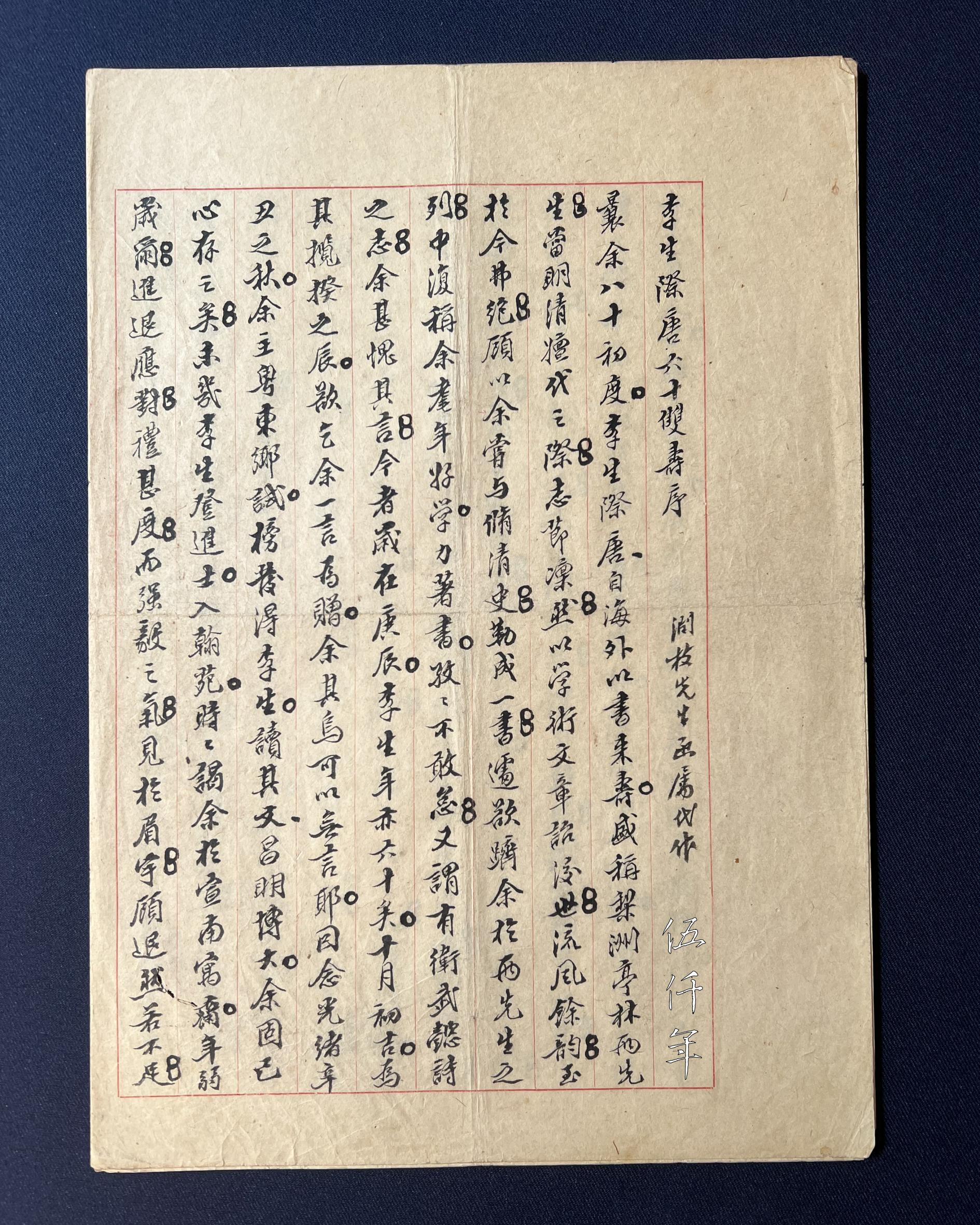
First page of Sixtieth Birthday Felicitations for Both Li Chi-t’ang (李際唐) and Wife
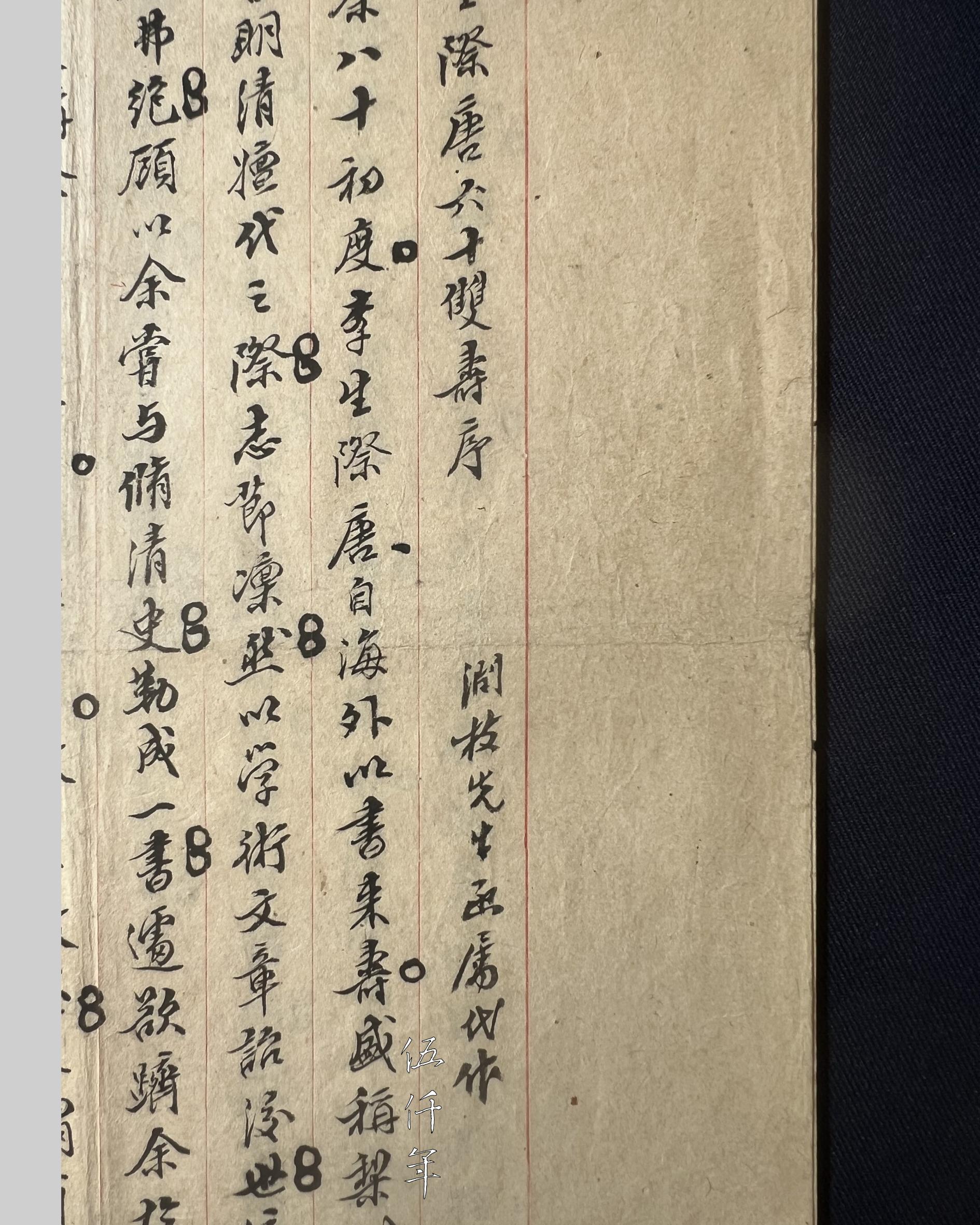
Words stating that this birthday felicitation was written on behalf of Hsia Sun-t’ung (夏孫桐)
Eminent scholars from the capital such as Ma Ch’i-ch’ang (馬其昶), Hsia Sun-t’ung (夏孫桐) and Liang Ch’i-ch’ao (梁啟超) successively asked T’ang En-p’u to ghostwrite for them. Among the surviving manuscripts are: Epitaph of Madam Yu, Mother of Fang Family, written on behalf of Ma Ch’i-ch’ang; Eulogium of General Ts’ai Sung-p’o (蔡松坡) at the State Funeral, written on behalf of Liang Ch’i-ch’ao; Birthday Felicitations for Both Mr. Li Luan-p’o (李鑾坡) and His Wife Madame Kao, written on behalf of Liang Ch’i-ch’ao; Sixtieth Birthday Felicitations for Both Li Chi-t’ang (李際唐 original name Ch’iao-shen 翹燊) and Wife, written on behalf of Hsia Sun-t’ung (夏孫桐); and others. There are also manuscripts by others that T’ang En-p’u revised, such as Biographies of Ch’en Tao-i (陳匋遺) Family from Chin-shan, written by Ch’en Shu-t’ung (陳叔通); Epitaph of Mr. Hsia of Chiang-yin, Grand Master for Assisting Toward Good Governance, Peacock Feather and Title of the Second Rank, Expectant Appointee Circuit, Prefect of Hu-chou City of Chekiang Province, written by Ch’en Shu-t’ung (陳叔通).
That Liang Ch’i-ch’ao requested T’ang En-p’u to ghostwrite was openly acknowledged by friends. In a letter dated 3 September in the 7th year of the Republic 1918, Liang Ch’i-ch’ao wrote to him:
“It is the mother’s birthday of Sun Yen-shen (孫彥深), and he asked for a birthday essay. I cannot but oblige. Yet I am really not adept at this kind of writing. Furthermore, there are already many articles I need to deliver promptly. My vigour and eyesights are inadequate for this. Therefore I beg you to ghostwrite instead…”
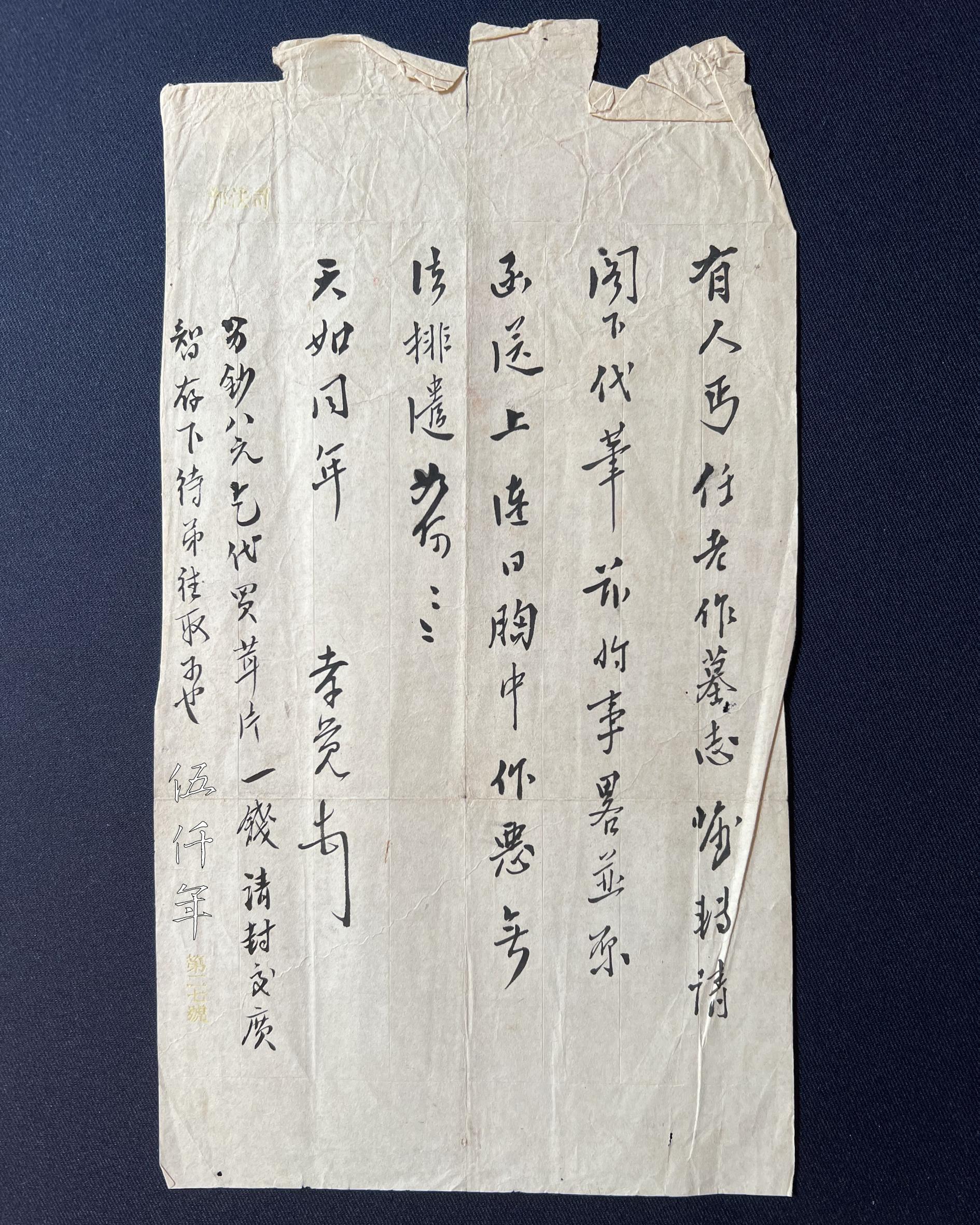
First letter by Huang Hsiao-chüeh (黃孝覺) to T’ang En-p’u
A letter from Huang Hsiao-chüeh (黃孝覺) to T’ang En-p’u reads:
“Someone has begged Jen-kung (任公 hao of Liang Ch’i-ch’ao) to write an epitaph, he beseeches your help to ghostwrite instead. I now enclose the biography and the original letter ….
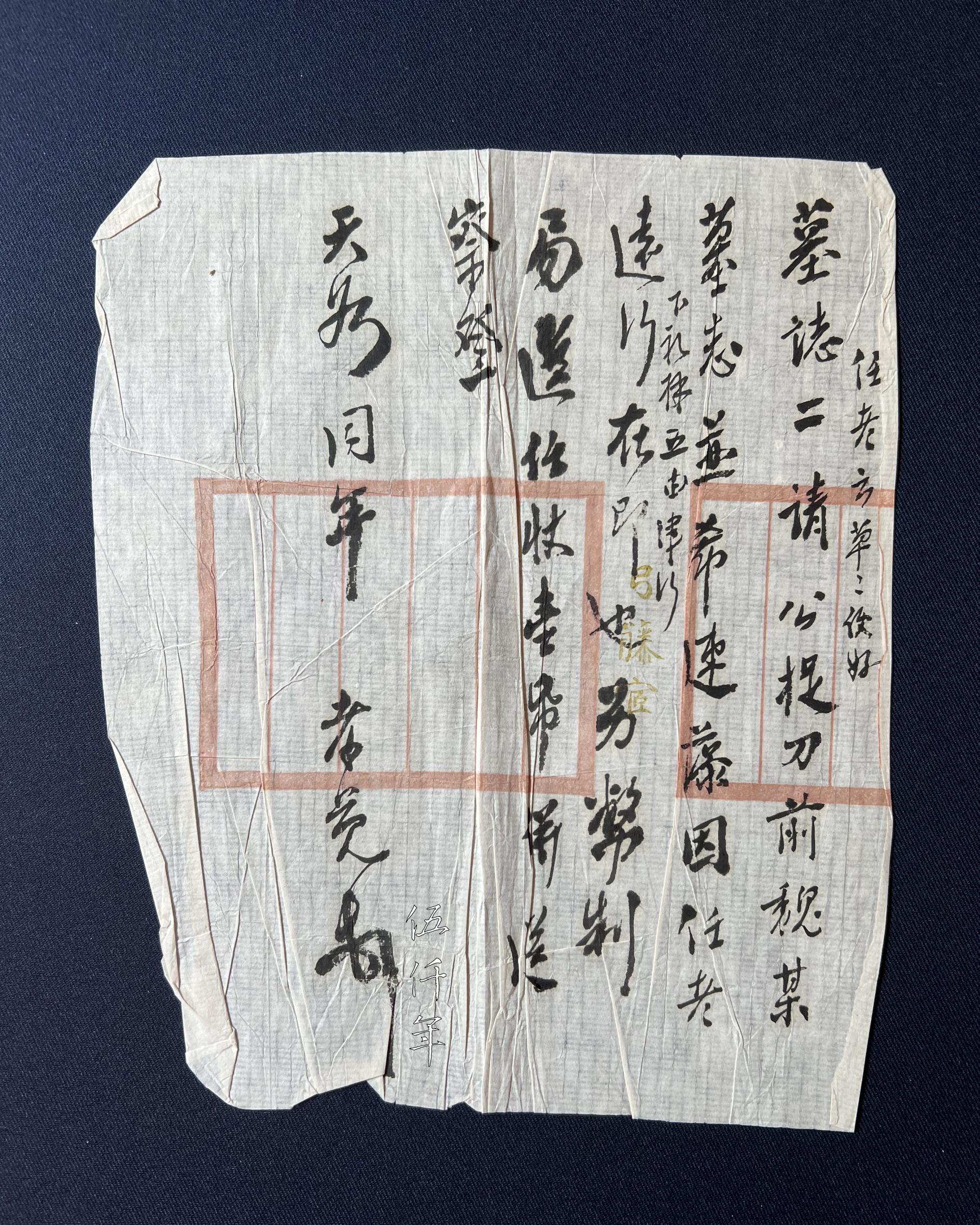
Second letter by Huang Hsiao-chüeh (黃孝覺) to T’ang En-p’u
A second letter from Huang Hsiao-chüeh to T’ang En-p’u reads:
“Jen-kung has asked you twice to ghostwrite this epitaph, he said it is acceptable to compose in haste. Please quickly finish writing the last epitaph dedicated to Mr. Wei, for Jen-kung is going to travel far very soon…
Lü Ts’an-ming (呂燦銘) wrote a foreword for Wen-chang Hsüeh (Studies in Literary Composition), some of his words are:
“In the 2nd year of the Republic 1913, I met Liang Ch’i-ch’ao in Peking at the house of T’an. We talked about T’an Chung-luan (譚仲鸞) who specialized in Han studies in his native city, as well as Mr. T’ang En-p’u. Hence I realized that the writings of Liang Ch’i-ch’ao were often ghostwritten by Mr. T’ang.”
Reading these writings, we can deduce that T’ang En-p’u ghostwrote a lot for Liang Ch’i-ch’ao.
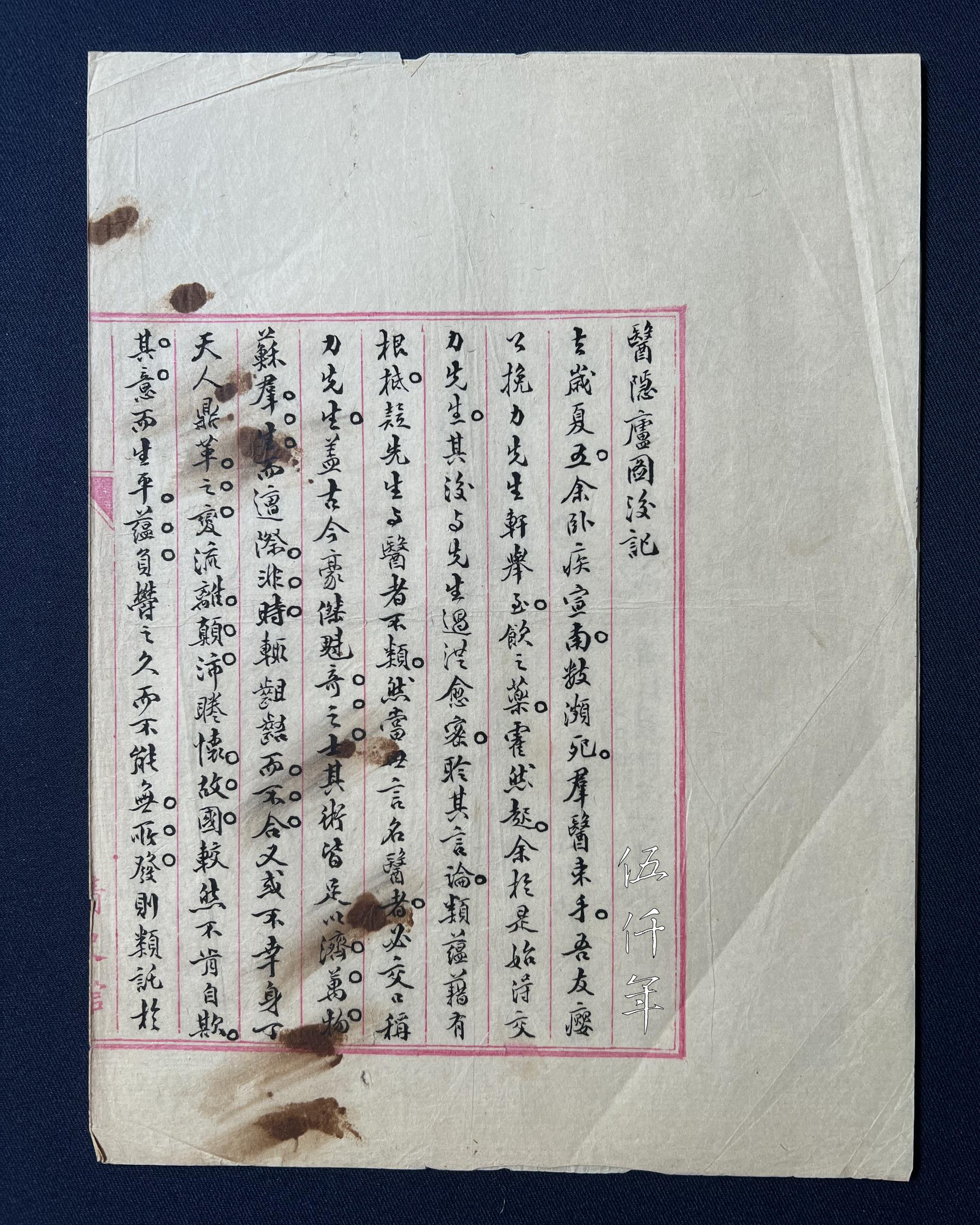
First page of An Account of the I-yin Lu Painting (醫隱廬圖後記)
T’ang En-p’u was highly skilled in the practice of medicine. During the few years he lived in Peking, he became acquainted with the Chinese doctor Li Hsüan-chü (力軒舉). In the eighth month of ping-ch’en (丙辰) year 1916, T’ang En-p’u wrote An Account of the I-yin Lu (醫隱廬 Medical Recluse Studio) Painting, some words are:
“In summer solstice last year, I was bed-ridden and gravely ill in Hsüan-nan. A number of times, I was near death. All the physicians were at a loss. My friend Ying-kung (癭公) took Mr. Li Hsüan-chü (力軒舉) to see me. After I took the medicine he prescribed, I immediately recovered. This was the beginning of my friendship with Mr. Li. Thereafter we met frequently, when he speaks, he is reserved and genteel, cultured and knowledgeable. I suspect he is different to ordinary physicians. When people talk about famous physicians today, invariably they exalt Mr. Li.”
Li Hsüan-chü, original name Chün (鈞), tzu Hsiang-yü (香雨), hao I-yin (醫隱 meaning medical recluse), native of Yung-fu, Fukien province, but lived in Fu-chou city. He attained the chü-jen degree in the 15th year of the Kuang-hsü reign, 1889. At one time he was the personal doctor to Empress Dowager and Kuang-hsü emperor.
Between the 8th to the 13th year of the Republic, 1919 to 1924, T’ang En-p’u sojourned in Hong Kong, while regularly visiting Peking and Tientsin. Soon after, through the successive recommendations of Chang I-lin (張一麐 1867-1943) and his fellow candidate from the kuei-mao (癸卯) year public examination Chang Ch’i-huang (張其鍠 1877-1927), he was appointed deputy secretary-general to the military staff of Wu P’ei-fu (吳佩孚 1874-1939) in the 14th year of the Republic 1925.
Between the 17th year to the 21st year of the Republic, 1928 to 1932, he took up residence in Shanghai. In 1932 he moved to Hong Kong, faraway from discord and retired himself from political life. Though his friends from north and south kept up with their correspondences without interruption.
In December of the 30th year of the Republic 1941, Japanese forces attacked and occupied Hong Kong, the T’ang residence was subsequently plundered. In the 38th year of the Republic 1949, when mainland China fell to the communists, he could but seek a reclusive life to preserve himself.
T’ang En-p’u moved within an exceptionally wide circle, as demonstrated by letters and poetry from forty-three friends.They include influential political figures, illustrious military commanders, leading magnates of the business world, erudite scholars of great learning, eminent poets and men of letters, as well as masters of the painting brush. Altogether, there are two hundred and ninety letters, four postcards, and seventy-nine pages of poems and prose.
The forty three friends are:
1) Hsia Sun-t’ung (夏孫桐 1857–1941).
Tzu Jun-chih (閏枝), native of Chiang-yin, Kiangsu province. He attained the chin-shih degree in the 18th year of the Kuang-hsü reign 1892. He was appointed prefect of Huchou, Ningpo, and Hangchou under the Ch’ing dynasty.
There is one letter addressed to T’ang En-p’u.

Letter by Hsia Sun-t’ung (夏孫桐) to T’ang En-p’u
2) Li Che-ming (李哲明 born 1857).
Tzu Hsing-ch’iao (惺樵), native of Hanyang, Hupei province. He attained the chin-shih degree in the 18th year of the Kuang-hsü reign 1892. He was appointed junior compiler of the Hanlin Academy under the Ch’ing dynasty.
There are two letters addressed to T’ang En-p’u.
3) Chiang K’ung-yin (江孔殷 1864–1952).
Hao Hsia-kung (霞公), native of Nanhai, Kwangtung province. He attained the chin-shih degree in the 30th year of the Kuang-hsü reign 1904. He was appointed bachelor of the Hanlin Academy under the Ch’ing dynasty.
There are five letters, eight pages of poetry (fourteen poems), and six pages of tz’u poetry (eleven lyrics), addressed and gifted to T’ang En-p’u.
4) Huang Pin-hung (黃賓虹 1865–1955).
Original name Chih (質), native of Shehsien, Anhwei province, but born in Chin-hua, Chekiang province. He was appointed professor of the Department of Art at National Chi-nan University and the National Hangchou Art Academy.
There are twenty-one letters, three sheets of poems, four pages of Ku-yin wen-tzu cheng (古印文字證 Textual Evidence of Ancient Seal Script), five pages of Chin-shih Hsüeh (金石學 Epigraphy), addressed and gifted to T’ang En-p’u.
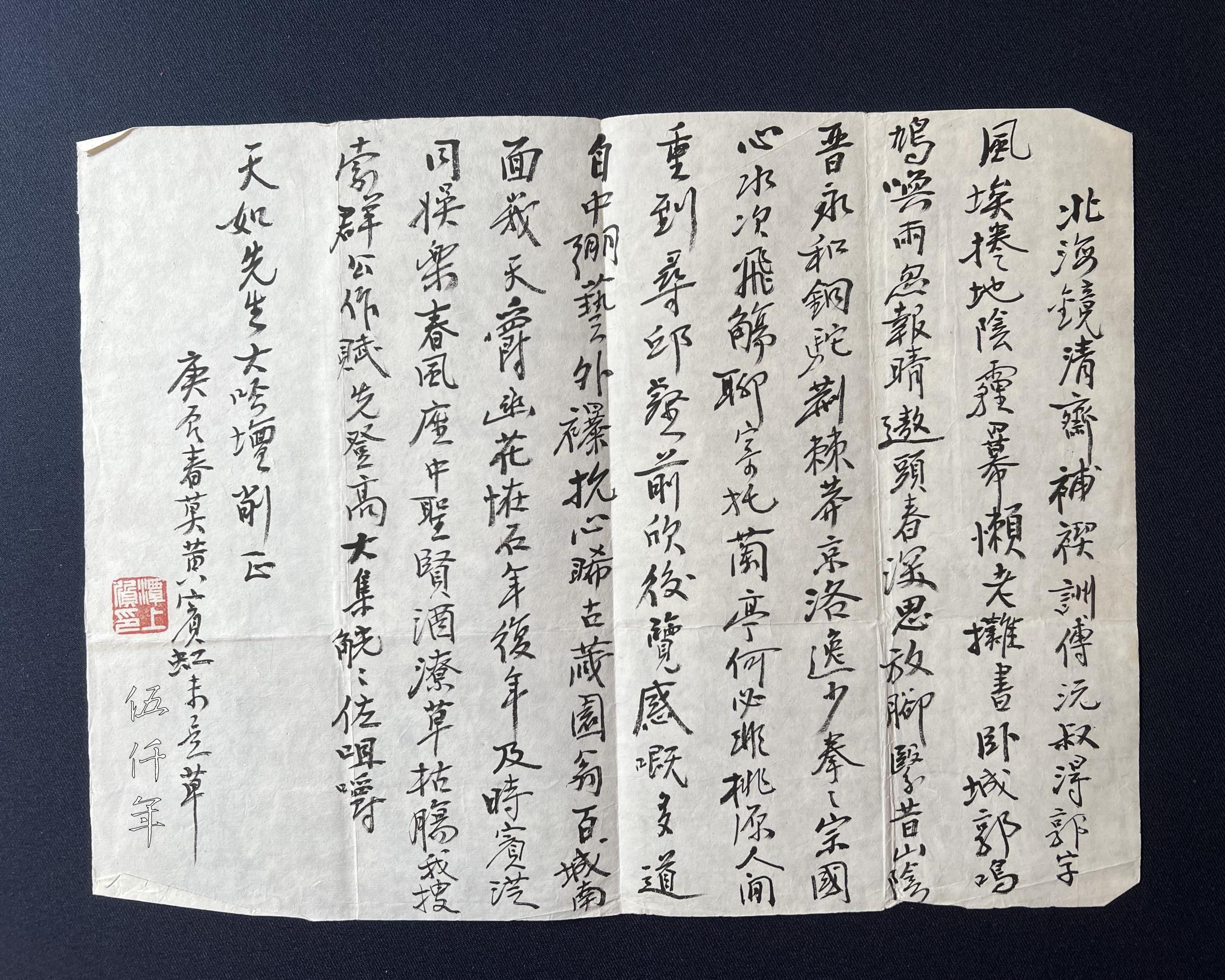
Poem by Huang Pin-hung (黃賓虹) to T’ang En-p’u
5) Tseng Hsi-ching (曾習經 1867–1926).
Tzu Kang-fu (剛甫), native of Chieh-yang, Kwangtung province. He attained the chin-shih degree in the 18th year of the Kuang-hsü reign 1892. He was appointed vice minister of the Ministry of Revenue under the Ch’ing dynasty.
There is one letter addressed to T’ang En-p’u.
6) Chu Ju-chen (朱汝珍 1870–1943).
Hao P’ing-san (聘三), native of Ch’ing-yüan, Kwangtung province. He attained the pang-yen (榜眼) degree, second place at the metropolitan examination in the 30th year of the Kuang-hsü reign 1904. He was appointed secretary of the Ministry of Justice under the Ch’ing dynasty, president of the Confucian Academy in Hong Kong.
There are nine letters addressed to T’ang En-p’u.
7) Yao Tzu-fang (姚梓芳 1871–1952).
Hao Ch’iu-yüan (秋園), native of Chieh-yang, Kwangtung province. He attained the chü-jen degree in the 33rd year of the Kuang-hsü reign 1907. He was appointed secretary in the Ministry of Justice under the Ch’ing dynasty.
There is one letter addressed to T’ang En-p’u.
8) Lo Tun-yung (羅惇曧 1872–1924).
Hao Ying-kung (癭公), native of Shun-te, Kwangtung province. He attained the title of yu-kung (優貢 recommended tribute student) in the 25th year of the Kuang-hsü reign 1899. Later he was appointed counselor of the State Council of the Republic of China.
There are thirty letters addressed to T’ang En-p’u.
9) Liang Ch’i-ch’ao (梁啟超 1873–1929).
Hao Jen-kung (任公), native of Hsin-hui, Kwangtung province. He attained the chü-jen degree in the 15th year of the Kuang-hsü reign 1889. He was appointed Minister of Justice and Minister of Finance of the Republic of China.
There are eighteen letters and two postcards addressed to T’ang En-p’u.
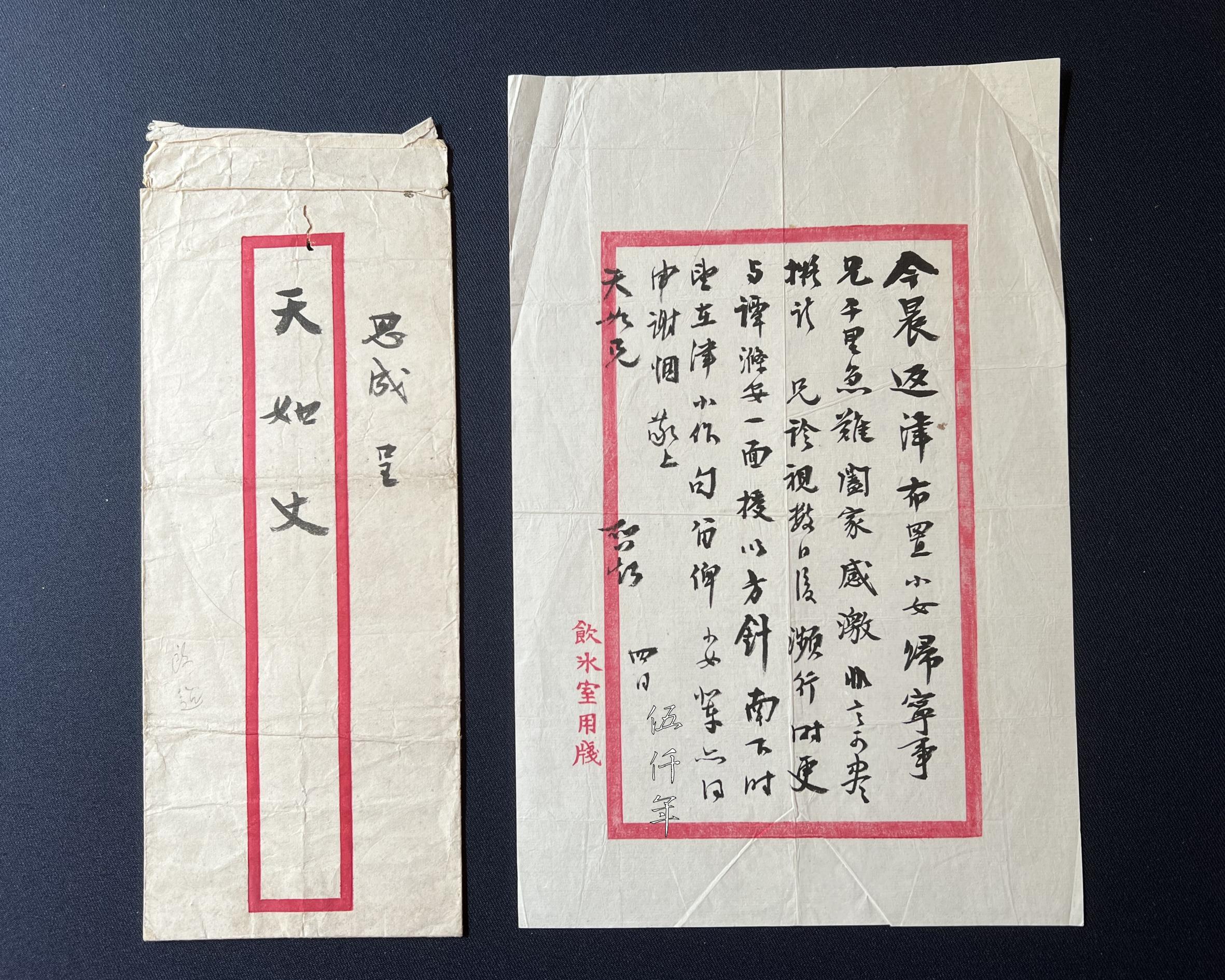
Letter by Liang Ch’i-ch’ao (梁啟超) to T’ang En-p’u
10) Huang Hui-wen (黃晦聞 1873–1935).
Hao Chieh (節), native of Shun-te, Kwangtung province. He was appointed professor at Peking University, director of the Department of Education of Kwangtung province of the Republic of China.
There are twenty-three letters, ten pages of poetry (eight poems), one page of tz’u poetry (one lyric), addressed and dedicated to T’ang En-p’u.
11) Wu P’ei-fu (吳佩孚 1874–1939).
Tzu Tzu-yü (子玉), native of P’eng-lai, Shantung province. He attained the hsiu-ts’ai degree and was awarded First Class General of the Army of the Republic of China.
There are two letters addressed to T’ang En-p’u.
12) Chu Ch’ing-lan (朱慶瀾 1874–1941).
Tzu Tzu-ch’iao (子橋), native of Shao-hsing, Chekiang province. He was awarded General of the Army of the Republic of China, governor of Kwangtung province.
There is one letter addressed to T’ang En-p’u.
13) Chang Erh-t’ien (張爾田 1874–1945).
Tzu Meng-chü (孟劬), native of Jen-ho, Chekiang province. He attained the chü-jen degree and was appointed secretary of the Ministry of Justice under the Ch’ing dynasty.
There is one letter addressed to T’ang En-p’u.
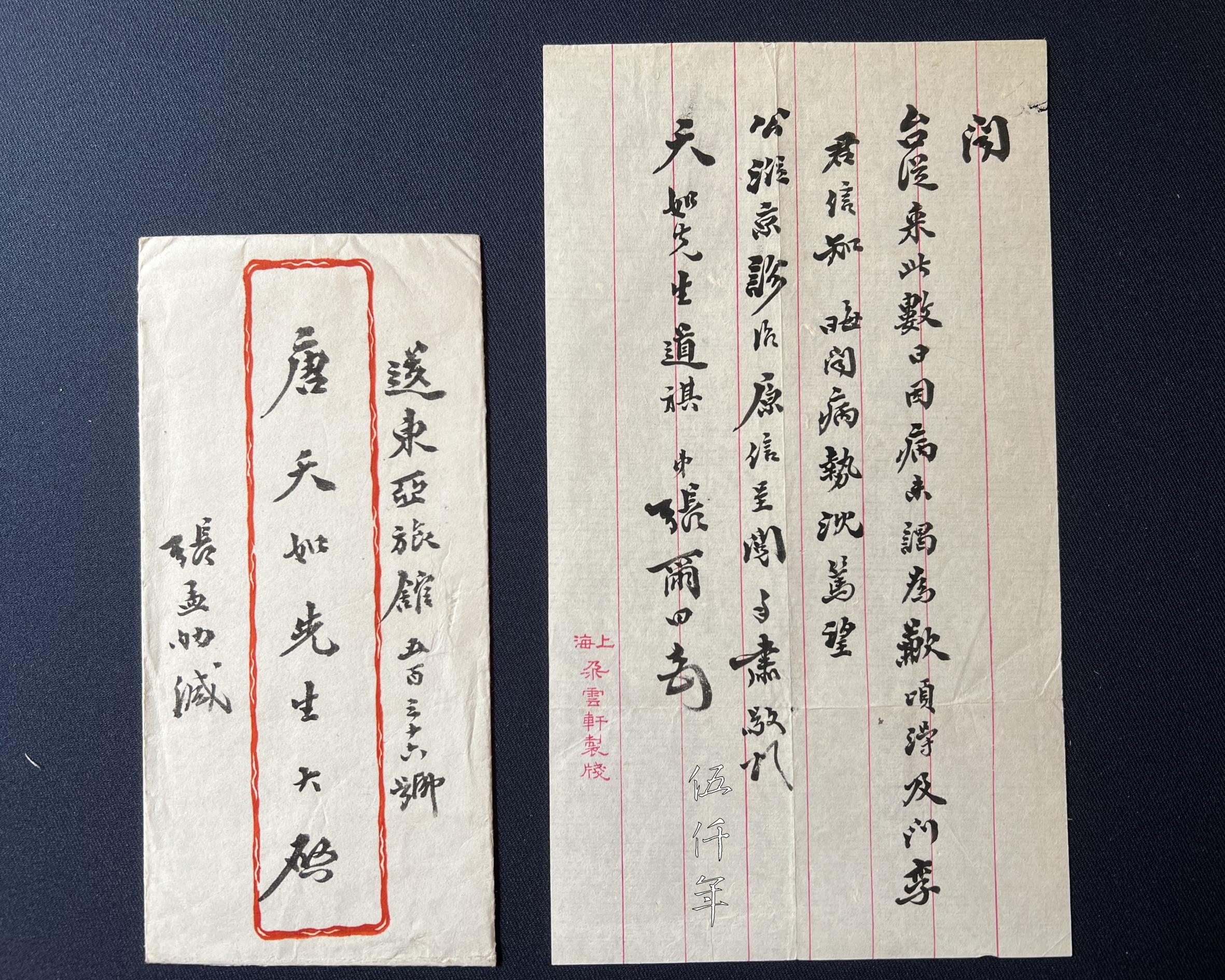
Letter by Chang Erh-t’ien (張爾田) to T’ang En-p’u
14) Lin Ch’ang-min (林長民 1876–1925).
Tzu Tsung-meng (宗孟), native of Min-hou, Fukien province. He was appointed member of the Diplomatic Committee of the Presidential Office of the Republic of China.
There are two letters and one postcard addressed to T’ang En-p’u.
15) Liang Ch’i-hsün (梁啟勛 1876–1965).
Tzu Chung-ts’e (仲策), younger brother of Liang Ch’i-ch’ao (梁啟超), native of Hsin-hui, Kwangtung province. He was appointed lecturer at the National University of Ch’ing-tao and the Peiping Railway Administration Institute.
There is one letter addressed to T’ang En-p’u.
16) Ch’en Ching-ti (陳敬第 1876–1966).
Tzu Shu-t’ung (叔通), native of Hangchou, Chekiang province. He attained the chin-shih degree in the 29th year of the Kuang-hsü reign 1903. He was elected member of the House of Representatives of the Republic of China.
There are five letters, one page of poetry with a single poem, addressed and gifted to T’ang En-p’u.
17) Chang Ch’i-huang (張其鍠 1877–1927).
Tzu Tzu-wu (子武), native of Yung-fu, Kwangsi province. He attained the chin-shih degree in the 30th year of the Kuang-hsü reign 1904. He was appointed secretary-general of the military staff of Wu P’ei-fu.
There are eight letters, two pages of poetry with one poem, addressed and dedicated to T’ang En-p’u.
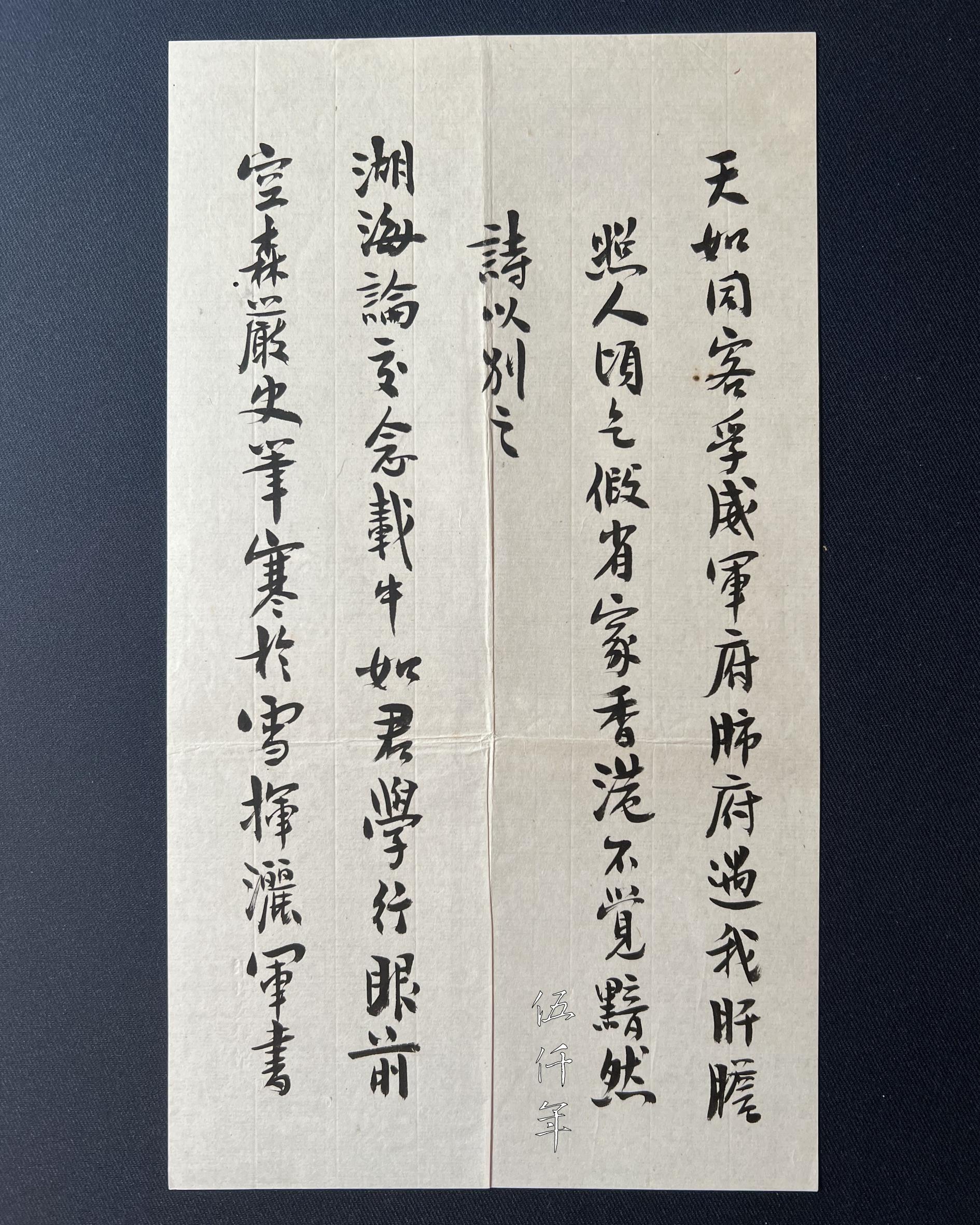
Letter by Chang Ch’i-Huang (張其鍠) to T’ang En-p’u
18) Liu Ch’ung-yu (劉崇佑 1877–1942).
Hao Sung-sheng (菘生), native of Hou-kuan, Fukien province. He attained the chü-jen degree in the 19th year of the Kuang-hsü reign 1893. He was elected member of the House of Representatives of the Republic of China, and was a practicing lawyer.
There is one letter addressed to T’ang En-p’u.
19) Chiang T’ien-to (江天鐸 1878–1948).
Tzu Ching-an (競庵), native of Hua County, Kwangtung province. He was a graduate of Waseda University in Japan, appointed acting minister of the Ministry of Agriculture and Commerce of the Republic of China, and was a practicing lawyer.
There are forty-eight letters, thirteen pages of poetry with twenty-seven poems, two sheets of poetry with ten poems, and twenty one essays, addressed and presented to T’ang En-p’u.
20) T’ang Ti (湯滌 1878–1948).
Tzu Ting-chih (定之), native of Wu-chin, Kiangsu province. He was appointed instructor of Calligraphy and Painting Research Society at Peking University, professor at National Peiping College of Fine Arts.
There are five letters and one postcard addressed to T’ang En-p’u.
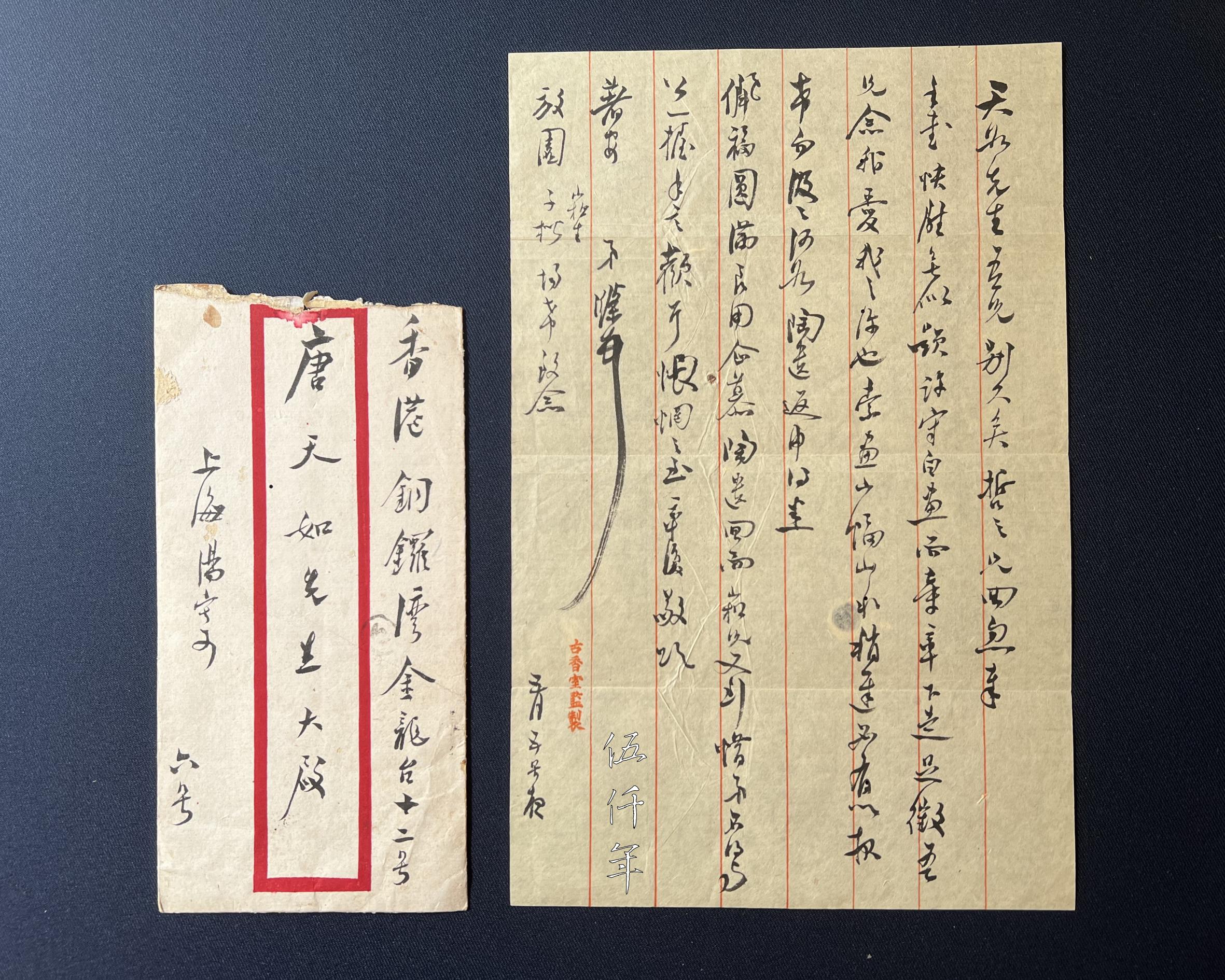
Letter by T’ang Ti (湯滌) to T’ang En-p’u
21) Lin Chih-chün (林志鈞 1878–1961).
Tzu Tsai-p’ing (宰平), native of Min County, Fukien province. He was appointed Minister of Judicial Administration of the Republic of China.
There is one letter addressed to T’ang En-p’u.
22) Huang Shih-lung (黃士龍 1880–after 1950).
Tzu Shen-t’ien (莘田), native of Hua County, Kwangtung province. He was a graduate of Kiangnan Naval Academy and the Kwangtung Military Academy. He was appointed lieutenant general of the National Revolutionary Army, deputy commander-in-chief of the Kwangtung Military Government.
There are eleven letters addressed to T’ang En-p’u.
23) Liu Ch’ung-chieh (劉崇傑 1880–1956).
Tzu Tzu-k’ai (子楷), younger brother of Liu Ch’ung-yu (劉崇佑), native of Hou-kuan, Fukien province. He was a graduate of Waseda University in Japan. He was appointed envoy extraordinary and minister plenipotentiary of the Republic of China to Spain, Portugal, Germany, and Austria.
There is one letter addressed to T’ang En-p’u.
24) K’ung Chao-yen (孔昭焱 1881–1943).
Tzu Hsi-pai (希白), native of Nan-hai, Kwangtung province. He attained the kung-sheng (貢生 tribute student) degree and was a graduate of the accelerated degree program at Hosei University in Japan. He was appointed deputy minister of the Ministry of Justice of the Republic of China, and president of the Northeast Branch of the Supreme Court.
There are three letters addressed to T’ang En-p’u.
25) Ch’en T’ao-i (陳陶遺 1881–1946).
Original name Kung-yao (公瑤), native of Chin-shan, Kiangsu province. He attained the hsiu-ts’ai degree in the 27th year of the Kuang-hsü reign 1901. He was appointed governor of Kiangsu Provincial Government, the Republic of China.
There are seven letters addressed to T’ang En-p’u.
26) Chiang Fang-chen (蔣方震1882–1938).
Tzu Pai-li (百里), native of Hangchou, Chekiang province. He was appointed chief of the general staff to Wu P’ei-fu, and General of the Army of the Republic of China.
There are sixteen letters and one sheet of poetry, addressed and gifted to T’ang En-p’u.
26-1) With an accompanying letter signed by both Hsieh Kuang-ch’ien (薛光前 original name Kuei-sheng 桂生 1910-1978) and Hsieh I-cheng (謝貽徵).
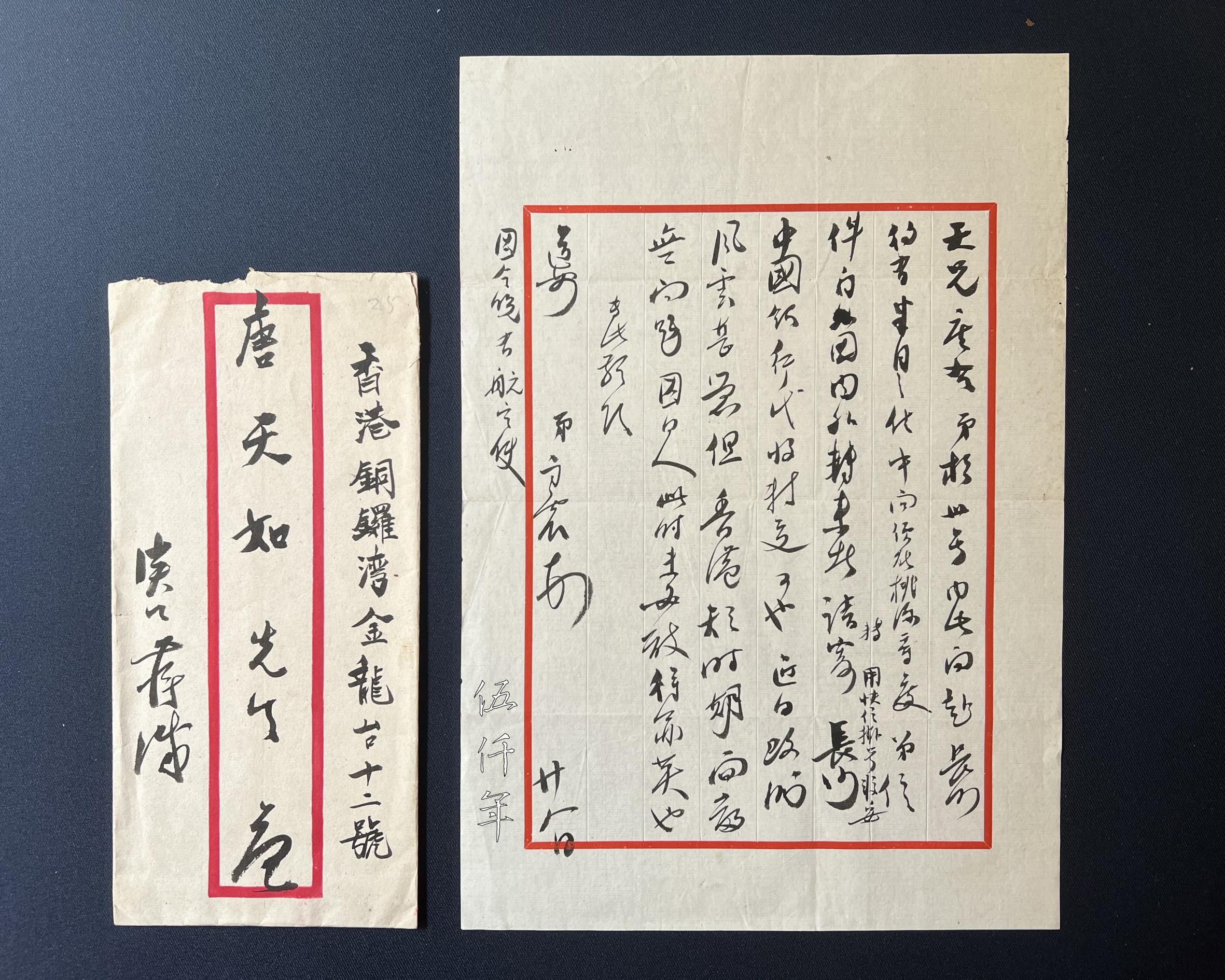
Letter by Chiang Fang-chen (蔣方震) to T’ang En-p’u
27) Feng Keng-kuang (馮耿光 1882–1966).
Tzu Yu-wei (幼偉), native of P’an-yü, Kwangtung province. He was a graduate of the Imperial Japanese Army Academy. He was appointed president of the Bank of China.
There is one letter addressed to T’ang En-p’u.
28) Yü Shao-sung (余紹宋 1882–1949).
Tzu Yüeh-yüan (越園), native of Lung-yu, Chekiang province. He attained the hsiu-ts’ai degree. He was appointed president of the National Peiping College of Fine Arts.
There are six letters addressed to T’ang En-p’u
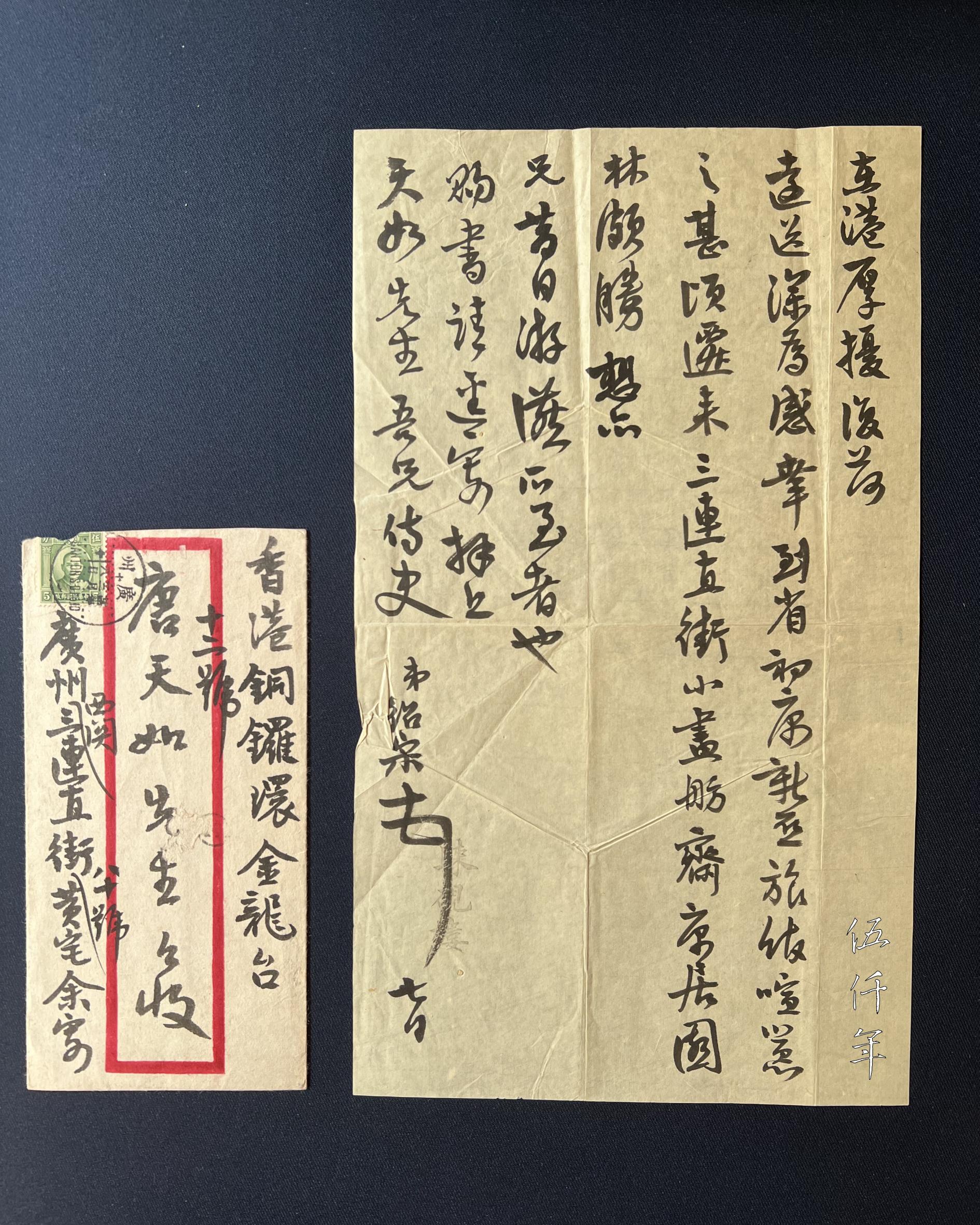 .
.
Letter by Yü Shao-sung (余紹宋) to T’ang En-p’u
29) Liu Tao-k’eng (劉道鏗 1883–1957).
Hao Fang-yüan (放園), native of Hou-kuan, Fukien province. He attained the title of yu-kung (優貢 recommended tribute student). He was elected secretary-general of the House of Representatives of the Republic of China, and director of the Department of Civil Affairs of the Ministry of the Interior.
There are twenty-two letters addressed to T’ang En-p’u.
30) Ch’ien Yung-ming (錢永銘 1885–1958).
Tzu Hsin-chih (新之), native of Wu-hsing, Chekiang province. He was educated at Peiyang University. He was appointed deputy minister of the Ministry of Finance of the Republic of China, and delegate to the National Constituent Assembly.
There are two letters addressed to T’ang En-p’u.
30-1) Reply letter from T’ang En-p’u.
31) Hsiung Shih-li (熊十力 1885–1968).
Tzu Tzu-chen (子貞), native of Huang-kang, Hupeh province. He was appointed professor at Peking University, Wuchang University, National Central University, and Chekiang University.
There are eight letters addressed to T’ang En-p’u.
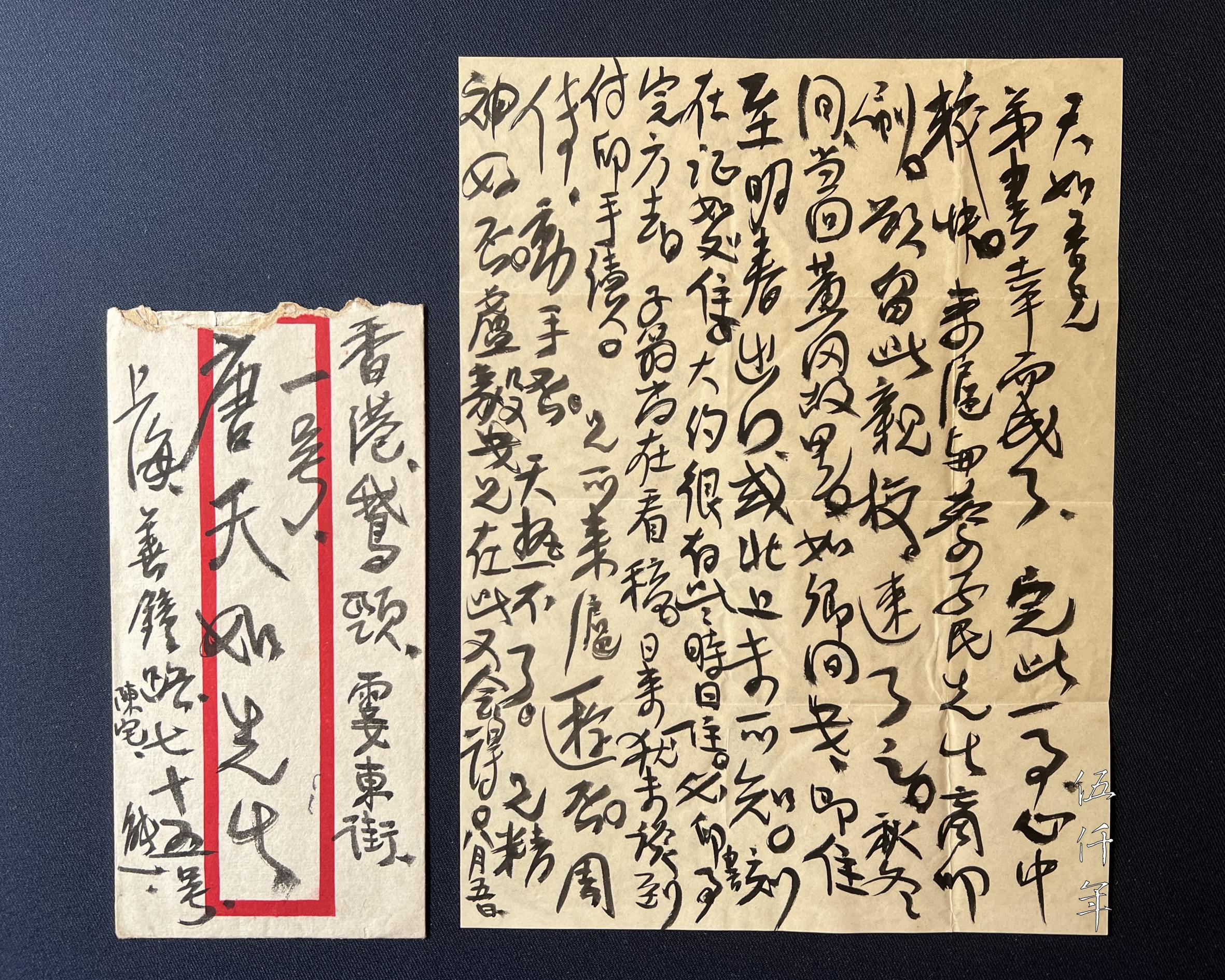
Letter by Hsiung Shih-li (熊十力) to T’ang En-p’u
32) Fan Kuang (樊光 1886–1962).
Tzu Chen-ch’u (震初), native of Chin-yün, Chekiang province. He was a graduate of National Central University. He was appointed secretary-general of the Ministry of Foreign Affairs of the Republic of China and concurrently director of Department of General Affairs of the Ministry of Foreign Affairs under the Executive Yuan.
There are two letters addressed to T’ang En-p’u.
33) Shen K’un-san (沈崑三 1889–1955).
Known by his original name, native of Fu-chou, Fukien province. He was a graduate of the University of Cambridge, England. He was appointed director of Shanghai Cigarette Manufacturers’ Industrial Guild, and director of Yichung Tobacco Company.
There is one letter addressed to T’ang En-p’u.
34) Ch’en Ming-shu (陳銘樞 1889–1965).
Tzu Chen-ju (真如), native of Ho-p’u, Kwangtung province. He was appointed Minister of Communications of the Republic of China, governor of Kwangtung Provincial Government.
There are four letters, one page of tz’u poetry (one lyric), addressed and dedicated to T’ang En-p’u.
35) Liu Wen-tao (劉文島 1893–1967).
Tzu Ch’en-su (塵蘇), native of Kuang-chi, Hupeh province. He was educated at Paoting Military Academy. He was appointed plenipotentiary envoy of the Republic of China to Germany, Austria, and Italy.
There is one letter addressed to T’ang En-p’u.
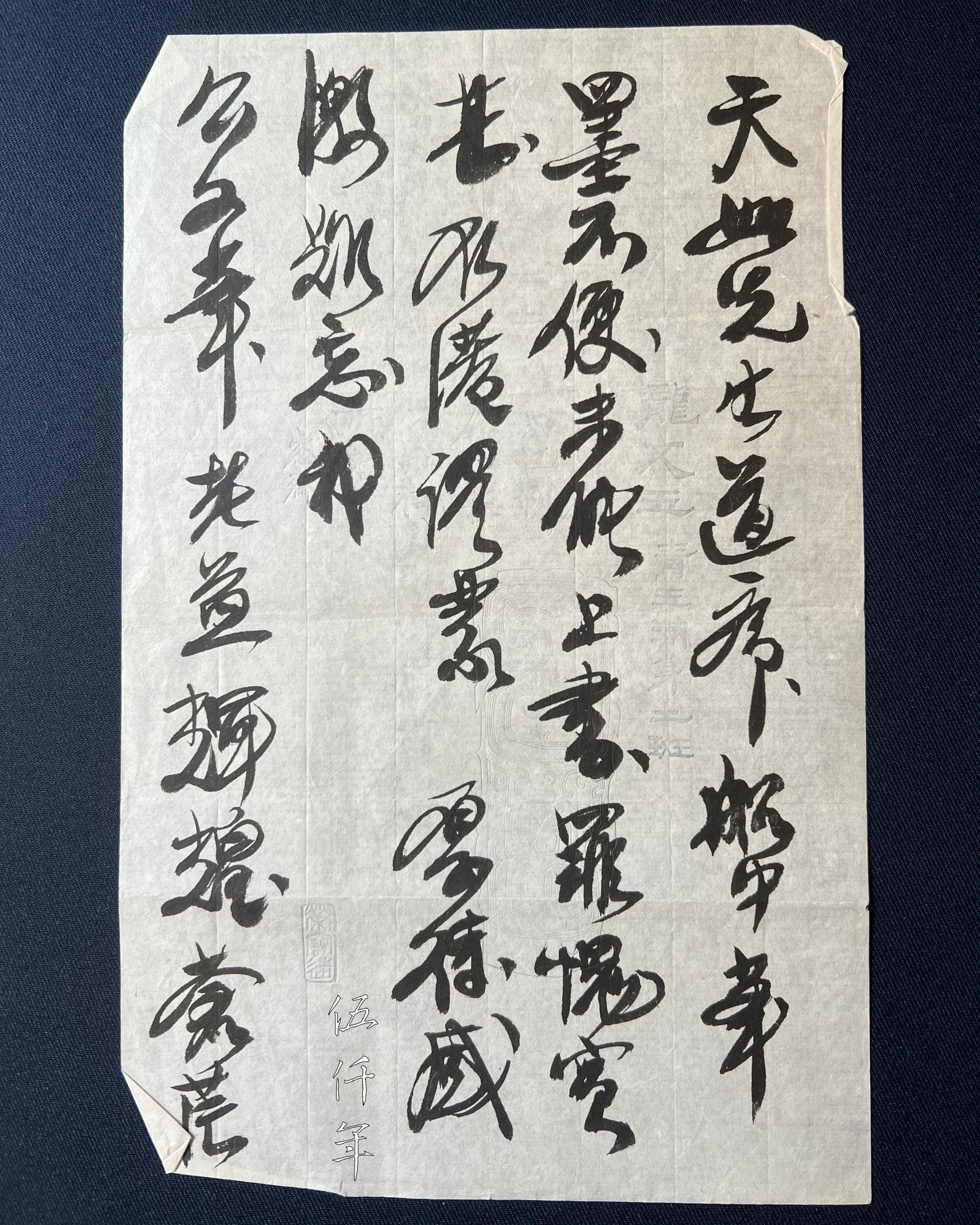
Letter by Liu Wen-tao (劉文島) to T’ang En-p’u
36) Yen Tun-ho (嚴敦和 1895–1968).
Tzu Hui-yü (惠宇), native of Chên-chiang, Kiangsu province. He was appointed deputy general manager of Kincheng Banking Corporation, manager of P’u-i Textile Mill, and founder of Ta-tung Cigarette Factory.
There is one letter addressed to T’ang En-p’u.
37) Li Ts’ang-p’ing (李滄萍 1897–1949).
Tzu Chü-sheng, native of Fêng-shun, Kwangtung province. He studied in the Department of Chinese Literature at Peking University. He was appointed secretary of Kwangtung Provincial Government, and secretary of the Department of Education of Kwangtung Provincial Government.
There are six letters addressed to T’ang En-p’u.
38) Huang Hsiao-chüeh (黃孝覺 ?–1918).
Known by his original name, native of Nan-hai, Kwangtung province. He attained the chü-jen degree in the 29th year of the Kuang-hsü reign 1903. He was appointed director of the Kwangtung Department of Finance, intendant of Ch’ao–hsün Circuit.
There are two letters, one page of poetry with a single poem, addressed and gifted to T’ang En-p’u.
39) Chang Jen P’u (張仁普).
He was appointed director of Department of Justice of Kwangsi province, attorney-general of High Prosecutors Office of Kwangsi, Kwangtung, Hupeh, Fukien and Kiangsi provinces.
There are six letters to T’ang En-p’u.
40) P’an Hao (潘灝).
There is one letter to T’ang En-p’u.
41) K’ang Yu-wei (康有為 1858–1927).
Hao Nan-hai (南海), Ch’ang-su (長素), native of Nan-hai, Kwangtung province. He attained the chin-shih degree in the 21st year of the Kuang-hsü reign 1895. He was appointed secretary of Tsung-li Ya-men.
There is one letter addressed to Wu P’ei-fu.
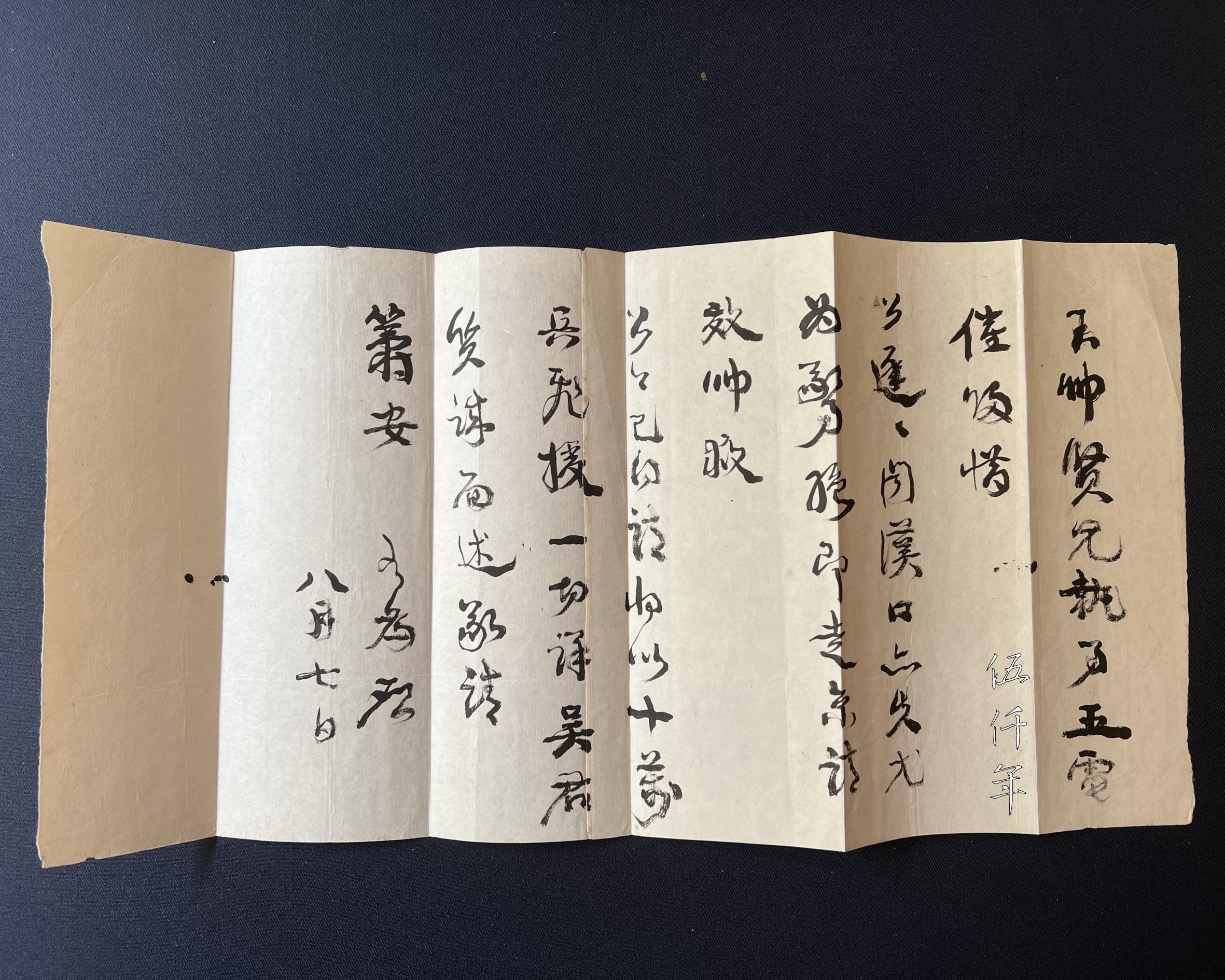
Letter by K’ang Yu-wei (康有為) to Wu P’ei-fu (吳佩孚)
There are four more literary gifts from friends:
1) A poetry album in running script by Shen Tseng-chih (沈曾植), dedicated to T’ang En-p’u.
Shen Tseng-chih (1850-1922), hao Mei-sou (寐叟), native of Chia-hsing, Chekiang province. He attained the chin-shih degree in the 6th year of the Kuang-hsü reign 1880. He was appointed provincial administration commissioner of Anhwei province, and Minister of Education.
2) A proofreading copy of the Preface of the History of Pai-tai Mountain (白帶山志) by P’u Ju (溥儒), gifted to T’ang En-p’u.
P’u Ju (1896-1963), tzu Hsin-yü (心畬), native of Peking. He was appointed professor at the National Taiwan Normal University and Tunghai University.
3) Two pages of poetry by Chih-po (之慱).
4) Reproduction copy of an album of poetry by Lei Chün-shih (雷君軾).
Lei Chün-shih, studio name Hsiao-lin-ch’ih Kuan (小臨池館), native of P’an-yü, Kwangtung province. He was an art collector based in Hong Kong.
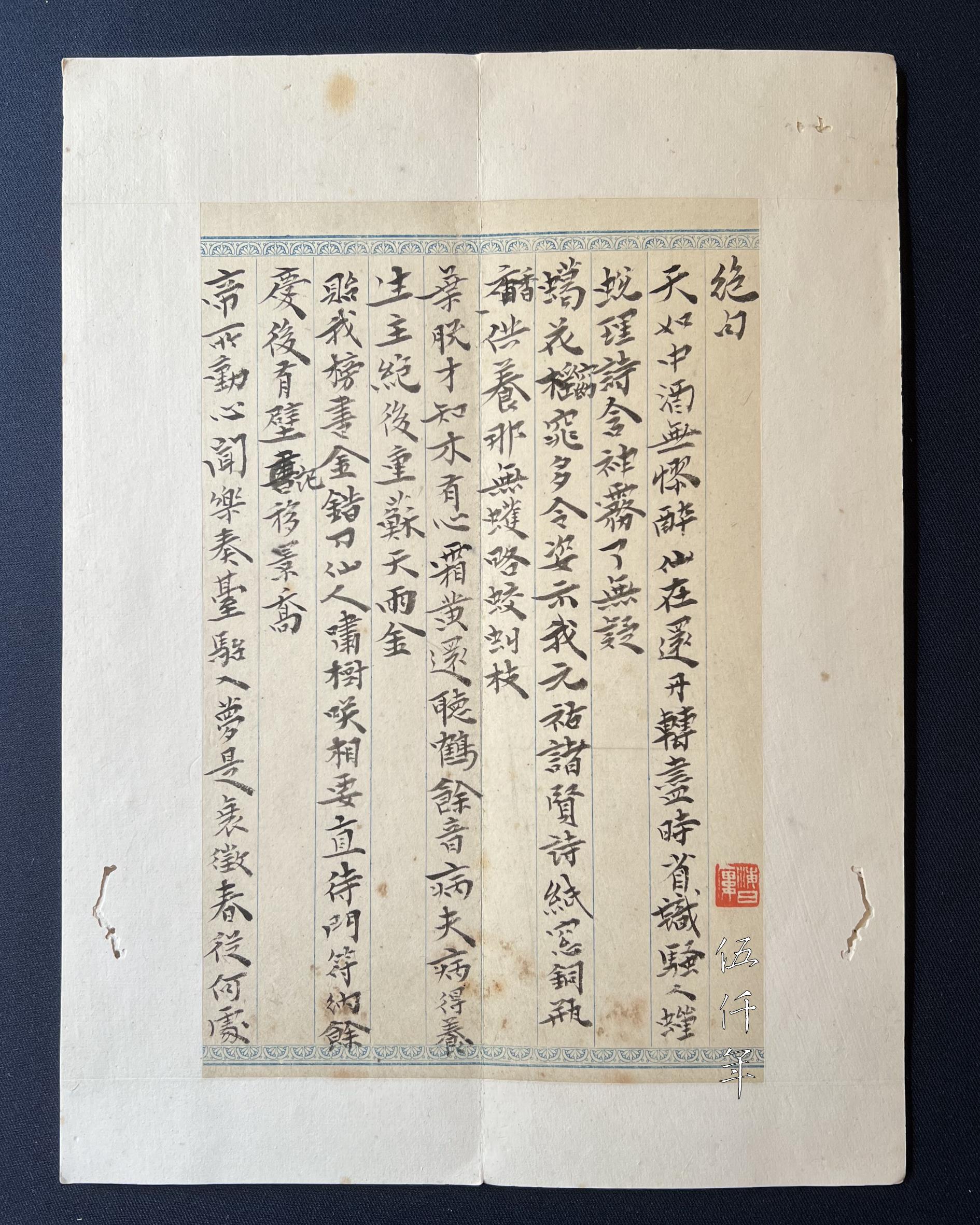
Poetry album in running script by Shen Tseng-chih (沈曾植)
Surveying these letters and pages of poetry, it is viable to trace the beginnings of many friendships. T’ang En-p’u was a renowned chü-jen from Kwangtung province, Chang Ch’i-huang (張其鍠) and Huang Hsiao-chüeh (黃孝覺) were his t’ung-nien (同年), a term used to call fellow candidates who passed the same public examination. After joining the Bureau of Historia Ch’ing, T’ang En-p’u likely met the chief compiler Shen Tseng-chih (沈曾植), assistant compilers Hsia Sun-t’ung (夏孫桐), Li Che-ming (李哲明), Lo Tun-yung (羅惇曧), Chang Erh-t’ien (張爾田), Ch’en Ching-ti (陳敬第) and Ma Ch’i-ch’ang (馬其昶). Lo Tung-yung was already a prominent poet from Kwangtung province.
When T’ang En-p’u was living in Peking, far away from his home province, fellow literati from Kwangtung naturally led to closer affinity. They included Chiang K’ung-yin (江孔殷), Tseng Hsi-ching (曾習經), Chu Ju-chen (朱汝珍), Yao Tzu-fang (姚梓芳), Liang Ch’i-ch’ao (梁啟超), Huang Hui-wen (黃晦聞), and Liang Ch’i-hsüan (梁啟勛) who was the younger brother of Liang Ch’i-ch’ao.
When Chang Ch’i-huang was serving as secretary-general to the military staff of Wu P’ei-fu (吳佩孚), T’ang En-p’u held the post of deputy secretary-general. Those attached to the headquarters were Chiang Fang-chen (蔣方震), Chiang T’ien-to (江天鐸), and Huang Shih-lung (黃士龍).
T’ang En-p’u was passionate about painting, painters such as Huang Pin-hung (黃賓虹), T’ang Ti (湯滌), and Yüeh Shao-sung (余紹宋) henceforth became close friends.
In a letter to T’ang En-p’u, Lin Chang-min (林長民) wrote:
“Yesterday I just came back from a long trip. When I passed by Tientsin, I received an introduction letter from Jen-kung. Originally, I intended to visit you today to pay my respects. However, I have caught a cold on my distant travels, my frail body is ill, making a visit awkward. I have no choice but to send Jen-kung’s letter of introduction to you first, to seek your kind perusal …”
Jen-kung, hao of Liang Ch’i-ch’ao, was the acknowledged leader of the literary world in Peking. He commanded an exceptionally wide social network, his introductions would have been plentiful.
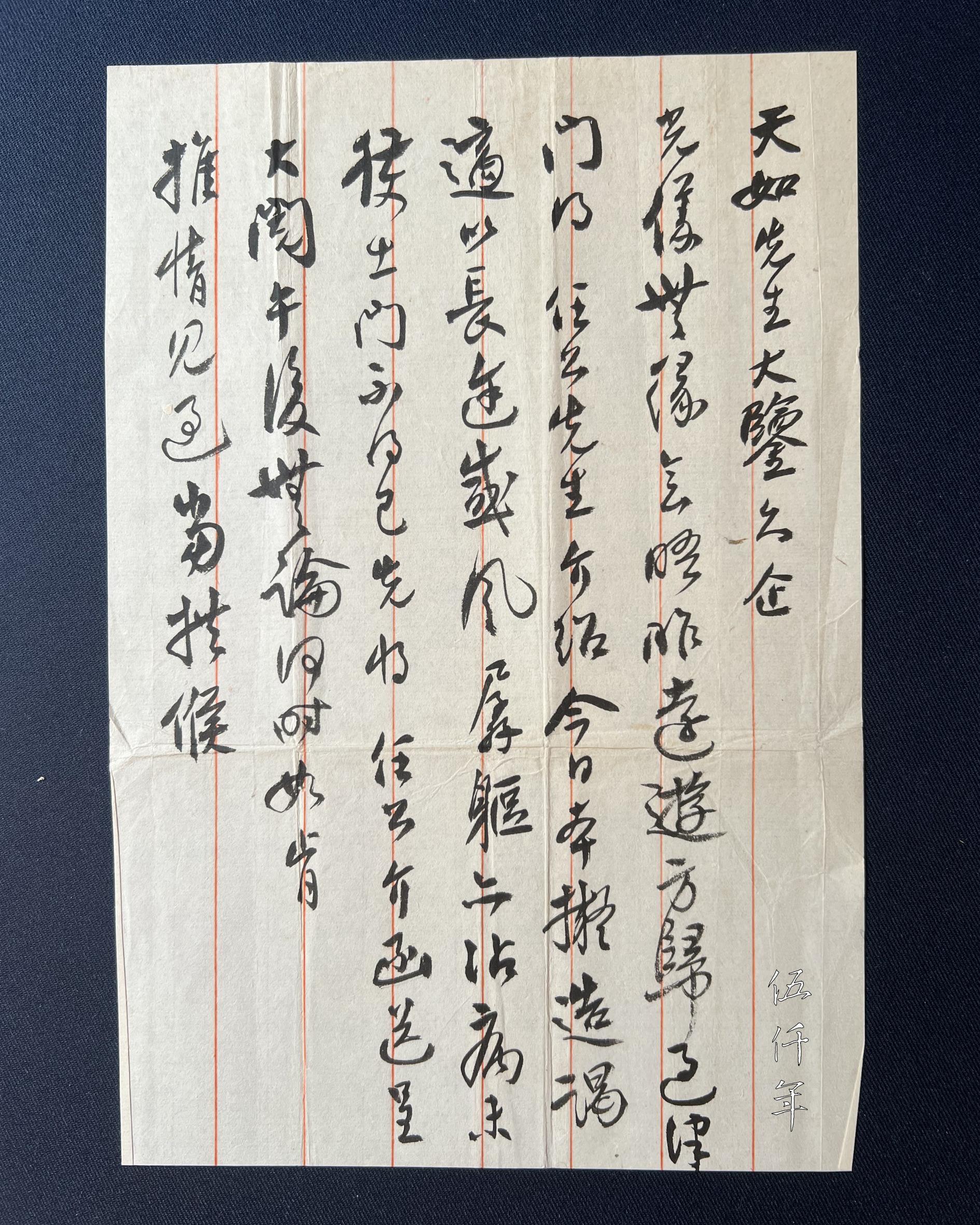
Letter by Lin Ch’ang-min (林長民) to T’ang En-p’u
The several hundred pieces of calligraphy and paintings that T’ang En-p’u once collected had long dispersed. The few I have kept, altogether eleven pieces, were what remained. Although they merely evoke some vague memory of that bygone world, they are precious traces to behold.
The pieces of calligraphy and paintings are:
1) A pair of calligraphy couplets in regular script by Tseng Hsi-ching (曾習經) in memory of Mrs. T’ang En-p’u.
2) Calligraphy by Chu Ju-chen (朱汝珍) and painting by Hsün-po (壎伯) on either side of a folding fan, inscribed by T’ang En-p’u. Hsün-po was the hao of T’ang Ching-ch’ang (湯經常), native of Hu-chou, Chekiang province.
3) A pair of twelve character calligraphy couplets in regular script by Lo Tun-yung (羅惇曧), dedicated to T’ang En-p’u.
4) A set of four hanging scrolls of Avataṃsaka Sutra in running script by Lo Tun-yung (羅惇曧), dedicated to T’ang En-p’u.
5) A fan leaf with tz’u lyrics To the tune Huan hsi sha (浣溪沙) and To the tune Ch’üeh ch’iao hsien (鵲橋仙) in running script by Liang Ch’i-ch’ao (梁啟超), dedicated to T’ang En-p’u.
6) A fan leaf in running script by Huang Hui-wen (黃晦聞), dedicated to T’ang En-p’u.
7) A hanging scroll of flowers and birds painted by Nieh Ch’i-te (聶其德 1885-1972), wife of Chang Ch’i-huang (張其鍠), dedicated to T’ang En-p’u.
8) A fan leaf titled A Sail in River and Sky, painted by monk Hui-yün (慧雲), dedicated to T’ang En-p’u. Hui-yün, hao Chuan-shih-seng (轉世僧 reincarnated monk).
9) A birthday scroll in running script by Ch’eng Tsu-i (程租彝), dedicated to T’ang En-p’u.
10) A hanging scroll titled Wild Geese Alighting on a Cold Islet, painted by Chiang Ting-min (蔣定閩), eldest daughter of Chiang Kuang-nai (蔣光鼐 1888-1967), dedicated to T’ang En-p’u.
11) A birthday scroll by members of the Hong Kong Branch of World Red Swastika Society, dedicated to T’ang En-p’u, dated October of the 37th year of the Republic 1948.
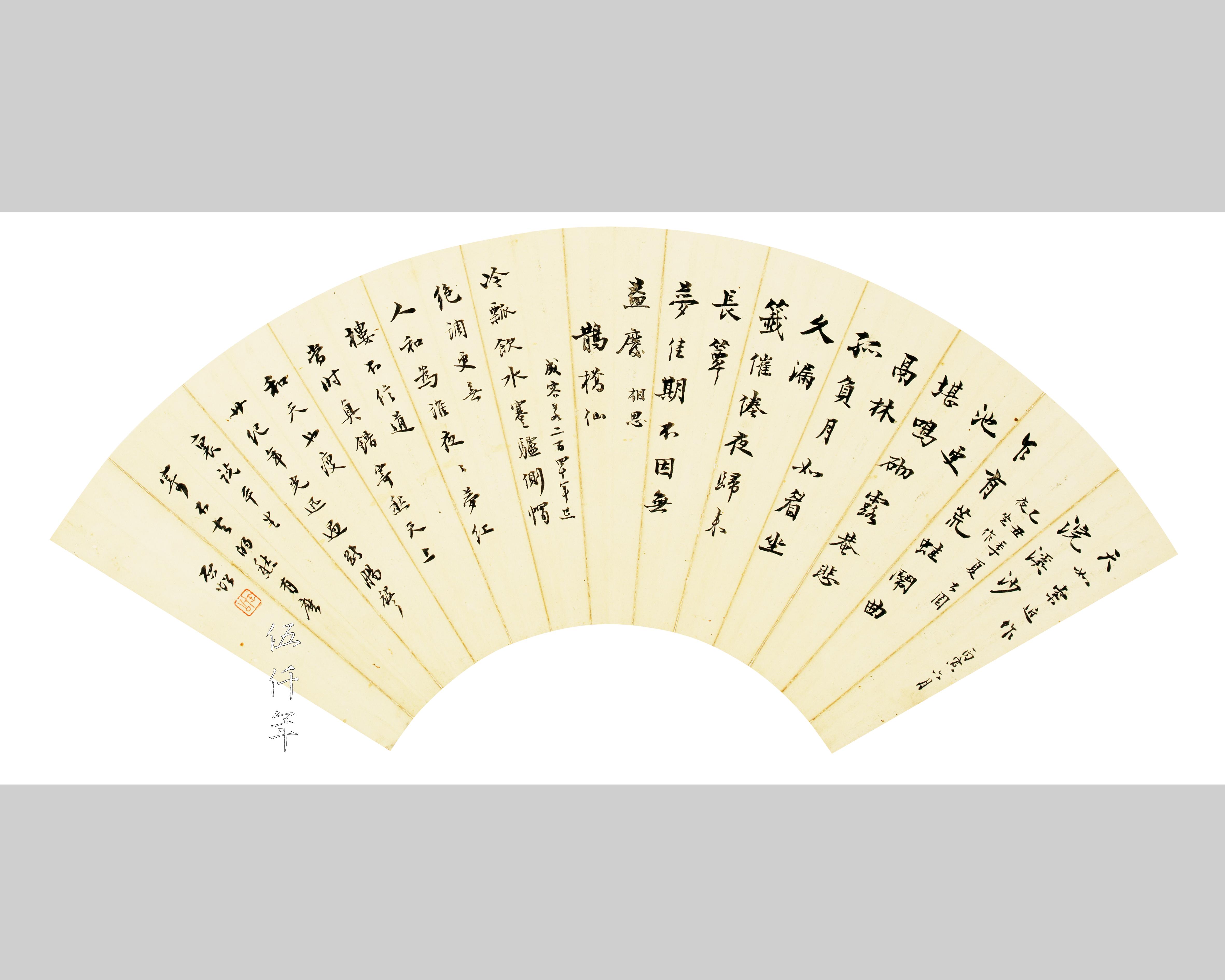
A fan leaf with tz’u lyrics by Liang Ch’i-chao (梁啟超)
There are also fifteen photographs gifted to T’ang En-p’u by his friends, they are listed as follows:
1) Portrait of Huang Pin-hung (黃賓虹) and friend.
2) Portrait of Liang Ch’i-ch’ao, inscribed on his fiftieth birthday in jen-hsü (壬戌) year, presented to T’ang En-p’u.
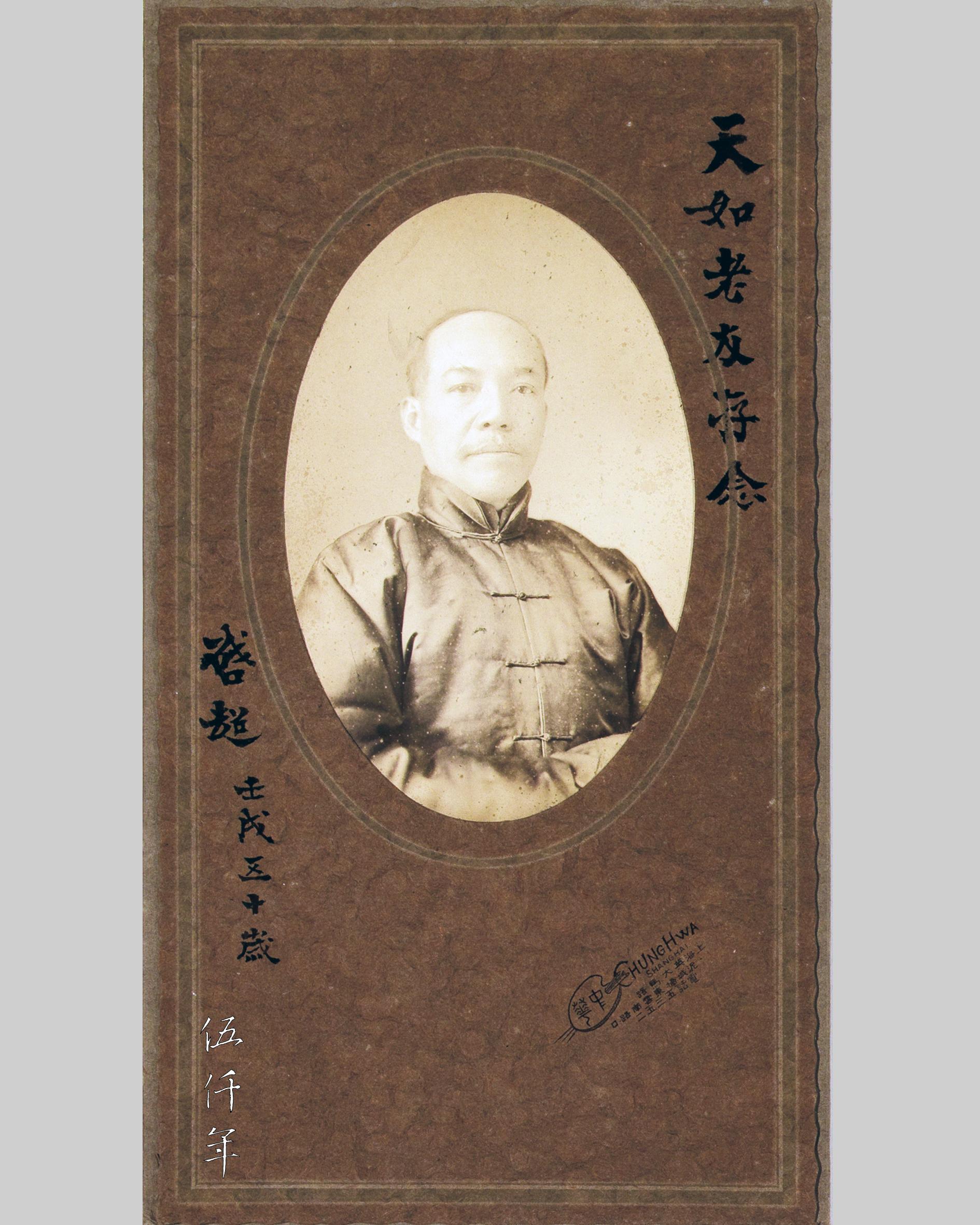
Portrait of Liang Ch’i-chao (梁啟超) inscribed on his fiftieth birthday
3) Portrait of a group of eminent literary figures who enacted the Hsiu-hsi Custom at the Garden of Myriad Living Gathering in Peking, at the invitation of Liang Ch’i-ch’ao, on 3rd day of third lunar month of kuei-ch’ou (癸丑) year 1913.
4) Portrait of Huang Hui-wen (黃晦聞), concubine and son Ta-hsing (大星), presented to T’ang En-p’u.
5) Half-length portrait of Wu P’ei-fu (吳佩孚).
6) Full-length portrait of Wu P’ei-fu (吳佩孚).
7) Portrait of T’ang Ti (湯滌), Ch’en T’ao-i (陳陶遺), and Wang Tzu-sung (王子菘), presented to T’ang En-p’u, Shanghai 1940.
8) Portrait of Huang Shih-lung (黃士龍) and Ching-fang (經舫), inscribed by Huang Shih-lung in Hong Kong, summer 1950.
9) Portrait of Chiang Fang-chen (蔣方震), 1926.
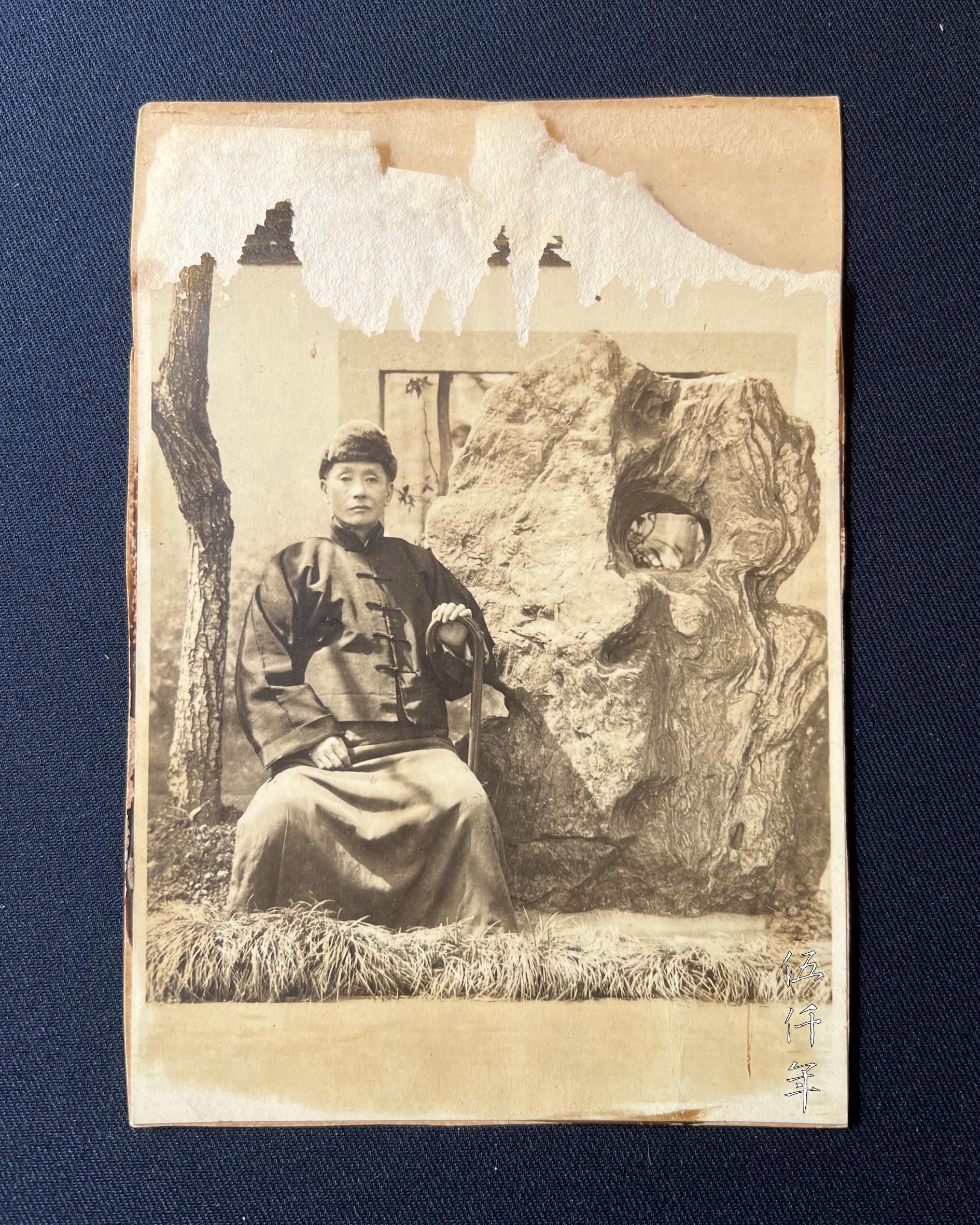
Front of portrait of Chiang Fang-chen (蔣方震)
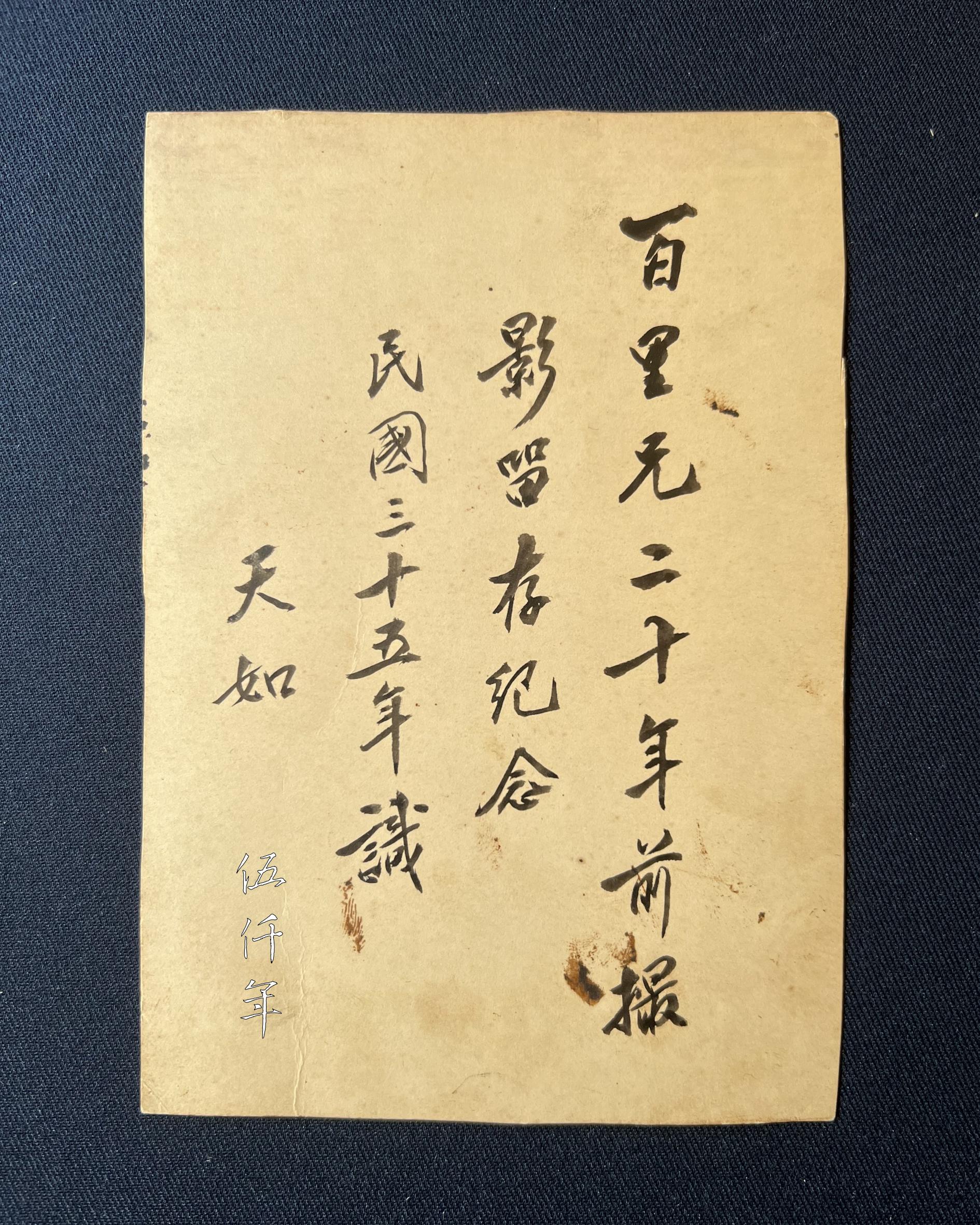
Back of portrait of Chiang Fang-chen (蔣方震)
10) Portrait of Ts’ai T’ing-k’ai (蔡廷鍇 1892-1968).
11) Portrait of Ch’en Ming-shu (陳銘樞), inscribed and presented to T’ang En-p’u, 1947.
12) Portrait of Ch’en Ming-shu (陳銘樞) and Ts’ai Tseng-chi (蔡增基).
13) Portrait of Chiang Kan-t’ing (江幹廷) on his birthday.
14) Portrait of Li Luan-p’o (李鑾坡 original name Yao-jung 矅蓉) and his whole family on the 3rd day of the tenth month in ting-ssu (丁巳) year, 1917.
15) Portrait of Li Luan-p’o (李鑾坡 original name Yao-jung 曜蓉) and his whole family to commemorate the 60th anniversary of attaining the chü-jen degree in chia-tzu (甲子) year of the T’ung-chih reign 1864. Photograph taken sixty years afterwards in 1924.
Some of those who appeared in the photographs are not commonly recognized, to name a few:
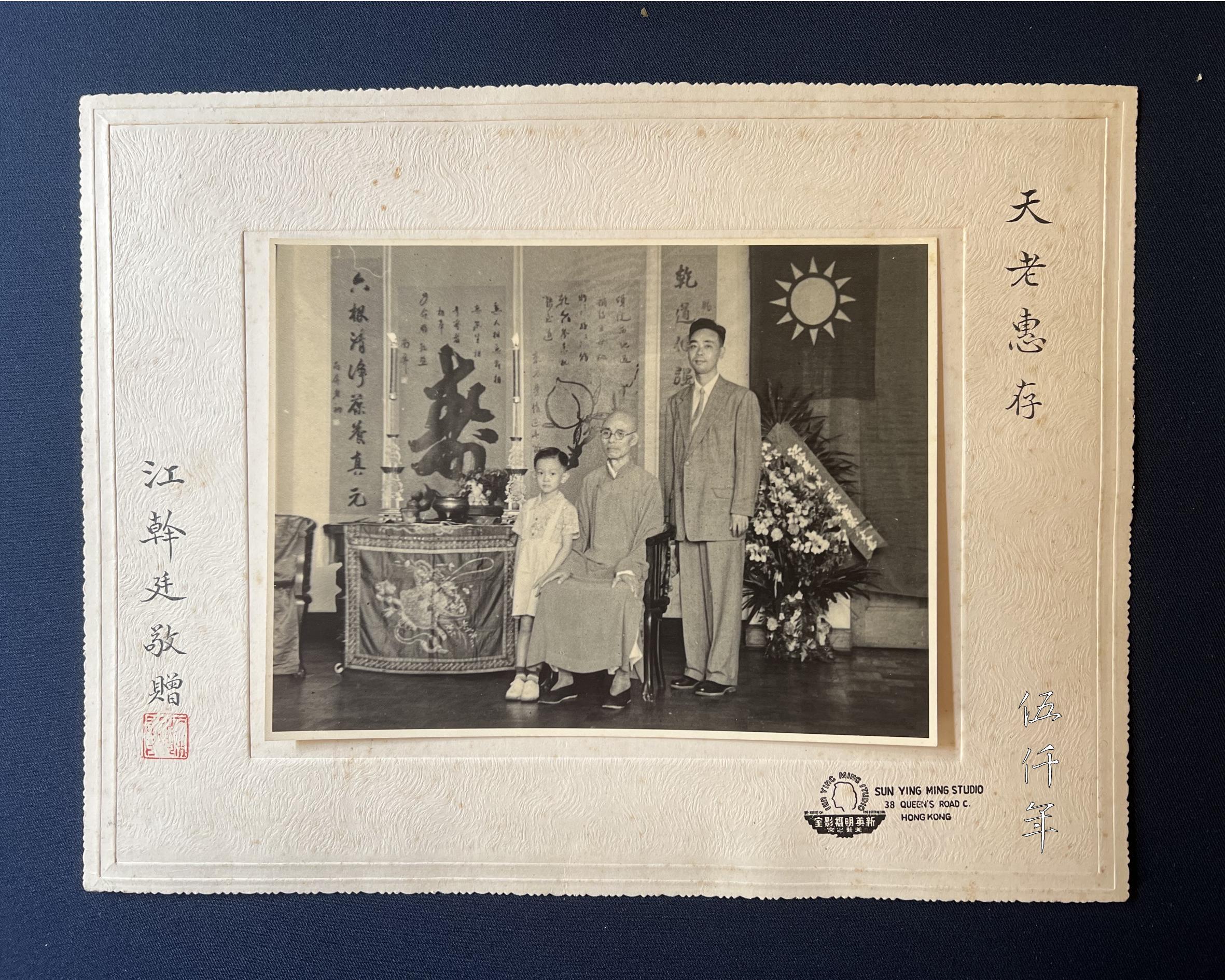
Portrait of Chiang Kan-ting (江幹廷)
Wang Tzu-sung (王子崧) was a Shanghai banker and director of the Note-Issuance Bureau of the Bank of Communications.
Chiang Kan-t’ing (江幹廷) was a leader of the secret society Green Gang (青幫), deferentially known as the Fifth Brother for wielding the ultimate authority over life and death within the organization. His seniority even surpassed that of the celebrated Green Gang leader Tu Yüeh-sheng (杜月笙 1888-1951). According to recollections by Elder T’ang Te-chao, whenever they visited his father at their house, Chiang Kan-t’ing would be seated first, with Tu Yüeh-sheng taking the seat after him.
Ching-fang (經舫) who appeared in the photograph with Huang Shih-lung (黃士龍), was a native of Hua County, Kwangtung province. He was a naval officer of the Republic of China. When mainland China fell to the communists in the 38th year of the Republic 1949, he fled to Hong Kong. Soon afterwards he ran into Huang Shih-lung, they were overjoyed to see each other and decided to take this photograph together in Hong Kong in 1950.
Li Luan-p’o (李鑾坡), original name Yao-jung (曜蓉), was a native of Hsin-hui, Kwangtung province. He attained the chü-jen degree in the 3rd year of the T’ung-chih reign, chia-tzu (甲子) year 1864.
T’ang En-p’u once ghostwrote an article on behalf of Liang Ch’i-ch’ao titled: Birthday Felicitations for Both Mr. Li Luan-p’o and His Wife Madame Kao.

Letter of Appointment to the position of assistant editor from the Bureau of Historia Ch'ing
Among the belongings of T’ang En-p’u, there are two Letters of Appointment with accompanying envelopes from the Bureau of Historia Ch’ing. The first is a Letter of Appointment for the positioin of assistant compiler and the second is a Letter of Appointment for the position of compiler. Since the Bureau of Historia Ch’ing had successively appointed only over one hundred and thirty scholars to be assistant compilers and compilers, such a Letter of Appointment is rarely seen. In the last hundred years, the nation’s destiny has been continuously struck with disruptions and calamities. It has to be exceptionally unlikely for the descendants of assistant compilers and compilers to conscientiously safeguard their ancestors’ Letter of Appointment.
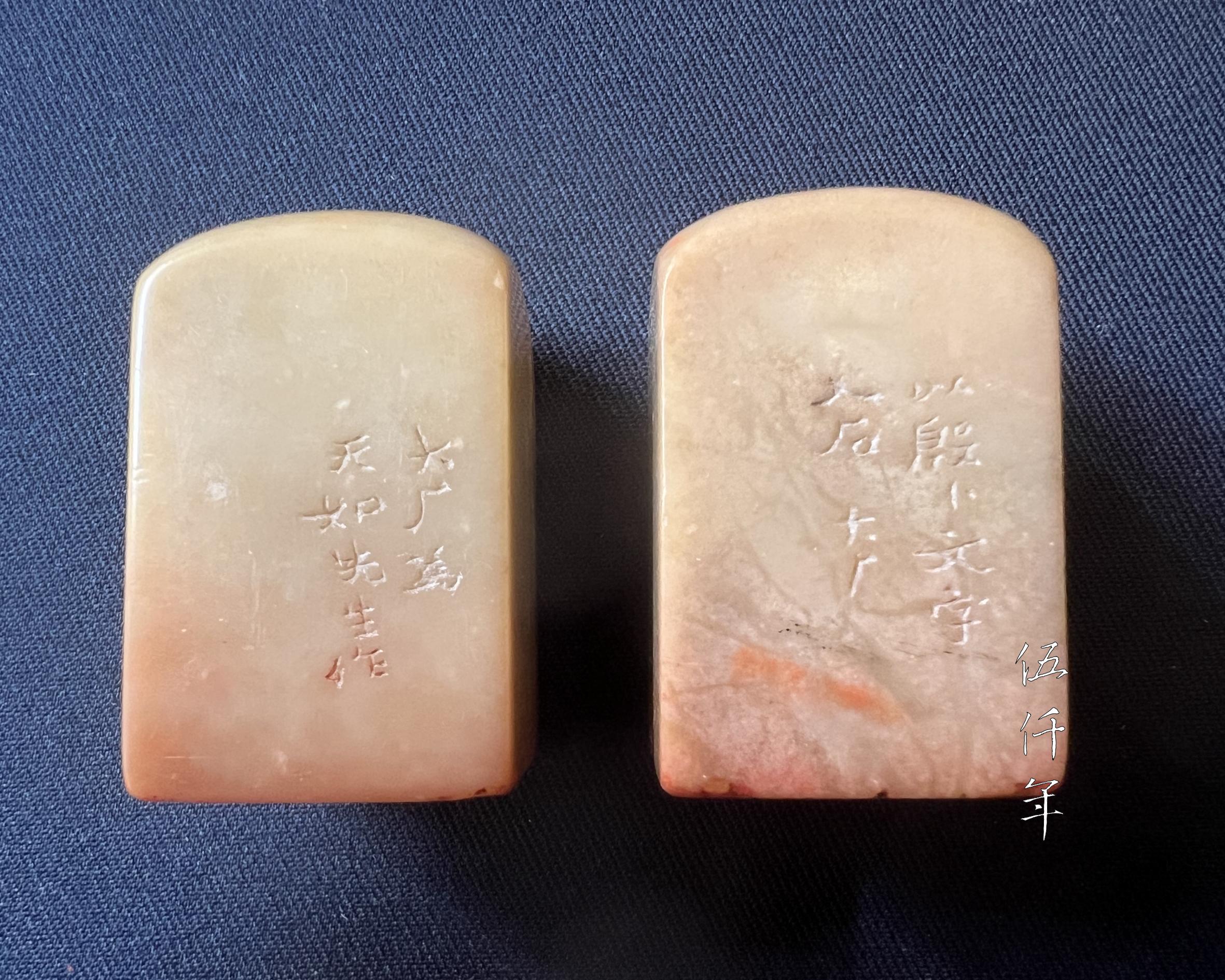
Side inscriptions of a pair of seals carved by I Ju (易孺)
Carved stone surfaces that carry the characters
T’ang En-p’u left behind thirteen seals which were carved with names, tzu, hao, studio-names or poetic words respectively. By close examination, there is a seal carved with the hao of Lan-yin (嵐隱), a seal carved with the studio-name of T’i-t’ung Kuan (題桐館), both names were seldom used by himself and little known by others. Some of the seals were carved by I Ju (易孺 1874-1941), hao Ta-an (大厂); Li Shen (李燊 1882-1945), tzu Yin-sang (尹桑); and Ch’en Han-chin (陳漢晉 1904-1987), tzu Yü-shan (語山); all friends from Kwangtung province.
The thirteen seals are:
1) A pair of seals carved with the words: “Seal of T’ang En-p’u” (唐恩溥之章) and “Tzu T’ien-ju hao Lan-yin” (字天如號嵐隱).
2) A pair of seals carved with the words: “T’ang En-p’u” (唐恩溥) and “T’ien-ju” (天如). Engraved by I Ju (易孺), hao Ta-an (大厂).
3) A seal carved with the words: “T’ang En-p’u” (唐恩溥). Engraved by Li Shen (李燊), tzu Yin-sang (尹桑).
4) A pair of seals carved with the words: “Seal of T’ang En-p’u” (唐恩溥印) and “Work by T’ien-ju after sixty” (天如六十後作). The first engraved by Ch’en Chü-lai (陳巨來 1904-1984) and the second by Ch’en Han-chin (陳漢晉), tzu Yü-shan (語山).
5) A seal carved with the words: “En-p’u” (恩溥). Engraved by Ch’en Wei (陳威 1880-1950), tzu Kung-meng (公猛), hao Yin-k’an (印堪).
6) A seal in bronze carved with the words: “T’ien-ju (天如)”.
7) A seal carved with the words: “T’eng-hsiang Kuan” (藤香館). Engraved by I Ju (孺), hao Ta-an (大厂).
8) A seal carved with the words: “T’i-t’ung Kuan” (題桐館).
9) A seal carved with the words: “The heart is untrammelled” (襟懷瀟灑).
10) An uncarved seal with the words: “Inkstone Record”(硯記)
Pictorial engravings on bronze paperweights and ink boxes by Ch’en Heng-k’ei (陳衡恪) and Yao Hua (姚華)
There are also a few pieces of desk objects:
1) A pair of bronze paperweights by Ch’en Heng-k’ei (陳衡恪 1876-1923), incised with stalks of prunus and an extract of a poem by Yang Wan-li (楊萬里 1127-1206), dedicated to T’ang En-p’u.
2) A bronze inkwell by Yao Hua (姚華 1876-1930), incised with seal legends, a gift from Chang Hui-jung (張惠榮) to T’ang En-p’u.
3) A bronze inkwell by Yao Hua (姚華 1876-1930), incised with an image of Han K’ang (韓康) selling medicine, commissioned by T’ang En-p’u..
4) A set of porcelain desk accoutrements from the early Republican period.
5) An agate circular box for seal paste.
6) A bamboo wrist rest incised with the image of prunus carved by Yün-hsi(筠溪), Ching dynasty
7) A bamboo wrist rest incised with the image of bamboo and rock, Ch’ing dynasty
8) A bamboo wrist rest incised with the image of lady by a window, Ch’ing dynasty
Ch’en Heng-k’ei (陳衡恪) arrived in Peking around the time of the founding of the Republic of China in 1912 and died in the 12th year of the Republic 1923. There he met T’ang En-p’u and were friends for more than a decade. Yao Hua (姚華) attained the chin-shih degree in the 30th year of the Kuang-hsü reign 1904, and he lived in Peking for many years. Yao Hua once inscribed an album of ink rubbings of the Princess Tai-kuo-ch’ang Stele with these words:
“Lately, I suffered from tophus a great deal. Lo Fu-k’an (羅復堪 1872-1955), T’ang En-p’u, and Ch’en Heng-k’ei visited me during my illness. I fetched this album for perusal and we admired it for a long time….”
This is an animated depiction of the friendships of Ch’en Heng-k’ei, Yao Hua and T’ang En-p’u.
Front cover of Illustrated Studies of Clay Teapots from Yang-hsien (陽羨砂壺圖考)

Title page of Illustrated Studies of Clay Teapots from Yang-hsien (陽羨砂壺圖考)
Drinking tea and collecting exquisite I-hsing clay teapots were also favourite past times for T’ang En-p’u. Some of his teapots were catalogued in the Illustrated Studies of Clay Teapots from Yang-hsien (陽羨砂壺圖考), published by Li Ching-k’ang (李景康) and Chang Hung (張虹) in the 26th year of the Republic 1937. In his preface, Chang Hung wrote:
“In recent years, living on an island with plenty of leisure time, I have devoted myself to collecting teapots. There are friends who have long occupied themselves with the passion of collecting teapots, such as Ts’ai Han-ch’iung (蔡寒瓊, original name Shou 守, 1879-1941) Ou Meng-yüan (區夢園), T’ang T’ien-ju (唐天如, original name T’ang En-p’u 恩溥), P’an Lan-ch’üan (潘蘭泉, tzu Po-yin 伯寅), Li Feng-t’ing (李鳳廷, tzu Feng-kung 鳳公, 1883-1967), Tsou Ching-ts’un (鄒靜存, 1874-?), Yeh Tz’u-chou (葉次周, original name P’ei-yü 佩瑜, 1875-1952), and Li Feng-p’o (李鳳坡, original name Ching-k’ang 景康, 1890-1960). We frequently visit one another, prepare tea, appraise teapots, and promote the art of teaware. Sometimes we send each other teapots by post, sharing our secretive treasures and exploring those we deem exceptional. Months and years are engrossed by the world of teapots, and the abundant leisure time in our old age gradually depletes. We almost forget the disarray in our human world.”
There are five teapots in the T’ang En-p’u Collection:
1) A square white-clay (pai-ni 白坭) teapot in the form of an imperial seal, made by Ch’en Ming-yüan (陳鳴遠), with seal of “Ch’en Ming-yüan” at base.
This piece was catalogued in the Illustrated Studies of Clay Teapots from Yang-hsien (陽羨砂壺圖考).
Ch’en Ming-yüan, original name Yüan (遠), hao Ho-feng (鶴峰), Shih-hsia Shan-jen (石霞山人), Hu-yin (壺隱). He was active in the K’ang-hsi and Yung-cheng reigns of the Ch’ing dynasty.
2) A small oblate purple-clay teapot, made by Wan Feng (萬豐), its base incised with the words “Ming-yüeh ch’ing-feng k’ei, Wan Feng chih” (明月清風客,萬豐製。 Guest of luminous moon and gentle breeze, made by Wan Feng). This piece was catalogued in the Illustrated Studies of Clay Teapots from Yang-hsien (陽羨砂壺圖考).
Wan Feng was likely the name of a Ming-dynasty teapot workshop, said by some to have been founded in the Wan-li period.
3) A small oblate purple-clay teapot, made by Liu P’ei (留珮), its base incised with the words “I-chih chi-ku kung, Liu P’ei” (以知汲古功,留珮。To realize the merit of studying antiquity, Liu P’ei). This piece was catalogued in the Illustrated Studies of Clay Teapots from Yang-hsien (陽羨砂壺圖考).
Liu P’ei was active in the late Ming and early Ch’ing periods.
4) A small oblate purple-clay teapot, made by Hui I-kung, its base incised with the words “K’ang-hsi I-kung” (康熙逸公).
Hui I-kung was active in the K'ang-hsi and Yung-cheng reigns of the Ch’ing dynasty.
5) A small oblate purple-clay teapot, made by Hui I-kung, its base incised with the words “I-tsun liao-yin chi-ho-hsiang, I-kung” (一尊聊飲芰荷香,逸公。Drinking lotus fragrance from a vessel, I-kung).
Front of invitation card illustrating a square white-clay teapot by Ch’en Ming-yüan (陳鳴遠) for the Tea, Wine and Poetry Exhibition at the Hong Kong University Museum and Art Gallery in 2007
Back of invitation card for the Tea, Wine and Poetry Exhibition at the Hong Kong University Museum and Art Gallery in 2007
Illustrated Studies of Clay Teapots from Yang-hsien (陽羨砂壺圖考) also catalogued another three teapots from the collection of T’ang En-p’u, but they have been long lost. The three teapots are: a small purple-clay teapot made by Hui I-kung, its base incised with the words Shih-men liu-lü ch’ing-ming-shih (石門柳綠清明市。 Stone gate, green willow, market at Ch’ing-ming Festival); a medium-sized white-clay teapot bearing Tuan Fang’s seal marks: “T’ao” and “chai” (陶、齋); a white-clay teapot in the form of a well headwall made by Wang Tung-shih (王東石).
Whether these three teapots were given away during his lifetime, exchanged, damaged, or stolen, cannot be known. They only inspire later generations to dwell longingly at length upon them. The two fine teapots by Hui I-kung that remain but not catalogued in the Illustrated Studies would have been acquired after its publication.
At times, T’ang En-p’u took part in the spirit-writing altars set up at the Hong Kong Branch of World Red Swastika Society. He was therefore able to acquire a number of calligraphic and pictorial works produced at these seances. Some of them are:
1) A horizontal calligraphy scroll with the words: “Lofty character and pure integrity” (風高清節), written at the altar by the spirit of Li Pai (李白 701-762).
2) A pair of calligraphy couplets written at the altar by the spirit of Li Pai (李白 701-762).
3) A painting executed at the altar by the spirit of Chi-kung Buddha (濟公 1148-1209).

Front cover of Tsung-ch’ien Chi (尊前集), inscribed by Tseng Hsi-ching (曾習經)
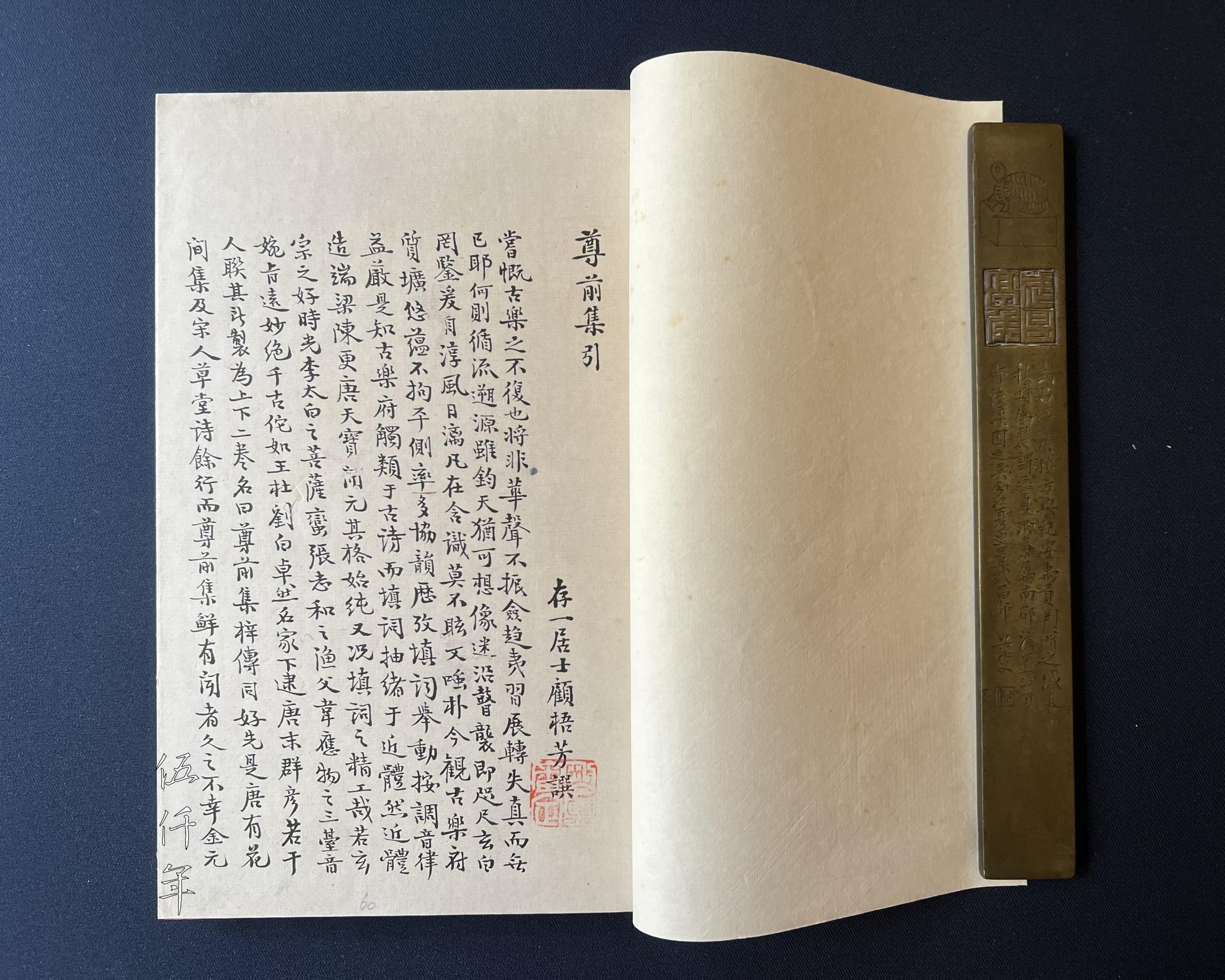
Foreword of Tsung-ch’ien Chi (尊前集)
Over the years, Elder T’ang Te-chao generously gifted me a number of books in his father’s collection, as well as some early reproductions of calligraphy by renowned figures:
1) Printed Copy of the Unfinished Metropolitan Examination Paper of Mr. Chu Ch’i-ch’i , inscribed by T’ang En-p’u. It was acquired by him in mid-spring of ting-ch’ou (丁丑) year at Shih-ku T’ang in Canton, corresponding to 1937.
2) Tsung-ch’ien Chi (尊前集), inscribed by Tseng Hsi-ching (曾習經), gifted to T’ang En-p’u.
3) Yang-hsien Sha-hu T’u-k’ao (陽羨砂壺圖考 Illustrated Studies of Clay Teapots from Yang-hsien), inscribed by Li Ching-k’ang (李景康), gifted to T’ang En-p’u.
4) Epitaph of Mr. Wang Ho-lin (王鶴隣先生墓誌銘), inscribed by Wang Wei (王薳, tzu Ch’iu-mei 秋湄, 1884-1944), gifted to T’ang En-p’u.
5) Yao-shih Hsüeh-yüan Ts’ung-k’an (姚氏學苑叢刋 Collected Publications of the Yao Family Academy), inscribed by Yao Tzu-fang, gifted to T’ang En-p’u.
6) Double Stem Lotus Painting (竝蔕蓮圖), collotype reproduction, painted by Ch’en Heng-k’ei (陳衡恪).
7) Ink Works of T’ao-i (陶遺墨蹟), collotype reproduction.
8) A Compilation of Authors in the Kuang-tung Literary Compendium, Two Volumes (廣東文徵作者考兩冊).
9) Collected Poems of Che-an, a title in the Hsia-an Series of the Yeh Family from P’an-yü (蟄庵詩存,番禺葉氏遐庵叢書之一).
10) A Special Album of Handwritten Letters and Seals of Chu Wen-ch’eng-kung with Later Inscriptions (朱文成公手牘印章及後題詠墨蹟專集), printed by Hong Kong America World Journal Bookstore.
11) A Special Album of Drafts by Wang Wen-ch’eng-kung and Inscriptions by Later Generations (王文成公稿及後人題詠墨蹟專集), printed by Hong Kong America World Journal Bookstore.
12) A Special Album of Letter by Yen Lu-kung on the Imperial Commissioner Liu, with Colophons from the Sung, Yüan, Ming, Ch’ing, and Republican Periods (唐顏魯公劉中使帖及宋元明清民國題跋墨蹟專集), printed by Hong Kong America World Journal Bookstore.
The writings of T’ang En-p’u enjoyed great renown within a small classical literary circle in his own time. Requests from all quarters for forewords, birthday felicitations, epitaphs, stelae inscriptions, and sacrificial texts were unceasing. T’ang En-p’u in turn sought far and wide for ink rubbings of stelae, their texts to be used as references for his own writings. Accordingly, what he collected were not supposed to be prized rarities sought by connoisseurs, they were just intended for a man of letters to study literary merits. T’ang En-p’u left behind eighty-nine sheets of ink rubbings, placed in three separate sets, a Chinese catalogue is appended at the end for reference.
Among the remaining personal effects are three fur lined winter garments that belonged to Mr. And Mrs. T’ang En-p’u.
1) A gentleman’s dark brown full length winter robe lined with fur.
2) A lady’s black half length short winter coat lined with fur.
3) A lady’s light-brown half length winter coat lined with fur.
T’ang En-p’u possessed consummate medical skill, taught by the Taoist recluse known by the name of Shai-yen Hsien (曬眼仙 Immortal of Sun Soaked Eyes) who lived in Lo-fu Mountain in Kwangtung province. The Elder T’ang Te-chao related that it was in the 25th year of the Kuang-hsü reign 1899, one year after his father attained the hsiu-ts’ai degree but having failed his chü-jen examination, he sought solitude in Lo-fu Mountain to study. At the time, it was rumoured that Chiang K’ung-yin (江孔殷) was extremely active in manipulating the provincial examination results in Kwangtung province, to earn the chü-jen degree free from his influence was nearly impossible. So T’ang En-p’u ended up spending four years in Lo-fu Mountain where he also studied medicine. It had been suggested that the reason he managed to attain the chü-jen degree in the 29th year of the Kuang-hsü reign 1903, was due to a fire that broke out in the examination hall, all the doctored papers were burnt, so the original examination paper written by T’ang En-p’u was submitted at last. The Elder T’ang Te-chao recounted that when his family knew Chiang K’ung-yin well later on, his mother even mockingly scolded Chiang. The Taoist recluse Shai-yen Hsien was accomplished in medicine and divination. Every morning before day break, he would climb to the peak of Lo-fu Mountain, gaze at the rising sun and let light rays bask his eyes. Apparently, he passed away at the venerable age of one hundred and forty something.
T’ang En-p’u had no wish to gain renown through medicine, he even regarded medical practice the least worthy activity for men of letters. His friend Chih-tuan (之慱) once remarked: “T’ien-ju is also highly skilled in medicine, yet he is somewhat ashamed to make a name in it for himself.”
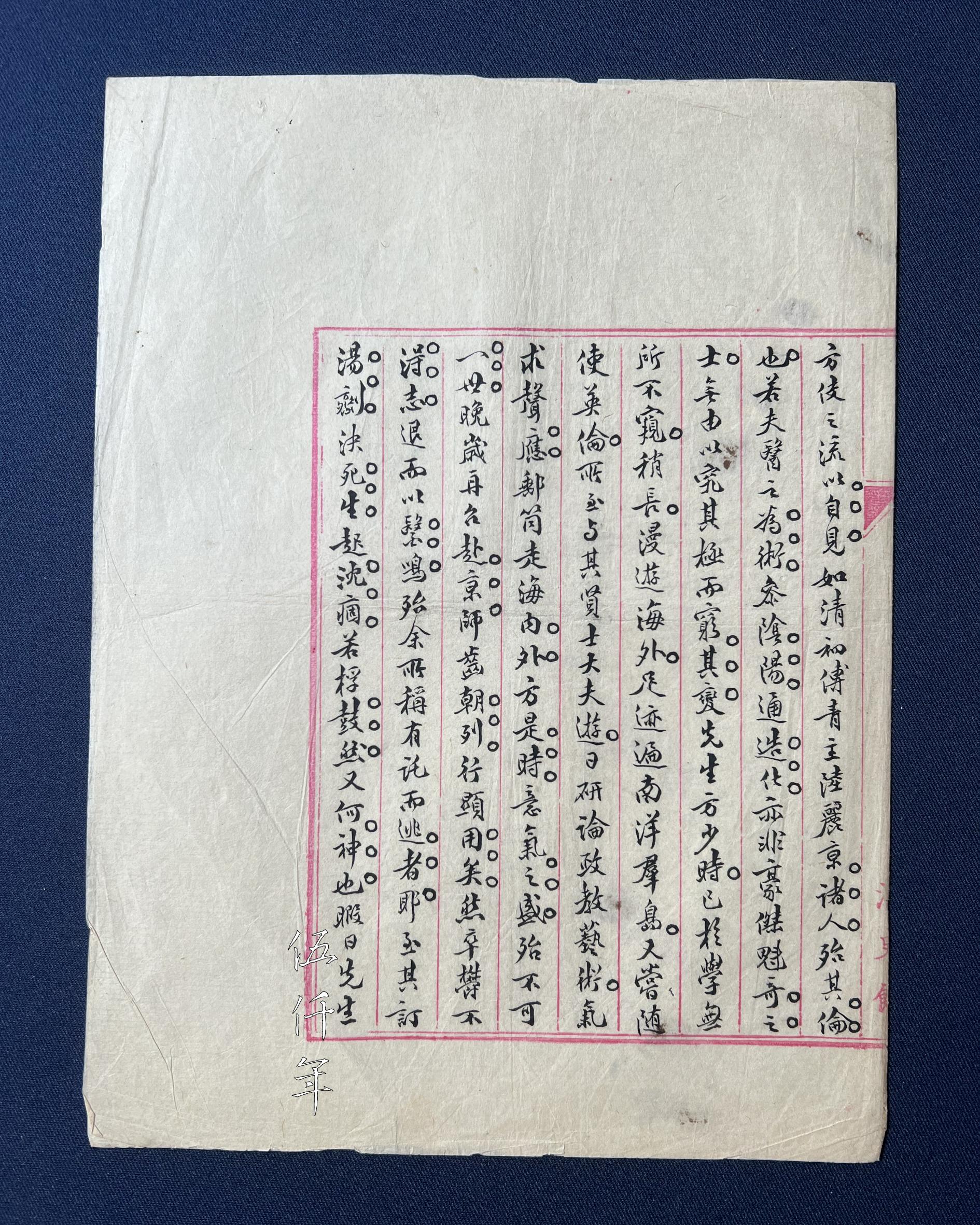
Second page of An Account of the I-yin Lu Painting (醫隱廬圖後記)
Among his manuscripts, there is nothing at all on medical studies. The nearest is his essay titled An Account of the I-yin Lu (醫隱廬) Painting, in which he recounted his friendship with the celebrated physician Li Hsüan-chü (力軒舉). There is a passage that hastens us to ponder the nature of Chinese medical practice. It reads:
“When people talk about famous physicians today, invariably they exalt Mr. Li. From ancient times to the present, heroic and extraordinary men, whose skills are suffice to help life everywhere, to save life everywhere, are sometimes trapped by wrong timing, by wrong people, or even by the unfortunate change of dynasty. Drifting aimlessly, bearing adversities, longing for country lost, unwilling to delude oneself, accumulating misery, hoping for a voice after a long haul, if there is any relief, medicine is the solitary consolation. There were men before, in early Ch’ing, like Fu Shan (傅山, tzu Ch’ing-chu 青主 1607-1684), like Lu Ch’i (陸圻 tzu Li-ching 麗京), who belonged to this category too. As for the skill of medicine, one has to understand yin and yang, to fathom life and death, without such heroic and extraordinary men, it is not possible to investigate such depth, to exhaust all possible variations.”
Though this piece of writing is ostensibly about Li Hsüan-chü, it is also a truthful self-portrait.
It is alleged that had Liang Ch’i-ch’ao continued to take medicine according to the prescriptions prepared by T’ang En-p’u, he would not have died. The two acknowledged authorities on historical anecdotes, Kao Po-yü (高伯雨, nom de plume Lin Hsi 林熙 1906-1992) in Hong Kong wrote an article titled Remembering Mr. T’ang T’ien-ju (記唐天如先生), and Kao Pai-shih (高拜石 1901-1969) in Taiwan wrote an article titled The Red Disease of Liang Ch’i-ch’ao and the Course of Its Treatment (梁啟超的赤化病與治療經過). Both documented the medical condition of Liang in great detail. There is no need to repeat a tautology, but a few selected passages are quoted here to convey the general outline. T’ang En-p’u passed away on 3 February 1961. Kao Po-yü then wrote Remembering Mr. T’ang Tien-ju (T’ien-ju is the hao of T’ang En-p’u), which was published serially in a newspaper over several consecutive days. He wrote:
“…when we talk about Liang Ch’i-ch’ao, we will recollect how Mr. T’ien-ju treated him for his illness of urinary bleeding. According to The Chronological Biography of Liang Jen-kung, the subject wrote to his children on the 26th day of the first lunar month in 1926, saying:
‘(Original note: T’ien-ju replied by telegram that he could not come, and urged me to go to Shanghai. I thought that since he had been with Wu P’ei-fu (吳佩孚) for so long, it would indeed be inconvenient for him to come to Peking at this time. I therefore plan to take the medicine prescribed by T’an T’iao-an (譚條安) instead.)’
On 21 May of the same year, Chiang Pai-li (Fang-chen 蔣方震) wrote to Jen-kung as follows:
‘…I have learned that after the operation urinary bleeding still persists. I do not know your recent condition, but I am deeply concerned. T’ien-ju is making a special journey north for this reason and should arrive in the capital within the next few days. Chün-mai (張君勱 1887-1969) will presumably get there first.’
Again, in a letter dated 14 September to his children, informing them of his lectures at Tsinghua University and of his illness, he wrote:
‘My illness has once again completely cleared up, it has already been ten days without any recurrence. During the few days I stayed at Nan-ch’ang Street, your second uncle examined my urine daily. He said its colour was even better than his, his looked like Pu-erh tea, while mine was like Pre-Rain Lung-ching tea. For ten days after I began taking Mr. T’ien-ju’s medicine, it was already like this, but in the middle of that period, when your fourth aunt passed away, it suddenly relapsed, and very severely. At that time Wu Lien-teh (伍連德 1879-1960) arrived in Tientsin and I showed him the urine. He said this illness should definitely not be ignored, when he arrived in Peking, he would carefully discuss my illness with the authorities at the Peking Union Medical College and with Clifford and others, and so forth. Five days ago I met him in Peking, by then he had already made his inquiries. When he saw my urine, the colour had already cleared, he stared at it and greatly admired the marvelous efficacy of Chinese medicine. (Original note: he was not contemptuous of Chinese medicine in the first place.) He copied down the prescription, T’ien-ju’s formula, which takes huang-lien (黃連 Coptis), yü-kuei (玉桂 cinnamon bark), and a-chiao (阿膠 donkey-hide gelatin) as its principal ingredients. (Original note: I have recently heard another noted physician say that anyone who dares to combine huang-lien and yü-kuei in a single prescription must certainly be a great physician.) He said that this illness should simply rely entirely on treatment with Chinese medicine.’
This shows the extraordinary efficacy of Mr. T’ien-ju’s prescriptions, so remarkable that even Western physicians were astonished by them. (Nevertheless, Jen-kung’s kidney was ultimately removed, and he later died as a result. This was an error on the part of Peking Union Medical College. Mr. T’ien-ju once said as much to me.)”

Letter by Liang Ch’i-ch’ao (梁啟超) to T’ang En-p’u
On 17 August of the fifteenth year of the Republic 1926, Liang Ch’i-ch’ao wrote a letter to T’ang En-p’u, thanking him for the consultation and prescription. It reads:
“My elder brother T’ien-ju:
For several days now I have been taking your esteemed medicine (with black p’u-huang 蒲黃 added). The ‘Red Emperor’s child’ has already turned into the ‘White Emperor’s child.’ A chronic affliction of more than a year has at last been completely swept away. I plan to take one more dose tomorrow, and then temporarily stop, awaiting further instructions.
Everyone in my household feels profoundly grateful for your great kindness, and says they do not know how it might be repaid.
Military affairs in the north have come to a temporary halt, those in charge may have to head south. What is your travel plan? I guess you rest too little.
Ch’i-ch’ao, with a bow,
the 17th.”
Apart from his close friend Liang Ch’i-ch’ao, other friends like Lo Tun-yung (羅惇曧) and Hsiung Shih-li (熊十力) also entrusted him with their medical treatments, as attested by their correspondences.
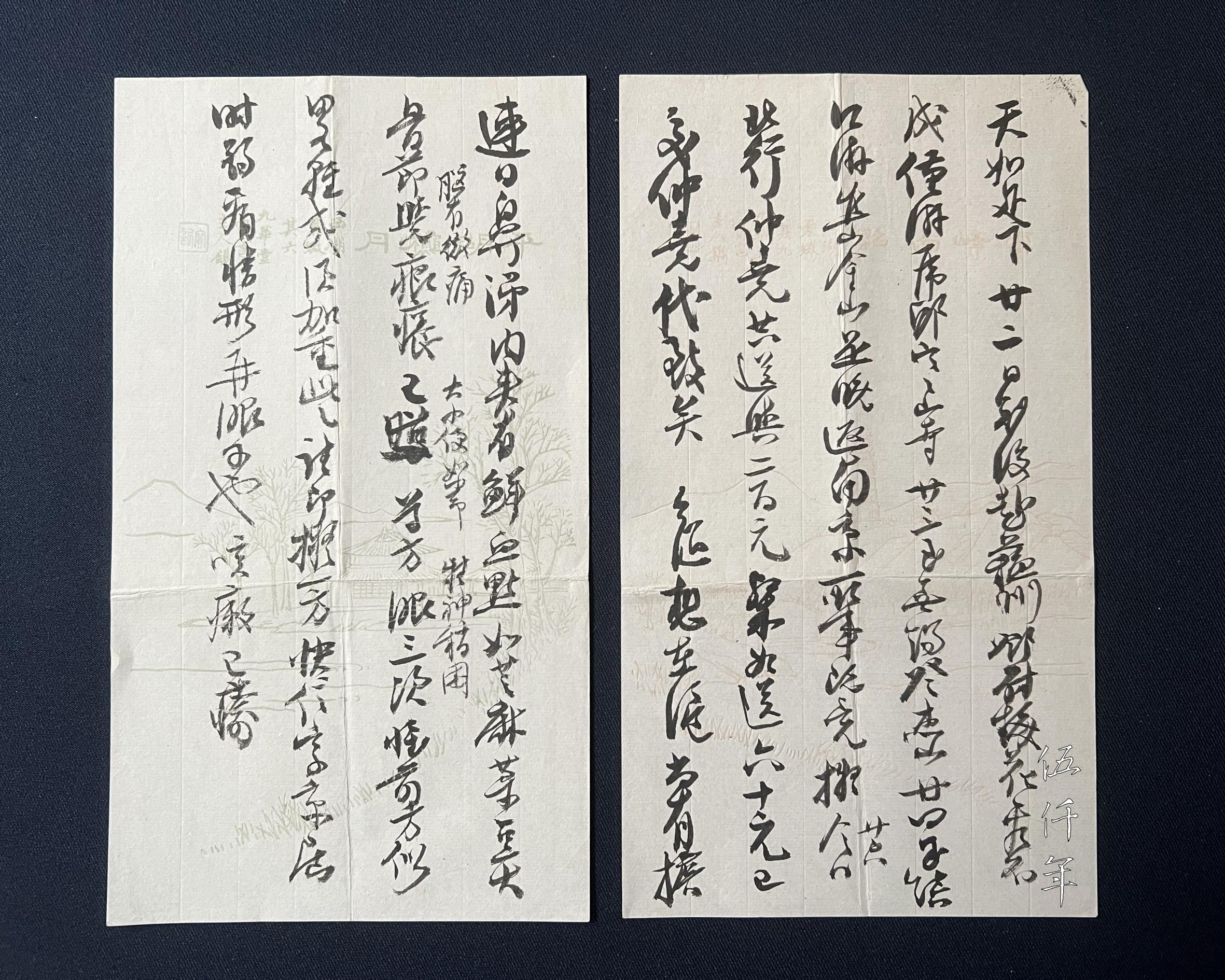
Letter by Lo Tun-yung (羅惇曧) to T’ang En-p’u
In a letter from Lo Tun-yung (羅惇曧) to T’ang En-p’u, it says:
“…I suppose you are now in Shanghai, and still burdened with responsibilities.
For several days I have a runny nose, from which there are fresh spots of blood, about the size of hemp leaves. My joints feel faintly itchy, and there is slight pain in my legs. Bowel and urinary functions are normal, though my spirits are somewhat fatigued.
I have already taken the medicine according to your esteemed prescription three times, but the earlier formula seems rather mild, perhaps it needs to be strengthened. Please formulate a new prescription as soon as possible and send it by express letter to Peking. Then I can take the medicine as my condition requires.
The cough has already been cured. …
Yung, respectfully.
the 26th.”
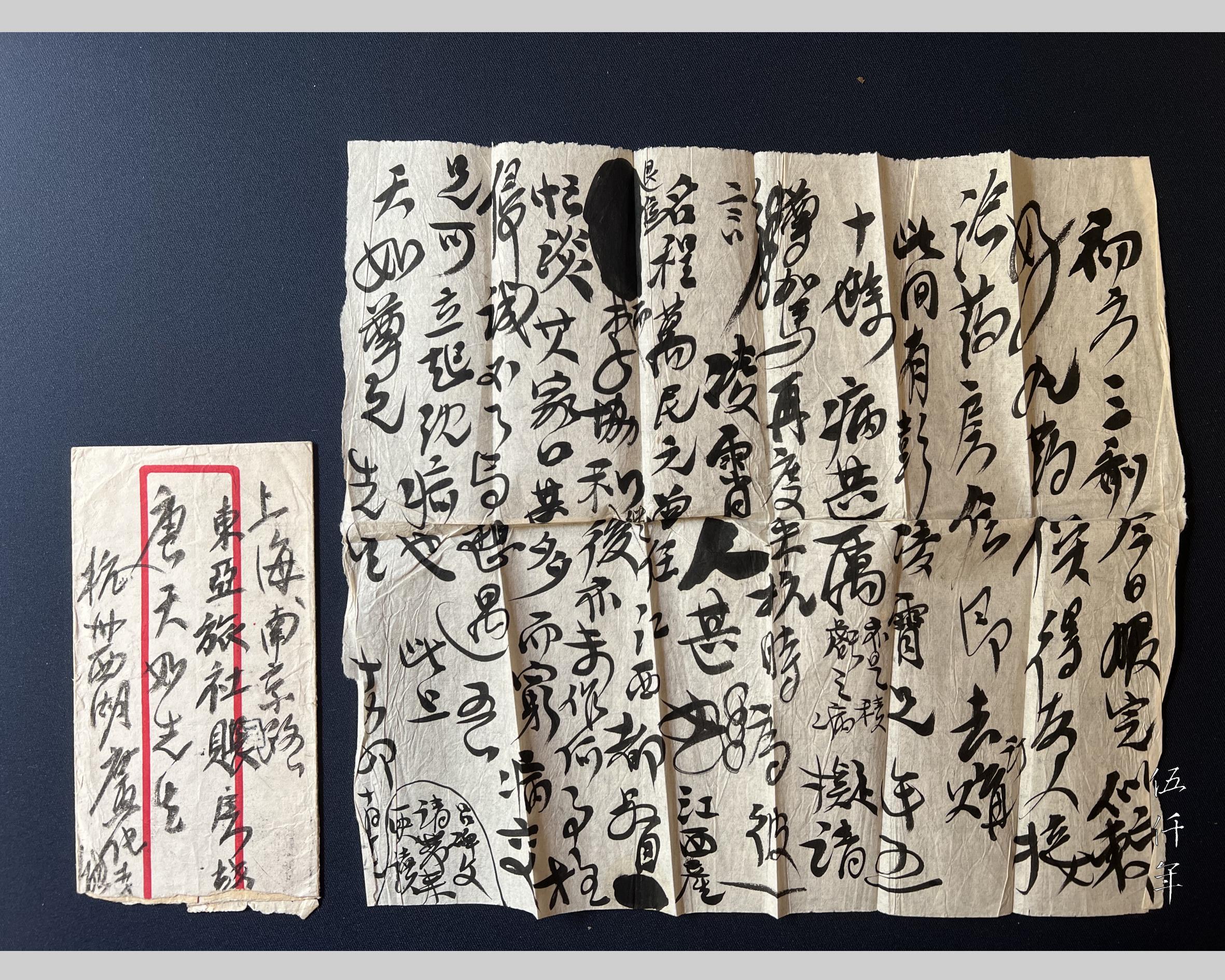
Letter by Hsiung Shih-li (熊十力) to T’ang En-p’u
In a letter from Hsiung Shih-li (熊十力) to T’ang En-p’u, it says:
“The initial prescription of three doses has been completed today, it seems I have improved.
As for the pill medicine, once I receive the letter from my friend who is contacting the pharmacy, I shall go and place the order.
I have another friend here by the name of P‘eng Ling-hsiao (彭凌霄), over fifty years of age, whose illness is extremely severe and likewise stems from long-standing depletion. When you next visit Hang-chou, may I ask you to examine him as well …
Shih-li, respectfully.
The 17th day of the tenth month.”
It was after the Chinese victory in the war against Japan, the wife of T’ang En-p’u suffered obstructed labour with catastrophic hemorrhaging. All the physicians who were called upon in Hong Kong were at a loss. T’ang En-p’u hastily set up a medicine stove in the courtyard, over seven days and seven nights, he decocted a Nine-Turn Ginseng Elixir and saved her. Those who heard of it were simply astonished, even Western doctors were compelled to acknowledge its efficacy.
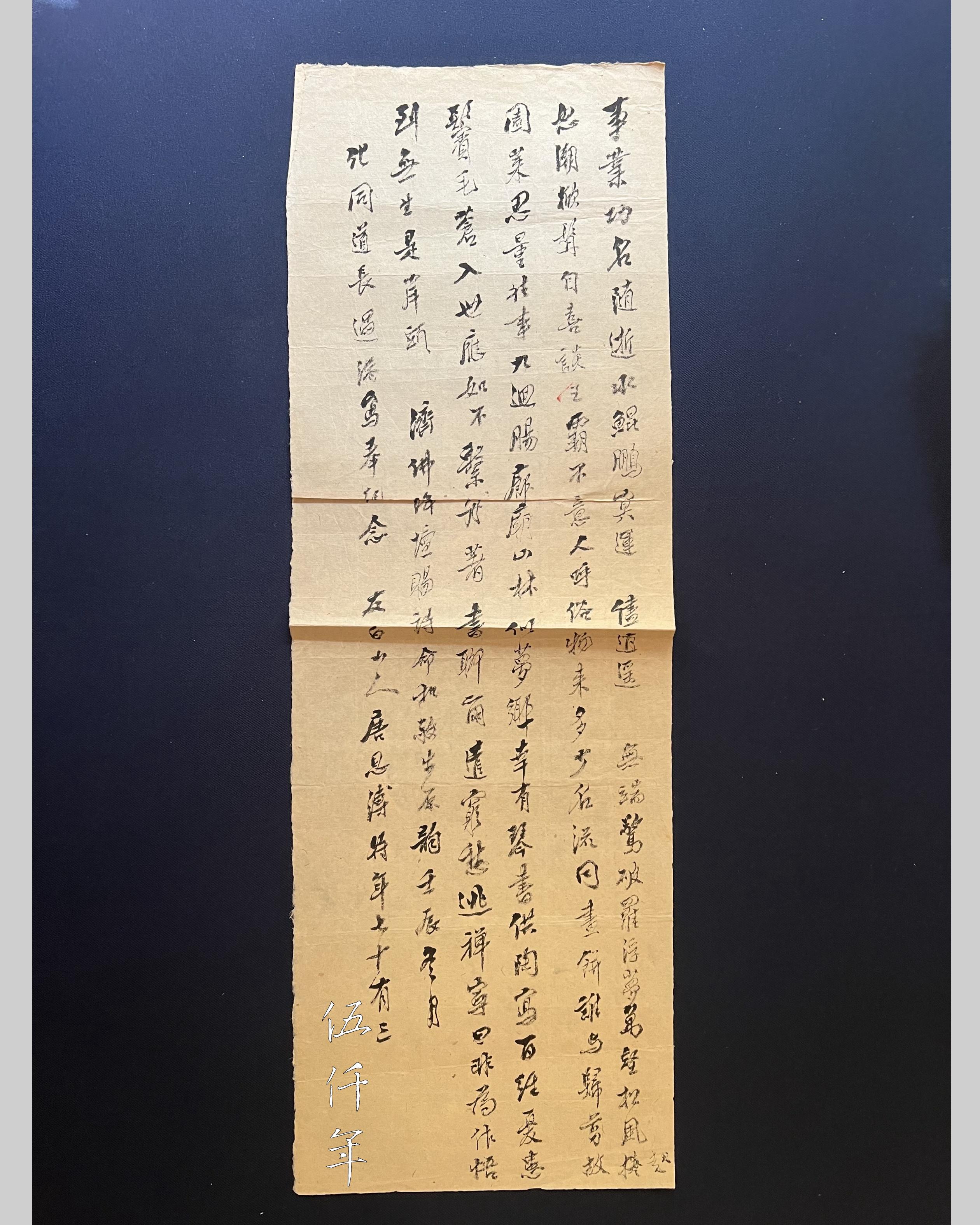
Poem in running script by T’ang En-p’u
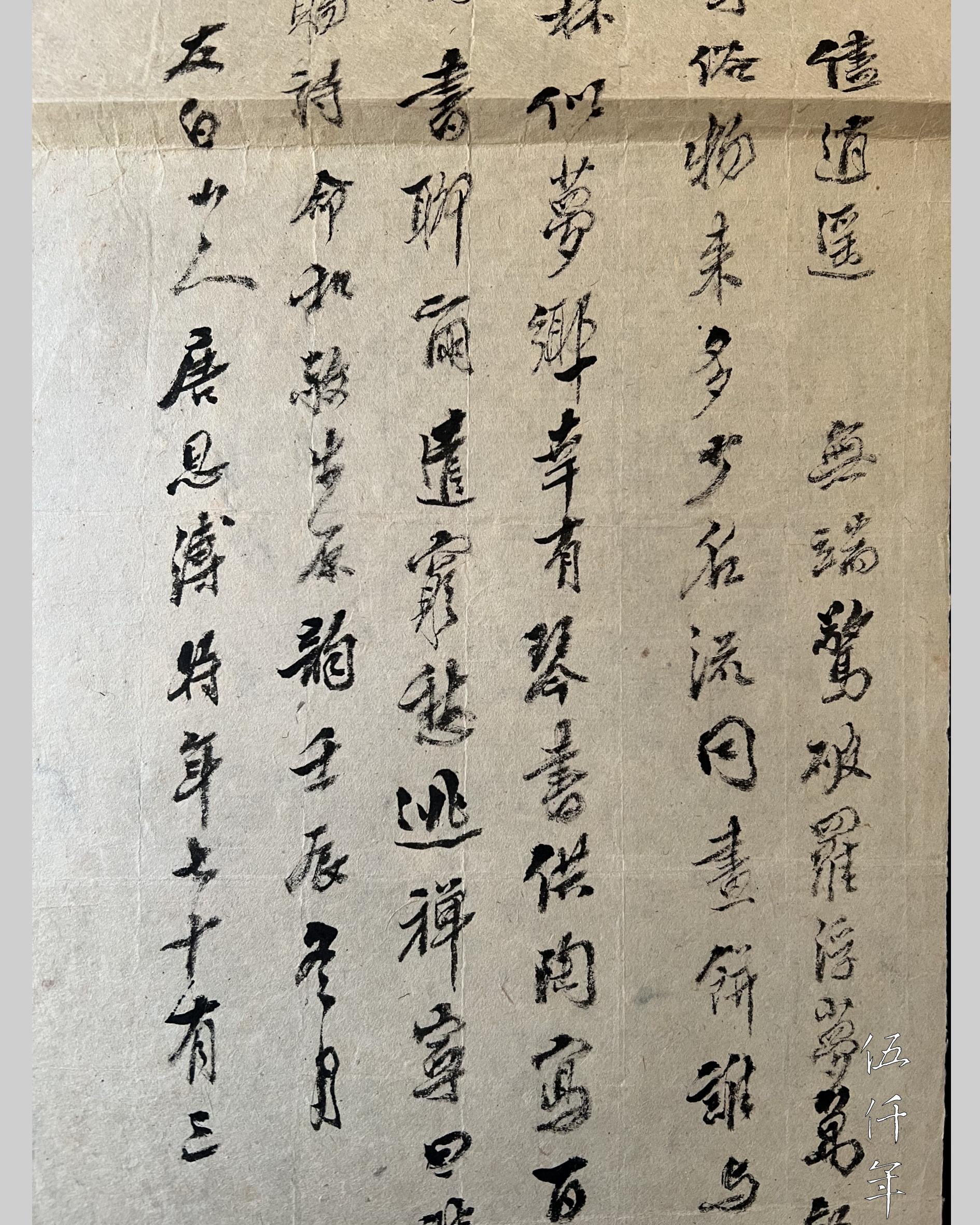
Detail of poem in running script by T’ang En-p’u
In the winter of jen-ch’en (壬辰) year 1952, mainland China had already fallen, great calamities were just beginning. T’ang En-p’u already had a foretaste of turmoil, he was laden with emotions and composed this poem:
Duty and honour flow by like water,
Only in fable can fate be unshackled.
For why a lovely dream just ruptured,
A raging tide from valleys and woods.
Happily I talk about kings and villains,
Astounded to be shouted a vulgar man.
All those famous wind up with nothing,
Let's go and tend an old farmland.
The past haunts and scorches the heart,
Peking and Canton lie in a dream.
Luckily zither and books are my solace,
Worries upon miseries turn me old.
Life to be lived like un unleashed boat,
Write a book to keep sorrow at bay.
I rather say reaching Zen a wicked act,
No more rebirth in the distant shore.
In his later years, T’ang En-p’u meditated on Confucianism, Taoism and Buddhism as a single harmonizing spiritual realm. Occasionally he visited spirit-writing altars, where he came into the presence of celestial spirits, and the worlds of yesterday and today appeared indistinguishable. One day, the spirit of the Taoist poet Lü Tung-pin (呂洞賓) from the T’ang dynasty bestowed upon him a painting of a pine tree, which still hangs in the T’ang family residence to this day. Pine shadow, light breeze, old traces, hazy reflections, to dwell on endlessly.

Ink rubbing of front of inkstone carved with the theme of Ode to the Red Cliff
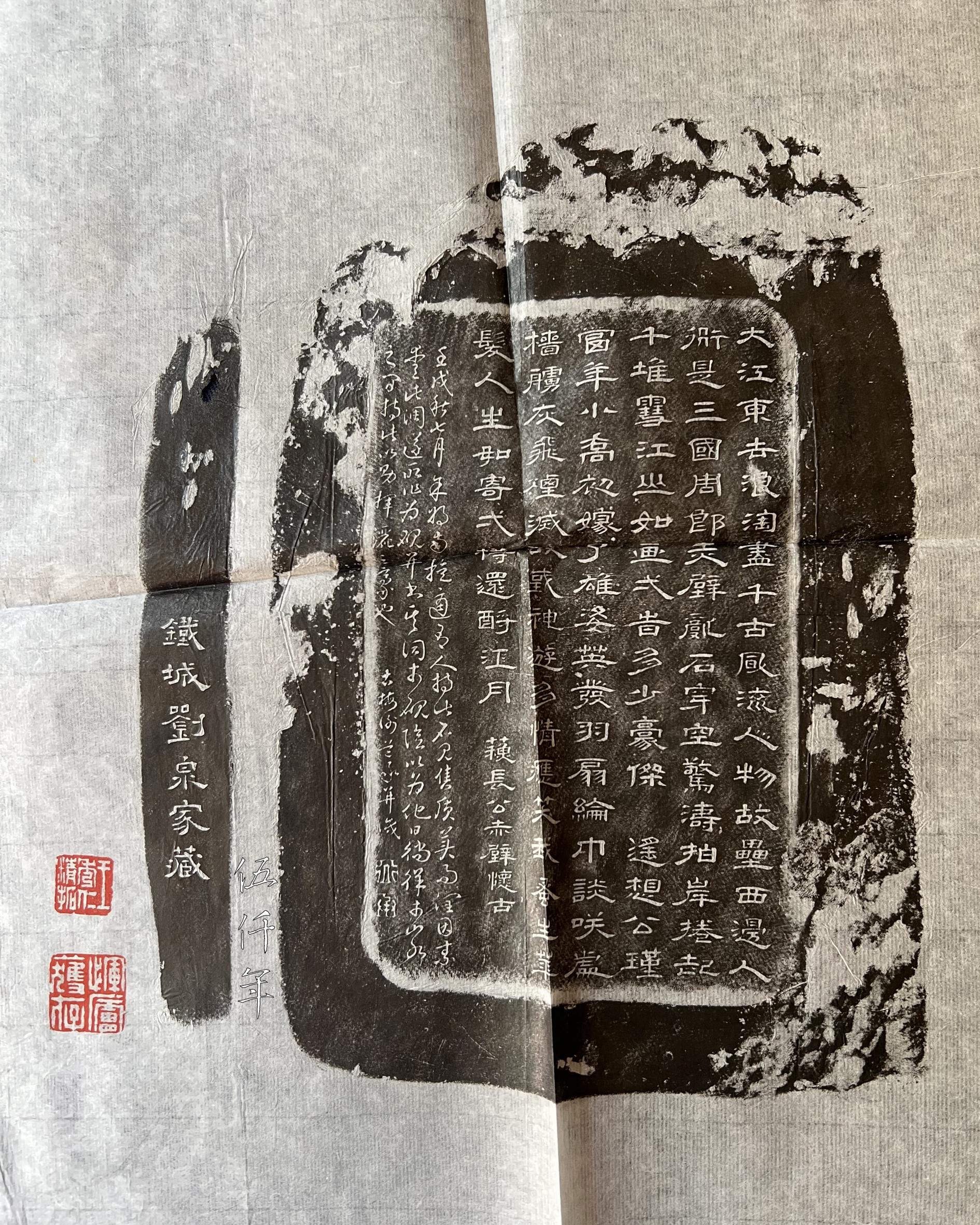
Ink rubbing of back of inkstone carved with the theme of Ode to the Red Cliff
Catalogue of Schoolworks and Examination Papers of T'ang Yüan-chün
崇智公課業試卷目錄
There are altogether 279 pieces of schoolworks and examination papers by T'ang Yüan-chün, father of T'ang En-p'u.
T'ang Yüan-chün attained the chü-jen degree in the 2nd year of the Kuang-hsü reign 1876.
1、The First Set
1)「賦得石盆新雨長蘭孫,得孫字五言八韻」。
黃秋蘩(敬祜) 批點。
黃敬祜,一八一五年生,一八八零年卒。字曉圖,號秋蘩,別號半庵,廣東南海人。道光二十四年甲辰,一八四四年舉人。負文名,工書畫,淡仕進。名見俞劍華編「中國美術家人名辭典」。
2)「劉院入天台賦,以雲海重尋一惘然為韻」。
朱九江批點無鈐印,崇智公子天如題誌。
朱九江 ,一八零七年生,一八八一年卒。名次琦,字子襄,號稚圭,世稱九江先生,廣東南海人。道光二十七年丁未,一八四七年進士。令山西襄陵一百九十日,民風大變,後隱居佛山九江鄉,主禮山草堂垂三十年。晚歲自焚其稿,門生康長素 (有為) 輯「是汝師齋詩集」、「大疋堂詩集」,有「朱九江先生集十卷」存世。
3)「子曰:可也,未若貧而樂,富而好禮者也。子貢曰:詩云如切如磋,如琢如磨,其斯之謂與」。
呂拔湖(洪)批點。
呂洪,字福瑜,號拔湖,廣東鶴山人。道光十九年己亥,一八三九舉人。劉銘伯(士驥) 、梁任公(啓超)等師從之。咸豐己未刊「學海堂四集」輯錄其詩。
4)「子游問孝。子曰:今之孝者」。
曙亭批點。姓名待考。
5)「孔子曰:天下有道」。
批點無鈐印。業師待考。
6)「據於德,依於仁」。
梁墨畦 (紹訓) 批點。
梁紹訓,廷標子,號墨畦,廣東南海人。道光十二年壬辰,一八三二年舉人,名見同治八年「南海縣志卷二十一選舉表二」。
7)「隘與不恭,君子不由也」。
黃秋蘩 (敬祜) 批點。
黃敬祜,一八一五年生,一八八零年卒。字曉圖,號秋蘩,別號半庵,廣東南海人。道光二十四年甲辰,一八四四年舉人。負文名,工書畫,淡仕進。名見俞劍華編「中國美術家人名辭典」。
8)「尊賢也,親親也,敬大臣也,體羣臣也,子庶民也,來百工也」。
黃秋蘩 (敬祜) 批點。
9)「夫子喟然歎曰:吾與點也」。
黃秋蘩 (敬祜) 批點。
10)「抑為之不厭,誨人不倦」。
黃秋蘩 (敬祜) 批點。
11)「故將大有為之君,必有所不召之臣」。
黃秋蘩 (敬祜) 批點。
12)「禮所生也」。
黃秋蘩 (敬祜) 批點。
13)「信以成之,君子哉」。
黃秋蘩 (敬祜) 批點。
14)「必有言,有言者」。
熊樨緣 (次夔) 批點。
熊次夔,字樨緣,廣東南海人。道光二十九年已酉,一八四九年舉人,名見光緒五年「廣州府志」。李陶邨 (欣榮) 撰「寸心草堂集外詩卷一」有「索熊樨緣藥酒詩」。
15)「誠之者,人之道也。誠者,不勉而中,不思而得,從容中道」。
黃秋蘩 (敬祜) 批點。
黃敬祜,一八一五年生,一八八零年卒。字曉圖,號秋蘩,別號半庵,廣東南海人。道光二十四年甲辰,一八四四年舉人。負文名,工書畫,淡仕進。名見俞劍華編「中國美術家人名辭典」。
16)「因之以饑饉,由也為之」。
陳傑臣 (國彥) 批點。
陳國彥,子傑臣,廣東南海人。同治元年壬戌,一八六二年舉人。名見光緒五年「廣州府志」。
17)「文獻不足故也足」。
熊樨緣 (次夔) 批點。
熊次夔,字樨緣,廣東南海人。道光二十九年已酉,一八四九年舉人,名見光緒五年「廣州府志」。李陶邨 (欣榮) 撰「寸心草堂集外詩卷一」有「索熊樨緣藥酒詩」。
18)「居則曰:不吾知也,如或知爾,則何以哉。子路率爾對曰」。
呂拔湖 (洪) 批點。
呂洪,字福瑜,號拔湖,廣東鶴山人。道光十九年己亥,一八三九舉人。劉銘伯(士驥) 、梁任公(啓超)等師從之。咸豐己未刊「學海堂四集」輯錄其詩。
19)「言孫」。
呂拔湖 (洪) 批點。
20)「人一能之已百之,人十能之已千之,果能此道矣」。
呂拔湖 (洪) 批點。
21)「賢哉,回也。一簞食、一瓢飲,在陋巷,人不堪其憂,回也不改其樂」。
熊樨緣 (次夔) 批點。
熊次夔,字樨緣,廣東南海人。道光二十九年已酉,一八四九年舉人,名見光緒五年「廣州府志」。李陶邨 (欣榮) 撰「寸心草堂集外詩卷一」有「索熊樨緣藥酒詩」。
22)「賦得羅浮仙蝶,得浮字五言八韻」。
黃秋蘩 (敬祜) 批點。
黃敬祜,一八一五年生,一八八零年卒。字曉圖,號秋蘩,別號半庵,廣東南海人。道光二十四年甲辰,一八四四年舉人。負文名,工書畫,淡仕進。名見俞劍華編「中國美術家人名辭典」。
23)「讀海忠介公傳,七古不拘韻」。
夢葵批點,無跋語。姓名待考。
24)「重修貢院落成,七律不拘韻有序」。三帋。
六階批點。姓名待考。
25)「子曰:直哉史魚,邦有道,如矢,邦無道,如矢。君子哉蘧伯玉,邦有道,則仕,邦無道,則可卷而懷之」。
黃秋蘩 (敬祜) 批點。
黃敬祜,一八一五年生,一八八零年卒。字曉圖,號秋蘩,別號半庵,廣東南海人。道光二十四年甲辰,一八四四年舉人。負文名,工書畫,淡仕進。名見俞劍華編「中國美術家人名辭典」。
26)「下焉者,雖善不尊。不尊,不信。不信,民弗從」。
孟轡批點。姓名待考。
27)「人心亦皆有害,人能無以饑渴之害為心害」。
呂拔湖 (洪) 批點。
呂洪,字福瑜,號拔湖,廣東鶴山人。道光十九年己亥,一八三九舉人。劉銘伯(士驥) 、梁任公(啓超)等師從之。咸豐己未刊「學海堂四集」輯錄其詩。
28)「與小人」。
黃夢榆 (懋熺) 批點。
黃懋熺,字夢榆,廣東南海人。道光二十九年己酉,一八四九年舉人,名見光緒五年「廣州府志」。
29)「君子坦蕩蕩」。
無批點。
30)「孟子曰:君仁莫不仁,君義莫不義」。
無批點。
31)「彼身」。
批點無跋語無鈐印。首頁右下書雲橋師三字。姓名待考。
32)「猶草芥也」。
批點無鈐印。亦當雲橋師批點。姓名待考。
33)「子適衞,冉有僕。子曰:庶矣哉。合下章」。
逢佰批點。姓名待考。
34)「賦得芙蓉出水,得詩字五言八韻」。
曹芝庭 (作霖) 批點。
曹作霖,字芝庭,廣東南海人。咸豐元年辛亥,一八五一年舉人,名見光緒五年「廣州府志」。
35)「賦得吾子幾時歸鳳閣,得時字五言八韻」。
立峰批點。姓名待考。
36)「子曰:伯夷叔齊。兩章」。
穀生批點。姓名待考。
37)「道千乘之國,敬事而信」。
何淡腴 (又雄) 批點。
何又雄,字淡腴、淡如、銘大,廣東南海人。同治元年壬戌,一八六二年舉人,名見光緒五年「廣州府志」。粱紀佩輯「何淡如先生妙聯」,著「嶺南即事」,善墨竹。
38)「不知命」。
呂拔湖 (洪) 批點。
呂洪,字福瑜,號拔湖,廣東鶴山人。道光十九年己亥,一八三九舉人。劉銘伯(士驥) 、梁任公(啓超)等師從之。咸豐己未刊「學海堂四集」輯錄其詩。
39)「故君子有不戰,戰必勝矣。孟子將朝王」。
宋霄初批點,無鈐印。首頁右下書宋宵初師四字,跋語簽署曉湘兩字。
40)「我所欲也熊掌」。
劉心蕖(覺享)批點,無跋語鈐印。首頁右下書劉心渠師四字。
41)「取人以身」。
何淡腴 (又雄) 批點。
何又雄,字淡腴、淡如、銘大,廣東南海人。同治元年壬戌,一八六二年舉人,名見光緒五年「廣州府志」。梁紀佩輯「何淡如先生妙聯」,著「嶺南即事」,善墨竹。
42)「正唯弟子不能學也」。
周雲瑑 (兆璋)批點。
周兆璋,號雲瑑,廣東順德人。光緒二年丙子,一八七六年進士。知甘肅肅州、平涼,政績卓著,後返鄉設帳講學。著「同症辨异」、「喉症指南」、「醫門守約」、「邊聲酬唱集」、「魚雁錄」、「枕善居賦草」。
43)「或謂孔子曰:子奚不為政。子曰:書云孝乎惟孝,友于兄弟,施於有政,是亦為政」。
黃秋蘩 (敬祜) 批點。
黃敬祜,一八一五年生,一八八零年卒。字曉圖,號秋蘩,別號半庵,廣東南海人。道光二十四年甲辰,一八四四年舉人。負文名,工書畫,淡仕進。名見俞劍華編「中國美術家人名辭典」。
44)「其不改父之臣與父之政,是難能也」。
黃秋蘩 (敬祜) 批點。
45)「民到于今,管仲章」。
梁盾臣 (汝儉) 批點。
梁汝儉,字盾臣,廣東南海人。同治元年壬戌,一八六二年舉人,名見光緒五年「廣州府志」。
46)「行寡悔,祿在其中矣」。
黃秋蘩 (敬祜) 批點。
黃敬祜,一八一五年生,一八八零年卒。字曉圖,號秋蘩,別號半庵,廣東南海人。道光二十四年甲辰,一八四四年舉人。負文名,工書畫,淡仕進。名見俞劍華編「中國美術家人名辭典」。
47)「故君子必慎其獨也。曾子曰:十目所視,十手所指,其嚴乎」。
黃秋蘩 (敬祜) 批點。
48)「今有璞玉於此」。
黃秋蘩 (敬祜) 批點。
49)「漂母飯信賦」。
羅琴石 (應鏗) 批點。
羅應鏗,字琴石,廣東南海人。同治元年壬戌,一八六二年舉人,名見光緒五年「廣州府志」。
50)「故君子不出家而成教於國,孝者所以事君也,弟者所以事長也,慈者所以使眾也」。
黃秋蘩 (敬祜) 批點。
黃敬祜,一八一五年生,一八八零年卒。字曉圖,號秋蘩,別號半庵,廣東南海人。道光二十四年甲辰,一八四四年舉人。負文名,工書畫,淡仕進。名見俞劍華編「中國美術家人名辭典」。
51)「既得人爵,而棄其天爵」。
呂拔湖 (洪) 批點。
呂洪,字福瑜,號拔湖,廣東鶴山人。道光十九年己亥,一八三九舉人。劉銘伯(士驥) 、梁任公(啓超)等師從之。咸豐己未刊「學海堂四集」輯錄其詩。
52)「如有周公之才之美,使驕且吝」。
呂拔湖 (洪) 批點。
53)「且而與其從避人之士也,豈若從避世之士哉。耰而不輟。子路行以告,夫子憮然曰:鳥獸不可與同羣,吾非斯人之徒與而誰與。」
子超批點。姓名待考。
54)「君子未有不如此」。
王茹泉 (鑑心) 批點。
王鑑心,字茹泉,居半讓西草堂,廣東南海人。道光十七年丁酉,一八三七年舉人。「教育大辭書」記:「歷官至太常寺博士,自道光六年任廣州文瀾書院山長,前後達五十年。鑑心素以授徒為業,及門多知名士,平日好行地方善舉,風節甚高。著有「詩草」一卷、「易經圖說」一卷、「匪不可齋講義」十三卷。」
55)「謹庠序之教,牽牛章」。
羅琴石 (應鏗) 批點。
羅應鏗,字琴石,廣東南海人。同治元年壬戌,一八六二年舉人,名見光緒五年「廣州府志」。
56)「中立而不倚,強哉矯。國有道,不變塞焉,強者矯」。
羅琴石 (應鏗) 批點。
57)「取人以身」。
寶珊批點。姓名待考。
58)「子曰:君子上達,小人下達」。
雲史批點。姓名待考。
59)「言孫」。
歐陽雙南 (鍇) 批點。
歐陽鍇,字雙南,廣東三水人。道光二十九年已酉,一八四九年舉人,名見光緒五年「廣州府志」。
60)「則勸。或謂孔子曰:子奚不為政。子曰:書云,孝乎惟孝,友于兄弟」。
胡間笙 (廷鏞) 批點。
胡廷鏞,字間笙,廣東順德人,道光十四年甲午,一八三四年舉人。嘗任江蘇候補縣正堂。位順德均安豸浦「胡公家廟」之簡史記載。
61)「桃之夭夭,其葉蓁蓁,之子于歸」。
文予批點。姓名待考。
62) 「盍各言爾志。子路曰:願車馬」。
何尺階 (龍章) 批點。
何龍章,字尺階,廣東順德人。咸豐二年壬子,一八五二年年舉人,名見光緒五年「廣州府志」。
63)「久而敬之。子曰:臧文仲居蔡」。
呂拔湖 (洪) 批點。
呂洪,字福瑜,號拔湖,廣東鶴山人。道光十九年己亥,一八三九舉人。劉銘伯(士驥) 、梁任公(啓超)等師從之。咸豐己未刊「學海堂四集」輯錄其詩。
64)「郁郁乎文哉,吾從周。子入大廟,每事問」。
黃秋蘩 (敬祜) 批點。
黃敬祜,一八一五年生,一八八零年卒。字曉圖,號秋蘩,別號半庵,廣東南海人。道光二十四年甲辰,一八四四年舉人。負文名,工書畫,淡仕進。名見俞劍華編「中國美術家人名辭典」。
65)「汎愛眾而親仁」。
黃秋蘩 (敬祜) 批點。
66)「市典曰:克明峻德」。
黃秋蘩 (敬祜) 批點。
67)「固天縱之將聖」。
黃秋蘩 (敬祜)批點。
68)「吾從眾」。
黃秋蘩 (敬祜) 批點。
69)「紅紫」。
陸達榮批點。
70)「雖欲勿用」。
余柣庸批點。
71)「察其所安,人焉瘦哉,人焉瘦哉」。
關硯農 (仲瑒) 批點。
72)「知虞公之不可諫而去,之秦,年已七十矣,曾不知以食牛干秦穆公之為汙也。可謂智乎。不可諫而不諫,可謂不智乎」。
黃秋蘩 (敬祜) 批點。
黃敬祜,一八一五年生,一八八零年卒。字曉圖,號秋蘩,別號半庵,廣東南海人。道光二十四年甲辰,一八四四年舉人。負文名,工書畫,淡仕進。名見俞劍華編「中國美術家人名辭典」。
73)「仲弓為季氏宰,問政。子曰:先有司,赦小過,舉賢才」。
黃秋蘩 (敬祜) 批點。
74)「隱居以求其志,行義以達其道,吾聞其語矣」。
陳松?(鑑泉) 批點。
陳鑑泉,號松斻,廣東南海人。道光二十六年丙午,一八四六年舉人,名見光緒五年「廣州府志」。
75)「賦得晚晴風過竹,得晴字五言八韻」。
侶笙批點。姓名待考。
76)「何事於仁,必也聖乎,堯舜其猶病諸,夫仁者」。
呂拔湖 (洪) 批點。
呂洪,字福瑜,號拔湖,廣東鶴山人。道光十九年己亥,一八三九舉人。劉銘伯(士驥) 、梁任公(啓超)等師從之。咸豐己未刊「學海堂四集」輯錄其詩。
77)「君子之所以教者五」。
呂拔湖 (洪) 批點。
78)「賦得九門寒食多遊騎,得多字五言八韻」。
曙亭批點。姓名待考。
79)「賦得出使星軺滿路光,得光字五言八韻」。
黃秋蘩 (敬祜) 批點。
黃敬祜,一八一五年生,一八八零年卒。字曉圖,號秋蘩,別號半庵,廣東南海人。道光二十四年甲辰,一八四四年舉人。負文名,工書畫,淡仕進。名見俞劍華編「中國美術家人名辭典」。
80)「賦得鵬程九萬風斯下,得程字五言八韻」。
黃秋蘩 (敬祜) 批點。
81)「賦得偶逢佳士亦寫真,得真字五言八韻」。
黃秋蘩 (敬祜) 批點。
82)「賦得花嶼讀書牀,得牀字五言八韻」。
黃秋蘩 (敬祜) 批點。
83)「賦得率馬以驥,得言字五言八韻」。
黃秋蘩 (敬祜) 批點。
84)「賦得率馬以驥,得言字五言八韻」。謝國材撰,當為同窗。
黃秋蘩 (敬祜) 批點。
85)「賦得梨花春雨掩重門,得門字五言八韻」。
梁撝叔 (汝謙) 批點。
梁汝謙,字撝叔,廣東南海人。同治九年庚午,一八七零年舉人,名見光緒五年「廣州府志」。
86)「四秋詩,七律」。
亮甫批點。姓名待考。
87)「淡雲微雨養花天賦,以題為韻」。
梁舜門(健修)批點。
梁健修,字舜門,廣東南海人。同治元年壬戌,一八六二年舉人,康長素 (有為) 嘗師從舜門,名見光緒五年「廣東府志」。
88)「鵬程萬里賦,以乘風破萬里浪為韻」。
梁舜門 (健修) 批點。
89)「賦得階臨池面勝看鏡,得看字五言八韻」。
陳松斻 (鑑泉) 批點。
陳鑑泉,號松斻,廣東南海人。道光二十六年丙午,一八四六年舉人,名見光緒五年「廣州府志」。
90)「賦得敬勝怠,得書字五言八韻」。
羽䑺批點。姓名待考。
91)「賦得綠槐高處一蟬吟,得吟字五言八韻」。
何廣源批點。右下書評月主人四字。
何廣源,廣東南海人。同治元年壬戌,一八六二年舉人,名見光緒五年「廣州府志」。
92)「賦得故人南北數行書」。
穀生批點。姓名待考。
93)「如用之」。
熊樨緣 (次夔) 批點。
熊次夔,字樨緣,廣東南海人。道光二十九年已酉,一八四九年舉人,名見光緒五年「廣州府志」。李陶邨 (欣榮) 撰「寸心草堂集外詩卷一」有「索熊樨緣藥酒詩」。
94)「帝典曰:克明峻德。皆自明也」。
星沱批點。姓名待考。
95)「賦得?上受書,得良字五言八韻」。
黃夢榆 (懋熺) 批點。
黃懋熺,字夢榆,廣東南海人。道光二十九年己酉,一八四九年舉人,名見光緒五年「廣州府志」。
96)「賦得才行雙舉,得俱字五言八韻」。
黃秋蘩 (敬祜) 批點。
黃敬祜,一八一五年生,一八八零年卒。字曉圖,號秋蘩,別號半庵,廣東南海人。道光二十四年甲辰,一八四四年舉人。負文名,工書畫,淡仕進。名見俞劍華編「中國美術家人名辭典」。
97)「賦得櫻桃欲熟筍應生,得生字五言八韻」。
何淡腴 (又雄) 批點。
何又雄,字淡腴、淡如、銘大,廣東南海人。同治元年壬戌,一八六二年舉人,名見光緒五年「廣州府志」。粱紀佩輯「何淡如先生妙聯」,著「嶺南即事」,善墨竹。
98)「賦得去而益詠」。
立峰批點。姓名待考。
99)「賦得梨花春雨掩重門,得門字五言八韻」。
梁撝叔 (汝謙) 批點。
梁汝謙,字撝叔,廣東南海人。同治九年庚午,一八七零年舉人,名見光緒五年「廣州府志」。
100)「賦得一年容易又秋風」。
伍霞邨 (蘭徵) 批點。
伍蘭徵,號霞邨,廣東順德人。咸豐元年辛亥,一八五一年舉人,名見光緒五年「廣州府志」。著「宦滇紀畧」一卷,附「滇南唱和詩」。
101)「包公笑比黃河清賦」。
羅岷山 (天培)批點。
羅天培,廣東順德人。同治元年壬戌,一八六二年舉人,名見光緒五年「廣州府志」。
102)「賦得綠樹重陰蓋四鄰」。
批點未鈐名印,僅鈐「為霖雨邨」印。業師待考。
103)「蛺蝶一生花裏活賦,以題為韻」。
五樓批點。姓名待考。
104)「賦得瘦竹如幽人,得幽字五言八韻」。
雲史批點。姓名待考。
105)「賦得送君南浦,得南字五言八韻」。
梁荔圃 (融) 批點。
梁融,號荔圃,廣東南海人。咸豐十一年辛酉,一八六一年舉人,同治十年辛未,一八七一年進士,名見光緒五年「廣州府志」,「明清進士題名碑錄」。
106)「禰正平賦鸚鵡賦,以題為韻」。
批點無鈐印。業師待考。
107)「學古入官賦,以惟學遜志務時敏為韻」。
胡間笙 (廷鏞) 批點。
胡廷鏞,字間笙,廣東順德人,嘗任江蘇候補縣正堂。位順德均安豸浦「胡公家廟」之簡史記載。
108)「桃葉渡賦,以一江春水濃於酒為韻」。
何淡腴 (又雄) 批點。字銘大、淡如。
何又雄,字淡腴、淡如、銘大,廣東南海人。同治元年壬戌,一八六二年舉人,名見光緒五年「廣州府志」。粱紀佩輯「何淡如先生妙聯」,著「嶺南即事」,善墨竹。
109)「夫政也者」。
羅岷山 (天培) 批點。
羅天培,廣東順德人。同治元年壬戌,一八六二年舉人,名見光緒五年「廣州府志」。
2、The Second Set
1)「伯夷隘,柳下惠不恭,隘與不恭,君子不由也」。
梁撝叔 (汝謙) 批點。
梁汝謙,字撝叔,廣東南海人。同治九年庚午,一八七零年舉人,名見光緒五年「廣州府志」。
2)「尊賢也,親親也,敬大臣也,體羣臣也,子庶民也,來百工也」。馮文燼撰,當為同窗。
批點無鈐印。首頁右下書馮文貳名。
3)「予欲聞六律五聲八音,在治忽」。
無批點。
4)「賦得臨淵羨魚,得淵字五言八韻」。
無批點。
5)庚申、己未、辛酉詩稿一冊。
5-1) 「竹深留客處賦,以題為韻」。
劉覺昌批點。
5-2) 「興酣落筆搖五嶽賦,以題為韻」。
桂節批點。
5-3)「三顧草廬賦,以三顧頻煩天下計為韻」。
黃秋蘩 (敬祜) 批點。
黃敬祜,一八一五年生,一八八零年卒。字曉圖,號秋蘩,別號半庵,廣東南海人。道光二十四年甲辰,一八四四年舉人。負文名,工書畫,淡仕進。名見俞劍華編「中國美術家人名辭典」。
5-4)「太史奏五色雲見賦,以韓魏公名在第二為韻」。
黃秋蘩 (敬祜) 批點。
5-5)「來聽黃鸝第一聲賦,以題為韻」。
陳品石 (碞) 批點。
陳碞,號品石,廣東南海人。咸豐元年辛亥,一八五一年舉人,名見光緒五年「廣州府志」。
5-6)「柳暗花明又一村賦,以簫鼓追隨春社近為韻」。
陳品石 (碞) 批點。
5-7)「?武子不答湛露彤弓賦,以臣為肄業及之也為韻」。
陳品石 (碞) 批點。
5-8)「畫中有詩賦,以高情合受王摩詰為韻」。
陳品石 (碞) 批點。
5-9)「數點梅花天地心賦,以講易見天心為韻」。
陳品石 (碞) 批點。
5-10)「郝隆曬書賦,以仰臥於庭曬腹中書為韻」。
陳品石 (碞) 批點。
5-11)「菊為重陽冒雨開賦,以題為韻」。
陳品石 (碞) 批點。
5-12)「花為四?船為家賦,以題為韻」。
陳品石 (碞) 批點。
5-13)「蒲葵扇賦,以謝傳風流至今猶在為韻」。
陳品石 (碞)批點。
6)「故君子以人治人,改而止,忠恕違道不遠」。
梁撝叔 (汝謙) 批點。
梁汝謙,字撝叔,廣東南海人。同治九年庚午,一八七零年舉人,名見光緒五年「廣州府志」。
7)「君子未有不如此,而蚤有譽於天下者也」。
批點未鈐印。
8)「謝傅東山賦,以功高百辟東山是思為韻」。
朱九江 (次琦) 批點。
朱九江 ,一八零七年生,一八八一年卒。字子襄,號稚圭,世稱九江先生,廣東南海人。道光二十七年丁未,一八四七年進士。令山西襄陵一百九十日,民風大變,後隱居佛山九江鄉,主禮山草堂垂三十年。晚歲自焚其稿,門生康長素 (有為) 輯「是汝師齋詩集」、「大疋堂詩集」,有「朱九江先生集十卷」存世。
9)「花落訟庭閒賦,以題為韻」。
朱九江 (次琦) 批點。
10)「賦得清明無客不思家,得家字七言八韻」。
朱九江 (次琦) 批點。
11)「淡交如水賦,以君子之接也如水為韻」。
朱九江 (次琦) 批點。
12)「賦得子之燕居,得居字五言八韻」。
朱九江 (次琦) 批點。
13)「賦得隆中對,得中字五言八韻」。
朱九江 (次琦) 批點。
14)「賦得有酒學仙,得仙字五言八韻」。
朱九江 (次琦) 批點。
15)「賦得蟄蟲坏户,得坏字五言八韻」。
朱九江 (次琦) 批點。
16)「葉公問政。子曰:近者說,遠者來。子夏為莒父宰問政。子曰:無欲速,無見小利,欲速則不達,見小利則大事不成」。
朱九江 (次琦) 批點。
17)「其為人也,發憤忘食,樂以忘憂,不知老之將至云爾」。
朱九江 (次琦) 批點。
18)「子貢問曰:何如斯可謂之士矣。子曰:行己有恥,使於四方,不辱君命,可謂士矣」。
朱九江 (次琦) 批點。
19)「賦得誕敷文德,得敷字五言八韻」。
朱九江 (次琦) 批點。
20)「白桃花,七律二首」。
朱九江 (次琦) 批點。
21)「賦得大江東去浪,得淘字五言八韻」。
朱九江 (次琦) 批點。
22)「賦得貧家不厭晴,得貧字五言八韻」。
朱九江 (次琦) 批點。
23)「寬則得眾,信則民任焉。敏則有功,公則說」。
朱九江 (次琦) 批點。
24)「先事後得,非崇德與。攻其惡,無攻人之惡,非脩慝與」。
朱九江 (次琦) 批點。
25) 「其事上也敬」。
朱九江 (次琦) 批點。
26)「四十而不惑,五十而知天命,六十而耳順」。
朱九江 (次琦) 批點。
27) 「賦得閒窗雨過苔花潤,得苔字五言八韻」。
呂拔湖 (洪) 批點。
呂洪,字福瑜,號拔湖,廣東鶴山人。道光十九年己亥,一八三九舉人。劉銘伯(士驥) 、梁任公(啓超)等師從之。咸豐己未刊「學海堂四集」輯錄其詩。
28) 「賦得許到山中寄藥來,得中字五言八韻」。
關硯農 (仲㻛) 批點。
29)「賦得待燕歸來始下簾,得歸字五言八韻」。
周雲瑑 (兆璋) 批點。
周兆璋,號雲瑑,廣東順德人。光緒二年丙子,一八七六年進士。知甘肅肅州、平涼,政績卓著,後返鄉設帳講學。著「同症辨异」、「喉症指南」、「醫門守約」、「邊聲酬唱集」、「魚雁錄」、「枕善居賦草」。
30)「賦得五月江深草閣寒,得江字五言八韻」。
梁盾臣 (汝儉) 批點。
梁汝儉,字盾臣,廣東南海人。同治元年壬戌,一八六二年舉人,名見光緒五年「廣州府志」。
31)「賦得碧溪青嶂繞螺亭,得亭字五言八韻」。
岑翥卿 (鳳鳴) 批點。
岑鳳鳴,號翥卿,廣東桂洲人,亦作廣便南海人。同治元年壬戌,一八六二年舉人,名見「順德縣志」、光緒五年「廣州府志」。
32)「賦得更上一層樓,得樓字五言八韻」。
呂拔湖 (洪) 批點。
呂洪,字福瑜,號拔湖,廣東鶴山人。道光十九年己亥,一八三九舉人。劉銘伯(士驥) 、梁任公(啓超)等師從之。咸豐己未刊「學海堂四集」輯錄其詩。
33)「賦得范叔綈袍,得寒字五言八韻」。
羅琴石 (應鏗) 批點。
羅應鏗,字琴石,廣東南海人。同治元年壬戌,一八六二年舉人,名見光緒五年「廣州府志」。
34)「賦得但將酩酊酬佳節」。
黃秋蘩 (敬祜) 批點。
黃敬祜,一八一五年生,一八八零年卒。字曉圖,號秋蘩,別號半庵,廣東南海人。道光二十四年甲辰,一八四四年舉人。負文名,工書畫,淡仕進。名見俞劍華編「中國美術家人名辭典」。
35) 「賦得業精於勤,得勤字五言八韻」。
黃秋蘩 (敬祜) 批點。
36)「賦得簾卷春風燕復來,得來字五言八韻」。
黃秋蘩 (敬祜) 批點。
37)「賦得政如農功,得功字五言八韻」。
羅琴石 (應鏗) 批點。
羅應鏗,字琴石,廣東南海人。同治元年壬戌,一八六二年舉人,名見光緒五年「廣州府志」。
38) 「秋來風雨生在梧桐樹,眼兒媚」。
無批點。
39)「敢侮老可不知其道乎」。
無批點。
40)「桓公之於管仲,則不敢召,管仲且猶不可召,而况不為管仲者乎」。
黃秋蘩 (敬祜) 批點。
黃敬祜,一八一五年生,一八八零年卒。字曉圖,號秋蘩,別號半庵,廣東南海人。道光二十四年甲辰,一八四四年舉人。負文名,工書畫,淡仕進。名見俞劍華編「中國美術家人名辭典」。
41)「閔子騫曰:仍舊貫,如之何,何必改作」。
梁荔圃 (融) 批點。
梁融,號荔圃,廣東南海人。咸豐十一年辛酉,一八六一年舉人,同治十年辛未,一八七一年進士,名見光緒五年「廣州府志」,「明清進士題名碑錄」。
42)「而無恥,道之以德,齊之以禮,有恥」。
勞真儕 (人瑞) 批點。
勞人瑞,字真儕,廣東南海人。道光十四年甲午,一八三四年舉人,名見同治八年「南海縣志卷二十一選舉表二」。
43)「賦得小雨輕風春一半,得春字五言八韻」。
「賦得春風得意馬蹄疾,得蹄字五言八韻」。
無批點。
44)「賦得春在先生杖履中,得春字五言八韻」。
無批點。
45)「自誠明謂之性」。
無批點。
46)「賦得竹深留客處,得留字五言六韻」。
無批點。
47)「賦得陳言務去,得韓字五言八韻」。
無批點。
48)「賦得春風柳上歸,得歸字五言八韻」。
無批點。
49)「賦得惜分陰,得分字五言八韻」。
「賦得以祈甘雨,得甘字五言六韻」。
無批點。
50)「賦得四月清和雨乍晴,得晴字五言八韻」。
「賦得晚臥不曾拋好夜,得拋字五言八韻」。
無批點。
51)「賦得三更畫船穿藕花,得花字五言八韻」。
羅應鏗批點。
羅應鏗,字琴石,廣東南海人。同治元年壬戌,一八六二年舉人,名見光緒五年「廣州府志」。
52)「賦得閉戶自精,得精字五言八韻」。
無批點。
53)「賦得磬渡落花潭,得潭字五言八韻」。
無批點。
54)「賦得花為四壁船為家,得家字五言八韻」。
無批點。
55)「賦得靜者心多妙,得心字五言八韻」。
無批點。
56)「賦得家在江南黃葉村,得村字五言八韻」。
「賦得風流儒雅亦吾師,得師字五言八韻」。
無批點。
57)「賦得委懷在琴書,得懷字五言八韻」。
無批點。
58)「賦得槐夏午陰清,得清字五言八韻」。
無批點。
59)「賦得小鬟勸酒不停箏,得停字五言八韻」。
無批點。
60)「賦得朱衣點頭,得功字五言八韻」。
「屈刀為鏡賦,以變化手中神乎技矣為韻」。
無批點。
61)「賦得千林嫩葉始藏鶯,得藏字五言八韻」。
「賦得橋晴有絮,得橋字五言八韻」。
無批點。
62)「子游對曰:至偃之言是也」。何人手筆待考。
無批點。
63)「子游對曰:昔者,偃也聞諸夫子曰,至偃之言是也」。
何人手筆待考。
無批點。
64)「夫君子所過者化,所存在神,上下與天地同流,豈曰小補之哉」。
何人手筆待考。
無批點。
65)「辟如行遠,必自邇,辟如登高,必自卑」。
何人手筆待考。
無批點。
66)「上酌民情言賦,以先民有言詢于芻蕘為韻」。
何人手筆待考。
無批點。
67)「子曰:直哉史魚」。梁鶚撰。
批點無鈐印,待考。
68)「事君,敬其事而後其食」。何人手筆待考。
批點無鈐印,待考。
69)「以予觀於夫子,賢於堯舜遠矣」。
批點無鈐印,待考。
70)「尊賢也,親親也,敬大臣也,體羣臣也,子庶民也,來百工也」。馮文燼撰。
批點無鈐印,待考。
71)「知及之,仁能守之,莊以涖之」。
醉丌批點。
72)「帝臣不蔽簡在帝心」。
黃秋蘩 (敬祜) 批點。
黃敬祜,一八一五年生,一八八零年卒。字曉圖,號秋蘩,別號半庵,廣東南海人。道光二十四年甲辰,一八四四年舉人。負文名,工書畫,淡仕進。名見俞劍華編「中國美術家人名辭典」。
73)「責難於君謂之恭」。
黃秋蘩 (敬祜) 批點。
74)「莫春者,至詠而歸」。歐陽勷撰。
批點未鈐印,待考。
75)「莫春者,至詠而歸」。趙從端撰。
批點未鈐印,待考。
76)「小人懷惠。子曰:放於利而行多怨」。
呂拔湖 (洪) 批點。
呂洪,字福瑜,號拔湖,廣東鶴山人。道光十九年己亥,一八三九舉人。劉銘伯(士驥) 、梁任公(啓超)等師從之。咸豐己未刊「學海堂四集」輯錄其詩。
77)「不可使知之」。
華卿批點。
78)「智」。
黃秋蘩 (敬祜) 批點。
黃敬祜,一八一五年生,一八八零年卒。字曉圖,號秋蘩,別號半庵,廣東南海人。道光二十四年甲辰,一八四四年舉人。負文名,工書畫,淡仕進。名見俞劍華編「中國美術家人名辭典」。
79)「使天下之人」。
黃秋蘩 (敬祜) 批點。
80)「夫達也者」。
呂拔湖 (洪) 批點。
呂洪,字福瑜,號拔湖,廣東鶴山人。道光十九年己亥,一八三九舉人。劉銘伯(士驥) 、梁任公(啓超)等師從之。咸豐己未刊「學海堂四集」輯錄其詩。
81)「張子房進履賦,以黃石公圯上授書為韻」。
真儕仳點。
82)「花為四壁船為家賦,以三更畫船穿藕花為韻」。
陳品石 (碞) 批點。
陳碞,號品石,廣東南海人。咸豐元年辛亥,一八五一年舉人,名見光緒五年「廣州府志」。
83)「王勃腹稾賦,以酣飲臥寤援筆成篇為韻」。
吳星儕 (炳南)批點。
吳炳南,字星儕、韶徵、華溪,廣東順德人。道光二十九年己酉,一八四九年舉人,名見光緒五年「廣州府志」。俞劍華輯「中國美術家人名辭典」云:「書、畫、琴、弈,靡不精妙。著「華溪詩鈔」」。
84)「子曰:士志於道而恥惡衣惡食者,未足與議也。子曰:君子之於天下也,無適也,無莫也,義之與比」。
培石批點。
85)「賦得五月江深草閣寒,得深字五言八韻」。
無批點。
86)特等第貳拾叄名唐元俊,肄業生員,正課。
「今夫天斯昭昭之多及其無窮也」。
批點無名印。
87)超等第拾貳名唐元俊,新會縣附生,正課。
「令王田獵於此,百姓聞王車馬之音,羽旄之美」。
批點無名印。
88)特等第叄名唐繼昌,新會縣監生,正課。
「一家仁,一國興,仁一家,讓一國興讓」。
批點無名印。
89)「凡為天下國家有九經,曰:脩身也,尊賢也,親親也。」
子經批點。
90)特等第二十三名唐元俊,肄業生員,正課。
「子曰:巧言亂德,小不忍則亂大謀。子曰:眾惡之,必察焉,眾好之,必察焉」。
批點無名印。
91)特等第三十九名唐元俊,肄業生員,正課。
「雖有不同,則地有肥磽,雨露之養,人事之不齊也」。
批點無名印。
92)「賦得竹留深留客處,得深字五言八韻」。
批點無名印。
93)壹等第拾捌名唐元俊,肄業生員,正課。
「人之有技,若己有之,人之彥聖,其之好之」。
批點無名印。
94)「嘗于事之外邀君賜也」。
批點無名印。
95)「帝典曰:克明俊德」。陳松年撰。首名。
批點無名印。
96)壹等第四十四名唐元俊,新會縣附生,外課。
「仁者靜,知者樂,仁者壽」。
批點無名印。
97)超等第貳拾名唐元俊,新會縣附生,外課。
「賦得先中中,得先字五言八韻」。
批點無名印。
98)壹等第四十七名唐繼昌,新會縣監生,正課。
「行而民莫不說,是以聲名洋溢乎中國」。
批點無名印。
99)壹等第五十三名唐繼昌,新會縣監生,正課。
「后稷教民稼穡,樹藝五穀,五穀熟而民人育」。
劉初拙批點。
100)第壹等百五十八名唐元俊,新會縣附生,正課。
「王赫斯怒,爰整其旅,以遏徂莒,以篤周祜,以對於天下」。
批點無名印。
101)壹等第六名唐元俊,新會縣附生,正課。
「瞽瞍底豫而天下之為父子者定」。
批點無名印。
102)第特等拾叄名唐元俊,新會縣附生,正課。
「經正則庶民興,庶民興斯無邪慝矣」。
批點無名印。
103)壹等第二十三名唐元俊,新會縣附生,正課。
「小人懷惠,子曰:放於利而行多怨」。
批點無名印。
104)特等第三十九名唐元俊,新會縣附生,正課。
「賦得獨占人間第一香,得丹字五言八韻」。
批點無名印。
105)壹等第三十四名唐元俊,新會縣附生,外課。
「一簞食,一豆羮,得之則生,弗得則死。嘑爾而與之,行道之人弗受,蹴爾而與之,乞人不屑也。萬鍾則不辨,禮義而受之」。
批點無名印。
106)特等第五十六名唐元俊,新會縣附生,外課。
「子曰:弟子入孝,孝出則弟。謹而信,汎愛眾而親仁,行有餘力則以學文。子夏曰:賢賢易色,事父母能竭其力,事君能致其身,與朋友交,言而有信,雖曰未學,吾必謂之學矣」。
批點無名印。
107)壹等第肆拾柒名唐元俊,新會縣附生,正課。
「非仁無為也,非禮無行也」。
批點無名印。
108)特等第十名唐元俊,新會縣附生,正課。
「賦得風雨何曾敗月明,得明字五言八韻」。
批點無名印。
109)特等第三十七名唐元俊,肄業生員,正課。
「子曰:古者,言之不出,恥躬之不逮也。子曰:以約失之者鮮矣」。
批點無名印。
110)特等第五十四名唐元俊,新會縣附生,外課。
「賦得賜筵榮入小瀛洲,得榮字五言八韻」。
批點無名印。
111)「賦得人語中含樂嵗聲,得聲字五言八韻」。
黃秋蘩 (敬祜) 批點。
黃敬祜,一八一五年生,一八八零年卒。字曉圖,號秋蘩,別號半庵,廣東南海人。道光二十四年甲辰,一八四四年舉人。負文名,工書畫,淡仕進。名見俞劍華編「中國美術家人名辭典」。
112)特等第四十六名唐元俊,新會縣附生,正課。
「君子創業垂統為可繼也,若夫成功則天也」。
批點無名印。
113)壹第百八十三名唐元俊,新會縣附生,正課。
「用之者舒則財恆足矣」。
O生批點。
114)特等第三十一名唐元俊,新會縣附生,外課。
「仕如此其急也,君子之難仕何也」。
批點無名印。
115)壹等第一百二十二名唐元俊,新會學附生,外課。
「君子賢其賢而親其親,小人樂其樂而利其利」。
印待考。
116)特等第十九名唐繼昌,新會縣監生,正課。
「 請益曰無倦」。
批點無鈐印。
117)集師長詩文鈔稿一冊。
3、The Third Set
1)第拾肆名唐元俊,新會縣附生,正課。
「仲弓問仁。子曰:出門如見大賔,使民如承大祭,己所不欲,勿施於人,在邦無怨,在家無怨。仲弓曰:雍雖不敏,請事斯語矣。司馬牛問仁。子曰:仁者其言也訒。曰:其言也訒,斯謂之仁矣乎。子曰:為之難,言之得無訒乎」。
批點無名章。
2)以上初稿。
3)唐元俊,新會縣附生。
「若濟巨川,用汝作舟楫,若歲大旱,用汝作霖雨」。
批點無名章。
4)以上初稿。
5)第特等壹名唐元俊,新會縣附生,正課。
「凡為天下國家,有九經。曰:修身也,尊賢也,親親也,敬大臣也,體羣臣也,子庶民也,來百工也,柔遠人也,懷諸候也」。
批點無名印。
6)貳名唐繼昌,新會縣監生。
「設為庠序學校以教之。庠者,養也,校者,教也,序者,射也。夏曰校,殷曰序,周曰庠,學則三代共之,皆所以明人倫也。人倫明於上,小民親於下」。
批點無名印。
7)以上初稿。
8)第柒拾壹名唐元俊,新會縣附生,正課。
「其行也恭,其事上也敬,其養民也惠,其使民也義」。
批點無名印。
9)以上初稿。
10)特等第肆名唐元俊,肄業生員,正課。
「衣錦尚絅,惡其文之著也。故君子之道,闇然而日彰」。
批點無名印。
11)特等第三名唐元俊,肄業生員,正課。
「人皆有所不忍,達之於其所忍,仁也。人皆有所不為,達之於其所為,義也」。
批點無名印。
12)超等第拾柒名唐元俊,肄業生員,正課。
「賦得會送夔龍集鳳池,得才字五言八韻」。
批點無名印。
13)第三名唐元俊,紫水義學,生員。
「為之者疾」。
批點無名印。
14)超等第貳拾陸名唐元俊,新會縣附生。
「子使漆雕開仕,對曰:吾,斯之未能信,子說。子曰:道不行,乘桴浮於海,從我者其由也與,子路聞之喜。子曰:由也好勇過我,無所取材」。
批點無名印。
15)以上初稿。
16)附課,第四名,應元書院。
「詩云:宜兄宜弟,宜兄宜弟,而后可以教國人。詩云:其儀不忒,正是四國。其為父子兄弟足法,而后民法之也」。
批點無名印。
17)壹等第壹百貳拾伍名唐元俊,新會縣附生,外課。
「子路問政。子曰:先之勞之」。
批點無名印。
18)壹等第貳拾壹名唐元俊,新會縣附生,外課。
「內省不疚,夫何憂何懼」。
批點無名印。
19)壹等第柒拾柒名唐元俊,新會縣附生,外課。
「子謂伯魚曰:女為周南、召南矣乎。人而不為周南、召南,其猶正牆面而立也與。子曰:禮云禮云,玉帛云乎哉。樂云樂云,鐘鼓云乎哉」。
批點無名印。
20)第柒名。
「所謂誠其意者,毋自欺也」。
增晴珊 (祜) 批點。增祜,原名汝蘭,子晴珊。
21)捌。
「子曰:善人為邦百年,亦可以勝殘去殺矣,誠哉是言也。子曰:如有王者,必世而後仁」。
陸?
22)「隱居以求其志,行義以達其道,吾聞其語矣」。
梁盾臣 (兆璋) 批點。
23)「子曰:躬自厚而薄責於人,則遠怨矣。子曰:不曰如之何,如之何者,吾末如之何也已矣」。
梁撝叔 (汝謙) 批點。
梁汝謙,字撝叔,廣東南海人。同治九年庚午,一八七零年舉人,名見光緒五年「廣州府志」。
24)擬貳。
「君子之所不可及者,其唯人之所不見乎」。
劉心蕖批點。
25)「子曰:知之者,不如好之者,好之者,不如樂之者。子曰:中人以上,可以語上也。中人以下,不可以語上也」初稿。
26)壹等第貳名唐繼昌,新會縣監生,正課。
「能治其國家誰敢侮之」。
批點無名印。
27)外課第貳拾名唐元俊,新會縣附生。
「子曰:知之者不如好之者,好之者不如樂之者。子曰:中人以上可以語上也。中人以下不可以語上也」。
批點無名印。
28)同治拾貳年菊坡甄別卷,新會縣附生唐元俊,菊坡精舍監院鈐記。
「日五色賦,以聖王在上則日五色為韻」。
批點無名印。
29)壹等第三十五名唐元俊,肄業生員,正課。
「豈惟口腹有饑渴之害。人心亦皆有害,人能無以饑渴之害為心害」。
批點無名印。
30)特等第二十七名唐元俊,新會縣附生,外課。
「司馬牛問君子。子曰:君子不憂不懼,曰不憂不懼,斯謂之君子矣乎。子曰:內省不疚,夫何憂何懼。司馬牛憂曰:人皆有兄弟,我獨亡。子夏曰:商聞之矣。死生有命,富貴在天。君子敬而無失,與人恭而有禮。四海之內皆兄弟也,君子何患乎無兄弟也」。
批點無名印。
31)特等第捌名唐繼昌,新會縣監生,正課。
「言語必信,非以正行也」。
批點無名印。
32)壹等第十九名唐元俊,肄業生員,正課。
「小人閒居為不善,無所不至,見君子」。
批點無名印。
33)特等第三十四名唐元俊,肄業生員,正課。
「宜爾室家,樂爾妻帑。子曰:父母其順矣乎」。
批點無名印。
4、The Fourth Set
1)特等第四十一名唐元俊,肄業生員,正課。
「耳目之官,不思,而蔽於物,物交物,則引之而已矣」。
批點無名印。
2)第十二名唐元俊,新會縣附生,正課。
「子曰:君子博學於文,約之以禮」。
批點無名印。
3)特等第四拾貳名唐元俊,新會學附生,正課。
「王如施仁政於民,省刑罰,薄稅斂,深耕易耨,壯者以暇日脩其孝悌忠信」。
批點無名印。
4)壹等第四十三名唐元俊,新會縣附生,正課。
「易其田疇,薄其稅斂,民可使富也。食之以時,用之以禮,財不可勝用也」。
批點無名印。
5)壹等第十五名唐元俊,新會縣附生,正課。
「吾聞出於幽谷,遷於喬木者,未聞下喬木,而入於幽谷者」。
批點無名印。
6)特等第十三名唐元俊,新會縣附生,外課。
「則其旦晝之所為,有梏亡之矣」。
批點無名印。
7)壹等第六十四名唐元俊,新會縣附生,外課。
「德行:顏淵,閔子騫,冉伯牛,仲弓。言語:宰我,子貢。政事:冉有,季路。文學:子游,子夏。子曰:回也非助我者也。於吾言無所不說。子曰:孝哉閔子騫,人不間於其父母昆弟之言」。
批點無名印。
8)粵秀課卷壹第十三名唐元俊,新會縣附生。
「可以仕則仕,可以止則止,可久則久,可以速則速,孔子也,皆古聖人也」。
批點無名印。
9)唐元俊,新會縣附生,外課。
「知天地之化育,夫焉有所倚」。
批點無名印。
10)壹等第三名唐元俊,新會縣附生,正課。
「賦得同學少年多不賤,得多字五言八韻」。
批點無名印。
11)壹等第六十三名唐元俊,新會縣附生,外課。
「賦得萬井樓臺疑繡畫,得春字五言八韻」。
批點無名印。
12)特等第二十一名唐元俊,新會縣附生,正課。
「不失其身而能事其親者,吾聞之矣。失其身而能事其親者,吾未之聞也」。
批點無名印。
13)「今之人脩其天爵」。
初稿。
14)第三等第二十九名唐元俊,新會學生員。
「今之人脩其天爵」。
批點無名印。
15)「可以仕則仕,可以止則止,可以久則久,可以速則速,孔子也,皆古聖人也」。
初稿。
16)超等第壹名唐元俊,肄業生員,正課。
「凡有血氣者莫不尊親」。
批點無名印。
17)超等第拾陸名唐元俊,新會縣附生,正課。
「故君子和而不流,強哉矯,中立而不倚,強哉矯」。
批點無名印。
18)手鈔各家文集
18-1)「晉文公譎而不正」。歐陽衢撰。
18-2)「俠天下之人」。莫灼華撰。
18-3)「無恒產而有恒心者,惟士為能」。廖翺撰。
廖翺,廣東南莊龍津人。道光六年,一八二六年進士。知山西定襄縣。
18-4)「四十而不惑,五十而知天命,六十而耳順」。鄭貞吉撰。
18-5)「天與賢,則與賢,天與子,則與子」。廣平章撰。
18-6)「魯人為長府一章」。鍾榮基撰。
18-7)「言寡尤,行寡悔,祿在其中矣」。吳鑑撰。
18-8)「中立而不倚,強哉矯。國有道,不變塞焉,強哉矯」。林繁擬作。
18-9)「好勇疾貧亂也」。朱九江撰。
19)「衞之政兄弟也」。黃吉旋撰。
5、The Fifth Set
1)手鈔各家四書文集暨評語。第一冊。
2)手鈔各家四書文集暨評語。第二冊。
3)手鈔各家四書文集暨評語。第三冊。
4)手鈔各家四書文集暨評語。第四冊。
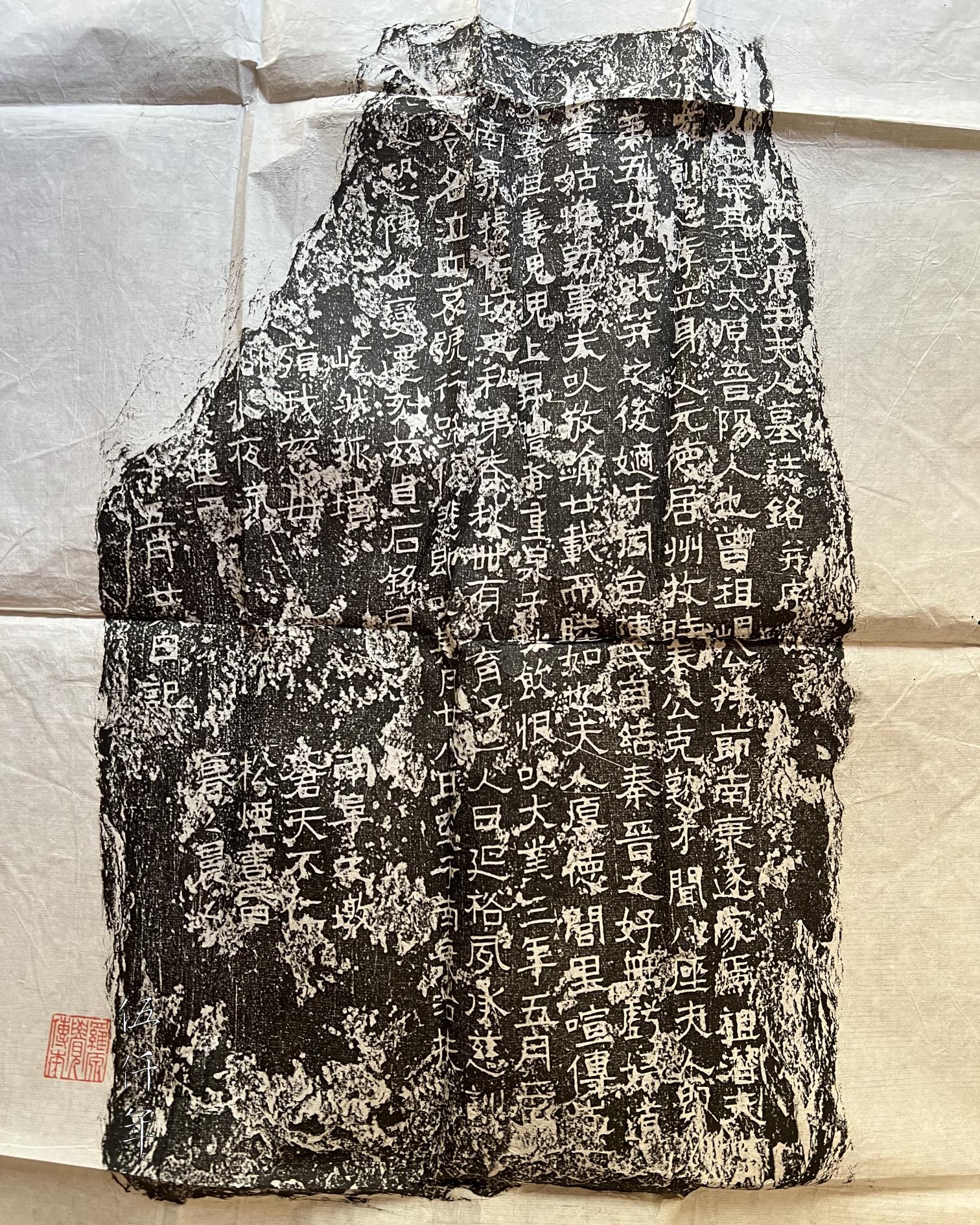
Ink rubbing of Epitaph of Madame Wang from T’ai-yüan Stele (故太原王夫人墓誌銘并序), made by Lo Yüan-chüeh (羅原覺 1891-1965)
Catalogue of Ink Rubbings in the Collection of T'ang En-p'u
唐天如先生珍藏拓本目錄
1、The First Set
1)「黃晦聞墓志銘」墨拓本。
2)「魏熒陽鄭文公之碑」墨拓本。
3)「北宋元豐二年河南清孫悼子刻佛像銘」墨拓本。
4)「道興造像記」墨拓本。
5)「荔子碑」墨拓本
6)「唐尚書省郎官石柱題名」墨拓本。
7)「湘潭周君墓誌銘」墨拓本。
8)「唐棲先塋記」墨拓本。
9)「宋天聖四年保平軍節度使魏咸信神道碑」墨拓本。
10)「唐懷素藏真帖律公帖」墨拓本。
11)「唐洛州司户高崇業等造像銘」墨拓本。
12)「太原段帖金光明經」墨拓本。
13)「唐龍朔三年常才合家敬造佛造像並銘」墨拓本。
14)「金沙洞銘」墨拓本,姚萬達書並跋。
15)「清故資政大夫補用道江蘇丹陽縣知縣劉公墓誌銘」墨拓本,王步瀛撰文,崔斯哲書丹。
16)「大隋故太僕卿夫人姬氏之誌」墨拓印本。
17)「吳九真太守谷朗府君之碑」墨拓本。
18)「清故暨配吏部胡夫侍郎之墓蓋」墨拓本。
19)「唐蘇靈芝易州鐵像碑頌」墨拓本。
20)「唐女道士銘誌」墨拓本,崔斯哲題贈。
21)「究竟莊嚴安樂淨土成佛(闕)記」墨拓本。
22)「湘潭周公印泉墓誌銘」墨拓本。
23)「唐(闕)寺尼(闕)和禪師(闕)修石龕銘」墨拓本。
24)「唐魏國夫人墓誌銘」墨拓本。
25)「唐魏國夫人墓誌銘」墨拓本。
26)「秋園記」墨拓本,鐵城楊玉銜書。
27)「智永書真草千字文碑」墨拓本。
28)「千字文碑」墨拓本。
29)「唐開元盧舍那佛像龕記」墨拓本。
30)「唐都督長沙姚意妻造像記」墨拓本。
31)「周大烈自撰墓誌」墨拓本。
32) 某碑墨拓本,待考。
2、The Second Set
1)「唐開元天寶聖文神武皇帝注孝經台碑」墨拓本。
2)「唐邠公功德碑」墨拓本。
3)「清授奉政大夫候選同知陳府君墓誌銘」墨拓本,唐天如撰,羅復翁(惇暖)書。
4)「唐隆闡師碑」墨拓本。
5)集王羲之「興福寺半截碑」墨拓本。
6)某碑墨拓本,待考。
7)「北宋權知陝州軍府飛騎尉游師雄墓誌銘」墨拓本。
8)「大唐三藏聖教序碑」墨拓本,太宗文皇帝製。
9)「唐內侍省功德碑」墨拓本。
10)「唐懷素聖母帖」墨拓本。
11)「秦嶧山模本」墨拓本。
12)「遵義蹇季常墓志銘」墨拓本,陳敬第撰,陳陶遺書。
13)「傅山太原段帖」墨拓本。
14)「大鄭上柱國鄧國公故太夫義安郡大人元氏墓誌」墨拓本。
15)某碑墨拓本,待考。
16)某碑墨拓本,待考。
17)「心經碑」墨拓本。
18)「褚遂良伊闕佛龕碑」墨拓本。
3、The Third Set
1)某碑墨拓本,待考。
2)「恩平縣儒學記」墨招本。
3)「尉富娘墓誌」墨拓印本。
4)「隋張夫人貴男墓誌」墨拓印本。
5)「蘭亭硯」墨拓本。
6)「唐蘭亭硯」墨拓本,項子京舊藏。
7)「赤壁硯」墨拓本。
8)「長樂公國中尉汝(闕)王國 (闕) 大夫太原王實神道碑銘」墨拓本。
9)某碑墨拓本,待考。
10)「魏故使持節冠軍將軍燕州刺史元使君墓誌銘」墨拓印本。
11)「(上闕) 兼左驍尉大將軍知內侍上柱國虢國 (闕) 像銘」墨拓本。
12)「都邑師道興造石像記并治疾方夫金軀西奄,儀像東流,O相OOOOOO」墨拓本。
13)「西京龍門山大像龕銘」墨拓本。
14)「金剛經碑」墨拓本。
15)某碑墨拓本。
16)「唐大彌等身像一鋪,銀青光祿大夫昭文館學士丘悅贊」墨拓本。
17)「湘潭周大烈暨妻袁明瑞之碑」墨拓本。
18)「明故翰林院檢討白沙陳先生改葬墓碑銘」墨拓本。
19)某碑墨拓本,待考。
20)「皇清誥授奉直大夫晉贈光祿大夫河南鄧州知州朱君墓表」墨拓本,陳三立撰,沈曾植書。
21)「大周潁州許戟字修業夫人故東海徐氏龍門山石龕像碑銘」墨拓本。
22)「清故誥授資政大夫顯祖考書圃太府君之墓」墨拓本。
23)「大隋故朝請大夫夷陵郡太守太僕卿元公之墓誌銘」墨拓印本。
24)某碑墨拓本,待考。
25)「唐國師千福寺多寶塔院故法華楚金禪師碑」墨拓本。
26)「鄭故大將軍舒懿公之墓誌銘」墨拓印本。
27) 張旭書墨拓殘片
28)「唐御史台精舍題名考」墨拓本。
29)「唐草心經」墨拓本。
30)「唐故比丘尼法琬法師碑」墨拓本。
31)「衡嶽碑」墨拓本。
32)「多寶塔碑」墨拓本。
33)「大唐故銀青光祿大夫撿挍禮部尚書,使持節梓州諸軍事兼梓州郟史,御史大夫充劔南東州節度副大使,知節度事管內觀察處置靜戎軍等,使上柱國長樂縣開國公,食邑一千五百戶贈吏部尚書馮公神道碑銘」墨拓本。
34)「洛州河南縣思順坊老幼等造彌勒像記」墨拓本。
35)「唐大智師碑」墨拓本。
36)「大宋新譯三藏聖教序碑」墨拓本。
37)「郭忠恕篆黃帝陰符經」墨拓本。
38)「龍門散碑」墨拓本。
39)「故太原王夫人墓誌銘并序」,羅原覺傳本。
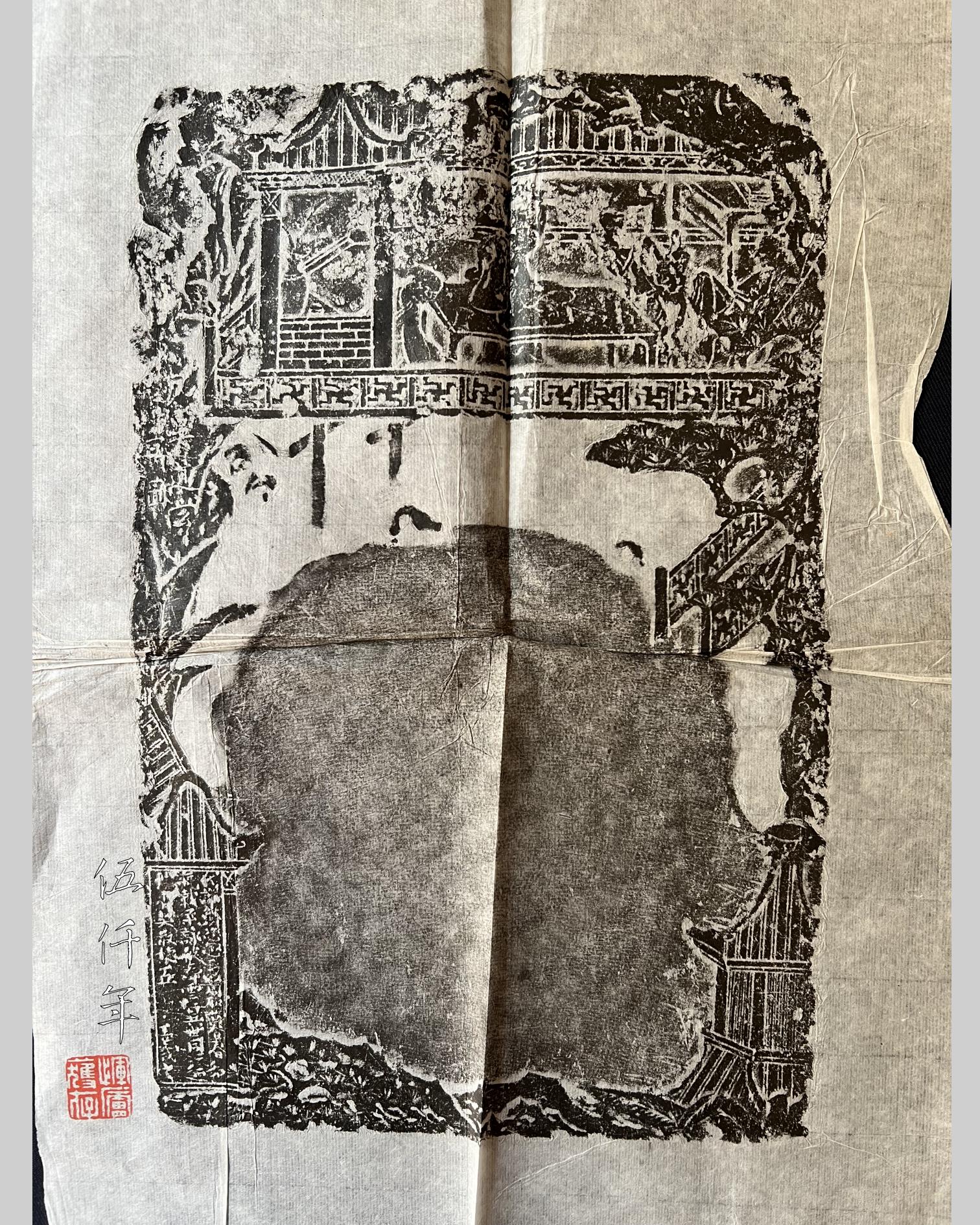
Ink rubbing of front of a T’ang dynasty inkstone carved with the theme of the Orchid Pavilion Gathering
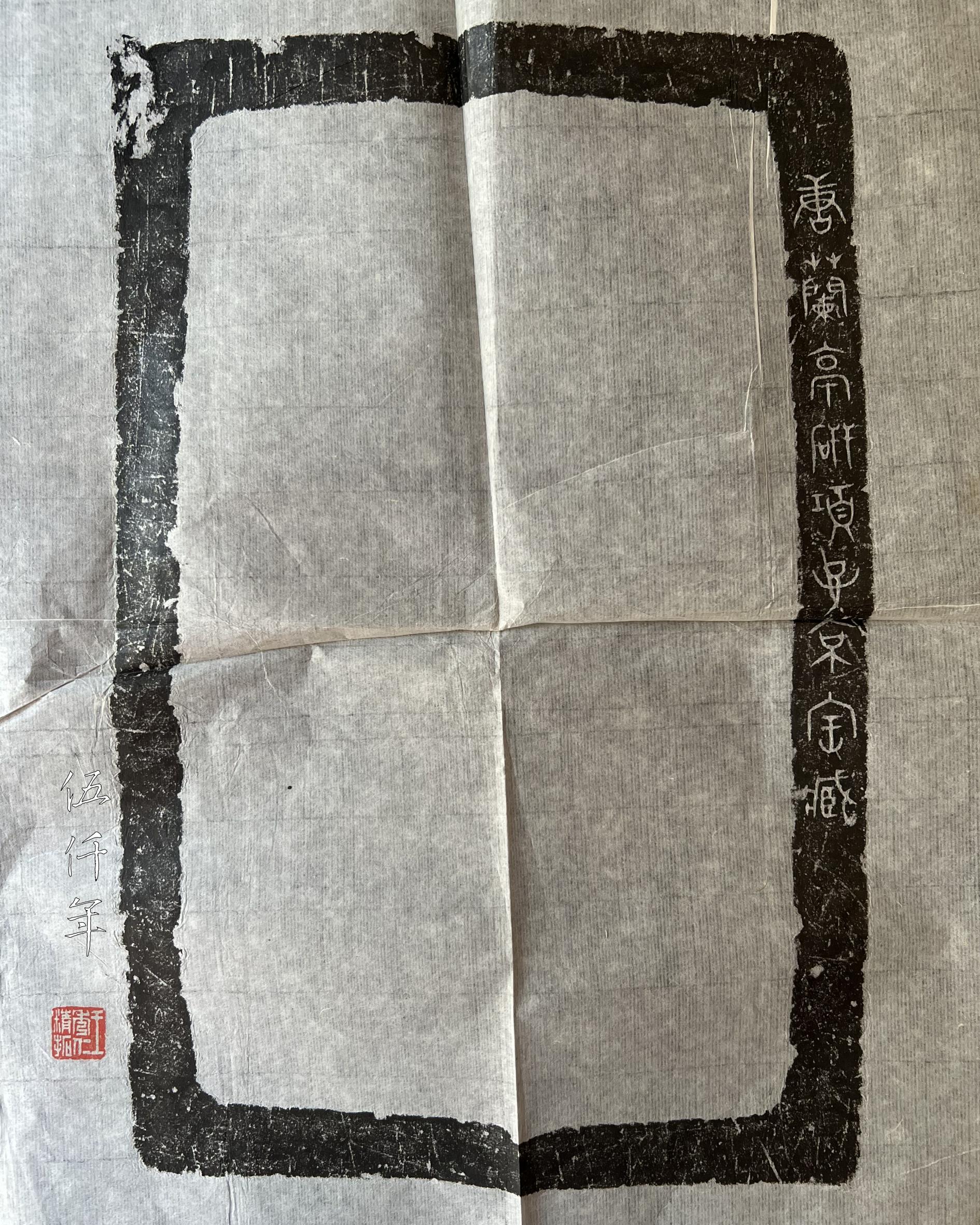
Ink rubbing of back of a T’ang dynasty inkstone carved with the theme of the Orchid Pavilion Gathering