Tsai Yüan-p’ei was a revolutionary, an educator, a statesman, and a scholar of modern and classical studies. In the 18th year of the Kuang-hsü reign, 1893, he passed the metropolitan examination and attained the chin-shih degree (進士). In 1906 he was appointed minister of the Shanghai branch of Chinese T’ung-meng Society, and the following year he went abroad to study in Germany. In the 1st year of the Republic of China (1912) he was appointed minister of education, in 1917 he was appointed president of Peking University, from 1926 onwards he was successively elected member of the 2nd, 3rd and 4th Session of the Central Contol Committeee of the Chinese Nationalist Party. In 1928 he was elected president of Academia Sinica.
Between 1927 and 1928, Tsai was a major figure in the purge of the communists within the Chinese Nationalist Party. Although mainland China publishes many editions of Complete Works, huge amount of Tsai’s writings have been intentionally redacted, making a mockery of the term Complete Works. To cite an example, on 16 October 1927,he delivered a speech at the Nationalist Party headquarters of Shanghai, Nanking and Ning-po Cities, he recalled the purge of the communists, and said:
“After the death of Dr. Sun Yat-sen, the Communist Party secretly organized many cells, and implemented the ideology of communism. They started with the farmers and workers. For workers they organized unions, for farmers, together with petty criminals, they were organized into peasant armies, weapons were given to them and they interfered in government administrations everywhere. By then our comrades in the Chinese Nationalist Party realized the pressing conspiracy of the communists, hence at the meeting in Hsi-shan of Peking, we decided to deal with the communists.”
The historian P’an Hui-lien explored in depth the time T’sai Yüan-p’ei spent in Hong Kong, inducing our recollections and remembrances.
Curatorial and Editorial Department
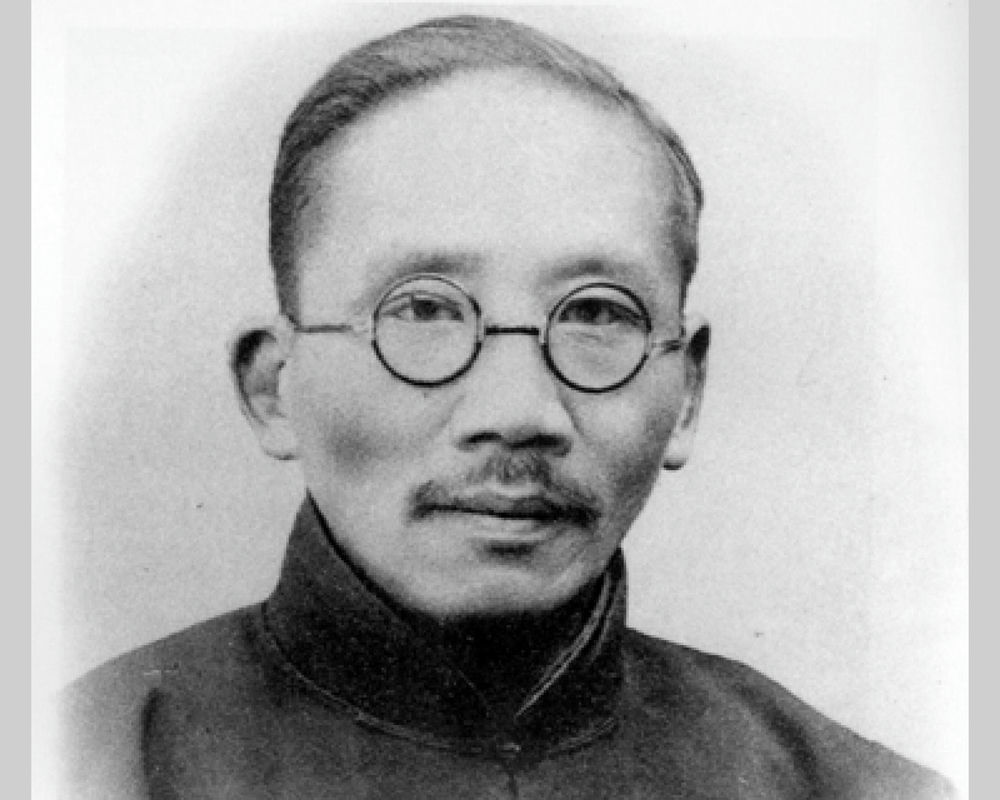
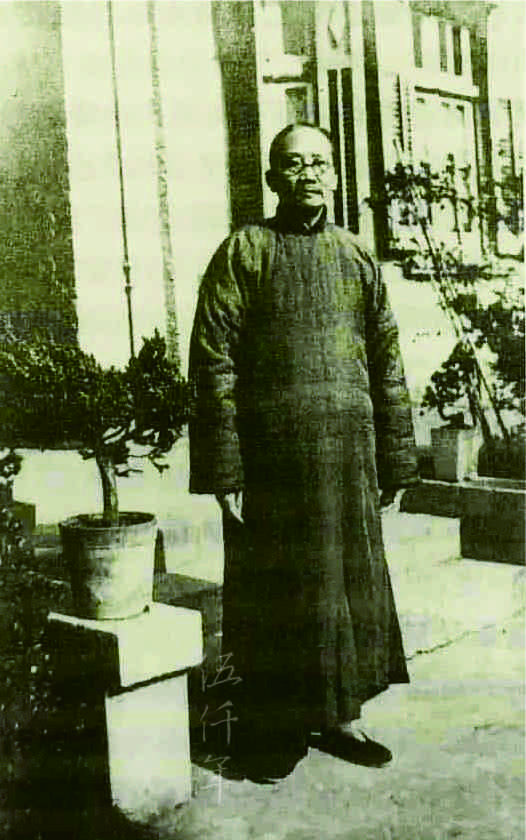
Portrait of T’sai Yüan-p’ei
The year 2025 marks the eighty-fifth death anniversary of Tsai Yüan-p’ei (1868–1940), the renowned modern educator. He spent the final years of his life in Hong Kong and passed away at the Hong Kong Sanatorium & Hospital on 5 March 1940 at the age of 72. While it is widely known that he was buried at the Aberdeen Chinese Permanent Cemetery, it is less often mentioned that he had visited Hong Kong three times. On the final visit, he toured many of the city’s historic sites and scenic spots. Alongside his diary accounts, his classical poems are also infused with his observations and expressed his sentiments over the nation’s ordeal in the War of Resistance Against Japanese Aggression.
Tsai Yüan-p’ei first visited Hong Kong in 1893 after he passed the metropolitan examination that awarded him the chin-shih degree (進士), according to an article titled Tsai Yüan-p’ei Soliciting Benefits in Kwangtung (蔡元培在廣東打秋風) by the late Hong Kong writer Kao Po-yü (高伯雨). The article was published by Ta-hua Magazine (大華雜誌) in Hong Kong in 1968. This anecdote was later incorporated by T’ao Ying-hui (陶英惠), a researcher at the Academia Sinica of the Republic of China, in the Chronological Record of the Life of Tsai Yüan-p’ei (蔡元培年譜), published in 1976. This anecdote was further incorporated by the Peking scholar Kao P’ing-shu (高平叔) in the Extended Chronological Record of the Life of Tsai Yüan-p’ei (蔡元培年譜長編), published in 1998.
Around early August 1893, Tsai Yüan-p’ei traveled by steamer from Shanghai to Hong Kong, and then onward to Kwangtung to visit friends. After his arrival in Hong Kong, he lodged at Yüan-fa Hsing (元發行), located at 10 Wyndham Street in Central of Hong Kong Island, which was operated by Kao Shun-ch’in (高舜琴), father of Kao Po-yü. The establishment was both a trading firm involved in north-south commerce and an inn that often welcomed distinguished visitors to the city. During this visit, Tsai Yüan-p’ei wrote a pair of calligraphy couplets for Kao Shun-ch’in with these words:
Be humble in face of difficulty and observe the entirety,
Be affable to others and give ear to varied opinions.
However, the article by Kao Po-yü makes no mention of the activities of Tsai Yüan-p’ei in Hong Kong during this trip.
On 18 October 1931, Kung Sheung Evening Press (工商晚報) in Hong Kong reported on Tsai Yüan-p’ei visiting the University of Hong Kong.
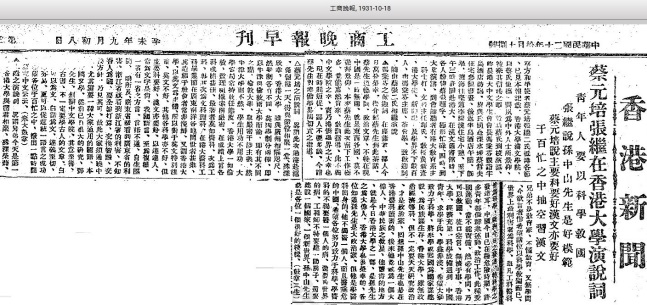
The second visit by Tsai Yüan-p’ei to Hong Kong took place after the Mukden Incident on 18 September 1931, an event conspired by Japan to occupy Chinese territories. At the time, he bore the grave responsibility assigned by the National Government in Nanking to travel south to meet with those political leaders in Kwangtung who were opposed to the leadership of Chiang Kai-shek, and to persuade them to join the War of Resistance Against Japanese Aggression. He sailed from Shanghai to Hong Kong at the end of September, and initially met with Kwangtung leaders such as Wang Ching-wei (汪精衛) and Sun Fo (孫科) at the Peninsula Hotel to discuss their thoughts. Afterwards he travelled to Canton for further negotiations and attained some preliminary results. On 17 October he travelled via Hong Kong to Shanghai, at the invitation of the University of Hong Kong School of Chinese, he visited the campus, met with teachers and students, and delivered a speech urging the students to value Chinese studies and to master the national language. The Chinese newspapers in Hong Kong provided extensive coverages of his southern trip.
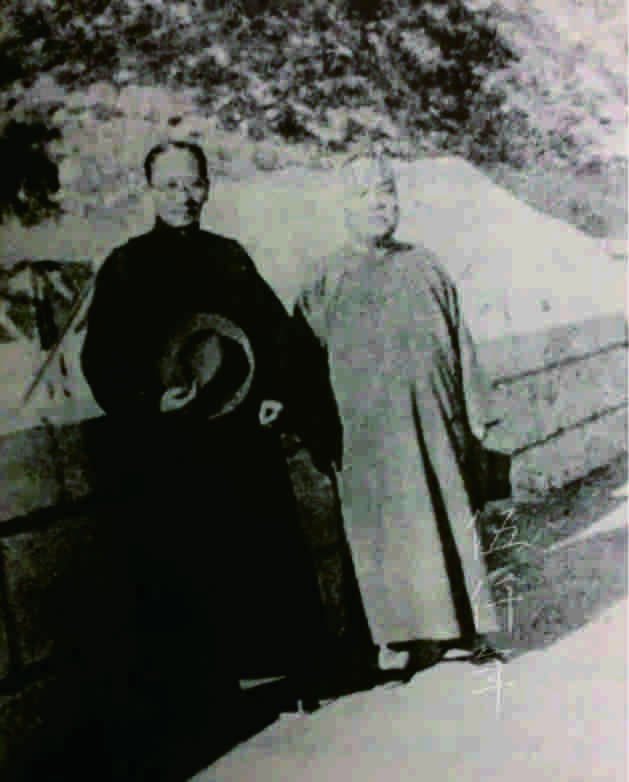
His third and final visit to Hong Kong took place after 29 November 1937, when Shanghai fell to the Japanese. Originally he had planned to travel through Hong Kong to reach the southwestern hinterland of China, but he had to stay in Hong Kong due to illness. This stay lasted more than two years, until his death. At the time, he held multiple official positions, including the president of Academia Sinica. Though he seldom appeared in public, he had a heavy daily workload, attending numerous official matters. He maintained extensive contact with Hong Kong’s cultural and educational communities and actively supported anti-Japanese social initiatives. As a lifelong proponent of the ideal of the “wholesome person”, Tsai Yüan-p’ei was by no means a reclusive person, he cherished family life and would, from time to time, take breaks from his busy schedule to go on excursions with his wife, children, and friends, relaxing both body and mind.
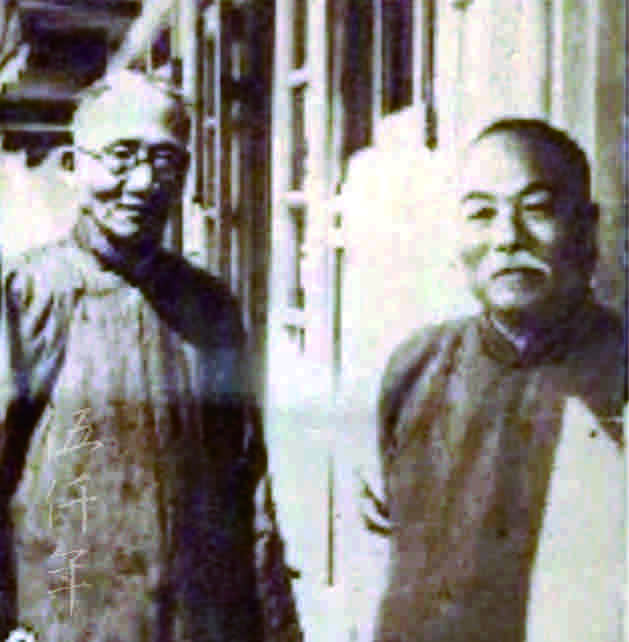
Photograph of Tsai Yüan-p’ei (left) and Wang Yün-wu (王雲五) on an excursion in Hong Kong. The location is not known, but likely to be Shing Mun Reservoir (城門水塘) in Kowloon, that Tsai’s diary recorded on 2 December 1937. Photograph courtesy Tsai Yüan-p’ei Photo Collection (蔡元培影集) published by Shandong Pictorial Publishing House (山東畫報) in May 2001.
On the evening of his arrival in Hong Kong, he checked into Luk Hoi Tong Hotel (陸海通旅館) by the waterfront in Central. The panorama of Victoria Harbour so inspired him that he composed a poem:
Cantonese to be mastered
In this small courtly room,
Calligraphy and paintings aplenty
Hang over four walls.
My favourite northern gallery
Overlooks the river flow,
Distant mountains form an arch
Like a paneled screen.
This poem was selected from the 1995 edition of The Collected Works of Tsai Yüan-p’ei Volume Fourteen (蔡元培文集), published by Chin-hsiu Publishers (錦繡出版社) in Taiwan. However, in the 2010 edition of The Diary of Tsai Yüan-p’ei (蔡元培日記) published by Peking University Press, the word fu (頫) meaning “overlooks” was replaced by a similar word fu (俯) in the third line of the poem. The author checked this with Tsai Lei-ke (蔡磊砢), granddaughter of Tsai Yüan-p’ei. Tsai Lei-ke, (蔡磊砢) who is president of the Tsai Yüan-p’ei Research Association at Peking University, confirmed that the word fu (頫) was the original character in the diary entry.
Reading The Diary of Tsai Yüan-p’ei, we are made aware that Tsai visited the following places in Hong Kong, and his diary entries are inserted in the parentheses:
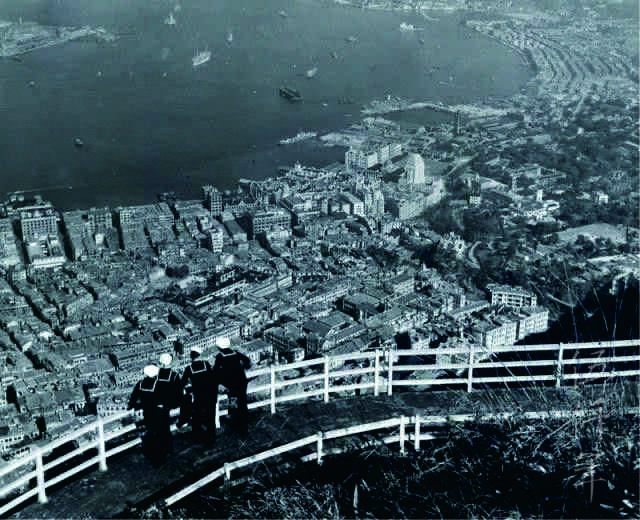
1) Victoria Peak (太平山). Tsai Yüan-p’ei strolled along a section of Lugard Road (盧吉道).
(Enjoyed the wide unobstructed view; the residences along the road are elegant and surrounded by abundant greenery).
Tourists on Lugard Road at the Peak in Hong Kong, circa 1940’s
2) Bing Tau Garden (兵頭花園). The current site of the Hong Kong Zoological and Botanical Gardens.
3) The area of Lai Chi Kok inlet where swimming, rowing and fishing took place before land reclamation (荔枝角泳棚).
(First went to Li-chia Ko 李家閣, accessible by public buses. In summer, water around the swimming area is blue and pretty. It is adjacent to the Mei Foo Kerosene Company.)
4) Kowloon Tong area (九龍塘).
(Most of the houses are villas. Visited Kowloon City again, saw the city gate and battlements. As the road was difficult, did not climb up. Heard there is a stone stele known by the locals as Sung Wang T’ai 宋王台).
Tsai Lei-ke, responding to the author’s inquiry, confirmed that the original diary entry was (宋王臺) and not (宋王台).
5) Hou Wong Temple in Kowloon City (九龍城侯王廟). Tsai Yüan-p’ei, his wife, and three children visited the site on 31 January 1938, the first day of the lunar new year.
(The Temple was too crowded, did not enter; saw people streaming continuously into Kowloon City.)
6) University of Hong Kong. Received and shown around by Chancellor Sloss.
7) Tsing Shan Bay (青山灣).
(Along the mountain road, pine forest covers the left side, while musa leaf huts dot the shoreline, creating a beautiful landscape. Passing Tsuen Wan, the residential area becomes dense.)
8) Fung Shan Christian Mission (沙田道風山基督教叢林) on Shatin Road. Tsai Yüan-p’ei was received by Pastor Notto Normann Thelle (田蓮德) and had a meal with the teachers and students there.
9) Tao Lu (沙田道道廬) on Shatin Road.
(Surrounded on three sides by mountains, with vast open fields stretching into the distance; the scenery was commendable.)
In the middle of his return journey through Kowloon.
(Saw many people looking at monkeys next to the woods, feeding them either peanuts or bananas; the monkeys jumped and chattered happily, we also got off the vehicle to watch.)
10) Gascoigne Road Pier (加士居道碼頭).
(Several road workers were swimming, and a number of small boats were moored. At dusk, went for a walk from Chatham Road to Tsim Sha Tsui, then took a bus back.)
11) Reservoir (水塘). This probably refers to Shing Mun Reservoir (城門水塘) in Tsuen Wan (荃灣), Kowloon.
(Also known as the Kowloon Drinking Water Storage, the construction is quite sturdy. It started in 1933 and ended in 1937. There is a tungsten quarry nearby.)
On another occasion, Tsai Yüan-p’ei visited the woods to watch monkeys.
Facade of No. 156 Austin Road in Tsim Sha Tsui (indicated by red arrow), residence of Tsai Yüan-p’ei. Eastward view from Austin Road showing intersection with Austin Avenue, 1954
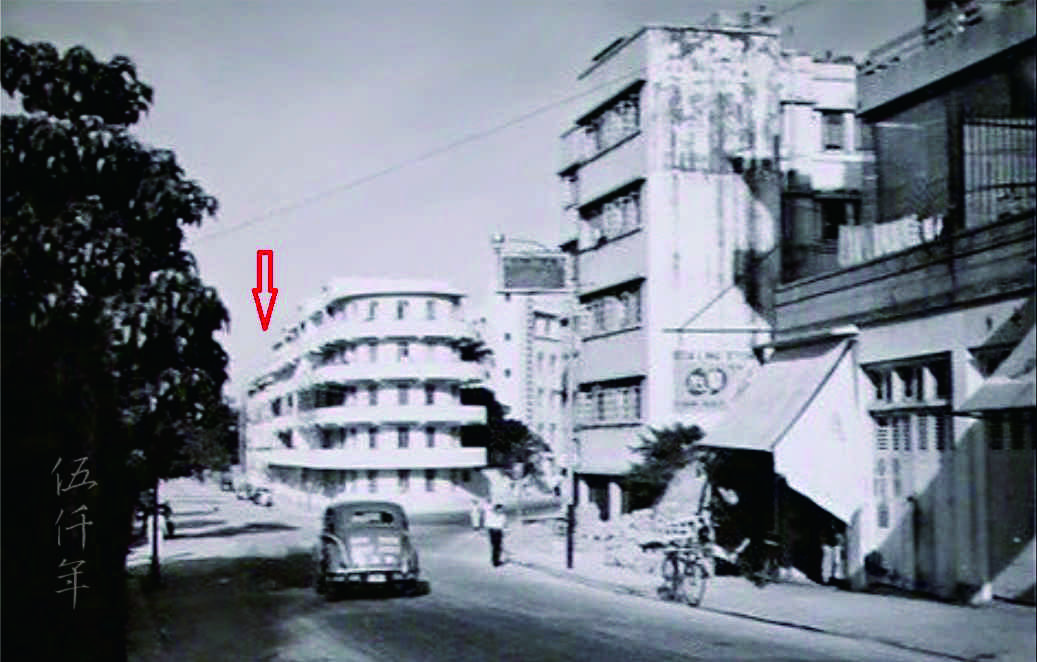
12) King’s Park (王囿). In 1902, the Hong Kong government laid out a vast stretch of forested hills starting from the north of present-day Austin Road (柯士甸道) in Tsim Sha Tsui to Waterloo Road (窩打老道) in Mong Kok (旺角). This public park was named King’s Park, and there was no official Chinese name back then. The purpose of the park was to commemorate the accession of King Edward VII the year before. Prior to the Second World War, Chinese newspapers translated the Chinese name of the park as wang-yu (王囿) or huang-yu (皇囿); the character yu (囿) is solely used to describe imperial gardens. After the Second World War, Chinese translations of English names are mostly phonetic renderings, King’s Park was translated as Ching-shih-pai (京士柏). At the end of January 1938, Tsai Yüan-p’ei and his family moved into a unit in a building on 156 Austin Road, called King’s Park Building, located right in front of King’s Park. In The Diary of Tsai Yüan-p’ei published by Peking University in 2010, the Chinese name of King’s Park was erroneously rendered as wang-kuo (王國, see 3 January 1938 entry). Since wang-kuo (王國) carries a different meaning in English, it prompted the author to consult Tsai Lei-ke who confirmed that the original diary entry used the traditional characters wang-yüan (王園) and also recorded the English name of King’s Park. The Complete Works of Tsai Yüan-p’ei (蔡元培全集) published by Zhejiang Education Publishing House (浙江教育出版社) in November 1998 rectified this error and also added the English name.
View of Chatham Road in Tsim Sha Tsui, circa 1930’s
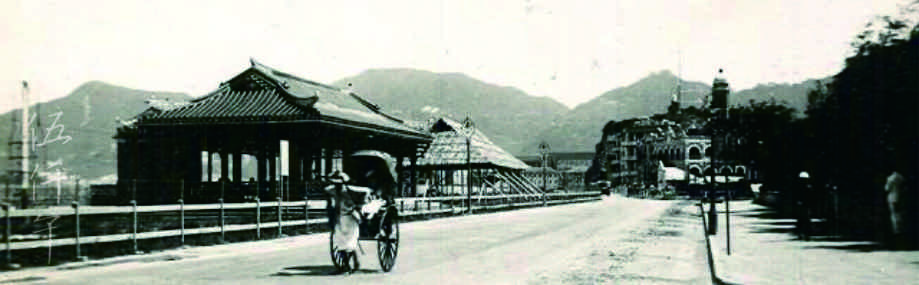
Tsai Yüan-p’ei also enjoyed walking. On clear days or after dinner, he often strolled with his wife and children along nearby Chatham Road and the roadside children’s playground. In those days, Chatham Road area was sparsely inhabited, with broad lawns beside the Kowloon–Canton Railway, quite unlike the bustling scene it has become today. His diary frequently describes these walks, stopping by Yu-chi Garden to admire hibiscus, going to Chin-chi Garden to buy chrysanthemums, purchasing two pots of red bean tree at Tse-chi Garden, and wandering through the nurseries along Observatory Road. It is easy to imagine that Chatham Road at that time was crowded with gardens and florists.
View of Repulse Bay in Hong Kong, circa 1930’s
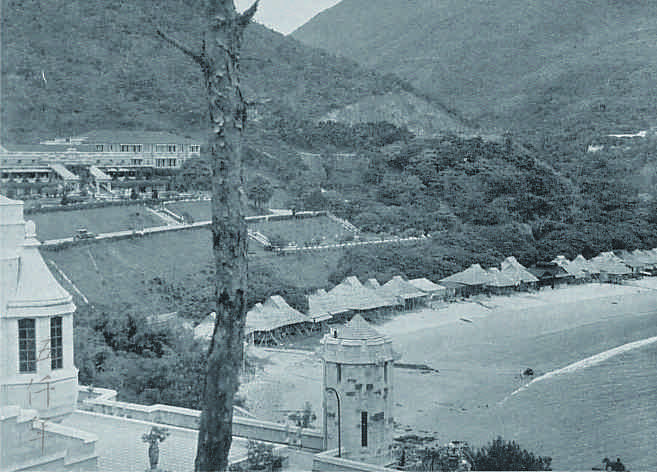
Of all the places Tsai Yüan-p’ei visited, Repulse Bay (淺水灣) was where he frequented most, six times in total. He usually went with friends by car, sometimes making side trips to Aberdeen (香港仔) and Stanley (赤柱) to enjoy seafood. On 7 January 1938, the ninth day after his wife and three young children arrived from Shanghai to reunite with him, Tsai went to Repulse Bay with his family. In his diary, he wrote: “The scenery is lovely. We took a taxi there, which cost 2 dollars and 6 cents; we took the bus back, fares were 25 cents per adult and 15 cents per child.”
View of Eu Tong Sen Villa in Repulse Bay Hong Kong, circa 1930’s
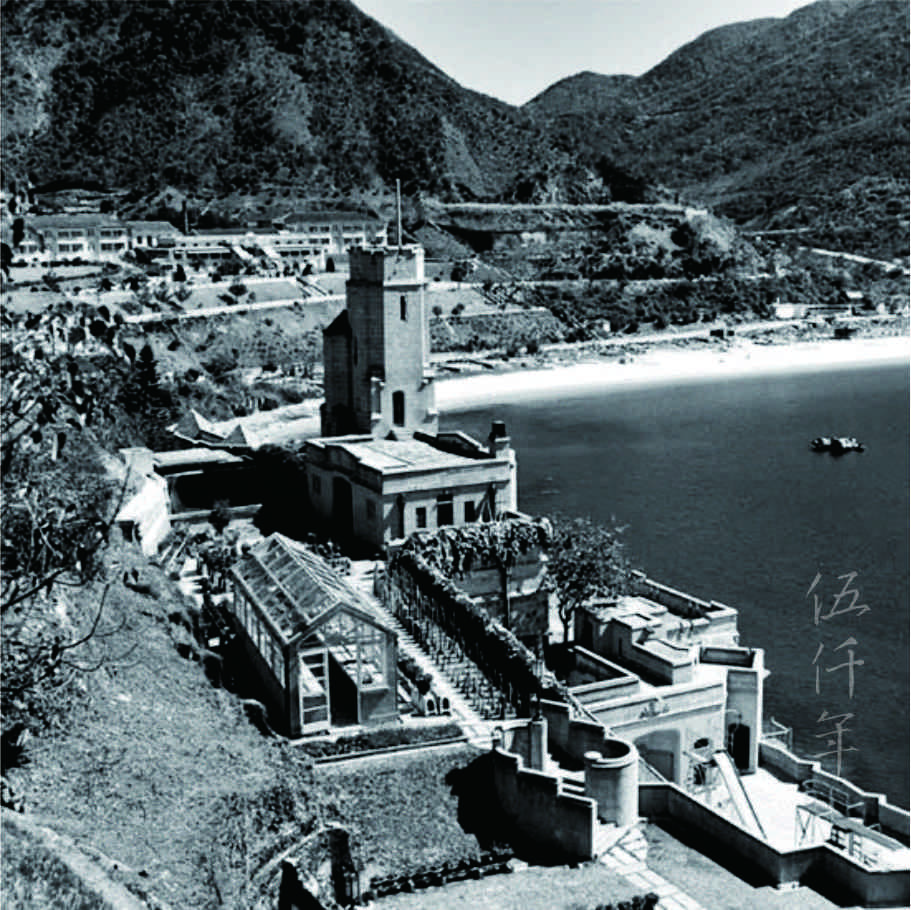
The Diary of Tsai Yüan-p’ei not only reveals the details of his life, but also offers a glimpse of Hong Kong’s social outlook and the landscapes that captivated writers and scholars before the Japanese occupation. Many of the places he described have long disappeared, only by examining pre-war records can their locations be established and their appearances ascertained.
Although Tsai Yüan-p’ei found temporary refuge in Hong Kong, he did not ever overlook the war-time suffering endured by his compatriots. After spending his first Lunar New Year in Hong Kong and one day before the Lantern Festival, on 13 February 1938, he recalled a poem composed by a relative while taking an evening stroll. He was inspired to write three classical poems in response, adding parenthetical notes to each. In these poems, he expressed his longing for his homeland and his hope that the nation would soon achieve victory, sparing her people from further suffering. The poems read :
A dweller in a foreign city that follows
Chinese Agricultural Calendar too,
(All Hong Kong newspapers use both Gregorian
and Lunar Calendars, some refer the latter as
Chinese Agricultural Calendar).
Passing the night prior to New Year Eve,
In a wild avalanche of firecrackers.
Long has it been known that Aberdeen
Is home to many fine seafood places.
(Aberdeen has several well-known restaurants
specializing in fish and seafood.)
Will fate take me back here soon again?
To taste the delicacy of unusual catch.
Affairs change and heart moves on,
History cycles back to Dawn.
Old slogan of Reclaim Our Land,
Will it bear fruition this year?
Stroll over eastern wall one fine night,
Moon will tell her glow is same afar.
Island sky swiftly cleared of cloud,
Car lights flash and neons deep red.
So much loyal blood spilled in the fields,
Only eerie cries talk to rain and wind.
Homes are there but can’t return,
Obituaries shared with birds east to west.
Tsai Yüan-p’ei wrote many poems during his time in Hong Kong, which were recorded in his diary and collected works. They can now be enjoyed and studied. The Hong Kong scholar Sun Kuang-hai (孫廣海) had estimated that Tsai wrote as many as forty poems in Hong Kong.
View of Tai Wan Beach in Hung Hom, 1935
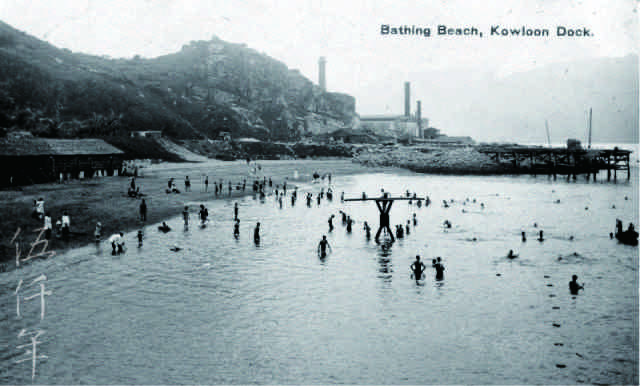
Tsai Yüan-p’ei seemed to be especially fond of seaside scenery. Just over two months before his death, he learned from friends that near his residence on Austin Road there was Tai Wan Bathing Beach (author’s note: Tai Wan Bathing Beach was also known as Tai Wan Swimming Beach, but no longer exists. The area corresponds to the coastal section of present-day Tai Wan Shan Park and the swimming pool in Hung Hom). It could be reached by car from Chatham Road, alighting at Wuhu Street (蕪湖街) and continuing on foot. Remarkably, during the course of two winter months, Tsai visited the site twice, once with friends and once with his family. In his diary, he so described the place: “the landscape is similar to Repulse Bay, yet completely free of any bustling amenities.” His last excursion was to Tai Wan Bathing Beach on 25 February 1940. Three days later, illness forced him to stop writing diary, and he passed away within a week.
Tsai Yüan-p’ei, a pioneering educator who championed “freedom of thought and inclusiveness”, was buried in Hong Kong. Perhaps it had to do with his fondness of the sea, a symbol of liberty and tolerance. His grave in Aberdeen is located near the waterfront, where the sound of waves can be heard. He can now rest in peace, as long as the malicious acts of desecration of his grave in 2019 by communist sympathizer does not recur.
Portrait of Tsai Yüan-p’ei outside his residence in Kowloon, 1938
Postscript:
In the course of writing this article, the author scrutinized separate publications of The Diary of Tsai Yüan-p’ei by three different publishers. After examining the entries for the final two years and more of his life in Hong Kong, some of the observations reached may be of interest to our readers.
The three publications mentioned here are listed according to their publishing dates:
- The Collected Works of Tsai Yüan-p’ei in Fourteen Volumes (蔡元培文集) was edited by Kao P’ing-shu (高平叔), while other editorial committee members included Tao Ying-hui (陶英惠) and members of the Tsai Yüan-p’ei Research Association at Peking University. It was published by Chin-hsiu Publishers in Taiwan in May 1995. The Hong Kong diary appears in Volume 14. This is the first ever publication of his China and Hong Kong diaries. It is referred here as the “Taiwan publication”.
- The Complete Works of Tsai Yüan-p’ei in Eighteen Volumes (蔡元培全集) was edited by the Tsai Yüan-p’ei Research Association of China. It was published by Zhejiang Education Press between 1996 and 1998. The Hong Kong diary appears in Volume 17. (Author’s note: The Tsai Yüan-p’ei Research Association of China is another name for the Tsai Yüan-p’ei Research Association at Peking University, established in 1986.) It is referred here as the “Zhejiang publication”.
- The Diary of Tsai Yüan-p’ei in Two Volumes (蔡元培日記) was edited by Wang Shih-ju (王世儒) and published by Peking University Press in September 2010. The Hong Kong diary appears in the second volume. It is referred here as the “Peking University publication”.
The author initially assumed that the The Diary of Tsai Yüan-p’ei published last, which is the “Peking University publication”, would be the most complete and contain the least errors. Surprisingly, many entries and English names are missing, and there are no annotations, making it less meticulous than the annotated “Zhejiang publication”. Likewise, the “Taiwan publication” of The Collected Works of Tsai Yüan-p’ei also omits many passages, such as the entries on 12 December 1937, 17 December 1937, 3 January 1938, and 13 March 1938. The reason for the omissions is unclear.
After speaking with Tsai Lei-ke, granddaughter of Tsai Yüan-p’ei and president of the Tsai Yüan-p’ei Research Association at Peking University, the author learned that there is an even more recent publication of The Complete Works of Tsai Yüan-p’ei in Twenty Eight Volumes, compiled by the Editorial Committee of Peking University, and published in April 2025 by the Commercial Press (商務印書館) in Peking. The last comprehensive publication before this should be the “Zhejiang publication”, published between 1996 to 1998. Since Tsai Lei-ke did not take part in the editing of the earlier “Taiwan publication” nor the “Peking University publication”, she does not know why the diaries have the above mentioned defects. Several scholars who had been involved in the earlier editorial work, including Kao Ping-shu, Wang Shih-ju, and Tao Ying-hui, have since passed away, so it is impossible to consult them. The latest publication of The Complete Works of Tsai Yüan-p’ei is not yet offered for sale in Hong Kong, so the author has not had the opportunity to read it.
After examining the diary entries in the “Zhejiang publication”, the author made the following findings, presented here for the consideration of the Tsai Yüan-p’ei Research Association and the wider community:
1) 12 December 1937. The location name should be “Kowloon Tong” (九龍塘), not “Kowloon Tang” (九龍堂).
2) 3 January 1938. Visited wang-yüan (王园) or King’s Park in Kowloon (King’s Park, Chin-p’u-li Road金溥利道). Chin-p’u-li Road (金溥利道) should be Kimberley Road (金巴利道), next to King’s Park Building where Tsai Yüan-p’ei lived.
3) 4 January 1938. There are two blanks after the surname Mr. Shen (沈君OO). The two blanks should be the characters Chung-chang (仲章). The full name is Shen Chung-chang (沈仲章), who appeared in the diary entry of 8 February 1938. He visited Tsai at his residence on that day, and he was a Peking University graduate. He visited Tsai again on 29 January 1940. Annotation 14.
4) 7 January 1938. The Chinese character “秬” inside the bracket (6赤秬) should be “柱” instead, which is (6赤柱). The place Stanley is called “赤柱” in Chinese. It is a seaside fishing village in the southern part of Hong Kong Island. At that time, bus No. 6 connected the city and Stanley, and was the standard public transportation for all visitors.
5) 31 January 1938. In the third paragraph, the four Chinese characters “嘉樹邊道” should be “嘉林邊道”, the Chinese name of Grampian Road in Kowloon City. Tram Number Six, that is “6號電車” should be Bus No. 6, as there was no tram (rail-based) in Kowloon at the time. Bus No. 6 connected Tsim Sha Tsui and Kowloon City via British Prince Road (英王子道), now called Prince Edward Road (太子道).
6) 22 January 1939. In the second paragraph, the English name of “普強製藥公司” should be “The Upjohn Company”, not “Upjoin.”
7) 25 February 1940. The address: Hung Hom, Ngau Chi Wan Vegetable Market, Wuhu Street, Dock Street (紅磡牛池灣菜市蕪湖街船澳街), is questionable. The reference to “Ngau Chi Wan” (牛池灣) needs verification, as Ngau Chi Wan is not in Hung Hom (紅磡) district, but near present-day Wong Tai Sin (黃大仙), quite far from Hung Hom. There is no evidence so far that Hung Hom had a market named Ngau Chi Wan at the time. The Chinese name of Dock Street “船澳街” is written as “船塢街” after the Second World War, it refers to a ship-repair facility.
Photograph of Tsai Yüan-p’ei (left) and Wang Yün-wu (王雲五) outside the terrace of Lishan Restaurant (廬山酒家) in Aberdeen (香港仔), Hong Kong, on 11 February 1940. This is the last photograph taken of Tsai Yüan-p’ei.Photograph courtesy Eastern Pictorial (東方畫刊), issue of March 1940.
Related Contents:
A History of the Tomb of Ts’ai Yüan-p’ei (蔡元培), by P’an Hui-lien